Adult evidence outside the family airlock
Build Long-Distance Adult Trust Without Exposing Family Life
A family-data airlock for single-parent distance dating: protect child identity, routines, home and money while testing adult trust.
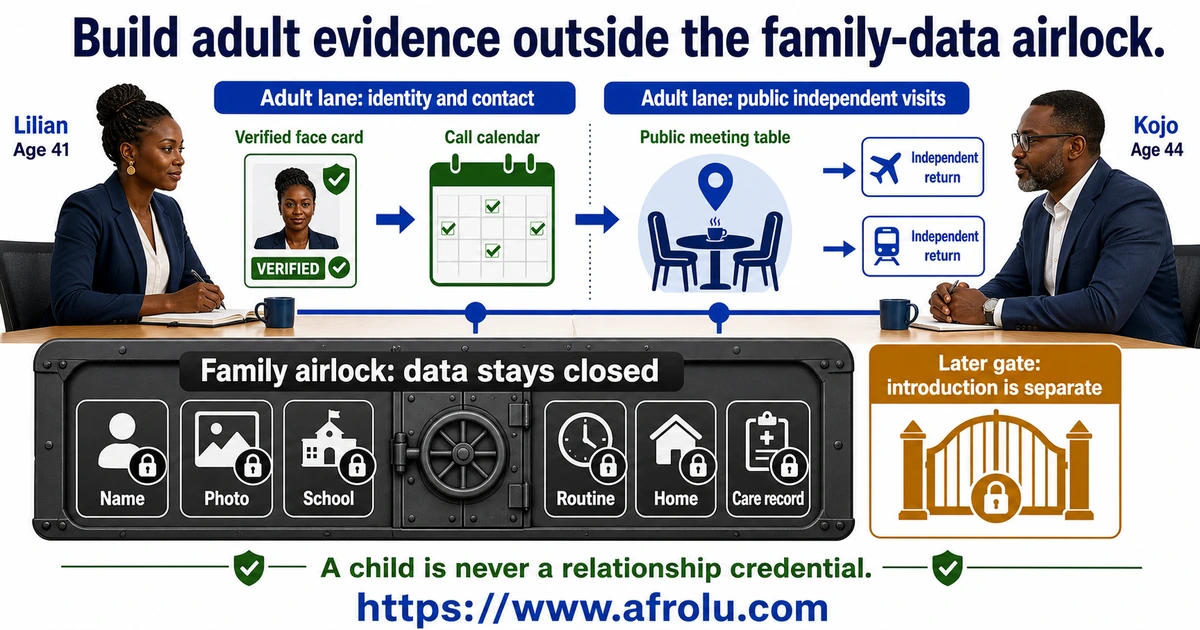
Verify and visit in the adult lane; release no family data merely to prove trust or simplify logistics.
Written and edited by Adwoa Boateng · Dating Safety Editor
Use two lanes. In the adult lane, verify identity in stages, define relationship direction and exclusivity, choose a sustainable contact rhythm, and make public visits independently survivable with separate lodging, transport, documents, money and return. Behind the family-data airlock, keep child names, images, school, routine, health, location, care contacts and home private. A child should never appear on camera or in a photograph as proof that the parent is genuine. Decline early gifts, care payments, home hosting and surprise travel that create family access or leverage. Treat any later introduction as a separate purpose-led decision with information limits, duration and explicit non-roles. Adult trust never automatically creates child access or parenting authority.
Distance and diaspora · Parents Returning To Dating
Can adult identity, contact, reciprocity and visits become credible while child data, home access, family money and any later role remain behind a separate airlock?
Single-parent long-distance dating is an adult romantic connection operating across geography while one adult also holds family responsibilities. The relationship lane and family-data lane contain different people, purposes and consequences. The airlock model permits adult verification, contact and independent visits to develop while child identity, household location, care systems, money and family authority remain closed. Any later introduction or role requires a new decision; it is not a stage automatically earned by serious intent.
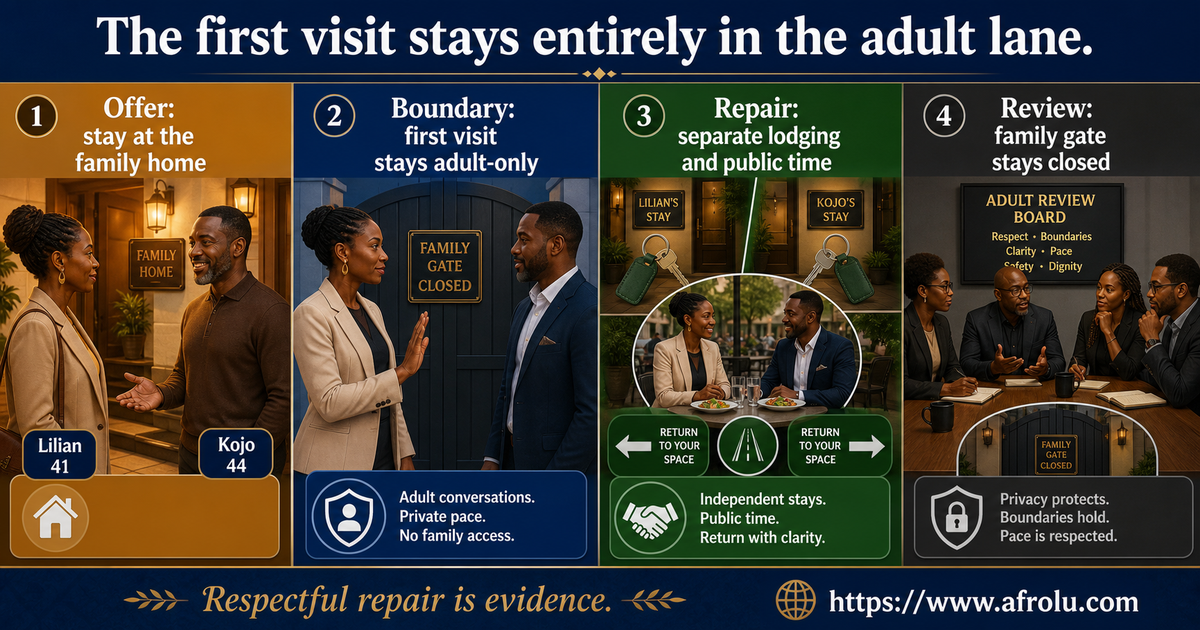
Lilian and Kojo are fictional adults. Lilian is 41, a single parent in Accra; Kojo is 44 and lives in Nairobi. They agree that their adult connection is serious and exclusive. When Kojo proposes a first visit, he assumes staying at Lilian's home would save money and prove trust. Lilian keeps the visit in the adult lane: public meetings, independent lodging, controlled travel and no child or home disclosure. Kojo accepts after initial disappointment and makes a complete revised plan. The visit provides evidence about repair, cost and compatibility while the family airlock stays closed. Their next review concerns the adult relationship, not a timetable for introduction.
The family-data airlock
Keep adult relationship evidence and family access on different tracks
Distance can invite excessive proof. Adwoa directs every verification request back to the dating adults.
The airlock permits adult identity, contact and visits while child data, household access and family authority remain separately gated.
Identity and direction
Verify the dating adult and define the present relationship without involving a child.
Contact and visits
Use adult availability, public meetings, independent lodging and controlled return.
Family data and home
Keep names, images, school, routine, location, care and residence behind the airlock.
Introduction without role
Use a separate purpose-led decision that creates no parent, care or household authority.
A two-lane safety system
Grow the adult relationship while the family-data airlock stays closed
Long-distance dating for a single parent creates two very different information lanes. The adult relationship lane contains identity, intention, contact, exclusivity, consent, visits, money and repair. Those questions belong to the dating adults. The family lane contains a child's name, image, age, school, routine, health, location, care arrangements, other caregivers and home access. The second lane deserves a separate airlock because its information belongs to more than the dating parent.
Build evidence in the adult lane first. Use consistent live conversation, independently checked context and complete public visit plans. Define whether the connection is casual, serious, exclusive or still exploratory. Agree on contact and what happens when work or care disrupts it. A parent can describe adult availability without explaining where a child is, who provides care or which route the household follows. Distance does not create a legitimate need for that data.
The airlock protects both privacy and relationship accuracy. A match who sees a child on video, receives family photographs or knows a school has not learned whether the adult relationship is compatible. Early family access may instead create emotional pressure, location exposure or a false sense of role. Keep adult calls adult-only where reasonably possible, review backgrounds and visits proportionately, and never use a child's presence as proof that the parent is real, honest or serious.
Any later introduction is a separate decision with a purpose, setting, information limit, duration and explicit non-role. It does not make the date a parent, caregiver, disciplinarian, driver, resident, financial supporter or emergency contact. Some adult relationships may never need family integration. That can be honest. The safety objective is not to move everyone through the airlock; it is to prevent adult romantic momentum from silently granting family information or authority.
A first visit without family access
Lilian and Kojo redesign a home-hosting assumption into an adult-only visit
Lilian is 41, a single parent and laboratory coordinator in Accra. Kojo is 44, an architect based in Nairobi. They meet online, speak live over several months and say they are exploring a serious exclusive relationship. Kojo offers to visit Accra and assumes staying at Lilian's home will save money and show that the relationship is genuine. Lilian realises that the visit plan has crossed from the adult lane into home and family access without a separate answer.
She says the first visit will contain public adult meetings only. She will not host, disclose the home's location, identify care arrangements or introduce a child. Kojo initially feels that a hotel makes him look untrusted. Lilian distinguishes the decisions: she is willing to meet and unwilling to open the household. If that structure does not fit him, they should not force the visit. She gives no private proof to make the boundary more persuasive.
Kojo returns with a revised plan: independently booked lodging, his own transport and return, two daytime public meetings and one optional activity. Lilian checks the places herself and shares only the adult times she can attend. During the visit they notice how each handles delay, cost, physical boundaries and an awkward disagreement. Kojo repairs after arriving late by naming the problem and offering a specific shorter alternative.
After the visit, the family airlock remains closed. Lilian and Kojo review adult evidence for six weeks before considering another reciprocal visit. They discuss what a later introduction would and would not mean, but set no date. Kojo's willingness to revise the plan is useful evidence; it is not a lifetime certificate. Lilian's boundary protected the household and made the adult relationship easier to assess on its own merits.
Proportionate adult verification
Reduce distance uncertainty without exposing a child, home or care system
Start with consistent adult facts. Use live conversation, cross-check public context through sources you find yourself and notice whether important details remain coherent over time. Ask relationship-status and intention questions directly. Do not ask a child to appear on camera, confirm the parent's story or form a bond. A family photograph and school detail cannot verify romantic availability, and they create privacy consequences for someone outside the agreement.
Protect identity documents, employer systems, financial records, legal papers and exact residence. A traveller may need selected information for a genuine booking or emergency plan, but the dating partner does not need an archive. Avoid passwords, one-time codes and continuous location. If a claim about a workplace, institution or travel process matters, locate the organisation independently rather than using contact details supplied inside the romantic story.
Money requests are not verification. Romance scammers may build trust and then use travel, health, family, customs, business or emergency stories. Do not send cash, gift cards, cryptocurrency, codes or account access to an online love interest. A parent's empathy or desire to help does not make the claim true. If suspected deception caused a payment, contact the financial provider promptly, preserve useful evidence and use relevant reporting support without shame.
Keep trusted adult perspective available. Share the basic visit plan with an appropriate person and arrange a check-in when useful. This does not require distributing the match's private history or inviting a family vote on the romance. If the match insists on secrecy, threatens exposure, tracks, contacts the household indirectly or arrives unexpectedly, reduce access and use suitable platform, venue, legal, safeguarding or emergency support.
Evidence in the correct lane
Judge adult reciprocity and repair without using family access as progress
Useful adult evidence includes a sustainable contact rhythm, direct relationship answers, reciprocal planning, independent visits, accurate notice and specific repair. Both adults can retain friends, work, rest and care duties without being continuously monitored. The distant match responds to the parent's limited availability as information, not as competition with a child. No adult is entitled to the reasons behind every unavailable period.
Family privacy receives respect in behaviour. The match stops asking for names, images, school, location, routines, health or other caregivers after the boundary is stated. They do not search social profiles for the child, send gifts through the parent to create a bond or approach relatives. Helpful intent does not excuse bypassing the airlock. Repeated bargaining is access pressure even when phrased as care or future-family interest.
Watch household money and role pressure. A new match may offer to pay care, school, health or family costs and then expect contact, home access or authority. Another may request money for their own family emergency. Keep finances separate and choose visits both adults can afford without harming essentials. A gift or transfer never purchases information, consent, an introduction, a parenting role or another date.
Immediate concerns deserve a direct response. Threats, stalking, surprise home or school contact, sexual coercion, blocked travel, document control or financial deception move beyond ordinary compatibility. Create distance when possible and seek appropriate local support. Do not ask a child to carry warnings, messages or evidence. Adult safety planning should remain with adults and qualified services suited to the facts.

Watch adult consistency, reciprocity and respected boundaries while family identity, location and resources stay protected.
Adult-only language
Use scripts for availability, privacy, visits, money and the later gate
For contact, give adult availability and the repair rule. You might offer two calls a week and a short update before a planned call fails. You do not need to disclose who is home, where anyone goes or which care arrangement makes the time possible. A distant partner can assess whether the rhythm fits from the offer itself. If they require constant access or private scheduling proof, the structures are incompatible.
For privacy, list categories rather than debating each question: names, images, schools, routines, health, location, home and other caregivers stay private. The boundary is not a claim that the match intends harm. It recognises that a child is not a party to the dating agreement. If information was already shared, reduce future access and review where it remains rather than assuming the privacy decision is permanently lost.
For visits, require public adult meetings, independent lodging, controlled transport and return. Hosting, pickups at home and surprise extensions are separate choices. If the plan changes, assess the new version before moving. A visitor's travel effort does not buy family time or intimacy, and the parent does not owe a larger visit because care arrangements were made.
For any later introduction, name the limited purpose, setting, duration, information boundary and non-role. The adult date does not become a parent, caregiver, disciplinarian, driver, emergency contact or resident. Either adult may decide the relationship cannot proceed under the available timeline. Do not accelerate the gate to avoid losing the relationship; compatibility includes whether both adults can respect the family's protective structure.

State the available adult offer and keep every family boundary valid without private proof.
An adult-lane audit
Review six ordinary weeks before considering any family integration
Review whether contact fit both ordinary lives. Were calls understood, disruptions named and missed plans repaired? Did either adult demand the child's routine as proof of the parent's availability? Do not count messages or create a file of family movements. The goal is to see whether the adult operating agreement works with the information it legitimately needs.
Review identity and reciprocity. Did basic facts remain consistent? Did both adults sometimes propose, travel or adapt according to real capacity? Were visit costs affordable and independently controlled? A distant relationship can involve an unequal split for valid reasons, but the burden should be discussed rather than hidden under serious language. If only one adult spends, waits and repairs, request one concrete contribution.
Review the airlock. Are child names, images, school, routine, health, location, care contacts and home still protected? Did a no remain intact? Has the match approached family data through public profiles, gifts or other people? If a leak occurred, reduce access and update privacy settings where appropriate. Do not create more disclosure to explain why the earlier disclosure happened.
Choose from adult outcomes: continue the current lane, revise contact or visits, pause or end. A later family introduction should enter a new review with a real purpose and substantially more evidence; it is not the reward for completing six weeks. The parent can want serious partnership and still decide that no integration is currently available. The child should never carry the job of proving that the adult relationship progressed.

Continue, revise or leave from adult conduct; do not open family access to manufacture progress.
Do not merge these gates
Separate adult trust, child information, introduction, home entry and family role
Adult trust is the parent's judgment about the dating adult, built from relationship evidence. It does not transfer automatically to the child or create a right to family data. Child-information access is a disclosure decision governed by purpose, privacy and the child's interests. A parent may trust a date enough for another adult visit while still sharing no child identity or routine. That is coherent rather than secretive.
An introduction is a bounded event, not general access. It needs a reason and a plan appropriate to the household. It may use minimal identifying information and a neutral setting. The meeting does not create private communication, transport authority or permission to photograph and post. A child should not be asked to evaluate the romance, hold secrets or provide emotional reassurance to either adult.
Household access is separate again. Knowing or visiting the home affects location privacy and future access. It should not be bundled into a first visit or introduction. A match may be kind and still not receive a key, overnight stay or unsupervised access. If the relationship ends, remove access that no longer has a purpose and review shared digital information.
A parenting or care role involves authority, responsibility and the child's welfare. It cannot arise from romance, spending, an introduction or the match's willingness to help. Legal and family arrangements vary; this guide gives no custody or safeguarding advice. If integration becomes serious, use qualified local guidance appropriate to the family and preserve the parent's and child's existing protective relationships.
Eight parent-distance decisions that keep family data outside adult dating
Mariam keeps the child off a verification call
Mariam is 38 and her distant match asks to see her child on video to confirm she is really a parent. Mariam declines and continues the adult call only if the request stops. A child is not identity evidence, and appearing on camera would reveal voice, image and home context without a relationship purpose.
Verify the adult through adult evidence and keep the child outside the call.Paul gives availability, not a school route
Paul is 46 and his match asks which school shapes his schedule so she can plan calls. Paul says when he is free and keeps the institution, route and pickup timing private. The relationship needs adult availability, not the source data behind it.
Share the usable adult window and protect the household system that creates it.Lilian keeps the first visit outside family space
Lilian is 41 and declines Kojo's plan to stay at her home. She accepts a revised public visit with independent lodging and return. The extra cost may change feasibility, but convenience does not make family access necessary.
Keep lodging and home entry separate from willingness to meet.Kofi refuses an early package for the child
Kofi is 43 and a match wants to send a gift addressed to his child. He declines and withholds the address. A gift can create identity, location and emotional access; generosity does not create a purpose for the package during early adult dating.
Decline family-directed gifts until a separate, appropriate integration decision exists.Achieng keeps financial help outside the airlock
Achieng is 40 and her match offers to pay care costs for a visit. She declines and chooses a plan she can afford independently. Payment could expose care details and create leverage over the date. If the visit is not affordable, it waits.
Choose an independently affordable visit rather than exchanging family data or access for help.Tendai refuses a distant family transfer
Tendai is 45 and an online match requests money for a child's medical emergency. Tendai sends nothing and verifies the story through no links provided by the match. Compassion does not make the institution, child or payment request real.
Stop the transfer and verify independently; contact a financial provider promptly after suspected loss.Nana does not reward an unplanned visit
Nana is 42 and a distant match announces that he has arrived nearby and asks for her home. She shares no address, goes to trusted support and declines contact. Travel undertaken without agreement does not create a meeting debt or family access.
Protect location and use suitable venue, trusted, platform or local support if pressure continues.Brian defines a twenty-minute neutral meeting
Brian is 47 and, after substantial adult evidence, plans a brief introduction for a clear reason. He shares no school or care record, permits no private contact and states that the meeting creates no parenting role. The plan can be cancelled if it no longer fits.
Treat introduction as a bounded event with explicit non-roles, not a general opening.Evidence that belongs in the adult relationship lane
Adult identity and relationship status are checked without involving a child as evidence.
Contact expectations use adult availability rather than school, care, custody or household detail.
The relationship direction and exclusivity agreement are stated directly between adults.
Child names, images, schools, routines, health, location and care contacts remain protected.
The match accepts family privacy without searching, gifting, bargaining or approaching others.
Visits are public and adult-only, with independent lodging, transport, documents and return.
Both adults sometimes plan, travel, adapt and repair according to their real capacity.
Money remains separate and no family or travel payment is used to create access or authority.
Home entry, family introduction and any later role receive separate purpose-led decisions.
A child is never asked to keep secrets, judge the date, provide proof or carry messages.
A clear no can reduce access or end the adult connection without retaliation.
Threats, fraud, stalking or coercion move promptly to suitable adult and specialist support.
Route each request to the adult lane or family airlock
| Situation | What it may mean | What to do next |
|---|---|---|
| A match asks to see the child on video. | Child identity is being requested as adult verification. | Decline and keep verification entirely in the adult lane. |
| A date asks which school shapes availability. | The planning question requests unnecessary location data. | Give the available adult time without naming the source routine. |
| The first visit assumes home lodging. | Adult travel and family-space access have been bundled. | Require independent lodging and public meetings or postpone the visit. |
| A gift is addressed to the child. | Family identity, address and emotional access may be created. | Decline until a separate appropriate integration decision exists. |
| A match offers to pay care costs. | Financial help may expose private logistics or create leverage. | Choose an independently affordable plan and keep care information private. |
| An online match requests family-emergency money. | A romance-scam pattern may be present. | Send nothing and verify any claimed institution independently. |
| A visitor arrives without agreement. | Travel is being used to manufacture obligation and location access. | Share no home address, create distance and use suitable support. |
| A family boundary receives a respectful alternative. | One useful piece of adult respect and repair evidence is present. | Notice it without opening another gate automatically. |
| The adult relationship is serious but still untested in person. | Direction is clear while ordinary evidence remains limited. | Plan an independent adult visit before discussing family integration. |
| A later introduction is being considered. | A new privacy, purpose and non-role decision has arrived. | Define setting, information limits, duration and authority not created. |
| A match contacts the child or school indirectly. | The family-data boundary has been bypassed. | Reduce access, preserve useful evidence and use appropriate adult support. |
| There is a threat, coercion or blocked movement. | The task has shifted from compatibility to immediate safety. | Create distance where possible and use suitable local professional or emergency support. |
Scripts for contact, child privacy, visits, money and later gates
“I can call Tuesday and Saturday. I do not share the family schedule behind those times.”
“Names, images, school, routine, health and location stay private during adult dating.”
“Our relationship calls are for adults. A child will not appear as proof.”
“Our first visits need public meetings, separate lodging and independent return.”
“I am not sharing the family address or hosting at home.”
“Please do not send gifts or messages for a child. That access is not open.”
“I do not exchange care details or family costs for help with a date.”
“I do not send fare, emergency money, codes or account access to an online match.”
“We can explore serious partnership while every family gate remains separate.”
“Any later introduction will have a limited purpose and create no parenting role.”
“Do not contact family members or search for child information through other channels.”
“The family boundary was not respected, so I am ending romantic contact.”
Know the difference
Adult relationship trust versus family access
Identity, contact, visits, consent, money and repair are assessed between the dating adults.
Child data, home, introductions and roles create separate privacy and authority consequences.
A parent can trust a date for another adult step while every family gate remains closed.

Do not let a positive adult relationship silently create family information or authority.
Compare adult trust with family information, access and authority
| Type or dimension | What it describes | Best next question |
|---|---|---|
| Adult identity | Evidence about the person who is dating and their ordinary life. | Which adult-only check supports the next reversible choice? |
| Contact agreement | A sustainable rhythm and repair for the two dating adults. | Which availability can be shared without family schedule data? |
| Child information | Names, images, location, health, school, routine and other private data. | What genuine purpose exists, and can the data remain closed? |
| Adult visit | Public time between dating adults with independent lodging and return. | Can the visit occur entirely outside family space? |
| Home access | Knowledge of or entry to a private family residence. | Why is access needed, and what happens if contact ends? |
| Family introduction | A bounded meeting with its own purpose, limits and non-roles. | Why now, in what setting and what authority remains absent? |
| Parenting role | Responsibility or authority affecting a child and household. | Which qualified local guidance and established relationships govern this? |
| Financial help | Payment for travel, care, household or family needs that may create leverage. | Can the plan remain independently affordable and free of access claims? |
| Romance scam risk | Trust-building followed by travel, health, family or other urgent money requests. | How can payment stop while claims are checked independently? |
| Safety escalation | Threats, tracking, surprise arrival, coercion or boundary bypass. | Which access and suitable adult support should change now? |
Build the family-data airlock in six moves
Draw two lanes
Keep identity, contact and visits in the adult lane while family data and access remain behind an airlock.
Verify the adult
Use live consistency, independent sources and public meetings without involving a child.
Protect six data classes
Keep names, images, schools, routines, health and location out of early dating.
Make visits family-neutral
Use public adult time, separate lodging, controlled transport and reliable return.
Refuse money bridges
Do not fund online matches or accept help that purchases household access.
Review the adult lane
Continue, revise or end from adult evidence before opening any family-integration review.
Questions for adult evidence without family exposure
Choose a few prompts that fit the moment. This is a reference library, not a list to complete.
Adult contact and direction
Build the relationship using only information that belongs in the adult lane.
- What relationship direction are we evaluating?
- What is our present structure?
- Which contact rhythm fits both lives?
- How do we repair a missed plan?
- Which family reasons do not need disclosure?
Family-data airlock
Name protected classes so every question does not require a new debate.
- Which names and images remain private?
- Which school, routine and location details stay closed?
- How will family-directed gifts be handled?
- What happens after an indirect contact attempt?
- Which digital access should be removed if dating ends?
Independent visits
Keep the first in-person evidence entirely in the adult lane.
- Where does the visitor stay independently?
- Which meetings remain public and adult-only?
- How does each person control transport and return?
- What is the affordable plan?
- What changes if a venue or duration shifts?
Possible later integration
Treat introduction as a separate review, never the reward for waiting.
- What is the exact purpose of an introduction?
- Which information is needed and excluded?
- What duration and setting fit?
- Which roles are explicitly not created?
- What evidence would make us cancel or postpone?
What research and public guidance can actually support
Child privacy includes identity, location and contact details
UNICEF Nigeria's child-online-safety guidance identifies details such as full names, home addresses, schools and phone numbers as personal information that should not be shared with strangers. Afrolu applies that principle conservatively: keep child data outside early adult dating and do not use a child as verification.
Evidence limit: The guidance is general and does not replace local safeguarding, custody or legal advice.
Distance alone does not predict relationship quality
A U.S. study comparing long-distance and close-proximity relationships found a mixed pattern rather than simple distance failure. The narrow use is to assess actual contact, visits and repair. It does not predict one parent relationship or prescribe frequency and integration.
Evidence limit: The study sample and context cannot represent every family or geographic setting.
Online dating includes unwanted conduct for some users
Pew's 2022 U.S. survey records unwanted sexual messages, continued contact, insults and threats among some online dating users. That supports preserving platform controls and boundaries. A population rate cannot classify a particular match or determine that online dating is unsafe for every parent.
Evidence limit: U.S. self-reported rates do not transfer directly to every African or diaspora context.
Consent remains specific and ongoing
NHS public guidance explains that sexual activity requires active consent, that a relationship or an earlier yes is not consent, and that consent can be withdrawn at any time. Serious direction, travel cost and parenting status cannot decide the next activity. A parent retains the same right to decline, stop and leave as any other adult.
Evidence limit: Public education is not jurisdiction-specific legal advice or an individual incident assessment.
Sexual-health choices belong to the dating adults
CDC guidance encourages partner conversations before sex about relevant STI information and testing. Keep that discussion adult-only and activity-specific. Do not use family status, exclusivity assumptions or trust as a substitute for informed sexual-health choices.
Evidence limit: Use qualified local healthcare for testing, prevention, symptoms and treatment.
Family and travel stories can carry romance-scam money requests
FTC guidance describes online love interests who build trust and then ask for money for travel, medical or other emergencies. Do not send money or account access. Verify institutions independently and contact a financial provider promptly after suspected loss.
Evidence limit: A warning pattern does not prove a crime; respond to observable risk and use suitable local support.
Six shortcuts that recruit the family into adult dating
Using a child as verification
A child's image, voice or story does not prove the adult's identity or intention and creates privacy exposure.
Sharing the schedule
A date needs adult availability, not school, care, custody or household movement data.
Hosting to prove seriousness
A home stay bundles private location and family access into an adult visit decision.
Accepting access-linked help
Care or travel payments can expose family systems and become leverage over time, intimacy or introductions.
Rewarding surprise travel
A trip made without agreement cannot manufacture a meeting or home-access debt.
Making introduction the milestone
Adult evidence can deepen without involving a child, and some relationships may never need family integration.
Use a reviewed resource that matches the decision
This guide focuses on the relationship decision, so it does not rank dating apps. Check current prices, safety tools, and local availability before choosing a service.
Explore the guide library
Show more related guides
Continue with Afrolu
Show more Afrolu guides
Research and public guidance reviewed for this family airlock
Afrolu reviewed these health, research, safety, or public guidance resources while editing this page. They support the behaviour and safety guidance; they do not diagnose any individual described by a reader.
Single-parent long-distance dating safety questions
When should a single parent tell a distant match about children?
A parent can state that they have family responsibilities without sharing a child's name, image, age, school, routine, health, location or other caregiver. The timing and depth depend on purpose and safety, not a universal date count. A child should never appear as proof that the parent's profile or story is genuine.
Should my child appear on video calls with a long-distance partner?
Not for adult verification or early relationship progress. Keep calls adult-only where reasonably possible. A child's image, voice and home context are personal data with lasting consequences. Any later contact needs a separate purpose-led decision appropriate to the family, not an informal camera appearance created by romantic pressure.
How can I explain limited availability without sharing the family schedule?
Give the usable adult windows and repair rule: for example, calls on two named evenings and a brief update if a plan fails. You do not need to identify a school, care provider, custody pattern, home routine or child's location. A match can assess fit from the adult offer itself.
Can a long-distance partner stay at my family home on the first visit?
You are not required to host. Independent lodging, public adult meetings, controlled transport and reliable return keep the visit reversible and the household private. Declining a stay does not accuse the visitor. If the independent plan is unaffordable, postponing may be safer than exchanging home access for feasibility.
Should I accept help with childcare or family costs for a visit?
Be cautious about money tied to early dating. Help can reveal private care data and create leverage over time, intimacy, home or introductions. Choose a plan you can freely afford without harming essentials. A payment never creates family authority or consent. This guide cannot assess a specific financial arrangement.
What if an online match asks for money for a child's emergency?
Do not send cash, gift cards, cryptocurrency, codes or account access to an online love interest. Verify any claimed institution through contact details you find independently. If money was sent after suspected deception, contact the financial provider promptly, preserve useful evidence and use relevant reporting support.
How soon should a serious partner meet my child?
There is no universal timetable. First require substantial adult identity, contact, in-person and repair evidence. Then make introduction a separate decision with a purpose, limited setting, information boundaries, duration and explicit non-role. It is not a reward for seriousness, and the child should not judge the relationship.
Does meeting my child make someone part of the family?
No. An introduction does not create a parent, caregiver, disciplinarian, driver, resident, emergency contact or private-communication role. Any later responsibility needs its own decision and may require qualified local legal or safeguarding guidance. Keep authority, home access and child data separate.
What if a distant match arrives without agreement?
Travel undertaken without consent does not create a meeting or home-access debt. Share no address, protect the household, involve trusted adults and decline contact. If pressure, threats, tracking or indirect family contact continues, preserve useful evidence when safe and use suitable platform, legal or emergency support.
Can a serious relationship remain completely separate from family life?
It can if the structure is honest, sustainable and freely chosen by both adults. Some relationships may need eventual integration for compatibility; others may not. State the real offer and timeline. Do not open family access merely to prove progress or preserve a connection whose requirements do not fit.
One thing to do now
Build adult trust without borrowing it from a child
Verify the adult through adult evidence and disclose only adult availability. Keep child identity, routine, location, care, home and money outside dating. Make visits public, independent and reversible; never reward surprise travel or fund an online match. Review six ordinary weeks of contact, reciprocity, repair and privacy before choosing another adult step. Open a family gate only for a separate defensible purpose with substantially more evidence, and never let an introduction create family authority by implication.