Serious direction, earned access
Test Serious Dating Safely Around Family Weekends
A trust-staircase guide for single parents: clarify serious intent, confirm bounded weekend dates and keep home and family access separate.
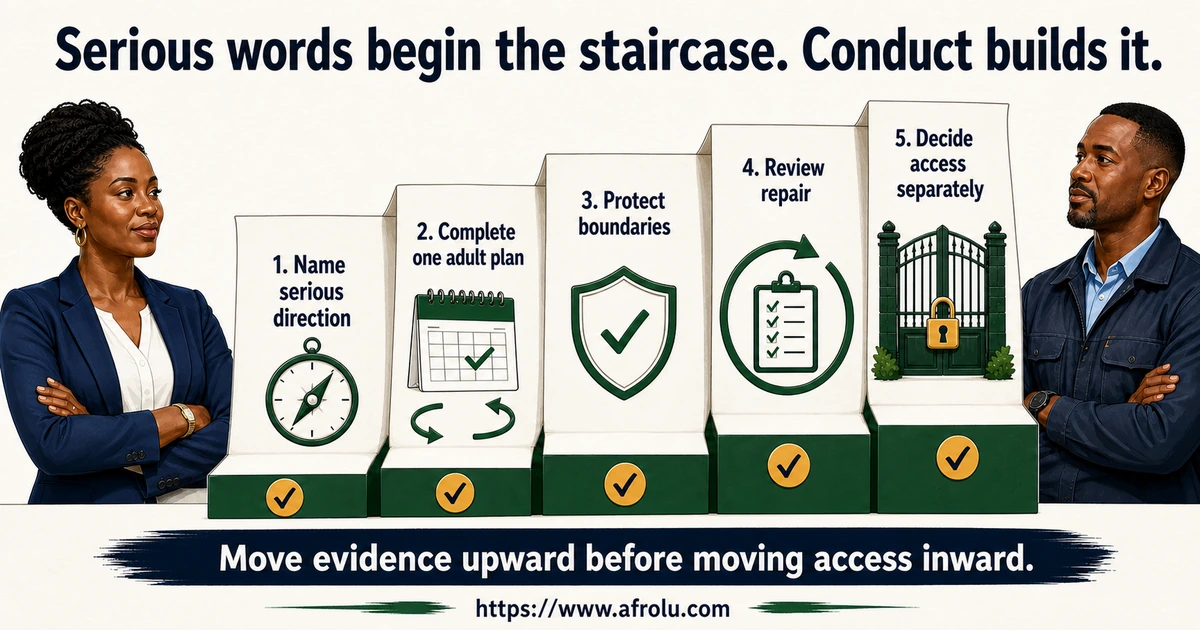
Climb one adult step at a time. A serious label does not unlock a home, family role, money or guaranteed future.
Written and edited by Jean-Claude Mukendi · Relationship Guides Editor
Use a five-step trust staircase. First, state serious direction without promising the outcome. Second, make one bounded adult weekend plan with a public place, confirmation point, affordable cost and independent return. Third, protect home, family data, devices, money and activity-specific consent. Fourth, observe how both adults handle a no, a changed plan and an ordinary low-cost date. Fifth, treat family introduction as a later purpose-led decision that creates no parenting role. Serious does not automatically mean exclusive, and exclusivity does not grant home or family access. Move evidence upward before moving access inward.
Relationship intent · Parents Returning To Dating
Does serious direction produce complete adult plans, respected boundaries and ordinary repair before anyone asks the family system to open?
Serious dating describes an adult direction toward possible lasting partnership. Weekend dating describes calendar availability and a setting for in-person evidence. Exclusivity is a present relationship agreement. Home access is a personal boundary. Family integration is a later relationship-stage decision. These answers may support one another, but none follows automatically from another. A serious single-parent relationship becomes safer and clearer when every stair receives its own words, evidence and free decision.
Mariam and Daniel are made-up single parents. Mariam is 39 and works in public administration; Daniel is 43 and supervises facilities. After six public dates, both say they seek a lasting partnership and have agreed to exclusivity. Daniel proposes an entire weekend including Mariam's home. Mariam declines the home stay and offers Saturday lunch with a clear finish and separate return. Daniel accepts the smaller plan without treating family access as proof. During lunch they discover that he hopes for eventual integration while she wants no introduction yet. They keep that question open, confirm one next adult date and leave without expanding access. The weekend becomes serious evidence because a boundary survives warmth, not because the household opens.
The weekend trust staircase
Let serious direction earn adult evidence before asking for family access
A meaningful weekend can remain small. The goal is to test planning, freedom and repair, not to stage a future household early.
Jean-Claude routes each decision to direction, present structure, the bounded plan, protected access or later integration so no answer silently grants another.
Direction
State the lasting-partnership goal while preserving the possibility that evaluation reveals a mismatch.
Complete adult plan
Confirm a public setting, time, cost and independent return before private family logistics change.
Boundary and repair
Watch whether home, family, money and consent limits survive disappointment and disruption.
Later integration
Use a separate purpose, readiness test and role boundary; never treat introduction as automatic promotion.
The trust staircase
Begin with serious direction and climb through adult evidence
The first stair is serious direction. Each adult says they are evaluating the connection for a lasting partnership. That answer matters because it helps rule out a known mismatch, but it is not a guarantee. It does not create exclusivity, home access, family contact or a future role. Translate the direction into present behaviour: honest questions, respect for existing responsibilities and willingness to learn rather than perform certainty.
The second stair is one complete adult weekend plan. Name the public place, time, duration, cost, confirmation point and independent return. A whole weekend is not required. A ninety-minute Saturday lunch can reveal whether both adults plan, listen, share effort and handle an ending. The size of the plan should fit current trust and family capacity, not the size of the romantic promise.
The third and fourth stairs are boundaries and repair. Keep home, family data, devices, money and precise routines protected. If a plan changes, observe whether useful notice and a specific alternative appear. Respect for a no is especially relevant. Someone may feel disappointed and still leave the boundary untouched. Pressure, monitoring or a gift tied to access is not transformed by serious language.
The fifth stair is a later integration decision, not a finish line. Consider it only after adult stability, ordinary evidence and a clear purpose exist. An introduction does not assign authority, caregiving, transport, discipline, financial responsibility or residence. The relationship can remain serious while that stair stays closed, and it can end if the adults' integration needs or timelines do not fit.
A narrowed weekend
Mariam keeps the adult date and declines the household takeover
Mariam and Daniel are fictional single parents. Mariam is 39 and works in public administration. Daniel is 43 and supervises facilities. After six adult dates, both say they seek a lasting partnership and have agreed to exclusivity. Daniel proposes Friday evening through Sunday, including time at Mariam's home. He imagines that a fuller weekend will show serious progress. Mariam likes him and still does not want that access.
Mariam separates the proposal. She declines the home stay and family contact. She offers Saturday lunch at a public restaurant, ending mid-afternoon so each adult returns independently. Daniel asks once whether Sunday would be possible, hears no and stops. He does not accuse her of hiding him or compare the boundary with their exclusive agreement. They confirm the smaller plan by Thursday.
During lunch they discuss what serious means now. Mariam wants continued adult evaluation and no family introduction yet. Daniel wants eventual integration but has no need for it this month. They name the difference without turning it into a deadline. Daniel may later decide a faster path is essential; Mariam may later become ready. Neither future answer is owed. Their present compatibility includes tolerating a meaningful open question.
They also review money and consent. Each chose a plan they could afford. Paying for lunch would not create home access, another date or physical intimacy. They leave separately and agree on one next adult plan. The Saturday does not prove permanent safety or fit. It provides bounded evidence: Daniel accepted a no, they discussed direction directly and the relationship remained warm without recruiting the household.
Plan completeness
Make the adult weekend complete without making it large
A complete plan gives both adults information they can act on. It includes the setting, start, likely finish, confirmation point, cost expectations and return. It may include a check-in with a trusted person. It does not require either parent to disclose the private family arrangement that made the window possible. Availability is enough. When an essential fact remains open, wait before spending or changing the household calendar.
Weekends can amplify intensity because more hours are available and weekday obligations temporarily recede. Do not interpret concentrated attention as permanent compatibility. Include ordinary moments: choosing food, handling a delay, respecting a tired answer, ending on time and returning separately. A smaller plan with clear edges may reveal more than an expensive escape in which every difficulty is hidden.
Protect personal space. Early serious dating does not require home visits, overnight stays, document access, live location or a tour of family systems. Accommodation and transport should remain independent when travel is involved. A parent can decline a private setting even after earlier private contact; consent belongs to the current activity and can change. The other adult's disappointment does not remove the choice.
If the plan changes, decide from the revised facts. A new venue, time, passenger, home or overnight request is a new choice. You may accept part, propose something else or cancel. Do not allow sunk cost, arranged care, a paid meal or a serious label to turn an unsafe or unwanted revision into an obligation. A later complete offer can be evaluated without rescuing the current one.
Ordinary evidence
Watch what serious intent does before opening family or financial systems
Serious intent should become modest repeatable actions. Both adults sometimes plan, confirm and travel. They answer present questions without hiding behind a grand future. Changes receive repair. A boundary remains intact after it is heard. Neither person must perform perfect weekends. The useful pattern includes how they handle inconvenience, limited money, tiredness and a plan that does not centre them.
Privacy-respecting conduct keeps family names, images, schools, routines, health information, home access and co-parent conflict outside early dating. It also protects each adult's devices, accounts and location. A date can learn how someone approaches responsibility without observing or contacting family members. Attempts to bypass the parent, appear at home or recruit relatives are not evidence of serious care.
Financial boundaries deserve their own attention. A serious partner does not use gifts, care payments, loans, household help or transport to purchase gratitude or access. Urgent fare, health, family, investment or business requests need independent verification. Keep essential money separate. If a payment was made under deception, contact the financial provider promptly and use suitable reporting support.
Pressure may increase after exclusivity because one adult assumes the agreement grants broader rights. It does not. Exclusivity concerns the defined romantic or sexual structure. Home entry, family contact, passwords, sex, money, weekend availability and future roles remain separate decisions. Threats, tracking, coercion, image misuse or repeated unwanted contact require a proportionate safety response rather than another relationship-status conversation.

Look for complete plans, respected no, repair and separate money; pause at tracking, rushed roles or urgent transfers.
Present-tense clarity
Ask one question for direction, structure, the plan and each protected boundary
For serious direction, say what you are evaluating the connection for and ask the other adult to describe their present direction. Avoid demanding promises about marriage, family roles or living arrangements before enough evidence exists. A person can sincerely want a lasting partnership and still decide this relationship is not it. That freedom makes the answer more credible, not less.
For exclusivity, ask directly whether either adult dates or seeks others, what the agreement includes and how change will be communicated. Discuss consent and relevant sexual-health information before physical choices. Do not infer structure from regular weekends, profile deletion, gifts, introductions or sex. If the available answer does not meet your needs, declining it is clearer than waiting under a private expectation.
For the weekend, make a bounded offer. Name the public setting, time, duration and return, then state when confirmation is needed. A complete no is also valid. Do not overexplain the family system to justify limited availability. The other adult can accept, counter or decline. A relationship remains voluntary even when both adults use serious language.
For integration, state that it is separate and later. When relevant, ask what purpose an introduction would serve and what role it explicitly does not create. Keep authority, discipline, transport, overnight access, emergency contact and financial responsibility outside implication. If either adult needs a different timeline, treat it as compatibility information rather than evidence that one person is unserious.

Ask about today, name the available weekend and protect each later step as a separate choice.
Three different tests
Review a planned, disrupted and ordinary weekend before increasing access
The planned weekend shows whether both adults make a complete, affordable offer. The disrupted weekend shows how they communicate and repair when work, health, weather, transport or family duty changes. The ordinary weekend shows whether conversation, consent and mutual interest survive without novelty or expensive entertainment. You do not need to engineer disruption. Review what ordinary life naturally provides.
Record only adult relationship facts. Note whether direction and exclusivity were understood, plans were shared, boundaries held and repairs appeared. Do not document a child's movements, health or care arrangements. Do not count messages or build a trust score. The aim is to reduce emotional fog while leaving personal dignity and privacy intact.
At review, choose one proportionate next step. It may be another public date, a changed contact rhythm, a deeper values question, continued exclusivity, more time or an ending. Family introduction is one possible later step, not the default reward for completing the review. Select it only when a purpose and household readiness independently support it.
If the evidence is mixed, ask which missing fact matters most. A single direct conversation may be better than a larger weekend. If pressure, deception or one-sided effort dominates, stop escalating. You do not need a courtroom case before protecting time, home, family, money or emotional capacity. Serious direction should make hard facts easier to discuss, not harder to act on.

Review the adult pattern after ordinary plans; choose another date, a changed agreement, more time or an ending.
Five separate answers
Compare serious direction with exclusivity, weekend time, home access and integration
Serious direction describes the hoped-for relationship destination. Exclusivity describes a present structure. Some adults date exclusively while still evaluating long-term fit. Others pursue serious partners while dating non-exclusively at the beginning. Both combinations need direct disclosure. A future hope cannot silently create a present agreement, and a present agreement cannot guarantee the future.
Weekend availability describes the adult calendar. A parent may offer one Saturday each month and be deeply serious. Another may have every weekend free and want casual companionship. Frequency can reveal effort relative to capacity, but it cannot rank intention. Ask whether the real time offer fits both adults instead of treating a full weekend as the certificate of importance.
Home access is a personal privacy and safety choice. It does not follow automatically from exclusivity, elapsed months or money spent. Family integration is another stage again. Meeting someone does not create a parenting role or permission to contact them. Each step can happen at a different pace, and a no or not yet in one category can coexist with warmth in another.
Long-term practical integration—shared housing, combined money, marriage, caregiving or formal authority—requires far more evidence and often independent advice. Do not use a successful weekend to rush those decisions. A serious relationship becomes clearer by tolerating separate questions, downside planning and reversible steps. The honest outcome may still be a mismatch or ending.
Eight serious weekend decisions before family integration

Asha and Kojo want partnership but have not chosen exclusivity
Asha is 38 and Kojo is 42. Both seek a lasting partner, yet Kojo continues early dates with others and Asha assumed serious meant exclusive. They name the present mismatch before another weekend. Asha can accept a defined evaluation period or leave; Kojo cannot use future direction to hide current structure.
Separate the serious goal from the present agreement and let each adult choose from both answers.Mariam replaces a home stay with Saturday lunch
Mariam likes Daniel and still declines Friday-to-Sunday access to her home. She offers one public Saturday plan with a clear finish and independent return. Daniel accepts without bargaining. The smaller date lets serious intent produce evidence instead of forcing a milestone.
Choose a bounded adult plan and observe the response to the access boundary.Eunice requires confirmation before a family cost becomes real
Eunice is 41. Her date repeatedly confirms after she must commit money and time elsewhere. She moves the deadline earlier and releases unconfirmed weekends. The date's serious language does not make repeated preventable cost fair.
Place confirmation before private cost and judge whether the new rule is respected across later plans.Tariq declines a late private replacement
Tariq is 45 and agreed to a public dinner. On the day, his date changes it to a private home and says an exclusive couple should be comfortable. Tariq declines the new setting. Prior agreement to dinner and exclusivity do not provide consent to a different place.
Treat the revised venue as a new choice and keep access separate from relationship structure.Abena keeps a gift from becoming authority
Abena is 40 and her date pays for an outing after she agrees. Later he implies that the spend earns an overnight stay. Abena says payment did not buy access and leaves through her own route. His response to that boundary becomes more relevant than the gift.
Keep consent specific and retain money and transport for an independent exit.Joseph makes one complete alternative after a cancellation
Joseph is 47 and must cancel because an existing responsibility changes. He shares only the adult consequence and offers a lower-cost Sunday plan. His date can accept or decline. A genuine disruption with repair is different from repeated vague weekends with no contribution.
Read notice, specificity and the longer pattern instead of demanding private family evidence.Njeri refuses a promise to become the perfect co-parent
Njeri is 36. A new serious match talks about collecting family members, solving care and moving in before meeting anyone. She stops the fantasy and keeps introductions off the table. Grand family-role promises can feel reassuring while bypassing adult knowledge and consent.
Return to present adult plans and decline any role or access that has not been separately considered.Moses and Lillian end over different integration needs
Moses is 49 and wants a partnership that eventually combines households. Lillian is 46 and wants a lasting adult relationship with separate homes and no wider family role. Both offers are serious. They end after clear discussion rather than treating one model as more loving.
Treat incompatible future structures as decision-ready information, not a project for persuasion.Evidence that serious intent is operating safely
Both adults can describe serious direction and current exclusivity as separate present answers.
Weekend plans become complete before care, travel or non-refundable spending changes.
A smaller public plan is accepted without treating scale, luxury or privacy access as seriousness proof.
Family names, images, schools, routines, home address, care and co-parent information remain protected.
A no or not yet receives respect without bargaining, shame, monitoring or indirect family contact.
Both adults contribute to proposing, confirming, travelling, paying fairly and repairing changes.
Gifts, meals, rides and help remain free of claims to sex, home entry, gratitude or another date.
Consent and relevant sexual-health questions stay specific even inside an exclusive serious relationship.
Ordinary low-cost time remains warm enough to reveal conversation, patience and mutual interest.
Family integration has a clear limited purpose and does not assign authority or a promised role.
Long-term housing, money or caregiving questions are discussed with downside planning rather than fantasy.
Either adult can name a mismatch or ending without threats, tracking, retaliation or recruitment of family members.
Place each weekend moment on the correct stair
| Situation | What it may mean | What to do next |
|---|---|---|
| Both adults say serious, but exclusivity was not discussed. | A future direction is being mistaken for a present structure. | Ask whether either adult dates or seeks others and define any agreement directly. |
| A full weekend and home stay are proposed early. | Scale and access are being used as a shortcut to evidence. | Separate the proposal and offer only the bounded adult plan you freely want. |
| Confirmation arrives after private costs become unavoidable. | One household is carrying preventable uncertainty. | Move the confirmation gate earlier and release plans that remain incomplete. |
| A public venue changes to a private setting. | The original consent no longer covers the revised plan. | Assess the new setting independently; decline or leave without treating sunk cost as obligation. |
| A gift or paid outing is linked to overnight access. | Generosity is being turned into authority or debt. | State that payment bought no access, keep transport control and move toward safety if pressured. |
| One weekend is cancelled with useful notice and an alternative. | An ordinary disruption may be receiving responsible repair. | Consider the new offer and watch the later pattern without requesting private proof. |
| A date promises an immediate family or parenting role. | Future fantasy is bypassing adult knowledge, purpose and consent. | Return to present adult steps and keep introductions and roles closed. |
| One adult asks for precise family schedules or home access. | Reassurance is crossing into protected third-party information. | Share availability only and judge the response to the privacy boundary. |
| Urgent family, fare, business or medical money is requested. | Romantic urgency is replacing independent financial verification. | Send nothing, avoid supplied links, protect codes and verify through official channels. |
| Several glamorous weekends feel perfect. | Novelty may be hiding ordinary cost, repair and compatibility questions. | Choose a simple bounded plan and observe low-stimulation conduct and a clear ending. |
| Integration visions differ after honest discussion. | Two serious offers may be structurally incompatible. | Decide whether the real future fits rather than ranking one adult's model as more committed. |
| A boundary triggers threats, tracking or repeated contact. | The task has shifted from clarity to safety and access control. | Reduce access, preserve useful evidence when safe and use suitable platform, legal or local support. |
Scripts for serious direction, weekend plans and protected access
“I am evaluating us for a lasting partnership. What present choices does serious direction mean to you?”
“Are either of us dating or actively seeking other people? I do not want the weekend pattern to answer for us.”
“I can meet Saturday from one to three at this public place and return independently. I am not available for a home stay.”
“Please confirm place and time by Thursday. If it remains open, I will release the weekend.”
“I share my adult availability, not family names, schools, routines, images, care contacts or home details.”
“Paying for the date does not create access, physical intimacy or another meeting. Let us choose a plan we both accept freely.”
“Our serious or exclusive label does not decide this activity. I want a present answer that either of us can change.”
“This weekend no longer works. I can offer Sunday lunch next week; it is fine if that does not suit you.”
“I am serious about evaluating us and not ready for family introductions. Those are separate answers.”
“If we later introduce anyone, we will name the purpose, duration, privacy limits and the role it does not create.”
“I do not send urgent dating-related money or share codes. Please use the provider or established support directly.”
“Our long-term household models do not fit. I respect your direction and am ending the romantic connection.”
Know the difference
A serious weekend pattern versus a complete serious relationship agreement
Adults spend regular or extended weekend time together. The pattern shows availability and effort but does not answer exclusivity, home access, family role or future integration.
Direction, exclusivity, each weekend plan, personal-space access, consent and any family stage receive their own present answers and review points.
Enjoy the meaningful pattern, then ask the exact question before making a decision in another category.

Name each decision directly. A warm weekend can be meaningful without granting the next kind of access.
Separate the five decisions hidden inside a serious weekend
| Type or dimension | What it describes | Best next question |
|---|---|---|
| Serious direction | An intention to evaluate a relationship for lasting partnership, without a guaranteed result. | Which present behaviours express that direction? |
| Exclusive dating | A current mutual agreement concerning other romantic or sexual connections. | What is included, disclosed and reviewable? |
| Weekend availability | Calendar capacity for adult time; it cannot rank the depth or future of a relationship. | Does the real time offer fit both adults fairly? |
| Home access | A privacy and safety choice that never follows automatically from commitment language. | Is this freely wanted, and what public alternative exists? |
| Overnight stay | A setting and consent decision with transport, accommodation and personal-safety consequences. | Does each adult retain a free answer and independent exit? |
| Family introduction | A later relationship-stage decision with a limited purpose; it creates no automatic role. | What will the meeting mean and explicitly not mean? |
| Parenting role | A consequential responsibility that cannot be promised through romance or one meeting. | Which authority, duty and safeguards would require separate consideration? |
| Shared household | A major practical integration involving money, law, privacy, care and exit planning. | What independent evidence and advice are needed before any move? |
| Consent | A free present agreement to a specific activity that can be withheld or withdrawn. | What does each person want now, independent of labels and spending? |
| Serious mismatch | Two adults may share long-term intent while wanting incompatible structures or integration paths. | Is the real available future enough, or is a respectful ending clearer? |
Build the adult trust staircase in six moves
Draw the staircase
Write direction, complete plan, boundaries, repair and later integration on separate steps. Mark only evidence that exists now.
Shrink the first weekend test
Choose a public duration, affordable cost and independent return that can answer one useful question without opening the household.
Ask structure directly
Name exclusivity and consent-relevant disclosures rather than interpreting regular weekends as an agreement.
Observe the boundary response
Pay attention to conduct after a no about home, time, money, devices, sex or family—not just the words before it.
Review three kinds of weekend
Use a planned, disrupted and ordinary weekend to see completeness, repair and low-pressure compatibility.
Gate every later role
Give introductions, home access, caregiving, shared money and housing their own purpose, evidence and free decision.
Questions for direction, the weekend, repair and later integration
Choose a few prompts that fit the moment. This is a reference library, not a list to complete.
Direction and exclusivity
Answer the adult relationship questions before interpreting weekend frequency.
- What does serious mean in present behaviour?
- Are either of us dating or seeking others?
- What does exclusivity include?
- Which disclosures matter before intimacy?
- When will we review the agreement?
The bounded weekend
Build one complete adult plan with clear edges and independent control.
- Which public place and hours fit?
- When do we confirm?
- What can each adult afford?
- How does each person return?
- Which revisions would require a new yes?
Boundaries and repair
Look at conduct when the ideal plan or preferred access is unavailable.
- Which home and family information stays private?
- How should a cancellation be repaired?
- Can disappointment leave a no intact?
- Which gift or money boundary matters?
- What would make us reduce access?
Later integration
Use these only when adult stability makes an introduction question relevant.
- What purpose would the meeting serve?
- Which information stays private?
- Which role is explicitly not created?
- How will we keep it brief and low pressure?
- What would make us wait longer?
What relationship research and public guidance can support
Ideal preferences are not an individual matching algorithm
Large cross-national research can examine whether stated partner preferences relate to attraction. Effects vary with method and cannot score one date. Afrolu uses the work narrowly: name the qualities that matter, then observe pair-specific conduct and practical fit rather than treating a checklist or initial chemistry as guaranteed compatibility.
Evidence limit: Survey and attraction measures cannot predict one relationship's safety, durability or family fit.
Initial interest contains person and pair effects
Speed-dating research has found that initial impressions can contain both generally desirable and pair-specific components. A warm weekend may therefore be meaningful without being destiny. Continue gathering ordinary evidence. Do not interpret chemistry as permission for home access, exclusivity, integration or irreversible commitment.
Evidence limit: Brief structured encounters and studied samples do not reproduce every parent-dating context.
Relationship-specific reports predict current quality better than trait lists
A large project combining many couples datasets found that relationship-specific self-reports were robust predictors of current relationship quality, while change was difficult to predict. The practical lesson is modest: ask about the experienced relationship and observe interaction, not just credentials or ideal traits. It cannot forecast one couple's future.
Evidence limit: The datasets were mostly Western and involved established couples; prediction does not establish cause.
Dedication and constraint should not be confused
Commitment research distinguishes dedication from constraints that make leaving costly. A parent may feel tied by elapsed time, paid care, gifts, family exposure or promises without receiving a healthy serious offer. Increase freely chosen dedication through truth and fit; do not manufacture constraint through money, access or premature roles.
Evidence limit: Observational and theoretical work does not diagnose a relationship or prescribe one timeline.
Consent remains specific inside a serious relationship
WHO describes sexual health through respect, safety and freedom from coercion. A serious or exclusive label, a paid weekend or a private setting cannot provide consent to an activity. Each adult needs a free present answer and may change it. Qualified local healthcare should guide individual sexual-health decisions.
Evidence limit: This page provides general communication and safety guidance, not legal interpretation or medical care.
Romance-linked money needs independent verification
FTC consumer guidance describes romance fraud that builds trust before requesting money or gifts. A serious future, family story or weekend fare can make urgency persuasive. Do not send money or account access to a person you have not met; verify independently and contact a financial provider promptly after suspected loss.
Evidence limit: A warning pattern does not prove criminal intent. Respond to observable risk and use suitable local support.
Six shortcuts that turn a serious weekend into pressure
Making the weekend a seriousness exam
Scale and intensity can create pressure while hiding whether ordinary plans, limits and repair work.
Treating exclusivity as broad ownership
A romantic structure does not grant devices, home, location, sex, money, family contact or every weekend.
Paying for access
Meals, trips, gifts, care costs and favours never purchase private settings, intimacy or continued contact.
Promising a family role early
Future-role language can bypass adult knowledge, household consent, real capacity and the safeguards a role would require.
Using introductions as a deadline
No universal date or weekend count makes integration appropriate. Purpose and household readiness matter separately.
Ignoring incompatible serious futures
Two adults can want lasting love while wanting different homes, roles or levels of integration. Clarity may require an ending.
Use a reviewed resource that matches the decision
This guide focuses on the relationship decision, so it does not rank dating apps. Check current prices, safety tools, and local availability before choosing a service.
Explore the guide library
Show more related guides
Continue with Afrolu
Show more Afrolu guides
Research and public guidance reviewed for this guide
Afrolu reviewed these health, research, safety, or public guidance resources while editing this page. They support the behaviour and safety guidance; they do not diagnose any individual described by a reader.
Serious weekend dating questions for single parents
What makes weekend dating serious for a single parent?
Seriousness comes from a shared direction toward possible lasting partnership plus present conduct: honest answers, complete plans, reciprocal effort, consent, repair and respected family boundaries. The length, cost or privacy of a weekend cannot create serious intent by itself.
Does serious dating mean we should be exclusive?
Not automatically. Serious describes direction; exclusivity is a present agreement. Ask whether either adult dates or seeks others, define what exclusivity includes and discuss relevant sexual-health information before physical choices. Choose from the stated structure rather than weekend assumptions.
Should a serious date spend the whole weekend with me?
No universal scale proves commitment. Choose the smallest complete adult plan that fits trust, family capacity, cost and safe return. A short public date can provide useful evidence. A full weekend, home stay or overnight remains a separate free choice.
When should a serious partner visit my home?
No date count creates home access. Consider purpose, trust, safety, privacy, household context and whether a public alternative works. You may keep the home private even inside exclusive serious dating. Observe whether the boundary is accepted without bargaining or indirect contact.
When should single parents introduce a serious partner to family?
There is no universal timetable. Establish adult stability, a clear purpose and suitable household readiness first. Limit the initial meeting and state what it does not create. It should not assign parenting, discipline, transport, caregiving, financial responsibility, emergency authority or residence.
Does paying for a weekend create any obligation?
No. Money, gifts, accommodation, meals, transport and care costs do not purchase home access, sex, gratitude, another date or family contact. Agree on affordable contributions and retain independent transport, communication, money and accommodation where relevant.
How do I judge a cancelled weekend?
Look at the notice, truthful limit, specific repair and repeated pattern. One genuine disruption with a usable alternative differs from chronic vagueness. Do not demand private work or family proof. If repeated changes make the relationship unworkable, you can decline without proving bad intent.
Can two serious single parents keep separate homes?
Yes. Serious direction does not require shared housing or one family model. State whether separate homes are temporary or preferred and discuss the real future. If one adult requires integration and the other does not, the honest result may be incompatibility rather than insufficient love.
What if a serious partner asks for urgent money?
Do not send money, gifts, codes, documents or account access because the relationship feels important. Verify any provider independently. Speak with someone you trust and contact a financial provider promptly after suspected loss. Serious language is not financial verification.
How many weekends should I review before taking the next step?
No fixed count applies. The three-weekend method is a reflection tool: observe complete planning, repair after ordinary disruption and low-pressure compatibility. The next step may be another date, more time, a changed agreement or an ending; it does not have to be family access.
One thing to do now
Choose one complete adult stair, not a household leap
Place every weekend choice on the correct stair. Name direction and exclusivity separately, make the adult plan complete, keep home, family, money and consent protected, and review conduct across ordinary and disrupted weekends. Open any later family step only for its own purpose. If the available structure or future does not fit, choose a respectful adult ending instead of using serious language to create pressure.