One-table field note · companionship, not cure
Start a New Dating Journey with One Low-Pressure Weekend
Restart dating after a significant ending with one bounded 60–90 minute weekend date, honest disclosure, less comparison, clear consent and an easy exit.
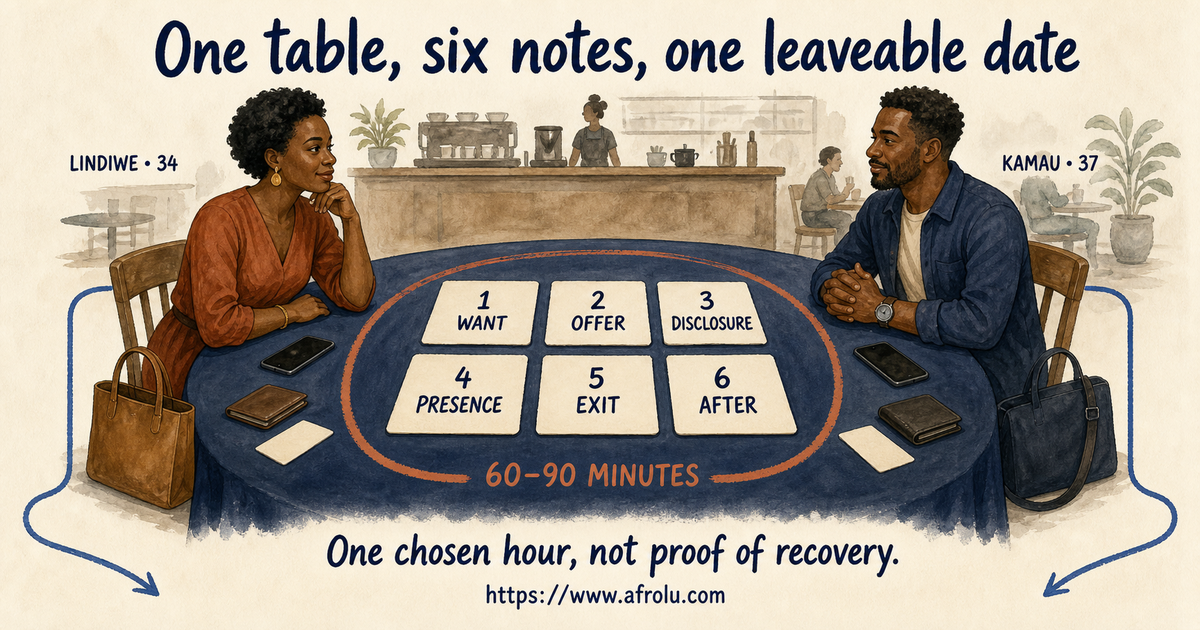
A new journey can be one chosen hour, not a promise that the old story has disappeared.
Written and edited by Clarisse Uwimana · Dating Culture Editor
Define new journey as one chosen present action, not proof that recovery is complete. Use six notes: WANT, OFFER, DISCLOSURE, PRESENCE, EXIT and AFTER. Offer one public 60–90 minute date only if it fits today. Share present impact rather than a compulsory history, notice comparison without making the date compete and request concrete conduct instead of a recovery verdict. Then continue slowly, ask, choose friendship, pause, close, seek care, report fraud or seek safety help.
Starting over · New Relationship Starters
How can an adult try one 60–90 minute weekend date after a significant ending while keeping disclosure voluntary, comparisons proportionate, companionship honest and every exit open?
A new dating journey is one honest present step after a significant ending. It is not a replacement relationship, recovery treatment, reassurance exam or promise about the future. A bounded weekend date can test current capacity for companionship while grief, memory or uncertainty still exists. No universal wait period, date count or emotional state certifies readiness.
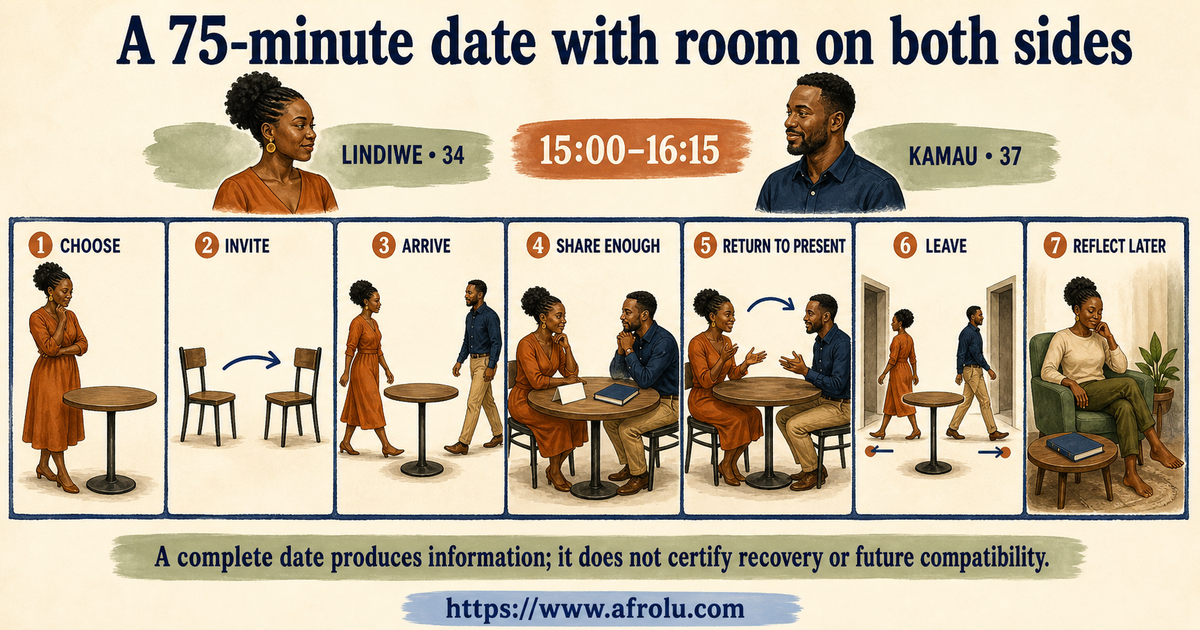
Lindiwe, 34, wants company eight months after a significant ending and offers Kamau, 37, a public coffee from 15:00 to 16:15. She shares only present impact, notices a comparison without asking him to defeat it, names companionship as today's lane and leaves independently before reflecting that evening. Both adults and all events are fictional.
Clarisse's one-table new-journey field note
Give the weekend date a smaller job and a generous ending
This route keeps companionship, disclosure, comparison, reassurance, exit and after-date space visible without a recovery clock.
Name the purpose, bound one public table, tell present impact, return from comparison and reflect only after the date ends.
Choose the job
Offer companionship or curiosity without promising that the date will heal anything.
Bound the table
Use a 60–90 minute public window only when it fits present capacity.
Keep history yours
Share current impact while the private archive remains voluntary.
Finish, then reflect
Leave independently before choosing whether any next step fits.
Begin with a smaller definition
Let new journey mean one chosen present action
New journey can sound like a total reinvention, a replacement romance or a promise to leave every difficult memory behind. Here it means something smaller: one chosen adult dating action whose purpose and limits are honest now. Lindiwe can want a public conversation on Saturday without claiming that she is ready for commitment, intimacy or even a second meeting.
A significant ending can involve a breakup, separation, divorce, bereavement or another relationship loss whose meaning varies by person and context. The page does not collapse those experiences or decide what caused distress. It asks about current capacity: can the adult make a bounded offer, stay present enough to choose, let the other person remain a separate human and keep a usable exit?
There is no evidence-based universal wait period that can determine when every adult should date. Research averages from particular samples are not personal clocks. One adult may choose company soon, another may pause for a long time and another may move in and out of dating. The defensible question is what one meeting is being asked to do and whether that job is freely disclosed.
A new date can offer conversation, humour, attraction or companionship. They should not be assigned to cure distress, erase a former relationship, provide a recovery grade or prove that someone else was replaceable. If the only acceptable outcome is feeling healed, desired or decisively better afterward, the meeting carries work the other adult did not agree to perform.
Give the date one table and one ending
Test capacity for a bounded 60–90 minute weekend meeting
WANT asks what companionship is actually desired: a coffee conversation, a museum visit or a short walk. OFFER names only the capacity available now. A public 75-minute coffee is a complete offer. It does not secretly mean casual sex, exclusivity, friendship, long-term intent or a promise to keep dating until difficult feelings stop.
DISCLOSURE asks what present information supports informed choice. It may be enough to say that a significant relationship ended and the pace needs to stay light. Names, private messages, legal records, therapeutic details and the full story remain optional unless some current fact is necessary for consent or safety. The other adult may decide limited disclosure does not fit them.
PRESENCE does not require a blank mind. A former partner may come to mind when a song plays or a question touches shared history. Notice the comparison, return to the person at the table and decide whether to continue, redirect or end. Repeatedly asking the date to prove they are kinder, more attractive or more committed turns them into a reassurance instrument.
EXIT names time, transport, money and the right to leave. AFTER protects a separate margin for rest and reflection before sending a verdict. The date need not be stretched because it feels promising or because ending on time might look cold. A kept boundary can make the experience easier to read and prevents one afternoon from deciding the entire new journey.
Lindiwe chooses company, not a cure
A fictional 75-minute date keeps disclosure, comparison and reassurance in proportion
Eight months after a significant relationship ended, Lindiwe notices that she wants company on Saturday. The number of months supplies context but no permission slip. She tells Kamau that she is restarting slowly and offers coffee from 15:00 to 16:15 at a staffed public cafe. He is free to accept, counter or decline without judging whether she waited correctly.
At the table, Lindiwe says the ending still affects her sometimes but does not tell the full story. When Kamau describes a favourite trip, she briefly compares it with travel from her former relationship. Instead of asking him to promise that he is different, she notices the memory, takes a breath and asks a present question about what he enjoyed on his trip.
Kamau asks whether she is seeking companionship or a committed relationship. Lindiwe answers that today's offer is companionship and curiosity, with no current promise about a later lane. That answer may not fit him. He says it does for this date. Each adult controls the bill, touch, private information, images and any later communication; no kindness purchases another step.
They leave separately at 16:15. Lindiwe gives herself the evening before deciding what the date meant. She notices interest, tiredness and relief without forcing one emotion to win. She could continue slowly, ask one question, choose friendship, pause or close. A successful new-journey step is the honest, leaveable meeting itself, not a relationship outcome.
Keep three tempting shortcuts off the table
Share present impact without turning the date into a witness or replacement
Disclosure becomes useful when it explains a current boundary or offer. I am keeping dates short, I am not ready for home meetings, or I am not discussing the details today gives the other adult information they can use. A long account may also be freely chosen, but it should not be demanded as proof of honesty or delivered because the date has been assigned a counselling role.
Comparison is a common mental event after a meaningful relationship. It becomes a dating problem when every present quality is turned into a contest with the former partner. Kamau cannot answer whether he will never repeat another person's conduct, and he should not be asked to outperform selected memories. Lindiwe can name the current need directly: slower questions, a public setting or no contact after the date.
Reassurance seeking asks the new adult to settle an internal verdict: am I lovable, fully recovered, attractive enough or finally safe? Ordinary reassurance can be kind, yet repeated tests can make the person responsible for regulating a fear they did not create. Ask for concrete conduct instead: confirm the plan, respect the boundary, state the present intent or accept a no.
Exit language protects dignity when the fit is not there. I enjoyed meeting, but I do not want another date is complete. So is I need romance out of my week and will not predict a return. If closure brings pursuit, threats, monitoring or unwanted access, the task changes from communication to protection; use current local services suited to the facts.

Read the cost and freedom of the date, not whether every difficult feeling vanished.
Give companionship an honest job
Distinguish mutual company from using a date as recovery treatment
Mutual companionship means both adults know the present offer and may enjoy it without performing a cure. Conversation, shared activity and affection can matter while the connection remains small. The date is still allowed their own feelings, limits and relationship goals. They can decline the proposed lane without confirming that the restarting adult is damaged or deceptive.
A recovery service has a different job: remove loneliness on demand, absorb the full breakup narrative, prove desirability, defeat comparisons or guarantee that future relationships will be safer. That assignment can remain hidden even from the person making it. The useful review is functional: what outcome must this date deliver before the meeting is allowed to count as worthwhile?
Rebound function and a new journey can overlap. Someone may sincerely like a new person while also hoping the attention will mute pain. Mixed reasons do not create a diagnosis or automatic prohibition. They call for proportion: name the offer, keep the meeting bounded, retain friends and care outside the date, and accept that the other adult may choose another pace.
Persistent or severe difficulty with sleep, appetite, concentration, enjoyment or ordinary tasks may fit qualified local mental-health support. Care is not a punishment for dating and should never be framed as a route to passing readiness. It can accompany a date, a pause or no romantic activity. Immediate self-harm risk or danger requires urgent local help rather than an editorial checklist.

Tell the present truth; leave the full history in your own keeping.
Keep the small table independently leaveable
Protect privacy, money, sexual health and movement on the new journey
Use proportionate identity checks, keep profile and workplace information limited and choose a staffed public setting. Arrange independent arrival and departure, retain your own phone and money, and share the plan with a trusted person when useful. A live call or public date can reduce some practical uncertainty but cannot certify intent, future conduct or compatibility.
Do not send fares, emergency money, gift cards, cryptocurrency, documents, passwords or verification codes. If romantic attention becomes a financial opportunity or crisis, check it through independently found official channels. Contact a financial provider promptly if money moved. A vulnerable story, professional profile or promise of companionship does not independently validate a transaction.
Sexual health includes physical, emotional, mental and social well-being and a respectful, non-coercive approach. Discuss testing, prevention, contraception where relevant, other partners and personal care with appropriate health professionals. A test result, paid bill, disclosure or first date never creates sexual consent. Every physical and digital choice remains specific and reversible.
If threats, tracking, coercion, impersonation, non-consensual image sharing or blocked movement appears, skip further dating analysis. Preserve relevant evidence where safe, secure devices and accounts and use current platform, financial, advocacy, legal, health or emergency support. Local law and services differ; a generic guide cannot assess immediate danger for an individual.
Leave a margin after the meeting
Review capacity and fit without giving the date a recovery grade
Begin with observable facts. Did the plan stay within 60–90 minutes? Was disclosure voluntary? Could comparison be noticed without turning Kamau into a contestant? Was reassurance requested as specific conduct rather than a verdict? Did money, consent, privacy and exit remain independent? These questions describe one meeting and should not be converted into permanent character claims.
Then notice cost and capacity. Interest and tiredness can coexist. A strong memory does not automatically prove the date was harmful, while a pleasant hour does not prove more dating is wise. Ask what ordinary life needs next: sleep, friendship, work, care, solitude or another small meeting. No answer has to satisfy an imagined recovery schedule.
CONTINUE SLOWLY, ASK ONE THING, FRIENDSHIP, PAUSE and CLOSE are equal ordinary routes. SEEK CARE addresses distress or functioning, not dating worth. REPORT FRAUD and SEEK SAFETY HELP follow concrete money deception or danger rather than the emotional tone of the date. Several routes can coexist, and the most urgent fact receives the first action.
A new journey may therefore be one date followed by a no, one date followed by rest or one date followed by another modest invitation. It may also be choosing not to meet. The durable achievement is smaller and kinder: the adult made a truthful present offer, treated the other person as a person, kept the table leaveable and allowed the ending to remain significant without ruling the future.

The smallest honest next move is a complete new-journey result.
Eight small-table moments where companionship, disclosure, comparison or risk changes the next step
An adult wants one hour of conversation
The aim is companionship, not immediate commitment, and the date receives enough information to accept or decline that lane.
Offer one bounded public meeting.A date asks for the whole ending story
Curiosity may be understandable, but present fit can be decided without names, records, messages or a recovery autobiography.
Share only useful present impact.A familiar song brings back a former partner
The memory can be noticed without asking the new adult to compete, reassure or erase it.
Return to a present question or pause.Attraction is used to ask whether healing is complete
The new person cannot grade recovery or permanently settle worth, safety and future outcomes.
Ask for concrete conduct instead.Kamau wants commitment while Lindiwe offers company
Both offers can be honest and still not fit; attraction creates no duty to accept the smaller or larger lane.
Close or redesign without ranking.A pleasant coffee reaches the chosen ending
Stopping at 75 minutes protects capacity and does not signal rejection, even when another meeting remains possible.
Leave on time and reflect later.A new match links affection to an investment
The emotional story does not verify the transaction, account, return or identity behind the request.
Send nothing and check independently.A no leads to threats or unwanted access
This is no longer a reflection question because freedom and safety have been directly affected.
Secure access and seek fitting help.Sixteen place cards for capacity, presence, exit and after-date space
New journey is defined as one present action rather than a replacement life.
The adult can name companionship, curiosity or another modest purpose.
A 60–90 minute public offer can be accepted, countered or declined.
The ending date supplies context but never acts as a readiness deadline.
Disclosure explains present impact while private history remains voluntary.
The other adult may decide that limited disclosure or pace does not fit.
Comparison is noticed without making the date compete with a former partner.
Reassurance requests focus on concrete conduct rather than recovery verdicts.
Friends, community and care remain available outside the dating connection.
The date may end on time even when it is warm and promising.
Each adult controls costs, transport, devices, images and private information.
Testing, prevention, contraception, touch and sex keep separate discussions.
An emotional moment does not automatically become diagnosis or incompatibility.
After-date reflection happens without an immediate performance rating.
Pause and closure are complete routes with no predicted return date.
Fraud, threats, tracking, image abuse and blocked exit trigger direct protection.
Ten questions before giving one weekend date a larger job
| Situation | What it may mean | What to do next |
|---|---|---|
| What job does the date have? | Fits: Mutual companionship or curiosity is named. Needs review: One expectation needs words. Stop: The date must prove recovery. | Write the present purpose. |
| Is the offer bounded? | Fits: Public setting and 60–90 minutes fit. Needs review: One logistical detail is open. Stop: The whole weekend becomes an obligation. | Shrink the plan before meeting. |
| Is disclosure voluntary? | Fits: Present impact is enough. Needs review: Curiosity is becoming pressure. Stop: Private history is demanded as proof. | Restate the disclosure limit. |
| Can comparison stay internal? | Fits: A memory is noticed and released. Needs review: One comparison needs redirecting. Stop: The date must defeat a former partner. | Return to present conduct. |
| Is reassurance concrete? | Fits: A specific behaviour is requested. Needs review: A broad verdict is being sought. Stop: Worth or healing depends on the answer. | Ask for conduct, not certification. |
| Is companionship mutual? | Fits: Both adults freely accept its present scope. Needs review: Intent needs one direct question. Stop: One waits for an unspoken promotion. | Define, redesign or close. |
| Are consent and sexual health separate? | Fits: Each choice has its own discussion. Needs review: One assumption needs correction. Stop: Disclosure or payment becomes entitlement. | Unbundle every adult decision. |
| Does the exit work? | Fits: Time, travel and no remain controlled. Needs review: One access route needs protecting. Stop: Movement or closure is defeated. | Leave and protect access. |
| What happens after? | Fits: Reflection leaves ordinary life intact. Needs review: The verdict can wait. Stop: The date becomes the sole coping system. | Restore outside support and space. |
| What is the strongest fact? | Fits: An ordinary fit choice remains. Needs review: Persistent impairment may fit care. Stop: Fraud or danger needs direct help. | Follow that route first. |
Twelve lines for a new journey with voluntary history and a complete exit
“A new journey for me means one honest date, not a replacement relationship.”
“I am open to companionship and curiosity today, without promising a later lane.”
“I can meet in public from 15:00 to 16:15 and will leave then.”
“A significant relationship ended; I can share how it affects today, not the full story.”
“That brought up an old memory, and I want to return to our present conversation.”
“Please confirm the plan; I am not asking you to prove I am ready or lovable.”
“We control our own costs, and I do not send dating contacts funds or codes.”
“Coffee does not decide images, touch, sex or another meeting.”
“I need ten quiet minutes, and I may decide to end the date.”
“I am leaving at the time we agreed and will arrange my own return.”
“I will reflect later; I am not giving an immediate verdict about another date.”
“I do not want to continue romantically, and I am closing this contact.”
Know the difference
A new journey is not another adult's recovery assignment
One chosen, bounded date offers honestly named companionship, curiosity and independent exits.
The new adult must erase pain, prove worth, replace the former partner or certify readiness.
Ask what job the date is being given and whether both adults freely accept it.

Ask what job the date is being given, then choose only the job both adults can accept.
New journey, mutual companionship and seven nearby functions
| Type or dimension | What it describes | Best next question |
|---|---|---|
| New journey | One honest present action is chosen without claiming the past is finished. | Offer a bounded date or another small step. |
| Mutual companionship | Both adults knowingly choose company without a hidden commitment promise. | Name scope and review freely. |
| Rebound function | Dating partly serves to regulate breakup distress or restore identity. | Keep the function visible and outside support available. |
| Reassurance test | The date must confirm worth, attractiveness, readiness or permanent safety. | Request concrete conduct, not a verdict. |
| Replacement project | The new adult is asked to occupy the former partner's role or erase history. | Return to this person's separate identity. |
| Comparison loop | Present qualities are repeatedly measured against selected memories. | Notice, redirect, pause or close. |
| Intent mismatch | Two honest relationship aims or pacing needs do not align. | Redesign or end without ranking. |
| Persistent impairment | Sleep, focus, appetite, enjoyment or ordinary tasks remain badly affected. | Use qualified local care when fitting. |
| Fraud or danger | Money deception, threats, tracking, coercion or blocked exit changes the route. | Protect access and use current local help. |
Use want, offer, disclosure, presence, exit and after
Define new narrowly
Let new journey mean one present action, not replacement, cure or proof.
Give the date one job
Name companionship, curiosity or another purpose the other adult can accept.
Bound the table
Use a public 60–90 minute meeting only when that range fits current capacity.
Tell present impact
Share enough for informed choice while keeping private history voluntary.
Return from comparison
Notice memory without recruiting the new person into a contest or reassurance test.
Keep direct routes
Care, fraud reporting and safety help remain separate from romantic decisions.
Questions for purpose, the table, present attention and the after-date margin
Choose a few prompts that fit the moment. This is a reference library, not a list to complete.
Purpose
Give the date one accepted job.
- Do I want company?
- Am I seeking proof?
- What am I offering?
- Can the other adult decline?
Table
Bound the weekend meeting.
- Which public place?
- Is 60–90 minutes suitable?
- How does each travel?
- What costs stay separate?
Presence
Keep history and this person distinct.
- What needs disclosure?
- Is comparison running?
- What reassurance is concrete?
- Would a pause help?
Margin
Choose after the date ends.
- What did I observe?
- What did it cost?
- Continue, friendship, pause or close?
- Does care or protection fit?
What breakup research and official care, sexual-health and safety guidance can support
APA describes one positively focused writing study
The APA overview reports short-term positive-emotion findings when recent breakup experiences were written about with attention to positive aspects.
Evidence limit: The featured experiment involved fewer than one hundred single people with breakups in the prior three months; it does not prescribe journaling, dating or a universal recovery path.
A young-adult study observed average change around one breakup
Across monthly observations, the study found a temporary average increase in depressive symptoms around breakup in its selected sample, with appraisal and control related to patterns.
Evidence limit: The sample was 156 young adults who were aged 18–23 at screening, lived within 60 miles of Seattle in the United States and met a past-year alcohol-use eligibility condition. Its PHQ-2 trajectory and three-month average cannot become an individual waiting period.
A longitudinal emerging-adult study examined attachment, coping and distress
The study followed 196 emerging adults and modelled associations among pre-breakup attachment, later coping strategies and depressive or anxiety symptoms.
Evidence limit: Association and mediation do not prove an individual's cause, diagnose attachment or identify a best dating date; the emerging-adult Canadian context limits transfer.
NIMH separates everyday self-care from reasons to seek help
The official page supports sleep, regular meals, movement, realistic priorities, connection and professional help for severe or distressing symptoms affecting ordinary life.
Evidence limit: Its U.S. services and two-week symptom examples are general guidance, not a breakup diagnosis, emergency plan or rule about romantic readiness.
WHO frames sexual health around well-being, respect and freedom from coercion
The working definition supports a positive and respectful approach in which safe sexual experiences, privacy and voluntary choice matter beyond disease prevention.
Evidence limit: It is a broad global framework and cannot choose individual tests, contraception, treatment, consent capacity or local legal advice.
eSafety covers data limits, public meetings and technology-facilitated abuse
Australian guidance supports proportionate identity checks, limited personal details, staffed meeting places, platform controls, evidence preservation and reporting choices.
Evidence limit: Its statistics, legal setting and reporting powers are Australian; precautions reduce some risks but cannot verify a date or guarantee safety.
Six ways a date can inherit recovery work it never accepted
Naming a replacement journey
The new adult inherits an old role. Repair: define only today's action.
Publishing the whole ending
Disclosure becomes admission payment. Repair: share present impact by choice.
Running a comparison audition
The date competes with selected memories. Repair: ask about present conduct.
Seeking a recovery grade
Reassurance becomes certification. Repair: request one concrete behaviour.
Stretching a good date
Interest overrides capacity and exit. Repair: end at the agreed time.
Using romance as sole care
One person carries wider distress. Repair: restore support outside dating.
Choose companionship without hiring a stranger to prove recovery
A short public date can be complete even when it leads nowhere. Name what you can offer now, share only the history you choose, leave independently and make any later decision after your own response has settled.
Explore the guide library
Show more related guides
Continue with Afrolu
Show more Afrolu guides
Three carefully limited breakup sources and three current official guidance pages
Afrolu reviewed these health, research, safety, or public guidance resources while editing this page. They support the behaviour and safety guidance; they do not diagnose any individual described by a reader.
Adult questions about a new dating journey after a significant ending
How long should I wait after a significant ending before dating?
There is no universal wait period. Research averages from selected young-adult samples cannot set an individual's calendar. Consider present purpose, capacity, ordinary functioning, voluntary disclosure and whether one meeting remains leaveable. You may date, pause, try once and stop, or not date. Severe or persistent distress may fit qualified local support.
What does new journey mean on this page?
It means one chosen present dating action, such as a 75-minute public coffee. It does not mean replacing a former partner, proving recovery, erasing memory or promising a relationship. The action is complete when its honest purpose, boundaries, consent and exit are respected, even if there is no second date.
Why suggest a 60–90 minute weekend date?
The range creates a practical beginning and ending for an adult testing current capacity. It is optional, not medical guidance, a safety guarantee or the correct length for everyone. Choose less, more or no date according to context. End sooner whenever you want, especially if discomfort, pressure or danger appears.
How much should I disclose about the ending?
Share what supports informed present choice: perhaps that a significant relationship ended, you want a slow pace or a topic is private. You do not owe names, messages, legal records, therapeutic information or a complete narrative. The other adult may decide limited disclosure does not fit, but should not demand pain as proof.
What if I compare the new person with my former partner?
A comparison can arise without proving unreadiness. Notice it, return to present evidence and decide whether to continue, redirect or leave. Avoid asking the date to defeat a memory or guarantee they will never repeat another person's conduct. If comparisons dominate and cause wider distress, outside reflection or qualified support may help.
Is it wrong to want reassurance after heartbreak?
No. Ask for reassurance that is concrete and voluntary, such as confirming a plan or restating present intent. A new adult cannot reliably certify that you are fully healed, permanently safe, lovable or ready for every relationship step. Keep friends, routines, community and professional care available so the date is not the only regulation system.
Can companionship be honest if I do not want commitment yet?
Yes, when the present scope is stated and genuinely accepted by both adults. Companionship does not automatically mean sex, exclusivity, friendship or an audition for commitment. The other person may want a serious relationship now and decline. That is an ordinary intent mismatch, not evidence that either adult is using the other.
Should I decide about a second date immediately?
No. You may choose immediately, but no obligation exists. Keep an after-date margin for rest and reflection if that supports clearer choice. Notice facts, capacity and cost without grading recovery. A warm date can end on time, and interest can coexist with tiredness, grief or a decision not to continue.
What should we discuss before sexual contact?
Discuss current consent, relevant partners or agreements, testing, prevention and contraception where relevant, using appropriate health guidance for individual decisions. A test result, breakup disclosure, paid bill, attraction or earlier yes never creates entitlement. Every physical and digital step remains specific, informed and reversible.
When should I bypass reflection and seek help?
Use direct protective help for threats, stalking, tracking, coercion, impersonation, non-consensual image sharing, financial deception or blocked movement. Preserve useful evidence where safe, secure devices, accounts and travel, and contact suitable platform, financial, advocacy, legal, health or emergency services. Immediate self-harm risk also needs urgent local support.
One thing to do now
Let one honest date be one complete step
Continue only while the present purpose is honest, the bounded plan fits capacity, disclosure remains voluntary, comparison does not become an audition, reassurance stays concrete, outside support remains intact and money, consent and exit are independent. Use qualified local care for severe or persistent impairment and direct protection for fraud, threats, tracking, coercion, image abuse or blocked movement.