Nairobi professionals · low-pressure dating
Low-Pressure Dating for Nairobi Professionals: Pace Without Ambiguity
Nairobi professionals: date at a low-pressure pace, protect work and client privacy, plan independent meetings, and distinguish mutual effort from ambiguity.
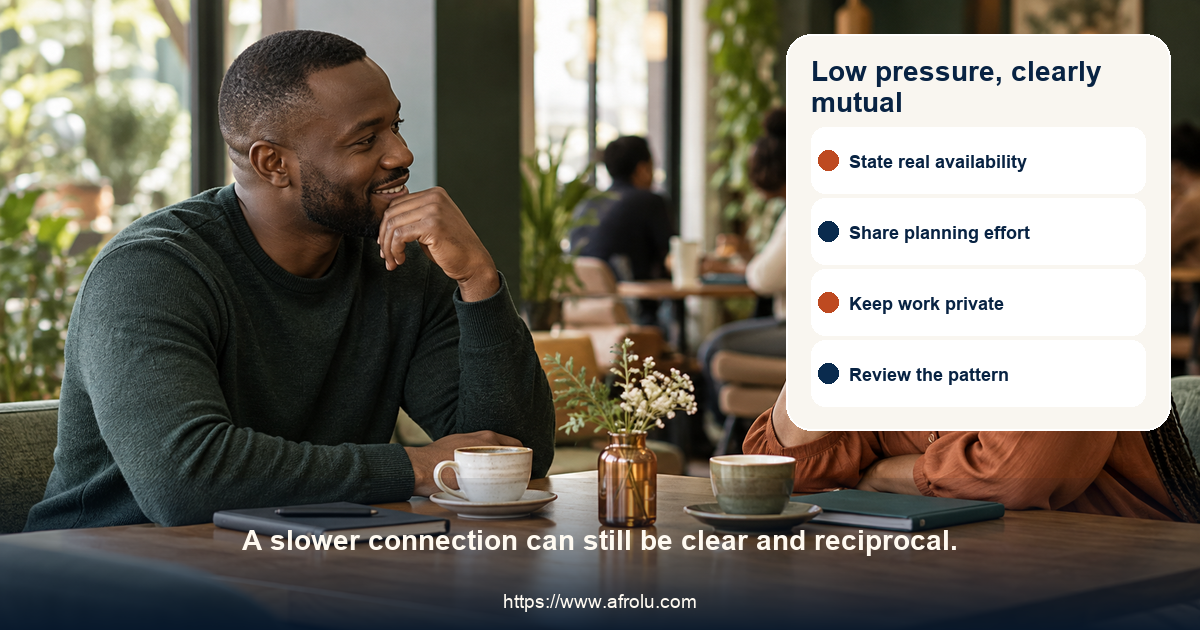
Name a time window you can genuinely offer.
Written and edited by Tariro Ncube · Diaspora Dating Editor
Name the kind of relationship you want now and the schedule you can honestly sustain. Low pressure should include mutual planning, clear updates, a budget you choose, and respect for employer and client privacy. Choose a public meeting and independent return using your own current knowledge; compare repeated behavior rather than message speed or job title; and renegotiate when work capacity changes.
Dating basics · Professionals
How can I date at a low-pressure pace that fits professional life without accepting one-sided effort, workplace access, or vague terms?
Low-pressure professional dating is an adult-chosen pace that leaves room for work and private life while retaining enough clarity, reciprocity, and freedom for both people to choose. A career or Nairobi location does not determine emotional intent, venue safety, income, or availability; those facts and boundaries should be discussed individually.
After a demanding week, Wanjiku and Peter want to see whether their connection can grow without adding pressure. She can meet twice a month and does not share client details; he prefers spontaneous weekday plans. They compare what each can realistically offer and choose one weekend afternoon. If their schedules do not fit, neither has to pretend that a job title or a warm message settles the question.
Nairobi professionals · pace and reciprocity
A full work life can coexist with a clear dating offer
Separate workload from intention, slow contact from one-sided effort, and location choice from unverified safety claims.
Offer a realistic window, protect professional privacy, choose independent logistics, and review what repeats.
What can I sustain?
Offer a real schedule rather than a job-title promise.
Who plans?
Notice shared effort across several interactions.
What stays at work?
Keep clients, systems, and colleagues out of dating.
Can I leave independently?
Choose a place and route from knowledge you trust.
Nairobi professionals · capacity · pace
Low pressure should describe a pace you choose, not a person disappearing behind a job title
Professional life can come in shifts, client deadlines, travel, on-call periods, long meetings, or a calendar that changes with little notice. Two adults may not be free at the same hours, and nobody has to prove that work is important enough to deserve a boundary. Say what is true for the next few weeks: perhaps you can meet on alternate weekends or prefer a planned call after work.
Low-pressure dating is not a promise to text constantly or to make an immediate decision about the future. It can mean that both adults are curious, make plans they can keep, and leave room to change their minds. It should not mean one person sends only last-minute invitations, avoids every question, or expects the other to remain available whenever their own schedule opens.
Separate pace from intention and intention from conduct. A person may want a serious relationship but have limited capacity today. Another may want a casual arrangement and still be direct, considerate, and reliable. Ask which term matters to the next choice: how often to meet, whether you are exclusive, or what sort of connection each person can offer now. The answer can be a mismatch without making anyone defective.
Choose the smallest plan that fits your real week. An hour in a public place may tell you more than a full evening squeezed between obligations. If you are too tired to be present, reschedule or decline rather than treating a date as another performance target. A workable rhythm should leave space for work, rest, friendships, and the other parts of life that keep you grounded.
reciprocity · observable patterns
Fewer messages can be low-pressure; one-sided plans and repeated uncertainty are a different problem
When work is demanding, fewer messages may be a healthy preference. The question is whether the agreed rhythm leaves both adults informed and able to make plans. If a call is postponed, does the person propose a time they can keep? If weekends are limited, do both people take turns suggesting something realistic? Reciprocity is about shared responsibility, not equal minutes on a screen.
Low effort often appears as a structure one person must maintain: you initiate, accommodate short notice, absorb cancellations, and receive no usable answer about what the relationship is. A job may explain temporary unavailability, but it does not require you to accept indefinite ambiguity. Describe the effect you notice rather than accusing the other adult of a hidden motive you cannot verify.
Try one clear, low-stakes invitation that fits your own availability. Offer a day and a public activity, then notice whether the person accepts, suggests an alternative, or leaves every next step to you. This is not a secret test. It is a chance to see whether the two schedules and the effort involved can meet under ordinary conditions rather than only during a burst of attention.
People can prefer different frequencies and still be respectful. One may want to meet weekly; another may manage twice a month. Share what each pattern means to you and decide whether the gap is livable. You do not need to call a person unsafe because the preference differs, and you do not need to keep dating because their reason is understandable. A calm mismatch remains a valid reason to choose differently.

Look at what both adults contribute.
career · confidentiality · personal access
A date needs enough information to plan with you, not access to your employer, clients, colleagues, or systems
It is reasonable to say that you work late on certain days, travel periodically, or cannot answer a personal call during a shift. It is different to share a client name, confidential brief, staff roster, internal calendar, badge, or screenshot that identifies where you will be. Keep other people's data out of a new connection and avoid turning a workplace into a date location before you have chosen that access.
A job title can be a useful broad description, but it should not become a proxy for wealth, availability, authority, or trustworthiness. If someone wants to verify your role through your manager, colleagues, or employer systems, you may decline. You do not owe a professional reference to a date. Be equally careful not to use another person's work credentials, client list, or access as leverage for attention or advantage.
Keep the transition from professional contact to dating explicit. If you already know the person through work, consider whether there is a reporting, client, procurement, or other dependency that could affect either adult's freedom to say no. Workplace policies may differ, so check the rules that actually apply rather than assuming. When power or confidentiality is involved, keeping the two roles separate can protect both people.
Notice how a boundary is handled. Respect may look like choosing another time, avoiding work calls, and accepting that you will not name a client. Pressure may look like contacting reception, colleagues, or a shared work channel after you asked them not to. If unwanted contact becomes persistent, keep relevant records where safe, use appropriate platform or workplace reporting routes, and seek local support without handling the access problem alone.
Nairobi context · first meetings · independence
Choose a meeting point and route based on your own familiarity rather than an unverified promise about a venue or commute
Nairobi work and commute patterns vary by neighborhood, hour, job, and individual circumstances. Rather than relying on a generic list of 'safe spots,' choose a public setting you can assess using your own current knowledge. Consider how you will arrive and leave, whether the timing works with your commitments, and whether the plan still feels manageable if it ends after one conversation.
Keep the first meeting separate from an office, client site, residence, or work event. A new date does not need your exact route, live location, building entrance, or regular leaving time. You may tell a trusted person the general plan if that helps you, but avoid sharing location access with the match as a requirement. Independent transport or a backup option can keep the decision yours if plans change.
Agree on the place and duration before setting out. If the other adult changes the destination after you arrive, treat that as a new proposal rather than an extension you already accepted. You may remain in public, choose another option after considering it, or leave. A colleague's recommendation, a polished venue, or the person's confidence cannot guarantee what the interaction will be like for you.
Do not read every logistics difference as a character judgment. A person may be unfamiliar with your preferred area or have a different schedule. Share the practical constraint and see whether you can find a mutually workable public plan. If someone insists on collecting you, arriving at your workplace, taking you to an undisclosed location, or preventing you from leaving, prioritize your immediate safety and contact trusted or appropriate local support.

Keep an exit and a return plan under your control.
spending · status · financial pressure
A polished job title or expensive invitation does not make a dating arrangement more honest or more serious
Two professionals may have very different incomes, debt, family commitments, or financial priorities. Do not assume that a senior title means someone can or should pay. Suggest a plan at a level that feels comfortable, and let the other person offer a different option. If the cost is not right for you, declining it is enough; you do not need to reveal salary, savings, or account balances to justify a boundary.
A generous date remains a gift only when it does not become leverage later. Paying for dinner cannot buy an extension, a private meeting, an introduction to a client, sexual access, or a promise of exclusivity. Make a fresh choice about each step. If you feel indebted because someone covered a cost, you may settle the agreed amount if appropriate and still end the date or connection.
Be cautious when a new romantic contact asks to borrow money, route a payment, invest, share a one-time code, or use your professional standing to solve an urgent problem. A convincing work story can still require independent checks. Keep personal finances separate from a new relationship, verify through a source you locate yourself, and speak with a trusted person before making a transfer. Do not share credentials to demonstrate care.
Status can also create an uneven conversation. If one person controls a work opportunity, referral, contract, or evaluation the other depends on, ask whether both can decline freely and whether the professional relationship should remain separate. Do not turn career access into a promise of dating, and do not accept an offer that makes your no feel professionally costly. Outside advice may help you assess the actual policy and power involved.
communication · scheduling · digital boundaries
A realistic contact agreement can respect demanding work without turning availability into a live status report
If both adults travel, work shifts, or have periods when phones must stay away, choose a simple system. You might confirm the day before a date and send an update if the plan changes. That is different from requiring screenshots, read receipts, calendar credentials, or immediate responses. A useful agreement gives each person enough information to plan while leaving private time intact.
Be truthful about capacity without using work as a permanent shield from every conversation. If you cannot offer regular dates, say that before the other person builds expectations. If your capacity changes temporarily, explain what changed and what you can still do. The other adult may want more than you can offer. Let them decide rather than asking them to wait without a clear return point.
Do not use a partner's professional calendar or client schedule to track them. A delayed response during a meeting or commute does not authorize work calls, contact with colleagues, or visits to an office. If someone repeatedly asks where you are, checks your status, or treats an unavailable phone as evidence of betrayal, discuss the limit once if safe and assess whether the pattern respects your autonomy.
Choose a channel and level of disclosure that make sense for the relationship stage. You can keep an early conversation on the dating platform, share a personal number later, or decline to connect professional profiles. Consider what a public work page reveals about routine and colleagues. Digital access should grow by choice over time; a serious or low-pressure label does not eliminate the need for permission.

Ask what low pressure looks like in actual plans.
review point · relationship type · next step
The right dating type is low pressure for both adults, not only convenient for the person with the least time
Review observable events instead of guessing at intent. Who suggested the last few plans? Were changes communicated? Did each person get to choose a day, a cost, and an end time? Could you say no to a last-minute invitation without being punished? The pattern is not a scorecard; it helps you see whether the arrangement distributes effort and flexibility in a way you can live with.
If you want a more serious connection, ask what that means now rather than interpreting a title, career success, or future plan. If you prefer casual dating, state the limits that keep it fair, including the information another adult needs for consent and informed choices. Both preferences can coexist with kindness. What matters is whether each person understands the offer and can choose it without being misled.
When work changes, update the agreement if it affects the other person's decisions. A new role, travel period, caregiving responsibility, or burnout may make a previous rhythm unrealistic. Say what you can offer now and invite an honest response. You are not required to preserve the connection by sacrificing sleep or professional privacy, and the other adult is not required to accept a schedule that leaves their needs unmet.
You may continue at the current pace, agree on one concrete adjustment, or end the arrangement. A respectful ending does not require a private office visit or a long explanation. If unwanted contact spills into work or continues after a clear no, save relevant evidence where safe and use appropriate support. Your job and dating life can intersect without allowing one to become a route for controlling the other.
Eight professional dating moments involving capacity, Nairobi logistics, money, and work access

The only free slot is last minute
A match repeatedly proposes plans after you have already committed to work or rest.
Offer a time you can keep and notice whether planning becomes mutual.The screenshot request
Someone asks for a work calendar or meeting screenshot to verify why you are unavailable.
Give a realistic window; keep employer systems private.The surprise visit
A person appears at your workplace after you said you were busy.
Protect your work access and involve trusted or appropriate support.The undisclosed destination
A date changes the meeting point and offers to drive you somewhere unfamiliar.
Choose again and keep a return plan you control.The referral with strings
A work introduction or opportunity is mentioned alongside pressure to continue dating.
Separate professional help from romantic consent and seek outside advice.The urgent investment
A new connection asks for funds or an account code to solve a work-related emergency.
Pause, verify independently, and share no credentials.A quiet week becomes a verdict
A busy period leads one person to infer rejection or demand live updates.
Discuss the agreed contact rhythm instead of surrendering constant access.Low pressure means no plans
One adult wants a calm pace; the other is left to initiate every meeting.
Name the pattern and decide whether the offer is reciprocal enough.Fourteen signs of a reciprocal, work-compatible, low-pressure arrangement
Each adult can describe a work-compatible dating rhythm honestly.
A slower pace still includes plans and updates both people can use.
A job title is not treated as proof of money, trust, or availability.
Neither person shares client data, employer credentials, or staff details.
The meeting point is chosen by both adults and can be assessed independently.
Transport and an end time remain under each person's control.
Costs fit a limit each adult can choose without explaining salary.
A paid date never creates a claim on intimacy or another meeting.
Work changes are communicated without handing over a calendar or location feed.
A date can be declined without office contact or professional consequences.
Both adults suggest plans rather than one person carrying the connection.
Professional authority or referral power is kept separate from romance.
A serious or casual label is translated into present behavior and terms.
A no or ending is respected across personal and work channels.
A decision map for schedule shifts, privacy, workplace overlap, spending, and endings
| Situation | What it may mean | What to do next |
|---|---|---|
| I can meet twice a month | Capacity is finite, even if interest is real. | Offer the rhythm plainly and let the other adult choose. |
| They say low pressure | The phrase may describe pace or may avoid useful clarity. | Ask what contact and planning look like now. |
| I arrange every date | Effort may be uneven despite warm messages. | Ask for a specific counterproposal and observe the pattern. |
| They ask for my calendar | Scheduling may be used to request workplace access. | Share availability, not systems or colleagues' details. |
| A public plan changes | The new place needs a new yes. | Stay with the original or leave using your own route. |
| A client or referral is involved | Work authority could affect freedom to decline. | Check relevant boundaries and seek independent advice. |
| The cost feels uncomfortable | The activity may exceed your chosen budget. | Offer an alternative or decline without disclosing income. |
| A transfer is requested | Romance does not verify an emergency or investment. | Do not send funds or codes; check independently. |
| My work pattern changed | A previous contact rhythm may no longer fit. | Explain your current capacity and propose a review point. |
| I want to end it | Neither a calendar nor a title requires further access. | Close the connection in a channel that feels appropriate and safe. |
Twelve scripts for offering a real window while protecting work boundaries
“What kind of connection are you open to building at the moment?”
“My current schedule allows one planned date every other weekend; how does that fit for you?”
“What does a low-pressure pace look like to you in actual plans and contact?”
“Could you suggest our next plan, including a time that works for you?”
“I do not share client names or internal calendars, but I can tell you when I am free.”
“I need a little notice for an evening plan; same-day invitations are hard for me to accept.”
“I would rather meet at a public place we each choose and arrange my own way home.”
“I prefer a plan within this budget and to cover my own part.”
“Because our work roles may overlap, I want to understand any policy before we date.”
“This week is unusually full; I can offer a short call Sunday or plan for next weekend.”
“I do not share live location or calendar access, but I will update you if our confirmed plan changes.”
“I do not want to continue dating. Please keep personal contact outside my workplace.”
Know the difference
Low-pressure pace versus low-effort professional ambiguity
Limited time is stated honestly; plans are shared; work privacy, spending limits, and changes are respected.
Only one adult initiates, availability stays vague, work systems become proof, and the other person absorbs every change.
Busy lives need clear terms, not constant access or indefinite uncertainty.

Compare shared effort instead of job status.
A calm pace is mutual; one-sided convenience is not
| Type or dimension | What it describes | Best next question |
|---|---|---|
| Low-pressure | A mutually chosen pace with enough clarity to plan. | Agree on a realistic frequency and communication window. |
| Low-effort | One person repeatedly carries invitations, updates, and rescheduling. | Name the pattern and request a workable counterproposal. |
| Casual | A current arrangement whose boundaries are defined by both adults. | Ask what it means for exclusivity and contact. |
| Serious | A desired direction that still needs present terms and capacity. | Ask what the intention changes this month. |
| Busy-season dating | Availability may be temporarily narrower due to actual work demands. | Set a review point instead of indefinite waiting. |
| On-call schedule | Plans may need backup options and clear updates. | Offer only a window you can realistically protect. |
| Workplace overlap | Professional duties may affect privacy or consent. | Check applicable policies before relying on assumptions. |
| Public first meeting | A setting chosen for independent access and a clear exit. | Choose a place you can assess yourself. |
| Undefined | A useful term has not yet been agreed despite ongoing contact. | Ask the question that changes your next choice. |
A simple plan you can use today
Capacity is not a title
Describe actual availability rather than relying on a job label.
Slow can still be reciprocal
Mutual planning matters more than message volume.
Work privacy is ordinary
A date can be scheduled without employer access or client details.
Local logistics are personal
Choose a meeting and route using current knowledge you trust.
Status is not consent
A paid bill, referral, or professional favor creates no romantic debt.
Review what repeats
Patterns give more information than one busy day or warm message.
Questions organised by purpose and depth
Choose a few prompts that fit the moment. This is a reference library, not a list to complete.
The pace
Define low pressure in observable terms.
- How often can I meet?
- Who plans the next date?
- What update do I need if a plan changes?
The work boundary
Keep scheduling distinct from access.
- What can I share about availability?
- Which client or office details stay private?
- How will I respond to workplace contact?
The Nairobi plan
Choose logistics that fit your own knowledge.
- Do I know the setting?
- Can I leave independently?
- What is my backup if the plan changes?
The review
Use repeated behavior instead of professional status.
- Did both adults contribute?
- Could I hold my spending limit?
- What would I ask to change?
What deserves a closer look
Translate workload into an honest offer
A realistic window helps both adults choose without converting a job title into a promise about emotional availability.
Evidence limit: Work patterns vary; no template predicts an individual's capacity.
Separate slow pace from one-sided convenience
Observe who suggests plans, communicates changes, and has room to say what they want over time.
Evidence limit: A single cancellation cannot establish a pattern.
Keep professional systems outside romance
Client data, staff details, credentials, internal calendars, and secure locations should not become proof of interest.
Evidence limit: Workplace policies differ by employer and role.
Choose plans from your own current knowledge
Assess the setting, route, time, and exit yourself instead of relying on generic venue or traffic claims.
Evidence limit: This guide does not certify locations or transport options.
Keep money and opportunity free of romantic leverage
A bill, referral, contract, or work favor cannot replace consent or create an obligation to continue.
Evidence limit: The guide cannot interpret a specific employment policy.
Let repeated agreements guide the next step
Compare the label with shared effort, follow-through, privacy, and how a no is handled.
Evidence limit: Editorial guidance cannot verify another adult's motives.
Shortcuts that turn a career or calendar into a relationship verdict
Treating a title as a personality
Employment cannot prove emotional capacity or honesty.
Calling every busy week rejection
Schedules vary; repeated broken agreements are more informative.
Accepting permanent ambiguity as low pressure
A calm pace still needs enough information for both people.
Sharing a client calendar
Professional information may belong to other people and systems.
Spending to match status
An expensive outing cannot prove a compatible connection.
Using a referral as leverage
Career access should not determine whether someone can refuse dating.
Plan for professional capacity, compare effort, or prepare for a first date
Choose a guide that fits the question in front of you. Afrolu does not verify a venue, another person's job, or a workplace policy.
Explore the guide library
Show more related guides
Continue with Afrolu
Show more Afrolu guides
Sources used for this guide
Afrolu reviewed these health, research, safety, or public guidance resources while editing this page. They support the behaviour and safety guidance; they do not diagnose any individual described by a reader.
Questions about Nairobi professional dating at a low-pressure pace
What does low-pressure dating mean for busy professionals?
It means a pace both adults can choose and discuss, not a rule that one person must accept unclear or last-minute access.
How often should professionals meet?
There is no universal frequency. Agree on a rhythm that both people can realistically maintain.
Is a slow reply a sign of low interest?
Not by itself. Compare the pattern with agreed plans, updates, and mutual effort.
Should I share my work calendar with a date?
No. Give an availability window and keep employer systems and client details private.
How should we plan a Nairobi first date?
Choose a public place and route you can assess using your own current knowledge; this guide does not rate venues.
Can I decline an expensive invitation?
Yes. Suggest a cost that fits your budget or decline without disclosing your income.
Does a paid date or work referral create an obligation?
No. Money or professional help cannot create consent or a duty to continue.
What if a date and I work together?
Consider any reporting, client, or policy dependency and seek independent guidance where relevant.
Can my availability change during a busy period?
Yes. Explain what you can offer now and let the other adult decide whether it fits.
Is this a local safety or employment-policy guide?
No. It is general editorial guidance and does not certify venues or interpret a specific workplace policy.
One thing to do now
Choose the next plan both adults can actually keep
State the relationship type and availability you can offer, agree on planning and update expectations, protect work systems and client information, and choose a public meeting with an independent exit. Review who adapts and follows through across several interactions. Treat a mismatch as information; do not equate a career, expensive date, fast reply, or local venue with trust or commitment.