Professional trust grows through reliability, not access to calendars and systems
Set Safe Long-Distance Dating Boundaries as a Professional
Professional long-distance dating boundaries for work privacy, travel, communication, money and consent without workplace or location control.

Verify identity, protect work, separate money, and control travel.
Written and edited by Grace Mutiso · Kenya Guides Editor
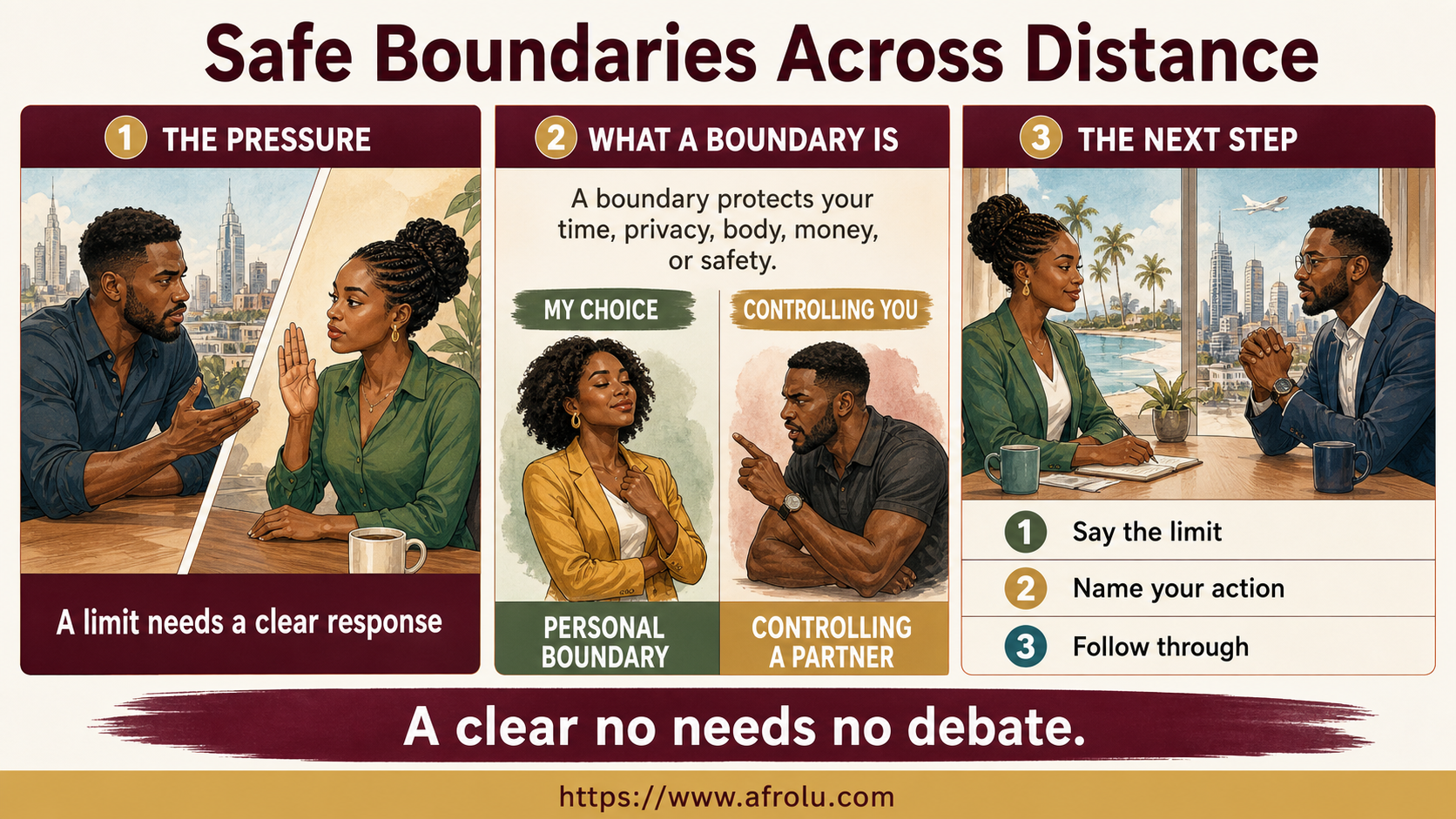
Agree on broad call windows, confirmation deadlines and visit plans while keeping client data, calendars, devices and live location private. A boundary governs your availability and participation; a request may be declined; an agreement is reciprocal. Password demands, workplace contact or compulsory tracking are control. Use separate travel funds and lodging, verify independently and keep consent current.
Healthy communication · Professionals
Can both people agree on reliable contact and visits while each retains authority over work systems, location, money, travel and physical access?
A professional long-distance dating boundary limits one's own work disclosure, communication, travel, spending or intimacy and names the action that follows a breach. It differs from a mutual agreement and must not become a rule controlling another adult's colleagues, calendar, device or movement.
Kendi and Robert scheduled two weekly calls across time zones. During a deadline, Robert demanded calendar access and began messaging Kendi's colleague for updates. Kendi revoked workplace contact, kept client schedules private and said future calls required respect for that wall. The relationship could ask for reliability; it could not enter her workplace.
Dating clinic
Make the advice usable in a real conversation for professionals
The same dating pattern can require a different response when you are needing a practical framework for busy schedules. Here, distance, calls, and planning and safety and emotional stability shape the advice.
Use one sentence, one boundary, and one behaviour check instead of a long speech.
Who this is for
Someone who wants to be kind without over-giving. this version is tuned for needing a practical framework for busy schedules.. Use the parts that match your situation and leave any rule that ignores your actual life.
Distance-Aware Dating
Factor in distance, calls, and planning; timing and practical limits can change what a workable next step looks like.
Safety-first
Judge the next move by whether it protects safety and emotional stability, not by whether it keeps a match alive at any cost.
Faster Pace
The suggested move should still work at a faster pace: clear enough to act on, calm enough to avoid panic.
Real dating life
Where this usually begins in a normal connection
Dating boundaries are clear limits around how you will participate in a connection and, when needed, what you will do if a condition is not respected. They protect resources such as time, money, privacy, physical consent, emotional pace, faith, family responsibilities, and safety. For professionals, the useful question is how this pattern changes when distance, calls, and planning and safety and emotional stability both matter. For someone who wants to be kind without over-giving. This version is tuned for needing a practical framework for busy schedules., the experience rarely feels neat while it is happening. It usually begins as a small mismatch between what the person says and what the pattern shows. In a distance-aware dating context, that mismatch can feel louder because of distance, calls, and planning. Notice it early, but do not turn one awkward moment into a verdict.
Many people discover a limit only after resentment arrives. They over-explain because they want permission, announce a consequence they cannot keep, or call every preference a boundary. A better boundary is smaller: name the protected resource, state the available behavior, and choose your own next action. In this edition, the pressure point is distance, calls, and planning: the same behaviour can feel different when your time, privacy, family rhythm, or future plan is already stretched. The useful response combines words you can say, safety habits you can keep, and a decision you control. The goal is not to become cold; it is to stay open without abandoning your judgment or safety and emotional stability.

Urgency is not proof of commitment.
Signals
What to notice when feelings get loud
The strongest signal is repetition. One late reply, one nervous date, or one clumsy sentence does not define a person. When the same behaviour keeps returning, it deserves attention. Ask yourself: How do you protect your standards without building a wall? For professionals, what changes when the goal is safety and emotional stability?
For professionals, dating boundaries works best when you keep safety and emotional stability visible, respect distance, calls, and planning, and choose a faster pace instead of copying someone else's dating rhythm. A calm answer matters because panic makes patterns harder to read. Pause long enough to separate facts from fear: what happened, how often it happened, what you asked for, whether the answer changed anything, and whether the pace still feels like faster pace.

Repeated surprises, secrecy, emergency transfers, and deadlines require a pause.
What to say
Language that protects clarity without drama
Most dating confusion gets worse because people wait until they are hurt before they speak. A short, steady sentence often protects more dignity than a dramatic speech. You are not trying to win a debate. You are trying to make the next step visible.
The best wording is specific and easy to answer. Say what you noticed, say what you need, and leave room for the other person to respond honestly. If they cannot handle a reasonable sentence, that is useful information too.

A respectful answer can survive a pause.
App strategy
Choosing a dating environment that supports the advice
App filters and verification tools help only after your own rules are clear: public first meetings, no early transfers, limited private data, a sustainable message rhythm, and a physical pace you can change at any moment. More apps are not the default answer to an emotional problem. Sometimes the smarter move is fewer matches, clearer filters, and more patience before paying for premium.
If you do use apps, choose them around the behaviour you want to encourage. A serious relationship goal needs more profile context. A safety concern needs better verification habits. A confidence reset needs lower volume and better pacing. Choose one useful test instead of opening every app at once.

Verify, meet publicly, pay independently, retain lodging, and share the itinerary.
Takeaway
The simple standard that keeps the page useful
Use the first two signals as a pattern check: you feel resentment because access has become expected rather than chosen and you keep saying yes while hoping the person notices your discomfort. If those repeat, ask once, slow the pace, and choose the response that protects safety and emotional stability. This rule is simple enough to remember under pressure, which is why it matters. Good dating advice should still work when you are tired, hopeful, nervous, or disappointed.
A boundary is not the sentence that changes them. It is the decision that guides you. For professionals, clarity has to survive distance, calls, and planning. Save that line, send it to a friend, or use it as a quiet check before you reply. Dating becomes healthier when you stop treating every uncertain person as a verdict on your future.
Make reliability visible without making professional life inspectable
Build a communication and travel system that stops at the workplace boundary
Agree on call windows, missed-call repair and visit confirmation without exposing calendars, clients or devices. Your boundary is the information you withhold and the action you take; controlling rules attempt to police another adult's work.
Keep colleagues, employers and professional profiles outside relationship monitoring. Repeated workplace contact, impersonation or threats require documentation and appropriate workplace, platform, legal or security support.
Fund travel independently, use separate lodging and verify emergencies outside the romance. A reunion does not purchase room access, time or sex, and either adult can leave without professional or financial retaliation.
Three ways this can show up
A broad window is enough
A partner requests full work-calendar and client-location access to verify availability.
Verdict: share only broad availability, protect confidential systems and end access demands that treat privacy as guilt.The workplace is not a relationship help desk
A distant partner messages colleagues when a call is missed.
Verdict: state no workplace contact, alert appropriate work support and block or escalate repeated intrusion.Professional language does not verify money
A match requests an urgent transfer for a deal or travel disruption.
Verdict: do not transfer or share accounts; verify independently and keep dating separate from investments or rescue finance.Shared geography does not create consent
A partner expects access to a hotel room because both are finally in one city.
Verdict: keep separate lodging and transport, say no clearly and use hotel, security or emergency support if needed.What to notice before you react
You feel resentment because access has become expected rather than chosen while distance, calls, and planning is already shaping the connection
You keep saying yes while hoping the person notices your discomfort even after the pace is named as faster pace
A small no leads to bargaining, guilt, ridicule, or repeated testing and it starts affecting safety and emotional stability
The same limit is crossed after clear communication and an apology instead of becoming easier to discuss
Read the moment without overbuilding the story
| Situation | What it may mean | What to do next |
|---|---|---|
| The first signal | You feel resentment because access has become expected rather than chosen while distance, calls, and planning is already shaping the connection | Notice it, but do not build a full story from one moment in distance-aware dating. |
| The repeated pattern | You keep saying yes while hoping the person notices your discomfort even after the pace is named as faster pace | Ask one clear question and watch whether behaviour changes after the answer. |
| The boundary test | A small no leads to bargaining, guilt, ridicule, or repeated testing and it starts affecting safety and emotional stability | Slow access if your limit is ignored, mocked, or negotiated endlessly. |
| The decision point | The same limit is crossed after clear communication and an apology instead of becoming easier to discuss | Choose the action that protects safety and emotional stability, safety, and honest intent. |
Three calm ways to start the conversation
““I can share call windows, not my client calendar, device access or live work location.””
““Do not contact my colleagues or employer about our relationship. Repetition will end contact.””
““We confirm visits by a deadline and each keeps lodging, transport, funds and a return plan.””
““Distance, expense and relationship status do not decide room access or physical consent.””
Know the difference
Boundary vs Wall
A clear limit that keeps connection respectful.
A defensive block that avoids all vulnerability.
Good boundaries protect warmth; they do not remove it.

Continue slowly, verify, pause, or leave and seek help.
Compare the closest dating types before choosing a label
| Type or dimension | What it describes | Best next question |
|---|---|---|
| When to Delete Dating Apps: Pause, Uninstall, Cancel or Close the Account | Both sit near healthy communication, but this page is reading the pattern through distance, calls, and planning and the related guide uses a different signal mix. | Use this guide first for safety and emotional stability, then compare with When to Delete Dating Apps: Pause, Uninstall, Cancel or Close the Account if the label still feels uncertain. |
| Ghosting in Dating | Both sit near healthy communication, but this page is reading the pattern through distance, calls, and planning and the related guide uses a different signal mix. | Use this guide first for safety and emotional stability, then compare with Ghosting in Dating if the label still feels uncertain. |
| Situationships: Turn Closeness into a Clear Choice | Both sit near healthy communication, but this page is reading the pattern through distance, calls, and planning and the related guide uses a different signal mix. | Use this guide first for safety and emotional stability, then compare with Situationships: Turn Closeness into a Clear Choice if the label still feels uncertain. |
| Types of Dating: Build Your Five-Part Map | Both sit near healthy communication, but this page is reading the pattern through distance, calls, and planning and the related guide uses a different signal mix. | Use this guide first for safety and emotional stability, then compare with Types of Dating: Build Your Five-Part Map if the label still feels uncertain. |
A simple plan you can use today
What this means
In plain words: Dating boundaries are clear limits around how you will participate in a connection and, when needed, what you will do if a condition is not respected. They protect resources such as time, money, privacy, physical consent, emotional pace, faith, family responsibilities, and safety. For professionals, the useful question is how this pattern changes when distance, calls, and planning and safety and emotional stability both matter.
How to spot it
Watch the behavior twice before judging. If "You feel resentment because access has become expected rather than chosen while distance, calls, and planning is already shaping the connection" or "You keep saying yes while hoping the person notices your discomfort even after the pace is named as faster pace" keep repeating, the pattern is stronger than one awkward moment.
First step for professionals
Use this line once, then watch behaviour: I do not text while I am working. I can catch up this evening; if that rhythm does not suit you, we may not be a fit.
If this is not helping
If the same pattern continues after one clear conversation, stop arguing with the evidence. Slow the pace, reduce access, or step back using this boundary: A boundary is not the sentence that changes them. It is the decision that guides you. For professionals, clarity has to survive distance, calls, and planning.
What success looks like
The useful outcome is not perfect certainty. It is a decision that protects safety and emotional stability and leaves you less dependent on guessing.
Four mistakes that make this harder
Explaining until the other person finally approves your limit when the real issue is distance, calls, and planning
It turns one difficult moment into a larger emotional decision before you have enough evidence.
Attaching a severe consequence to every personal preference because professionals often need cleaner pacing
It gives uncertainty more attention instead of asking for the clarity or consistency you need.
Announcing follow-through you are not prepared to keep instead of asking for one specific next step
It replaces a direct, answerable conversation with guessing, testing, or pressure.
Treating guilt or disappointment as proof that the boundary is unkind when safety and emotional stability should be the standard
It keeps you invested in a pattern that is not protecting your time, safety, or relationship goal.
Use a reviewed resource that matches the decision
This guide focuses on the relationship decision, so it does not rank dating apps. Check current prices, safety tools, and local availability before choosing a service.
Explore the guide library
Show more related guides
Continue with Afrolu
Show more Afrolu guides
Sources used for this guide
Afrolu reviewed these health, research, safety, or public guidance resources while editing this page. They support the behaviour and safety guidance; they do not diagnose any individual described by a reader.
Set Safe Long-Distance Dating Boundaries as a Professional Questions
Is dating boundaries for professionals: safety-first in distance-aware dating always a bad sign?
Not always. One awkward moment can be human. It becomes important when the same pattern repeats and starts costing you safety and emotional stability, safety, or peace.
How soon should professionals bring it up?
Bring it up when the pattern is clear enough to name calmly, especially if distance, calls, and planning is already shaping the connection. You do not need a courtroom case; you need one honest sentence and a willingness to notice the reply.
Should I keep dating other people while I figure this out?
If there is no clear exclusivity agreement, it is reasonable to keep your options open respectfully. Keep the pace faster pace, and do not pause your whole dating life for someone who has not chosen clarity with you.
Can dating apps make this easier?
Apps can help when they give you better filters, profile context, and access to people with clearer intent. They do not replace boundaries, verification, or the consistency you observe away from the app.
What is the safest next step?
Use public meetings, protect private information, avoid early money requests, and slow down any connection that pressures you to ignore discomfort. Do not let distance, calls, and planning rush your decision.
Why does this guide include dating app links?
The app links offer an optional next step after the advice. Some may earn Afrolu a commission, but app fit, safety, and honest intent come before the commercial link.
Should long-distance partners share work calendars?
They can share broad availability voluntarily. Full calendars may expose confidential people, places and projects and are not proof of trust.
What if a partner contacts my employer?
State no workplace contact, preserve records and use workplace, platform, legal or safety support if intrusion continues.
Can I refuse business or travel money requests?
Yes. Keep accounts private, verify independently and never treat a transfer as required relationship care.
Does a rare reunion change consent?
No. Consent remains specific and reversible; travel cost and time apart create no physical obligation.
One thing to do now
Turn the lesson into a better match pool
Continue when communication and visits are predictable without workplace intrusion, surveillance or financial dependency. Pause or end contact when professional pressure, travel expense or relationship status is used to claim documents, location, money or sex.