Professionals · Nairobi pace and public choice
Low-Pressure Ghosting Guide for Nairobi Professionals
A low-pressure ghosting guide for Nairobi professionals: confirm plans, protect location, work and money, keep dates public, and leave safely when needed.
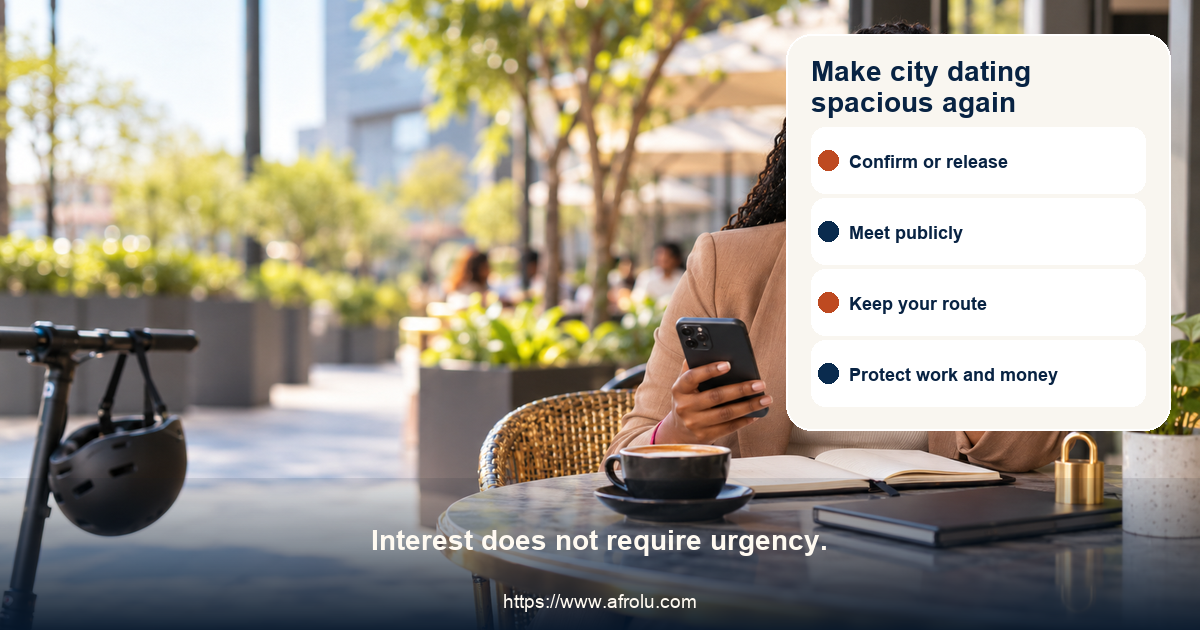
Keep the plan small and your choices large.
Written and edited by Miriam Otieno · Senior Kenya Editor
Do not let an undefined city-date plan run your calendar. Confirm a public plan or release the time, use no more than one useful follow-up, and keep your route, location, transport, work resources, money, accounts, and current consent under your control. A late location pin or apology does not require a private meeting, a ride, a referral, a transfer, or extra disclosure. If contact becomes repeated, coercive, financially urgent, threatening, monitoring, image-based, or frightening, reduce access and seek appropriate support.
Dating behaviour · Professionals
Is this an open city-date idea, a missed confirmation, a considerate reschedule, a return after silence, or conduct that uses location, transport, work access, money, social pressure, repeated contact, coercion, monitoring, threats, blackmail, or fear to reduce your choice?
Low-pressure ghosting for Nairobi professionals is a reduced or ended dating conversation that leaves a city-date plan or expectation unclear. It is not a judgement about a neighbourhood, job, status, background, or worth. The useful distinction is between an open suggestion, a missed agreement, a clear reschedule, a practical repair, a location or work request, a money request, repeated unwanted contact, coercion, threats, monitoring, blackmail, or fear.
Tariq has a full week and agrees to a short public coffee with a match. When the plan remains unconfirmed, he releases the evening and sees friends. The match later returns with a late location pin, an offer to pick him up, and a request for an event introduction. Tariq keeps the next decision small, public, and independent, recognising that a low-pressure date should make room in his city life—not take over his route, work, or attention.
professionals · Nairobi pace and public choice
Tariq stops letting one quiet city-date chat organise his calendar, location, work access, and choices
This guide separates ordinary urban dating ambiguity from patterns that make a professional’s time, movement, private location, work, money, body, or ending less freely chosen.
Name the actual plan, use a release point, protect independent movement, keep work and money separate, evaluate a return by conduct, keep shared spaces out of closure, and choose the next move that restores space.
Make room, not urgency
A busy city does not make a vague invitation more important than your life.
Confirm or release
A modest public plan can prevent waiting, traffic, and last-minute pressure.
Keep your route
Independent transport and location privacy preserve a clear way to leave.
Protect what outlasts a date
Work contacts, money, accounts, and reputation do not repair a quiet chat.
city life does not require constant availability
a low-pressure Nairobi dating rhythm can leave room for work, rest, friendships, privacy, public movement, and a genuine no
Professionals dating in Nairobi may balance changing work hours, traffic, family commitments, social invitations, exercise, faith or community activities, travel, and the ordinary need for quiet time. A new match can feel exciting precisely because it seems to offer a break from routine. When the conversation goes quiet, or a plan appears late, that excitement can turn into pressure to be more available than you intended. Start by returning to the facts: was there a confirmed plan, a loose idea, a missed agreement, a clear return, or a request that asks for more access than you want to give?
Low-pressure dating does not mean low-effort dating. It means the connection can develop without one adult having to cancel everything, reveal a private route, fund a plan, give work access, or manage another person’s disappointment. You can enjoy a spontaneous coffee, a public event, a short call, or a slow exchange of messages. You can also prefer plans that are confirmed before you leave work, travel across town, or make space in your weekend. Neither preference makes you difficult.
A quiet chat may be an ordinary ending, a mismatch in communication style, or a sign that someone has less capacity than they suggested. You do not need to solve the reason before deciding what works for you. One practical message can close an open plan; after that, you can make your own evening. Repeated calls, showing up at a venue, checking every social post, or asking colleagues and mutuals for updates will not make a connection more mutual. It can make a simple disappointment take over more of your life.
The city itself is not a risk factor, and neither is a person’s neighbourhood, job title, background, or social visibility. Advice becomes more useful when it focuses on conduct: whether a person respects a public plan, accepts independent transport, keeps money and professional resources separate, receives a no without pressure, and leaves you able to choose where, when, and whether the next contact happens. Those are the conditions that make dating feel lighter rather than more complicated.
make a city-date plan easy to answer and easy to release
a little specificity can replace the cycle of traffic, waiting, last-minute changes, and resentful guesswork
Offer a plan that fits the scale of a new connection. A short public coffee near a route you already use, a daytime gallery visit, a walk in a busy area, a meal with a clear finish, or a call at a defined time can be enough. Avoid making the first plan a complex excursion, a long drive, a private home, or an expensive event that is hard to leave. Simple plans remove the pressure to continue when either person is tired, delayed, no longer interested, or simply ready to go home.
Name a confirmation point that lets you make an alternative plan. “If we have not confirmed by four, I will use the evening for something else” respects both adults. Someone who cannot make it can say so, suggest another time, or let the plan go. If confirmation does not arrive, do not sit in traffic, remain dressed for a date, or send message after message trying to turn an old suggestion into an agreement. Release the time, feed yourself, see friends, rest, or follow through with your own plans.
A thoughtful change includes practical information and a new option. “Traffic has held me up; I cannot make seven, but I could do lunch Saturday” is different from “I am nearby, come now,” “Wait for me,” or “You should have kept the night free.” The first leaves you a choice; the second asks you to absorb uncertainty or urgency. You can accept a reschedule, offer a different public time, or say that last-minute plans do not work for you. The response does not need a long negotiation.
If a person reappears after a quiet period, decide whether the new message creates a real plan or merely restarts suspense. Warm banter, a late-night location pin, a promise of a ‘better place,’ or an invitation to a private apartment may be flattering. You can enjoy city dating without being hurried into a setting that makes it harder to leave, changes your transport, or reveals your private routine. A later public plan is always an available option; so is no plan at all.
keep public movement and personal location under your control
a date should not require you to reveal a home address, work route, live location, or ride plan before you want to
Choose meeting places and timing that you can navigate on your own terms. You may prefer a venue you already know, a daytime time slot, a busy public setting, or a location close to an independent route home. You do not need to disclose where you live, where you work, what route you take, or where you will be later in the evening. A date can know enough to meet you without being handed a map of your life.
A ride can be thoughtful, and you are still allowed to decline it. Meeting at the venue and making your own way home gives you a separate exit if the conversation changes. Do not accept a pickup, drop-off, long drive, or change of location just because someone says it is more convenient, has paid for something, or has gone quiet and now wants to make up for it. Convenience is not the same as consent, and a ride does not create a claim on your address or your time.
Keep live location, photo backgrounds, work check-ins, travel plans, and private social accounts within your control. A person who has not earned more access may say that sharing location proves trust or makes a date safer. You can use your own support arrangements without giving a new match continuous visibility into your movements. If you want to tell someone you trust a broad plan, choose what you share and when. Safety planning should add choice, not create another form of monitoring.
If a person appears near your work, home, regular route, or social venue after you have not shared the information, asks other people to track you down, or uses a location request as a condition for contact, slow down. Do not meet privately to explain why you are uncomfortable. Reduce the access that feels safest to reduce, tell trusted people, use platform tools, and seek appropriate support if you are worried. A person’s desire for contact does not outweigh your ability to move freely.

Read conduct, not city stories.
keep professional access and money outside a quiet connection
urban dating can overlap with work and expenses without turning either into a relationship currency
A match may ask about your field, event, office district, clients, contacts, business ideas, or professional social circle. Ordinary curiosity is not a problem; access is different. You can speak in broad terms and keep the names, schedules, locations, referrals, work passes, meeting rooms, devices, and internal accounts private. A person who respects you can keep getting to know you without turning the date into a route toward an introduction or a resource.
Do not send, receive, lend, invest, hold, or route money for someone you are dating. A story about a ride, delivery, ticket, rent, medical issue, late payment, business opportunity, or emergency can be true and still not be yours to solve. Romance can make a request feel more personal, especially if it arrives after a quiet period and is paired with an apology or a future promise. Keep finance separate and use independent official channels if you suspect fraud or an unsafe transaction.
Protect digital access with the same calmness. Do not share a one-time code, a payment request, a work device, a booking reference, a calendar view, a password, a recovery link, a document, a business account, or a private contact list to prove trust. A person who says you are overreacting or unkind for declining is not asking for a small favour; they are asking you to put their urgency above your boundaries. You can stop the conversation there.
If a person uses work channels, public events, colleagues, clients, or reputational threats to keep a dating connection open, do not treat it as a question of urban dating sophistication. Keep necessary professional communication formal, narrow personal access, and use appropriate workplace or platform routes if behaviour continues. Your career and safety should not become the price of ending an undefined connection gracefully.

A small boundary can keep city dating light.
let a city-life return earn a slower, public restart
an apology can matter without cancelling the conditions that help you choose a date freely
When someone returns after ghosting, notice whether they name what happened in a simple way and offer a practical next step. “I missed our plan and should have told you; would a short coffee next week suit you?” gives you information and a choice. You may accept, suggest another time, say that the pattern does not work for you, or leave the message unanswered. You do not need a detailed explanation before deciding how much of your time you want to offer.
A return becomes less useful when it comes with pressure. Someone may want you to meet immediately, travel across town, enter a private space, lend money, join a work event, disclose a location, or prove that you are not upset. You can decline each request without arguing about whether their excuse was good enough. A compatible person can make a smaller plan later. If they cannot accept that, the connection may not be a low-pressure fit.
If you choose to restart, make it easy to observe the new pattern. Choose a short public meeting, independent transport, a clear finish, and no professional or financial exchange. Notice whether the person confirms, communicates a change, accepts a no, and avoids trying to escalate privacy or intimacy because they have been ‘given another chance.’ A restart should not require you to erase what you learned from the previous silence.
You may decide a restart is not worthwhile. A city has many ways to meet people, and scarcity thinking can make one return feel more important than it is. Let your standard be simple: does this person’s actual pattern leave me able to make plans, keep my resources private, and date without nervous calculation? If the answer is no, a concise ending or no response can be more respectful to yourself than another cycle of ambiguity.
end an urban dating mismatch without making it a public route
professional and social overlap can be managed with clear limits rather than public exposure, mutual pressure, or private negotiation
For a straightforward quiet connection, you can stop offering more plans. If you want to say something, keep it direct: “I am looking for a more dependable way of getting to know someone, so I am moving on.” You do not need to explain your home, work, schedule, expenses, or every missed message. A short boundary avoids creating a new conversation in which you have to defend why a low-pressure pace still needs basic respect.
Do not use professional groups, social media, venue staff, neighbours, colleagues, clients, or mutuals to locate, embarrass, or pressure a person over ordinary ghosting. Shared city spaces can make it tempting to seek a visible resolution, but public exposure can enlarge a private disappointment and create more routes for unwanted contact. Ask trusted people for support, not investigation. If you need to attend the same public event, plan your own arrival, departure, and support.
If someone returns with a request for a final drink, a ride, a private talk, an introduction, or a chance to ‘explain in person,’ decide whether you want it before you reply. You can decline without a counteroffer. You do not owe an intimate, private, or expensive meeting to prove that you are generous or mature. A brief written boundary, no reply, a block, or a public short conversation can each be appropriate depending on what leaves you safest and most at ease.
When contact becomes repeated, threatening, financially manipulative, image-based, monitoring, coercive, or frightening, use a safety-led exit. Limit access, preserve information only if it is safe, use platform and relevant workplace reporting routes, tell trusted people, and seek urgent local help if you think you are in immediate danger. You do not have to become smaller, less visible, or more accommodating to manage someone else’s refusal to accept an ending.

Choose the move that gives your space back.
let low pressure make Nairobi dating more spacious
the aim is not to control another adult’s response; it is to keep your own time, location, resources, and choices from being governed by uncertainty
Review the actual pattern. Could the person make or release a plan? Did they respect public venues, independent transport, privacy, and a clear finish? Did they keep work, money, devices, contacts, and social spaces separate from dating? Did a return after silence offer a small practical repair, or did it require urgency and access? The answers are more useful than someone’s charm, social status, neighbourhood, or explanation.
Notice what is changing in your own behaviour. Are you avoiding your usual plans to remain available? Taking routes you do not want? Sharing more location or work information than feels right? Spending money to keep someone interested? Looking for answers through social media, a mutual, or a professional contact? These are not reasons to judge yourself. They are signs that a boundary, a pause, a different plan, or an ending could make dating feel lighter again.
Choose one action for the next week that restores space. Set a confirmation cutoff, make a public daytime plan, meet at the venue, turn off location sharing, keep a work detail private, decline a money request, take an app break, use one follow-up only, ask a friend for support, or archive a quiet conversation. The action can be small. Its value is that it makes your choices visible before someone else’s inconsistency shapes them.
Nairobi is full of different people, schedules, dating goals, and ways of moving through city life. You do not need advice that turns any of those differences into a stereotype. Let observable respect be the standard: a plan you can choose, a boundary that is accepted, resources that remain yours, and an ending that does not cost you your safety. Low-pressure dating can be warm, discerning, and open without asking you to hand over more of yourself than you want.
Eight Nairobi professional moments after quiet contact
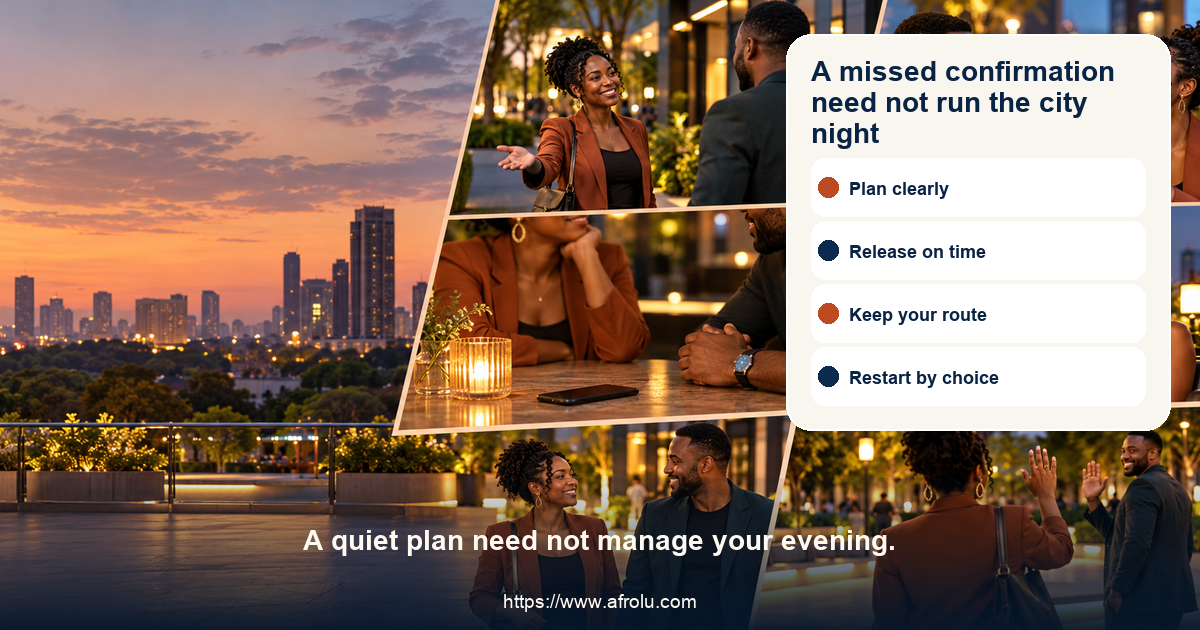
A plan stays open through the day
Two professionals mention meeting after work, but one never gives a time or venue and sends a late message asking whether the other is still nearby.
Treat the earlier idea as unconfirmed and use the evening as you choose.Traffic changes a plan with notice
A match says before the confirmation point that they cannot make the original time and proposes a specific public alternative on another day.
Consider the new option only if it works for you; notice that your time was released.A quiet match asks you to come immediately
After no reply around a planned date, a person sends a late location pin and says a better conversation needs to happen in private.
Choose a public time later, decline, or end contact; a pin does not settle your privacy or transport.A ride becomes a condition of dating
A match says they will only meet if they can collect you from home or drive you to the next stop after the date.
Meet at the venue or decline; independent movement is a valid boundary.A return becomes a professional shortcut
Someone who went quiet asks for a workplace event pass, a referral, a business introduction, or a meeting near your office.
Keep work access and professional networks separate from a dating repair.An apology is linked to a money request
A match says a delivery, ride, travel, rent, or business issue is the reason they disappeared and asks for a transfer or code.
Do not transact or share access; use independent official guidance if worried.Mutuals are asked to reopen a boundary
After you end contact, a person asks friends or colleagues to say that you are being unfair by refusing a final meeting.
Ask others not to relay messages and keep personal boundaries out of professional channels.Private location is used after an ending
A person contacts you from new accounts, mentions a place you often visit, and becomes angry when you do not reply.
Reduce access, preserve what is safe, report relevant channels, and seek support if the pattern causes fear.Signals about city plans, movement, location, work, money, consent, social space, and safety
They can make a public city plan with a time, place, confirmation point, and clear finish that either adult can change.
They respect a preference to meet at the venue and leave independently without treating a ride as a condition.
They accept that an unconfirmed plan does not own your work evening, rest, or social time.
They do not use traffic, a late return, a location pin, a ticket, or a paid meal to pressure a private plan.
They keep home address, work route, live location, social accounts, travel plans, and routines within your control.
They do not ask for professional introductions, office access, work devices, client details, referrals, or event passes as proof of interest.
They keep money, transfers, loans, investments, codes, and payment-account requests outside a dating connection.
They can repair a missed plan with acknowledgement, a specific public alternative, and respect for your answer.
They do not use social media, colleagues, mutuals, or city venues to locate, pressure, or embarrass you after quiet contact.
They respect a no to a ride, a location share, a late invitation, alcohol, intimacy, a private meeting, or a restart.
They do not make you feel that your job, address, reputation, money, or social visibility is the price of dating them.
They keep consent current and do not treat a date, gift, travel effort, or apology as permission for further access.
They respond to boundaries without repeated bargaining, reputational threats, monitoring, coercion, or emotional punishment.
They leave you able to move through your city, work, social life, and dating choices without fear or surveillance.
Choose a proportionate next move
| Situation | What it may mean | What to do next |
|---|---|---|
| A city-date idea stays vague | A suggestion did not become a plan that needs to occupy your evening. | Release the time and make another plan rather than repeatedly seeking confirmation. |
| A confirmed plan changes early | A practical disruption may have occurred, and a clear reschedule gives you a real choice. | Accept, offer another time, or decline based on your own availability. |
| They return with a late location pin | Urgency may be replacing a date plan and reducing your ability to choose the setting. | Choose a public alternative later, decline, or end contact. |
| They insist on a pickup or drop-off | Transport may be offered as convenience but can also create a route to your private location. | Meet at the venue and keep an independent way home. |
| They ask for a live location or routine | Reassurance language is being used to seek more access than a new connection needs. | Keep the information private and use your own support arrangement if useful. |
| They ask for professional help | Dating is becoming a route toward career resources or reputation. | Keep referrals, workspaces, devices, contacts, and events separate. |
| They ask for money or a code | Romance and urgency can create financial or digital exposure. | Do not transact or grant access; use independent official help if concerned. |
| They return with a clear public plan | A practical repair may be possible if the person accepts your answer and changes the pattern. | Try a small restart only if you genuinely want it. |
| They contact mutuals or work channels | A private dating boundary is being moved into social or professional spaces. | Ask others not to relay messages and keep necessary work contact formal. |
| You feel monitored or afraid | Threats, repeated unwanted contact, coercion, blackmail, or fear change the priority to safety. | Use a protected exit, reporting options, trusted support, and urgent help if needed. |
Twelve lines for plans, routes, work boundaries, money, returns, and endings
“If we have not confirmed by four, I will use the evening for something else.”
“I am open to a short public coffee near a route that works for both of us.”
“I have not heard back, so I am making other plans tonight.”
“I will meet you there and make my own way home.”
“I do not share my home, work route, or live location at this stage.”
“I do not mix professional introductions or work access into early dating.”
“I do not send, receive, lend, or move money in a dating connection.”
“If we reconnect, I would only be open to a specific public plan that works for me.”
“The stop-start rhythm does not work for me, so I am moving on.”
“I am not available for a private late meeting about this.”
“Please do not contact me through work, friends, or new accounts.”
“I am not discussing this further. I am taking steps to protect my privacy.”
Know the difference
An open city-date idea, a reschedule, a return, pressure, and fear need different Nairobi professional dating responses
A person can make or release a plan, respect public and independent movement, keep location, work, and money separate, and accept a no without making the city feel smaller.
Late private pressure, location demands, work shortcuts, money stories, social routes, repeated contact, monitoring, coercion, threats, blackmail, and fear make the connection less freely chosen.
Low pressure is not disinterest. It is keeping your city life, resources, and choices from being governed by uncertainty.

Low pressure has an observable rhythm.
Separate an open city-date idea, a reschedule, pressure, and fear
| Type or dimension | What it describes | Best next question |
|---|---|---|
| An open city-date idea | Interest exists, but no time, place, or confirmation makes it a real agreement. | Make your own plan until an invitation becomes specific. |
| A confirmed public plan | Both adults know the basic plan and how to release it if circumstances change. | Judge changes by whether your time remains freely usable. |
| A considerate reschedule | A change is communicated with a concrete alternative and no assumption that you will wait. | Accept only if the new plan suits you. |
| A late private return | Silence is followed by a location pin, pickup offer, or immediate private invitation. | Choose a public alternative later, decline, or end contact. |
| A location request | Your route, home, work, live location, or routine is framed as a condition of trust. | Keep it private and retain independent movement. |
| A work shortcut | Dating is used to seek referrals, event access, contacts, devices, or reputation. | Keep professional resources outside the connection. |
| A money request | Romance is paired with a transfer, code, loan, ride payment, investment, or urgent account story. | Do not transact or share access. |
| A social shortcut | Mutuals, colleagues, venues, or public posts are used to reopen or pressure a boundary. | Keep shared spaces out of private pursuit. |
| A safety concern | Repeated contact, monitoring, threats, blackmail, coercion, or fear appear. | Use a safety-led response and relevant support. |
Date in Nairobi with enough space to keep plans, routes, resources, and choices your own
Make city plans smaller
A modest public plan with a clear finish is easier to accept, decline, change, and leave.
Use a release point
A confirmation cutoff protects an evening from vague plans and late pressure.
Treat movement as a boundary
Independent arrival, departure, and location privacy can make a date more freely chosen.
Keep work outside dating repair
Referrals, work events, devices, contacts, and reputation are not relationship currency.
Keep money and access separate
Transfers, codes, documents, accounts, and financial urgency do not build trust.
Escalate for conduct
Repeated contact, monitoring, coercion, threats, blackmail, financial pressure, or fear need more protection than a date-planning conversation.
Questions organised by purpose and depth
Choose a few prompts that fit the moment. This is a reference library, not a list to complete.
Map the plan
Separate an urban invitation from the pressure it created.
- Was a time, place, and confirmation actually agreed?
- When will I release the slot?
- What plan already belongs to me?
Check movement
Notice whether you keep enough choice around location and transport.
- Can I meet publicly and arrive independently?
- Am I being asked for an address, route, or live location?
- Can I leave without negotiation?
Check resources
Identify what can remain outside dating.
- Has work access, money, an account, or a referral entered the conversation?
- What do I not want to share?
- Can I say no without a long explanation?
Check escalation
Separate a quiet plan from conduct that needs protection.
- Has someone used mutuals, work channels, new accounts, threats, or monitoring?
- Do I feel watched or afraid?
- Who can support my next safe step?
Look more closely at plans, movement, resources, money, returns, and escalation
How to make an urban date easy to release
Use a public place, time, broad finish, and confirmation point so an unconfirmed idea does not take over your evening.
Evidence limit: A cutoff is for your planning, not a test of affection.
How to keep a city date independently mobile
Meet at the venue, choose a route that works for you, and do not share a home, work route, or live location before you want to.
Evidence limit: A public venue does not guarantee safety; leave if your choice becomes constrained.
How to keep work outside early dating
Keep referrals, client or employer details, events, workspaces, devices, credentials, and private contacts outside a dating repair.
Evidence limit: You do not need to defend a professional boundary.
How to answer a romantic urgent request
Keep transfers, loans, rides, investments, codes, account help, and payment stories outside dating and use independent official support if worried.
Evidence limit: Do not send another payment to prove trust or retrieve a previous one.
How to evaluate a match who reappears
Look for acknowledgement, a small public plan, respect for your answer, and changed behaviour before you offer more access.
Evidence limit: An explanation does not create a debt.
How to recognise when this is no longer ghosting
Repeated unwanted contact, monitoring, threats, blackmail, coercion, financial manipulation, or fear need reduced access and relevant support.
Evidence limit: Choose actions that are safe for your particular situation.
Shortcuts that let a quiet city-date connection take more access than it has earned
Treating city pace as permanent urgency
A busy social environment does not make a late invitation or vague plan more important than your own choices.
Holding every evening open
An undefined plan should not displace rest, work recovery, friendships, or your own movement through the city.
Sharing location to create trust
A home address, route, live location, or calendar detail can create access without creating reliability.
Letting a ride decide the date
Transport can make it harder to leave or can reveal information you did not want to share.
Mixing work and repair
Professional access, events, referrals, devices, and contacts can outlast a quiet dating connection.
Using mutuals or public space for closure
Social and professional shortcuts can spread private information and create more unwanted contact.
Use one focused resource for a clear follow-up, a quiet ending, or conduct that needs a firmer boundary
Use a first-date texting guide for one practical message, a ghosting guide for an ordinary quiet ending, or a red-flags guide when pressure, money, monitoring, or boundary bypassing changes the response.
Explore the guide library
Show more related guides
Continue with Afrolu
Show more Afrolu guides
Sources used for this guide
Afrolu reviewed these health, research, safety, or public guidance resources while editing this page. They support the behaviour and safety guidance; they do not diagnose any individual described by a reader.
Questions about ghosting for Nairobi professionals
Does a busy Nairobi schedule excuse ghosting?
It may explain a change, but it does not decide what dating pace works for you. A clear pause or reschedule is more useful than leaving you waiting.
How long should I wait for a city-date confirmation?
Set a confirmation point that lets you make an alternative plan. When it passes, use the evening as you choose.
Should I accept a late location pin after silence?
Only if it genuinely suits you. You can choose a public plan later, decline, or end contact instead.
Do I have to accept a ride from a match?
No. You can meet at the venue and arrange your own way home to protect route and exit choices.
Can I keep my work information private?
Yes. A new connection does not need your employer details, route, workplace access, contacts, referrals, devices, or calendar.
What if a returning match asks for money or a code?
Do not send, receive, lend, invest, hold, or route funds, and do not share codes or account access. Use independent official help if concerned.
What if they say a public plan is too formal?
A compatible adult can accept a public, short, independently reachable plan without treating caution as an insult.
Can mutuals or colleagues ask why someone ghosted me?
It is usually better to seek support without asking shared contacts to investigate, pressure, or relay messages.
Do I owe a private meeting for closure?
No. A brief written boundary, no response, a block, or a public short conversation can be appropriate depending on what feels safe.
When should I seek safety support?
When repeated unwanted contact, monitoring, threats, blackmail, coercion, financial manipulation, image-based abuse, or fear appear, use a more protected exit and relevant support.
One thing to do now
Let low pressure make Nairobi dating more spacious
Choose the smallest next action that protects your calendar, public movement, independent transport, private location, work resources, money, current consent, support, and ability to end contact without negotiation.