Personal faith · work capacity · safety
Faith-Led Dating With Safety in Career-Heavy Seasons
Explore faith-led dating without assumptions: name your values, protect work and rest, plan public meetings, and discuss consent and present intent clearly.
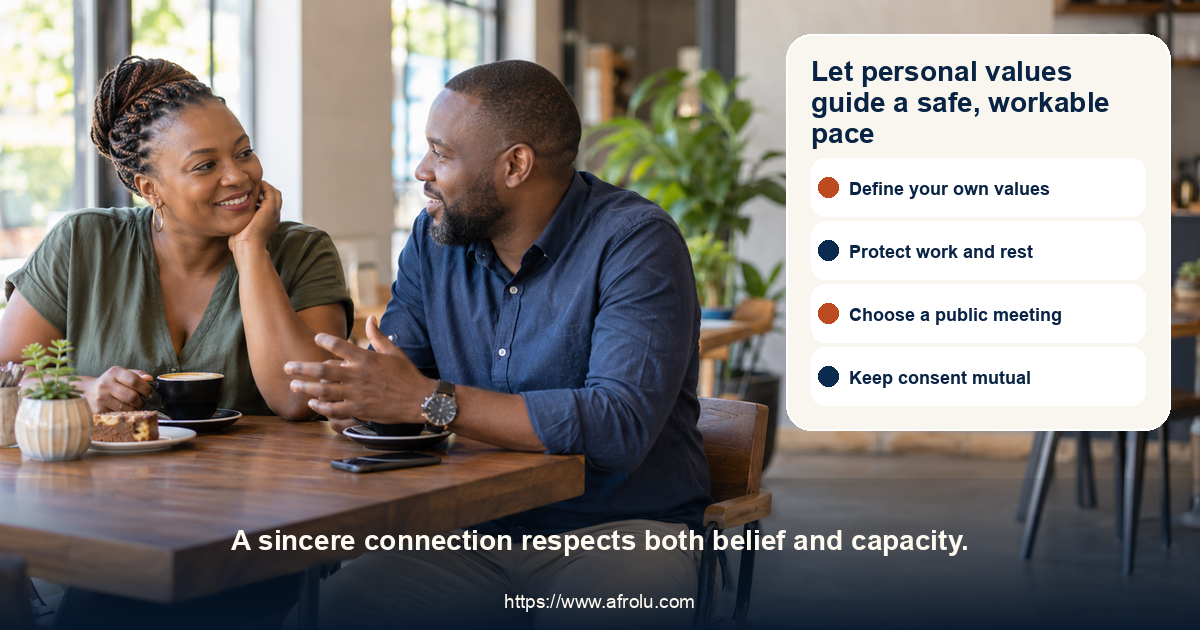
Define values, work capacity, and present terms together.
Written and edited by Miriam Otieno · Senior Kenya Editor
Describe the values you personally practice, state a realistic contact rhythm, and ask what the other adult means by serious or faith-led today. Choose a public meeting with an independent return option. Keep work credentials and private history protected, discuss consent directly, and reassess based on repeated conduct rather than a label or promise.
Dating basics · Faith-Led Daters
How can I date in a faith-led way while protecting safety, work boundaries, and a pace I can genuinely sustain?
Faith-led dating in a career-heavy season is an adult-chosen way to let personal spiritual or ethical values inform a relationship while keeping time, privacy, safety, and present terms mutually clear.
Njeri has a full work week and wants a connection shaped by honesty and community, not constant messaging or instant disclosure. A match describes himself as faith-led and serious, then assumes she will share her office badge and agree to exclusivity. Njeri asks what each phrase means today, offers a weekend cafe meeting, and keeps her employer details private. His response gives her information; the label alone did not.
Faith-led dating · career capacity · safety
Keep personal belief beside practical choice
A meaningful value can guide dating without becoming a test of availability, disclosure, or obedience.
Define your own practice, clarify present terms, meet publicly, and protect work and rest.
What do you practice?
Use your own account instead of an assumed community rule.
What fits this work week?
Offer realistic windows and protect rest.
Can both people choose?
Keep venue, transport, and boundaries independent.
What is true today?
Ask about present terms instead of reading a future promise into a label.
personal values · lived practice · privacy
Faith-led starts with what you choose to practice
For Njeri, honesty and a weekly community commitment matter, while public disclosure about her dating life does not feel right yet. She can describe those choices plainly without offering a full spiritual history. A new match is entitled to ask about compatibility, not to demand a testimony, proof of observance, or access to private conversations.
Ask the other adult which values affect the relationship they want today. They may describe a different practice, be questioning, or use spiritual language loosely. Compatibility depends on the decisions you would make together, not on guessing from a name, clothing, family origin, or how confidently someone quotes a rule.
Safety and belief can be discussed together without turning either into a test. Explain what helps you feel secure, such as a public first meeting or time to think before a commitment. The other person can ask questions and share their own needs. Both adults must remain free to disagree, change their minds, or end the match.
If a disagreement touches a decision that matters to you, ask what each person would actually do rather than debating which label is correct. You may discover a workable difference, or you may decide the relationship form does not fit. Neither outcome requires you to rank another adult's sincerity or disclose a private history.
work calendar · time · mutual effort
A full work week needs a dating plan that fits real capacity
Njeri works a demanding week and prefers one planned conversation rather than messages during every break. She tells a match when she is usually free and asks whether a weekend call works. That practical exchange reveals more about fit than a promise to reply instantly, cancel rest, or make work subordinate to a new connection.
If one adult's schedule repeatedly carries the relationship, talk about the imbalance without assuming the reason. Could both people alternate planning? Is a shorter call more realistic? Does one person want more contact than the other? A fair arrangement can look different for each couple, but both should be able to name its cost.
Spiritual language should not be used to demand unpaid emotional labor or constant availability. A partner may ask for support; they cannot make a person prove faith by missing work, losing sleep, or disclosing sensitive professional details. Set a boundary in ordinary terms and notice whether the response respects it without guilt or punishment.
Review the arrangement after a few weeks of real scheduling rather than after one unusually free day. Did both people initiate plans? Could either person reschedule without accusation? If your work season changes, update the agreement. A healthy plan can be renegotiated; it should not depend on one adult repeatedly absorbing the inconvenience.
intent · present terms · pace
Serious values do not require a rushed relationship label
Njeri asks whether they are both meeting other people and whether either expects exclusivity. Her match says he is dating intentionally but has not agreed to date only one person. That answer gives her usable information. She can decide whether the current arrangement fits without interpreting a shared faith label as an unspoken promise.
If marriage, family involvement, or a particular ceremony matters to either adult, discuss it as a personal hope rather than a deadline imposed on the other. Ask what practical steps would follow and what choice each person retains. A future aim can guide selection; it cannot substitute for present consent or mutual agreement.
When a match avoids every direct question but asks for loyalty, private access, money, or major sacrifices, pause. You do not need to diagnose motive. State what information you need to make your choice and what you will do if the answer is unavailable. A clear limit is useful even when the relationship ends.
A serious future can be a shared hope without being a contract. If one person wants a quick label and the other wants more time, name that difference directly and decide whether a specific check-in is acceptable to both. Do not use a vague promise to keep someone invested while refusing the present conversation that would let them choose.

Ask about current terms rather than relying on implied promises.
privacy · work · community
Keep your work identity and spiritual life under your control
Njeri can say she works in finance and is free on Sunday afternoon without naming a client, office floor, or exact route home. She can also explain that her faith matters without disclosing a painful family conflict. A respectful person can discuss compatibility using those boundaries rather than treating them as evidence of dishonesty.
Before sharing a photograph, document, or calendar screenshot, check what else appears in the frame. Staff badges, email previews, meeting names, phone numbers, and location clues can be exposed accidentally. Do not send a login code, payment screenshot, or workplace credential to verify yourself. A dating match does not need access to your accounts.
If someone asks for secrecy that isolates you from every trusted person, or proposes a spiritual or professional consequence for refusing, take the pressure seriously. Keep relevant messages if safe, stop sharing information, use platform reporting, and consult support appropriate to your location. Advice from a foreign agency may not describe local services or law.
You can also decide which work details become appropriate later. A partner who has earned trust may eventually meet a colleague or hear more about your routine, but that access is not owed at the beginning. Share only what serves a mutual choice, and keep information that could expose clients, coworkers, or a private place out of early dating.
first date · transport · venue
Choose a first meeting that is public, affordable, and easy to leave
Njeri suggests a daytime cafe near a route she already uses. They agree on a short window, each person pays their own way, and neither depends on the other for a ride home. She shares the public venue but not her office, home, or the exact time she finishes a shift the next day.
A meeting plan should include room to change or cancel. If the other person moves the venue to a private place at the last minute, you can decline and keep the original plan or leave it. You do not owe a detailed explanation. A match's response to a small boundary can inform your next decision without proving what they will do later.
Tell a trusted person the broad plan if that helps you, keep your phone and return option available, and leave when you want. Those steps support choice; they are not guarantees and do not make a person responsible for another adult's harmful behavior. Seek current local emergency or specialist help if immediate danger arises.
If the match insists that accepting a ride, private home, or unfamiliar venue proves trust, you can decline. A person who respects your safety plan does not need you to take a risk to reassure them. End the date when you want, even if the other adult paid, traveled, or expected more time than you chose to give.

Agree on a place, time window, and independent return plan.
consent · intimacy · difference
A shared faith label never replaces a direct consent conversation
Njeri says she wants to move slowly with physical intimacy and asks whether that works for the other person. They may agree, discuss a different preference, or decide they are not compatible. None of those outcomes requires either adult to argue about whose belief is more authentic or to accept pressure to continue.
If sexual intimacy is part of the relationship either person wants, talk about safer sex, testing, contraception, and relevant health questions using reliable sources or a qualified clinician. Do not present general editorial material as personal medical advice. Each adult can set limits, request a pause, or end contact without owing an alternative.
Threats to expose private images, faith history, or work information are not ordinary disagreements. Preserve relevant evidence when safe, avoid retaliating or escalating, report the behavior on the platform, and seek independent local support. A community or employer should not be used to coerce continued contact, silence, money, or physical access.
A calm conversation about a mismatch is different from repeated pressure after you have answered. If the person keeps asking, invokes spiritual authority, or threatens disclosure, stop negotiating the boundary. You can leave, block contact, and speak with a trusted person. Reporting options and legal protections differ by country, so use current local guidance.

Consent, privacy, and work access are personal choices.
consistency · check-in · choice
Use a check-in to decide whether this connection still fits
Njeri notices that her match keeps plans and listens when she says she cannot text during work. She also sees that they want different levels of family involvement. She can appreciate the respectful moments and still decide the mismatch matters. Good conduct does not obligate her to keep dating or to disclose more than she wants.
Look for patterns across ordinary moments: whether a person follows through, accepts a changed plan, shares effort, and repairs a misstep. One awkward conversation is not a diagnosis. Repeated contempt, double standards, financial pressure, or punishment for saying no are meaningful reasons to reassess, regardless of public claims about faith or seriousness.
At the check-in, name the current arrangement and one specific change you need, if any. Agree on what each person will do next and when you will review it. If the other adult refuses any honest conversation while expecting loyalty or access, you may end the connection clearly. The choice remains yours even when the story is unfinished.
Afterwards, compare the answer with what happens in the following weeks. A sincere apology matters when it leads to a different action; polished words alone do not settle a pattern. Keep trusted relationships, professional responsibilities, and private routines. Dating can be important without becoming the only place where your values or safety are allowed to exist.
Eight work, faith, and first-date decisions

Faith is treated as one fixed checklist
A match assumes a label tells them how Njeri will handle sex, family, and commitment.
Explain her own values and ask what the other adult personally means.Work availability becomes a sincerity test
A person expects replies during meetings and calls a delayed answer a lack of devotion.
Offer a workable contact rhythm and keep work boundaries intact.Future hopes are mistaken for current exclusivity
Both mention serious values, but neither has agreed to date only one person.
Ask what the present arrangement is before investing on an assumption.A new match requests employer details
The person asks for a badge photo, office floor, or calendar screenshot as proof.
Share broad context only; send no credentials, codes, or client information.A worship event is proposed as the first date
One adult assumes the setting will feel neutral and meaningful to both.
Choose a public venue both people actively prefer.A boundary is framed as unfaithful
Belief language is used to push for intimacy or immediate commitment.
Restate the limit; seek independent help if pressure or threats continue.A date change removes the return option
The plan shifts at the last minute to a private venue far from Njeri's route.
Decline the change and keep an independent way home.A mismatch is always postponed
The match asks for loyalty but refuses to discuss contact or exclusivity.
Set a useful check-in or decide whether the current terms work.Fourteen signs that values and safety leave room for choice
Each adult describes faith-led through personal choices, not a presumed universal rule.
A busy work schedule is discussed without treating instant access as proof of care.
Present dating intent and exclusivity are separate questions with direct answers.
Both people can request a slower pace without hiding current terms.
Professional details are shared only at a level useful to the relationship decision.
No badge, client record, login code, or calendar screenshot is requested as proof.
A first venue is public, mutually chosen, affordable, and easy to leave.
Neither adult relies on a new match for the ride home or return fare.
A community or family introduction is discussed as its own decision.
Personal boundaries are accepted without spiritual ranking or shame.
Consent is checked in the moment and can be withdrawn without punishment.
Work, rest, friends, and community commitments remain part of ordinary life.
Both people repair a missed plan and share the effort of rescheduling.
A check-in can lead to continuation, a specific adjustment, a pause, or an end.
A practical map for present terms and boundaries
| Situation | What it may mean | What to do next |
|---|---|---|
| They say they are faith-led | The phrase does not explain their practices or expectations. | Ask which values affect their dating choices now. |
| They want replies during work | Availability may be confused with care or commitment. | Name the hours you can communicate and ask what works for them. |
| They call themselves serious | Future intention may be mistaken for present exclusivity. | Ask whether either person is currently dating others. |
| They request an employer badge | A work credential can expose identifying or access information. | Decline and keep employer systems, codes, and client details private. |
| They want to meet at a service | The setting may carry significance one person has not chosen. | Choose a public neutral venue unless both prefer the community setting. |
| They ask for a calendar image | The screenshot may expose colleagues, clients, or locations. | Offer a broad time window instead of forwarding the screen. |
| They say a boundary is unfaithful | Spiritual language may be replacing voluntary agreement. | Restate the boundary and consider whether the conversation feels safe. |
| They change the venue late | The revised plan may remove comfort or a return option. | Decline or reschedule; keep your own transport and exit. |
| They avoid every check-in | The relationship may remain unclear while demands continue. | Ask for one present answer, then choose whether to wait or leave. |
| I no longer want to continue | A mismatch is enough; a dramatic reason is not required. | End briefly and protect private details and accounts. |
Twelve scripts for work capacity, consent, and intent
“When you say faith-led, which values shape how you date day to day?”
“For me, honesty and community matter, while I keep some spiritual history private at first.”
“I cannot message during meetings; evenings and Sunday afternoon are usually easier.”
“Are we both meeting other people, or have we agreed to exclusivity?”
“I want to date intentionally, but I am not ready to make a long-term promise today.”
“Would a public cafe near a route we both know feel comfortable for a first meeting?”
“I will arrange my own way home; what time window works for you?”
“What would meeting your community mean, and would you want that now?”
“I am not comfortable sharing my work badge or office location with a new match.”
“I want to pause here. Please do not treat my earlier answer as agreement now.”
“Could we check in next week about contact and exclusivity rather than assume?”
“I respect your hopes, but our present expectations do not fit, so I am ending this.”
Know the difference
Personal values with mutual choice versus pressure framed as faith
Each adult explains what their beliefs mean in practice, asks about present expectations, and remains free to disagree or change a boundary.
One interpretation is treated as binding; work limits, privacy, consent, or an independent ending are punished or called proof of weak belief.
Look at whether both adults retain a real choice after the conversation.

Notice whether a conversation expands choice or narrows it.
Mutual faith discussion versus pressure for access
| Type or dimension | What it describes | Best next question |
|---|---|---|
| Values-led dating | A person's own ethics guide choices without assuming one tradition. | Ask which values show up in ordinary decisions. |
| Faith-community dating | A community may be part of meeting or support, by mutual choice. | Clarify what an introduction signifies to each person. |
| Interfaith dating | Adults may hold different traditions or levels of practice. | Discuss the concrete choices where differences matter. |
| Intentional dating | The adult dates with a direction but may not be exclusive today. | Ask for the current agreement, not a forecast. |
| Exclusive dating | Both adults have agreed to date only each other. | State what exclusivity changes and when it begins. |
| Low-pressure dating | The pace or schedule is spacious, while present terms remain speakable. | Define contact, plans, and a useful review point. |
| Work-first season | Available time is shaped by job duties, not a test of affection. | Share realistic windows and protect rest. |
| Private dating | Adults limit disclosure while trust and circumstances develop. | Agree what remains private and what would change that. |
| Faith pressure | Belief language is used to demand access or silence a no. | Pause contact and seek independent support if needed. |
A simple plan you can use today
A label is not a map
Ask what faith changes in the person's actual dating choices.
Serious is not a status
A future hope does not establish exclusivity today.
Capacity is real
Work, commute, rest, and community all occupy time that should be planned honestly.
Privacy can be truthful
Broad context can answer a compatibility question without exposing employer or spiritual records.
Consent stays specific
Neither a label nor an earlier yes decides what a person wants now.
A mismatch can end kindly
Respectful behavior does not obligate either adult to keep dating.
Questions organised by purpose and depth
Choose a few prompts that fit the moment. This is a reference library, not a list to complete.
Lived values
Start with choices you personally make.
- Which values shape how I date?
- What do I want to keep private?
- How do I want disagreement handled?
Present intent
Use direct questions instead of assuming a shared label.
- Are we dating other people?
- What does serious mean today?
- When would a check-in help?
Work capacity
Plan around real availability and rest.
- Which windows can I reliably offer?
- What contact pace feels sustainable?
- Are we sharing the effort?
Safety and consent
Keep both choices voluntary and current.
- Where would I feel comfortable meeting?
- What boundary matters before a date?
- Can either person stop without pressure?
What deserves a closer look
Ask for the person's own definition
Faith can shape ethics, community, ritual, or private conviction in different ways. A profile label cannot tell you which decisions matter to this adult.
Evidence limit: Do not treat appearance, family, or origin as proof of belief.
Make availability a shared planning fact
A busy season may support fewer dates or shorter calls. Both people can decide whether that rhythm meets their needs without making a career sacrifice a loyalty test.
Evidence limit: Protect work credentials, client confidentiality, rest, and the right to decline.
Keep serious intent distinct from exclusivity
Adults may want a committed future but have different agreements today. Clear present terms help each person choose without guessing from spiritual language.
Evidence limit: Do not imply the other person has promised more than they have.
Choose a public plan with an independent exit
A familiar public venue, short time window, and separate transport make logistics easier to own. None can guarantee another person's behavior.
Evidence limit: A date is voluntary; either adult may cancel or leave.
Talk about the boundary in the moment
Belief can inform a personal boundary, while consent remains an individual and current choice. A difference may be a compatibility issue rather than a debate to win.
Evidence limit: No one owes intimacy, secrecy, or contact to prove faith.
Look for patterns and retain the option to end
Reliability, repair, and mutual effort are observable over time. One respectful conversation matters, but repeated conduct gives more context for a decision.
Evidence limit: This guide is not religious counseling, legal advice, or emergency support.
Shortcuts that confuse belief, access, and availability
Using instant replies as a faith test
It confuses work availability with belief or care.
Assuming a label means exclusivity
The adults may hold different present agreements.
Sending a badge to prove honesty
A credential can expose workplace access and identifying details.
Agreeing to a venue to avoid offense
A meaningful setting should be chosen by both adults.
Treating consent as settled once
Agreement can change; check the choice in the moment.
Waiting indefinitely for clarity
A spacious pace still needs terms that both people can discuss.
Build clarity around belief, work, and consent
This guide is editorial, not religious counseling, legal or medical advice, or emergency support. Seek qualified local help for needs that require it.
Explore the guide library
Show more related guides
Continue with Afrolu
Show more Afrolu guides
Sources used for this guide
Afrolu reviewed these health, research, safety, or public guidance resources while editing this page. They support the behaviour and safety guidance; they do not diagnose any individual described by a reader.
Questions about faith-led dating in demanding seasons
What does faith-led dating mean?
It means the people involved let personally described faith or values inform dating. The phrase does not specify one doctrine, schedule, or relationship structure.
Can faith-led dating be safety-focused?
Yes. Adults can discuss public meetings, privacy, transport, and boundaries while keeping their own spiritual definitions.
Does serious intent mean exclusivity?
Not unless both adults agree to date only each other. Ask what is true now instead of inferring a promise.
How do I date during a busy work season?
Share realistic windows, protect rest, and ask whether a lower-frequency rhythm meets both adults' needs.
Should I share my employer or badge?
No. A match does not need credentials, client information, login codes, or an exact workplace route to discuss compatibility.
Is it safe to meet at a religious event?
Only if both people actively want that context. A neutral public venue may be easier for a first meeting, but no venue guarantees safety.
What if we disagree about intimacy?
State your own boundary and hear the other person's. A mismatch can be a reason not to continue; pressure does not create consent.
Can I keep my spiritual history private?
Yes. Share only what you choose and what is relevant to a mutual decision; a new date is not owed a full personal history.
What if someone asks for money or work access?
Do not send funds, credentials, or codes. End the exchange, preserve evidence if safe, report the account, and use appropriate local support.
How can I end a connection respectfully?
Say the current expectations do not fit and that you are ending contact. You do not need to debate faith or provide private details.
One thing to do now
Choose a connection that respects values and capacity
Name your own values and availability, then ask for the other person's current intent and boundaries. Make a public first-date plan that both adults can reach and leave independently. Share professional or spiritual details only when you choose. Continue, adjust, pause, or end based on mutual respect and observable conduct; no faith label proves safety or creates consent.