Faith-led dating · Nairobi safety
Faith-Led Dating Red Flags for Safety in Nairobi
Faith-led dating red flags in Nairobi: protect values, public plans, community privacy, consent, money and a free route home without pressure every time.
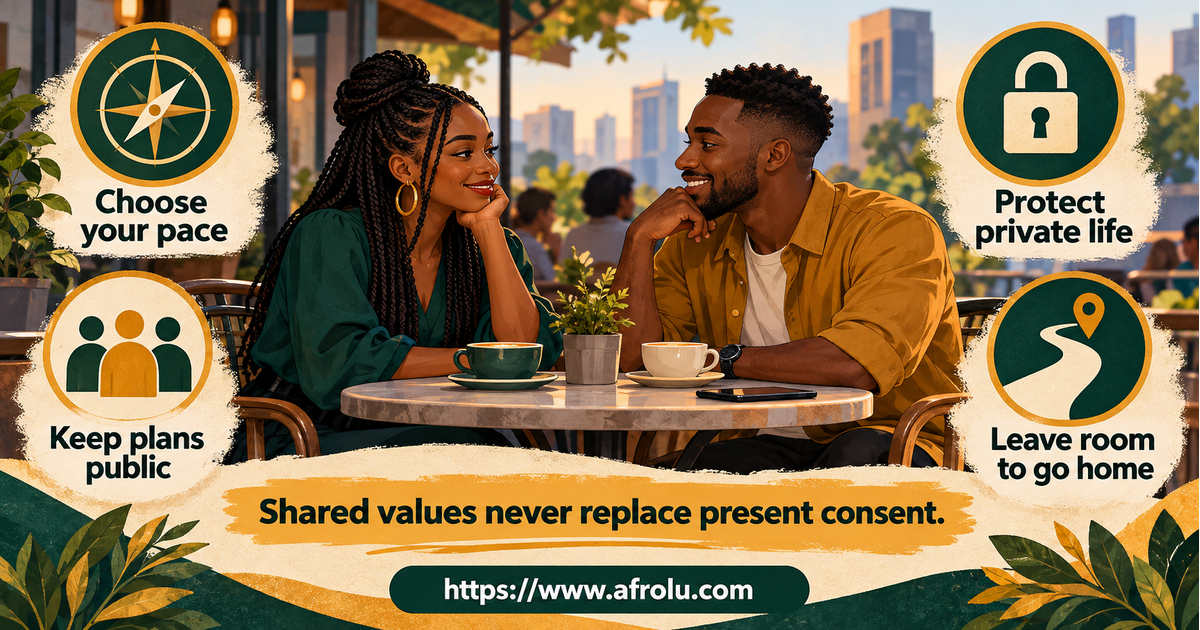
Values should leave your voice and exit intact.
Written and edited by Samira Benali · Faith and North Africa Editor
Keep faith-led dating safe by separating shared values from pressure, choosing public plans and independent logistics, protecting community privacy, keeping consent current, and separating money from care. A belief or future promise may be meaningful, but it does not decide today’s boundary. Repeated shame, monitoring, money pressure, coercion, indirect contact, threats, or fear deserve less access and a more protected response.
Dating safety · Faith-Led Daters
Is this faith-led dating connection making values, city plans, community, privacy, money, consent, and an exit more workable—or is it using seriousness and belonging to hurry access?
Faith-led dating red flags are observable behaviours that make values, public plans, community, privacy, money, consent, or a free exit less voluntary. They can include shame disguised as guidance, rushed serious intent, logistics control, financial leverage, monitoring, indirect community contact, coercion, threats, or fear. The phrase describes conduct, not a faith, community, city, or diagnosis of a person.
Maya appreciates that a new date in Nairobi shares her desire for a values-led relationship, then notices that serious language is being used to rush private access, transport, community involvement, and a financial favour. She separates faith from entitlement, keeps a public independent plan, asks others not to mediate, and holds her boundaries. The response gives her clearer information than the promise of shared intention alone.
faith-led dating · Nairobi safety
Maya keeps shared values from becoming a claim on pace, city logistics, community, money, or private access
This guide respects faith-led dating without treating belief, community, or Nairobi as a shortcut around a person’s practical right to choose.
Use values to name a boundary, build a reversible city plan, keep community from becoming a messenger, keep consent current, separate money and future talk, layer private life, and choose an ending that fits the risk.
Let conviction increase choice
Serious language is most meaningful when a no remains entirely safe.
Keep logistics reversible
Public plans, independent routes, funds, charge, and an end point make a changed mind practical.
Protect private decisions
Shared spaces and people cannot become a route around a clear boundary.
Match the risk
Clarify a mismatch; reduce access and seek support when shame, pressure, or fear appears.
Let values guide a boundary, not excuse someone else from it
Faith-led dating can hold hope, seriousness, family, service, and conviction while still leaving each adult in full control of pace, privacy, consent, and an ending
Maya meets someone through a values-oriented social circle in Nairobi. The conversation quickly turns to serious intentions, family hopes, and a desire to avoid casual dating. Those can be good things to name. The difficulty begins when the person says that a serious believer would not need public meetings for long, should share a home address to prove honesty, and ought to decide quickly because delaying a future is unfaithful. Maya can value commitment and still treat each demand as a separate present choice.
A faith-led connection does not require both adults to practice in identical ways, move at identical speeds, or share every private history immediately. It does ask for integrity: words should not be used to hide coercion, shame, entitlement, financial pressure, control, or contempt. You can ask how a person understands commitment, family, intimacy, service, money, privacy, and repair without letting any answer replace the practical evidence of how they respond when you set a limit.
Be careful with language that turns uncertainty into a moral failure. A date may say that trust requires access, that a pause means you lack conviction, that private boundaries are secrecy, or that a community will judge you for ending something. Those claims can make a person feel isolated before they have done anything wrong. A compatible adult can express a belief and still leave room for another adult to say not now, not there, not with you, or no without punishment.
Your values can support a smaller plan: a daytime meeting, independent transport, a slower conversation about commitment, no money exchange, no private-room expectation, an honest disclosure at the scale you choose, or a clear end. You do not have to abandon warmth, faith, or hope in order to keep those choices. A relationship that needs you to surrender them is not asking for trust; it is asking for access you have not freely offered.
Make a Nairobi date practical enough to change
A city plan is safer when each adult can arrive, leave, communicate, and return to ordinary routines without depending on a new date’s permission, device, money, or vehicle
Nairobi offers many different daily rhythms, and practical planning matters more than an assumed idea of the city. Choose a venue and time you freely want, tell a trusted person a broad plan if that adds safety, keep your phone charged, and retain a realistic way to leave. You can meet in a well-used public setting, arrive separately, and decide in advance that a meal, worship gathering, community event, or conversation has an ordinary end point. These are planning choices, not accusations against a date.
Notice when logistics are made to feel like a test. A person may insist on collecting you, complain that a public place is too formal, push for a late extension, make an independent ride sound insulting, or say that a serious connection should move directly into private space. You can thank someone for an offer and still keep your own transport, location, funds, and route home. A no to a plan does not become less complete because a date travelled, spent money, or says the alternative is inconvenient.
When a plan changes, name the change without trying to manage another person’s emotion. You might leave after one event, decline a second location, switch to a daytime call, or decide not to meet after all. The relevant response is not whether the other adult is pleased. It is whether they accept your choice without blocking a departure, withholding a ride, repeatedly bargaining, tracking your movement, threatening to involve others, or creating fear around your ability to go home.
Once a date makes you feel trapped, the next move is no longer a question of social polish. Move toward a public place if you can, alert a trusted person, use emergency services for immediate danger, and contact a local specialist, health, legal, security, or community-support service that suits the facts. A careful plan cannot promise safety, but it gives you choices when an ordinary change of mind has begun to feel risky.
Keep a faith community from becoming a channel around your decision
A mutual congregation, service project, prayer group, family network, mentor, leader, choir, workplace, or friend circle may be meaningful, but no shared setting can decide who gets your information or your time
A shared circle can make someone feel more familiar than they are. A person may be well liked, active, respected, or introduced by someone you trust, yet those facts do not replace your own observation of how they respond to boundaries. If they say a leader knows them, a family knows their intentions, or everyone will be disappointed if you slow down, bring the question back to the present: Can you say no without being pressured, exposed, recruited, or made responsible for a group’s reaction?
It helps to decide who is actually a support person before a dating issue arises. You might choose one friend, counsellor, elder, colleague, relative, professional, or service route who can listen without trying to deliver messages or decide for you. Ask others not to share your schedule, address, contact information, screenshots, photographs, or whereabouts with a date. This does not reject community. It creates a boundary that stops community warmth from becoming a surveillance route.
Be alert to reputation pressure. A person may hint that they will tell a group you led them on, recruit someone to persuade you, arrive at a familiar gathering after you asked for space, or use spiritual language to shame an ending. A private decision does not need a public defence. If safe, keep a factual record, limit visible routine details, and choose a quieter protective response when direct contact would add risk.
A healthy faith community can make room for privacy, disagreement, and a clear no. It does not require you to stay in a connection because others see potential, nor does it make an introduction a guarantee of character. If your ability to attend a valued space begins to feel controlled by a date’s presence or threats, consider practical support and alternate plans rather than isolating yourself. Belonging should be a source of safety, not a cost of leaving.

Read the response to your boundary, not the values claim alone.
Keep consent current when beliefs, commitment, and intimacy are discussed
A date’s stated intentions, gifts, prayer, a prior kiss, family expectations, a private conversation, or a plan for marriage do not decide what you agree to today
Adults may have different faith-informed choices about physical intimacy, alcohol, privacy, family involvement, and the pace of commitment. Difference itself is not misconduct. The problem begins when one person makes their preferred standard a tool for control: demanding private access as proof of trust, accusing someone of impurity or hypocrisy for a boundary, using marriage language to rush sexual or domestic access, or insisting that an earlier yes settles every later choice.
You can set a limit without defending your whole worldview. Say that you are not going somewhere private, do not want that touch, will not send an image, do not want to discuss an intimate detail, or are leaving now. A person may feel disappointed, but they do not get to touch you after a no, keep your phone, block a doorway, make transport conditional, threaten exposure, or demand another meeting in order to decide whether your reasons are acceptable.
Plan for a changed mind before a date becomes intense. Keep your own device and a practical route home, meet in environments where you can leave independently, avoid letting exhaustion or financial dependence make a private plan harder to revise, and tell a trusted person a broad outline where useful. These actions do not assume bad intent. They make consent practical by ensuring that a boundary does not depend on another person agreeing that it is reasonable.
Threats, coercion, unwanted sexual contact, image pressure, stalking, financial leverage, blocked exits, or fear change the task from a values conversation to a safety response. Where it is safe, note dates and messages, protect accounts, use emergency help for immediate danger, and find trusted, specialist, health, legal, security, advocacy, or local support suited to the circumstances. No faith framing should make urgent safety support feel disloyal to kindness or hope.

A respectful boundary does not need a moral defence.
Keep marriage language, gifts, and generosity outside the early bargain
Serious intention can be discussed with patience; it should not make money, property, work contacts, family access, documents, or a fast commitment the price of being believed
A person may speak passionately about marriage, introduce family hopes, offer a gift, pay for a meal, propose a business idea, mention a faith-based project, or describe a sudden difficulty. None of those actions creates a debt. Be cautious when a date asks for a loan, transfer, code, account use, documents, a co-signature, a place to stay, a business connection, or private property information while saying that a serious person would help without questions. You can wish someone well and still keep your finances and assets separate.
Different budgets and responsibilities are normal. One adult may support relatives, give to a cause, pay school costs, build a business, manage debt, or prefer simple public dates. An income difference or generous lifestyle is not evidence of harm. The concern is secrecy, leverage, repeated urgency, a changing story, or pressure to treat your resources as proof of devotion. A compatible adult can hear a financial boundary without calling it a failure of compassion, faith, or commitment.
If you are considering a serious future, make practical questions ordinary rather than urgent: How are decisions made? What financial boundaries exist now? How will each adult keep independent accounts or advice where appropriate? What happens if a disagreement arises? Slow, factual conversations are not evidence of distrust. They are a way to make sure affection does not become a reason to sign, transfer, host, invest, or disclose before you freely want to do so.
Where a money request, payment, or gift now feels binding, begin with recovery rather than shame. Contact the relevant bank, payment service, account provider, platform, or support channel promptly if useful; protect credentials from a device you trust; and do not agree to a private meeting simply to settle an emotional debt. You can leave an unhealthy financial arrangement without deciding whether every earlier word was false.

Choose the action that keeps your values and exit yours.
Let personal history and digital access arrive in layers
A faith-led dater may carry family relationships, community roles, former relationships, health information, work responsibilities, routines, and private convictions that deserve a pace of disclosure they choose
You might mention family responsibilities, a broad work field, a kind of community space, or a past relationship without naming relatives, addresses, schedules, employer details, leader contacts, documents, messages, medical information, private photographs, or the details of a former partnership. A respectful person can remain curious and still wait. A person who turns a broad truth into suspicion is revealing their response to a reasonable limit.
Digital access can make a connection harder to leave long after a date ends. Keep passwords, two-factor codes, live location, shared calendars, cloud folders, private images, account recovery details, device passcodes, home cameras, and personal records outside early dating. If you choose to share anything later, do it because it fits a steady, reciprocal relationship—not because another adult says it is the price of spiritual transparency or serious intent.
Reputation concerns can make private images, messages, or disclosures feel especially risky. Do not send material to end pressure or demonstrate affection, and do not pass another person’s private information through a group. If someone threatens to share material, bargains with screenshots, or repeatedly demands proof, close access, keep safe evidence where possible, and seek support instead of trying to satisfy a demand that has already ignored your no.
A privacy slip does not cancel your right to choose a safer next move. Review audiences and account settings, update credentials thoughtfully, ask trusted people not to relay information, and weigh whether direct contact would lower or raise risk. A past disclosure need not be perfect before you can protect privacy today. Reclaiming control matters more than offering a persuasive account of your changed mind.
Let a connection be measured by whether your life stays open
Before offering more time, family access, money, intimacy, personal history, community visibility, or a place in your routine, ask whether the relationship makes ordinary life more workable or more controlled
At the end of a handful of interactions, ask a grounded set of questions. Can I set a limit without being called selfish, unfaithful, secretive, or immature? Can I choose public plans and independent transport? Can I keep my address, money, devices, images, family, work, and community details private? Can I discuss serious intention without being hurried into access? Can I revise a plan or end contact without fear of gossip, retaliation, threats, or messages routed through other people? These observations matter more than eloquence or a shared label.
Healthy conduct has a recognisable shape: a person receives a no, respects a gradual pace, keeps plans workable, discusses values without using them as leverage, repairs through changed conduct, and never turns community or generosity into a claim. A mismatch may concern beliefs, pace, communication, or future hopes. Shame, coercion, monitoring, money pressure, threats, unwanted contact, image pressure, indirect community contact, or fear call for a different response than a normal difference.
Let the evidence choose the action: keep a date public, slow a marriage conversation, refuse a transfer, avoid private disclosure, ask a trusted person for perspective, decline another meeting, block repeated contact, or use appropriate support. Agreement from another person or group is not required before you act in the way that makes your day safer and more workable.
Faith can strengthen discernment, courage, care, repair, and hope. It need not ask you to explain away the loss of your own voice. When a relationship supports work, rest, prayer, trusted people, money management, movement through Nairobi, and a no without dread, it may be worth learning more. When it narrows those freedoms, distance or an ending can honour your values as much as continuation.
Eight faith-led Nairobi dating moments

Serious faith language becomes a deadline
A date says that people who share values should know quickly and asks Rina to meet privately after only a few public conversations.
Rina keeps the public pace she freely chose and watches whether serious intent can coexist with patience.Convenience becomes control of the route
A person insists on collecting David from home and says arriving separately looks distrustful.
David chooses his own transport and a public meeting, treating access to his address as separate from gratitude.A mutual contact is recruited after a boundary
After a pause, a date asks an acquaintance from a community group to persuade Jamila to take one final call.
Jamila asks the acquaintance not to carry messages and keeps the ending outside group discussion.A no is treated as a moral failure
When Asha declines physical intimacy, her date says a future spouse would not make him feel rejected in this way.
Asha keeps the no complete and treats shame or bargaining as information about the safety of the connection.A gift becomes a claim
After paying for several meals, a person says Malik owes more time and should share his private plans.
Malik keeps future dates and travel independent and does not repay spending with access.A cause becomes financial pressure
A match asks Njeri to use her account for a time-sensitive project payment and says helping is a test of her values.
Njeri shares no account, code, document, or transfer and verifies through independent channels only if she chooses.Different beliefs are discussed without control
Two adults discover that they want different paces around family introductions and physical intimacy.
They name the mismatch respectfully, make no one prove devotion, and decide whether a shared plan is possible.A community event becomes unwanted contact
After an ending, a person repeatedly waits near a gathering Maya regularly attends and asks others to bring her over.
Maya leaves with support, avoids a private conversation, preserves information if safe, and seeks help if the behaviour continues.Signals about values, public plans, community, consent, money, privacy, and safe exits
They can discuss values and serious intentions without treating your pace, privacy, or no as a moral defect.
They accept a public plan, separate arrival, independent transport, and a change of mind without making caution insulting.
They use faith, status, family hopes, a leader, or a community reputation to hurry access or silence questions.
They recruit friends, relatives, mentors, group members, or colleagues to gather information or persuade you after a boundary.
They can hear a broad answer about family, work, history, or community involvement without demanding documents, contacts, or proof.
They pressure you for money, transfers, account access, documents, business help, property information, or support for a cause.
They treat a gift, paid meal, ride, service, or future plan as a debt of time, intimacy, private access, or commitment.
They respect a current no to touch, images, a private room, an introduction, or a conversation without shame or bargaining.
They make a specific repair after a hurtful comment instead of using apology language to restart the same pressure.
They keep private messages, images, family details, and disclosures out of group chats, social media, or community talk.
They do not make spiritual transparency a demand for passwords, location, device access, medical information, or private history.
They do not make leaving a date harder by controlling a ride, venue, money, phone, or homeward route.
They do not use threats of gossip, rejection, exposure, or family contact to gain another chance.
They do not leave you afraid to say no, keep attending a valued space, go home, end contact, or ask for support.
Choose a proportionate next move
| Situation | What it may mean | What to do next |
|---|---|---|
| They want a quicker commitment | A difference in pace can be ordinary until your boundary becomes a flaw to correct. | Name the pace you can freely choose and observe the response. |
| They ask to collect you from home | A kind offer can become an address and transport-access demand. | Keep your own route or decline without defending your location. |
| They invoke a leader or mutual group | Shared community can become a route around a direct decision. | Keep dating decisions private and ask others not to mediate. |
| They say privacy is dishonesty | A broad truth may be enough while a relationship is new. | State the information boundary and do not trade details for reassurance. |
| They press for intimacy after a no | Disappointment can be normal; shame, bargaining, retaliation, or coercion is different. | Keep the no, leave if needed, and seek support if fear enters. |
| They offer a costly gift or future plan | Generosity becomes leverage when declining a next step is no longer free. | Keep money, travel, property, and access separate from affection. |
| They request a transfer or account help | An urgent story may be a scam, access test, or burden you do not want to carry. | Do not send funds, codes, documents, or account access; verify independently. |
| They contact people around you after an ending | Indirect contact can become harassment or a boundary bypass. | Ask people not to relay information, preserve records if safe, and reduce access. |
| You feel ashamed for setting a limit | Shame can be a sign that values language is being used as pressure. | Return to the practical boundary and seek a trusted perspective. |
| You feel afraid to leave or say no | Fear changes the task from relationship clarification to safety planning. | Prioritise a protected exit and appropriate urgent, specialist, local, or trusted support. |
Twelve lines for pace, public plans, community, consent, money, and an ending
“I am open to getting to know you, and I will decide the next step at a pace I can freely choose.”
“I am comfortable meeting there and arriving independently. I am not sharing my address or private route.”
“My values do not require me to give access before I am ready. This is my boundary for now.”
“Please do not ask people around me for information or involve them in this dating decision.”
“I do not want that. I am leaving or changing the plan now.”
“I do not lend, transfer, receive payments, share codes, or use my account for someone I am dating.”
“That part of my family and past is private for now. I have shared what I want to share.”
“I can discuss serious intention without making a financial, family, or private-access decision today.”
“Our expectations around pace and boundaries do not fit, so I am stepping back.”
“I asked for space. Do not keep calling, use other accounts, or contact people around me.”
“I do not want to continue this connection. Please do not contact me again.”
“I am not meeting privately to discuss this. I am getting support and need no further contact.”
Know the difference
Shared values, a belief mismatch, and pressure for access need different responses
A person can discuss serious intent, accept a slower pace, respect public and independent plans, keep community and money separate, acknowledge impact, and leave every current choice under your control.
Shame, rushed commitment, logistics control, financial leverage, monitoring, indirect community contact, coercion, threats, unwanted contact, or fear turn values language into a claim on access you have not freely offered.
The values claim and future story do not decide the risk. The observed pattern and your freedom to choose do.

A value claim does not decide the risk; freedom does.
Separate shared values, a belief mismatch, and access pressure
| Type or dimension | What it describes | Best next question |
|---|---|---|
| Shared values | Two adults can describe convictions while both retain their own pace, privacy, consent, and freedom to leave. | Discuss the present agreement and observe the response to a boundary. |
| Values pressure | Faith, status, family, or a group is used to make a no sound selfish, secretive, or disloyal. | Return to the boundary and reduce access if shame or bargaining continues. |
| A public plan | A meeting has independent arrival, an ordinary end point, a charged phone, funds, and a realistic route home. | Use the plan only if you can revise it freely. |
| Logistics control | A pickup, late extension, private venue, or controlled transport makes leaving more difficult. | Keep separate logistics or decline the plan. |
| A belief mismatch | Adults want different paces or practices and can name that without trying to convert or punish one another. | Clarify or leave the arrangement. |
| Consent pressure | A future, gift, prior intimacy, or moral accusation is used to obtain touch, images, private access, or silence. | Keep the no, leave if needed, and seek support if risk rises. |
| Free generosity | A meal, ride, gift, or service has no later claim on time, body, money, property, or commitment. | Accept or decline while keeping an independent exit. |
| Financial leverage | A cause, business, family need, or future plan is used to secure money, documents, codes, accounts, or property access. | Pause, verify independently, and make no transfer under pressure. |
| Safety concern | Threats, stalking, coercion, image pressure, unwanted contact, or fear require more than a relationship talk. | Use a protected exit and appropriate support. |
Start with the values and city plan you can freely choose
Values need behaviour
A shared belief matters most when it makes patience, honesty, consent, repair, and a free no more available.
Serious can be patient
Commitment language should not require irreversible access before practical trust exists.
Community needs consent
A mutual group cannot become a route around your privacy or an ending.
A city plan needs an exit
Independent arrival, funds, charge, and a route home make a changed mind easier to act on.
Generosity is not a debt
Gifts, service, meals, and future plans do not buy intimacy, money, access, or commitment.
Safety can be values-led
Seeking support or choosing distance when pressure appears can honour care for yourself as well as for others.
Questions organised by purpose and depth
Choose a few prompts that fit the moment. This is a reference library, not a list to complete.
Values audit
Use before accepting a serious-intent conversation.
- What value supports my present boundary?
- What pace can I freely choose?
- What future claim should not decide today?
City-plan audit
Use before an early meeting.
- Can I arrive and leave independently?
- What remains public and separate?
- Who knows the broad plan if that helps?
Community audit
Use when social overlap feels complicated.
- Who is support rather than a messenger?
- What details stay private?
- Would an ending be safer outside this shared space?
Safety audit
Use when a boundary is not being accepted.
- Can I say no without shame or fear?
- What evidence is safe to keep?
- What protected next action fits the risk?
Look more closely at values, city plans, community, consent, money, and endings
Let conviction increase agency
Discuss commitment, privacy, family, intimacy, money, repair, and pace in a way that leaves each adult able to say yes, no, not yet, or leave.
Evidence limit: A guide cannot interpret anyone’s personal beliefs or decide compatibility.
Make a date easy to revise
Use public settings, independent transport, charge, funds, a clear end point, and a practical route home when getting to know someone.
Evidence limit: A public plan cannot guarantee safety in every situation.
Choose support without creating messengers
Keep friends, leaders, relatives, and groups from sharing private details or pressing one adult to reopen an ending.
Evidence limit: Support structures vary; use the safest route for your circumstances.
Keep a present yes separate from a future story
Treat each meeting, touch, image, invitation, and private space as a current decision that can be revised without shame.
Evidence limit: This guide cannot assess a specific incident or replace urgent local support.
Separate compassion from access
Pause transfer, account, document, property, business, cause, and financial-rescue requests and verify independently.
Evidence limit: A concerning request does not prove every person is committing fraud.
Risk can change the communication plan
Use a concise end for mismatch and a more protected route when shame, pressure, threats, unwanted contact, or fear appear.
Evidence limit: Blocking alone may not resolve every safety concern.
Shortcuts that can turn values and community into pressure
Treating shared faith as proof of safety
A common belief can be meaningful without replacing present observation and a practical boundary.
Calling privacy a lack of trust
Broad, truthful answers can protect choice while a connection is still new.
Letting a group decide the dating pace
Community warmth should not make an introduction, leader, or shared circle the author of your consent.
Paying emotional debt for generosity
A gift, meal, ride, service, or future promise does not require money, access, intimacy, or another date.
Meeting privately to make an ending kinder
A private closure is not required and can add risk when pressure or fear already exists.
Letting shame delay support
Threats, image pressure, money demands, or unwanted contact are easier to address with early practical help.
Choose one resource that fits the fact in front of you
Use a guide for a clearer values, communication, or safety boundary, and choose a more protected support route if pressure, threats, or fear are part of the situation.
Explore the guide library
Show more related guides
Continue with Afrolu
Show more Afrolu guides
Sources used for this guide
Afrolu reviewed these health, research, safety, or public guidance resources while editing this page. They support the behaviour and safety guidance; they do not diagnose any individual described by a reader.
Questions about faith-led dating red flags and safety in Nairobi
Are faith-led dating red flags different?
The core question is the same: does conduct reduce your free choice? Faith, family, community, commitment, reputation, and service can add important context, but none cancels consent, privacy, money boundaries, or a free exit.
Can shared faith make dating safer?
Shared values may create meaningful common ground, but they are not a safety certificate. Observe how a person responds to a boundary, a slower pace, a public plan, financial limits, and an ending.
Is it disrespectful to insist on public dates in Nairobi?
No. You can choose a public setting, independent arrival, a practical end point, and a route home. A considerate person can accept a plan that protects both adults’ ability to change their minds.
What if a date says privacy means I am hiding something?
A broad truthful answer can be enough while a connection is new. You do not owe an address, calendar, family contacts, messages, documents, account access, medical information, or private history to prove interest.
Can I say no to intimacy if someone says they want marriage?
Yes. A stated future, earlier touch, gift, meal, date, prayer, or family expectation does not settle your current answer. Pressure, shame, bargaining, or retaliation are reasons to reduce access and seek support if needed.
Should I help with a financial need or faith project?
Do not transfer money, share codes, documents, accounts, property details, or payment-forwarding help to create early trust. Pause and independently verify where appropriate; compassion does not require financial access.
How do I handle shared community after an ending?
Ask people not to relay information, keep private details private, choose supportive people rather than mediators, and use a quieter or more protected plan if direct contact or gossip feels unsafe.
What if I feel ashamed for setting a boundary?
Return to the practical fact: you are allowed to decide pace, location, intimacy, disclosure, money, and contact. A trusted perspective can help if someone’s language has made a normal boundary feel wrong.
Can I end a faith-led connection by message?
Usually, a concise message is enough for an ordinary mismatch. If you feel unsafe, choose the format that reduces risk rather than meeting privately for closure.
How do I avoid assuming every difference is a red flag?
Separate a difference in belief or pace, a repairable mistake, and repeated pressure. Name one boundary, then decide from the response and practical impact rather than trying to prove a motive.
One thing to do now
Let every next date leave your values, community, city route, and exit under your control
Choose the smallest next action that protects values, independent city logistics, community privacy, current consent, money and account boundaries, personal history, trusted support, and a real ability to slow down, decline, or leave.