Six-window call bridge · adult students 25+
Six Call Windows for an Adult-Student Long-Distance Talking Stage
A low-pressure long-distance talking-stage guide for adult students 25+, with six call windows, study boundaries, scripts, safety and clear next choices.
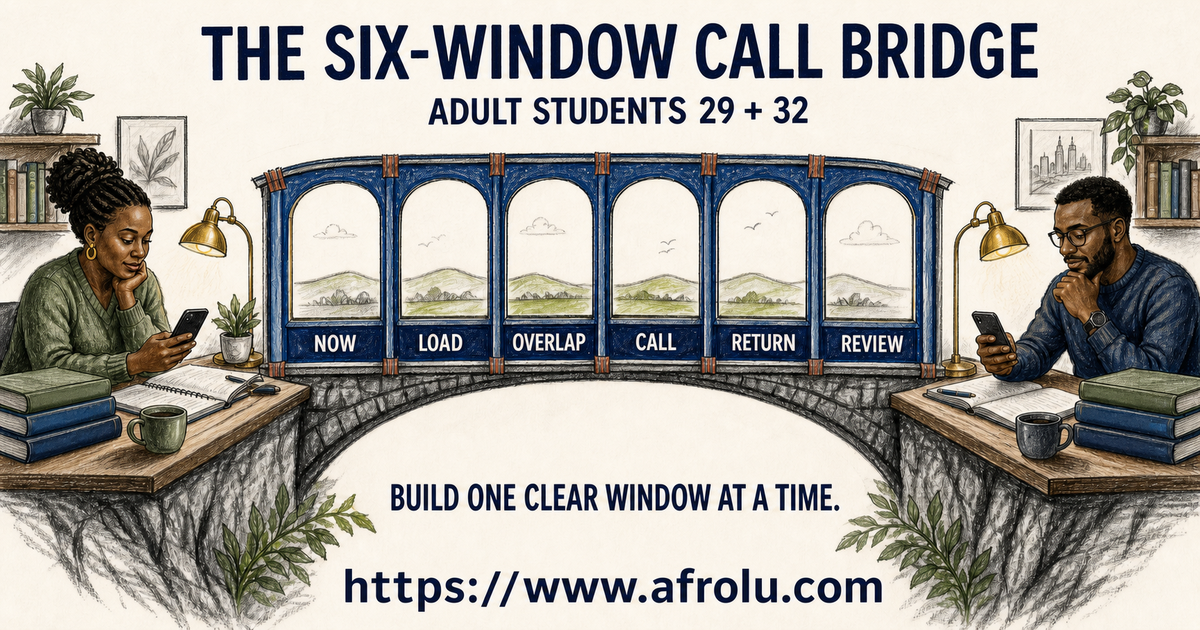
Open NOW, LOAD, OVERLAP, CALL, RETURN and REVIEW one window at a time.
Written and edited by Jean-Claude Mukendi · Relationship Guides Editor
Use six small windows: NOW names present status and structure; LOAD protects broad study and work blocks; OVERLAP finds a fair time; CALL sets mode, purpose, and length; RETURN shares initiation and repair; REVIEW keeps continue, resize, meet, pause, and close open. Low pressure means each offer can receive a free yes, counter, or no. It does not mean vague status or one-way effort. Keep portals, exact timetables, codes, money, private images, and live location outside proof. Plan travel separately through official sources. Fraud, threats, tracking, coercion, or blocked movement need direct protection.
Early relationship discovery · Students
How can adult students 25+ keep a long-distance talking stage warm and clear without constant calls, hidden status, study surveillance, or pressure to travel?
A low-pressure long-distance talking stage is an early period when two adults aged 25+ explore dating across separate locations through a clear, leaveable contact rhythm. Talking stage names exploration, long distance names context, and low pressure names pace and free choice. None automatically creates a dating relationship or exclusivity.
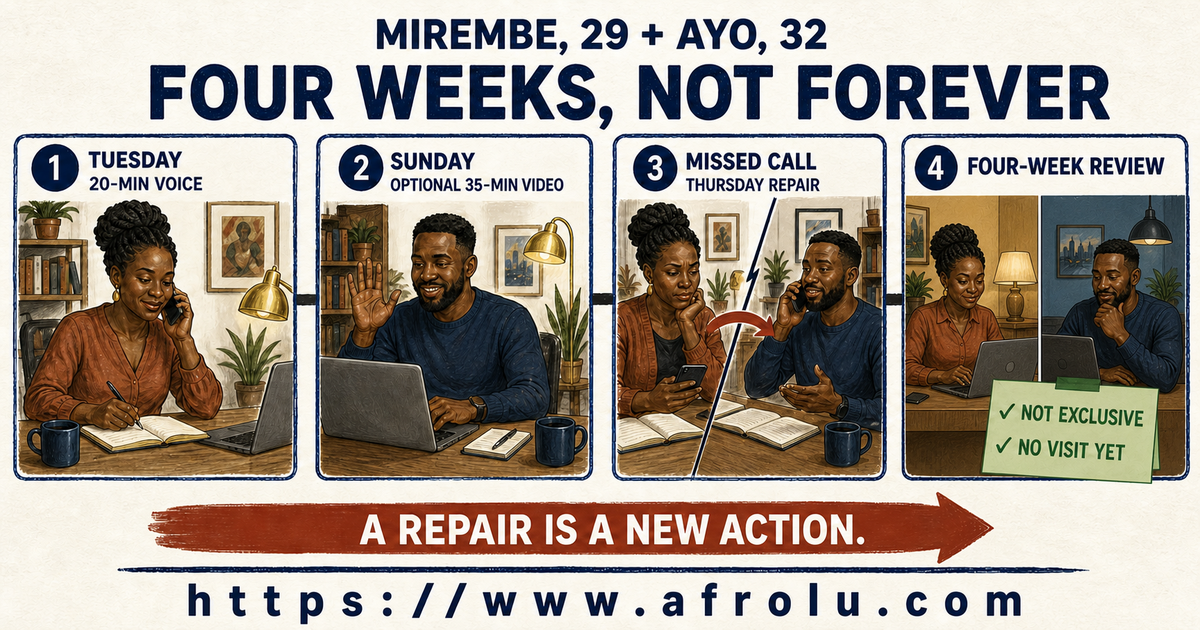
Mirembe, 29, and Ayo, 32, are fictional adult postgraduate students in Kigali and Accra. They protect study blocks, choose a Tuesday 20-minute voice call and an optional Sunday 35-minute video call, repair one miss on Thursday, and review after four weeks. They remain not exclusive and plan no visit yet.
The adult-student six-window call bridge
Build only the span two real study weeks can hold
Jean-Claude keeps status, study load, overlap, call consent, return action, and review in separate windows for adult students aged 25+.
Name one window, offer the smallest clear action, and let the other adult freely accept, counter, or decline.
NOW
Say what exists before describing what might grow.
LOAD
Protect broad study blocks without sharing private systems.
OVERLAP
Find a fair opening that does not consume sleep.
CALL
Choose mode, purpose, and a clear end.
RETURN
Share initiation and turn a miss into new action.
REVIEW
Keep every honest landing available.
The quiet opening
A talking stage can be light without being foggy
A long-distance talking stage can begin with kind messages and no shared plan. That is not a failure. It is an early space where two adults learn whether dating could fit. For adult students 25+, the useful question is not how to reply all day. It is what small, clear contact both can freely sustain.
Low pressure describes the freedom around a choice. Either adult can offer a smaller call, counter a time, pause, or leave without punishment. It does not mean low effort, hidden status, or endless waiting. A modest rhythm can still include a present answer, a kept plan, repair after a miss, and a date for review.
Distance changes access, not the meaning of consent or care. Calls may cross time zones, paid work, lab sessions, family duties, and sleep. Those facts deserve planning. They do not grant access to a timetable, student portal, live location, grades, money, private images, or every free hour. Each door needs its own willing yes.
Use the six-window call bridge as a short trial, not a test of love. Open NOW, LOAD, OVERLAP, CALL, RETURN, and REVIEW. Each window answers one question. If the bridge feels kind but one window stays blank, ask once. If pressure, fraud, threats, or tracking appears, leave the bridge and seek direct help.
A four-week field note
Mirembe and Ayo build only what their weeks can carry
Mirembe, 29, is an adult master's student in Kigali. Ayo, 32, is an adult postgraduate student in Accra. They meet online and enjoy long voice notes. Both say they are single. Neither asks for exclusivity. They are open to a relationship later, yet they agree that the next four weeks are still a talking stage.
Their clocks and study days do not line up neatly. Mirembe protects two evening research blocks. Ayo has paid work and a weekend assignment group. They share broad capacity, not class links or full calendars. Tuesday offers twenty minutes for voice. Sunday offers an optional thirty-five-minute video call when both have energy. Silence outside those windows is ordinary.
In week two, Ayo misses Tuesday after a group task runs late. He sends no dramatic excuse. On Wednesday, he names the miss and offers Thursday at the same short length. Mirembe accepts. She does not ask for a live location or proof from a tutor. The changed action supplies one useful repair fact.
At the four-week review, both adult students still like the connection. They keep the talking stage and remain not exclusive. They add one rule: the person who cannot use a window offers the next opening. They plan no visit yet. Their result is not a promotion. It is a clearer bridge that still fits two real lives.
The bridge plan
Open six windows instead of opening the whole day
NOW names the present. Ask whether each adult is single, dating others, or bound by another agreement. Say what the talking stage means today. Interest can be serious, casual, or undecided. None of those words creates exclusivity. If one adult needs a different structure, the mismatch is useful information rather than a reason to bargain.
LOAD protects study and ordinary life. Share broad blocks such as class, research, work, care, rest, and offline time. Do not trade full schedules, login details, grades, supervisor names, or attendance proof. OVERLAP then finds one or two windows that work often enough. Fair does not always mean equal minutes; it means both can shape the plan.
CALL gives each window a purpose, mode, and end. A twenty-minute voice call may fit a hard week. A longer video call may fit another. Neither adult must turn on a camera, share a room view, or stay beyond the end. A call can hold ordinary talk plus one real question without becoming an interview.
RETURN says who acts after the call or after a miss. It prevents one adult from carrying every restart. REVIEW names when the trial will be discussed and keeps several landings open: continue, resize, plan a safe meeting, pause, or close. Review is not a hidden deadline. It is a place where current facts receive words.
The join check
Read sixteen signs without grading either adult
CLEAR NOW has four signs: present status is spoken; intention is not sold as a promise; exclusivity is never assumed; and an honest difference can be heard. These signs do not prove a future. They show that the current bridge has labels. Future pet names or daily greetings cannot fill an unanswered status window.
FITS STUDY has four more: offline blocks are accepted; reply delay is not punished; call length can shrink during hard weeks; and rest remains legitimate. A busy term can explain less contact. It does not excuse contempt or deception. A fit rhythm leaves each adult able to focus, sleep, work, and return without a loyalty test.
SHARED RETURN covers initiation, counteroffers, repair, and review. Both adults can start a call. Both can suggest another time. A missed window gets ownership and a workable next offer. The review happens or is reset together. Count useful actions, not gifts, data bundles, grand apologies, or who stayed awake the latest.
SAFE LIMITS complete the set: no private record is demanded; no money request becomes romance proof; consent stays specific; and a no closes the affected route. Repeated new accounts, tracking, threats, image pressure, account theft, or blocked travel are not weak joins. They are direct safety facts that call for protection outside the relationship talk.

Read clear status, study fit, shared return and safe limits as separate facts.
Words between classes
Use twelve scripts that leave a real choice on both sides
A script is useful when it makes a choice easier to understand. It is not a trick for earning the reply you want. Keep the line short enough to sound like you. Then allow yes, a fair counter, or no. Adult students do not owe constant access because a message arrived during a free-looking hour.
For NOW, try: 'I like this, and I am still in a talking stage.' Add: 'We are not exclusive unless we both agree.' For LOAD, say: 'I am offline while I study and will reply tomorrow.' These lines name present facts. They do not apologise for having work, rest, care, or a private timetable.
For OVERLAP, offer: 'Tuesday at eight works for twenty minutes; what works for you?' For CALL, say: 'Voice is comfortable today; I am not using video.' For RETURN, try: 'I missed our window. I can offer Thursday at the same length.' A repair names what happened and carries a new action.
For REVIEW, say: 'Let us check this in four weeks and choose whether to keep, resize, meet, pause, or close.' If a visit comes up, separate it from the call rhythm. Check travel through official sources and keep money, documents, lodging, consent, and return independent. No script replaces fraud, provider, legal, or emergency help.

Say the offer you control, then leave room for an honest counter or no.
The landing board
Choose one next move from the strongest fact
KEEP preserves a rhythm that fits. CLARIFY asks for one missing present answer. RESIZE changes a time, mode, length, or frequency. SHARE RETURN asks the other adult to start the next useful action. These choices suit ordinary uncertainty. They do not demand a larger promise or make patience the price of being kind.
REPAIR tests whether a miss can lead to a changed action. HOLD REVIEW uses the agreed date. PLAN MEETING begins separate work on a public place, cost, transport, lodging if needed, consent, and independent return. A long call never earns a visit. A costly journey never earns access to a body, home, account, or relationship title.
PAUSE closes the bridge for a stated or open period. CLOSE ends romantic contact. Neither needs proof that the other adult is bad. A capacity mismatch is enough. If an answer is ignored through new numbers, classmates, family, or repeated accounts, stop offering more wording. Preserve what matters and protect the channels you control.
DIRECT HELP fits the fact that sits outside ordinary dating advice. Contact a real provider for account or payment loss. Check official travel sources before a journey. Use local support for image abuse, threats, stalking, coercion, or blocked movement. In urgent danger, contact local emergency help. Do not use a match's link as verification.

Choose KEEP, RESIZE, PLAN, PAUSE, CLOSE or GET HELP from facts, not pressure.
The route map
Keep stage, distance, pace, effort, and harm in separate lanes
A TALKING STAGE explores fit before a shared relationship agreement. LONG-DISTANCE DATING is an agreed dating relationship shaped by distance. LOW PRESSURE names freedom and pace in either setting. These answers can sit together, but they are not synonyms. Mirembe and Ayo have distance, low pressure, and exploration without an agreed relationship yet.
MUTUAL SLOW DATING uses a chosen pace with enough clarity to decide. LOW EFFORT leaves planning, repair, or care to one adult. A SITUATIONSHIP has ongoing date-like contact without shared clear status. A CAPACITY MISMATCH can be fully honest. Labels help only when they point toward the right question, boundary, or ending.
EXCLUSIVE DATING needs a direct agreement about other partners. SERIOUS DATING needs a shared direction and present commitments. A planned meeting is only a meeting until more is agreed. Sexual-health choices, consent, privacy, travel, and money each need their own words. No call count, study sacrifice, or distance crossed can silently decide them.
ROMANCE FRAUD seeks money, identity data, or account access through deception. UNSAFE CONTROL uses pressure, surveillance, threats, or blocked choice. These are not stronger forms of a vague talking stage. Stop exposure and use genuine help that fits the place and harm. A good bridge expands free choice; it never makes leaving harder.
Eight adult-student moments where one call window changes the next move
Amina, 27, goes quiet for three study nights
Amina is an adult student aged 27. Her 30-year-old adult-student match knows the focus block, yet sends loyalty tests after every delayed reply.
Restate the offline block once; reduce or close if punishment continues.Kojo, 29, prefers voice after a late class
Kojo is an adult student aged 29. His 33-year-old adult-student contact says video is the only proof that he is real tonight.
Decline the camera demand and choose a smaller mutual check if wanted.Lerato, 34, cannot keep taking midnight calls
Lerato and Sefu are adult students aged 34 and 38. Their current window protects only Sefu's clock and leaves Lerato tired in seminars.
Move the time or alternate the burden; fair overlap is jointly shaped.Njeri, 31, misses one planned voice call
Njeri is an adult student aged 31. She names the missed window, offers Friday at the same length, and accepts that her 35-year-old match may decline.
Judge the new action without granting a permanent trust pass.Tomi, 26, is asked to buy urgent airtime
Tomi is an adult student aged 26. A 28-year-old adult-student contact links affection to an emergency data purchase and asks for an account code.
Send neither money nor codes; verify provider issues independently.Musa, 37, receives a private-room invitation
Musa and Eden are adult students aged 37 and 40. Warm calls lead to a first-meeting plan with no public venue, separate lodging, or independent return.
Pause travel until every practical and consent choice stands alone.Zola, 30, starts every new call
Zola and Kofi are adult students aged 30 and 32. Kofi replies warmly but never offers a time after a missed or completed window.
Ask Kofi to carry the next return action, then use the answer.Sana, 28, wants a different relationship direction
Sana and Jabari are adult students aged 28 and 36. At review, Sana wants exclusivity while Jabari wants open exploration for another term.
Accept the clear mismatch; resize only if both offers can truly fit.Sixteen signs across clear status, study fit, shared return, and safe limits
Both adult students state the relationship status that exists today.
Future interest is offered as hope, not used as a promise.
Exclusivity is discussed directly instead of inferred from call frequency.
A different intention can be heard without bargaining or punishment.
Study blocks remain offline without demands for proof or live access.
Reply delays during known focus time do not trigger loyalty tests.
Call length can shrink during a hard week without loss of respect.
Sleep, paid work, care, friends, and rest remain legitimate needs.
Either adult may open the next call window or offer a countertime.
A missed window receives ownership and one realistic return action.
The agreed review happens or is reset by both adults together.
Useful action matters more than gifts, airtime, or grand apologies.
Student records, passwords, codes, grades, and exact schedules stay private.
Money and travel never become proof of care or relationship intent.
Consent stays specific across calls, images, meetings, touch, and sex.
A no closes the route without tracking, threats, or new-channel pursuit.
Use ten decisions to keep, resize, repair, review, close, or seek help
| Situation | What it may mean | What to do next |
|---|---|---|
| Is the present stage named? | Fits: Both say this is exploration. Needs review: One label needs plain words. Stop: Future romance replaces every current answer. | Ask once what exists today and decide from that answer. |
| Is exclusivity clear? | Fits: No agreement is assumed. Needs review: The scope needs one discussion. Stop: Call frequency is used as automatic exclusivity. | Name dating-other-people and disclosure terms directly. |
| Does the load window protect study? | Fits: Broad offline blocks are respected. Needs review: One block needs a new edge. Stop: Proof, grades, portals, or live access are demanded. | Keep study systems private and restate only the broad limit. |
| Is overlap fair enough? | Fits: Both shape workable times. Needs review: The burden can alternate. Stop: One adult must lose sleep to prove interest. | Resize or alternate the window; decline an unsafe rhythm. |
| Is the call bounded? | Fits: Mode, purpose, and end are clear. Needs review: One detail remains open. Stop: Camera, room view, or endless access is forced. | Offer the mode and length you can freely sustain. |
| Is return shared? | Fits: Either adult can start or counter. Needs review: One next action can test the join. Stop: One adult carries every restart. | Ask the other adult to offer the next usable window. |
| Did repair change conduct? | Fits: Ownership and a realistic offer arrive. Needs review: The new offer needs one limit. Stop: Warm words repeat without a changed action. | Use the new conduct, not the apology size, as evidence. |
| Can the review hold several outcomes? | Fits: Keep, resize, meet, pause, and close remain possible. Needs review: The review date needs one mutual reset. Stop: Review is delayed while access grows. | Hold the review, agree one reset, or close the bridge. |
| Does no work the first time? | Fits: The affected route closes. Needs review: A channel setting may help. Stop: Pressure returns through people, accounts, or threats. | Protect channels, save useful evidence, and seek fitting help. |
| Where does the strongest fact belong? | Fits: Ordinary uncertainty fits a conversation. Needs review: A real provider or travel source can answer it. Stop: Fraud, stalking, coercion, or force needs protection. | Use genuine local, provider, safety, or emergency support. |
Twelve lines that fit between classes without shrinking the truth
“I like this, and I am still in a talking stage.”
“We are not exclusive unless we both choose that agreement.”
“I am offline while I study and will reply tomorrow.”
“Tuesday at eight works for twenty minutes; what works for you?”
“Voice works for me today; I am not using video.”
“I have twenty minutes, and I will finish at the agreed time.”
“I opened this window; please suggest the next one.”
“I missed our call. I can offer Thursday at the same length.”
“I do not send airtime, fees, fares, or account codes to a match.”
“A visit needs a separate public plan, budget, lodging, and return.”
“Let us check this in four weeks and choose the next landing.”
“This bridge no longer fits me, so I am ending romantic contact.”
Know the difference
Talking stage and long-distance dating answer different questions
Two adults explore fit across distance before a shared dating relationship is agreed. Status, structure, calls, visits, and review remain open questions.
Two adults have agreed that they are dating, while distance shapes contact, visits, money, privacy, and two ordinary lives.
Low pressure can describe the pace of either route. It protects free choice, but it never requires vague status or one-way effort.

Talking stage explores fit; long-distance dating has an agreement; low pressure names pace.
Separate stage, distance, low pressure, shared effort, mismatch, and harm
| Type or dimension | What it describes | Best next question |
|---|---|---|
| Long-distance talking stage | Exploration crosses distance before a dating agreement exists. | Name status and test a bounded call bridge. |
| Long-distance dating | An agreed dating relationship is shaped by separate locations. | Define calls, visits, money, privacy, and review. |
| Low-pressure pace | Both adults keep free choice around timing and access. | Make offers small, clear, and easy to decline. |
| Mutual slow dating | A chosen lower pace still has shared status and useful movement. | Name what progresses and when it is reviewed. |
| Low effort | Planning, initiation, or repair rests mainly on one adult. | Ask for one shared action, then use the result. |
| Situationship | Ongoing date-like contact lacks shared clear status. | Ask for the present agreement you actually need. |
| Capacity mismatch | Two honest offers differ in time, mode, or direction. | Resize together or close without blame. |
| Exclusive dating | Adults explicitly agree on not dating others and define scope. | State the start, terms, disclosure, and exit. |
| Serious dating | A shared long-term direction includes present commitments. | Describe today's commitments without promising permanence. |
| Fraud or unsafe control | Deception, money pressure, tracking, threats, or blocked choice changes the task. | Stop exposure and use relevant direct protection. |
Open the six-window call bridge for one bounded trial
Open NOW first
Present status keeps warm future talk from becoming an accidental agreement.
Share load broadly
Class and work blocks can be private while availability stays understandable.
Build fair overlap
A workable rhythm lets both adult students propose, counter, and rest.
Bound the call
Mode, purpose, and end turn a small window into a complete offer.
Share the return
Initiation and repair show whether both adults can carry the bridge.
Give review real exits
Continue, resize, meet, pause, and close all remain adult choices.
Questions for NOW, LOAD, OVERLAP, CALL, RETURN, and REVIEW
Choose a few prompts that fit the moment. This is a reference library, not a list to complete.
NOW and structure
Keep hope and the present agreement on separate lines.
- What exists today?
- Are we dating others?
- What is not agreed?
- Which answer would not fit?
LOAD and overlap
Protect adult study life before adding contact.
- Which blocks stay offline?
- What broad capacity can I share?
- Which time is fair enough?
- How can we alternate burden?
CALL and return
Make one window complete and share the restart.
- Voice or video?
- How long?
- Who opens next?
- What would repair look like?
REVIEW and protection
Keep ordinary choices and direct help distinct.
- When will we review?
- Which landings remain open?
- Does no work?
- Does this fact need outside help?
What current official privacy, fraud, account, consent, and travel guidance supports
eSafety keeps privacy and in-person planning visible
The official guide supports limiting personal detail, using platform controls, meeting only when ready, and preparing a public plan with an exit.
Evidence limit: Australian reporting paths and laws may differ where the reader lives.
FTC guidance separates affection from money requests
The official consumer page supports refusing money or gifts to an online love interest and contacting a real payment company quickly after a loss.
Evidence limit: Its reporting route is for the United States and does not replace local help.
Kenya's ODPC lists rights around personal information
The official page supports care with how personal data is used, accessed, corrected, deleted, or transferred, which matters when calls invite extra disclosure.
Evidence limit: This is broad Kenyan privacy context, not legal advice for a private dating dispute.
NCSC explains why two-step verification protects accounts
The official guidance supports adding a second sign-in step to important accounts so a stolen password alone is less useful to an intruder.
Evidence limit: Product steps vary, and this guidance cannot recover an already compromised account.
eSafety describes consent as clear, free, specific, and reversible
The official guide supports separate permission for video, images, meetings, touch, and sexual activity, with regular check-ins and no pressure.
Evidence limit: Australian consent law and services vary from those in another country.
The UK foreign travel checklist keeps visits independently verifiable
The official checklist supports checking destination advice, entry rules, documents, insurance, health needs, backup information, and unexpected costs before international travel.
Evidence limit: It is written for British travellers and cannot declare any trip safe.
Six ways a small call window becomes unwanted access
Opening the whole day
Constant access replaces chosen windows. Repair: offer one bounded overlap.
Publishing the timetable
Reassurance expands into exact classes or portals. Repair: share broad blocks only.
Calling silence a verdict
A focus block becomes proof of lost interest. Repair: use the agreed return point.
Making video the test
Camera access is treated as identity or care. Repair: keep mode voluntary and checks small.
Paying for the bridge
Airtime, fees, fares, or codes become affection duties. Repair: send nothing and verify independently.
Hiding the landing
Contact grows while review keeps moving. Repair: hold it, reset together once, or close.
Use one resource after distance, study and status have clear edges
Frequent calls can feel close without defining a relationship or a visit. Protect adult study blocks, identity, documents, money and sleep first, then choose one guide for the still-open agreement.
Explore the guide library
Show more related guides
Continue with Afrolu
Show more Afrolu guides
Current official online-dating, fraud, privacy, security, consent, and travel sources
Afrolu reviewed these health, research, safety, or public guidance resources while editing this page. They support the behaviour and safety guidance; they do not diagnose any individual described by a reader.
Adult-student long-distance talking-stage questions
What is a low-pressure long-distance talking stage?
It is an early period when two adults explore dating across distance with room to offer, counter, pause, or leave freely. Low pressure names the pace and freedom. It does not create exclusivity, excuse vague status, or require one adult to carry every call.
Why does this guide say adult students 25+?
Every dating subject here is explicitly an adult aged 25 or older. Study can happen at any adult age through university, college, training, or professional courses. The examples do not depict teenagers, school pupils, or childlike adults in romantic situations.
How often should adult students call?
There is no universal count. Choose a rhythm that protects focus, sleep, paid work, care, and both time zones. One short anchor call plus an optional window may work for some pairs. Review the impact instead of copying another couple's schedule.
Does a daily call mean we are dating?
No. Frequency shows that calls happened. It does not create a dating relationship, exclusivity, serious intent, consent, or safety. Ask what stage exists today and what each adult is offering. A warm answer can still leave the talking stage in place.
Should I share my class timetable to prove I am busy?
No. You can share broad focus blocks without giving class links, exact rooms, attendance, grades, portals, supervisor details, or a live location. A respectful contact can work with the availability you choose to offer. Proof pressure is useful information.
What if our time zones make every call hard?
Try a smaller call, voice instead of video, alternating burdens, or more asynchronous contact. If no rhythm protects both adult students, capacity may not fit. That can be an honest mismatch rather than a failure or proof that either person cares less.
What counts as repair after a missed call?
Useful repair usually names the miss, owns the effect, and offers a realistic new action. The other adult may accept, counter, or decline. A large apology without changed conduct is not stronger than a small repair that makes the next window workable.
When should we review the talking stage?
Choose a date that fits the actual pace, such as the end of a short agreed trial. There is no universal four-week rule. Keep several outcomes open: continue, resize, plan a safe meeting, pause, or close. A review is not an ultimatum.
Can a low-pressure talking stage become exclusive?
Yes, if both adults freely make a clear exclusivity agreement and define what it covers. It can also remain exploratory or end. Call length, message frequency, travel, money, or sexual contact cannot create that agreement silently. Status needs direct words.
What should skip the normal review?
Fraud, stolen accounts, money loss, image abuse, threats, tracking, coercion, force, or blocked movement need direct protection. Stop sharing access, preserve useful evidence, and contact genuine provider, local safety, legal, or emergency help that fits the place and harm.
One thing to do now
Keep only the bridge that leaves both adult lives intact
Keep the bridge when present status is clear, study stays protected, overlap is fair, calls are bounded, return actions are shared, repair changes conduct, and review leaves real exits. Clarify or resize one ordinary gap. Pause or close a mismatch. Use genuine provider, fraud, travel, safety, legal, or emergency help when the strongest fact sits outside relationship advice.