Seven spans · warmth must respect not yet
Test Long-Distance Affection Without Sacrificing Study or Safety
A safer long-distance pace test for adult students: compare warm words with study, identity, money, consent, visit logistics and response to boundaries.
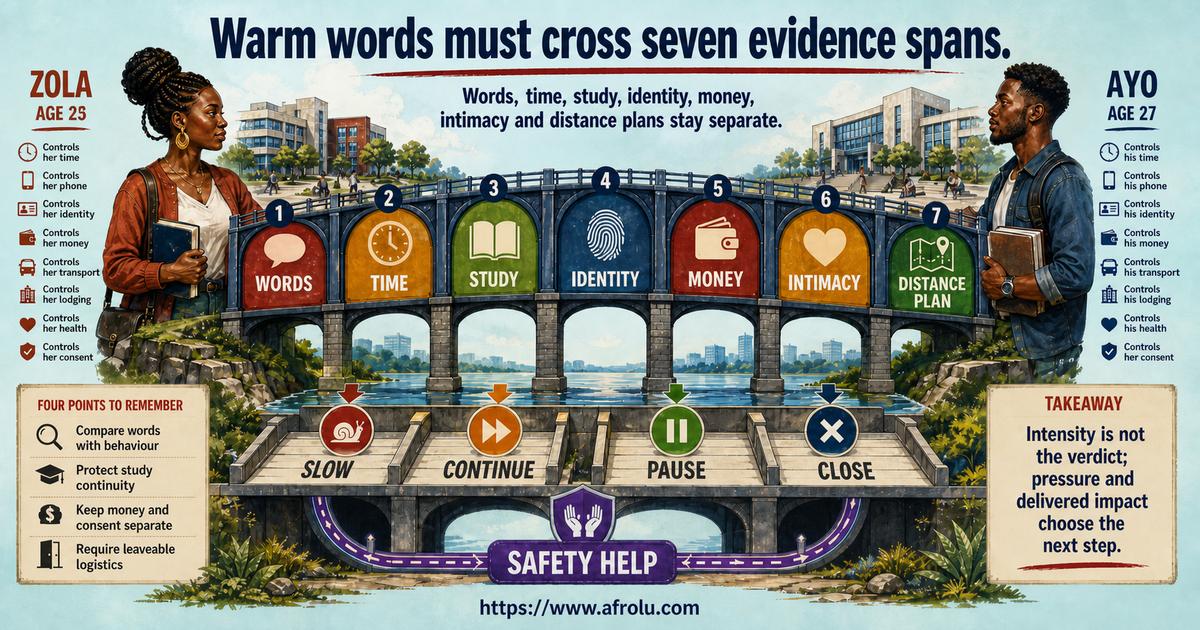
Healthy enthusiasm can cross a slower bridge without demanding access as proof.
Written and edited by Thabo Mokoena · Dating Trends Editor
Move affectionate words across seven independent spans: WORDS, TIME, STUDY, IDENTITY, MONEY, INTIMACY and DISTANCE PLAN. Slow one variable and observe what happens when you say not yet. Keep student accounts, documents, airtime, gifts, tickets, lodging and transport separate. Calls, labels, images, touch and sex are different decisions. Continue small only when warmth remains respectful and logistics become real. No universal love-bombing timeline exists. Threats, stalking, fraud, coercion, image abuse or blocked movement bypass the pace test and use suitable safety help.
Emotional safety · Students
How can an adult student distinguish welcome long-distance enthusiasm from a pressure pattern without diagnosing a person or letting intensity accelerate access?
Love bombing is a non-diagnostic label for a pattern in which intense affection helps create pressure, debt, isolation or accelerated access. Early enthusiasm and frequent long-distance communication can be healthy when boundaries remain intact. The seven-span test compares words with repeatable conduct; it cannot determine motive or certify safety.
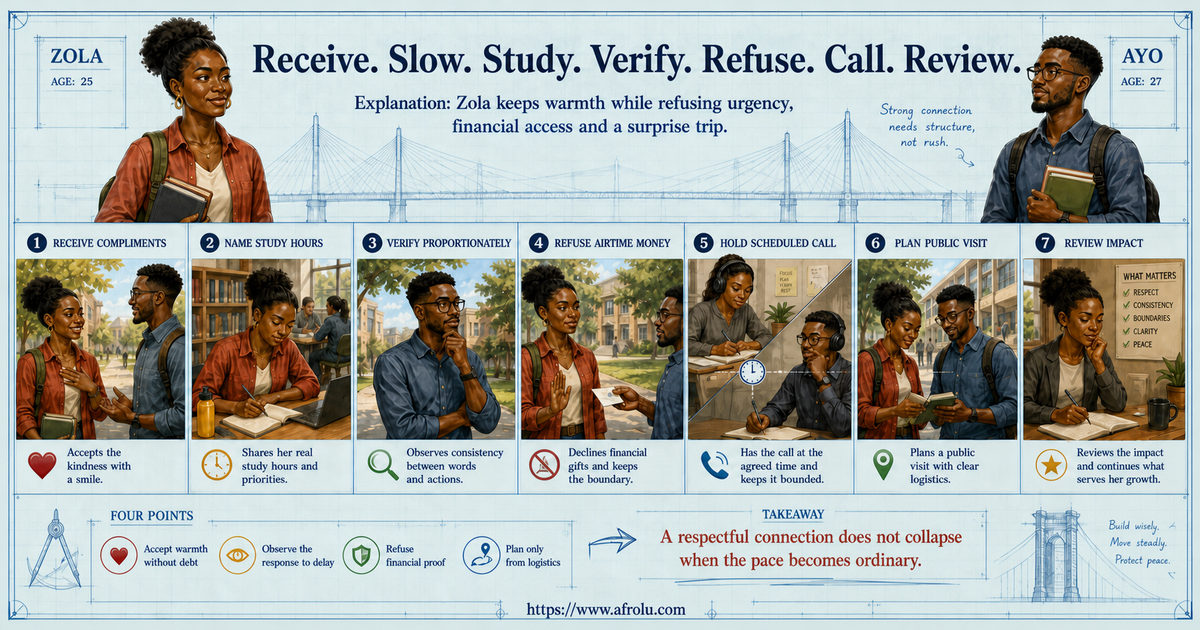
Zola, a fictional 25-year-old adult student, protects an assessment, declines airtime and a gift, holds one bounded call with Ayo, 27, and counters a rushed visit with later public logistics. He accepts every limit. She continues a small schedule after seven days without treating that fictional review window as a universal test.
The seven-span adult-student distance bridge
Compare warm words with study, privacy, money, intimacy and a real visit plan
Thabo avoids diagnosing intensity and focuses on the delivered response to delay, independent life and a complete no.
Slow one variable, protect sensitive doors, make distance concrete and review what the affection actually did.
Keep discovery open
Let warmth exist without future certainty or all-day access.
Protect adult life
Keep coursework, documents, portals and exact routines private.
Unbundle access
Gifts, funds, labels, images and sex never become one debt.
Require leaveable logistics
Use dates, budget, public meeting, lodging, transport and cancellation.
Describe a pattern
Love bombing is most useful when it names pressure, not a personality verdict
Early long-distance dating can sound unusually intense because messages compress time. Two adult students may exchange personal histories, voice notes and future ideas before they have shared ordinary errands or seen each other handle disappointment. Warmth, frequent contact and excitement are not automatically love bombing. The useful question is whether affection remains respectful when access becomes smaller.
Zola records observable acts rather than assigning a hidden motive. Ayo sends forty messages, calls her perfect, proposes exclusivity, offers a gift or discusses a visit. Each fact needs context. She then observes whether he accepts study hours, a delayed label, independent verification, separate money, a declined image and a public travel plan without punishment or escalation.
A pressure pattern may combine idealisation with urgency, guilt, surveillance, financial access, isolation or rapid control. It matters even when the person describes their behaviour as generosity. At the same time, one awkward compliment or eager date idea may simply need a clear counteroffer. A safety-first pace test creates a response opportunity without requiring Zola to remain available for repeated harm.
No script can make coercion safe. Threats, stalking, impersonation, sexual pressure, image abuse, financial exploitation or blocked exit move outside ordinary pacing. Zola can reduce access, preserve relevant records where safe and seek appropriate platform, financial, legal, health or emergency support. She does not need proof of intent before acting on dangerous conduct.
Cross seven spans
Words must travel through time, study, identity, money, intimacy and a real plan
WORDS asks whether compliments remain proportionate to what the adults know. TIME asks whether contact can become scheduled rather than continuous. STUDY protects classes, work, assignments, sleep and friendships from loyalty tests. Ayo can feel excited and still accept that Zola's education is not a rival he must defeat.
IDENTITY uses proportionate checks while limiting sensitive data. A video call may add context but does not prove character. Zola keeps her address, student portal, identity documents, account codes and detailed routine private. If Ayo treats protective choices as accusations or requests reciprocal oversharing, the bridge is showing strain.
MONEY separates generosity from access. Gifts should be freely declineable and never create debt, while airtime, tuition, emergency, investment, ticket or verification requests remain closed. INTIMACY separates disclosure, sexual talk, images, touch and sex. A relationship label, travel distance or gift does not bundle those decisions.
DISTANCE PLAN turns fantasy into logistics: dates, budget, public meeting, independent lodging, transport, check-in and cancellation. A surprise visit is not romantic when it removes choice. If there is no feasible plan, the pair can keep learning at a smaller pace or end the route. More intensity cannot substitute for missing logistics.
Follow one slower week
Zola accepts warmth while testing how Ayo handles study, money and delay
After four days of messaging, Ayo calls Zola his future, sends long voice notes and asks to speak every night. Zola enjoys his humour but notices that she is reading messages during laboratory preparation. She states that she will answer after Thursday's assessment and does not apologise for protecting study. Ayo replies warmly and waits.
On Friday Ayo suggests sending airtime and ordering an expensive gift. Zola declines both and says money will stay separate. He accepts without asking for an address or account. They hold a scheduled video call in neutral spaces, answer ordinary identity questions and discuss what each means by serious interest without agreeing to exclusivity.
Ayo then imagines visiting the following weekend. Zola counters with a later date that allows a public daytime meeting, independent accommodation and separate return travel. He does not arrive unexpectedly or frame delay as rejection. The plan remains tentative until both confirm. Interest is present, but no travel has become owed.
At the end of seven days Zola records that contact no longer interrupts study and every no remained intact. She continues one scheduled call and two message windows. Seven days is simply this fictional review period, not a universal test. If Ayo had punished her boundaries, closure would have been the useful result.
Read fourteen paired signals
Every bridge span shows both respectful enthusiasm and pressure for access
WORDS respect pace when compliments fit present knowledge and uncertainty stays allowed. Redesign claims of uniqueness, destiny or permanent commitment before ordinary evidence exists. TIME respects pace when contact can be scheduled and missed without retaliation. Stop cross-platform harassment, threats or repeated unwanted contact across any account.
STUDY respects pace when education, work and sleep stay protected. Redesign contact that repeatedly becomes an exam, grade or attendance issue. IDENTITY respects pace when verification is reciprocal and limited. Stop requests for documents, codes, institutional access, exact routines or intimate material offered as proof.
MONEY respects pace when gifts can be declined and each adult covers personal costs. Stop requests for airtime, fees, emergencies, investments or tickets. INTIMACY respects pace when each disclosure and sexual choice receives its own freely changeable answer. Stop coercion, image threats or the use of a label to claim access.
DISTANCE PLAN respects pace when travel is feasible, public and independently leaveable. Redesign elaborate fantasy without dates or cost. Stop surprise arrival, controlled lodging or removed transport. Across every span, the response to not yet carries more information than the original affectionate gesture ever could.

One serious safety fact is enough to close access; no positive total cancels it.
Use ten direct pace lines
Clear sentences protect study, identity, money, visits and sexual choice
For contact Zola can say, 'I enjoy this, and I am available for two calls a week.' For study, 'I will answer after my assessment, not during preparation.' For labels, 'I am not agreeing to exclusivity yet; I need more ordinary evidence.' These statements preserve warmth while refusing acceleration.
For identity, 'I can video call, but I do not share documents, my portal or my exact routine' offers a bounded check. For money, 'Please do not send airtime or gifts, and I do not send funds to matches' closes both debt and rescue routes. A respectful adult can accept, counter or decide that the arrangement does not fit.
For a visit, Zola can require a later public daytime plan with independent lodging, transport and cancellation. For intimacy, she can state that affectionate messages, a call, images, touch and sex are separate choices. Sexual-health discussions about partners, testing and prevention happen before sex, not after travel creates pressure.
For closure, 'The pressure after my no means I am ending contact' is enough. She does not need to diagnose Ayo, prove a pattern or debate whether he intended love. If contact crosses accounts after closure, the task becomes blocking, evidence preservation and suitable reporting or safety support rather than another explanation.

A direct line is useful only when it preserves a free yes, no, counteroffer or ending.
Review delivered impact
Continue small, slow further, pause, close or seek the right support
CONTINUE SMALL means the tested contact rhythm remains manageable and every boundary still works. SLOW FURTHER reduces frequency, disclosure or future talk while retaining chosen contact. PAUSE ends optional interaction for a period without turning silence into punishment. None of these options promises a relationship or future travel.
CLOSE applies to mismatch, unwanted intensity or repeated pressure. It does not require a diagnostic label. Zola can end one connection while keeping the app, leave the service while retaining one contact or stop dating entirely. Money, time and emotion already invested are past costs, not reasons to accept new access.
SEEK CARE belongs to severe or persistent distress that interferes with ordinary functioning, whatever its cause. A qualified local professional can assess individual circumstances. SEEK SAFETY HELP belongs to threats, coercion, stalking, fraud, image abuse or blocked movement and may involve distinct platform, financial, legal, health or emergency channels.
The review asks what changed after Zola named a limit. Did warmth remain? Did study recover? Did money stay separate? Did a visit become safer and more concrete? A person may answer some questions well and still be incompatible. A single serious danger fact is sufficient to protect access without completing the board.

Seven days is the fictional story window, not a universal test or required waiting period.
Separate seven nearby states
Enthusiasm, intense style, pressure, fantasy, stress, mismatch and control need different responses
HEALTHY ENTHUSIASM brings warmth, curiosity and plans while keeping no complete. An INTENSE STYLE may involve frequent messages or expressive language that both adults genuinely enjoy and can reduce. Neither state is automatically manipulative. The response to a smaller pace provides more information than volume alone.
A PRESSURE PATTERN appears when affection repeatedly secures time, identity, money, isolation, sexual material or accelerated commitment and punishes resistance. DISTANCE FANTASY builds a future without feasible dates, budget or ordinary evidence. The first calls for access protection; the second may need a logistics question or a clean ending.
STUDENT STRESS can make even respectful contact feel heavy during deadlines, and reducing dating may not solve the wider workload. ORDINARY MISMATCH means preferred contact, intention or distance commitment differs. Both can be handled without accusing either adult of love bombing, provided safety and consent remain intact.
UNSAFE CONTROL includes stalking, threats, sexual coercion, fraud, identity misuse, image abuse or blocked exit. It uses appropriate safety channels, not a communication exercise. A person experiencing abuse is not responsible for causing it by moving too quickly, accepting affection or failing to identify the pattern earlier.
Eight student-distance moments where affection needs an evidence check
Compliments arrive before ordinary questions
Ayo calls Zola perfect but cannot describe her current study, values or preferences accurately.
Enjoy the warmth if wanted while slowing labels and asking one concrete question.Nightly calls interrupt coursework
The connection is pleasant, yet every evening becomes an assumed video appointment.
Name two available calls and observe whether the reduced rhythm is respected.A gift requires an address
An expensive surprise is offered after a few days and framed as proof that Zola trusts him.
Decline the gift and keep home, payment and delivery details private.Airtime becomes an emotional debt
Ayo offers credit, then implies Zola should stay online because he paid.
Keep money separate and close contact if payment is used to purchase access.A future label is treated as consent
Talk of commitment is used to request intimate images or sexual video.
Separate every choice and stop engagement if pressure or threats appear.A surprise visit is announced
Ayo says he will arrive near campus without an agreed date, lodging or return plan.
State that no meeting will occur and protect location information; use help if he persists.A delayed reply is accepted
Zola finishes an assessment and returns to find one kind message rather than punishment.
Count the delivered respect and keep the smaller schedule if it remains wanted.Intensity falls after the boundary
The connection becomes quiet once gifts, constant calls and rapid labels are declined.
Treat reduced effort as evidence and close without chasing the earlier performance.Fourteen signals across words, study, identity, money, intimacy and visits
{'name': 'Proportionate words', 'detail': 'Compliments leave room for uncertainty and do not claim knowledge the pair has not earned.'}
{'name': 'Schedulable contact', 'detail': 'Calls and messages can move around adult study, work, sleep and friends.'}
{'name': 'A complete not yet', 'detail': 'Delay receives curiosity or acceptance rather than guilt, anger or withdrawal of care.'}
{'name': 'Ordinary questions', 'detail': 'The other adult learns present routines, preferences and constraints instead of narrating a fantasy.'}
{'name': 'Limited identity data', 'detail': 'A video call never becomes a demand for documents, portals, codes or exact location.'}
{'name': 'Declineable gifts', 'detail': 'A gift can be refused without creating debt, offence or a claim to access.'}
{'name': 'Separate finances', 'detail': "Airtime, fees, emergencies, investments and tickets remain each person's responsibility."}
{'name': 'Specific intimacy', 'detail': 'Disclosure, sexual talk, images, touch and sex each retain a freely changeable answer.'}
{'name': 'Feasible visit', 'detail': 'Dates, budget, public meeting, lodging, transport and cancellation can all be named.'}
{'name': 'Independent movement', 'detail': "Neither student controls the other's campus routine, accommodation, phone or return."}
{'name': 'Visible reciprocity', 'detail': 'Warm words are joined by listening, practical effort, repair and accepted differences.'}
{'name': 'Safe closure', 'detail': 'Zola can end contact without threats, cross-account pursuit or community pressure.'}
{'name': 'Study continuity', 'detail': 'Dating remains outside protected classes, assignments, paid work and necessary recovery.'}
{'name': 'No universal clock', 'detail': 'The pair review evidence without treating seven days as a diagnosis or deadline.'}
Review early long-distance intensity through ten independent questions
| Situation | What it may mean | What to do next |
|---|---|---|
| Do the words fit what is actually known? | Fits: Warmth leaves room for discovery. Needs review: Destiny language outruns ordinary knowledge. Stop: Affection is used to demand immediate commitment. | Slow labels, ask a concrete question or close pressure. |
| Can contact be scheduled? | Fits: Both students protect study and sleep. Needs review: Calls expand without agreement. Stop: Delay triggers monitoring or harassment. | Name the available rhythm and protect access if punished. |
| What happens to study continuity? | Fits: Classes and deadlines remain intact. Needs review: Messages repeatedly fragment work. Stop: Education is belittled, sabotaged or tracked. | Move contact outside study or end controlling access. |
| Is verification proportionate? | Fits: A bounded call and consistent context are available. Needs review: Oversharing is framed as closeness. Stop: Documents, codes or exact routines are demanded. | Keep sensitive data closed and use independent checks. |
| Can every gift be declined? | Fits: No gift creates debt or access. Needs review: Generosity arrives before trust. Stop: Money, airtime, fees or tickets are requested. | Decline, separate finances and use fraud help when relevant. |
| Does intimacy remain unbundled? | Fits: Each step has a fresh unpressured choice. Needs review: Labels are used to assume access. Stop: Sexual pressure or image threats appear. | Separate decisions and seek suitable safety support. |
| Is a visit administratively real? | Fits: Dates, budget, public place and exit are clear. Needs review: Future talk has no feasible logistics. Stop: A surprise or controlled visit removes choice. | Require independent plans or do not meet. |
| How does the person respond to not yet? | Fits: Interest remains respectful and proportionate. Needs review: Warmth becomes withdrawal or argument. Stop: Punishment, threats or cross-account pursuit follows. | Keep the boundary, close or protect access. |
| Is the difficulty intensity or wider strain? | Fits: A smaller route restores fit. Needs review: Student stress remains without contact. Stop: Persistent impairment affects ordinary life. | Match the route to dating pace, workload or qualified care. |
| What does the review support now? | Fits: One small next step is freely wanted. Needs review: More distance would improve clarity. Stop: Danger requires immediate action. | Continue small, slow, pause, close or seek suitable help. |
Ten lines for contact, study, labels, money, visits, consent and closure
“I enjoy talking with you, and I am available for two calls a week.”
“I will answer after my assessment, not during preparation.”
“I am not agreeing to exclusivity yet; I need more ordinary evidence.”
“I can video call, but I do not share documents, portals or my exact routine.”
“I do not exchange airtime, fees, tickets or emergency money with online matches.”
“Please do not send a gift; I am not sharing my delivery address.”
“Tonight's call ends at eight, and I will decide later about another.”
“I will only consider an agreed public visit with independent lodging and return travel.”
“A label or visit does not agree to images, touch or sex; each needs a separate yes.”
“The pressure after my no means I am ending contact; do not reach me elsewhere.”
Know the difference
Long-distance student affection can be warm, mismatched, pressuring or unsafe
Warmth remains compatible with study, privacy, separate money, specific consent and a freely chosen slower pace.
Access demands, fantasy without logistics, incompatibility or danger requires a different response.
One enthusiastic week is not a diagnosis, and one dangerous fact is not erased by kindness.

Use observable conduct, scope and the response to boundaries.
Separate eight nearby enthusiasm, pressure, stress, mismatch and safety states
| Type or dimension | What it describes | Best next question |
|---|---|---|
| Healthy enthusiasm | Frequent warmth coexists with questions, delay, study, privacy and a complete no. | Keep the mutually wanted rhythm and review before expanding. |
| Intense communication style | Both adults genuinely enjoy high contact and can reduce it without punishment. | Negotiate frequency instead of assigning a harmful motive. |
| Love-bombing pressure pattern | Affection repeatedly secures time, data, money, isolation, sexual access or rapid commitment. | Reduce access, state a boundary when safe and close repeated pressure. |
| Distance fantasy | Future visits and permanence are vivid while dates, cost and ordinary evidence remain absent. | Ask one logistics question or stop investing in the imagined plan. |
| Student workload strain | Even respectful contact feels heavy during classes, paid work or deadlines. | Adjust dating capacity and use relevant academic or health support. |
| Ordinary mismatch | The adults want different contact, commitment or distance effort without coercion. | Name the difference and permit a respectful ending. |
| Persistent impairment | Distress affects sleep, concentration, appetite, enjoyment or ordinary tasks across contexts. | Seek qualified local assessment; a pace test cannot establish cause. |
| Unsafe control | Threats, stalking, fraud, sexual coercion, image abuse or blocked movement changes the problem. | Protect access and use suitable platform, financial, legal, health or emergency help. |
Use the seven-span affection bridge in six moves
Describe the pattern
Record affection, access requests, impact and the response to not yet.
Cross seven spans
Words, time, study, identity, money, intimacy and travel stay independent.
Slow one variable
Reduce frequency or labels without staging a loyalty test.
Make distance concrete
Require dates, budget, public meeting, lodging, transport and cancellation.
Treat no as evidence
Respect after a boundary matters more than an impressive first gesture.
Bypass the board for danger
Coercion, stalking, fraud and image abuse use suitable safety routes.
Questions for words, student life, access and distance
Choose a few prompts that fit the moment. This is a reference library, not a list to complete.
Words
Compare affection with current knowledge.
- What do they actually know?
- What future claim appeared?
- What ordinary question was asked?
- Can uncertainty remain?
- What happens after not yet?
Student life
Protect adult responsibilities.
- Which class stays protected?
- When do calls happen?
- What sleep cost appears?
- Can friends remain?
- Does delay receive respect?
Access
Keep sensitive doors separate.
- Which identity check is proportionate?
- What gift is declineable?
- What money stays closed?
- Which intimacy is not agreed?
- Can contact end?
Distance
Turn fantasy into a leaveable plan.
- Which date is feasible?
- Who controls lodging?
- How does each person travel?
- Where is the public meeting?
- What cancels the plan?
What online-safety, distance and adult-student research can support
eSafety guidance identifies rapid romance, pressure, money and tech-based control risks
The current official page supports watching patterns of manipulation, limiting information and preparing safer meetings.
Evidence limit: Australian guidance and reported prevalence cannot determine the intent or risk of a specific person elsewhere.
WHO describes controlling behaviours within intimate partner violence
The resource supports treating control, isolation and sexual or emotional abuse as more than an ordinary pace disagreement.
Evidence limit: A global fact sheet does not provide individual legal advice or a jurisdiction-specific reporting route.
A relationship study examines texting and satisfaction in long-distance couples
The findings guard against assuming that frequent remote contact is inherently unhealthy and support asking how a channel functions.
Evidence limit: Established-couple correlations cannot prescribe frequency or certify a new match.
Five studies compare online disclosure with relational outcomes
The research supports considering disclosure medium and partner-focused content rather than treating more sharing as automatic intimacy.
Evidence limit: It does not set a safe disclosure quantity for student daters or prove harm in one exchange.
A cross-sectional university study examines problematic dating-app use and health outcomes
The evidence supports discussing intensity, mental health and sexual-health context among adult students.
Evidence limit: Associations cannot establish individual cause, diagnose a condition or define every high-use pattern as problematic.
Research characterises agreements and sexual-health communication across young adult partner types
The work supports making agreements explicit even when a relationship is casual, new or not formally labelled.
Evidence limit: The population and measures do not generalise to all students or prescribe a particular relationship model.
Six ways a pace test can become diagnosis or pressure
Calling every eager person a love bomber
Intensity becomes a diagnosis. Repair: describe pattern, impact and response to limits.
Rewarding words with immediate access
Compliments purchase time, data or labels. Repair: let conduct cross each span.
Accepting gifts to avoid offence
Generosity creates debt and location access. Repair: keep gifts freely declineable.
Using a visit to test seriousness
Travel pressure replaces ordinary evidence. Repair: plan only from independent logistics.
Debating after repeated pressure
Perfect wording becomes another contact route. Repair: close and protect access when needed.
Treating seven days as a verdict
A story window becomes a universal clock. Repair: review current evidence without a diagnosis.
Use a reviewed resource that matches the decision
This guide focuses on the relationship decision, so it does not rank dating apps. Check current prices, safety tools, and local availability before choosing a service.
Explore the guide library
Show more related guides
Continue with Afrolu
Show more Afrolu guides
Current safety guidance and research on distance, disclosure and student dating
Afrolu reviewed these health, research, safety, or public guidance resources while editing this page. They support the behaviour and safety guidance; they do not diagnose any individual described by a reader.
Adult-student long-distance affection-pace questions
Is one intense week automatically love bombing?
No. Frequent messages, compliments and excitement alone cannot diagnose a person or establish manipulation. Look at the pattern: what access is requested, how study and privacy are affected, and what happens when you say not yet. Respectful enthusiasm can slow. Repeated pressure, punishment or unsafe conduct needs a firmer response.
Why use seven days in the story?
It gives Zola's fictional sequence a bounded review point; it is not a universal love-bombing timeline, waiting rule or risk test. Your relevant period may be shorter or longer. Serious danger never waits for a review date. Ordinary uncertainty can be assessed whenever enough delivered behaviour exists to choose a next step.
Can adult students have a healthy high-contact relationship?
Yes, if both genuinely want the rhythm and can reduce it without punishment. High contact should coexist with classes, work, sleep, friendships, privacy, separate money and specific consent. Frequency alone does not determine health. The ability to negotiate and preserve independent life is more informative than a message count.
Should I accept an expensive gift from a long-distance match?
You may decline any gift. Early gifts can reveal private addresses or create a sense of debt, and money routes can be exploited in scams. Do not send a reciprocal payment, fee or account information. A caring response accepts no. Pressure, anger or claims that a gift purchased access are reasons to reduce contact.
What makes a long-distance visit safer?
No plan eliminates risk, but it can remain more leaveable when dates, cost, public meeting, independent accommodation, transport, check-ins and cancellation are explicit. Protect exact routines until appropriate, tell a trusted person where you are where feasible, and do not let a match control documents, phone, money or return travel.
What if they say slowing down proves I am not serious?
They may prefer a faster pace, and that mismatch is useful information. Seriousness does not create unlimited access. State one pace or plan you can genuinely offer. They can accept, counter or close. Guilt, spiritual or emotional threats, surveillance and retaliation are not ordinary preference differences.
Does a relationship label provide sexual consent?
No. A match, exclusive label, gift, call or visit does not consent to sexual messages, images, touch or sex. Each choice is specific and can change. Before sex, discuss partners, testing and prevention with enough time for informed decisions. Pressure or image threats move into safety support, not negotiation.
What if the affection disappears after I set a boundary?
Treat the change as information. The earlier warmth may have been conditional, the person may prefer a different pace, or interest may simply have changed. You do not need to recover the performance. Decide whether the remaining conduct offers reciprocity and a realistic plan; otherwise close the route without diagnosing motive.
When should distress receive professional support?
Consider qualified local care when distress is severe, persistent or interferes with sleep, concentration, appetite, enjoyment or ordinary tasks across contexts. A pace framework cannot determine cause or treatment. Immediate self-harm risk or danger needs urgent local help rather than waiting to finish a dating review.
When should I stop using a script?
Do not keep explaining when threats, stalking, fraud, coercion, image abuse, controlled movement or persistent unwanted contact appears. A response can increase access or risk. Preserve relevant records where safe and use appropriate platform, financial, legal, health, campus or emergency support for your location.
One thing to do now
Let warm interest cross ordinary evidence before access expands
Continue only while affection remains compatible with study, limited identity data, separate money, specific consent and independently leaveable travel. Slow, pause or close whenever the pace is unwanted. Use qualified care for severe persistent impairment and problem-specific platform, financial, legal, health or emergency support for unsafe conduct.