Four lanes for connection that still leaves room to learn
Choose a Low-Pressure Long-Distance Dating Type as a Student
Map long-distance student dating by type, intention, structure and pace, with clear exam rhythms, privacy, money, consent and safe visit plans.
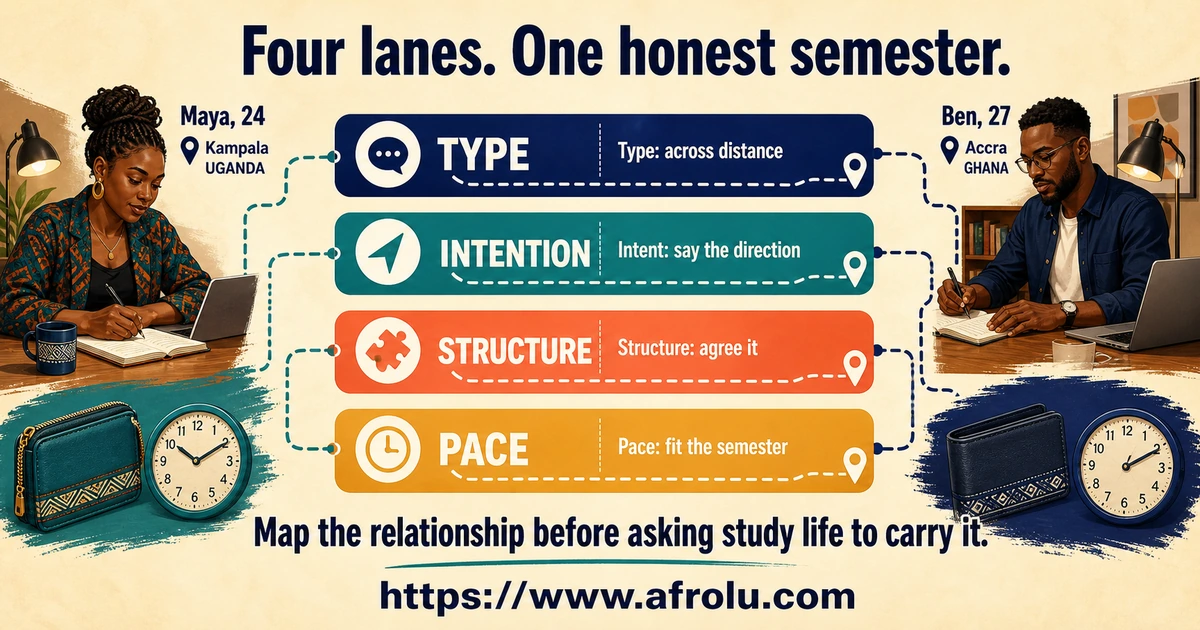
Map the relationship before asking study life to carry it.
Written and edited by Thabo Mokoena · Dating Trends Editor
Treat long-distance as geography, not commitment. Write four separate answers: the relationship type, each adult's intention, the present exclusivity structure and a low-pressure pace that fits the semester. Create a bounded exam mode with a return date; lower contact should still contain reciprocity and repair. Keep tuition, devices, accounts, residence details and location outside relationship proof. Send no fare, phone, emergency or investment money. Before a visit, independently check necessary facts and complete the public plan, lodging, budget, consent and return. After real interactions, continue, revise or close from clarity, study impact and conduct—not message volume.
Dating basics · Students
Which relationship type, intention, structure and pace can both adults sustain without sacrificing study, safety, money or free choice?
Low-pressure long-distance dating for adult students is connection across geography with a deliberately modest, mutually understood rhythm. The four-lane semester map separates type, future direction, present exclusivity and speed so a lighter pace protects education without becoming disappearance, low effort, financial dependence or monitoring.
Maya and Ben are fictional adult students, 24 and 27. They date across cities with one weekend call and two brief check-ins. During overlapping examinations and placement assessment, they agree on a three-week exam mode and a named review date. When Ben misses a call, he repairs it without demanding proof or access. They later keep a modest rhythm and remain non-exclusive while discussing what that structure requires.
The four-lane semester map
Let a lighter relationship rhythm remain clear enough to choose
Thabo separates geography, intention, agreement and pace before building an exam-safe communication and visit plan.
The semester map uses four independent lanes, a bounded exam mode and a six-pocket travel check without grading the adults or the relationship.
Type and geography
Describe what exists across distance without turning location into a promise.
Intention and structure
State future direction and present exclusivity as two different choices.
Pace and exams
Choose modest contact and make temporary capacity changes visible and bounded.
Privacy and visits
Protect essential systems and complete every travel pocket before movement.
Start with four separate answers
Long-distance names geography; it does not decide the relationship
Adult student life can contain lectures, placements, research, paid work, care duties, shared housing and abrupt timetable changes. Add distance and a few messages may begin carrying every emotional task. The first protection is conceptual: long-distance describes where two people live. It does not reveal whether they are casually exploring, dating toward partnership, exclusive today or moving quickly. Those choices need words of their own.
Type is the broad relationship category. Intention is the direction each adult hopes to explore. Structure is the present agreement about other partners. Pace is how quickly communication, visits, intimacy and personal access expand. A pair can date toward commitment, remain non-exclusive for now and choose a low-pressure rhythm during a demanding semester. Another pair may prefer casual intention and the same rhythm. Neither arrangement is inferior when both understand it.
Low pressure should reduce performance, not accountability. It can mean fewer scheduled calls, permission to answer after class, affordable dates and no demand to narrate every hour. It does not mean disappearing without explanation, cancelling every plan, refusing all relationship questions or returning only when attention is convenient. Healthy lightness still contains a reason, a mutual rhythm, reciprocal effort and a point when the arrangement will be reconsidered.
This guide concerns adult students only. It does not assume a particular age, degree, income, sexuality or institution. Some readers study full time; others return to education while working or parenting. The common test is whether the connection leaves both adults able to learn, sleep, manage essential money and choose freely while useful relationship evidence grows at a pace their actual lives can sustain.
Build the semester map
Give type, intention, structure and pace their own lanes
In the type lane, describe what exists rather than choosing the most flattering label. Are you getting acquainted online, dating across cities, maintaining an established partnership or planning a first visit? Name uncertainty if it is present. A precise description makes a smaller promise than a dramatic label, but it gives both adults something real to organise around.
In the intention lane, each adult states what they are open to exploring. Serious direction can mean learning whether a lasting partnership is possible; casual direction can mean connection without that goal. Intention may change, but a private change is not a shared update. Family hopes, religious expectations, profile labels and frequency of contact cannot speak on behalf of either adult.
In the structure lane, discuss whether either person dates or has sex with others and which sexual-health information is relevant before intimacy. Exclusivity begins through a mutual agreement, not through jealousy, daily calls, travel cost or access to a social account. It also does not purchase passwords, location monitoring, sexual images or control of friendships. Every permission stays specific and reversible.
In the pace lane, make study capacity observable. Agree on a modest contact rhythm, how cancellations are communicated, what changes during exams and when normal contact will be revisited. Include visits only when a complete safe plan and affordable budget exist. A map is not a contract for constant performance; it is a shared reference that lets both adults notice whether the relationship remains reciprocal and kind.
Maya and Ben use exam mode
A temporary rhythm works because its boundaries are visible
Maya and Ben are fictional postgraduate students, 24 and 27, living in different cities. They have spoken for three months and want to learn whether a committed relationship is possible. They have not agreed to exclusivity. Their ordinary rhythm is one longer weekend call and two brief midweek check-ins. Both can initiate, either can decline a call and neither expects access to lecture timetables or live location.
Maya's examination period arrives at the same time as Ben's paid placement assessment. Instead of trying to maintain the ordinary rhythm, they set a three-week exam mode: one Sunday call, one flexible voice note and no expectation of an immediate answer during protected study blocks. They write the end date in their own calendars. Reduced contact is not treated as a loyalty test, and each remains responsible for saying if capacity changes again.
In week two, Ben misses the Sunday call and sends an apology the following morning. He explains that a placement shift overran, offers two alternative times and does not ask Maya to prove where she was when he later sees her online. Maya says the silence worried her and chooses Tuesday. The repair is small but useful: explanation, ownership, an alternative and changed conduct appear without surveillance or a dramatic promise.
After exams, they review. Maya wants to keep one phone-free study evening; Ben wants slightly more spontaneity. They agree on a four-week trial and keep the relationship non-exclusive while discussing what that means for sexual-health disclosure. The low-pressure arrangement has movement because both adults can describe it, contribute to it and change it. It is not measured by message volume or academic sacrifice.
Read the signal pattern
Separate deliberate lightness, temporary strain, vagueness and control
Deliberate low pressure has a stated reason and an observable rhythm. Contact may be modest, yet both adults initiate, answer important questions, make affordable plans and repair missed agreements. There is room for study and room for a no. The pace can be revised without one person threatening the relationship or treating attention as a debt.
Temporary strain has a context and a boundary. Examinations, fieldwork, illness or an unexpected care duty may reduce capacity. A useful update says what is known, what contact remains possible and when the situation will be revisited. Nobody must disclose confidential academic or medical records to earn belief. If the return date moves, a fresh conversation is more honest than pretending the original arrangement still exists.
Vagueness avoids definition. The person may repeatedly say they are busy while offering no next step, resist questions about structure and reappear only when they want comfort or sexual attention. Low effort leaves one adult initiating, planning, paying and repairing. These patterns are not diagnoses. They are enough information to reduce investment or close a connection that does not meet the reader's needs.
Control is different again. Demands for passwords, continuous location, residence access, intimate images, tuition money or proof from lecturers remove choice rather than create closeness. Repeated contradictions, threats, impersonation or urgent transfers require practical distance, account protection and appropriate support. The task is not to investigate a match alone; it is to protect the systems and people already in your care.

Judge the pattern by clarity and choice, not message volume.
Use language that fits limited attention
Short scripts can carry type, study capacity, money and travel
To name the relationship: ‘I like getting to know you across distance and I am open to a serious direction. We have not agreed to exclusivity, so can we talk about the structure we each want?’ This holds warmth and precision together. It does not force a decision on the spot, but it prevents a profile label from silently becoming a present agreement.
To protect examination time: ‘From Monday through the twenty-second I can manage one Sunday call and a flexible voice note. If that no longer works for either of us, let us say so and review after my final paper.’ The dates make the change bounded. A respectful partner may negotiate; they do not demand a timetable screenshot or turn delayed replies into accusations.
To protect money and systems: ‘My tuition, devices, passwords and student accounts stay separate. I do not send fare, phone or emergency money in a new connection.’ No detailed financial explanation is required. If money was sent after deception, contact the payment provider promptly, secure affected accounts and use reporting or support routes appropriate to the transaction and location.
To discuss a visit: ‘I will book only after we confirm a public first plan, independent lodging, costs and a return I control.’ Travel remains a separate decision even when the relationship feels emotionally important. Payment does not create consent, and a visit can be shortened or cancelled when material facts change. The aim is not suspicion; it is a plan in which each yes remains voluntary.

Say the small agreement before distance enlarges the assumption.
Use the holiday window carefully
Complete six visit pockets before spending scarce time or money
Check only the identity facts the meeting needs. Look for consistency across time and channels, use live conversation and independently locate relevant public or booking information. Verification is partial; a live face does not prove every biography claim. Do not exchange passwords, identity scans, academic records or account access as a test of trust, and do not store more personal information than the present decision requires.
Choose a staffed public first setting with a real date, time and duration. The traveller controls essential transport, documents, communication, medication and a route away. Independent lodging protects sleep and choice when practical. A trusted person can receive the useful itinerary at the traveller's discretion. Neither adult owes a home address, residence entry or campus tour because distance made the meeting rare.
Use a budget that survives disappointment. Protect tuition, rent, food, data and return fare before dating spending. Avoid urgent transfers for devices, fees, travel, emergencies or investments. Each adult should be able to cancel without debt or financial retaliation. If a provider offers refundable options, assess the actual terms yourself; a match's screenshot is not a substitute for independent confirmation.
Keep consent in the present tense. A ticket, exclusive agreement, past image or earlier yes does not authorise touch, sex, recording or sharing. Discuss relevant sexual-health information before intimacy and seek locally appropriate clinical advice where needed. After each person returns to ordinary life, compare words, logistics, autonomy and repair. The next step should be proportionate to that evidence, not to the cost or anticipation already spent.

A scarce holiday should remain a visit, not a financial trap.
Close the semester without grading love
Continue, revise or close from the pattern you actually lived
Choose a review point tied to real life: after examinations, after four agreed calls, after a first visit or before the next term begins. Each adult answers separately: What relationship did I believe we had? Did our words match? Did I retain sleep, study, money and friendships? Could I say no? Did both people initiate and repair? The comparison reveals agreement gaps without pretending every feeling can be reduced to a score.
Continue when the map remains mutual, important questions receive answers and lower contact still contains care. Choose one next step, such as another four-week rhythm or one safely planned visit. Do not enlarge every permission together. Exclusivity, sexual contact, family introductions, home access, shared expenses and relocation each deserve their own conversation and can occur on different timelines.
Revise when interest is real but the rhythm is unsustainable. Make the change specific, bounded and reciprocal. Perhaps calls move away from placement days, visits wait until income is steadier or the relationship returns to non-exclusive while a future question remains open. Revision is useful only when behaviour changes; repeating a new label over the same imbalance leaves the underlying evidence untouched.
Close when the arrangement chronically disrupts essential life, leaves one adult carrying the connection or turns distance into monitoring, secrecy or money pressure. A short ending is sufficient: ‘This no longer works for me, so I am ending contact.’ Protect accounts and seek trusted, campus, platform, financial, legal or emergency support according to the concern. A low-pressure relationship should leave both adults more able to choose—not less able to study or leave.
Eight student distance moments where a light rhythm needs an honest reading
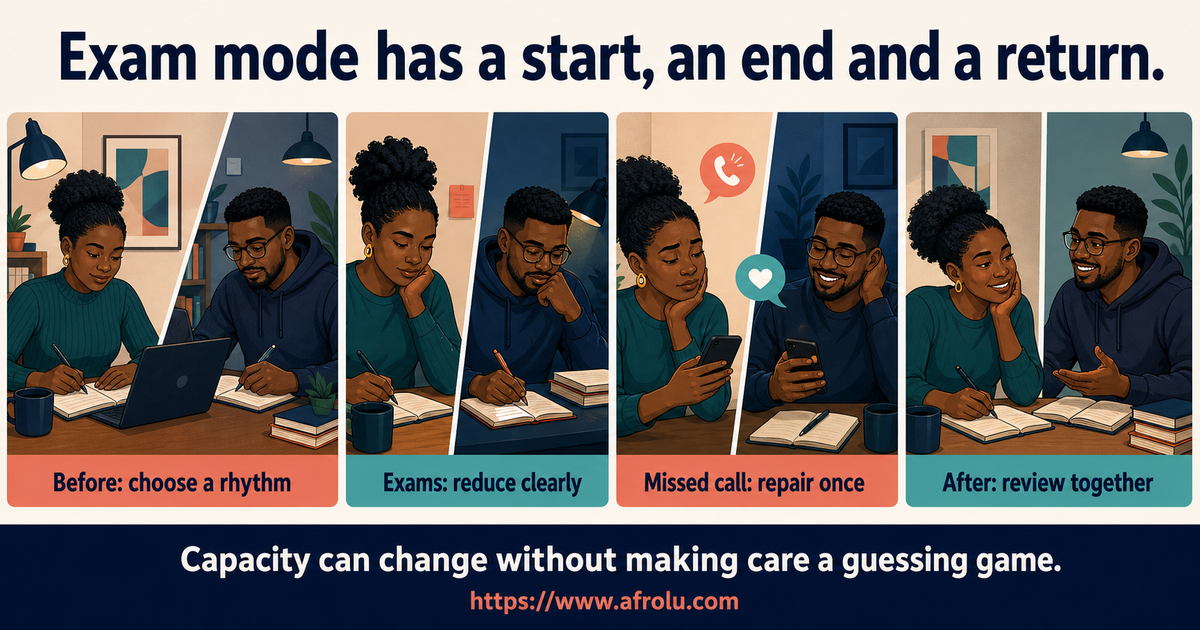
Two adults agree on a temporary rhythm
One student's final assessments overlap with the other's placement. They set three weeks of lighter contact and a date to restore or renegotiate it.
Treat the change as deliberate low pressure because reason, rhythm and return are visible.Frequency is mistaken for exclusivity
A match says that messaging every day means neither person may date anyone else, although structure was never discussed.
Pause the assumption and ask for an explicit mutual agreement.A missed check-in receives a repair
A fieldwork day runs late. The student owns the miss, offers a new time and follows through without demanding proof from the other person.
Count the repair as evidence while watching whether it becomes a reliable pattern.A rare visit is pushed toward private housing
The public plan changes to a student residence because the match says separate lodging wastes money.
Keep housing private and meet publicly or cancel the incomplete visit.Connection is made conditional on a device transfer
A remote interest says a broken phone will end the relationship unless tuition money is used for a replacement.
Send nothing, protect essential funds and reassess the pressure.Availability becomes a surveillance test
A match demands a timetable and live location after seeing an online status during a protected study evening.
Refuse monitoring and reduce access if the boundary is challenged.Casual and serious intentions do not match
Both adults like the current rhythm, but one wants eventual partnership and the other wants only casual connection.
Treat the difference as compatibility information, not a safety verdict or conversion project.Affordability and safety align
A first visit has verified basics, public plans, separate lodging, independent funds and a return each adult controls.
Proceed if both freely choose, then review after ordinary life resumes.Evidence that low pressure still contains movement and choice
{'label': 'Reason', 'title': 'The lighter pace has an honest purpose', 'detail': 'Study, work or care capacity is named without using busyness to end every question.', 'reading': 'Deliberate low pressure'}
{'label': 'Rhythm', 'title': 'Contact is modest and mutually understood', 'detail': 'Both adults know the rough cadence and can request a change without punishment.', 'reading': 'Shared structure'}
{'label': 'Reciprocity', 'title': 'Initiation and planning travel in both directions', 'detail': 'One person is not responsible for every call, repair, visit and emotional task.', 'reading': 'Balanced effort'}
{'label': 'Return', 'title': 'Temporary changes have a review date', 'detail': 'Exam mode does not quietly become an indefinite disappearance.', 'reading': 'Bounded capacity'}
{'label': 'Answers', 'title': 'Important relationship questions receive words', 'detail': 'Type, intention, structure, sexual-health expectations and endings can be discussed.', 'reading': 'Useful clarity'}
{'label': 'Study', 'title': 'Learning and sleep remain protected', 'detail': 'Care is not measured through missed classes, exhaustion or sacrificed assessments.', 'reading': 'Sustainable fit'}
{'label': 'Money', 'title': 'Essential funds remain independent', 'detail': 'Tuition, food, rent, devices and return fare are not used to prove affection.', 'reading': 'Financial choice'}
{'label': 'Privacy', 'title': 'Accounts and location stay proportionate', 'detail': 'No passwords, records or continuous tracking are required for reassurance.', 'reading': 'Protected systems'}
{'label': 'Travel', 'title': 'A visit is complete before booking', 'detail': 'Public plans, lodging, cost, communication and return work without dependency.', 'reading': 'Practical readiness'}
{'label': 'Repair', 'title': 'A missed agreement changes later conduct', 'detail': 'Explanation and apology lead to a realistic alternative rather than another grand promise.', 'reading': 'Growing reliability'}
Choose the next step from the four-lane semester map
| Situation | What it may mean | What to do next |
|---|---|---|
Scripts for relationship type, exams, money, privacy, visits and endings
“I see this as getting to know each other across distance. How would you describe it?”
“I am open to a serious direction, but I am not promising that outcome today.”
“Have we agreed to exclusivity, or are either of us still dating other people?”
“For these three weeks I can manage one call and a flexible voice note; let us review on the twenty-third.”
“If a study or placement conflict appears, please tell me and offer another realistic time.”
“I share broad availability, not my timetable, passwords, residence access or live location.”
“My tuition and essential funds stay separate; I do not send device, fare or emergency money.”
“I will book only after we confirm a public plan, independent lodging, costs and return.”
“Distance, exclusivity and travel do not make images or physical contact automatic.”
“This arrangement no longer fits my needs, so I am ending the connection.”
Know the difference
The four-card student distance map

Register each relationship choice separately.
Compare geography, direction, structure and pace
| Type or dimension | What it describes | Best next question |
|---|---|---|
| Long-distance | ||
| Serious intention | ||
| Casual intention | ||
| Exclusive | ||
| Non-exclusive | ||
| Low pressure | ||
| Exam mode | ||
| Visit |
Build a low-pressure student distance map in six moves
Draw four lanes
Protect fixed commitments
Create exam mode
Keep systems private
Complete any visit
Review without grades
Questions organised by map, study, privacy and visits
Choose a few prompts that fit the moment. This is a reference library, not a list to complete.
Map questions
Separate geography, direction, agreement and speed.
- What exists now?
- Which future am I open to?
- Are we exclusive?
- What pace fits this term?
- When will we review?
Study questions
Protect fixed responsibilities before offering capacity.
- Which hours stay protected?
- What changes during exams?
- How will a missed call be repaired?
- Can both adults initiate?
- Does sleep remain viable?
Privacy questions
Keep access proportionate to the present decision.
- Which identity fact is necessary?
- What schedule detail stays private?
- Are accounts fully separate?
- Is location sharing voluntary?
- Can a no stand?
Visit questions
Make the trip complete before spending.
- Is the first plan public?
- Who controls lodging?
- Which funds are protected?
- Is consent current?
- Does return work independently?
What relationship research and official guidance can support
Distance alone does not predict relationship quality
A nationally representative U.S. study compared long-distance and close-proximity relationships and found a more complicated picture than distance pessimism suggests. Afrolu uses only that narrow lesson: assess the actual agreement and behaviour.
Evidence limit: The 2013 study cannot predict an individual couple or represent every adult student and African context.
Study and work systems deserve realistic capacity
World Health Organization guidance on mental health at work addresses organisational and individual supports rather than romantic performance. The practical boundary here is modest: a dating rhythm should not require chronic exhaustion or system exposure.
Evidence limit: Workplace guidance is not a diagnosis, student-treatment plan or rule for contact frequency.
Purpose and data minimisation offer useful discipline
Kenya's Data Protection Act requires covered processing to be lawful, purpose-specific and limited to what is necessary. In personal dating, the cautious parallel is to request and share only what the present decision needs.
Evidence limit: The Act has defined scope and exemptions; this page does not decide legal coverage or provide legal advice.
Remote trust can be followed by urgent money stories
The U.S. Federal Trade Commission warns that romance scams may use travel, emergency or investment stories before requesting money. Protect study funds and contact the provider quickly after suspected loss.
Evidence limit: U.S. reporting routes and remedies are jurisdiction-specific; use appropriate local and provider channels.
A relationship or earlier yes never replaces a current answer
NHS public-health guidance explains active consent and the ability to withdraw it. Afrolu applies that principle to physical contact, images and every visit without assuming a particular relationship structure.
Evidence limit: The source explains UK context; legal definitions and support options vary by location.
Documents, insurance and backup access are travel tasks
The UK Foreign, Commonwealth & Development Office travel checklist centres destination requirements, insurance, health, documents and backups. These preparations support travel; they do not prove romantic trust.
Evidence limit: The checklist is for British travellers. Use current official information for your citizenship, destination and circumstances.
Six shortcuts that make distance compete with education
Use a reviewed resource that matches the decision
This guide focuses on the relationship decision, so it does not rank dating apps. Check current prices, safety tools, and local availability before choosing a service.
Explore the guide library
Show more related guides
Continue with Afrolu
Show more Afrolu guides
Research and official guidance used for this semester map
Afrolu reviewed these health, research, safety, or public guidance resources while editing this page. They support the behaviour and safety guidance; they do not diagnose any individual described by a reader.
Adult student low-pressure long-distance dating questions
Does daily texting make a long-distance student relationship exclusive?
No. Frequency may show interest, but exclusivity begins only when both adults discuss and accept the same present structure. Ask whether either person dates or has sex with others and which sexual-health information is relevant. Do not treat jealousy, travel cost, a profile label or a message streak as an agreement.
Can exam season justify less contact?
Yes. Capacity can change without care disappearing. State what will reduce, what remains possible and when the arrangement will be reviewed. Nobody needs to provide records or a timetable screenshot. If a temporary change keeps extending without mutual discussion, decide whether the new pattern still meets your needs.
What makes low-pressure dating different from low effort?
Deliberate low pressure has a reason, a mutually understood rhythm, reciprocal contribution and a review point. Low effort leaves initiating, planning and repair to one person. Vagueness avoids defining anything. Judge observable conduct over time rather than trying to diagnose motives.
Should I pay for a distant match's phone, data or fare?
No payment proves care. Protect tuition, housing, food and return money, especially in a new or unverified connection. Romance scams may use devices, travel, emergencies or investments to create urgency. If money was sent under suspicious circumstances, contact the provider promptly and secure related accounts.
How often should adult students call across distance?
There is no universal number. Choose a cadence both adults can sustain and initiate around study, work, care and sleep. Agree how to handle a missed call and when to review. A smaller honest rhythm is more useful than constant access followed by resentment or collapse.
May a match ask for my class timetable or live location?
You can share broad availability without opening detailed schedules, residence patterns or continuous tracking. A trusted person may receive selected travel information for your safety at your choice. A match who requires monitoring as proof of honesty is reducing privacy and free choice rather than creating clarity.
When is a first student visit ready?
After necessary identity facts and bookings are checked independently and the plan includes a staffed public first meeting, affordable costs, controlled documents and communication, suitable lodging and a usable return. Tell a trusted person what helps them support you. Do not travel because a holiday window or sunk cost makes an incomplete plan feel urgent.
Can low-pressure long-distance dating still be serious?
Yes. Intention and pace answer different questions. Two adults can date toward a lasting partnership while choosing modest contact and gradual access. Serious direction still needs a separate structure agreement, practical travel decisions and behaviour that respects study, money, privacy and consent.
What if one of us wants serious dating and the other wants casual?
That is important compatibility information. Ask whether either adult can freely accept the other's actual direction without waiting for conversion. A respectful mismatch can lead to a smaller arrangement or an ending. It does not by itself make either person deceptive or unsafe.
How should we review the relationship after exams?
Compare what was agreed with what happened: clarity, reciprocity, study impact, privacy, money, consent and repair. Each adult can then continue, revise or close. Choose one proportionate next step rather than enlarging exclusivity, travel, home access, family involvement and finances all at once.
One thing to do now
Let the relationship fit the semester without becoming invisible
Draw the four lanes, protect fixed study and essential money, and make any capacity reduction bounded. Continue when both adults can name the relationship, contribute and repair while privacy and consent remain intact. Revise one specific part when the rhythm strains. Close when distance becomes indefinite vagueness, one-sided labour, surveillance, unsafe travel or money pressure.