Seven signal credits before one visit upgrade
Build a Low-Pressure Long-Distance Relationship as Adult Students
A student long-distance dating guide to low-pressure texting, calls, study time, repair, security, visit costs, consent and relationship review.
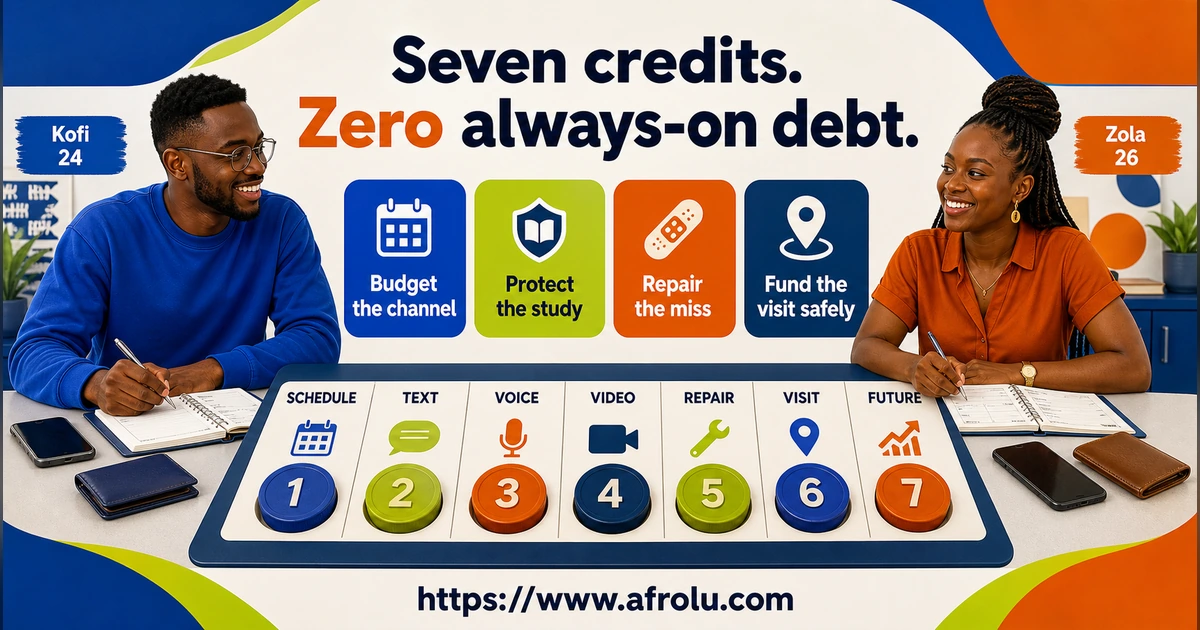
Spend communication, attention and travel capacity where both adults can actually repeat it.
Written and edited by Liya Bekele · Horn of Africa Editor
Name relationship status apart from message volume, then allocate seven finite credits: schedule, text, voice, video, repair, visit and future. Match each medium to purpose, privacy and bandwidth; define normal delays and a specific return after missed plans. Keep study, accounts, money, travel and consent independently controlled. Audit two ordinary weeks without surveillance, then keep the mix, tune one variable, pause for defined capacity or close. Low pressure is clear and revisable, not always-on or indefinite.
Distance and diaspora · Students
Which relationship status and channel mix gives both students enough responsive connection while preserving study, privacy, money, movement and the right to need something different?
Low-pressure student long-distance dating is a clearly defined relationship across locations that uses a finite, purposeful communication mix and preserves each adult's study, digital systems, money, travel control and consent.
Kofi and Zola are fictional adult students, 24 and 26. An eight-week distance trial, one missed video call, exam mode, responsive repair and an independently funded visit decision reveal whether their channel plan works.
The seven-credit student distance signal lab
Build enough connection without creating always-on debt
Liya allocates schedule, text, voice, video, repair, visit and future capacity, then audits two ordinary student weeks.
The lab separates status from channels, treats communication findings as bounded associations and gates visits through independent funds and movement.
Schedule
Share protected blocks and return windows without exposing the whole day.
Channels
Choose text, voice and video by purpose, privacy and bandwidth.
Repair
Turn a missed plan into acknowledgement and one kept return.
Movement
Gate visits and future location through safe independent capacity.
Reduce pressure without reducing clarity
Low-pressure distance dating still needs a relationship people can locate
Student long-distance dating joins two scarce resources: attention and movement. Classes, placements, paid work, group tasks, unreliable connectivity and sleep can make continuous contact unrealistic. Low pressure means neither adult must prove care through instant replies, all-night calls or a visit they cannot afford. It does not mean that plans, status or disappearance are beyond discussion. A useful arrangement tells both adults when connection normally happens, what counts as a material change and when they will review whether the rhythm is enough.
Separate relationship structure from communication volume. Two people can text all day while still exploring openly, or exchange fewer messages inside a committed partnership. Ask whether either adult dates or has agreed forms of sexual contact with others. Name the current structure before reading channel frequency as commitment. If one person needs more presence than the other can offer, that may be a genuine incompatibility. Low pressure protects an honest no; it does not require the lower-contact preference to win.
Different media do different jobs. Text can handle logistics, affection and asynchronous updates. Voice can carry nuance without the visual and bandwidth demand of video. Video can support live presence but may require privacy, data and preparation. A shared study session can create company without continuous conversation. Choose a medium because it fits the message and both adults' conditions, not because research or culture declares it the most intimate. Keep the right to turn a device off and return at the agreed time.
Distance also produces idealisation opportunities. Each adult may see curated moments while ordinary stress, friends, household duties and local behaviour remain less visible. That is not proof of deception; it is a limit of the sample. Use modest curiosity, live interaction and real-world visits when safe and feasible. Do not compensate by demanding location tracking, passwords or constant video. The goal is better evidence with less unnecessary access.
Allocate seven finite credits
Schedule, text, voice, video, repair, visits and future plans all consume capacity
Schedule credit sets the weekly frame. Mark immovable study, work and sleep, then identify two or three windows rather than exposing the whole timetable. Text credit defines what asynchronous contact can carry and how silence is interpreted. A brief 'deadline day; back tomorrow' may prevent hours of guessing, but no one should be required to narrate every movement. Agree whether urgent plan changes use one call, a text or another method available to both.
Voice and video credits should reflect purpose. A voice call may suit emotional nuance when bandwidth or privacy is limited. Video may help with live presence or a shared activity, but it is not superior when it exhausts one adult or intrudes on a shared residence. Ask permission before surprise calls. Set a length when study follows. If a channel repeatedly fails, change the tool or timing instead of interpreting every technical problem as relationship evidence.
Repair credit answers what happens after a miss. The adult who changes a plan names it, acknowledges the effect and offers a realistic return. The other can express disappointment without demanding surveillance. A rescheduled conversation only counts when it happens; repeated apologies without changed conduct are their own pattern. Low pressure allows ordinary mistakes while keeping accountability visible. Severe threats, coercion or digital intrusion are not minor misses that require another trial.
Visit and future credits remain gated. Choose travel each adult can fund and control, with independent documents, accommodation, emergency money and departure. A first meeting should use a public plan and appropriate safety measures. Future co-location belongs after relationship evidence and independent work, legal, housing and financial research. The cost of distance may affect whether couples move together, remain apart or separate, but no population study determines what this pair must do.
Kofi and Zola test eight weeks
A missed video call shows whether their low-pressure promise includes repair
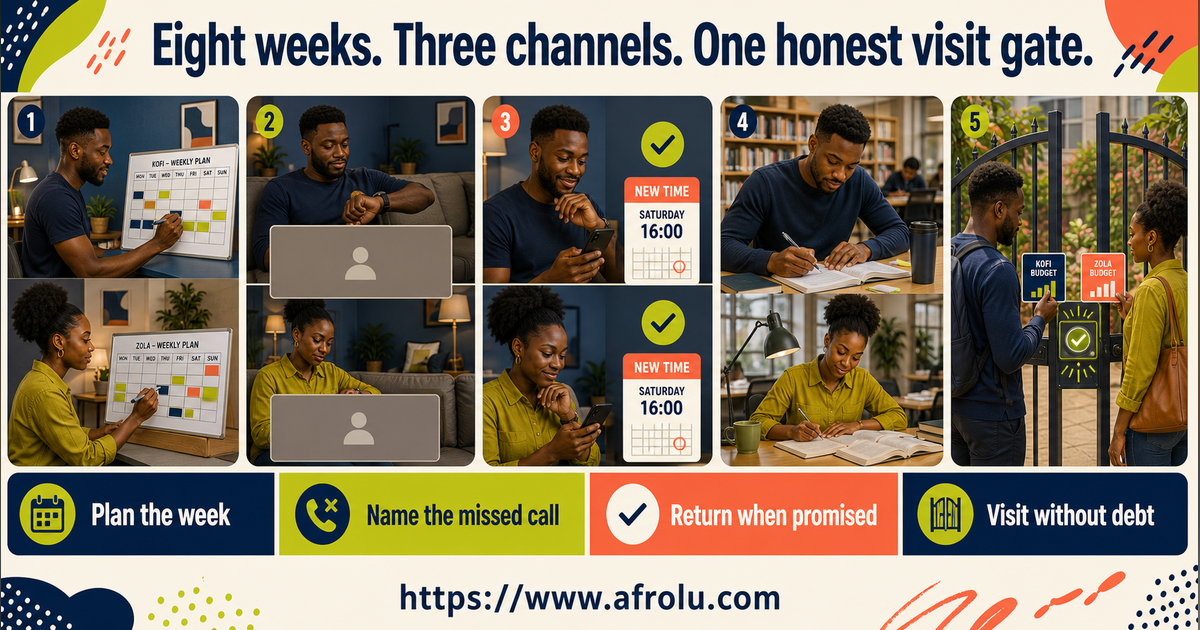
Kofi, 24, and Zola, 26, studied in different cities and had been dating locally before one moved for a postgraduate programme. They chose an eight-week distance trial inside their existing exclusivity: short texts most days when capacity allowed, one planned voice call and one optional shared video study session each week. They kept study calendars private, agreed that delayed replies were not emergencies and chose one call as the route for a material plan change.
During week three, Kofi missed the video session after a group project ran late. Zola saw no update and felt dismissed. The next morning Kofi acknowledged that he had known the risk earlier, apologised and offered a specific voice-call window. He did not send screenshots of his group, demand that Zola ignore the impact or promise permanent instant access. Zola explained that timely notice mattered more than the video format. They added a simple deadline-day text and kept the next call.
Exams changed their contact again. They removed the optional video sessions for two weeks and kept one responsive text thread plus the planned voice call. Neither monitored online status or interpreted active time elsewhere as stolen relationship time. The lower volume still felt connected because both knew its purpose and end date. When a longer conversation was needed, they placed it after the exam rather than attempting to resolve an emotional issue through fragmented late-night messages.
At eight weeks, they considered a visit. Each priced travel, essential spending and academic load independently. The earliest date would have required debt and missed coursework, so they chose a later public visit and retained separate transport and lodging options. They continued the relationship without treating postponement as failure. Their evidence was a repeatable channel mix and usable repair, not a dramatic journey made to prove that distance mattered.
Read seven channel signals
Frequency, responsiveness, burden and purpose belong in the same interpretation
Communication research offers useful questions. One study of emerging adults found that more frequent and responsive texting was associated with higher relationship satisfaction among long-distance participants. The design was correlational, so it cannot show that adding texts will cause satisfaction. Ask instead whether your texting feels responsive, fits both lives and supports rather than replaces necessary conversation. More is not automatically better; less is not automatically mature.
A diary study of long-distance dating examined disclosure, idealised perceptions, media and intimacy. Its findings can help readers notice how communication across channels shapes perceived closeness. They do not justify manufacturing idealisation, extracting disclosure or assuming every distance couple becomes more intimate. Balance curated conversations with ordinary topics, consistent facts and in-person evidence when feasible. Let uncertainty remain named rather than filling it with a perfect image or suspicion.
Burden matters at each meter. Who receives the late-night time slot? Who pays data costs? Who finds private space, travels or sacrifices study blocks? Equal contribution need not mean identical actions, but recurring inconvenience should not be invisible. Rotate where possible and explicitly agree any asymmetry. A relationship may be loving and still unsustainable under its current channel mix. Adjusting the medium or frequency can be a commitment act rather than a downgrade.
Security and consent are signals too. Use unique passwords, multifactor authentication, updates and phishing awareness. Keep codes, accounts and intimate media separate from reassurance. Never require a camera, screen share or live location to prove presence. Consent to digital or physical intimacy remains specific and withdrawable. If refusal brings threats, exposure or persistent coercion, prioritise safety, preserve relevant evidence and use appropriate platform, cyber, specialist or emergency support.

Read purpose, responsiveness and burden together.
Program a humane signal
Ten scripts replace always-on pressure with clear channel choices
Begin with status and schedule. 'We are exclusive during this distance trial; let us review after eight weeks.' 'My protected study blocks are Tuesday and Thursday, and I can call Sunday.' For text: 'A delayed reply during class is normal; a material plan change gets one direct message.' These sentences reduce interpretation without exposing an entire timetable. They also make it possible to notice when conduct repeatedly falls outside the plan.
For voice and video: 'This needs nuance; can we choose a thirty-minute voice call tomorrow?' 'Video is optional during exam weeks, and surprise calls do not work in my residence.' For a change: 'I missed our plan and should have warned you. I can return at seven tomorrow; does that fit?' A repair respects the effect and offers a specific action. It does not require the hurt adult to accept the first alternative or pretend disappointment vanished.
For security: 'I do not share passwords, codes, screen access or continuous location.' For money and visits: 'I only book travel I can fund and change safely; let us choose a later date.' These are relationship boundaries, not accusations. A genuine partner can dislike the limitation and still accept it. Urgent requests, investment offers, secret transfers or pressure to expose accounts should stop the relevant action and trigger independent verification or support.
For consent and review: 'I am comfortable with this image or act now, not with that, and I may change my answer.' 'After fourteen ordinary days, let us ask whether the plan offers enough connection and protects study.' A low-pressure review must include the possibility that the rhythm is too little. Continue, tune one variable, pause for capacity or close. No adult has to accept chronic unmet need to prove they respect a student's schedule.

Say when, by which channel and what happens if the plan changes.
Audit two ordinary weeks
Review the channel plan without reading receipts, locations or private messages
Plan asks whether the agreed contact occurred and whether both understood the week. Do not count every message unless volume was the chosen variable. Response asks whether important sharing received understanding and a useful return. A brief reply can be responsive; a long reply can evade. Ask each adult about their experience rather than grading text style. If the plan did not happen, identify whether the cause was exceptional, technical, capacity-based or part of a repeated pattern.
Study asks what the relationship consumed. Did calls interrupt sleep, classes, placement or focused work? Did uncertainty make concentration harder? Also ask whether the plan was too sparse to provide the relationship one adult wanted. The aim is not to minimise all cost; meaningful relationships require attention. It is to make the trade-off visible and mutual. A plan that only works because one student absorbs the inconvenient time is not genuinely low pressure.
Repair asks what happened after a miss, boundary or misunderstanding. Look for acknowledgement, specific return and changed conduct. Avoid turning apologies into tokens that cancel impact. Visit asks whether timing, money, documents, accommodation and departure remain independently workable. A visit can be postponed without downgrading love. If a meeting depends on debt, secret payments, surrendered documents or unsafe lodging, keep the gate closed.
Next offers four choices. Keep the mix when it provides enough connection. Tune one channel, time window or frequency when the reason is clear. Pause during a defined period of absent capacity, with neither adult required to wait. Close when needs differ or when deception, coercion, surveillance, financial pressure or chronic unreliability undermines agency. Review again after the selected change rather than adding every medium at once.

Review quality, burden and repair before adding volume or booking travel.
Compare eight distance structures
Choose the status and channel mix separately before deciding whether to visit
Remote discovery means learning before a relationship pattern. Low-pressure open dating adds planned remote contact while either may date others. Async-first dating relies mainly on text or recorded messages because schedules do not overlap. Scheduled-call dating centres voice or video windows. These are communication structures, not measures of importance. Pair each with a spoken relationship status and review whether the chosen mix delivers enough presence.
Exclusive distance dating defines outside dating while keeping separate study and digital systems. A distance partnership adds chosen responsibilities and may have a richer channel mix. Neither requires continuous availability, location tracking or shared passwords. Define emergencies, privacy, sexual-health communication and the process for changing a call. A relationship can be committed and still recognise that each adult has a local life not available for remote inspection.
Exam mode temporarily reduces an established pattern through a start date, minimum contact and return point. Visit planning adds a bounded in-person step only after identity, money and movement conditions fit. Research on living-apart relationships in a German panel found distance associated with different transitions in that setting, but it cannot tell an individual couple to move, remain apart or end. Use it to take travel burden seriously, not to forecast fate.
Compare status, channel mix, study load, visit boundary and next evidence. If the channel mix is louder than the relationship agreement, clarify the status. If the status is strong but the mix leaves one adult chronically alone, tune or close. If a visit is the only proposed repair for weak remote conduct, wait. A sustainable long-distance relationship makes ordinary presence and practical choice possible before it asks geography to change.
Eight distance moments where low pressure can become ambiguity or control
Daily texting feels like exclusivity
High contact volume is carrying a structure no one named.
Ask directly about outside dating and present obligations.The whole timetable becomes shared
Coordination is expanding into unnecessary monitoring.
Share protected blocks and return windows, not account access.A delayed reply becomes a loyalty crisis
An ordinary study gap has no agreed interpretation.
Set the normal delay and route for material changes.Camera access is treated as reassurance
Privacy and bandwidth are being overridden by anxiety.
Choose video windows voluntarily and keep surprise access off.A missed call receives only an apology
The affected adult still has no reliable return plan.
Name the effect, offer a time and observe whether it happens.Low pressure turns into disappearance
A busy period has no minimum contact or end point.
Define exam mode or pause the relationship honestly.Travel debt becomes proof of love
A visit is planned before money and study capacity fit.
Postpone until each adult retains funds and movement control.Distance creates pressure for an image
Missing physical contact is used to seek intimate media.
Decline, secure accounts and read the response to no.Signs that channels, study, security, visits and consent remain workable
{'label': 'Status', 'title': 'The relationship is named apart from contact volume', 'detail': 'Open or exclusive status does not depend on message count.', 'reading': 'Explicit'}
{'label': 'Schedule', 'title': 'Only necessary windows are shared', 'detail': 'Coordination preserves timetable and location privacy.', 'reading': 'Bounded'}
{'label': 'Text', 'title': 'Asynchronous contact feels responsive', 'detail': 'Important sharing receives understanding and a useful return.', 'reading': 'Connected'}
{'label': 'Voice', 'title': 'Calls fit nuance and bandwidth', 'detail': 'The medium serves the conversation rather than status.', 'reading': 'Purposeful'}
{'label': 'Video', 'title': 'Camera use stays optional', 'detail': 'Privacy, data and preparation are respected.', 'reading': 'Voluntary'}
{'label': 'Repair', 'title': 'A miss changes the next action', 'detail': 'Acknowledgement and a kept return replace vague apology.', 'reading': 'Reliable'}
{'label': 'Study', 'title': 'Connection does not consume essential focus', 'detail': 'Both adults retain sleep, work and independent support.', 'reading': 'Sustainable'}
{'label': 'Security', 'title': 'Accounts and codes remain personal', 'detail': 'Distance anxiety does not create surveillance rights.', 'reading': 'Secure'}
{'label': 'Visit', 'title': 'Travel can be funded and exited independently', 'detail': 'Postponement remains a valid option.', 'reading': 'Leaveable'}
{'label': 'Review', 'title': 'Both may ask for more, less or an ending', 'detail': 'Low pressure does not silence unmet need.', 'reading': 'Revisable'}
Choose the next signal through ten low-pressure questions
| Situation | What it may mean | What to do next |
|---|---|---|
| Is the relationship status explicit? | Fits: Both describe the same open or exclusive structure. Needs review: Contact volume has created an assumption. Stop: Ambiguity is used to demand loyalty or access. | Name outside dating and current obligations directly. |
| Is the schedule proportionate? | Fits: Protected blocks and return windows are enough. Needs review: One time-zone burden needs adjustment. Stop: Full timetables or locations are demanded for monitoring. | Share only the coordination information required. |
| Does text feel responsive? | Fits: Important sharing receives understanding and return. Needs review: Frequency or meaning needs discussion. Stop: Messages are used for coercion, threats or relentless access. | Tune the purpose or reduce the channel safely. |
| Do calls serve the conversation? | Fits: Voice and video match privacy, bandwidth and nuance. Needs review: One format repeatedly exhausts an adult. Stop: Camera or screen access is forced as proof. | Choose another medium and preserve device control. |
| Can a missed plan be repaired? | Fits: Notice, ownership and a kept return restore choice. Needs review: One genuine miss needs a clearer response. Stop: Chronic disappearance continues without change. | Require specific repair or reduce the relationship. |
| Does study remain functional? | Fits: Sleep, work and focus remain intact. Needs review: A deadline season needs defined minimum contact. Stop: Academic harm or isolation is demanded as devotion. | Protect essentials and shrink or pause the plan. |
| Are accounts and media secure? | Fits: Passwords, codes and intimate media stay chosen. Needs review: A new channel reveals more than expected. Stop: Tracking, credential demands or exposure threats appear. | Secure access, preserve evidence and seek support. |
| Is visit money independent? | Fits: Both retain essential funds, documents and departure. Needs review: Cost distribution needs explicit agreement. Stop: Debt, secrecy or urgent transfers are required. | Postpone and verify outside the romantic channel. |
| Is consent current across distance? | Fits: Every digital or physical act receives a free answer. Needs review: An assumption needs immediate clarification. Stop: Distance, status or previous media is used to override no. | Stop the act and prioritise safety. |
| Does low pressure meet both needs? | Fits: The rhythm provides enough connection and choice. Needs review: One channel or window needs testing. Stop: One adult must accept chronic absence or pressure. | Keep, tune, pause or close from the shared review. |
Scripts for status, schedules, channels, repair, security, visits and review
“We are exclusive during this distance trial; let us review after eight weeks.”
“Tuesday and Thursday are protected; I can call Sunday afternoon.”
“A class-day delay is normal; I will message directly if our plan changes.”
“This needs nuance; can we choose a thirty-minute voice call tomorrow?”
“I am offline for the exam block and will return Friday evening.”
“I missed our call and should have warned you; I can return at seven tomorrow.”
“I do not share passwords, codes, screens or continuous location.”
“I only book travel I can fund and change safely; let us choose a later date.”
“I am comfortable with this image or act now, not with that.”
“Does this rhythm give you enough relationship while protecting study?”
Know the difference
Relationship status, channel mix and visit readiness are separate decisions
Names status, selects channels by purpose, protects study and accounts, repairs missed plans and funds visits without romantic debt.
Uses message volume, camera access, tracking or costly travel to prove a commitment that the adults have not clearly defined.
Choose the smallest channel mix that gives both adults enough responsive connection and leaves every study, travel and consent choice usable.

Compare channel purpose and burden before increasing contact.
Compare eight low-pressure student long-distance arrangements
| Type or dimension | What it describes | Best next question |
|---|---|---|
| Remote discovery | Learn before a dating pattern. Rhythm: Light async contact. Boundary: No implied relationship status. | Live contact and a shared plan |
| Low-pressure open dating | Explore while dating may remain open. Rhythm: Named text and call windows. Boundary: No always-on expectation. | Two weeks of responsive contact |
| Async-first dating | Build around non-overlapping schedules. Rhythm: Texts or recorded messages first. Boundary: Delay is defined, not monitored. | Enough nuance and mutual fit |
| Scheduled-call dating | Centre live remote time. Rhythm: Chosen voice or video windows. Boundary: Camera remains optional. | Repair after a missed session |
| Exclusive distance dating | Stop agreed outside dating. Rhythm: Balanced channel mix. Boundary: Accounts and local life stay independent. | Ordinary reliability |
| Distance partnership | Choose mutual commitment. Rhythm: Shared and solo remote rhythms. Boundary: No surveillance or automatic travel duty. | Fairness across a term |
| Exam mode | Temporarily reduce an existing rhythm. Rhythm: Minimum contact to an end date. Boundary: No unilateral disappearance. | Return and repair after exams |
| Visit planning | Add a bounded in-person step. Rhythm: Only when cost and study fit. Boundary: Independent funds, lodging and exit. | Safe ordinary in-person conduct |
Build a sustainable distance signal in six moves
Name status
Separate open, exclusive or partnered structure from message volume.
Allocate seven credits
Budget schedule, text, voice, video, repair, visit and future capacity.
Choose media by purpose
Match the channel to nuance, privacy, bandwidth and timing.
Protect study and systems
Keep focus, sleep, accounts, codes and local support independent.
Repair the miss
Use notice, ownership and a kept return rather than more monitoring.
Audit two weeks
Keep, tune, pause or close before adding contact or travel.
Questions for status, channels, capacity and the signal audit
Choose a few prompts that fit the moment. This is a reference library, not a list to complete.
Status prompts
Define the relationship apart from signal volume.
- Are we open or exclusive?
- What does this trial include?
- Which access stays separate?
- When do we review?
- Can either adult leave?
Channel prompts
Match schedule, text, voice and video to purpose.
- What needs nuance?
- What can wait?
- Which delay is normal?
- Is camera optional?
- What signals a changed plan?
Capacity prompts
Protect study, systems, money and movement.
- Which blocks are protected?
- Who gets inconvenient hours?
- Are accounts controlled?
- Can both fund a visit?
- Where is the exit?
Audit prompts
Review two ordinary weeks without surveillance.
- What plan happened?
- Did response feel useful?
- What did study lose?
- Was repair kept?
- Keep, tune, pause or close?
What communication, texting, distance, fraud, security and consent evidence supports
Distance communication can involve adaptation and idealised perceptions
A peer-reviewed Journal of Communication diary study examined disclosure, media use, idealisation and intimacy in long-distance and geographically close dating. It supports noticing how channel features shape experience while keeping idealised perceptions and sample limits visible.
Evidence limit: The study cannot prescribe a channel mix, prove causation for every process or predict a particular relationship.
Responsive texting was associated with satisfaction in one emerging-adult sample
A peer-reviewed study available through PubMed Central found more frequent and responsive texting associated with higher relationship satisfaction among long-distance participants. The authors explicitly note the correlational design prevents causal inference.
Evidence limit: The finding does not mean increasing message volume will cause satisfaction or fit every age, culture, relationship and access context.
Travel distance may shape relationship development without deciding it
A peer-reviewed German panel study of living-apart couples ages 20 to 40 examined distance in transitions to co-residence or separation. Its findings make travel burden a legitimate planning question rather than a reason to assume one inevitable outcome.
Evidence limit: The population, definitions and observational design cannot forecast an individual student couple or prescribe co-residence.
Remote trust should not create urgent financial access
The U.S. Federal Trade Commission warns that romance scammers may build trust before requesting money. Students can refuse ticket, emergency or investment transfers and verify claims independently without deciding whether every part of the story is false.
Evidence limit: FTC examples and reporting routes are U.S.-specific; use relevant local, platform and financial-provider channels.
Distance reassurance should not require credentials
The U.S. Cybersecurity and Infrastructure Security Agency recommends strong unique passwords, multifactor authentication, software updates and phishing awareness. These practices support keeping student, email, finance and social systems controlled.
Evidence limit: Security hygiene cannot verify a partner or prevent every form of coercion, fraud or image abuse.
Digital and physical intimacy remain specific and withdrawable
NSW Government guidance presents consent as free, voluntary, communicated, ongoing, specific and withdrawable. Distance, exclusivity, previous images, travel plans or missing someone cannot supply a current answer.
Evidence limit: Legal definitions and services vary by location; seek appropriate local help when needed.
Six ways distance technology can blur status or agency
Using volume as status
Daily contact is mistaken for an exclusive or committed agreement. Repair: Ask the relationship question directly and define its scope.
Publishing the timetable
Coordination expands into full schedule and location access. Repair: Share protected blocks and return windows only.
Promoting one medium
Video, voice or text is treated as universally more intimate. Repair: Choose by task, privacy, bandwidth and experience.
Calling disappearance low pressure
A busy period has no minimum contact or review date. Repair: Define exam mode, pause honestly or close.
Repairing anxiety with surveillance
Tracking, camera or account access replaces dependable conduct. Repair: Secure systems and test one clear communication agreement.
Booking proof-of-love travel
Debt, unsafe lodging or missed study makes the visit possible. Repair: Postpone until the plan is independently affordable and leaveable.
Use a reviewed resource that matches the decision
This guide focuses on the relationship decision, so it does not rank dating apps. Check current prices, safety tools, and local availability before choosing a service.
Explore the guide library
Show more related guides
Continue with Afrolu
Show more Afrolu guides
Primary communication, distance, fraud, security and consent sources
Afrolu reviewed these health, research, safety, or public guidance resources while editing this page. They support the behaviour and safety guidance; they do not diagnose any individual described by a reader.
Low-pressure student long-distance dating questions
What is low-pressure long-distance dating for students?
It is a relationship rhythm that reduces demands for instant availability while keeping status, contact windows, changes and review clear. Students protect study, work, sleep, accounts and essential money, choose media by purpose and repair missed plans. Low pressure does not require accepting indefinite ambiguity, chronic absence or a level of contact that leaves one adult persistently unmet.
How often should long-distance student couples text?
There is no universal number. Research has found associations between frequent responsive texting and satisfaction in one long-distance emerging-adult sample, but not that adding messages causes satisfaction. Choose enough asynchronous contact for both, define normal delays and review responsiveness, burden and fit. A shorter useful exchange may serve the relationship better than an exhausting quota.
Are video calls necessary for a real long-distance relationship?
No. Video can support live presence and identity context, but privacy, bandwidth, shared housing and fatigue matter. Voice, text or a planned shared activity may work better for some conversations. Use video by mutual agreement, not as proof or surprise access. One live call also cannot verify every personal claim.
How do we stop delayed replies from causing anxiety?
Agree what an ordinary delay looks like, which events require a direct update and when contact normally returns. Share only the schedule information needed. After a miss, use acknowledgement and a specific kept return rather than location tracking, read-receipt monitoring or passwords. If the agreed pattern remains too sparse for you, ask for change or leave; your need is valid.
Can we pause calls during exams without harming the relationship?
You can choose a defined exam mode with a start, end, minimum contact and return conversation. Remove the highest-burden channel first and keep one realistic connection. A pause becomes harmful when it is unilateral, indefinite or used to avoid a known relationship issue. Neither adult must wait if the available rhythm no longer meets their needs.
How should students budget for a long-distance visit?
Price travel, changes, local transport, safe accommodation, food, data and emergency return without using essential funds or debt. Each adult should control documents, money and departure. Discuss cost distribution openly; unequal resources do not create automatic duty. Postpone when the safe plan does not fit, and verify consequential arrangements outside the romantic channel.
Should partners share live location at distance?
Not as a standing proof of loyalty. A person may voluntarily share limited trip information for a specific safety purpose, but continuous tracking can expose routines and support control. Keep passwords, codes and accounts private, use strong security and turn off access when the purpose ends. Refusal should not trigger punishment.
How do digital consent boundaries work in long-distance dating?
Ask before each intimate image, recording, sexual call or redistribution, and accept that consent can change. Relationship status, prior sharing or missing someone does not create a right to new material. Avoid including identifying details where possible, secure accounts and seek appropriate platform, cyber or specialist support if threats or non-consensual sharing occur.
When should a student long-distance relationship plan co-location?
Explore whether both are open to it once the relationship has an ordinary reliable pattern, but keep the plan conditional on education, work, housing, legal, financial, care and support facts. Use independent qualified information. Research on distance cannot choose for you, and living apart may remain a valid structure. Do not move mainly to repair weak remote conduct.
How do we decide whether the channel plan is working?
Audit two representative weeks without reading receipts or private logs. Ask whether planned contact happened, important sharing felt responsive, study remained functional, missed plans were repaired and a visit remains independently safe. Keep the mix, tune one variable, pause for defined capacity or close when needs differ or conduct undermines safety and agency.
One thing to do now
Choose the signal mix both students can keep and still switch off
Advance when status is shared, channels serve clear purposes, contact feels responsive, study remains functional, repair is kept and travel is independently safe. Tune one channel when the mismatch is bounded. Pause for defined capacity. Close when chronic absence, surveillance, financial pressure, coercion or incompatible needs make the rhythm unworkable.