Two protected calendars, one well-planned weekend
Build a Slow Weekend Dating Rhythm That Protects Work and Safety
A practical slow-dating guide for professionals who meet on weekends. Confirm plans, protect work privacy, control transport and money, and keep consent free.
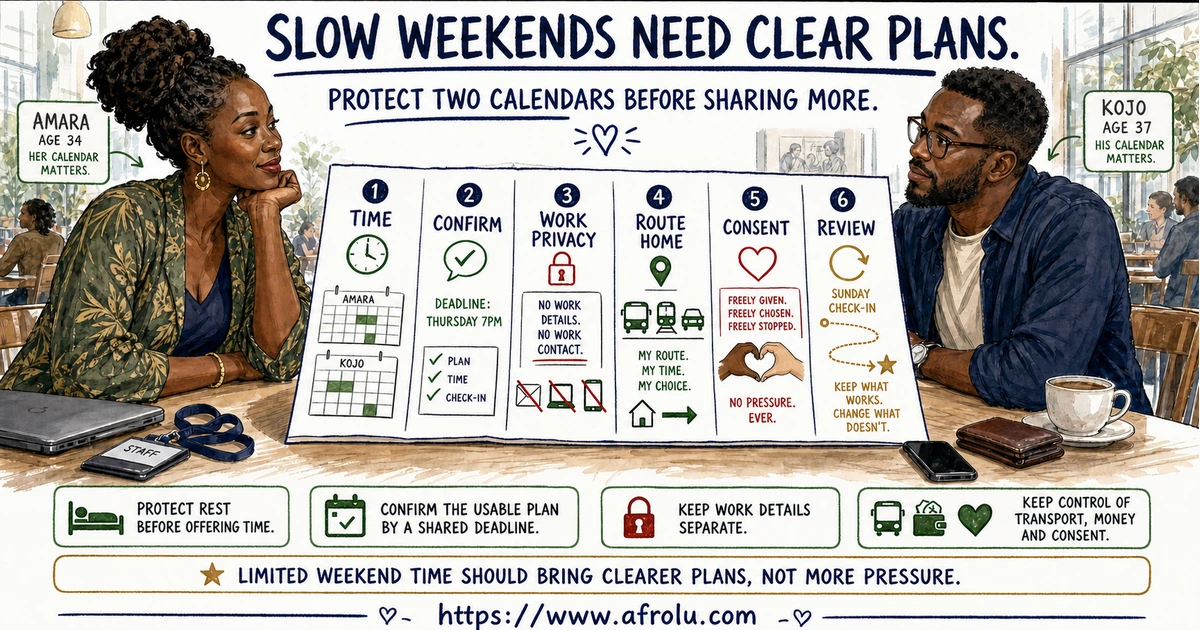
Set the time, confirm by an agreed deadline, keep work systems separate, protect transport and consent, then review the weekend.
Written and edited by Nia Kato · Profile Advice Editor
Yes. Slow weekend dating works when the pace is chosen by both adults and the next step is still clear. Before the week begins, set aside one honest date window. Keep one backup plan for friends, errands, or rest. Choose a confirm-by time, such as Thursday at 7 p.m. for a Saturday date. If the plan is still unclear then, both adults may use the time another way. Meet in public while trust is new. Keep your own transport and route home. Do not share work systems, client details, staff passes, live calendars, home addresses, passwords, or live location just to make planning easier. Set the date cost before choosing the venue. Paying for a meal, fare, or room never buys privacy, touch, sex, or another weekend. Slow describes speed. It does not answer whether the connection is casual, serious, or exclusive, so ask those questions separately. Review what happened on Sunday: Were plans confirmed? Did both adults travel, spend, adapt, and repair fairly? Did a no remain easy to say? Continue when the rhythm protects both lives and teaches you something useful. Step back when work is used to excuse endless uncertainty, tracking, money pressure, or closeness that one adult did not freely choose.
Intentional dating · Professionals
Can a connection move slowly without turning every Friday evening into an unpaid waiting shift?
Slow weekend dating for professionals is a pace chosen by both adults. Most in-person dates happen in limited weekend windows. Trust, private sharing, physical closeness, meetings with friends or family, and commitment grow step by step. Work creates real limits. These may include shifts, deadlines, on-call duties, client privacy, travel, care duties, and the need to rest before Monday. Weekend dating describes when meetings are practical. It should not make Saturday proof that dating matters more than sleep, family, exercise, faith, friendship, or unfinished work. Slow does not mean vague. A slow connection can still have confirmed dates, direct answers, increasing knowledge, and a review point. It is not a synonym for low effort either. Fewer dates may be reasonable, but invitations, travel, cost, hard talks, and repair should not repeatedly fall to one person. Finally, pace is separate from intention and exclusivity. Two adults can move slowly while exploring casually, while dating toward partnership, or while already exclusive. Those choices require their own clear current agreement.
Amara is 34 and manages product launches for a Nairobi technology company. Kojo is 37 and supervises regional construction projects, sometimes spending Friday on a site outside the city. They enjoy one another, but their first month creates an invisible cost. Kojo sends warm messages during the week and says he will know by Saturday morning whether he can meet. Amara keeps each Saturday open, declines lunch with her sister, postpones errands, and stays near her phone. Two dates happen; two disappear after noon with an apology about work. Kojo calls the arrangement slow. Amara notices that only her calendar is being slowed. She does not demand a busier relationship. She proposes a five-box weekend promise board. It has a Thursday evening confirm-by time and a two-hour Saturday window. They will take turns choosing convenient areas and use separate transport. Neither person must show a work calendar. If a duty truly changes after the date is confirmed, the person making the change sends one clear message and offers a realistic alternative. The first week Kojo misses the deadline, Amara attends a friend's birthday without drama. The next week he confirms a public lunch near a route that works for both of them. On Sunday they discuss not only chemistry but how the plan handled delay, cost, rest, and a boundary. The connection becomes calmer because nobody must stay available to prove interest. Slow dating starts to mean small steps and reliable learning, not endless waiting.
The weekend promise board
Treat free time as something both adults protect, not a loyalty test
Professionals often know how to protect a client meeting yet leave a date in a fog of maybe. The result is not always one dramatic cancellation. It is a series of small losses. A friend is not called. A train is not booked. A gym session is skipped. Dinner stays undecided, and one adult watches the phone all Friday. The board makes those hidden costs easy to see. It asks five simple questions before either adult gives more time or shares more private details.
Read the board from left to right. Time asks what part of the weekend is truly free. Confirm turns an idea into a plan by an agreed time. Work privacy keeps dating away from protected work systems and details. Safety keeps transport, money, privacy, and consent under each adult's control. Review looks at what happened after both people are home. No single date must prove a future. Every date should teach both adults something while each person keeps control of their own life.
What portion of the weekend is truly available?
Name a real window after shifts, care, worship, travel, exercise, errands, and rest. Do not offer the whole weekend when two unhurried hours are what you can keep.
When does an idea become a date?
Set a time by which venue, start, end, and transport assumptions must be clear. Missing the deadline releases the time; it does not begin a trial about who cares more.
Which systems remain outside the relationship?
A date does not need your work diary, staff rota, client file, staff pass, work device, work contact list, or exact live location.
Can either adult change course and leave?
Keep spending affordable and meet in public while trust is developing. Each person should control their own transport. Keep consent clear and make sure either adult can leave without asking permission.
What did this weekend actually teach?
Notice whether plans were confirmed, whether effort was fair, how limits were received, and repair. Chemistry is part of the record, not the entire record.
Monday to Wednesday: protect the blank space
Set aside honest dating time before offering a Saturday
A work calendar usually shows paid work more clearly than rest. A meeting appears as a coloured block. The hour needed to rest after a late shift may look empty. That blank space is easy to give away twice. First, write down the weekend duties that cannot move. Then add sleep, groceries, laundry, worship, exercise, family calls, medical care, travel home, and preparation for Monday. Also keep time for people who were there before the match. What remains is the time you can offer for dating. A smaller honest offer is kinder than a full, tiring day.
This private list is not a schedule to send to the other person. It simply helps you make an offer you can keep. Amina, 31, is a hospital pharmacist whose Saturday shift sometimes ends at 3 p.m. She stops promising a 4 p.m. date across town. She offers 6 p.m. at a staffed restaurant near a direct ride home, with a 90-minute first-date window. Daniel, 33, can accept, suggest a different weekend, or decline. He does not need her rota, the ward name, or the reason a shift may run late. The useful fact is the window she can keep.
Use three categories: fixed, flexible, and protected. Fixed items cannot move, such as an on-call period, a booked journey, or care for a parent. Flexible items can move once without damage, such as an errand that can happen Sunday morning. Protected items are easy to erase but hard to lose again and again. They may include rest, a long run, a faith gathering, lunch with a friend, or quiet preparation for the week. A new relationship should not automatically consume the protected category merely because work has already consumed the fixed one.
Then choose a dating rhythm that works in a usual month. One date most weekends may suit two adults with stable hours. Two dates a month may be more honest for rotating shifts, frequent travel, parenting, or project deadlines. The number does not reveal seriousness. Reliability and learning matter more. A twice-monthly connection can progress when both people keep plans, ask meaningful questions, and review intention. Weekly contact can remain shallow when every meeting is rushed and every direct question is postponed.
Protect non-date weekends on purpose. They prevent a new connection from becoming the only source of rest, excitement, or adult company. They also make fit easier to judge. Can each person accept the other's full life without creating a crisis? Someone who treats your friends, family, or rest as competition is not asking for closeness alone. They may be asking for priority before trust and agreement support it.

When the agreed deadline passes, release the time without punishment. A later date needs a new confirmed plan, not standby loyalty.
Thursday: turn maybe into yes or released time
Choose a confirm-by time that protects both weekend plans
The confirm-by time is the agreed deadline for making the plan clear enough to use. It does not demand perfect certainty. By then, both adults should know the day, start time, likely end, and public meeting place. They should also know whether each person will arrange their own transport. Thursday evening often gives enough time for a Saturday date, but the right deadline depends on tickets, distance, shifts, and care. A same-area coffee may need less notice than an SGR journey or a drive between counties.
Missing the deadline has one simple result: the date is not active. Each person may rest, see friends, accept another invitation, or make a solo plan. There is no need for a angry message. 'I did not receive confirmation, so I made another plan. We can look at a later weekend' is complete. This rule prevents one person's lack of a clear answer from occupying another person's time. It also removes the argument that making a backup plan proves low interest. An unconfirmed proposal is not a reservation.
Real emergencies and work problems can happen after a plan is confirmed. What matters next is how the person tries to make things right. They send a quick message, own the effect, and offer a realistic choice. They do not ask the other adult to remain on standby. If Jonah, 35, is called to an urgent building inspection on Saturday morning, he can say so without sending client details. He can suggest Sunday lunch only if he can actually keep it. Grace, 30, remains free to say that Sunday does not work.
Watch the pattern across several weekends. One disrupted plan with clear repair is life. Watch for plans confirmed late, vague timing, or silence until a preferred option disappears. Invitations sent only after other plans fail also show how the person sets priorities. The question is not whether the job is demanding. It is whether this adult can make an honest offer within that demand. A senior title does not make another person's unused Saturday refundable.
Avoid using the deadline as a test. Do not stay silent to see whether the other person chases, pretend to have options, or issue a countdown. State the rule once, apply it evenly, and observe. A compatible adult may propose a better deadline or a simpler plan. A concerning response mocks the boundary or demands an immediate meeting after missing the deadline. It may also call you rigid, needy, or not fun enough for asking for a clear plan.

Look for confirmed details, fair effort, repair that fits the change, private work details, and an easy route to say no or leave.
Before the third or fourth weekend: name the relationship questions
Keep pace, intention, exclusivity, and effort on separate lines
Slow answers how quickly closeness grows. It does not answer what future is being explored. A working adult may prefer two dates a month because work is intense and still be dating toward a committed partnership. Another may use the same frequency for casual companionship. Both can be honest; they are not the same offer. Ask, 'What are you genuinely open to in this season?' The person may not know the final outcome. They should still name which kinds of future the person is truly willing to explore.
Exclusivity is another separate decision. Four reserved Saturdays, regular messages, sexual intimacy, jealousy, or a shared work network do not silently create it. If either person needs exclusivity for emotional or sexual health reasons, ask directly. If the answer is not yet, discuss other partners. Share the facts each adult needs to choose freely and safely. Time already spent is not a substitute for agreement.
Effort is separate from frequency. Compare the work around the date: Who suggests a venue? Who crosses the city? Who confirms? Who pays more than they can afford? Who adjusts after a shift? Who begins every difficult conversation? Fairness does not require a perfect half-and-half split on each outing. It does require both adults to notice burdens and help solve them. A lower-paid person may contribute through planning and a venue within budget. A person with less travel flexibility may take the next turn choosing a convenient area.
Zuri, 29, is a management consultant who travels during some weeks. Elias, 36, is an auditor with a predictable month-end rush. They choose two dates a month and a short Wednesday call. After six dates, Elias assumes the steady pattern means exclusivity; Zuri believes they are still openly exploring. Neither calendar can answer the question. They discuss it before the next weekend and decide on exclusive dating for the next two months, followed by a review. The agreement is useful because it is spoken, limited, and open to revision.
Be careful with smooth but unclear answers. Someone may say they value an organic connection. Another may say they do not want to pressure things. A person may also say that a career makes labels difficult. Ask what each phrase means in practice this month. Are other people being dated? Is partnership a possible direction? What contact and private sharing can each person rely on? If plain questions never get clear answers, the issue is not the slow pace.
Saturday: design arrival and departure before chemistry
A safe date gives each adult their own route home
Transport is part of the date, not an afterthought. Before leaving, each adult should know how they will arrive and leave. They should know the likely cost and what happens if the plan changes. Early meetings are easier to leave when staff and other people are nearby. A natural end time also helps. A remote venue, long drive, private office, empty club, or colleague's apartment may make one adult depend on the other too soon.
Control of transport means the ability to leave without persuading the date. It can be a personal vehicle or public transport with a known last service. It can also be a ride-hailing option arranged on one's own device or a trusted pickup. It does not require refusing every offered lift forever. It means checking what the lift would change. Would it reveal a home address or remove another way home? Could it strand someone after drinking or make a boundary harder to keep? An early ride should not reveal more private details than trust now supports.
Njeri, 32, leaves an operations workshop in Westlands before meeting Malik, 35, for an early dinner in the CBD. Malik offers to collect her from the office. She declines because the pickup would identify her employer and make the end of the date dependent on him. They meet inside the restaurant instead. Njeri shares the venue and expected finish with a trusted friend, not a live work calendar. Malik accepts the plan without treating it as an accusation. His response shows that he can respect a limit.
A check-in should fit the situation. Tell a trusted person where you are going, who you are meeting, and when you expect to be home if that helps. Agree on what the friend should do if the check-in does not arrive. Avoid posting the venue publicly in real time. A new date does not need your live location as proof of trust. If location sharing helps with safety, send it to a trusted person outside the date. Turn it off when that safety purpose ends.
Some behaviour changes the task from dating to safety. Examples include taking your phone, blocking transport, following you after a clear ending, or appearing at work without invitation. Pressure to move to a private place also matters. If you feel afraid to leave, move toward safety. Seek help from venue staff, a trusted person, transport staff, local services, or emergency support as appropriate. Preserve useful messages or incident details if doing so is safe.
Throughout the weekend: date the person, not the organisation
Keep work details, systems, and reputation separate from dating
Work can reveal private details even when a calendar looks harmless. A diary can reveal client names, travel, medical appointments, security routines, colleagues, or an empty home. A staff badge may expose an employer and which parts of a building someone can enter. A photograph taken at a desk can show documents, screens, building layouts, or contact details. A caring date does not need any of these to believe that work is busy. Share the minimum personal fact needed for the plan: 'I am unavailable until five,' not a screenshot of the internal rota.
Keep work devices for work. Do not install a dating app on an employer-controlled phone if policy forbids it. Do not hand a new partner the device or use work email for private dating records. Do not send intimate images through systems you do not control. Never ask a date to solve a work login problem, review private files, borrow an account, or use a company payment method. Skill, affection, and a senior title do not change these rules. Use separate personal accounts, strong passwords, and extra sign-in checks.
Colleagues need boundaries too. A work contact may introduce two adults, but that contact cannot promise safe private behaviour. Ask before telling colleagues, adding a date to an office event, or sharing workplace photographs. Do not seek an informal background check through staff. Never ask a junior worker, receptionist, or security worker to reveal a person's schedule. A public job title does not make private movement or relationship status public property.
Thandi, 40, is a partner at a small law firm. Peter, 42, works in finance and wants to send lunch to her office after their second date. The gesture sounds considerate, but it would disclose the dating connection to reception and confirm where she can be found. Thandi says, 'Please send plans to me, not items to my workplace. I keep dating separate from the office.' Peter can respect the boundary and choose a different gesture. Arguing that public romance is his love language would not make the uninvited sharing acceptable.
Privacy is not deception. You can truthfully describe your field, usual hours, travel limits, and values without sharing protected details. You may also check important identity facts through lawful public sources you find yourself. Keep the check limited to a real safety need. Do not ask staff to monitor the person, enter private accounts, or collect facts that could be used as pressure.

Offer the available window, name the confirm-by time, keep the work calendar private, share travel fairly, and treat each physical yes separately.
During the date: keep every yes unpurchased
Decide cost, privacy, physical contact, and health as separate choices
Set a comfortable cost before the venue is chosen. Include transport, tickets, food, childcare if needed, and the price of getting home on your own. A salary does not make expensive dates harmless. A grand job title does not show how much money is free to spend. One person may enjoy paying. The other can accept without owing more time, a private location, physical affection, sex, business help, or the next bill. If a gift would make either person feel unable to decline, reduce the gift rather than trying to explain away the pressure.
Do not mix romance with urgent money requests in a new connection. Do not lend money, receive funds, route a payment, or share a mobile-money account. Never reveal a one-time security code, promise to cover a debt, join an investment, or buy work equipment. Do not pay travel before identity has been checked. A work story can sound believable because it uses familiar words. Check the claim outside the relationship and protect essential money. A real offer can wait while you seek outside advice.
Consent is specific to the present activity and can change. Agreement to a weekend date does not agree to alcohol or a second venue. It does not agree to a vehicle, hotel, home, touch, photographs, sex, or an overnight stay. A previous date, time already spent, exclusivity, payment, job title, or earlier yes does not create blanket permission. Ask, listen, and make stopping easy. Sulking, bargaining, threatening a person's reputation, mentioning the cost, or saying the rare weekend will be wasted are forms of pressure. They are not reasons to continue.
If sexual contact is possible, discuss the facts needed for a free choice before the final minutes of a late night. That may include current partners, exclusivity, barriers, contraception, testing, and relevant health questions. A slow pace and polished career do not reveal health status. General guidance cannot replace personal care from a doctor or other qualified health worker. Either adult may postpone intimacy while seeking facts without being accused of changing the dating agreement.
Alcohol and fatigue can change judgment and the ability to choose. Plan the route home before drinking. Keep control of the drink and device, and do not treat reduced resistance as agreement. If an adult is asleep, unconscious, severely impaired, frightened, or not freely choosing, do not proceed. Legal definitions vary by location. A clear dating rule is still useful: look for a free and active yes now. Stop if that yes is absent, uncertain, or withdrawn.
Sunday: close the weekend before opening another
Review conduct while the details are still fresh
A useful review is brief and factual. Start with the calendar: Was the plan confirmed by the agreed confirm-by time? Did the start and end roughly match? If work changed, was the message quick and the repair realistic? Then review the route: Could each person arrive and leave without the other's help? Did either adult push for an unplanned private setting? These questions do not turn dating into a work review. They keep chemistry from erasing useful facts.
Next ask whether both adults carried a fair share. Do not count romantic points. Perhaps Amara travelled farther this time because the venue suited Kojo's site duty. Did Kojo notice and offer to come toward her next time? Perhaps one person paid for dinner. Did the choice fit both budgets without creating a debt? Perhaps a call from work interrupted twenty minutes. Did the interrupted person apologise and return attention to the date, or expect their role to dominate the whole evening? Small repairs reveal whether two busy lives can share space.
Review the privacy and consent record. Which personal detail was shared freely? Was any photograph, location, work contact, health detail, or message passed on without permission? How did the other adult respond to a boundary, a slower physical step, or an early departure? A calm response deserves weight. A joke that humiliates, a repeated request after no, or a threat involving colleagues deserves weight too. Do not share more time or private details just because the rest of the date felt pleasant.
Choose one next move that fits what happened. It may be another date in two weeks or a direct talk about exclusivity. It may be a cheaper plan, a fairer journey, a pause during a deadline, or an ending. Write down the question the next weekend should answer. A small question might be, 'Can we enjoy a daytime plan?' Do not ask one date to prove that someone is a future partner. Slow dating works best when each step can change after new facts appear.
Finally, release the calendar. Do not begin planning the next month at midnight if either person is tired. Send one warm message if wanted, return to rest, and confirm the next proposal through the same confirm-by time. If the weekend brought fear, stalking, lost money, pressured contact, or a workplace intrusion, skip the usual dating review. Focus on safety, account protection, and trusted support. Keep useful records if it is safe, and seek suitable local or specialist help.

Review the calendar, route, effort, privacy, cost, consent, and repair. Choose one next step that fits, then return to rest.
Five weekend incidents where a professional boundary becomes visible
A 38-year-old consultant wants Saturday held without a time
Tola, 38, says a client may need him and asks Wanjiku, 34, to keep the day open until he knows. This is the third weekend in which her plans are treated as the flexible layer beneath his work.
Release Saturday at the confirm-by time. Offer a later date only when Tola can name a window he can responsibly keep.A 36-year-old executive changes lunch into a whole travel day
Musa, 36, asks Leila, 33, to collect him near JKIA and wait through a delay. He also wants to replace their public lunch with a visit to a private house. The new plan makes Leila depend on him more and reveal more about her location.
Keep the public plan or postpone. Leila does not need to absorb a larger, less safe date because a flight changed.A 30-year-old manager calls a shared work calendar a trust shortcut
After four dates, Ruth, 30, asks Ibrahim, 35, to share his live work calendar so she can find free weekends. The diary contains client names and travel. Her planning problem is real; the request asks for far more detail than planning needs.
Ibrahim can offer two available windows from a personal calendar. Trust does not require exposing other people's details.A 41-year-old founder uses a luxury booking to repair a cancellation
Kemi, 41, books an expensive overnight stay after cancelling twice. She tells Samuel, 39, that the non-refundable cost means they should make full use of it. The gesture combines repair, money, private space, and sexual expectation.
Separate the choices. Samuel may decline the hotel or meet publicly; Kemi's purchase cannot decide his location, time, or consent.A 32-year-old date turns silence into workplace contact
After Ada, 32, ends the connection, Felix, 37, appears at her office reception to demand an explanation. He calls it a grand gesture, but Ada had not disclosed permission to visit and had already asked for no contact.
Treat the behaviour as a safety and workplace-boundary issue, not a romance conversation. Use trusted workplace and local support appropriate to the risk.Ten signs the pace protects two adult lives
Both adults can name a weekend window they can keep without exposing private work details.
A proposal becomes a date only after time, place, end point, and transport assumptions are confirmed.
Missing the confirm-by time releases both calendars without guilt, chasing, or punishment.
Travel, planning, cost, and repair move back and forth over time instead of becoming one person's permanent job.
Work devices, calendars, client details, passwords, staff contacts, and exact live locations remain private.
Pace, intention, exclusivity, physical contact, and public visibility receive separate answers.
A lower-cost plan, public venue, own ride, limited drink, or early departure is accepted without ridicule.
No payment, gift, fare, ticket, booking, title, or rare free weekend is used to buy consent or closeness.
Cancellations include quick notice and repair that fits the disruption rather than a dramatic promise that soon dissolves.
Sunday leaves both adults with more clarity and enough energy, money, privacy, and freedom for their own week.
Match the response to the calendar, privacy, and safety change
| Situation | What it may mean | What to do next |
|---|---|---|
| A Saturday idea has no venue or time by the agreed Thursday deadline. | The workweek remained uncertain, or the proposer did not turn interest into a usable plan. | Release the time and make another plan. Revisit dating only through a newly confirmed proposal. |
| A genuine duty appears after both adults confirmed the date. | Work disrupted a real plan. The response will show whether the person can make things right. | Communicate promptly, protect confidential details, and offer one realistic alternative without demanding standby. |
| One adult travels across the city for the third date in a row. | The convenience pattern is becoming unequal even if each individual trip seemed reasonable. | Move the next venue, share the travel fairly, or explain why the current plan cannot continue. |
| A date asks for a screenshot of a work diary to verify busyness. | The date wants private proof instead of accepting a clear statement about free time. | Decline the screenshot. Share only the available windows and observe whether the privacy limit is respected. |
| An expensive venue makes one person afraid to decline a second location. | Cost is creating romantic or sexual pressure even if payment was described as a gift. | Name the separate choice, leave as planned, and do not let money already spent rewrite consent. |
| The connection is warm after six dates, but intention and exclusivity remain unspoken. | A slow pace has produced familiarity without yet producing a relationship agreement. | Ask both questions directly before adding intimacy, travel, workplace visibility, or more reserved weekends. |
| A former date continues contacting colleagues after a clear ending. | This is no longer just poor communication. Unwanted workplace contact may be part of stalking. | Do not negotiate through colleagues. Preserve useful records where safe and use workplace, platform, specialist, or local support. |
Eight scripts for time, work privacy, transport, intention, money, and endings
“I can give Saturday from four to six my full attention. I cannot offer the whole day on standby. Does that window work for you?”
“Let us confirm the venue and time by Thursday at seven. If we do not, I will release Saturday and we can choose another weekend.”
“I can share when I am free, but I do not share my work calendar, client details, office entry details, or live location.”
“I came toward your area for the last two dates. For the next one, please choose somewhere on my route or halfway between us.”
“I like our slow pace, and I still need to know the direction. Are you exploring a serious partnership, casual companionship, or something else?”
“Regular weekends do not tell me whether we are exclusive. Are either of us dating other people, and what agreement do we want now?”
“Thank you for paying. I am still leaving at the time we agreed, and I am not agreeing to a private venue or physical contact I do not want.”
“This pattern keeps my weekends uncertain and my boundaries under debate. I am ending the dating connection. Please do not contact my workplace or colleagues.”
Know the difference
Slow weekend dating or a leftover-time situationship?
Two adults choose a slower speed while keeping progress easy to see. Plans have a clear confirm-by time, and both people make an effort. They can discuss intention and exclusivity. Boundaries receive calm respect, and each stage has a review point. Work limits shape the plan but do not excuse harm.
Closeness appears when one person's schedule opens, but the relationship remains undefined and the other adult is expected to wait. Contact may be warm and dates may repeat, yet clear plans, priority, fair effort, or direction cannot be relied upon. Professional busyness becomes a permanent answer to every request for clarity.
Limited time is real. Endless uncertainty is a pattern. Slow weekend dating protects both calendars and produces decisions, while an leftover-time situationship repeatedly asks one adult to fit inside whatever time remains.

A slow connection has shared deadlines, movement, and review. A leftover-time situationship keeps one adult waiting without dependable direction.
Seven nearby arrangements that use similar calendar language
| Type or dimension | What it describes | Best next question |
|---|---|---|
| Slow weekend dating | The adults choose a slower pace, confirm plans, and build trust through small steps and review. | What did the last two weekends teach, and what small step is now supported? |
| Busy-season dating | A temporary workload reduces free time for a named period. It does not become the permanent way the relationship works. | When does the season end, what contact remains realistic, and what will be reviewed then? |
| Low-effort dating | One adult repeatedly avoids planning, travel, cost, curiosity, or repair regardless of available time. | Is the problem truly hours, or is one person declining the work of connection? |
| Casual weekend dating | The adults do not share a serious-future promise now; the pace may be slow or fast and still requires consent and clarity. | What does casual include, are other partners involved, and when will the agreement be reviewed? |
| Exclusive dating | The adults have explicitly agreed not to date others; exclusivity says nothing by itself about speed or long-term outcome. | What does exclusivity cover, and which privacy, health, and communication agreements accompany it? |
| Serious dating | Both adults are intentionally testing compatibility for a committed future, even if meetings remain gradual. | Which present actions support that direction beyond the label? |
| Leftover-time situationship | Recurring closeness occupies leftover time while direction, priority, and dependable planning stay unresolved. | Can the adults make one shared agreement, or is not knowing the only thing that stays the same? |
Build the weekend promise board in six moves
Mark three kinds of weekend time
Mark fixed duties, flexible tasks, and protected rest. Offer a date only from the time that remains, and keep at least one non-date source of connection or rest alive.
Choose one confirm-by time
Select a deadline early enough for transport and backup plans. Define the minimum details needed and agree that silence releases the time.
List the work details that stay private
List what stays private: employer-controlled devices, calendars, client names, staff contacts, passes, travel records, passwords, and office visits.
Price the whole date
Include the meal or ticket, transport in both directions, care costs, and an way home under your own control. Choose a plan that does not create debt or make payment feel like a reason to say yes.
Name the missing relationship line
Ask separately about pace, intention, exclusivity, other partners, physical boundaries, and public visibility. Do not infer one answer from another.
Run a ten-minute Sunday review
Record whether the plan was confirmed, whether effort was fair, and whether privacy was kept. Also note transport, money, consent, repair, and energy. Choose one next action, then release the rest of the week.
Questions for the workweek, the date, and the Sunday review
Choose a few prompts that fit the moment. This is a reference library, not a list to complete.
Monday: mark the weekend time you can honestly offer
Count the life that exists before a date asks for the blank space.
- Which weekend duties are fixed, and which only look flexible from outside?
- How much rest do I need to enjoy the date and begin Monday safely?
- Which friend, family, faith, health, movement, or quiet-time plan stays protected?
- What two-hour or half-day window can I honestly keep?
- How often could I keep this rhythm during a usual month?
Thursday: confirm without collecting private work details
Settle the usable plan, then release anything still vague.
- What exact time is our confirm-by deadline for this date?
- Do we know the public venue, start, likely end, and each person's travel plan?
- Which work detail is not necessary to answer the planning question?
- What will each adult do if the deadline passes without a confirmed plan?
- If work changes later, what would quick and fair repair look like?
Saturday: keep five choices separate
A warm evening does not merge location, payment, privacy, touch, and tomorrow.
- Can either adult leave the venue without the other's help or permission?
- Does the full cost leave essential money and return transport intact?
- Which photo, location, work, family, or health detail may be shared, and with whom?
- What physical contact is actively wanted now, and what has not been agreed?
- Would alcohol, fatigue, pressure, or a private move make choice less free?
Sunday: review the facts and choose one next move
Use the record to guide the next weekend rather than asking chemistry to decide everything.
- Was the plan confirmed and repaired in the way both adults agreed?
- Who carried the travel, planning, cost, changes, and hard conversations?
- How did each person respond to a limit, delay, difference, or no?
- Did intention, exclusivity, privacy, or health need a direct conversation?
- Does the next step that fits best look like another date, one question, a pause, support, or an ending?
Where official guidance sharpens privacy, fraud, consent, health, and safety decisions
Easy planning does not justify using protected work systems
NIST guidance covers security for remote work and personal devices used for work. It explains the need to protect devices, messages, remote connections, and stored data. The dating lesson here is narrow. Use a personal channel for personal plans and share only the free time needed. A new partner should not handle an employer-controlled device, receive passwords, or inspect an internal calendar.
Evidence limit: NIST guidance is technical and written for work security. Follow the employer's current policy and qualified security advice for a specific system.
A name, location, photograph, schedule, and family detail all carry context
Kenya's Office of the Data Protection Commissioner says people have a right to be informed about how their personal data will be used. Its page also covers clear purpose, collecting only what is needed, accuracy, storage, and privacy. These legal duties depend on who holds the data and why. For dating, they also suggest a simple habit: ask why a detail is needed and share less. Ask before passing it on. Never use private details to embarrass, track, or pressure someone.
Evidence limit: This dating lesson is not a full statement of Kenyan data law. Use current legal or ODPC guidance for a workplace complaint or suspected misuse of personal data.
A work story can still lead to a request for money or account details
The U.S. Federal Trade Commission describes romance-scam patterns in which a person builds trust and says work or distance prevents a meeting. The person later asks for travel, health, or emergency money. You do not need to label every request as fraud. Still, do not send money or passwords to a new online love interest. Stop and check the story through a contact you find yourself. After suspected fraud, contact the bank, payment service, or other provider promptly.
Evidence limit: A difficult workweek or unequal income is not proof of fraud. The source supports caution when trust-building is followed by money requests. It does not prove what one person intends.
Freedom and the ability to choose matter more than cost or a rare free weekend
Crown Prosecution Service guidance for England and Wales says consent requires choice, freedom, and the ability to choose. Agreement to one activity is not agreement to another. Consent may also be withdrawn. A clear dating rule follows: seek a free yes for the specific act now. Never use payment or a rare weekend as pressure. Stop if willingness is missing or changes.
Evidence limit: The cited page describes law in England and Wales. Obtain current local legal and specialist guidance for a specific incident in another place.
Slow pace and exclusivity labels cannot reveal STI status
The U.S. Centers for Disease Control and Prevention provides general guidance on STI transmission, testing, vaccination, barriers, number of partners, and prevention. For dating, the useful move is a direct conversation before sexual contact and qualified personal care where needed. Do not infer status from education, income, profession, appearance, a long courtship, or an exclusive label. Ask for the agreement and health facts needed for your own choice.
Evidence limit: General public-health guidance cannot diagnose a person or choose an individual testing, vaccination, contraception, or treatment plan.
Repeated appearances and tracking require a safety plan, not better date manners
The National Domestic Violence Hotline lists stalking acts such as unwanted calls, following, workplace appearances, collecting details, rumours, and digital tracking. Repeated unwanted contact from a current or former date may create fear. The first task is not finding a perfect explanation. Consider trusted people, workplace safeguards, account security, and suitable specialist or emergency support. Keep records where safe.
Evidence limit: Safety choices and laws vary, and blocking contact can sometimes increase risk. Use confidential, locally appropriate support for an individual safety plan.
Six habits that make a scarce weekend less safe
Treating the blank weekend as free inventory
Rest, family, friendship, worship, errands, and quiet preparation still matter when they are not marked as appointments.
Using an impressive job as a reason to accept endless uncertainty
A demanding role can limit options, but it does not make another adult's time, money, or boundaries less important.
Sharing a live work calendar to avoid a planning conversation
The calendar may expose clients, travel, colleagues, and security patterns. Offer your free times instead.
Reading repeated weekends as automatic exclusivity
Frequency and exclusivity answer different questions. Ask whether either adult is dating others.
Letting an expensive booking decide physical closeness
A non-refundable cost is the buyer's risk. It cannot turn a public date into an overnight or a no into a yes.
Turning every cancellation into a test of patience
Judge notice, responsibility, repair, and the wider pattern. Patience without a changed process only preserves the same loss.
Use a reviewed resource that matches the decision
This guide focuses on the relationship decision, so it does not rank dating apps. Check current prices, safety tools, and local availability before choosing a service.
Explore the guide library
Show more related guides
Continue with Afrolu
Show more Afrolu guides
Sources behind the work-device, privacy, fraud, consent, health, and stalking guidance
Afrolu reviewed these health, research, safety, or public guidance resources while editing this page. They support the behaviour and safety guidance; they do not diagnose any individual described by a reader.
Slow Weekend Dating for Professionals: Clear Answers
How often should busy professionals meet when dating slowly?
There is no universal number. Choose a frequency both adults can keep during an usual month after work, care, sleep, travel, and essential tasks are counted. For some people that is weekly; for others it is twice a month. The better test is whether dates are confirmed, effort is mutual, knowledge grows, and there is a review point. More frequent exhausted meetings are not automatically more serious than fewer reliable ones.
What is a fair deadline for confirming a weekend date?
Use the latest point that still protects transport, tickets, care, rest, and backup plans. Thursday evening may work for a local Saturday date. A journey or major booking may need to be confirmed earlier. Agree on the deadline before it becomes a conflict and name the details both adults need. These are the day, start, likely end, meeting area, and travel plan. If the deadline passes, release the time rather than beginning a chase.
Is a person genuinely busy or simply making low effort?
Do not try to prove how busy the job is. Look at the offer made within the time available. A busy but interested adult can usually name and confirm a limited window. They can communicate a real change and help make things right. They can also take a turn travelling or planning. Low effort leaves one person carrying invitations, not knowing, cost, and repair. Judge several weekends, not one difficult day, while refusing indefinite standby.
Should partners share work calendars to make weekend planning easier?
Not as a default, especially in a young connection. A work calendar may reveal clients, colleagues, travel, security routines, health appointments, or other people's details. Offer the personal windows you are free and use a separate personal calendar if needed. Established partners may choose a limited shared household calendar, but each employer's policy, privacy obligations, and account controls still apply.
Does dating only on weekends make a relationship casual?
No. Weekend timing describes free time, not intention. Adults can meet mainly on weekends while casually exploring, dating seriously, or building an exclusive relationship. Ask what future is genuinely possible now and whether either person dates others. Do not infer direction from a recurring Saturday, daily messages, sexual intimacy, jealousy, or the amount spent on dates.
When should slow weekend daters discuss exclusivity?
Discuss it when either adult needs the answer for emotional choices, sexual health, weekend planning, or expectations about other dates. That may happen after a few dates or later; elapsed time does not make the agreement for you. Ask directly whether either person is dating others, what exclusivity would include, and when the arrangement will be reviewed. A no or not-yet answer tells you where things stand. It is not an invitation to argue.
How should professionals split travel and date costs?
Use a fair pattern rather than demanding identical contributions every time. Consider income, route, shift end, mobility, care costs, and who carried the previous plan. Alternate areas, choose halfway points, or let one person plan an affordable date after the other travels. Set spending before the venue. Paying more never buys private time, publicity, touch, sex, or another weekend. Neither adult should risk essential money to look successful.
Is accepting a ride home safe on a slow weekend date?
It depends on trust, the route, whether anyone has been drinking, and whether you can leave another way. Early dates are often easier when each adult controls transport and keeps a home or workplace address. If you accept a ride, keep your device and an alternative plan. Decline any change that makes you dependent or uneasy. Pressure to enter a vehicle, surrender a phone, or continue elsewhere is a warning sign.
Does paying for an expensive weekend change what either person owes?
No. A meal, ticket, fare, gift, room, or non-refundable booking does not buy extra time. It also does not buy affection, sex, secrecy, business help, or a future date. Discuss cost before booking and reduce the plan if the expense creates pressure. Consent remains specific and changeable. The buyer is responsible for a purchase made without the other adult's free agreement to each separate part of the plan.
What should I do if a date contacts my workplace after I end things?
One accidental contact is different from repeated unwanted workplace contact. You do not have to negotiate after a clear stop. Tell trusted workplace contacts only what they need to keep you and the office safe. Save useful messages or incident details if it is safe. Review account and location settings. Seek suitable platform, specialist, legal, local, or emergency support based on the risk. Do not ask colleagues to mediate the romance.
One thing to do now
Confirm one honest weekend without signing away the rest of your life
Share only the time and private details that trust now supports. Keep dating when both adults can confirm, revise, travel, pay, disclose, consent, and rest without one person's job or desire becoming the permanent priority. Share less when the calendar is uncertain, a work detail is too sensitive, the cost is unclear, or a physical step has not been discussed. End the connection when work excuses repeatedly show contempt for another person's time. Also end it for demands for private work or money details, stalking, workplace intrusion, punishment after a boundary, or pressure that makes consent unsafe. A promising date may deserve another date. It never deserves control of a life.