Five envelopes for one bounded first date
Plan a Low-Pressure Professional Weekend First Date
A five-envelope weekend plan for professional first-date anxiety: protect work recovery, energy, money, privacy, consent and Monday.

A first date should fit the weekend that exists; it does not earn energy borrowed from work, safety or Monday life.
Written and edited by Nia Kato · Profile Advice Editor
Treat the first date as one mutual meeting, not a performance review or lifetime forecast. Before offering time, fund five envelopes: close enough work residue to be present; choose a social load you can carry; protect essential money; keep employer, client, calendar and device access private; and reserve independent return, sleep and Monday recovery. Confirm a staffed public place, start, finish and affordable scope. If capacity changes, give timely news and one complete smaller alternative with room for no. On the date, allow pauses and ordinary nerves. Route evidence correctly: reduce load for nerves, assess poor fit later, resist boundary pressure and leave concrete danger. Payment and professional status create no access. Review for twenty minutes after sleep—safety, energy cost, fit, reciprocity and curiosity—then offer another bounded date, a smaller plan or a direct no.
First dates · Professionals
Can I fund one complete first date from work transition, social energy, money, privacy and recovery while keeping ordinary nerves separate from fit, pressure and danger?
A low-pressure professional weekend first date is a bounded mutual meeting sized to the capacity remaining after work and the rest of adult life. The five-envelope plan protects work transition, social energy, money, privacy and recovery before scheduling. It removes job-interview rules from romance and separates ordinary activation from poor fit, pressure and danger so the next action matches the actual evidence.
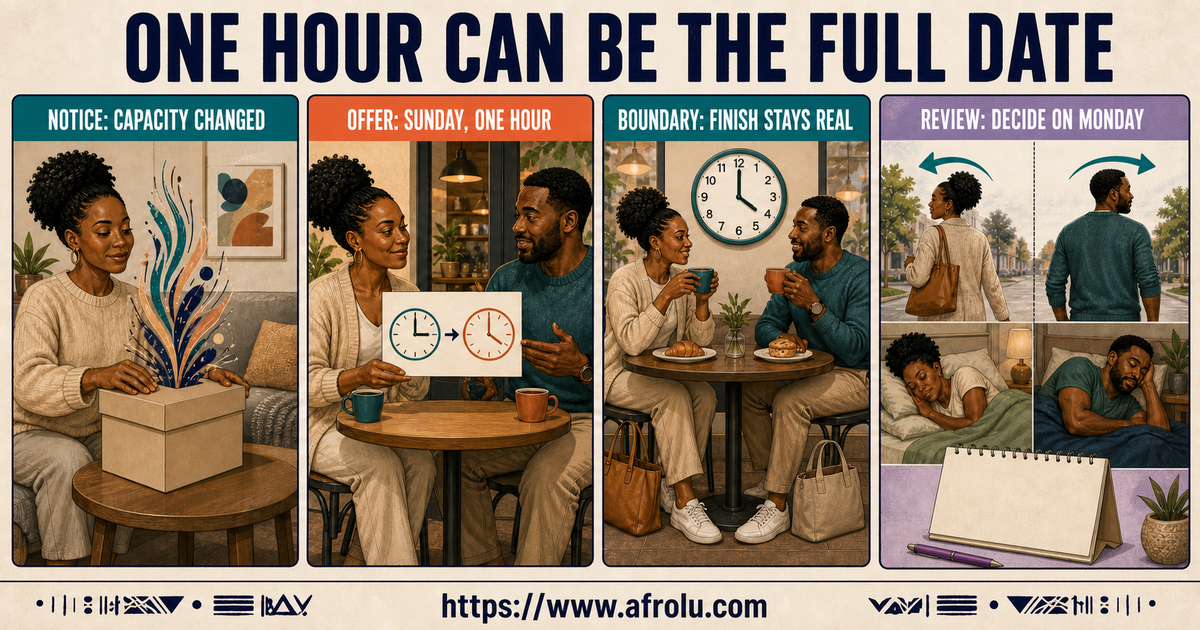
Amara and Tinashe are fictional professionals aged 36 and 39. When a Saturday work demand changes Amara's capacity, she offers a complete one-hour Sunday cafe date with room for him to decline. He respects her work privacy and the finish. Their conversation includes a normal blank moment and no interview-style status test. They leave separately and review Monday, then choose one more bounded date.
The professional weekend energy budget
Fund one real first date without borrowing from work, privacy or Monday
Professional confidence does not guarantee spare weekend energy or effortless romance. Nia removes the interview and protects a small mutual encounter.
Five envelopes close work residue, size social load, bound money, protect systems and reserve recovery before any compatibility review.
Work residue
Close active demands and create a transition without exposing professional information.
Energy and money
Reduce novelty, duration and cost until the offer fits real capacity.
Privacy
Share personal availability while employer, client, calendar and devices stay closed.
Return and review
Finish independently, recover, then choose one accurate next answer.
A meeting, not an appraisal
Let the first date answer one small mutual question instead of proving professional or romantic worth
First-date anxiety is ordinary anticipatory activation for many adults: attention may narrow, the body may feel alert and self-conscious thoughts may appear. It is not automatically an anxiety disorder, incompatibility or danger. A professional may also arrive carrying work residue—the cognitive, emotional or physical demands left after the working week. Do not ask one date to settle a diagnosis or prove that a competent worker can also perform effortless romance.
A low-pressure professional weekend date is a bounded mutual meeting designed around the capacity that exists after work. It is not a networking event, job interview, client dinner or assessment centre. Neither adult owes a polished life narrative, employer details, salary, title, industry contacts or a five-year relationship plan. The useful first question is smaller: Can we share this place and hour with enough safety, curiosity and choice to consider another meeting?
Weekend does not mean unlimited availability. It may contain care, parenting, worship, study, health, errands, domestic labour, exercise, friends, solitude and preparation for Monday. Name the actual date window rather than treating blank calendar space as free energy. One hour in a staffed public place can be complete. A smaller offer is not a lack of interest when it is specific and honestly carried.
Protect work systems while using personal information relevant to the plan. Share broad availability and occupation only at the depth freely chosen. Keep client data, restricted travel, calendars, badges, devices, passwords and employer channels outside dating access. If ordinary nerves remain manageable, reduce load and observe. If the date reveals poor fit, pressure or danger, use the action matched to that evidence rather than demanding calm from yourself.
The five-envelope energy budget
Reserve capacity for work residue, social energy, money, privacy and recovery before making the offer
The work-residue envelope asks what must close before the date. That may be a shutdown note, meal, clothing change, commute buffer, shower, medication, quiet or a decision not to check work again. Do not expose files or prove why the week was demanding. If an emergency duty remains genuinely active, reschedule with timely news and a complete alternative rather than attending while secretly managing restricted work.
The social-energy envelope asks how much conversation, novelty and stimulation are realistically available. Reduce variables: familiar neighbourhood, clear meeting point, quiet staffed venue, one activity and a known finish. Choose seating, accessibility and noise level where relevant. A date can include pauses and ordinary speech. Neither adult needs a rapid list of impressive stories or perfectly sustained eye contact for the meeting to count.
The money and privacy envelopes protect essential spending and separate systems. Name an affordable plan and payment expectation without turning cost into status. Payment does not buy time, touch or follow-up. Keep employer devices, calendar links, location trails, work email, client information, salary records and professional contacts controlled. If a personal phone also carries work access, use ordinary security habits and share only the date information required.
The recovery envelope protects independent return, food, sleep, medication, Sunday obligations and Monday preparation. Set the finish before meeting and avoid using an unplanned extension as proof of chemistry. A brief immediate safety check can happen; compatibility review can wait. Reserve twenty minutes after sleep to examine facts and desire. The date is complete when the agreed meeting ends, even if neither adult has yet decided about another one.
Amara makes the date smaller
A changed workweek creates a one-hour Sunday offer instead of a depleted performance
Amara is 36 and works in project operations. Tinashe is 39 and works in supply planning. They meet on a dating app, verify through ordinary conversation and plan a Saturday afternoon walk and meal. On Friday, Amara learns that a system migration will require several Saturday hours. She can still force the original date, but notices that doing so would remove her meal, transition and safe attention.
Amara tells Tinashe as soon as the work demand is confirmed. She owns that she cannot keep Saturday and offers Sunday from three to four at a staffed cafe near transport they can each use. She does not send a work screenshot, expose the employer or ask him to remain on standby. She says he may decline. Tinashe feels disappointed but accepts the Sunday offer and does not ask for her work calendar as proof.
Before meeting, Amara closes her work notes, eats and uses a separate personal device. Tinashe chooses a low-cost order and they agree to pay separately. Conversation includes their weekends, interests and what each is seeking; it does not become a rehearsal of job titles or salaries. Amara pauses once when her mind goes blank. Tinashe lets the pause exist rather than rescuing it with an interview question.
At four, Tinashe says he has enjoyed the hour and does not pressure an extension. They leave separately. Amara waits until Monday to review and notices ordinary nerves, balanced curiosity, respected privacy and low recovery cost. Tinashe notices the changed plan was repaired. They offer a second bounded date. The result is useful because one hour was treated as a complete encounter, not because either adult performed perfect energy.
Four signals, four actions
Separate ordinary nerves, poor fit, boundary pressure and danger before responding
Ordinary nerves may include a faster heartbeat, dry mouth, self-consciousness, temporary blankness or the urge to overprepare. Reduce load: slow the pace, take one breath, drink water, name a brief pause or return to one genuine question. Do not require yourself to eliminate sensation. NIMH distinguishes occasional anxiety from persistent symptoms that interfere with daily life; seek qualified care when distress is persistent, broad, severe or personally concerning rather than diagnosing from a single date.
Poor fit is relational information, not failure. Conversation may feel effortful, humour may not land, preferred pace may differ or one adult may need more weekend time than the other can offer. Complete the safe bounded date if desired, then decide after recovery. You do not owe a second date to prove openness. A direct no is kinder than turning professional politeness into indefinite availability.
Pressure appears when a limit becomes a negotiation: demands for employer details, salary, calendar access, a private venue, more alcohol, extra hours, a ride, touch or immediate follow-up after no. Restate once if safe: ‘That is not available.’ You may leave without persuading the other person. A paid bill, professional status or long workweek does not create entitlement or excuse contempt.
Danger involves observed facts such as threats, blocked exits, stalking, device seizure, sexual coercion, violence or interference with transport. Do not use breathing techniques to reinterpret a concrete threat as nerves. Move toward a staffed area or independent exit where possible and use suitable trusted, venue, platform, local or emergency support. The safest action depends on the facts and location; a general guide cannot prescribe one response for every incident.

Do not diagnose from one anxious moment or soothe away a concrete safety fact.
Words that conserve energy
Make a smaller offer, keep work systems closed, finish on time and decide after rest
For capacity, combine news, ownership and a complete alternative: ‘My capacity changed and I cannot keep Saturday. I can offer Sunday from three to four at this cafe; I understand if that does not work.’ Avoid vague maybes or a detailed employer case. Repeated cancellations still deserve pattern review even when each explanation is plausible. Good language cannot make an unavailable relationship fit.
For work privacy, state personal availability instead of opening systems: ‘I work in operations and my schedule changes sometimes. I do not share work calendars, client information or employer devices.’ A date can ask whether the rhythm fits without auditing the job. If a match contacts professional channels, searches restricted details or demands salary and travel proof, protect access and treat the behaviour as new evidence.
For the finish, say: ‘I am leaving at four and returning separately.’ You need not invent another appointment. If the date is enjoyable, express that without extending: ‘I liked this hour and would consider another date.’ Consent to stay longer is separate and may be declined. Payment, travel and interest do not buy a ride, private venue, touch or immediate second date.
For review, say: ‘I do not decide on the spot; I will message tomorrow.’ Do not use the delay as manipulation or require the other adult to wait indefinitely. Send the promised answer. If it is no, keep it direct. If it is yes, offer another bounded plan rather than escalating because the first meeting was short. If persistent anxiety affects daily functioning, qualified care—not a date's reassurance—can help assess individual needs.

Name the available date, the closed system and the review time without turning the meeting into an interview.
A twenty-minute Monday review
Check safety, energy cost, fit, reciprocity and curiosity after the nervous system settles
Begin with safety and choice. Was the identity context reasonably consistent? Did the venue and return remain usable? Could you decline, pause, keep work private and leave at the finish? Separate a concrete pressure or danger fact from the body sensations that occurred. A warm conversation does not erase coercion; a shaky voice does not prove danger. Respond to the observed category.
Review energy and cost. What preparation, money, travel, sensory load and recovery did the date require? Did it leave enough for food, sleep, care and Monday? A high energy cost is not automatically the other adult's fault; it may mean the plan was too large or the current rhythm does not fit. Ask whether a smaller date would provide better evidence or whether dating capacity needs a pause.
Review fit and reciprocity without scoring polish. Did both adults ask, listen, share and adapt? Could pauses exist? Did professional identity stay one part of a whole adult rather than becoming status comparison or networking? What felt easy, effortful or incompatible? One first date offers a sample, not a complete personality assessment. Avoid researching every answer to escape uncertainty.
Review curiosity. Do you freely want another bounded meeting? Choose yes with a specific offer, a smaller alternative, or no. Do not say yes because the other adult paid, travelled, has an impressive career or seems objectively suitable. Do not say no merely because nerves occurred if the actual interaction remains interesting. The next choice needs only to fit present evidence and capacity.

Review facts, cost and desire; do not turn a first date into a performance appraisal of either adult.
Four meeting formats
Keep mutual dating curiosity separate from networking, formal selection and pressure
A low-pressure first date is a mutual adult encounter. Both people are choosing, both may ask and decline, and neither controls an outcome owed by the other. The purpose is limited relational learning. Work may appear naturally, but job title, employer, education, salary and network do not rank the daters. The meeting can end with yes, smaller or no without either adult failing an assessment.
Networking is a professional exchange in which contacts, industry knowledge or opportunities may be the stated purpose. A job interview is a formal selection process with defined organisational power and legal or policy context. Those formats can require professional information that a date does not. Do not ask a romantic match for referrals, clients, restricted introductions, confidential context or career leverage under the cover of chemistry.
A high-pressure date mimics selection while making access the test: rapid interrogation, status comparison, demands for immediate certainty, strategic oversharing or punishment for an imperfect answer. It may also recruit professional prestige to lower privacy boundaries. You may redirect once, reduce the plan or leave. Another adult's polished style does not entitle them to employer access, personal information or continued romantic attention.
Keep the formats explicit. If two adults genuinely want to discuss professional collaboration, move that question to an appropriate channel later and maintain relevant duties. If a work relationship or power imbalance already exists, use applicable workplace policy and independent judgment; a general dating page cannot decide the ethical or legal position. The weekend date should remain a voluntary personal meeting with two clear exits.
Eight professional weekend moments where capacity and compatibility need separate answers
Amara shrinks rather than performs
An unexpected work demand removes Amara's transition and recovery. She offers a complete one-hour Sunday date rather than arriving depleted or disappearing.
Resize with timely news, a specific alternative and room for no.Tinashe reduces novelty
Tinashe chooses a quiet staffed cafe near transport instead of an elaborate unfamiliar itinerary. The smaller plan leaves more attention for actual conversation.
Reduce variables without turning safety into a test.Nadia answers at the depth she chooses
Nadia shares her broad field but not her employer or seniority. Her date returns to personal interests rather than searching for status.
Treat work identity as optional context, not ranking data.Kojo keeps work scheduling closed
A match asks for Kojo's calendar link to find a date. He offers two personal windows instead and shares no work-system access.
Share availability, never a professional system as dating proof.Leila lets a pause be ordinary
Leila loses her train of thought and says she needs a moment. Her date waits without diagnosing, teasing or conducting an interview.
Lower conversational load before interpreting fit.Samuel keeps the finish unchanged
Samuel's date pays after offering, then asks to extend at a private venue. Samuel thanks them and leaves at the agreed finish.
Payment creates no access, time or intimacy debt.Ruth sends the answer she promised
Ruth waits until Monday, notices balanced curiosity but no romantic interest and sends a direct kind no rather than professional ambiguity.
Delay review briefly, then close the loop.Daniel routes danger correctly
A date stands between Daniel and the exit after he says he is leaving. He moves toward staff and calls trusted support rather than treating his alarm as mere nerves.
Respond to the concrete safety fact, not the pressure to stay calm.Route ordinary nerves, poor fit, pressure and danger to different actions
The date fits an actual weekend window rather than every blank-looking hour.
Work residue receives a transition without exposing employer, client or restricted information.
A public venue, start, finish, affordable scope and independent return are confirmed.
Both adults can pause, speak imperfectly and ask ordinary questions without interview pressure.
Occupation is context rather than a ranking system for worth, status or relationship suitability.
Personal availability is shared while calendars, devices, passwords and work channels remain closed.
A changed capacity receives timely news, a complete alternative and genuine room to decline.
Payment creates no claim to extra time, transport, private access, touch or follow-up.
The planned finish remains real even when the conversation is enjoyable.
Both adults contribute curiosity, listening, logistics and respect for the other's energy.
Review happens after recovery without obsessive research or immediate lifetime forecasting.
Another date, a smaller offer and a direct no remain equally legitimate outcomes.
Match each work, energy, privacy or safety fact to the right envelope
| Situation | What it may mean | What to do next |
|---|---|---|
| Work leaves no transition or recovery. | The original date exceeds current capacity. | Offer a smaller complete alternative or reschedule promptly. |
| A match asks for a work calendar link. | Scheduling convenience would open a professional system. | Share two personal availability windows instead. |
| Conversation pauses after an anxious moment. | Ordinary activation or cognitive load may be present. | Slow down, take a pause and avoid diagnosing from one moment. |
| The date asks rapid career-status questions. | The encounter is drifting into selection or networking. | Redirect to mutual personal curiosity or end if the format does not fit. |
| One adult wants a quieter, shorter plan. | A capacity adjustment may improve usable evidence. | Confirm the reduced venue and finish without treating it as rejection. |
| A paid bill is linked to an extension. | Spending is being converted into entitlement. | Keep the finish, decline the added activity and return independently. |
| Employer information is searched after a limit. | Professional boundaries are not being respected. | Protect channels and reassess or end contact. |
| The date is pleasant but recovery cost is high. | Plan size or current capacity may not fit. | Try a smaller offer only if curiosity remains genuine. |
| There is no romantic interest after sleep. | A normal first-date outcome is clear. | Send a direct no without a performance explanation. |
| Nerves persist across daily life and cause impairment. | Individual support may be useful beyond date planning. | Consider qualified healthcare rather than self-diagnosing from the page. |
| The finish receives respect and warm closure. | One piece of mutual compatibility evidence is present. | Review later and offer another bounded date if wanted. |
| Threats, blocked exit or device seizure appears. | The task has shifted from nerves to concrete danger. | Prioritise an exit and appropriate venue, trusted or local support. |
Scripts for capacity, work privacy, finish, consent and later review
“My capacity changed; I can offer Sunday from three to four at this cafe.”
“I understand if the smaller plan does not work for you.”
“I work in operations; I keep my employer and client details private.”
“I do not share work calendars, devices, passwords or restricted travel.”
“My mind went blank for a moment; give me a second.”
“I would rather learn what your weekends feel like than compare job titles.”
“I want a plan each of us can afford without expectation.”
“I am leaving at four and returning separately.”
“Paying, travelling and enjoying the date do not answer another activity.”
“I do not decide on the spot; I will message tomorrow.”
“I would like another bounded date; Thursday dinner for one hour works.”
“Thank you for meeting; I do not want another romantic date.”
Know the difference
Low-pressure first date versus job interview
Two adults mutually notice safety, curiosity and present fit, with either free to leave or decline another meeting.
An organisation evaluates a candidate for a defined role through a formal process and unequal decision authority.
Dating should not borrow formal selection, professional disclosure or candidate ranking as a model for intimacy.

Remove career-performance rules from dating while keeping direct plans, privacy and consent.
Compare a date with networking, interviewing and pressure
| Type or dimension | What it describes | Best next question |
|---|---|---|
| Low-pressure first date | Mutual relational learning within a bounded adult meeting. | Do both freely want one more meeting? |
| Networking meeting | Professional contacts or industry information are the stated purpose. | Keep opportunity exchange outside romantic expectation. |
| Job interview | Formal selection for a role occurs within organisational power and rules. | Do not import candidate evaluation into dating. |
| Client meeting | A professional service or commercial decision governs the encounter. | Protect duties and avoid mixing access with romantic pressure. |
| High-pressure date | Polish, disclosure, time or immediate certainty becomes a test. | Reduce, redirect or leave without auditioning. |
| Ordinary nerves | Temporary activation occurs around uncertainty or perceived evaluation. | Lower load and observe without diagnosing. |
| Poor fit | Preferences, pace, values or available energy do not align. | Offer a smaller plan or decline another date. |
| Boundary pressure | A clear limit is bargained with, punished or repeatedly tested. | Restate if safe, protect access and leave as needed. |
| Danger | Threats, blocked exit, stalking, coercion or violence are observed. | Prioritise exit and appropriate support. |
| Persistent anxiety concern | Distress extends beyond one date and meaningfully interferes with life. | Seek qualified individual assessment if wanted. |
Build one five-envelope first date in six moves
Define one small question
Ask whether another bounded meeting is wanted, not whether a partnership is proven.
Fund five envelopes
Protect work transition, social energy, money, privacy and recovery before offering time.
Make the plan complete
Choose public place, start, finish, affordable scope and independent return.
Route the signal
Respond differently to nerves, fit, pressure and danger.
Review after sleep
Check facts, cost, reciprocity and curiosity without a performance score.
Send one accurate answer
Offer another date, a smaller plan or a direct no.
Questions organised by energy, plan, signal and review
Choose a few prompts that fit the moment. This is a reference library, not a list to complete.
Five envelopes
Fund the date without borrowing from work, privacy, essentials or recovery.
- What work residue remains?
- How much social energy exists?
- What cost protects essentials?
- Which systems stay closed?
- What recovery protects Monday?
Complete plan
Reduce ambiguity before the meeting begins.
- Which staffed place fits?
- What are start and finish?
- How will each arrive and return?
- What accessibility matters?
- What change cancels or resizes?
Signal routing
Do not give nerves, fit, pressure and danger the same response.
- What body sensation occurred?
- What relational fact occurred?
- Was a limit accepted?
- Is there a concrete threat?
- Which action matches the category?
Monday review
Choose one next answer after sleep without performance scoring.
- Could I choose and leave?
- What energy did it cost?
- Was effort reciprocal?
- Is curiosity genuine?
- Another date, smaller or no?
What anxiety, work, privacy and safety sources can support
Occasional anxiety differs from a disorder that interferes with life
NIMH describes social anxiety disorder as persistent fear in situations involving scrutiny and explains that dating can be one context. Afrolu uses the source to avoid diagnosing ordinary first-date activation and to signpost qualified care when symptoms persist or interfere.
Evidence limit: A webpage cannot diagnose, select treatment or determine whether one person's date nerves meet clinical criteria.
Work conditions and schedules can affect mental health
WHO identifies job content, schedule, workload and low control among workplace psychosocial risks and discusses organisational responses. The narrow planning lesson is to treat work residue and recovery as real context rather than personal failure.
Evidence limit: Population and workplace guidance does not measure an individual's date capacity, prescribe a weekend or replace employer and healthcare support.
Work access on personal devices carries security and privacy questions
NIST's BYOD practice guide explains that work activity on personal devices introduces organisational security and employee privacy risks. Afrolu uses that narrow fact to keep dating access outside employer systems and restricted information.
Evidence limit: The technical U.S. practice guide is for organisations; it is not personal device configuration, employment or legal advice.
Kenya data-protection principles reinforce purpose-limited information
Kenya's Office of the Data Protection Commissioner lists rights and principles tied to lawful, transparent and specified purposes. On a date, the practical habit is to offer personal availability rather than unrelated work or identity data.
Evidence limit: The official page concerns legal data processing; this guide does not determine application to one interaction or provide legal advice.
Online dating safety includes public meetings and limited sharing
Police Scotland advises avoiding personal information, using trusted services, meeting publicly during the day and bringing a friend. Those practices support a bounded weekend first date.
Evidence limit: The policing and reporting context is Scottish; platform features and suitable local services vary.
Consent remains active and withdrawable
NHS guidance explains that sexual activity requires active consent, that a relationship or earlier yes is not consent and that consent can be withdrawn. Payment, professional status, time and date enjoyment do not change that principle.
Evidence limit: Public-health information is not jurisdiction-specific legal advice or an individual incident assessment.
Six shortcuts that turn dating into unpaid overtime
Using the date to prove work-life mastery
Professional competence does not require effortless social energy after a demanding week.
Turning conversation into an interview
Rapid evaluation and status questions replace mutual adult curiosity.
Opening work systems for convenience
Calendars, devices and professional channels carry privacy and security consequences.
Extending to prove chemistry
A bounded ending protects recovery and leaves genuine desire for another plan answerable.
Calling every body signal danger
Ordinary nerves, poor fit, pressure and danger require different actions.
Writing a performance appraisal afterward
A first date needs one next choice, not a score of either adult's worth.
Use a reviewed resource that matches the decision
This guide focuses on the relationship decision, so it does not rank dating apps. Check current prices, safety tools, and local availability before choosing a service.
Explore the guide library
Show more related guides
Continue with Afrolu
Show more Afrolu guides
Public guidance reviewed for this five-envelope plan
Afrolu reviewed these health, research, safety, or public guidance resources while editing this page. They support the behaviour and safety guidance; they do not diagnose any individual described by a reader.
Professional weekend first-date anxiety questions
Is first-date anxiety normal for professionals?
Many adults experience temporary activation around uncertainty and perceived evaluation, regardless of workplace confidence. Do not diagnose from one date. Reduce load and observe. If anxiety is persistent, severe, broad or interferes with daily functioning, qualified healthcare can assess individual needs; a dating guide or match cannot.
Should I date after a demanding workweek?
Only if the available plan protects transition, attention, money, privacy, safe return and recovery. You may shrink the date, offer another window or pause. A complete one-hour meeting can be more useful than an elaborate depleted plan. The other adult remains free to decide that the offered rhythm does not fit.
How long should a low-pressure first date be?
There is no universal duration. Choose a bounded window that fits both adults' capacity, venue and return. One hour may be enough; another plan may need longer. Confirm the finish before meeting and allow either adult to leave sooner. The date does not fail because it ends on time.
How much work information should I share?
Share only what you freely want and what relationship fit presently needs, such as broad field or schedule pattern. Keep employer, client, restricted travel, calendar links, devices, passwords, badges, salary records and professional contacts controlled. Personal availability is enough for scheduling.
What if my mind goes blank on the date?
Take a moment, breathe normally, drink water or say that you lost your thought. A pause is not proof of incompatibility or disorder. Reduce interview-style questioning and return to one genuine topic. If similar anxiety persistently affects daily life, consider qualified assessment rather than relying on dating performance advice.
Should professionals split the date bill?
There is no universal rule. Agree or handle cost in a way each adult can afford and freely accept. Income, title and who invited do not create entitlement. Paying never buys extra time, transport, private access, touch, disclosure, a second date or a favourable answer.
Can I leave exactly at the planned finish if the date is good?
Yes. Ending on time protects return and recovery and can coexist with interest. Say that you enjoyed the meeting and offer another bounded date later if wanted. You do not need to extend to prove chemistry, and the other adult may decide a different rhythm is needed.
How do I know whether it was nerves or poor fit?
Wait until basic activation settles, then separate body sensations from relational facts. Ask whether conversation, pace, values, effort and privacy felt workable. Nerves can occur with good fit, and calm can occur with poor fit. Another smaller date is optional evidence, not an obligation.
When should I respond after the first date?
Choose a brief honest window you can keep. If you said tomorrow, send the answer then. There is no universal texting rule. A yes can include a specific next plan; a no can be direct and kind. Do not leave someone indefinitely waiting to avoid an uncomfortable answer.
What if a date contacts me through work?
If that channel was not invited, state that professional channels are not for dating and protect access. Preserve relevant records and use platform, workplace, security or local support appropriate to the conduct. Repeated contact, threats or stalking is different from an awkward one-time mistake and deserves a safety-focused response.
One thing to do now
Offer the date your real weekend can carry
Fund all five envelopes before offering the date. Complete the public plan and keep work systems controlled. When capacity changes, resize specifically. During the date, route nerves, fit, pressure and danger to different actions. End at the planned finish and review after recovery. Choose another date, a smaller offer or no without scoring professional or romantic worth.