Parenting · weekend clarity
Parents' Weekend Situationship Clarity
Parents dating on weekends: clarify a situationship, protect a child's privacy, plan around real availability, and keep family access separate from romance.

A weekend date does not require family access.
Written and edited by Miriam Otieno · Senior Kenya Editor
Describe the availability you can offer, ask what the current connection means, protect identifying details, and keep early dates public and independent. Decide for yourself whether and when an adult connection enters family life; a date, gift, or casual label never creates a right to child or home access.
Relationship clarity · Parents Returning To Dating
Can we make a clear weekend plan and define this situationship while keeping a child's information, home, care, and introduction decisions separate?
A parent's weekend situationship is a recurring or emerging adult dating connection whose time together may be shaped by parenting responsibilities while its longer-term definition remains unsettled. It can be clear and respectful when adults plan honestly, protect a child's privacy, discuss current terms, and let the parent decide independently about family introductions.
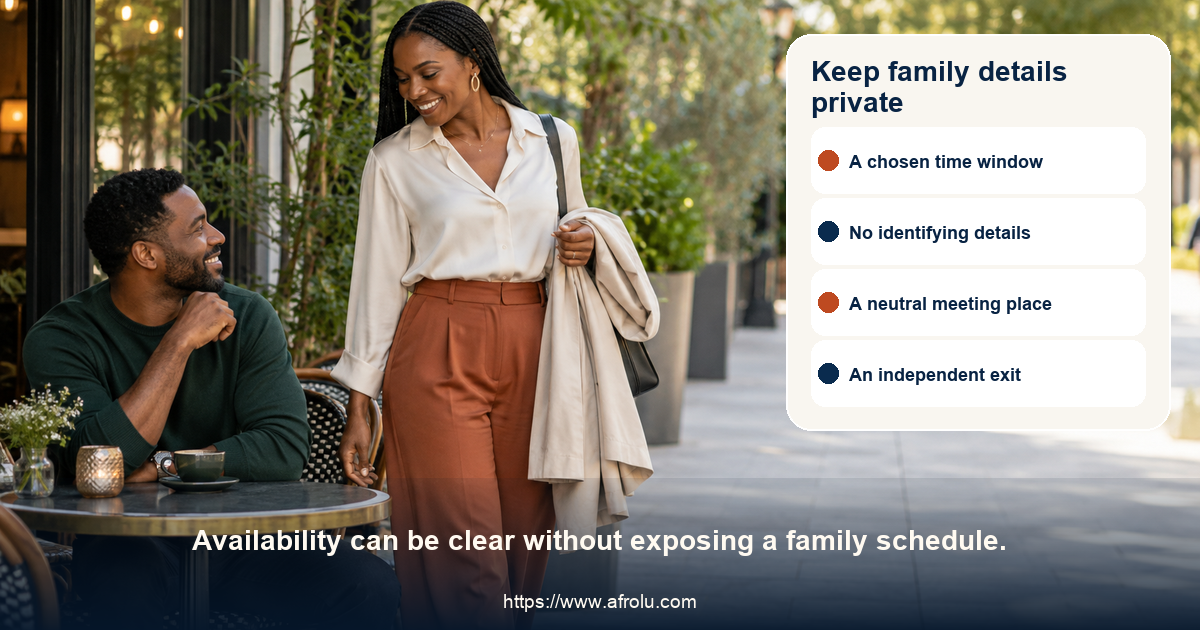
Amina wants a short Sunday date but does not want to publish her family's schedule. She offers a time window, asks what casual means around contact and other dates, and suggests a neutral public place. When the date asks to meet her child, she says she will decide about introductions separately and only if the connection is ready. The answer protects family privacy without making the adult plan unclear.
parenting · weekend clarity
Amina offers a workable weekend plan while keeping her child's privacy and introduction decisions separate
This guide avoids assuming a family structure or schedule and separates adult dating terms from child privacy, availability from on-call access, and thoughtful discretion from pressure to isolate.
Share a practical time window, clarify what the situationship means now, protect identifying details, plan an independent public date, and make a separate decision about any family introduction.
Offer real availability
A time window is enough; a full care schedule is private.
Protect child details
Names, photos, routines, and locations are not dating currency.
Choose introductions
A casual partner does not earn access as proof.
Keep plans independent
Public settings and separate systems protect choice.
parenting · individual context
Being a parent tells a date one part of your life; it does not explain your family structure, schedule, support, privacy, or readiness to date
Parent is not a complete relationship biography. Some adults parent on their own, some share care, some have support from relatives or a wider community, and some keep family arrangements private. No label tells a date which weekends are open, who provides care, what contact with another parent looks like, or whether you want a serious relationship. Ask about the terms that affect a plan rather than filling in the gaps from a stereotype.
Decide what you want from a weekend connection in your present life. You might want an occasional public date, a casual arrangement with clear boundaries, or a conversation about whether your goals match. You do not need to present parenting as a limitation or prove that you can be available on demand. A workable plan respects your actual responsibilities and your right to have preferences beyond them.
Notice if someone treats your schedule as an obstacle to overcome, a test of loyalty, or an opportunity to gain access to your home or family. A considerate date can accept limited availability without demanding private details or insisting that you rearrange a child's routine. You can share the practical fact that a certain time works without providing names, locations, school information, or a detailed care calendar.
Your dating choices remain adult choices. A casual connection does not need to become part of your child's life simply because it has repeated. You can decide whether, when, and how a person meets your child after considering trust, stability, the child's needs, and your own judgment. There is no universal timeline. A date who treats access to your family as proof of affection is asking for a decision you can decline.
situationship clarity · weekend planning
A free Saturday does not mean unlimited availability, and a cancelled plan does not explain every detail of someone's family life
A weekend invitation can be warm and still need details. What time and place are proposed? Is the plan short or open ended? Are you both comfortable with a public meeting? What happens if a care arrangement changes? Asking those questions does not make you difficult. It helps each adult decide whether the meeting fits without asking anyone to disclose more family information than is necessary.
Use neutral language to describe availability. You might say, 'I can meet between two and four on Sunday' or 'I need more notice before I can confirm a weekend plan.' You do not owe a new date the name of a caregiver, details about a child's routine, or a full explanation for a reschedule. A plain limit is enough for another adult to decide whether that time works for them.
Clarify what situationship means in practice. Some people mean occasional dates without exclusivity; others expect regular weekend time, daily contact, or future plans. A parent's limited availability can make assumptions especially costly, but the answer is still a conversation between adults. Ask what each person wants now, whether either is dating others, and what would prompt a review of the arrangement.
A schedule change is not automatically rejection or lack of interest. It is also not a reason to accept a pattern that leaves you permanently waiting. Look at how both people handle changes: do they communicate, offer a workable alternative, and accept a no? If one adult expects the other to remain on standby while refusing to plan, name the pattern and decide whether that arrangement suits your time.
child privacy · information boundaries
A child's name, face, school, routines, location, private account, and personal story do not belong in an early dating connection by default
Keep dating profiles focused on you. Avoid posting a child's photo, full name, school, regular activities, or location clues that make them easy to identify. A new match does not need access to a child's social media or a detailed account of family routines. This boundary can protect privacy without suggesting that parenthood is shameful or that you must hide the fact that it matters in your life.
Share information gradually and with a clear purpose. It may be enough to say that you have parenting responsibilities and plan dates around them. If a particular detail does not affect consent or the plan, you can keep it private. Be especially careful about photos, live location, home address, pick-up routines, account access, and information that could expose a child to unwanted contact.
Do not use a child as a test of someone's seriousness. A casual relationship does not need to meet a child to become meaningful to the adults involved. Conversely, a request to meet, message, photograph, or follow a child should not be treated as a harmless shortcut when the parent is not ready. You can say no without predicting how the relationship will develop.
If you eventually consider an introduction, make the decision for the child's wellbeing and your own judgment, not to soothe a date's insecurity. Consider the stability and nature of the connection, what the child is ready for, and whether the meeting can remain low pressure for them. If family, safeguarding, or legal arrangements affect the decision, get qualified local advice rather than relying on a dating guide or a stranger's opinion.
first meetings · separate settings
A first date can happen in a neutral public place with your own transport and a clear end, without bringing a new connection into your home or a child's routine
A public café, restaurant, event, or other neutral location can keep a first meeting simple. Choose a place that works with your real schedule and that you can leave without depending on the date for a ride. You can tell a trusted person your plan if you want a check in. There is no need to share your home address or reveal where a child will be during the date.
Decide how you want to handle costs before the plan begins. You may prefer to pay separately, choose a modest venue, or agree on a straightforward split. A meal, gift, babysitting offer, or ride is not a purchase of intimacy, family information, or future access. Keep money and account access separate, and pause if a new date asks for transfers, codes, documents, or financial help.
If care needs change, communicate only what is necessary: 'I need to reschedule; Sunday no longer works.' You can suggest another time if you want to. The other adult can decide whether the alternative suits them. You do not need to compensate for a cancellation with a longer date, private access, an introduction to your child, or a promise about your future availability.
If the meeting moves to another setting or becomes intimate, make a fresh decision. Agreeing to a public date is not consent to a private home, a longer evening, physical contact, an image, or sex. Each adult can pause or leave. If you feel pressured or unsafe, prioritize leaving and contacting support; do not stay because you feel you must be polite or because childcare was arranged.
communication · family boundaries
A clear dating agreement can include how you communicate around parenting responsibilities without asking either adult to disclose a child's private schedule
Talk about response expectations before silence becomes a story. You might not be available for continuous messages during family time, work, or rest. You can say when you usually have space to talk without promising a response at a particular hour. The other adult can decide whether that rhythm works for them. Neither person needs to pretend that all weekends are equally flexible.
Keep parenting decisions out of dating negotiations. A new partner does not automatically get a vote on a child's routines, family contacts, or co-parenting arrangements. You also do not need to recruit a date to provide care, resolve a family dispute, or serve as a messenger. If you share a household or parenting responsibilities with another adult, protect everyone's privacy and use appropriate channels for those existing responsibilities.
If the date asks why you cannot meet, offer only the detail you are comfortable sharing. 'That weekend is not available for me' is a complete answer. Repeated demands for names, schedules, custody details, or a child's location can signal that the person is not respecting your boundary. A trustworthy adult can make plans with the information needed to meet and accept that family specifics are not theirs to manage.
Discretion can be a thoughtful way to protect a child; secrecy that isolates or controls you is different. You should still be free to talk with trusted people, seek advice, and use support. If someone insists that you hide the relationship from everyone, monitors family communications, or uses a child as leverage, treat the behavior as serious and get appropriate support rather than trying to solve it with a better schedule.

Offer the plan you can keep.
money · digital safety · consent
A situationship does not grant access to a parent's accounts, home, child, caregiving role, private images, or family decisions
Keep bank details, passwords, one time codes, identity documents, benefits information, and financial accounts private. A new romantic contact should not need them to prove affection or help with an emergency. If someone requests money for travel, a crisis, an investment, or a family situation, pause and verify independently. Do not move money or open an account at another person's direction.
Decide who may see your location or private images. You do not have to enable live tracking, send a photo, reveal a child's whereabouts, or connect social accounts. If a date uses technology to monitor, threaten, impersonate, or expose you, consider platform reporting and specialist technology abuse support. If your safety could be affected by changing settings, seek tailored help before doing so.
A casual label does not soften a boundary around intimacy. A previous date, physical affection, payment, transport, or family responsibility does not create consent now. Check in when a plan changes and stop if either person hesitates, changes their mind, or feels pressured. You can choose not to discuss intimacy by text or not to share intimate material at all.
Be attentive to requests that place a child in the middle: asking for private access, gifts in exchange for contact, unsupervised time, personal messages, photos, or a role in a child's care before you have chosen that. You can refuse without negotiating a trial. If there is an immediate safety concern or a relevant legal or safeguarding question, use qualified local services; this guide cannot determine an individual family's obligations.

A date does not purchase family access.
personal standard · next step
The right weekend arrangement leaves you able to parent, date, rest, ask for clarity, protect a child's privacy, and change a plan without someone claiming you owe them access
Your standard might be: 'I make weekend plans with notice,' 'I do not share my child's photos or routine with a new date,' or 'I do not introduce a casual partner until I decide it is appropriate.' Keep it practical and personal. It is not a rule for every parent, and it does not require you to justify your family structure or predict how long the connection will last.
Use the standard to read current conduct. Does the person work with a reasonable plan? Can they accept a reschedule without demanding private details? Do they answer what casual means now? Are they willing to keep your home, child, money, location, and accounts outside the early relationship? These signs cannot guarantee future behavior, but they help you decide whether the present connection respects the boundaries you actually named.
If you do not have enough information, choose a smaller next step. Ask one direct question, meet briefly in public, or wait to introduce the person to family life. If the answer is a mismatch, you can end the connection without proving that the other adult is bad. If it fits, you can keep learning at a pace that protects everyone involved.
A parent is allowed to want romance, affection, companionship, or a casual connection. You are also allowed to keep parenting responsibilities, a child's privacy, and your own rest non-negotiable. A considerate partner can make room for all of those facts. If someone makes your no costly or uses family access as a measure of love, step back and seek support that understands your circumstances.

A child is not proof of romantic commitment.
Eight parent dating situations where planning, privacy, access, or a changed weekend affects the next move
The assumed family schedule
A date treats every weekend as unavailable or assumes you can always arrange care.
State the time you can offer without defending the whole schedule.The vague invitation
A late message asks you to be free but gives no plan or notice.
Ask for a concrete time and decide whether it fits.The family interview
A new match asks for a child's name, school, routine, or detailed family history.
Keep identifying details private and share only what is relevant.The early introduction
A date asks to meet or message your child before you feel ready.
Say no and decide about introductions on your own terms.The changing weekend
A parenting responsibility changes after you accepted a date.
Reschedule plainly without offering private access as compensation.The care offer
A person offers money or childcare in exchange for more time or access.
Keep caregiving and financial arrangements independent.The account request
A romantic contact asks for money, codes, or account help for a family emergency.
Pause, decline transfers, and verify independently.The privacy breach
Someone shares a child's photo or location after you asked them not to.
Protect access, document safely, report where appropriate, and seek support.Fourteen signs that a weekend situationship respects adult choice and a child's separate privacy
You define which family details are relevant to the date.
Weekend plans include workable notice and a clear time.
A change in care or availability is handled without accusation.
You can ask what the situationship includes right now.
Your child is not used to prove a date's seriousness.
A new connection stays separate from a child's private accounts and routines.
No one expects a child introduction as a reward for attention.
Your home address and live location remain your choice.
Money or childcare offers do not create romantic debt.
A public first meeting has independent transport and an exit.
A new date respects the contact rhythm you can offer.
You can talk with trusted people without being isolated.
Consent stays current when a plan changes.
A clear boundary about family access is accepted.
A decision map for availability, situationship terms, child introductions, home access, money, and boundaries
| Situation | What it may mean | What to do next |
|---|---|---|
| A weekend invitation arrives late | A spontaneous offer or a pattern that ignores your planning needs. | Ask for notice or decline if it does not fit. |
| A care plan changes | A normal change in availability. | Reschedule with only the detail you want to share. |
| They ask about your family | Relevant curiosity or a request for private information. | Share only what affects the present decision. |
| They ask to meet your child | A request that needs your independent judgment and timing. | Say no until you decide the connection is ready. |
| The situationship is undefined | Different assumptions about contact or commitment. | Ask what each person wants now. |
| They want your home address | A convenience request or premature access to private location. | Choose a neutral public meeting instead. |
| They offer childcare or money | Kindness or a source of dependence and leverage. | Keep family care and finances separate. |
| They ask for a child's photo | Interest that still does not override a child's privacy. | Decline and keep identifying details private. |
| A date pays for dinner | A generous choice without entitlement. | Keep consent and time separate from payment. |
| A privacy boundary is ignored | A serious access or safety concern. | Reduce access and seek appropriate support. |
Twelve direct lines for weekend plans, contact rhythm, privacy, consent, and a clear ending
“I can meet Sunday afternoon with a little notice. What time and place were you thinking?”
“That weekend does not work for me. I can suggest another time if I want to.”
“What does a situationship mean to you around contact, other dates, and weekend plans?”
“I keep my child's name, school, routine, and photos private when I am getting to know someone.”
“I am not ready to introduce you to my child. I will make that decision if and when it feels right.”
“I prefer our dates to happen in public while we are getting to know each other.”
“I need to change our plan. I can meet another day if that still works for both of us.”
“I am not available for continuous messages during family time, but I can talk later.”
“I do not share accounts, codes, or money with someone I am dating.”
“I will make my own arrangements for care and will not treat that as part of our date.”
“I agreed to meet in public. I am not agreeing to move somewhere private now.”
“This arrangement does not work for me, so I am ending it. Please do not contact me again.”
Know the difference
Parenting-aware dating versus a demand for family access
Both adults make workable plans, protect a child's privacy, discuss the present relationship, and let the parent decide if or when a child is introduced.
One adult treats availability, a child's information, home access, caregiving, or an early introduction as a test of affection or commitment.
Family access is a separate decision, never a dating reward.

Family access is a separate decision.
Keep parenting-aware dating separate from demands for family access
| Type or dimension | What it describes | Best next question |
|---|---|---|
| A clear weekend | The time and place work for the adults involved. | Accept, decline, or suggest another time. |
| On-call availability | One person expects the parent to remain free without a plan. | State what notice and timing you need. |
| Relevant context | You share the practical detail needed for the date. | Keep the rest of family life private. |
| Family interrogation | A date requests identifying details without a present need. | Set a privacy boundary. |
| Thoughtful pacing | The parent decides whether and when to introduce a child. | Keep the child outside early casual dates. |
| Access test | An adult treats a meeting with the child as proof of love. | Decline and evaluate the pressure. |
| Independent care | Each adult manages their own plans and responsibilities. | Keep dating separate from childcare. |
| Dependency offer | Money or care creates obligation or leverage. | Pause and keep support independent. |
| Public first meeting | Both adults can arrive and leave on their own. | Keep the date at the agreed place. |
| Ignored family boundary | A request for privacy is disregarded or shared. | Protect access and seek support. |
A simple plan you can use today
Parenthood is not a full biography
Each adult chooses what context a date needs.
A schedule is a boundary
Availability should be discussed without entitlement.
A child has separate privacy
Photos, names, routines, and locations are not dating currency.
Introductions are a decision
Repeated dates do not automatically create a reason to involve a child.
Casual still needs clarity
Contact, other dates, plans, and intimacy can be discussed plainly.
Family access stays separate
Money, care, home access, and child contact are not proof of affection.
Questions organised by purpose and depth
Choose a few prompts that fit the moment. This is a reference library, not a list to complete.
Before accepting
Choose a plan that fits your life without oversharing.
- W
- h
- a
- t
- t
- i
- m
- e
- c
- a
- n
- I
- g
- e
- n
- u
- i
- n
- e
- l
- y
- o
- f
- f
- e
- r
- ?
- H
- o
- w
- m
- u
- c
- h
- n
- o
- t
- i
- c
- e
- d
- o
- I
- n
- e
- e
- d
- ?
- C
- a
- n
- I
- a
- r
- r
- i
- v
- e
- a
- n
- d
- l
- e
- a
- v
- e
- i
- n
- d
- e
- p
- e
- n
- d
- e
- n
- t
- l
- y
- ?
Clarifying the situationship
Ask about the terms that affect adult choices.
- W
- h
- a
- t
- d
- o
- e
- s
- c
- a
- s
- u
- a
- l
- m
- e
- a
- n
- n
- o
- w
- ?
- W
- h
- a
- t
- c
- o
- n
- t
- a
- c
- t
- r
- h
- y
- t
- h
- m
- w
- o
- r
- k
- s
- ?
- A
- r
- e
- e
- i
- t
- h
- e
- r
- o
- f
- u
- s
- d
- a
- t
- i
- n
- g
- o
- t
- h
- e
- r
- p
- e
- o
- p
- l
- e
- ?
Protecting family privacy
Keep the child's information separate from dating.
- W
- h
- a
- t
- d
- e
- t
- a
- i
- l
- s
- a
- r
- e
- i
- d
- e
- n
- t
- i
- f
- y
- i
- n
- g
- ?
- W
- h
- a
- t
- d
- o
- e
- s
- t
- h
- i
- s
- p
- e
- r
- s
- o
- n
- n
- e
- e
- d
- t
- o
- k
- n
- o
- w
- f
- o
- r
- t
- h
- i
- s
- d
- a
- t
- e
- ?
- W
- h
- a
- t
- c
- a
- n
- r
- e
- m
- a
- i
- n
- p
- r
- i
- v
- a
- t
- e
- ?
Considering an introduction
Make a separate decision based on your judgment and the child's needs.
- I
- s
- t
- h
- e
- c
- o
- n
- n
- e
- c
- t
- i
- o
- n
- s
- t
- a
- b
- l
- e
- e
- n
- o
- u
- g
- h
- ?
- W
- h
- a
- t
- w
- o
- u
- l
- d
- k
- e
- e
- p
- t
- h
- e
- m
- e
- e
- t
- i
- n
- g
- l
- o
- w
- p
- r
- e
- s
- s
- u
- r
- e
- ?
- I
- s
- q
- u
- a
- l
- i
- f
- i
- e
- d
- l
- o
- c
- a
- l
- a
- d
- v
- i
- c
- e
- n
- e
- e
- d
- e
- d
- ?
What deserves a closer look
Offer a usable weekend window
Share the time you can meet and the notice you need without publishing a care calendar.
Evidence limit: You do not owe a new date a detailed explanation.
Make situationship expectations current
Discuss contact, other dates, plans, intimacy, and when to revisit the arrangement.
Evidence limit: A clear label cannot guarantee behavior.
Keep child information out of early dating
Limit photos, identifying details, accounts, routines, locations, and home access.
Evidence limit: This guide cannot assess a specific family's safeguarding needs.
Separate dating from family access
Decide whether a connection is ready for an introduction based on your judgment and the child's needs.
Evidence limit: There is no universal introduction timeline.
Keep first meetings independent
Choose a public place, a clear end, and transport you control.
Evidence limit: A plan reduces uncertainty but cannot guarantee safety.
Use qualified help for complex family questions
Seek local professional advice when legal, safeguarding, or immediate safety questions arise.
Evidence limit: An editorial guide is not legal or safeguarding advice.
Shortcuts that assume a family schedule or turn a child into proof of commitment
Assuming all parents share a schedule
Family structures, care, and support differ.
Explaining every reschedule
A date needs a workable alternative, not a child's private details.
Using a child to test seriousness
A child is not a relationship milestone or proof.
Sharing identifying details too early
Location and routines can expose a child's privacy.
Letting payment create access
A meal or gift does not buy time, intimacy, or family contact.
Solving pressure through a longer explanation
Repeated disregard may need distance and support, not more disclosure.
Consider parent dating, plan around a full schedule, or look for respectful conduct
Choose the resource that fits the decision in front of you. Editorial guidance cannot assess an individual family's legal, safeguarding, or care arrangements.
Explore the guide library
Show more related guides
Continue with Afrolu
Show more Afrolu guides
Sources used for this guide
Afrolu reviewed these health, research, safety, or public guidance resources while editing this page. They support the behaviour and safety guidance; they do not diagnose any individual described by a reader.
Questions about dating as a parent and keeping a weekend situationship clear
Do I have to explain my family schedule to a date?
No. Share the practical availability or notice you need. You can keep care arrangements, a child's routine, and family details private.
Does being a parent mean I can only date other parents?
No. Each adult can decide what relationship context fits them. Discuss practical expectations instead of assuming compatibility from a label.
Should I introduce a casual partner to my child?
That decision is yours. Consider the nature and stability of the connection, your child's needs, and your judgment; there is no universal timeline.
When should I tell someone I am a parent?
There is no single script. You can disclose that context when it matters to an honest adult choice while keeping identifying details private.
How do I handle a changed weekend plan?
Tell the person the plan needs to change and offer another time only if you want to. You do not owe private family details as compensation.
Is it okay to keep a first date away from my home?
Yes. A neutral public meeting can protect your address privacy and give both adults an independent way to arrive and leave.
Can a date ask to meet my child as proof of commitment?
You can decline. A child introduction is a separate decision, not a test that a parent owes a dating partner.
Should I share photos or my child's school information?
Keep identifying details such as names, photos, schools, routines, and locations private, especially in profiles and early conversations.
Does paying for a date create an obligation?
No. Money, a meal, a gift, or a ride does not create consent, family access, or a promise of another date.
What if a date ignores a family privacy boundary?
Reduce access and consider platform reporting or trusted and specialist local support, especially if contact becomes threatening or involves a child's information.
One thing to do now
Choose the next adult dating step that protects your time and family privacy
Choose the smallest next step that respects your actual availability and protects a child's identifying details, your home, money, accounts, body, support, and ability to leave. If someone makes family access a test of affection or commitment, pause and keep the boundary.