Five separate choices for an adult date and a protected family life
Choose a Low-Pressure Weekend Dating Type as a Parent
Choose low-pressure weekend dating types as a parent, with childcare, privacy, consent, public-date plans, scripts and child-introduction boundaries.

Choose the format, direction, agreement, pace and family plan one card at a time.
Written and edited by Grace Mutiso · Kenya Guides Editor
Choose five things separately. Pick a format that fits time, travel and cost; name serious, casual or uncertain direction; agree whether either adult is dating others; set a reviewable pace; and keep care, home, children's information, money and transport outside the new connection. Low pressure means a clear, manageable plan with dependable effort, not last-minute ambiguity. Confirm before care costs, meet publicly, keep an independent return and let one good date earn only one adult-sized next step. Child introductions require a later, separate decision after stable conduct—not a warm weekend or a request for convenience.
Dating basics · Parents Returning To Dating
Which dating format fits a parent's real weekend capacity, and how can intention, structure, pace and family boundaries remain separate?
Low-pressure weekend dating for a parent is an adult meeting whose format and practical load fit current capacity. It preserves explicit relationship choices and a firm family boundary, so ease never becomes low effort, rushed private access or child involvement.
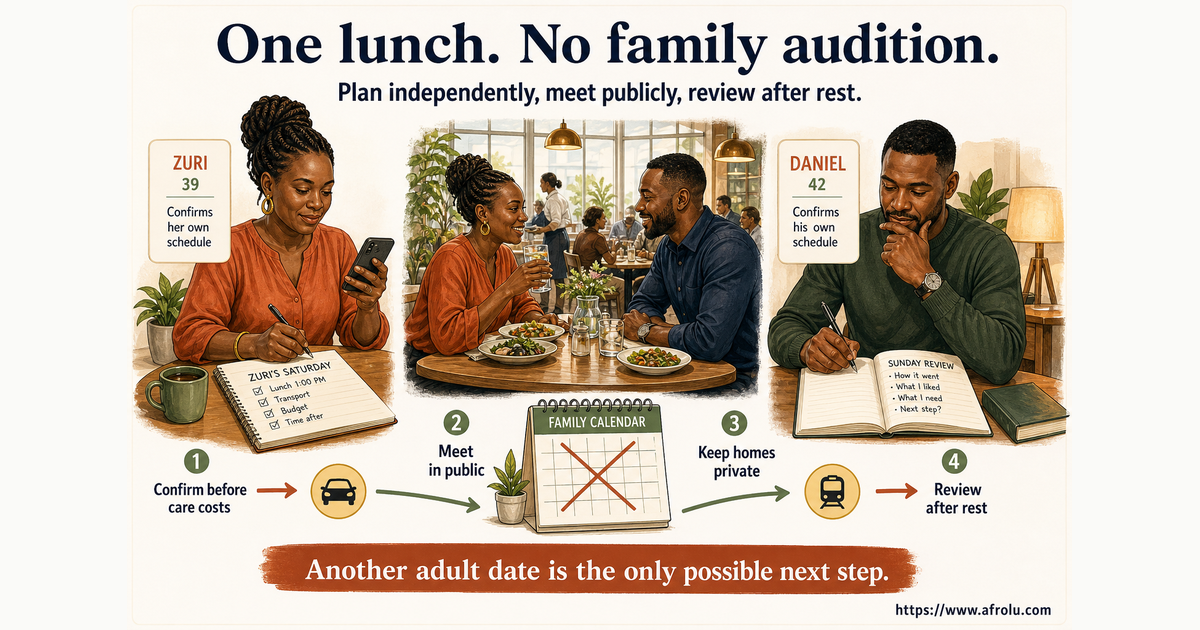
Zuri and Daniel are fictional single parents, 39 and 42. They confirm a Saturday public lunch before care costs, travel separately and state different levels of certainty without forcing agreement. Daniel respects Zuri's home and time limits. After a private Sunday review, they choose one more adult-only date while all family access remains closed.
The five-pocket weekend board
Make the date small enough to enjoy and complete enough to trust
Grace separates the adult meeting from relationship assumptions and the family systems that should remain protected.
The board compares five formats, four behavioural zones and six independent plan pockets before recommending one proportionate next step.
Meeting format
Choose what today's time, travel, cost and conversation can carry.
Relationship choice
Name direction, structure and pace without borrowing from the venue.
Family boundary
Keep care, home, images, routines and introductions independent.
Weekend evidence
Judge confirmation, reciprocity, repair and respect after the date.
Start by shrinking the decision
A low-pressure weekend date answers five questions, not one
Single parents are often told to keep dating simple, but simple can hide several different decisions. The format is what the adults will do: a video call, coffee, a walk, an activity, a group event or dinner. Intention is the direction each person is exploring. Structure covers whether either person may date others. Pace controls how quickly contact, intimacy and private-life access expand. The family plan protects care, routines, addresses, images and introductions. None of these answers can safely stand in for another.
Low pressure should mean that the meeting has a manageable cost, a clear end and room for either adult to say no. It does not mean confirming after a parent has already paid for care, disappearing when plans become inconvenient or treating the parent's home as the easiest venue. A date can be brief and still require dependable effort. The useful measure is whether both adults carry a fair share of planning and whether the family system remains stable if the connection ends tomorrow.
Parents do not owe a new match the details of children's names, schools, photographs, care arrangements, health information or movement. Even innocent questions may request more than the present adult decision needs. Share the fact that parenting shapes availability without publishing a family timetable. Ask what the other adult needs for planning, offer a general window and keep the particular care plan inside the trusted circle already responsible for it.
This guide concerns consenting adults. Children are never participants in the dating decision and should not be asked to approve a match, keep secrets, carry messages or absorb uncertainty. The aim is not to produce one waiting period for every family. It is to make each expansion deliberate: adult dates first, observable conduct over time, then a separate child-introduction decision only if the relationship becomes stable enough and the parent judges it suitable.
Open the five-pocket choice board
Give every weekend decision its own card
The format card begins with capacity. A short video date removes travel but may reveal little about public conduct. Coffee or a walk can create easy conversation and a graceful end, while weather, accessibility and transport still matter. A structured activity reduces interview pressure but may limit deeper talk. Dinner creates more time and cost. Group-social plans can feel comfortable but introduce privacy questions. Choose together rather than deciding that one format proves seriousness.
The direction card uses plain words: serious, casual, open to discovery or uncertain. A parent may date toward partnership while choosing a modest first meeting. Another adult may want companionship without a long-term plan. Neither answer is dishonest when stated early and lived consistently. Trouble begins when a light format is used to hide serious expectations, or serious language is used to rush access that the relationship has not earned.
The structure and pace cards prevent two common assumptions. Frequent weekend dates do not create exclusivity, and exclusivity does not create access to phones, homes, finances or children. Ask whether either adult is dating others and what relevant sexual-health decisions require. Then choose one pace marker: how often to meet, how much messaging fits, which private spaces remain closed and when to review. A review point is more useful than a promise to see where it goes forever.
The family-plan card stands outside romance. Suitable care is chosen through the parent's established standards, not supplied by a new match. Essential transport, phone access and money remain under the parent's control. The home address, school route and children's images stay private. If a plan collapses, cancel or reschedule without blaming the child or revealing sensitive details. A respectful dater may be disappointed and still support the boundary.
Zuri and Daniel plan one Saturday
A complete small plan creates more ease than hopeful improvisation
Zuri, 39, and Daniel, 42, are fictional single parents who match online. Zuri can usually date every second weekend, but she does not disclose the children's routine. Daniel has a different care arrangement and understands that matching calendars may take time. On Thursday they choose a Saturday lunch in a staffed public place and agree to confirm by Friday afternoon, before either person makes non-refundable arrangements. Each organises care independently and keeps the household address private.
At lunch they describe direction without turning the date into an audition. Zuri is open to a lasting partnership but wants several adult-only meetings before discussing family introductions. Daniel is recently back in dating and is genuinely uncertain about long-term timing. He says that plainly instead of mirroring her answer. They clarify that neither assumes exclusivity and that any physical step still needs a present yes. The conversation gives them useful difference without creating a crisis.
Daniel offers to drive Zuri home. She declines and uses the transport she arranged. He accepts the answer without asking for the address or suggesting that independence means distrust. When the meal runs longer than planned, Zuri leaves at the agreed time. Daniel does not ask her to extend care or make parenting sound like an obstacle. Those small responses matter more than a polished declaration because they show whether her practical no remains usable.
On Sunday, each reviews the date alone. Zuri liked his honesty about uncertainty; Daniel appreciated her clear schedule. They choose a ninety-minute public activity two weeks later. They do not exchange children's photographs, introduce relatives, combine transport or promise exclusivity. The choice is intentionally ordinary. Low pressure works here because confirmation, privacy and return plans were dependable enough that neither adult had to manage avoidable chaos.
Read behaviour rather than charm
Calm effort, flexible repair, low effort and access pressure are different patterns
Calm effort is specific and reciprocal. The adult confirms within the agreed window, proposes realistic options, accepts a time box and arrives without demanding a reward for ordinary courtesy. They can hear that a parent has limited availability without competing with the children or requesting details. Low pressure comes from fewer moving parts and a respectful attitude, not from one person doing all the invisible planning.
Flexible repair becomes visible when life changes. A child may become ill, care may fall through or work may intervene. A useful repair states what happened without exposing the child's private information, apologises for the impact and offers a realistic alternative. The other adult may still decline. Repair does not require instant forgiveness or repeated rescheduling; it restores choice and changes the next plan.
Low effort transfers work. Examples include vague invitations that become urgent on Saturday, expecting the parent to host because travel is inconvenient, repeatedly choosing times outside stated availability or disappearing until the next free evening. The issue is not message frequency or an expensive date. It is that the parent pays in care costs, uncertainty, emotional labour or family disruption while the other person preserves maximum convenience.
Access pressure tries to turn dating into family entry. It may sound like requests to meet children immediately, collect someone from home, see school pictures, inspect a co-parenting arrangement or prove trust through a private visit. Decline the step. If the response includes shame, threats, monitoring, unwanted contact or attempts to reach children, co-parents or workplaces, protect those systems first and seek support suited to the risk.

Low pressure reduces strain while dependable effort stays visible.
Use adult-sized sentences
Clear scripts protect time and privacy without making parenting an apology
For timing, try: ‘Saturday afternoon can work if we confirm by Friday at three; otherwise I will keep the weekend free.’ This sentence names the option and the deadline without explaining a child's schedule. If confirmation does not arrive, treat the plan as off. Do not spend money or rearrange care to reward ambiguity. A reliable person can miss a deadline; the repair is a new plan, not a retroactive demand that the parent remain available.
For privacy, say: ‘I keep my home and children's information private while I get to know someone. I meet in public and arrange my own return.’ You do not need to prove that the rule applies to everyone. If the match asks a reasonable planning question, answer at the smallest useful level. If they push for a school, address, image or routine, repeat the limit once and reduce access rather than offering more detail to make the refusal sound kinder.
For direction and structure, try: ‘I am open to a serious partnership, and today we are two adults having a first date. I do not assume exclusivity; what are you exploring?’ This keeps hope and present reality in the same sentence. Add sexual-health and contraception conversations before relevant activity. A parent label does not imply monogamy, marriage, reduced desire or automatic willingness to blend families.
For the next step, say: ‘I enjoyed this. I can offer another public date in two weeks, not a home visit or family meeting.’ A respectful yes supports the plan; a respectful no closes it. Bargaining, sulking or invoking the amount spent reveals a different pattern. Consent to a meal, ride, kiss, photograph or future date is specific and withdrawable. Serious intention does not convert one yes into continuing access.

A specific boundary makes a low-pressure plan easier to respect.
Make the weekend resilient
Care, public place, time, transport, money and support should stand without the match
Use care that already meets the parent's standards and does not depend on the new match. The American Academy of Pediatrics advises caution about asking new friends or partners to watch children and recommends caregivers with proven experience. The practical boundary is simple: dating and childcare remain separate systems. If suitable care is unavailable, reschedule the adult date rather than converting it into a family encounter.
Choose a public, staffed place you can identify directly, set a duration and keep your own phone, payment method and route home. Share a broad plan with one trusted person if helpful, without circulating the match's sensitive data. Verify only what the present decision reasonably needs. Do not send identity documents to a match or use a verification service they insist upon. Contradictions justify slowing or declining; they do not authorise surveillance.
Keep money outside affection tests. Romance scams may build trust before introducing travel, medical, investment or family emergencies. Do not send money, gifts, account credentials or financial documents to a new or unverified love interest. If a suspicious transfer occurred, contact the provider promptly and secure related accounts. Parents may be targeted through stories about children or family hardship; compassion can be expressed without transferring funds through a stranger.
Plan the exit before the date. Either adult can leave when the time box ends, the conversation no longer fits or safety changes. A date, meal, ride or gift never purchases contact or intimacy. If there are threats, stalking, account compromise, extortion or attempts to reach a child, preserve useful records, lock down affected systems and contact appropriate local support. The objective is not to win an argument; it is to restore practical control.

If the date changes, the family system should still work.
Choose one proportionate format
The right dating type fits today's capacity without predicting the whole future
A short video date can confirm conversational ease before travel and care costs, while still protecting location. It cannot verify every identity claim or show how someone behaves in public. Coffee or a walk offers a clear time box and conversation; accessibility, weather and transport need checking. A structured activity gives shared focus and can reduce interview pressure, but may make deeper discussion harder. Choose it when the next question is how you interact, not whether every future value aligns.
A group-social event can reduce one-to-one intensity and show ordinary social behaviour, yet it exposes the connection to other adults and may create pressure to perform. Ask before inviting or posting. Dinner supplies more conversation time but brings higher cost and a less flexible exit. It is not more serious by nature. Decide who pays before ordering if the issue would create strain, and retain the ability to leave independently.
Continue when the format was manageable, both adults carried effort, privacy remained intact and the next question is specific. Revise when the person seems respectful but the timing, cost or setting did not fit. Try a shorter meeting, more advance notice or a different venue. Close when direction is incompatible or when repeated low effort, family-access pressure, money requests, retaliation or boundary violations make the connection smaller than the work required to contain it.
The durable rule is not ‘parents must date slowly’ or ‘weekends must stay casual.’ Parents can choose serious, casual or uncertain direction, and they can move at different speeds. What remains constant is adult consent and a protected family boundary. Let behaviour earn one next layer at a time. Children should meet only through a separate, considered decision after the adult relationship has enough stability to justify that change.
Eight weekend moments where a parent needs one smaller decision
The date is still unconfirmed
A parent would need to pay for care before the other adult commits to a time.
Let the deadline pass and offer no last-minute rescue.Travel would consume the whole free window
Both adults want to check conversational ease before arranging a longer outing.
Choose a short call without treating it as identity proof.A match calls a private visit easier
Convenience would reveal the family address and remove a public exit.
Keep the meeting public or decline.One parent wants partnership and the other is uncertain
The answers differ, but neither adult has misrepresented the present.
Choose a short review period or close without blame.A suitable caregiver becomes unavailable
The parent can no longer complete the date without disrupting family needs.
Cancel cleanly and propose one realistic alternative.A warm match asks to see the children
The request arrives before the adult relationship has stability or need.
Keep images and identifying details private.A family emergency needs an urgent transfer
Affection and parent empathy are used to make verification feel cruel.
Send nothing and protect the payment system.The first meeting was respectful and manageable
Both adults want more evidence without expanding family access.
Plan another adult-only public date.Signs that low pressure still contains dependable effort
{'label': 'Timing', 'title': 'Plans are confirmed before costs', 'detail': 'The agreed deadline is treated as real.', 'reading': 'Calm effort'}
{'label': 'Capacity', 'title': 'Availability is accepted without interrogation', 'detail': "The adult asks for options, not a child's timetable.", 'reading': 'Privacy-aware'}
{'label': 'Format', 'title': 'The meeting size matches the weekend', 'detail': 'Travel, money and duration are workable for both.', 'reading': 'Proportionate'}
{'label': 'Direction', 'title': 'Hope is stated without promises', 'detail': 'Serious, casual or uncertain receives its own answer.', 'reading': 'Honest'}
{'label': 'Structure', 'title': 'Exclusivity is discussed directly', 'detail': 'Contact frequency is not used as an agreement.', 'reading': 'Mutual'}
{'label': 'Home', 'title': 'Private space remains protected', 'detail': 'Convenience does not become a reason for access.', 'reading': 'Bounded'}
{'label': 'Children', 'title': 'Family introductions are not rushed', 'detail': "The adults build evidence before changing a child's world.", 'reading': 'Considered'}
{'label': 'Repair', 'title': 'Changes include a realistic alternative', 'detail': 'An apology is followed by different planning.', 'reading': 'Observable'}
{'label': 'Money', 'title': 'Essential funds remain separate', 'detail': 'No transfer is treated as proof of affection.', 'reading': 'Independent'}
{'label': 'Consent', 'title': 'Every no remains usable', 'detail': 'Disappointment never becomes bargaining or punishment.', 'reading': 'Respectful'}
Choose the next step from the five-pocket board
| Situation | What it may mean | What to do next |
|---|---|---|
| Is the format manageable? | Fits: Time, travel and cost fit both adults. Needs review: One part needs a smaller plan. Stop: The parent must absorb every cost. | Resize or decline the date. |
| Was confirmation timely? | Fits: The agreed deadline was met. Needs review: One miss received a clear repair. Stop: Last-minute ambiguity repeats. | Stop rescuing the plan. |
| Is direction named? | Fits: Both answers are understood. Needs review: Uncertainty has a review point. Stop: A light date hides a demand. | State the hoped-for direction. |
| Is structure mutual? | Fits: Dating-others expectations are explicit. Needs review: A talk is scheduled. Stop: Jealousy is called exclusivity. | Ask rather than infer. |
| Does pace preserve choice? | Fits: One layer expands at a time. Needs review: A limit needs repeating once. Stop: Home or family access is rushed. | Close the requested layer. |
| Is family data limited? | Fits: Only general availability is shared. Needs review: One unnecessary question appears. Stop: Schools, images or routines are pursued. | Restrict information and access. |
| Can care stand alone? | Fits: A trusted suitable arrangement exists. Needs review: The plan may need rescheduling. Stop: The match becomes the caregiver. | Separate dating from care. |
| Can either adult leave? | Fits: Phone, fare, payment and route work. Needs review: One item needs completion. Stop: Return depends on the match. | Restore independence first. |
| Does repair change conduct? | Fits: The next plan works differently. Needs review: One follow-through is pending. Stop: Apologies repeat without change. | Judge the pattern, not the speech. |
| What does evidence support? | Fits: One modest second date. Needs review: A smaller experiment. Stop: Less privacy, agency or stability. | Continue, revise or close. |
Scripts for timing, privacy, direction, care, money and consent
“Saturday works if we confirm by Friday at three; otherwise I will release the plan.”
“I can share my general window, not my children's schedule.”
“I meet in public at first and arrange my own route home.”
“I am open to partnership, and I am only promising today's date.”
“I do not infer exclusivity from regular contact; what are you choosing now?”
“My care plan is separate from dating, so I will reschedule if it changes.”
“I do not make introductions while the adult relationship is still new.”
“I do not send emergency or travel money through a new connection.”
“I am changing my answer, so I need us to stop now.”
“I enjoyed this and can offer another public date in two weeks.”
Know the difference
The parent-friendly weekend format deck

Pick a format for today's capacity, then state intention and structure separately.
Compare five common weekend formats without confusing them with intention
| Type or dimension | What it describes | Best next question |
|---|---|---|
| Short video | ||
| Public coffee | ||
| Public walk | ||
| Structured activity | ||
| Group social | ||
| Lunch | ||
| Dinner | ||
| Home date |
Build a parent-friendly weekend date in six moves
Choose the format
Name direction
Agree structure
Set the pace
Protect family
Review conduct
Questions for capacity, relationship choice, family privacy and review
Choose a few prompts that fit the moment. This is a reference library, not a list to complete.
Capacity questions
Choose the smallest useful weekend plan.
- What time can I truly offer?
- When must we confirm?
- Which format fits?
- What cost remains mine?
- Can I leave on time?
Relationship questions
Separate direction, structure and pace.
- What am I exploring?
- Are we dating others?
- Which access remains closed?
- When will we review?
- What would make me stop?
Family questions
Keep children outside early uncertainty.
- Which details stay private?
- Does care stand alone?
- Is the home protected?
- Who knows the broad plan?
- Is introduction still a separate choice?
After-date questions
Review observable conduct after rest.
- Was effort reciprocal?
- Did my no remain usable?
- Was repair concrete?
- What did the format reveal?
- Is one next date proportionate?
What official guidance can and cannot support
New partners should not become early caregivers
American Academy of Pediatrics guidance for single parents cautions against asking new friends or partners to watch children and recommends caregivers with proven experience. The practical dating lesson is to keep care independent from a new connection.
Evidence limit: Family circumstances differ; qualified local child-health or safeguarding advice may be needed.
Adult dating and child introductions are separate stages
AAP guidance after divorce advises that children do not need to meet every date and that a developing serious relationship calls for a considered discussion. Afrolu applies the narrow distinction, not one universal timetable.
Evidence limit: The source is U.S.-based and cannot decide what is suitable for a particular child or family.
Family details can be sensitive personal data
Kenya's ODPC explains that personal data can include location, photos and recordings, while sensitive data includes family details and children's names. A cautious dater shares only what the present adult plan needs.
Evidence limit: This guide does not determine legal duties or provide data-protection advice.
Romance trust can precede an urgent payment story
The U.S. Federal Trade Commission describes scammers who move conversations, avoid meeting and later request travel, medical or investment money. Keep transfers outside new or unverified connections.
Evidence limit: FTC reporting and remedies are U.S.-specific; use channels appropriate to your location.
Agreement remains specific and current
Healthdirect explains consent as knowingly and freely agreeing and says an answer can change at any time. A meal, childcare cost, ride, serious intention or earlier yes cannot supply permission for a different physical or digital step.
Evidence limit: Healthdirect services are Australia-specific; legal definitions and support routes vary by jurisdiction.
Relationship structure and sexual health need direct conversation
WHO guidance explains that condoms, when used correctly and consistently, reduce the risk of most sexually transmitted infections and unplanned pregnancy. Discuss relevant testing, contraception and barrier choices before activity.
Evidence limit: General health information cannot replace individual medical advice or local clinical services.
Six shortcuts that make a light date expensive
Use a reviewed resource that matches the decision
This guide focuses on the relationship decision, so it does not rank dating apps. Check current prices, safety tools, and local availability before choosing a service.
Explore the guide library
Show more related guides
Continue with Afrolu
Show more Afrolu guides
Official family, privacy, scam and consent sources
Afrolu reviewed these health, research, safety, or public guidance resources while editing this page. They support the behaviour and safety guidance; they do not diagnose any individual described by a reader.
Single-parent weekend dating questions
What does low-pressure dating mean for a single parent?
It means a manageable format, realistic notice, a clear end and freedom to decline. It does not mean low effort, vague confirmation or easy access to the parent's home and family. Both adults should carry planning fairly, while care, transport, money and children's information remain independent from the new connection.
Which weekend dating type is easiest for a busy parent?
There is no universal winner. A short video call has the lowest travel load; public coffee creates a useful time box; an activity supplies shared focus; lunch or dinner creates more conversation at greater cost and duration. Choose the smallest format that can answer the next real compatibility question.
How much should I tell a match about my children?
Share that parenting shapes your availability, but protect names, schools, photographs, addresses, health details and regular movements. A new match usually needs a general time window, not a family timetable. If someone pushes for unnecessary details, repeat the boundary and reduce access rather than explaining more.
When should a single parent confirm a weekend date?
Choose a deadline before care costs or major rearrangements become necessary. State it clearly: if the plan is not confirmed by that time, it is off. The exact hour depends on your circumstances. A missed deadline can receive a new plan, but you do not need to remain available for last-minute rescue.
Does a casual format mean the person only wants casual dating?
No. Coffee, a walk or a short call describes the meeting format, not relationship direction. Ask whether the adult is exploring a serious partnership, a casual connection or genuine uncertainty. State present structure separately too; regular dates do not create exclusivity unless both adults agree.
Should a new match ever babysit so we can spend time together?
Keep early dating and childcare separate. Use care that already meets the parent's standards and does not depend on the match. If suitable care is unavailable, reschedule the date. A relationship may eventually support different family decisions, but those require separate evidence and safeguarding judgment.
When is it appropriate to introduce children to a date?
There is no single timetable that fits every child and family. Treat introduction as a later, separate decision rather than a way to test a new connection. First gather stable adult conduct, compatible direction and respectful boundaries. Consider the child's circumstances and seek qualified local guidance where needed.
How do I handle a cancellation caused by parenting?
Protect the child's privacy, name the impact and offer one realistic alternative if you want to continue: ‘I cannot make Saturday; I can offer the following weekend.’ The other adult may decline. A good repair changes the plan; it does not require a detailed explanation or automatic forgiveness.
What are red flags around money or family emergencies?
Urgent requests for travel, medical, investment, care or family money are reasons to stop. Do not transfer funds, credentials or financial documents through a new or unverified match. Verify independently, contact the payment provider promptly after a suspicious transfer and use reporting channels suitable to your location.
How can I end a parent-dating mismatch cleanly?
Use a short adult statement: the timing, direction or family boundary does not fit, so you are not continuing romantically. You do not owe access to children or a private closure meeting. If contact becomes threatening or persistent, stop explaining, secure affected systems and seek appropriate local support.
One thing to do now
Let one manageable date remain one manageable date
Use the five cards in order: format, direction, structure, pace and family plan. Continue when effort is reciprocal, a no remains usable and the family system stands alone. Revise one observable planning element when fit is possible. Close when direction conflicts or repeated low effort, family-access pressure, money requests, monitoring or retaliation makes the connection unsafe or unsustainable.