Three rings protect one gentle pace
Date Slowly in Nairobi Without Pressuring Family Life
A three-ring guide for Nairobi parents: confirm low-pressure public dates, protect household privacy and make family integration a later choice.
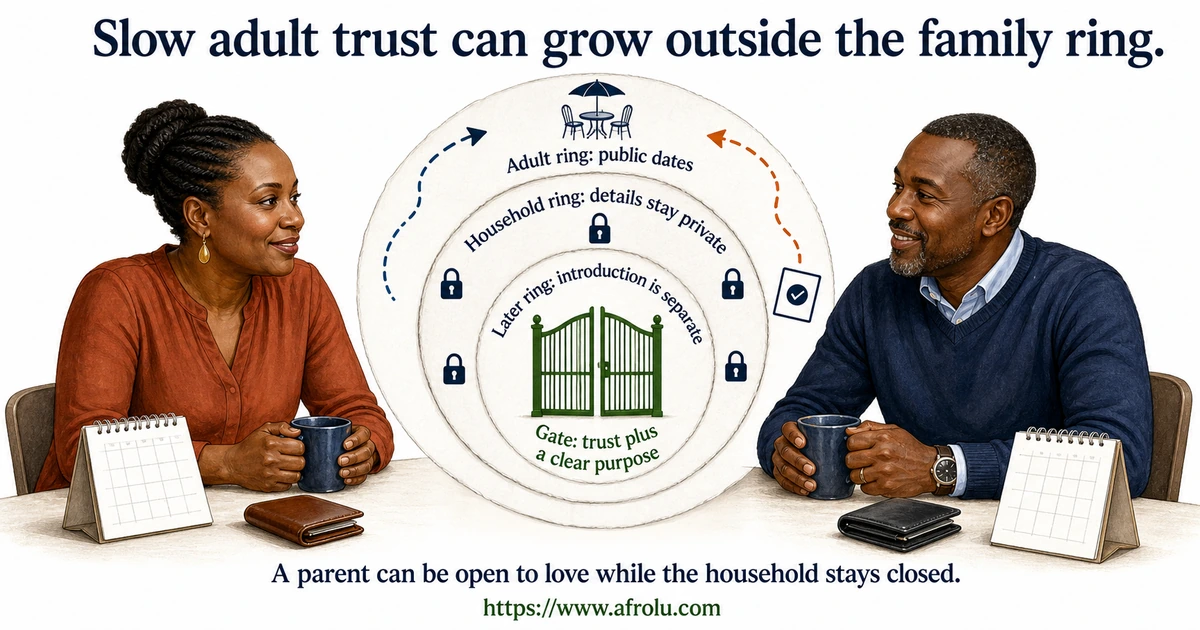
Keep early dates in the public adult ring, private family systems behind a firewall and integration as a later decision.
Written and edited by Grace Mutiso · Kenya Guides Editor
Use three rings. Keep early dating in the public adult ring: confirm a staffed place, time, cost, duration and independent return before care or travel changes. Keep names, images, schools, routines, health information, home access, co-parent details and essential money inside the protected household ring. Treat any family introduction as a later, separate decision with a limited purpose; it does not create a parenting role. Slow dating should still produce complete plans, honest direction and reciprocal repair. Low pressure protects a free answer—it does not require a parent to hold weekends open, overspend or disclose private family systems.
Intentional dating · Parents Returning To Dating
Is the slower pace creating reliable adult knowledge while family life stays protected, or is the household carrying another person's uncertainty?
Slow dating for a Nairobi parent is a deliberate pace for adult knowledge, disclosure, intimacy and possible integration. Low pressure describes a decision environment in which either adult can say yes, no, not yet or make a different offer without punishment. Neither term means vague planning, low effort or hidden relationship structure. Parenthood is life context rather than a relationship type. The practical work is to keep adult dating, protected household life and any later family integration in separate rings while clarity grows.
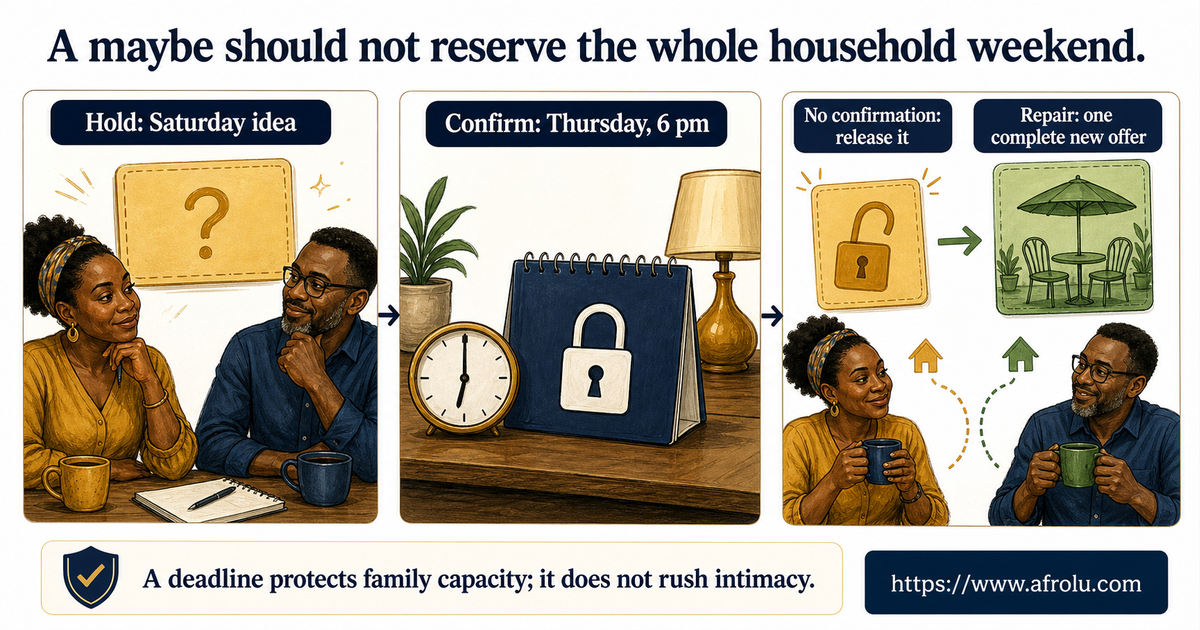
Wanjiku and Kamau are fictional Nairobi parents. Wanjiku is 42 and works in procurement; Kamau is 45 and works as an electrical technician. After two public dates, Kamau suggests a Saturday but leaves the place and time open. Wanjiku would need to change private commitments, so she sets Thursday at six as the confirmation gate. The deadline passes and she releases the day without disclosing her family system. Kamau later offers a complete Sunday plan with separate transport and an affordable setting. Wanjiku accepts. They keep dates in the adult ring, review their pace after four weeks and make no family introduction. His specific repair, not faster access, becomes the useful evidence.
The Nairobi parent three-ring map
Let connection grow without making family life the testing ground
The map separates what a date needs now from information and access that belong to a later, more consequential decision.
Grace reads every moment through adult plan completeness, household privacy and whether any integration step has a clear purpose and free consent.
Public adult dating
Messages, public plans, relationship answers, consent, transport, cost, repair and endings stay between the adults.
Protected household
Home, school, care, health, family images, routines, accounts and private relationships remain outside early dating.
Later integration
An introduction needs adult stability, a limited purpose and clarity about every role or authority it does not create.
Family capacity
Confirmation, affordability, privacy and reciprocal effort determine whether dating remains workable before access expands.
The three-ring map
Let adult dating grow in public while the household remains protected
The first ring belongs to two adults. It includes messages, public dates, relationship questions, sexual-health conversations when relevant, transport and endings. A parent can be warm, curious and serious inside this ring without sharing a home, family calendar or child information. Keeping early dating here is not secrecy. It is a proportionate boundary while the adults learn whether plans, values, consent and repair are dependable.
The second ring contains household life. Names, images, schools, routines, care arrangements, health information, home access, co-parent conflict, passwords and essential money do not belong in early reassurance. A date needs to know when the parent is available, not why every other hour is occupied. Another person's private life cannot be traded as proof that the parent is honest, open or serious.
The third ring is possible family integration. It is not the prize for waiting a certain number of weeks. It needs a separate purpose, greater adult stability and a plan appropriate to the household. An introduction does not make someone a parent, caregiver, driver, disciplinarian, emergency contact or home resident. Those would be different decisions, most of which should remain far beyond early dating.
Slow dating controls the pace within and between rings. Low pressure protects the freedom to say yes, no, not yet or a different offer. Neither phrase excuses unreliable adult planning. In Nairobi, a vague Saturday may require someone else to hold family time, travel across the city and spend money. A confirm-by rule keeps the pace gentle without making the household wait indefinitely.
A Saturday that stays usable
Wanjiku releases the maybe and accepts a later complete plan
Wanjiku and Kamau are fictional adults. Wanjiku is 42, works in procurement and has family responsibilities. Kamau is 45, works as an electrical technician and is also a parent. They enjoy two public Nairobi dates and agree to move slowly. Kamau suggests another Saturday but says he will confirm later. Wanjiku would need to rearrange personal and care commitments before leaving. She notices that an informal idea creates formal work for her household.
Wanjiku sets a rule: venue and time by Thursday at six, otherwise Saturday is released. She does not disclose who provides care, where anyone will be or why the arrangement has a deadline. Kamau says he understands, yet Thursday passes without a complete plan. Wanjiku makes another adult plan and does not spend Friday trying to rescue the date. Her boundary is a calendar decision, not punishment or a test.
On Sunday, Kamau apologises and offers the following Sunday at a staffed cafe they both know how to reach. He provides a time, asks whether the cost range works and accepts that they travel separately. Wanjiku can accept, decline or make a counteroffer. She accepts because the repair is specific. One complete plan does not erase the missed one, but it creates new evidence. If the same pattern repeats, she can stop allocating scarce family capacity.
They keep the relationship in the adult ring. Kamau does not ask to collect Wanjiku from home, meet family members or receive a household schedule to make planning easier. Wanjiku does not ask for his family details. After several weeks, they review whether the slow pace is producing knowledge and mutual effort. The result can be continued public dating, a revised rhythm or an ending; no family introduction is required to prove progress.
A complete city plan
Plan Nairobi time, cost and return without exposing the household
A useful Nairobi date offer names a public place, meeting time, expected duration and confirmation deadline. Both adults consider the route and how they will return. The guide does not prescribe one venue, district or fare because circumstances change. The durable principle is control: do not leave for a vague location, depend on a new date for the only return or disclose a home address merely to simplify pickup.
Count the real cost before accepting. A parent's date may involve transport, food, care, time away from paid work or recovery afterward. Neither adult needs an itemised household account. Each can state the amount or type of plan that feels comfortable. Simple dates are not weaker evidence. Spending that competes with rent, food, health, education, care or safe return is too expensive for that household.
Low pressure means either adult may decline a proposed place or time without being accused of low interest. Offer alternatives only when you want to. A smaller public plan can be more informative than an ambitious day that requires secrecy, debt or exhaustion. If a date changes the venue late, decide from the new facts. You do not owe travel because you had agreed to the earlier plan.
Use trusted support proportionately. A parent may tell one trusted adult the date plan and check in afterward. That does not require circulating a match's full profile or family details. If behaviour becomes threatening, deceptive or persistent, the task changes from scheduling to safety. Move toward people or staff, reduce access, preserve useful evidence when safe and use relevant platform, financial, legal or local support.
Deliberate progress
Look for adult reliability that never recruits the family as proof
Deliberate slow dating has a visible shape. Plans become complete before they affect others. Contact expectations fit work and care. Each adult sometimes proposes, travels or repairs. Relationship questions receive present answers even when the answer is not yet. The pace can remain gentle while knowledge increases. You should be able to say what became clearer during the last few dates without measuring progress by family access or physical intimacy.
Vagueness avoids the defining question. Someone may enjoy companionship yet refuse to say whether they seek casual dating, exclusivity or a serious direction. Low effort is different again: the answer may sound clear while one adult repeatedly plans, pays, travels and adjusts care. The parent does not need to diagnose motive. A structure that consumes household capacity without enough return can be declined on its observable pattern.
Respect appears after a family boundary. A date may feel disappointed about delayed introductions or unavailable weekends. The feeling can be honest. The behaviour must still leave the boundary intact. Watch whether the person accepts a public alternative, waits for a separate decision and avoids asking for school, routine, home or co-parent proof. Repeated bargaining turns low pressure into access pressure.
Money pressure can hide inside romance or helpfulness. A new date may offer to cover care, bills, devices or household needs and then expect access. Another may request urgent fare, medical, business or family money. Keep early finances separate, choose affordable plans and verify claims independently. Gifts and help never purchase home entry, family contact, sex, attention or another date.

Look for confirmation, reciprocal travel, repair and protected family data—not speed, spending or early access.
Words that protect capacity
Use short scripts for time, privacy, money and the later ring
For plans, state the confirmation gate early: the public place and time need to be complete by a named point. If the gate passes, release the time. Do not threaten or send repeated reminders. A person who cannot confirm may have a real reason; the parent's weekend still needs to remain usable. The repair is a new complete offer, not an argument about why the original maybe should keep priority.
For pace, describe the progress you are available for. You might want fewer reliable dates, honest status conversations and no home visits yet. Slow does not mean the other adult must wait forever, and low pressure does not mean you must avoid every answer. Ask what a modest next step looks like to both people and choose a date to review whether it happened.
For privacy, use a simple boundary: family names, schools, routines, images, health information, care contacts and home access remain private during early dating. You do not need to prove that a concern occurred before setting the limit. Offer only adult availability. If the date treats privacy as dishonesty or repeatedly approaches the household through other channels, reduce access.
For integration, say that introductions are a separate later decision rather than a reward. Discuss purpose, setting, information limits, duration and the role the meeting does not create. If you are not ready, not yet is sufficient. An adult who needs faster integration may decide the available relationship does not fit; compatibility does not require either person to surrender a protective timeline.

Say what is available, what stays private and when the plan expires; a respectful date can answer freely.
A household-neutral review
Review four ordinary weeks using adult facts only
Choose a short review period that includes ordinary responsibilities. Note whether dates were confirmed, changes repaired and effort shared. Record only information that belongs to the adult relationship. Do not write down a child's location, care schedule, health information or another caregiver's movements. The review should help a parent see the pattern, not create a file that increases privacy risk.
Compare the cost with the value without reducing affection to money. Did the plans fit transport, rest, household essentials and care capacity? Did either adult repeatedly remain on standby? Did affordable alternatives receive respect? A date can be meaningful and inexpensive. A relationship that repeatedly needs the parent to overspend, miss essential duties or recover from preventable uncertainty needs a changed structure.
Ask what became clearer about direction, exclusivity, communication, consent and boundaries. If the answer is nothing, identify one direct conversation rather than adding access. If both adults made reliable progress, continue in the public ring or choose another adult step. The next useful action might be one planned date, a status review or a sexual-health conversation—not an introduction.
If the pattern does not fit, end the adult connection clearly and proportionately. Remove any access that no longer has a purpose. Do not ask children, relatives or co-parents to carry messages or decide who was right. If unwanted contact, threats, tracking, intimate-image pressure or financial deception appears, use appropriate safety and specialist support rather than trying to make the person understand one more boundary.

Track adult facts only: plans, effort, repair, privacy and family capacity. Do not record a child's routine.
Do not confuse these
Separate slow pace, low pressure, vagueness, low effort and family integration
Slow dating is a deliberate pace for learning, disclosure, intimacy or integration. It can serve casual, exclusive or serious relationships. Low pressure describes freedom around the decisions: no adult must say yes faster, reveal more or remain because time was invested. The two ideas often support each other, but neither removes the need for reliability, consent or direct answers about the present structure.
Vagueness is missing clarity. It appears when a consequential question is repeatedly avoided or answered in a way neither adult can use. Low effort is missing contribution. It appears when one person plans, confirms, travels, pays, repairs and reassures while the other supplies mostly potential. Someone may be clear but low effort, or active but vague. Respond to the specific gap instead of calling every disappointment slow dating.
Family integration is a later relationship-stage and boundary decision. It can move more slowly than adult exclusivity or serious intent. That is not inconsistent. A parent might know they want a lasting partnership and still need much more evidence before a date enters household space. An introduction can also happen without creating a future role. Name its limited purpose and keep authority, contact and privacy separate.
The available outcome may remain adult companionship with no family integration. That can be honest if both adults freely accept it. Another pair may decide that eventual integration is essential and end when their timelines or visions differ. The goal is not to push every connection through all three rings. It is to let each person choose from the real pace, real effort and real boundary without making the household pay for ambiguity.
Eight Nairobi parent moments at the edge of the three rings
Achieng releases Saturday when the venue never arrives
Achieng is 39 and needs advance coordination before going out. Her match asks her to keep Saturday open but has no place or time by the agreed Thursday gate. She releases it without giving private family reasons. The match can make a later complete offer; Achieng does not keep the household on standby.
Use a confirm-by point before private logistics change, then follow the rule without punishment.Peter shares availability, not pickup details
Peter is 44. After three dates, a match asks which school and pickup route shape his week so she can help plan. Peter says he is free Sunday afternoon and keeps the underlying names, place and routine private. Helpful intent does not create a legitimate need for another person's location.
Give the adult availability needed for the date while the family data remains inside the household ring.Fatuma does not travel toward an incomplete location
Fatuma is 37 and receives a late message saying the venue may change after she leaves. She keeps her fare, remains where she is and asks for a complete public plan another day. Low pressure does not require her to wait in transit or depend on the match for the return.
Do not begin travel until the public place and time are confirmed; retain an independent route home.Omondi chooses a simple date instead of proving interest through spend
Omondi is 46 and protects household essentials. A date interprets his affordable cafe suggestion as low investment and proposes an outing beyond his limit. Omondi repeats the available budget. The other adult may accept or decline; he does not borrow or disclose household accounts to defend the choice.
State the affordable offer once and let financial compatibility become visible.Nyambura keeps convenience outside her private address
Nyambura is 41. A date offers to bring dinner to her home because her week is busy. She appreciates the thought and declines the location. They can meet publicly later or skip the week. A warm alternative is optional; a home boundary does not require proof of danger.
Protect the address and offer only a setting you freely want; observe whether the no stays intact.Kamau refuses to use family contact as a seriousness certificate
Kamau is 45 and his date wants to meet family after a month, arguing that slow dating should still show progress. Kamau says adult consistency is the current progress marker and no introduction is planned. His date can decide the pace is incompatible without bargaining for access.
Define progress inside the adult ring and reserve introductions for a separate purpose-led decision.Lilian's changed work shift comes with one usable alternative
Lilian is 35 and cancels when her shift changes. She does not disclose workplace records. She offers a weekday lunch near a route both adults can manage and confirms it. One change is not the pattern; her specific repair gives the other parent something real to accept or decline.
Judge notice, repair and the longer pattern instead of demanding private proof for one disruption.Moses refuses to fund a new match's family emergency
Moses is 48. A new online match describes an urgent family need before they have met and requests a transfer. Moses sends nothing, avoids the supplied payment link and speaks with a trusted person. The story may be emotional; romance does not verify the claim or make him the emergency fund.
Separate compassion from payment, verify independently and protect financial accounts and codes.Signs that slow adult dating is protecting family capacity
Public dates become complete before care, transport or household money must change.
Both adults sometimes propose, confirm, travel, repair and accommodate rather than assigning the work to one parent.
A slower pace still produces clearer answers about direction, exclusivity, communication and consent.
Family names, images, schools, routines, health details, home address and care contacts remain protected.
A home or family boundary receives respect without repeated bargaining, shame or indirect contact.
Simple affordable plans are accepted as legitimate evidence of interest rather than treated as low value.
Each adult controls transport, return, device, money and private systems during early meetings.
Cancellations receive useful notice and a specific alternative rather than endless apologies or silence.
No gift, favour, care payment or ride is used to purchase access, sex, gratitude or continued dating.
Family integration has its own purpose and does not automatically assign authority or a future role.
The parent feels more able to predict adult plans without revealing the household timetable.
Either adult can decide the available pace or family boundary does not fit and leave respectfully.
Decide whether the moment needs a plan, boundary, repair or exit
| Situation | What it may mean | What to do next |
|---|---|---|
| A Saturday idea remains unconfirmed before care must be arranged. | An adult maybe is reserving household capacity without a complete plan. | Set a confirm-by gate and release the time if venue and time remain missing. |
| A match asks for school, pickup or co-parent details. | Planning curiosity is crossing into information that belongs to the household. | Share only adult availability and keep names, places, routines and contacts private. |
| A venue changes after one parent starts travelling. | The original consent applied to a different plan and the return may now be weaker. | Pause travel, assess the new facts and decline unless the revised public plan is comfortable. |
| A simple date is called proof of weak interest. | Spending is being used as a relationship test. | Protect essentials, state the affordable offer and refuse debt or account disclosure. |
| A home visit is proposed as the convenient solution. | Convenience is being used to move dating into a protected ring. | Decline the location and choose a public alternative only if you genuinely want one. |
| A family introduction is demanded as progress. | Adult clarity and family access are being merged. | Name current adult progress and keep introduction behind its own purpose and readiness gate. |
| One adult cancels once and offers a specific repair. | An ordinary disruption may be handled responsibly. | Consider the new offer and watch the pattern without demanding private work or family proof. |
| One person repeatedly plans, pays and travels. | The pace may be slow, but the operating effort is unequal. | Request one concrete contribution, set a review point and choose from the response. |
| A date offers to pay a household or care cost early. | Help could create pressure, dependency or an implied claim to access. | Keep essential expenses under household control and choose a lower-cost date instead. |
| An urgent family, fare or medical transfer is requested online. | Emotion and urgency are replacing independent verification. | Send nothing, avoid supplied links, protect codes and verify through an official channel. |
| The parent wants serious direction but no integration yet. | Adult intention and family pace are moving at different, legitimate speeds. | State both answers clearly and let the other adult decide whether the combination fits. |
| A boundary leads to repeated unwanted contact. | The task has moved beyond low-pressure communication into access and safety. | Reduce contact, preserve useful evidence when safe and use relevant platform or local support. |
Scripts that keep adult dating clear and household life private
“I need the public venue and time by Thursday at six. If it is not complete, I will release Saturday.”
“Low pressure for me means fewer reliable dates and free answers, not an open-ended hold on family time.”
“I want honest status talks and plans we both keep. Family access is not how I measure early progress.”
“I share my availability, not names, schools, care contacts, routines, images or private household details.”
“I am not meeting at my home. We can choose a staffed public place another day if that suits us both.”
“This simple plan fits my budget and safe return. I do not spend household essentials to prove interest.”
“I will make my own route there and back. Please confirm the location before I leave.”
“Today no longer works. I can offer Sunday at two at this public cafe; it is fine if that does not fit.”
“I am not planning a family introduction yet. That will be a separate decision with a clear purpose.”
“We are moving slowly, but I do not want to guess about structure. Are either of us dating other people?”
“I do not send transfers or share codes in dating. Please use your provider or trusted existing support.”
“Our available pace and boundaries do not fit. I am ending the adult connection and will not involve family members.”
Know the difference
Deliberate slow dating versus household-consuming drift
Fewer complete public plans, honest adult answers, shared effort, protected family information and named review points make knowledge grow gradually.
Vague holds, late changes, repeated care or travel cost, missing status answers and pressure for home or family access consume capacity without building trust.
The distinction is not speed. It is whether small reciprocal facts accumulate while the household remains stable.

Choose pace deliberately, require adult reliability and keep family integration behind its own gate.
Separate pace, pressure, clarity, effort and family stage
| Type or dimension | What it describes | Best next question |
|---|---|---|
| Slow dating | A deliberate pace for learning, disclosure, intimacy or integration. | What modest progress should be visible by the next review? |
| Low-pressure dating | A decision climate where either adult can say yes, no, not yet or offer something different. | Can both people decline without punishment, shame or access pressure? |
| Vagueness | A consequential question remains unclear or is repeatedly avoided. | Which present answer is missing, and what will you do if it remains missing? |
| Low effort | Planning, travel, cost, repair or reassurance falls persistently on one adult. | What concrete contribution can the other person make next? |
| Casual dating | A relationship scope or direction that may still be honest, reliable and deliberately paced. | Does the available casual structure fit both adults' needs and consent? |
| Exclusive dating | A present agreement about other romantic or sexual connections, not a speed or family-access decision. | What does exclusivity include and when will it be reviewed? |
| Serious direction | An intention to evaluate the connection for lasting partnership without guaranteeing integration. | Which present actions express the direction without rushing the household? |
| Family integration | A separate later-stage decision about introductions and limited roles around family life. | What is the purpose, what stays private and which authority is not created? |
| Home access | A privacy and safety boundary that never follows automatically from elapsed time or relationship labels. | Is there a real need, free consent and a safer public alternative? |
| Family help | Practical support that can create dependency or implied authority when introduced too early. | Can the household remain in control and accept or refuse without romantic consequence? |
Build a low-pressure parent plan in six moves
Draw the three rings
Place public adult dating, protected household life and later integration on separate circles. List what currently belongs in each.
Set the confirmation gate
Choose when venue and time must be complete before care, cost or travel changes. Release the plan when the gate passes.
Price the whole date privately
Include transport, care, food, time and safe return without handing a match an itemised household account.
Measure reciprocal progress
Watch whether both adults propose, confirm, travel, repair and answer important questions across ordinary weeks.
Keep integration purpose-led
Do not introduce family to prove seriousness. Define purpose, setting, privacy and the role the meeting will not create.
Review family capacity
Ask whether dating added knowledge while rest, essentials, privacy and important household commitments remained intact.
Questions for each ring of the slow-dating map
Choose a few prompts that fit the moment. This is a reference library, not a list to complete.
The public adult ring
Use these to make a small plan complete without opening the household.
- Which public place works for both routes?
- By when do we confirm?
- What duration and cost fit?
- How does each adult return independently?
- What repair follows a cancellation?
Pace and direction
Keep a gentle pace while answering the present relationship questions.
- What does slow progress mean to you?
- What direction are you available for now?
- Are we dating other people?
- Which conversation should happen before the next step?
- When will we review the pace?
The household firewall
Identify what remains private and how to respond to access pressure.
- Which family information is not mine to share?
- What adult availability is enough?
- Which home or transport boundary matters now?
- How will I respond to repeated bargaining?
- Who is a suitable trusted support person?
Later integration
Ask these only when adult stability makes the question relevant.
- What is the limited purpose of an introduction?
- Which information stays private?
- Where and how long would a meeting be?
- Which role or authority does it not create?
- What signs would make us postpone it?
Evidence limits behind pace, responsiveness, consent and money safety
More options can change searching without setting an app quota
Experimental and speed-dating research has examined how larger or more varied option sets affect searching and choice. Afrolu uses that evidence cautiously: a parent may reduce active conversations to protect attention and capacity. The studies do not establish one correct match count, and fewer options do not guarantee a better partner.
Evidence limit: Event design, samples and measured tasks restrict transfer to every adult, platform or Nairobi context.
Responsiveness is wider than immediate replies
Diary research on intimacy has examined disclosure and perceived responsiveness within interactions. A working parent may show responsiveness through listening, a kept plan, a later reply or respectful repair rather than constant availability. Use the evidence to observe the exchange, not to demand a response timer or private family explanation.
Evidence limit: Associations in particular samples do not prescribe one communication rhythm or prove causation.
Low pressure still needs free and informed consent
WHO frames sexual health around respectful, safe experiences free from coercion. A casual, serious or slow label never provides consent for an activity, home visit or disclosure. Each choice needs a free present answer, and a person can withdraw or change that answer. Qualified local healthcare should guide personal health decisions.
Evidence limit: This guide offers general relationship communication, not legal interpretation or medical advice.
Adult sexual-health conversation belongs before the relevant choice
Current CDC guidance encourages open partner conversation before sex, including relevant testing and prevention topics. Parenthood, time pressure and a slow pace do not remove that need. Ask only when the choice becomes relevant and use qualified local care for individual testing, symptoms or prevention decisions.
Evidence limit: Public-health guidance cannot decide an individual's diagnosis, treatment or relationship readiness.
Family privacy is an ethical boundary, not a suspicion claim
Afrolu does not require a parent to prove that a date is dangerous before limiting home, school, schedule or care information. The practical principle follows from proportionality: early adult planning usually needs availability, not a third person's identifying data. Increase disclosure only for a legitimate purpose and with suitable consent.
Evidence limit: Households and safeguarding needs differ; no article can determine the correct introduction timeline for every family.
Romance money requests deserve independent verification
FTC consumer guidance describes romance scams that build trust before requesting money or gifts. A family, fare, health or business story can feel especially urgent. Do not send money, codes or account access to a person you have not met; independently verify claims and contact a financial provider promptly after suspected loss.
Evidence limit: A warning pattern does not prove criminal intent. Respond to observable risk and use suitable local support.
Six ways a gentle pace turns into avoidable pressure
Calling every maybe low pressure
A gentle pace still allows complete plans. Repeated vague holds transfer uncertainty into the household.
Explaining the whole family calendar
A date needs adult availability, not another person's school, health, care, home or movement information.
Counting introductions as progress
Family access can grow while adult clarity stays weak. Use direct answers and reciprocal plans as early evidence.
Making cost a seriousness test
Expensive outings, gifts and care payments can reduce freedom. Affordable public dates can reveal more.
Treating one cancellation as a verdict
Ordinary disruptions happen. Judge the notice, specific repair and pattern across time.
Keeping a mismatch on family standby
A parent may end when pace, effort or integration needs differ; nobody must wait for resentment to prove the mismatch.
Use a reviewed resource that matches the decision
This guide focuses on the relationship decision, so it does not rank dating apps. Check current prices, safety tools, and local availability before choosing a service.
Explore the guide library
Show more related guides
Continue with Afrolu
Show more Afrolu guides
Research and public guidance reviewed for this parent guide
Afrolu reviewed these health, research, safety, or public guidance resources while editing this page. They support the behaviour and safety guidance; they do not diagnose any individual described by a reader.
Slow low-pressure Nairobi dating questions for parents
What does slow dating mean for a parent in Nairobi?
It means choosing a deliberate pace for adult knowledge, disclosure, intimacy or integration while plans remain reliable. Low pressure protects free answers; it does not excuse vague Saturday holds, one-sided travel, privacy pressure or repeated family cost. Define what modest progress looks like and review it.
How early should a Nairobi parent confirm a weekend date?
There is no universal deadline. Place the gate before care, travel, cost or another commitment must change. State it clearly: if the public venue and time are not complete by that point, release the plan. A later specific offer can be considered separately.
Should I tell a date my childcare or co-parenting schedule?
Share the adult availability needed for planning, not precise handovers, schools, routes, care contacts, health information or another person's movements. More detail may be shared later for a legitimate purpose, but early reassurance rarely needs the household system.
Does low-pressure dating mean casual dating?
No. Low pressure describes how choices are made; casual usually describes relationship scope or direction. Adults can pursue a serious relationship at a low-pressure pace, or date casually with frequent contact. State direction, exclusivity and pace separately.
When should a parent introduce someone to family?
No universal date count applies. First assess adult stability, purpose, privacy, household context and how the date responds to boundaries. Keep the first meeting limited and age-appropriate. It should not assign authority, home access, caregiving, discipline, transport or a promised future role.
What if a match says my family boundary means I am hiding them?
Repeat the boundary and the adult offer that is available. Privacy is not proof of shame. The other adult may decide the pace does not fit, but repeated bargaining, indirect family contact or demands for proof are useful evidence that access should not expand.
How can parents keep Nairobi dates affordable?
Count transport, care, food, time and safe return in the real cost. Protect essential household money, choose simple public plans and decline debt or spending tests. You can name an affordable range without revealing private income, bills or account balances.
How do I distinguish slow progress from low effort?
Slow progress contains small reciprocal facts: complete plans, honest answers, repaired changes and respected limits. Low effort leaves proposal, confirmation, travel, cost or reassurance mostly with one adult. Request one concrete contribution and choose from the response over a defined review window.
Should a new date pay for childcare or household needs?
Early essential-cost involvement can create pressure or dependency. Keep the household in control and choose a lower-cost date when possible. A gift or favour never purchases home access, family contact, sex, gratitude or continued dating.
What if an online match asks for urgent family or fare money?
Do not send money, gifts, codes, documents or account access because the story feels urgent. Verify any provider independently, speak with someone you trust and contact a financial provider promptly after suspected loss. Romance is not verification.
One thing to do now
Confirm one adult plan while the household ring stays closed
Confirm the adult plan before the household pays its cost. Share availability rather than family data, keep transport and essential money under personal control, and judge whether small reciprocal facts accumulate across ordinary weeks. Increase family access only through a separate purpose-led decision. If the available pace, effort or integration boundary does not fit, let the mismatch become an adult ending rather than permanent family standby.