Casual clarity · adult capacity
Ghosting for Latecomers: Clarity in Casual Dating
A practical ghosting guide for latecomers to casual dating: set clear plans, ask once, protect privacy, read a return calmly, and choose your next step.
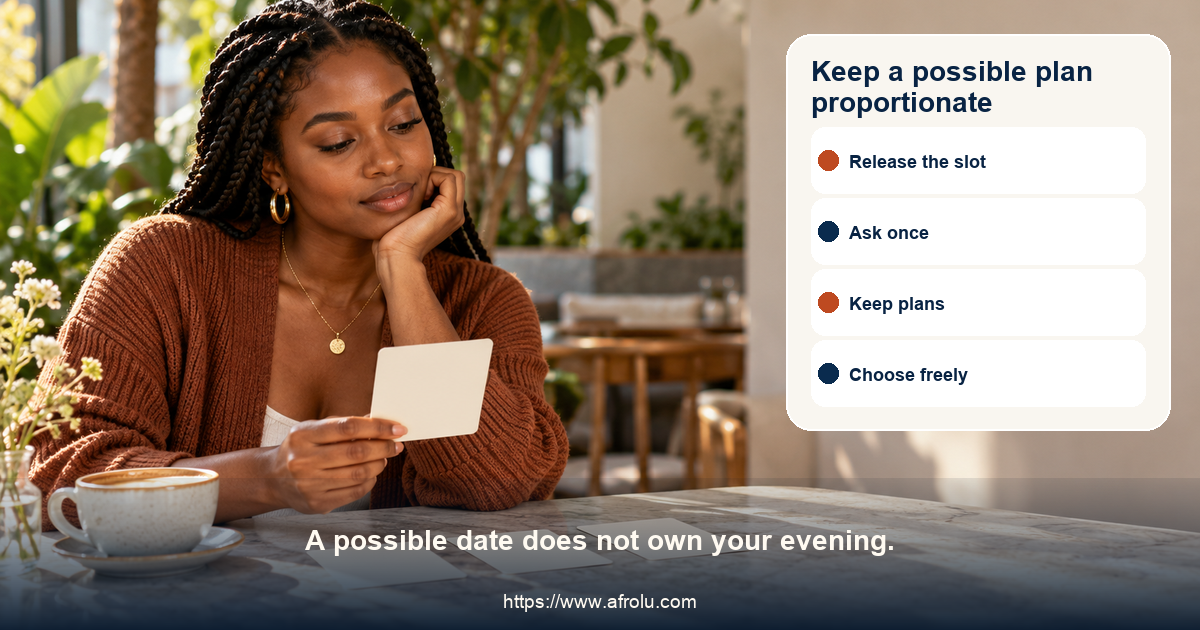
A possible date does not own your evening.
Written and edited by Grace Mutiso · Kenya Guides Editor
Do not let an unconfirmed casual invitation reserve your evening or make you audition for attention. Set a release point, ask one answerable question when the result changes your plan, and judge a return by the next arrangement rather than its intensity. Keep private information, money, codes, and consent under your control. When contact becomes coercive, persistent, financially manipulative, or frightening, reduce access and use appropriate support.
Dating behaviour · Late Entrants
Is this a plan that simply needs confirmation, an honest mismatch, a casual pace difference, a return worth a smaller arrangement, a request for access or money, unwanted pursuit, or conduct that makes me feel unsafe?
Ghosting in casual dating is reduced or ended contact without a direct closing conversation. It can sting even when no one promised a relationship. The useful distinction is between an open plan, an honest mismatch, a different pace, observable repair, pressure for access, financial manipulation, unwanted pursuit, and conduct that removes your freedom to choose.
Miriam has started dating again because she is curious, not because she wants every invitation to become a commitment. A person suggests a Friday drink but never confirms. She makes a dinner plan with a friend instead. When a warm message arrives late asking her to come over, Miriam says she only meets publicly for now and decides that any return will need a time she can freely accept or decline.
casual clarity · adult capacity
Miriam keeps one quiet invitation in proportion to the life she already values
This guide separates a missing confirmation from a casual mismatch, a returning message, access pressure, financial requests, unwanted pursuit, and fear—without asking an adult to become detached or endlessly available.
Set a release point, ask once when useful, choose small voluntary plans, make access gradual, read returns through conduct, and change to protection when the pattern removes choice.
Release the slot
A possible date does not reserve an evening you have not mutually planned.
Ask once
A narrow question can replace a week of private speculation.
Share gradually
Early interest does not need your routine, systems, or location.
Change the task
Pressure and fear need protection, not a better dating script.
casual dating · adult capacity
a relaxed connection can still be easy to read
Starting or returning to dating later in adult life does not make every promising conversation a rare opportunity. You may have chosen to date after a long pause, alongside a full social life, or with a clearer sense of what makes a connection enjoyable. When someone goes quiet before a casual plan is settled, it can stir an old scarcity story: perhaps you should be more available, more forgiving, or less direct. Begin with the observable fact instead. The plan has not been confirmed.
Treat the unconfirmed slot as yours until two people make it mutual. Pick a point at which you will stop checking your phone and make the evening pleasant on its own terms. That might mean seeing a friend, cooking something you like, reading, taking a walk, or simply resting without treating the time as a failed date. Releasing a plan is not punishment or theatre. It is a practical refusal to place your life in a waiting room.
Casual can describe the level of commitment without describing the level of respect. One person may want occasional dates, another may prefer a slow start, and another may realise they are not interested. Each outcome can be handled plainly. The difficulty is not a limited connection; it is a pattern where one adult repeatedly keeps the other person available without confirming, changing, or ending anything. A clear rhythm lets you decide whether the lightness still feels good.
Before sending a follow-up, ask what information would materially change your next move. If an answer affects whether you leave now or keep an evening free, one calm question is reasonable. If you already know you will use the time well either way, you may not need to chase an explanation. Silence can be disappointing without becoming an assignment to decode another adult's motives.
expectations · honest ease
use ordinary language before vagueness becomes a pattern
The word casual carries different hopes. For some people it means no pressure to merge routines; for others it means space to meet occasionally without future promises. Those preferences can coexist with direct plans, considerate changes, and a clear no. Trouble starts when casual is used as a licence for last-minute access, unexplained disappearances, or pressure to remain responsive while the other person avoids every practical question.
Try defining your own baseline rather than asking another person to guess it. You might prefer a daytime date, a message before a planned evening, a public first meeting, or no expectation that either person will be reachable all day. These are not rules you impose on a stranger. They are the conditions that help you decide whether a casual connection is compatible with the life you already have.
A person who wants something lighter may still be capable of saying, “This week is not workable,” “I can meet next Tuesday,” or “I do not think this is the right fit.” Notice whether their conduct gives you enough material to choose. When every invitation is provisional and every change arrives after you have rearranged your day, the issue is not that you want too much; it is that the arrangement lacks mutual care.
You can revise a casual agreement as you learn. Perhaps you discover that spontaneous invitations exhaust you, that a slower pace feels better, or that you prefer contact that does not spill into your private routine. Updating a preference is not a betrayal of being relaxed. It is how adults let real experience, rather than an appealing label, guide the next plan.
silence · one clear check
one useful question can replace a week of private speculation
If you decide to message after a quiet stretch, keep the purpose narrow. “Are we still on for Thursday?” or “Would you like to choose another day?” gives the other person a simple opening to confirm, decline, or change the arrangement. It also gives you a clean stopping point. A message becomes less useful when it tries to contain every feeling, possibility, and fear created by the silence.
Read the response by its practical effect. A sincere apology can be welcome, but it does not confirm a date by itself. A new plan becomes meaningful when it includes a time, a setting that works for you, and room for you to say no. If the reply stays vague, shifts responsibility back to you, or arrives only when the original occasion has passed, you have enough information to release the slot without turning the exchange into a hearing.
Avoid converting clarity into a test of your worth. Asking once does not mean you are demanding, and choosing not to ask does not make you detached. The stronger question is whether the next contact leaves you calmer and more able to choose. A connection that repeatedly turns simple coordination into emotional labour may be too costly, however enjoyable the earlier messages were.
A person can decline a date or lose interest without becoming a villain. You can also decide that the way they handled the change does not fit you. That distinction matters because it permits a clear boundary without pretending to diagnose intent. Casual dating improves when you judge the available pattern, make a proportionate choice, and leave enough room for both adults to move freely.

One clear line can be enough.
return after ghosting · earned access
a warm message after silence is an option, not a reset button
A returning person may offer humour, tenderness, a difficult explanation, or a promise that life became unexpectedly busy. Any of those details may be sincere. You do not need to settle that question immediately. Instead, notice whether they can acknowledge the missed plan and participate in a new arrangement that is easy for you to accept, decline, or modify.
If you remain interested, choose an experiment that matches your actual appetite: a brief call at a time you nominate, a simple public lunch, or a message exchange that ends when you need it to. The aim is not to make them prove themselves under pressure. It is to give conduct a chance to speak at a scale that does not consume your whole weekend or private life.
Do not compensate for their absence by supplying more access. An apology does not require your home address, private number, intimate images, detailed routine, account information, or an immediate late-night meeting. Trust has more room to grow when disclosure follows consistent behaviour rather than an anxious attempt to make a returning connection feel secure quickly.
You may also decide that the earlier quietness changed your interest. A closing line can be simple: “I’m not reopening this conversation.” It does not need an argument, a verdict, or a performance of forgiveness. An adult can wish someone well and still choose a dating rhythm that does not require repeated recovery from the same uncertainty.
privacy · consent · independent movement
a casual date does not need a shortcut into your private life
New conversations often make ordinary details feel harmless: where you spend weekends, which places you visit, who you know, what your social profile shows, or when you are usually alone. Pause before offering information that makes your life easier to locate or enter. The only details a casual plan needs are the ones required for that plan. Everything else can remain gradual while you learn whether the person respects a boundary.
Choose meetings that preserve your ability to change your mind. A public location, timing you control, and your own way home can make it easier to stay present rather than manage an uncomfortable situation. A previous conversation, a gift, a drink, an apology, or an earlier date does not purchase more time, touch, images, a private location, or access to your devices. Consent belongs to the present moment.
Be especially alert when a return after silence comes with a request to move channels, prove where you are, share a live location, send intimate material, or keep the interaction secret. You can decline without proving that the other person has bad intentions. The fact that a request narrows your freedom to choose what you share is enough reason to keep the answer short and protect your access.
If pressure continues, use the tools that reduce it. That can mean muting, blocking, reporting, keeping material only when it is safe to do so, or telling someone you trust what is happening. You do not need to arrange a private conversation for closure just because another adult insists they deserve one. A boundary can be complete before it is understood or welcomed.
safety · proportional action
ordinary disappointment, financial pressure, and fear belong in different categories
An unanswered message, a changed mind, or a date that never settles can be disappointing without creating a safety problem. You may let the thread fade, ask once, or decide that the mismatch is enough. Keeping those possibilities proportionate preserves your energy and makes it easier to recognise when conduct moves beyond ordinary uncertainty into something that takes away choice.
Keep money and verification outside a new connection. Do not act as a lender, recipient, investor, document sender, code-holder, payment route, or emergency contact for someone you are dating. A compelling crisis can be real and still not make you the person who should solve it. If you choose to check a claim, use a bank, service provider, or official source rather than the person asking you to act quickly.
When someone uses new accounts after a block, contacts people around you, threatens, blackmails, monitors, pressures you for sexual material, or makes you afraid, stop treating the situation as a casual dating question. Restrict their access, get support from a trusted person, and use platform, specialist, or emergency help according to what is safest in your circumstances. Safety does not depend on winning a conversation.
Protecting yourself is not an accusation about another person's hidden character. It is a decision about what you will allow near your time, private life, money, and body. You can take a protective step because a pattern has become costly or frightening, even if you cannot explain every motive behind it. Your comfort and ability to leave are enough grounds for action.

Name the category before acting.
next step · self-directed dating
let this quiet thread clarify the kind of casual dating you actually enjoy
If the conversation remains quiet, let your next action belong to you. Archive the chat, release the plan, and spend the reclaimed time somewhere that leaves you more settled. You do not have to manufacture a final exchange in order to move on. An unmade date can remain a small disappointment rather than becoming a story about your future chances or your capacity to connect.
Choose one lesson that is specific enough to use. You might decide to ask for plans earlier, keep first meetings shorter, avoid late-night pivots, separate dating from private accounts, or treat repeated vagueness as information sooner. These are not penalties for having been interested. They are design choices that make the next connection easier to assess and easier to leave if it stops feeling mutual.
Keep casual dating in proportion to the rest of your life. Continue saying yes to friendship, rest, curiosity, work, and the ordinary pleasures that do not need a match's reply to be meaningful. A compatible connection should have room beside those things. It should not require you to shrink a full life into a sequence of waiting periods.
Where there is pressure, fear, persistent pursuit, financial manipulation, threats, or coercion, make protection the next step instead of more dating analysis. You can reduce contact without offering a final meeting or a more persuasive explanation. The right to end an early connection belongs to you, whether it was brief, warm, confusing, or unfinished.

Choose the move that restores your time.
Eight real situations where casual clarity protects adult capacity
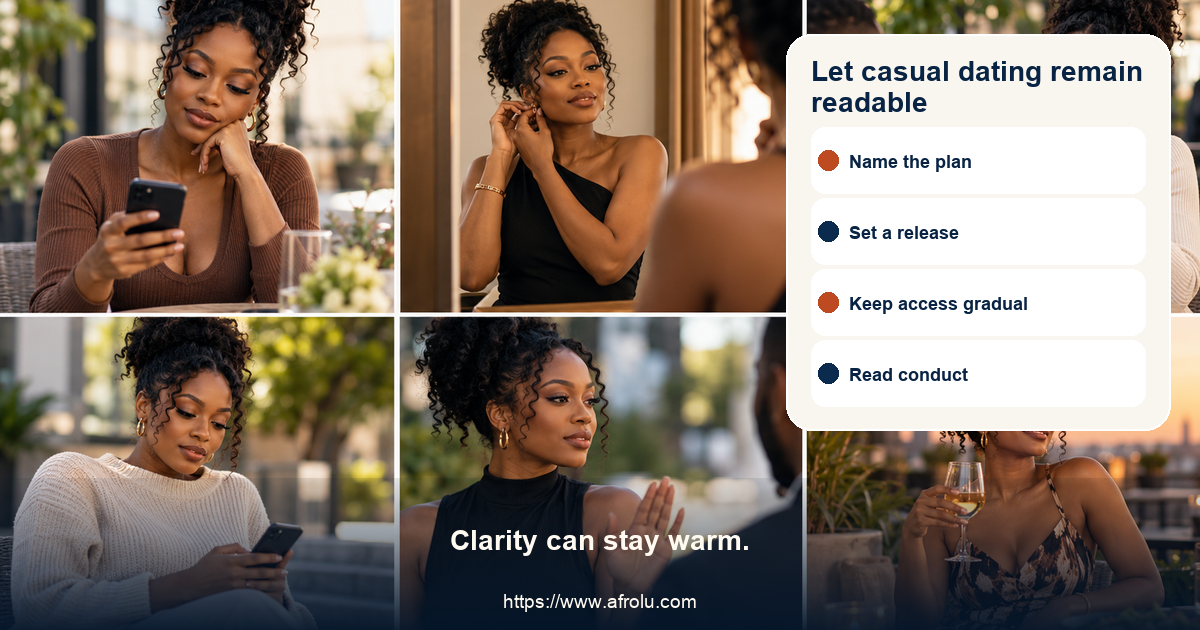
A casual plan never becomes a time
A person suggests meeting after work but leaves the arrangement open until the evening is already half gone.
Choose a release point and use the evening without waiting for a late rescue message.Casual is used to avoid every practical question
A match calls any request for confirmation too serious while expecting instant replies and flexible access.
State the pace you enjoy and notice whether they can meet it without turning clarity into conflict.One message would change your plan
You need to know whether to leave for a public date or make a different evening plan.
Ask one answerable question and let no answer become permission to proceed with your own plan.An apology arrives with no next arrangement
Someone sends warmth after a quiet week but does not name a time, setting, or change in conduct.
Receive the context without treating it as a confirmed restart.A public plan becomes a late private invitation
A returning match frames a change of location as proof that you are relaxed and interested.
Keep the setting you chose, offer an alternative only if you want one, or decline.Dating becomes a route to money or a code
A new connection introduces a crisis that needs funds, documents, verification, or account access.
Keep financial and digital systems outside the connection and verify independently if needed.A clear no becomes a debate
The person keeps explaining why you should meet, share more, or give them another chance.
Repeat the limit once if safe, then reduce channels rather than litigating your decision.A closed conversation reappears elsewhere
After you stop responding, the person tries another account or contacts someone in your wider circle.
Protect evidence only if safe, restrict access, and seek support appropriate to the conduct.Fourteen observable signs that a casual rhythm is workable, vague, pressuring, or unsafe
They can confirm a modest plan, change it early, or release it without expecting you to stay on standby.
They understand that casual interest and direct communication can coexist.
They accept a public setting, a shorter date, a slower pace, or a changed mind without bargaining.
They do not treat a late invitation as proof that you should rearrange your life immediately.
They can answer a simple question about a plan without making you defend why you asked.
They return after silence with a usable next arrangement rather than a demand for instant warmth.
They do not ask for your routine, location, devices, private accounts, or social network as evidence of trust.
They keep money, codes, documents, payment issues, and investment talk outside new dating.
They do not treat a past conversation, gift, date, or flirtation as permission for a new request.
They can hear a no without turning it into a moral argument or a test of your character.
They do not bypass a limit through alternate accounts, mutual contacts, or repeated messages.
They do not press for secrecy, intimate material, a private location, or a change of channel.
They communicate in a way that leaves you more able to make plans, not less.
They never use threats, humiliation, surveillance, financial pressure, or fear to keep access.
A proportional decision map for silence, returns, access, money, and safety
| Situation | What it may mean | What to do next |
|---|---|---|
| A plan is not confirmed | The invitation is still only a possibility. | Set a release time and make an independent plan. |
| You need an answer to leave home | One direct question is practical coordination. | Ask once, then act on the answer or silence. |
| The reply is warm but vague | Interest may be present without a usable arrangement. | Ask for a time or let the thread remain light and unclaimed. |
| A return arrives after silence | Context is not the same as repair. | Choose a small, reversible next step only if you want one. |
| A person rejects public or bounded plans | Their preferred access may not fit your comfort. | Keep your boundary and decline the escalation. |
| They request money or verification | The connection is being asked to carry a financial risk. | Keep systems separate and use independent sources. |
| They want proof of location or availability | A request may be reducing your freedom to choose. | Decline the request and share less, not more. |
| They argue after a no | The issue has moved from disappointment to pressure. | End the debate and reduce channels. |
| They appear through another account | Your stated limit is not being respected. | Block, document only if safe, and get support. |
| You feel afraid or controlled | This is no longer a casual dating puzzle. | Prioritise safety, support, and urgent help where needed. |
Twelve complete lines for a plan, a return, privacy, consent, and an ending
“Are we still meeting at six, or should I make other plans?”
“I have not heard back, so I am using the evening differently.”
“I enjoy casual dating when plans are simple and clearly agreed.”
“Thanks for explaining. I would only restart with a small, planned meet-up.”
“I am meeting in public for now.”
“I am not sharing that detail yet.”
“I do not handle money, codes, or account issues in a new connection.”
“I am not sending that.”
“That change does not work for me tonight.”
“I do not think this rhythm is a fit for me.”
“Do not contact me again.”
“I am stepping away from this and will use support if contact continues.”
Know the difference
A quiet gap is not the same as a pattern that narrows your choices
A date is not confirmed, a person changes their mind, or a conversation fades without a threat or request for access.
A person seeks money, private access, proof of location, repeated contact, leverage, or control after you set a limit.
Use a proportionate answer for disappointment and a protective answer for conduct that reduces freedom.

Different patterns call for different moves.
Keep an unconfirmed date distinct from patterns that reduce choice
| Type or dimension | What it describes | Best next question |
|---|---|---|
| Unconfirmed plan | No mutual time has been settled. | Release the slot at the point you chose. |
| Honest mismatch | Someone names disinterest or changed capacity. | Accept the information and move on. |
| Different casual pace | Both people want contact but prefer different rhythms. | State your preference and see whether it fits. |
| Vague return | Warmth returns without a practical change. | Ask for a usable arrangement or keep distance. |
| Observable repair | A person names the miss and follows a smaller agreement. | Consider fresh conduct at a pace you choose. |
| Privacy pressure | Access is requested before trust is earned. | Keep information and channels limited. |
| Financial request | Romance is used as a route to money or systems. | Do not transact; verify through official routes. |
| Unwanted pursuit | A stated limit is bypassed or ignored. | Reduce access and preserve safety options. |
| Fear or coercion | Contact leaves you unsafe or unable to exit freely. | Seek support and urgent help as appropriate. |
A simple plan you can use today
Availability is not interest
A person can sound interested while still failing to make a workable arrangement.
Casual needs boundaries
A lighter connection works better when its timing and access remain voluntary.
One check is enough
A clear question can replace repeated attempts to make silence explain itself.
Returns need new conduct
An apology matters most when the next plan becomes more reliable.
Privacy protects choice
Gradual disclosure keeps early interest from becoming unearned access.
Safety changes the task
Pressure, financial requests, and fear need protection rather than better chemistry.
Questions organised by purpose and depth
Choose a few prompts that fit the moment. This is a reference library, not a list to complete.
Release the slot
Keep a possible date from taking over a real evening.
- When will I stop waiting?
- What will I do if no answer comes?
- What am I protecting by releasing this plan?
Define casual
Choose the version of low-pressure dating you can genuinely enjoy.
- What does a workable small plan look like?
- What pace feels mutual?
- What would make an invitation too vague?
Read the return
Let conduct, not intensity, guide a restart.
- What changed in the next arrangement?
- What access am I not restoring yet?
- Would a smaller plan be enough information?
Choose protection
Separate disappointment from conduct that reduces freedom.
- Has someone asked for systems, money, secrecy, or proof?
- Has a no been respected?
- Who can support me if the pattern escalates?
What deserves a closer look
Release points are not games
A release point prevents an unconfirmed plan from absorbing every other possibility in your day.
Evidence limit: It does not force another person to reply.
Casual can be precise
Small agreements about timing, setting, and pace can preserve the ease people want from casual dating.
Evidence limit: It does not create commitment by itself.
One answerable question is enough
A narrow check-in gives you current information without assigning a stranger the task of calming every uncertainty.
Evidence limit: It cannot reveal every motive.
A return needs a different next move
A smaller arrangement lets observed conduct matter more than a persuasive explanation.
Evidence limit: It does not guarantee future consistency.
Gradual access is practical
Keeping routines, systems, and private channels separate makes early dating easier to leave if needed.
Evidence limit: It is not proof that anyone is dangerous.
Protection is a category change
Persistent pursuit, threats, financial manipulation, and fear should shift the response away from dating advice.
Evidence limit: Urgent local circumstances determine the safest support.
Shortcuts that turn an open invitation into access, pressure, or waiting
Holding every evening open
Standby time turns a possible date into an unpaid claim on your life.
Calling vagueness relaxed
A label can hide whether anyone is actually coordinating with care.
Writing a long follow-up
A complex message can obscure the simple information you need.
Treating an apology as a plan
Context does not replace a specific, voluntary next arrangement.
Overexplaining privacy
You do not need a persuasive case in order to share less.
Meeting for closure under pressure
A person does not gain private access because they dislike your boundary.
Use one focused resource for boundaries, a quiet ending, or a better first-date rhythm
Choose the resource that fits the next decision in front of you. A guide can help you name a preference, but it cannot promise another adult's interest or conduct.
Explore the guide library
Show more related guides
Continue with Afrolu
Show more Afrolu guides
Sources used for this guide
Afrolu reviewed these health, research, safety, or public guidance resources while editing this page. They support the behaviour and safety guidance; they do not diagnose any individual described by a reader.
Questions about ghosting and casual dating for latecomers
Should I ask why someone ghosted a casual plan?
Ask only if the answer changes your next choice. A question about whether they want to make another plan is often more useful than an investigation.
Is it unreasonable to want a confirmed time for casual dating?
No. Casual describes commitment, not your obligation to remain on standby or accept vague arrangements.
What if I do not want to message again?
You can release the plan and let the quiet thread end. No further message is a valid adult decision.
Can I accept an apology without restarting?
Yes. You can acknowledge context while deciding that the earlier rhythm no longer suits you.
How small should a restart be?
Choose something that protects your time and access, such as a brief call or a short public plan you can easily leave.
Do I need to explain why I prefer public early dates?
No. A present preference for a public setting is enough.
What if someone asks for money, a code, or help with an account?
Keep money, documents, verification, and account access outside a new connection and use independent official routes if you need information.
Does ghosting always mean danger?
No. A quiet ending can be painful without being unsafe. Repeated unwanted contact, coercion, threats, financial pressure, and fear are different categories.
Can I block someone after I set a limit?
Yes. You can reduce access when contact is unwanted or when a boundary is not respected.
How do I stay open after a disappointing thread?
Carry forward one useful preference instead of turning a single experience into a rule against connection.
One thing to do now
Choose the next move that returns your time and attention to you
Choose the smallest next action that protects your time, privacy, independent movement, current consent, money, support network, and ability to end contact without negotiating your comfort.