Two-lantern re-entry map · no age clock · Nairobi safety
Return to Nairobi Dating After Heartbreak Without an Age Clock
A safety-first Nairobi guide for self-defined late-comers after heartbreak: reject age clocks, check present willingness, protect privacy, and plan exits.
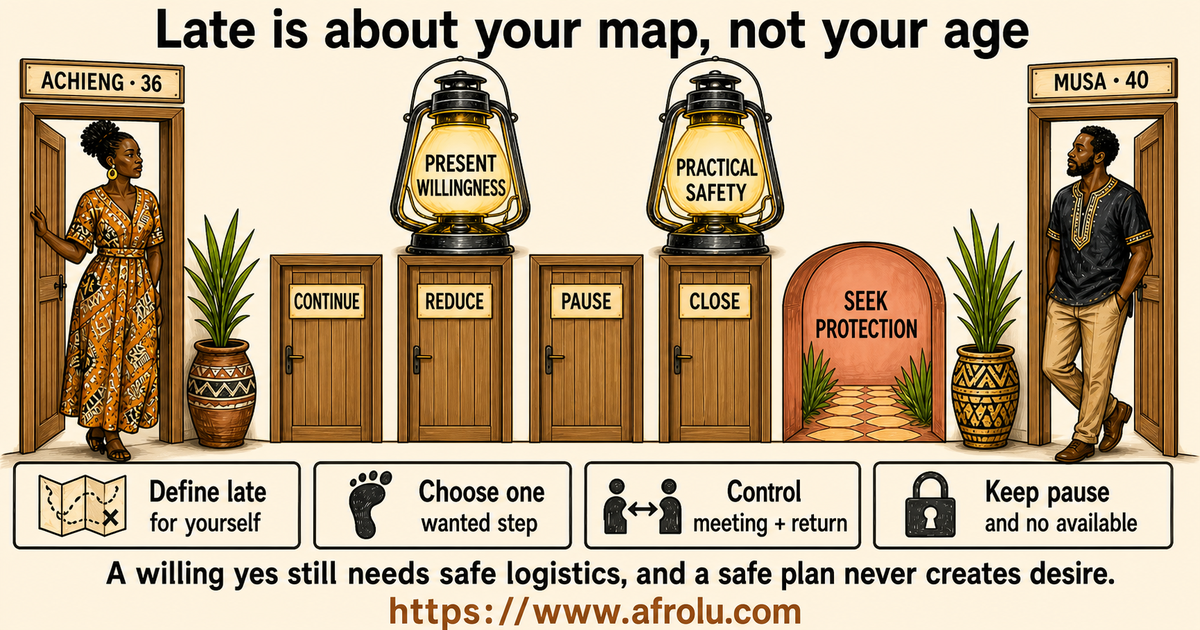
Later than your old plan is not late for your present choice.
Written and edited by Adwoa Boateng · Dating Safety Editor
Define late only against your own old expectation, then light two questions separately: do I want this specific step now, and are its privacy, public setting, transport, money, consent and exit workable? Continue once, reduce, redesign, pause or close without proving recovery or reserving a future. Direct fraud, threats, tracking, doxing, hacking, image abuse, coercion or contact after no bypass ordinary dating review.
Starting over · Late Entrants
How can a self-defined late-comer return to dating after heartbreak in Nairobi without obeying an age stereotype, proving complete recovery or trading away practical safety to make up for imagined lost time?
A late-comer is any adult who feels a return to dating is happening later than their own imagined plan; it is not an age bracket, deficit, experience level or relationship type. Heartbreak has no universal expiry. A present yes may be small and mixed with memory. Practical safety remains a separate choice involving information, setting, transport, money, consent, support and a usable exit.
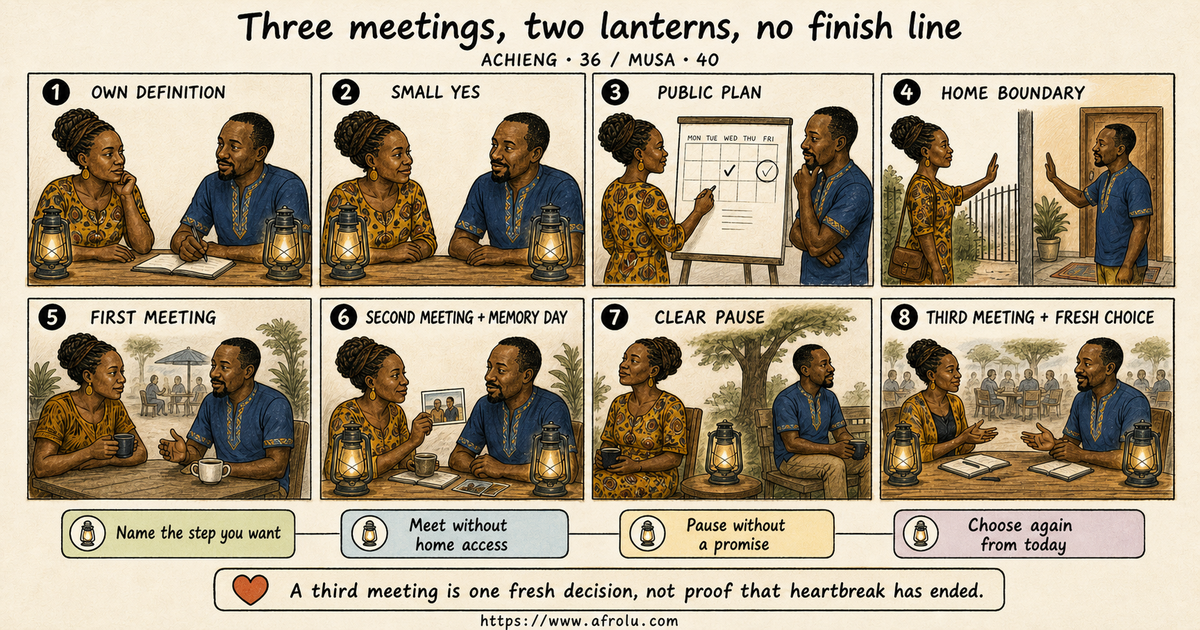
Achieng, 36, and Musa, 40, are fictional Black Kenyan adults in Nairobi. Achieng defines late against her own former plan, chooses two short public meetings, keeps home and return private, then asks for a pause when a memory-heavy day reduces capacity. The pause is respected. Later she proposes one fresh meeting, which proves only that both lanterns support that day.
Adwoa's two-lantern Nairobi re-entry room
Retire the age clock before choosing which door opens today
This route treats late-comer as self-defined timing, heartbreak as varied experience and safety as a practical independent decision.
Light present willingness, light practical safety, reduce the step when needed and keep care, protection, pause and closure distinct.
Present willingness
Ask whether this one action is genuinely wanted now.
Practical safety
Control information, public logistics, money, consent and return.
Complete pause
Create no secret loyalty period or promised restart.
Direct protection
Route fraud, threats and defeated no outside ordinary review.
Retire the public clock
Late-comer means later than your own old expectation, not older or behind
A late-comer here is an adult who feels their return to dating is happening later than they once pictured. The feeling might follow a long relationship, grief, caregiving, migration, study, work, health, money pressure, faith decisions or a period when dating simply was not wanted. It is self-description, not a demographic category, and it carries no minimum age.
The term does not mean inexperienced, desperate, lonely, conservative, technically confused, healed, unhealed or ready for commitment. A 28-year-old may feel late relative to a private plan; a 58-year-old may feel exactly on time and reject the label. Editorially, the word matters only because outside clocks and lost-time pressure can distort a present choice.
Heartbreak also has no universal finish line. Sadness, anger, relief, affection for a former partner or an unexpected memory can coexist with a clear yes, no or maybe about one new interaction. Conversely, feeling calm does not create an obligation to date. Ask what this particular step asks of today's attention, privacy, body, money and safety rather than declaring the whole person ready.
Popular re-entry advice often compresses readiness into a short quiz or asks whether somebody is fully past an ending. That binary leaves important questions unanswered. This guide instead offers bounded decisions, transparent research limits, Nairobi logistics and safety routes, because mixed feelings can be ordinary while consent and access still need precise present-tense answers.
Light two questions separately
Present willingness and practical safety are independent, not one readiness score
PRESENT WILLINGNESS asks whether the adult wants this specific action now: reading messages, having a short call, meeting in daylight or accepting another invitation. The answer can differ by action and by day. Curiosity need not prove permanent openness. A no today need not reserve a future yes. Each choice becomes complete without explaining the whole heartbreak history.
PRACTICAL SAFETY asks whether information, transport, setting, money, consent and exit remain controlled. Check consequential identity or venue facts independently and proportionately; never outsource safety to chemistry or a profile badge. A public meeting, shared friend or video call may change limited uncertainties but cannot certify every claim, predict conduct or replace the ability to leave.
When both lanterns support one step, continue only that far. When willingness exists but logistics do not, redesign or decline. When the logistics are sound but desire is absent, stop. When feelings are mixed, reduce the action rather than issuing a global verdict. No combination obliges a date, and another adult may freely decide the smaller offer does not suit them.
Direct danger uses a separate corridor. Threats, cyberstalking, hacking, coerced images, doxing, impersonation, money deception, physical intimidation or contact after a clear no are not proof that heartbreak made someone choose badly. Secure accounts, location, money and evidence where safe, then use current Kenyan platform, support, legal or emergency routes matched to urgency.
Achieng chooses again after the pause
One fictional return keeps interest, memory and safety in separate hands
Achieng calls herself a late-comer because a painful ending and several years outside dating moved her beyond a future she once imagined. Her age does not create the label. When Musa suggests meeting, she notices genuine curiosity alongside a wish to protect the home and routines she rebuilt. She chooses a forty-minute daytime tea rather than a full-evening test.
Musa offers to collect her. Achieng says she does not share her home address in early dating and will meet at the public venue using her own transport. Musa accepts without asking for a live pin. They each check the venue and return route, tell whomever they choose, meet, and leave separately. That respectful response supports one interaction, not a safety guarantee.
After their second meeting, a familiar song brings a difficult day. Achieng does not decide she has failed recovery or ask Musa to treat the feeling. She says she wants a pause and is not reserving a restart date. Musa respects the stop. Achieng leans on an existing friend and ordinary routines, with qualified care available if functioning becomes persistently disrupted.
Two weeks later, Achieng wants another short meeting and asks afresh. Musa is still interested, so they make a new public plan. The third date is not a reward for healing and does not promise a relationship. The meaningful result is smaller: both lanterns support this particular meeting, the earlier pause stayed complete, and either adult can choose differently afterward.
Read sixteen lights without forcing sunrise
Separate curiosity, scope, memory, disclosure, logistics, money, consent and exit
CURIOSITY supports one step when interest concerns the present person rather than competition with an ex, social pressure or proof of worth. SCOPE supports it when exploratory contact, exclusivity and pace are named only as far as needed. Mixed motives are common; the useful response is a smaller honest offer, not a claim that one motive reveals the whole adult.
MEMORY can enter without taking control. A place or phrase may evoke the former relationship, and the adult can still choose. DISCLOSURE stays proportionate when the new date receives only context that shapes today's interaction. Intimate history, accusations, legal records, messages and a former partner's personal information are not an entry fee for empathy or evidence of authenticity.
MEETING safety grows through a checked public setting, controlled transport, charged phone, optional trusted-contact plan and independent return. MONEY remains separate: no fare, emergency, fee, investment, code or account access proves trust. Nairobi travel should be planned with current facts and a buffer, but live route surveillance is not the price of accommodating congestion.
CONSENT remains unbundled across messages, images, calls, touch, sex, exclusivity, home, transport and future dates. EXIT AND SUPPORT work when slow down, pause and no are respected and the adult retains people and resources beyond the new match. If a boundary is defeated through accounts, workplaces, relatives or physical access, stop ordinary review and seek protection.

Feelings may be mixed; choices and boundaries can still be clear.
Plan the return before the greeting
Use current Nairobi facts, minimal data and a route each adult controls
Nairobi County's July 2026 rapid-transit announcement still describes congestion as a problem while proposed infrastructure moves through implementation. That does not forecast one trip. It supports leaving a realistic time buffer, confirming after independently checking current conditions and making sure a delay does not trap either person after the planned ending. Each adult controls what live location, if any, is shared.
Choose an operating public venue both people can identify without exposing a home, workplace or routine. Decide duration, arrival and return before meeting. Carry personal fare and a working phone, and keep enough independence to leave without the other person's car or money. A trusted person may know the plan, but community awareness is optional and does not verify the date.
The Office of the Data Protection Commissioner explains Kenyan data-subject rights and principles including lawful, transparent, purpose-limited processing and data minimisation. Its page cannot resolve a private incident. Applied editorially, the practical lesson is narrow: disclose only what this stage needs, and do not exchange IDs, addresses, photographs, account access or intimate records as trust theatre.
Kenya's State Department Digital Safe Space identifies doxing, cyberstalking, hacking, image abuse and cross-platform harassment and describes reporting, account security, evidence and referral options. Australian eSafety guidance separately supports public meetings, trusted contacts, privacy and platform reporting, but its law and services are not Kenyan. Immediate danger needs current local emergency help, not an educational checklist.
Give context without surrendering the keyring
Twelve scripts keep timing, home, transport, money, consent and pause answerable
Define the label before someone else fills it with age: 'Late means later than I expected, not a reason to hurry.' That sentence shares the relevant pressure without explaining every year. Follow with scope: exploratory, exclusive, casual or undecided. Another adult may accept the offered pace or say it does not fit. That answer remains complete.
Keep home and transport independent: 'I keep my home address private; let us meet in public.' Then, 'I will travel there and back independently.' A respectful response is information for one plan. Resistance, guilt or attempts to discover the address are different facts that may end the route. No trust performance is owed.
Money and consent need their own lines. Decline fares, emergencies, fees, codes, documents and investments without debating whether a person is fraudulent. State that a meeting does not decide touch, images, sex, exclusivity, home access or another date. Past betrayal can explain why a boundary matters, but no history is required before a current no becomes valid.
Pause without creating an emotional waiting room: 'I am pausing romantic contact without a restart date.' If interest returns, ask again rather than treating the pause as an appointment. Closure can be equally brief. When an ending is bypassed, do not keep polishing the sentence; protect channels and use appropriate current support. Silence may be safest.

You can give context without surrendering the case file.
Leave by the door the facts require
Eight equal outcomes keep a self-defined late return free from performance
CONTINUE ONCE means both lanterns support one more specific interaction, not a whole relationship. REDUCE THE STEP means a call replaces dinner or forty minutes replaces an evening. REDESIGN LOGISTICS changes place, transport, information or timing without negotiating away consent. Each route remains optional, and the other adult may decide the revised offer does not fit.
REVIEW LATER means no present romantic reservation; if both people happen to want contact later, they ask anew. PAUSE creates space with no loyalty claim. CLOSE ends participation because interest, capacity, rhythm or fit is absent. None says the former relationship won, that age closed a door or that the adult will never date again.
SEEK CARE fits severe or persistent distress or disruption to sleep, appetite, concentration, work, relationships or ordinary tasks when qualified help is wanted. It is not a punishment for feeling sad and a new date is not treatment. SEEK PROTECTION fits fraud, threats, tracking, doxing, hacking, image abuse, coercion, physical danger or contact that defeats no.
The late-comer principle is simple enough to keep: retire the public clock, define late only for yourself and choose from the present. Carry no proof that you are healed, modern, young enough, experienced enough or brave enough. Keep willingness and practical safety separate, give each yes a boundary, and let each no return the keys to its owner.

Your present route does not owe your old calendar an ending.
Eight moments when an old clock and a present choice point elsewhere
Friends say it is time to get back out there
Outside encouragement becomes a deadline even though the adult does not want this week's invitation.
Decline the step without defending an age or recovery status.A short daytime tea feels interesting
Willingness exists for one bounded meeting, not necessarily a serious relationship or full evening.
Plan only that meeting with an independent return.A song brings sadness after a good date
An emotion appears without automatically cancelling consent, capacity or every future choice.
Reduce, pause or continue from today's needs rather than a healed verdict.A new match wants the complete breakup story
Relevant context has become pressure for intimate records, messages or allegations.
Share only what shapes the present offer or decline.A date offers convenience by collecting you
The offer would expose an early home address and make return dependent on the same person.
Meet at the public venue and keep transport separate.The home and ride limits are accepted
One response protects choice and supports one plan, but it cannot certify future conduct.
Credit the response at its true scale and keep other checks.A meeting suddenly needs your fare or emergency transfer
Romantic urgency has opened a financial channel unrelated to heartbreak readiness.
Send nothing and use verified provider or reporting help if needed.New accounts and relatives are used after no
The issue is no longer ordinary re-entry uncertainty because the exit does not work.
Secure information, preserve useful evidence and seek protection.Sixteen lights across willingness, memory, disclosure, Nairobi logistics and exit
Late-comer is defined against one adult's own expectation, never an age bracket.
Curiosity concerns the present person rather than a demand to prove recovery.
One wanted action is separated from a verdict about all dating.
Scope and pace are named without promising a faster future.
Mixed feelings can be noticed without being assigned to the new date to fix.
Breakup context is shared only as far as the present interaction needs it.
Former-partner messages, allegations and records remain purpose-limited and private.
A Nairobi venue and route are checked through current independent information.
Each adult controls home address, fare, phone, arrival and return.
A public meeting is not treated as proof of identity or a safety certificate.
Money, codes, documents and account access never become a trust exercise.
Images, touch, sex, exclusivity, home and another date remain separate choices.
Pause creates no secret loyalty period or guaranteed restart.
Closure is accepted across accounts, friends, relatives and workplaces.
Qualified care remains available without making ordinary sadness a diagnosis.
Fraud, threats, tracking, doxing, hacking or defeated no move directly to protection.
Ten doorway questions without an age or healing score
| Situation | What it may mean | What to do next |
|---|---|---|
| Who defines late? | Fits: The adult describes their own changed plan. Needs review: Outside comparison is loud. Stop: Age is used as a deadline or deficit. | Return the word to personal meaning or drop it. |
| Is this step wanted now? | Fits: Curiosity supports one bounded action. Needs review: Motives are mixed. Stop: Fear or pressure is choosing for the adult. | Reduce, pause or decline without a global verdict. |
| Is scope honest? | Fits: Present pace and relationship direction are named. Needs review: One expectation needs words. Stop: A date is treated as proof of full readiness. | Offer only the present scope. |
| Is disclosure proportionate? | Fits: Only relevant context is shared. Needs review: One detail serves no current purpose. Stop: Private records or allegations are demanded. | Close the case file and restate the boundary. |
| Is the meeting independently checked? | Fits: Current venue and route facts are known. Needs review: One logistical fact remains open. Stop: Chemistry or a badge replaces verification. | Check proportionately or redesign. |
| Can each adult leave? | Fits: Fare, phone, arrival and return stay controlled. Needs review: One dependence needs separation. Stop: Home or transport access removes exit. | Meet there, travel separately or decline. |
| Are money and consent separate? | Fits: Every access choice remains voluntary. Needs review: One assumption needs correction. Stop: Funds, codes, images or touch are pressured. | Refuse and protect the relevant channel. |
| Can pause stay complete? | Fits: No loyalty or restart date is reserved. Needs review: One expectation lingers. Stop: Contact continues through other channels. | Restate once only if safe, then protect exit. |
| Does distress need care? | Fits: Ordinary life remains workable with chosen support. Needs review: Persistent disruption merits attention. Stop: Immediate health or safety concern is present. | Use qualified current help matched to need. |
| What is the strongest fact? | Fits: One safe wanted step remains. Needs review: A smaller route or pause fits. Stop: Fraud, coercion or danger changes the task. | Choose the matching doorway, never an average score. |
Twelve lines for timing, home, transport, consent, pause and closure
“Late means later than I expected, not a reason to hurry.”
“My last relationship ended painfully; I will share only what affects this date.”
“I want one short meeting and will decide afterward whether I want another.”
“I am exploring, not promising exclusivity, a serious path or a fixed timetable.”
“Let us each check the public venue and meet there during the agreed window.”
“I keep my home address private; let us meet in public.”
“I will travel there and back independently.”
“I keep fares, fees, codes, documents and investments outside new dating contact.”
“This meeting does not decide touch, images, sex, exclusivity, home or another date.”
“An old memory is present today; I want a shorter plan, not reassurance about recovery.”
“I am pausing romantic contact without a restart date.”
“I do not want to continue this connection, so I am ending romantic contact.”
Know the difference
A self-defined late return is about an old expectation; rebound dating is about the function of a new connection
An adult feels beyond their imagined timing and chooses present steps without age rules, recovery proof or pressure to accelerate.
A new connection may be carrying distraction, comparison, proof, retaliation or immediate replacement work; the label still cannot be inferred from timing alone.
Ask what this connection is being asked to do now; neither elapsed time nor age answers that question.

Use the nearest description to choose, never to predict a person.
Self-defined late return, possible rebound function and seven nearby states
| Type or dimension | What it describes | Best next question |
|---|---|---|
| Self-defined late-comer | The adult feels later than a personal plan, with no age boundary or required relationship intention. | Retire comparison and choose from today's willingness. |
| Cautious re-entry | Interest exists while disclosure, meetings and access expand in deliberately small units. | Respect the pace and keep logistics independently leaveable. |
| Ordinary heartbreak memory | Sadness, anger, relief or tenderness appears without deciding every present choice. | Notice it, then reduce, continue or pause as wanted. |
| Possible rebound function | A new connection may be assigned distraction, comparison, proof or replacement work. | Name the current scope and remove work the new person cannot own. |
| Pace mismatch | Both adults are clear, but one wants faster contact, disclosure or commitment. | Redesign once or close without age-based blame. |
| No current interest | The meeting may be safe and kind while desire is absent. | Decline; sound logistics never create consent. |
| Respectful closure | No ends contact without retaliation, monitoring or a reserved future. | Let the ending stand and return access. |
| Romance fraud | Affection or a meeting becomes a route to fares, emergencies, codes, documents or investment. | Keep money and credentials closed, then use the relevant provider or reporting route. |
| Unsafe control | Threats, tracking, doxing, coercion, hacking, image abuse or defeated no changes the problem. | Prioritise current local protection over another dating talk. |
Light willingness and practical safety separately before one new step
Define late personally
The word compares today with one adult's old expectation, never with an age group.
Light two separate lanterns
Present willingness and practical safety answer different questions.
Choose one action
A call or tea can be wanted without proving readiness for all dating.
Keep the case file closed
Share current context without former-partner records, allegations or intimate detail.
Plan the independent return
Check the public setting while each adult controls home, fare, phone and exit.
Match help to facts
Ordinary emotion, persistent impairment and direct danger require different responses.
Questions to define, light, protect and exit
Choose a few prompts that fit the moment. This is a reference library, not a list to complete.
Define
Remove age and outside clocks before choosing.
- What does late mean to me?
- Whose deadline is this?
- Do I want this step?
- What is not promised?
Light
Check willingness without a global recovery verdict.
- Call, meet or decline?
- How long?
- What scope fits?
- Would a smaller step help?
Protect
Plan the meeting and return as separate controlled choices.
- Which public setting?
- Who knows the plan?
- How do I arrive and leave?
- Which data stays private?
Exit
Match the doorway to the strongest fact.
- Continue once?
- Reduce or pause?
- Close?
- Care or protection?
What breakup research and current Nairobi safety sources can support
German panel data examines varied emotions after relationship dissolution
The analysis supports treating relief, anger, guilt, sadness and general adjustment as different outcomes influenced by multiple circumstances rather than one recovery state.
Evidence limit: The pooled observational data covered 3,734 separations among 2,709 people aged 18–48 in Germany; regressions do not prescribe an individual timeline, establish cause or represent Nairobi.
Two surveys compare recently separated young adults who were single or in a new relationship
The findings complicate the claim that dating again soon is automatically harmful, supporting caution about rebound assumptions based on timing alone.
Evidence limit: Both studies were anonymous online cross-sectional surveys of adults aged 18–25; the PubMed abstract lists Canadian author affiliations but not sample geography, and the design cannot establish cause or define a late-comer's choice.
A County announcement approves Phase I of a rapid-transit framework
The official statement supports planning with a city travel buffer and verifying present route facts instead of promising precise arrival.
Evidence limit: It announces implementation rather than completed infrastructure and cannot predict one person's route, safety, cost or travel time.
The regulator outlines processing principles and data-subject rights
The page supports a general data-minimisation rule; applied editorially, that means limiting early disclosure of addresses, location, photographs, identifiers, relationship records and account information.
Evidence limit: It is a general Kenyan regulatory overview, not personalised legal advice, an incident finding or proof that a private person or platform violated the Act.
The State Department's Digital Safe Space describes technology-facilitated abuse and reporting
The portal supports separating doxing, cyberstalking, hacking, image abuse and cross-platform harassment from ordinary dating uncertainty.
Evidence limit: It is a Kenyan national information and support portal, not a safety, response, prosecution or recovery guarantee; appropriate action depends on facts and urgency.
eSafety covers privacy, public meetings, trusted contacts, platform tools and abuse response
The official guidance supports independently checked public plans, charged phones, trusted-contact options, blocking, reporting and proportionate evidence capture.
Evidence limit: Australian laws, statistics, services and industry-code arrangements differ from Kenya; these measures reduce selected risks but cannot verify a person or guarantee conduct.
Six ways re-entry advice becomes an age rule, confession or unsafe shortcut
Turning late-comer into an age group
It stereotypes adults and invents a deadline. Repair: let each reader define or reject the term.
Waiting to feel completely healed
A global state replaces an action-specific choice. Repair: ask what one step needs today.
Confessing the whole ending
Privacy is traded for reassurance. Repair: share only context that changes the present offer.
Letting convenience expose home
Pickup merges address, movement and return. Repair: meet at the public venue independently.
Calling every new date a rebound
Timing becomes a motive diagnosis. Repair: ask what function and scope are actually present.
Using another script after danger
Conversation advice delays protection. Repair: secure access and use current local help.
Take one present step without obeying the old clock
Use the route matched to present capacity, rebound questions, or a first meeting that needs a smaller and safer shape.
Explore the guide library
Show more related guides
Continue with Afrolu
Show more Afrolu guides
Two bounded primary studies and four current official sources
Afrolu reviewed these health, research, safety, or public guidance resources while editing this page. They support the behaviour and safety guidance; they do not diagnose any individual described by a reader.
Late-comer questions about heartbreak, Nairobi meetings, privacy and safety
What age is a late-comer on this page?
There is no age. Late-comer means an adult who feels dating is resuming later than their own former expectation. A younger adult may use it and an older adult may reject it. The term says nothing about experience, maturity, technology, desirability, loneliness or relationship goals.
How long should I wait after heartbreak?
No universal interval determines readiness. Research describes group patterns and associations, not a personal date. Ask whether this particular call or meeting is wanted, manageable and safely leaveable now. You may feel sadness and say yes, feel calm and say no, or choose a pause without promising a return.
Does dating soon make the connection a rebound?
Not automatically. Timing alone cannot reveal what a new connection is doing. Ask whether it is carrying comparison, distraction, proof, retaliation or instant replacement work, and name present scope. A 2025 cross-sectional study complicates simple harm claims but cannot establish that repartnering causes better adjustment.
How much of the breakup should I disclose?
Share only what affects today's offer, such as wanting a slower pace or not offering exclusivity. You do not owe intimate history, allegations, legal records, messages or the former partner's private information. The new adult can accept or decline the available scope without receiving a complete case file.
Is a public Nairobi venue enough for safety?
No. It reduces selected risks. Independently check current venue and transport facts, control fare, phone, arrival and return, consider a trusted-contact plan, and keep home and live location private as needed. A public setting, shared friend, profile badge or video call cannot verify every claim or guarantee conduct.
Should I accept a ride to show trust?
No trust proof is owed. Meeting at the venue and arranging your own return preserves home privacy and exit during early dating. A date may respectfully offer and accept your no. Pressure, guilt, unexpected arrival or attempts to obtain the address are separate facts that may justify closing or seeking protection.
What if an old memory appears during a good date?
A memory is information, not an automatic verdict. You can shorten the date, take a pause, continue if genuinely wanted or stop. You do not need the new person to erase it. Seek qualified care if distress is severe, persistent or disrupts ordinary functioning and you want support.
Can I pause without promising to return?
Yes. Say the pause is a present stop and that no restart date is reserved. If both adults want contact later, they can ask again from then-current facts. The other person is free to move on. A pause should not create secret exclusivity, monitoring or emotional place-holding.
What if friends say I am being too cautious?
Friends may offer perspective, but they do not own your home address, transport, body, money or consent. Use a trusted person for a meeting plan if that helps, yet keep the decision yours. Caution can be adjusted to facts without becoming either a moral virtue or an age stereotype.
When is another conversation the wrong next step?
Skip it when contact may increase danger or when fraud, threats, tracking, doxing, hacking, coerced images, physical intimidation or persistence after no is present. Secure devices, accounts, money and location; preserve useful evidence where safe; and use current platform, Kenyan support, legal or emergency routes suited to the incident.
One thing to do now
Return the keys to the adult who owns today's door
Continue only one step while it is genuinely wanted, current scope is honest, breakup disclosure stays proportionate, venue and route facts are independently checked, home and return remain controlled, money and consent stay separate, and pause or no works. Seek qualified care for persistent serious impairment and current Kenyan protection for fraud, threats, tracking, doxing, hacking, image abuse, coercion or defeated exit.