Arrival, one honest table, a clean way home
A Low-Pressure Faith-Led First Date in Nairobi
Adult Nairobi guidance for first-date nerves: plan the arrival, keep faith expectations and community privacy clear, and leave freely.
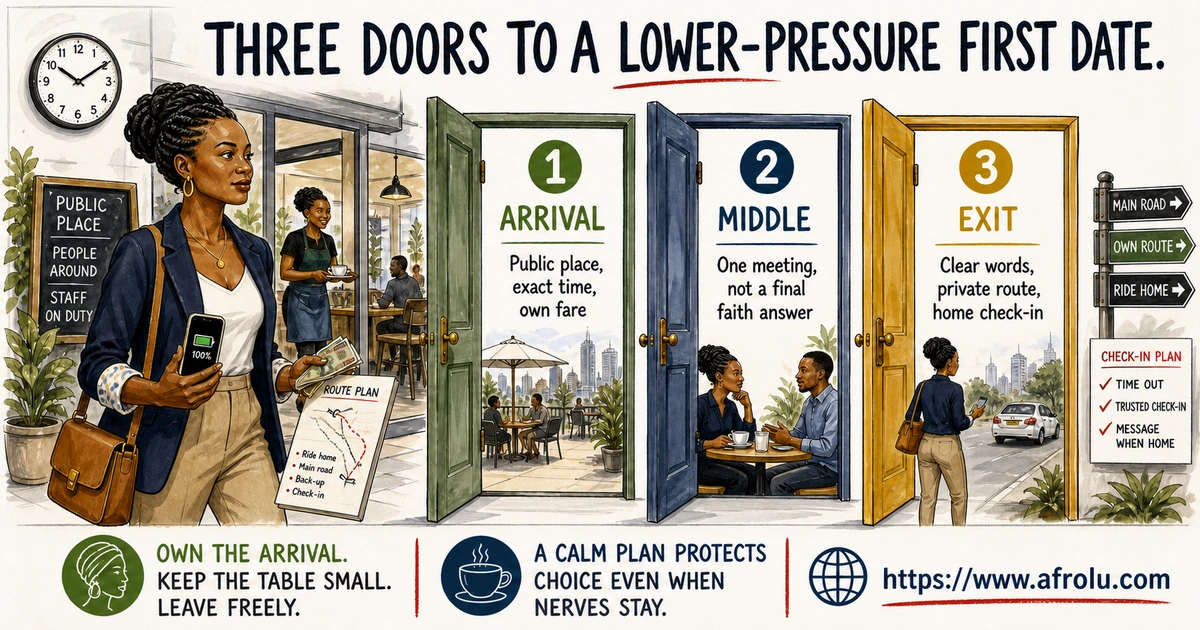
https://www.afrolu.com | Write the public place, short time window, private return, and clean ending before the first hello.
Written and edited by Clarisse Uwimana · Dating Culture Editor
Build the date around three doors. At the arrival door, confirm a staffed public Nairobi venue during active hours. Set a short window, keep your own fare, plan two ways home, and arrange one private check-in. At the low-pressure door, let both adults settle before discussing worship, relationship intent, family hopes, sexual boundaries, or community involvement. Shared faith can guide your own choices, but it does not give a date, relative, matchmaker, or leader authority over the other adult. At the exit door, say the ending once, leave by a route you control, and decide about another meeting later. Ordinary nerves are mainly an internal experience such as a tense stomach, racing thoughts, or fear of awkwardness. A values mismatch is an honest difference that can be discussed without punishment. Danger shows up in clear actions. These include identity deception, forced privacy, public shaming, money or account pressure, unwanted touch, threats, following, or blocking your way out. You may shorten, postpone, cancel, or leave for any reason, including when you cannot yet name which kind of discomfort is present.
First dates · Faith-Led Daters
How can faith guide a first date without giving up privacy, a clear no, or a way home that I control?
In this guide, first-date anxiety means the everyday worry some adults feel before or during an unfamiliar romantic meeting. It may include self-conscious thoughts, a dry mouth, tense muscles, a faster heartbeat, a blank mind, or a wish to rehearse every answer. One nervous date is not a diagnosis, and these sensations can have many causes. Faith-led dating means an adult wants belief and values to inform whom they date and how the connection grows. It does not name one religion, one Nairobi community, or one rulebook. Low pressure means the first meeting is small, specific, affordable, private enough, and easy for either adult to end. It does not mean vague, careless, or free from standards.
Muthoni is 32, works in logistics, and is active in a Nairobi church. Tobias is 35, teaches at a professional college, and was introduced by a married friend they both trust. Muthoni is glad to meet him, yet the date feels crowded before it begins. Her friend has already asked whether Tobias seems like husband material. An aunt wants a photograph. Muthoni's stomach is tight, traffic is moving slowly, and she worries that one quiet minute will be reported as a lack of faith or interest. She returns the meeting to its actual size. They will meet for seventy-five minutes at a staffed cafe she can locate independently. Each adult travels and pays for transport separately. One friend has the venue and end time, but no group chat knows about the date. When Muthoni arrives, she asks for a quieter table and says she takes a few minutes to land after Nairobi traffic. Tobias does not interpret the request. Later they discover that he expects a dating relationship to become known to close community members early, while she wants several private meetings first. They do not solve the difference at the table. At the planned end, Tobias asks whether she would like another coffee on a different day. Muthoni says she will think after she is home. He accepts that complete answer. The date does not remove every nerve or settle their future. It gives Muthoni better evidence. Tobias can hear a small request and an unfinished values question. He can also hear a clear ending without making it a final statement about faith.
The three-door date
Keep ownership at arrival, at the table, and at the exit
Nairobi can add traffic, rain, fare, venue noise, family messages, and community expectations before two adults have even said hello. Do not ask one feeling to carry all that information. Walk through three doors and check who still owns each choice.
The arrival door holds place, time, identity, money, and transport. The low-pressure door holds conversation, faith expectations, privacy, and present consent. The exit door holds the ending, route home, check-in, and later decision. A door stays usable only when either adult can move through it without persuasion, punishment, or debt.
Can I reach the meeting without depending on the date?
Know the staffed public place, active hours, start and finish, spending limit, and return options. Keep your phone, money, address, account, and transport under your control.
Can both adults be curious without performing certainty?
Let worship, values, marriage hopes, family, and physical boundaries become questions both adults can ask and answer. Neither person has to produce a sign, promise, testimony, or quick agreement.
Can the date end before the relationship is decided?
A planned ending needs no crisis. Say it once and move toward your own route. Complete the limited check-in. Review the meeting at home, not at the curb.
What did the meeting show after my body and the city settled?
Separate ordinary nerves from the other adult's actions. Note how they handled a request, a difference, the planned ending, and your freedom to leave. Then choose another date, one question, or a kind no.
Door one: before Nairobi carries the mood
Make the arrival ordinary, public, affordable, and yours
Start with a place you can find and assess without the other adult's help. A staffed cafe, restaurant, gallery, or other public venue during active hours can offer people, light, receipts, and more than one direction of travel. Public does not guarantee safety, and a familiar neighbourhood is not risk-free. The practical benefit is that you can confirm the location yourself and look around. You can ask staff for help. You can also leave without entering a new person's home, car, workplace, or private community room. Agree on the exact branch or entrance, the start, and a natural end. Nairobi names can repeat across neighbourhoods, and a vague pin can move. Check the venue through a channel you found yourself. If the plan changes to private at the last minute, postpone instead of arguing from the roadside.
Choose a time window that survives ordinary city friction. Seventy-five or ninety minutes may be enough. Choose a length both adults can afford in time, attention, and fare. Add a private arrival buffer for traffic, rain, and security checks. Use it to find the entrance, visit a restroom, eat, or settle after a crowded matatu or long ride. Do not make punctuality a moral or spiritual score. A late message with a realistic update is different from disappearing, repeatedly changing the location, or demanding that the waiting adult move somewhere less public. Keep the original end time unless both freely choose a change. A delayed start does not automatically take more of the evening.
Keep two return ideas: the route you expect and a backup you can arrange yourself. Know the staffed pickup point and the nearby stage. You may also keep a licensed taxi option, a ride service you order on your own phone, or a trusted adult you can contact. Conditions change, so verify the route on the day. Carry enough charge and return money separately from the date budget. Do not hand over your phone for someone to enter a payment code. Never reveal a PIN or account login. Do not let the date become your only ride. If an adult offers a lift, you can decline without accusing them of anything. Convenience is not more important than keeping the exit under your control.
Tell one trusted adult the useful minimum. Share who you expect to meet, the public venue, start, and expected finish. Tell them what you want them to do if a check-in does not arrive. Choose someone who can follow the plan without turning it into community news. They do not need passwords, continuous location access, every message, or authority to approve the person. The date does not need your supporter's name, phone number, congregation, or relationship to you. A limited check-in protects choice; a circle of live commentary can increase anxiety and expose private information. If no one appropriate is available, strengthen the public plan and know which venue or local service you would approach if help were needed.
The threshold: the person is not the profile or introduction
Use the first ten minutes to arrive, verify, and notice conduct
Remote conversation, a mutual friend, or a community introduction can make a stranger feel partly known. The first in-person minutes still bring new information. Notice the voice in a shared room, pace, eye contact, and physical distance. Notice how belongings and staff are treated. Check whether the agreed plan remains the plan. Confirm that the adult matches the important identity details you expected. A mutual contact can add context but cannot guarantee relationship status, motives, finances, consent, or future behaviour. If an important detail changes, you do not have to solve it at the table. Stay public, avoid money and private transport, and leave or postpone while you verify through a source you choose.
Let the body arrive without giving it a sermon. Muthoni can notice a warm face, tight stomach, fast speech, shallow breathing, a blank mind, or an urge to impress Tobias. She can also notice practical conditions: she has not eaten, the music is loud, the chair faces a busy entrance, or traffic left her overstimulated. Name the sensation and condition separately from the prediction. 'My shoulders are tight' is an observation. 'This means the meeting is wrong' is one possible story, not a fact. Ask for water, food, a quieter seat, a few minutes, or the original short ending. A familiar, comfortable breathing rhythm may help some adults settle. It is optional. Never use it as a reason to stay beside pressure, deception, or a blocked exit.
Make one small request early enough to see the response. Keep your bag on your side or decline an alcoholic drink. Ask to stay at the public table, order your own ride, or repeat the finish time. The content of the request matters, but the response adds separate evidence. A respectful adult may be disappointed, curious, or briefly surprised and still accept the limit. Mocking your anxiety or calling caution a lack of faith is not care. Neither is demanding a long defence, moving your belongings, or ordering for you after a no. An introduction is not proof that you should trust faster. These actions call for distance, not a better calming exercise.
Keep the date between adults. Never ask children or younger relatives to act as chaperones, messengers, photographers, or witnesses. If accountability matters to you, arrange it with trusted adults. One trusted adult can know the plan. Adult friends can sit elsewhere in the public venue without joining the date. Explain the arrangement before anyone travels. The other person can decline if it does not suit them. No adult should arrive to find a surprise family panel, ministry interview, or audience. Low pressure means both people know and accept the plan.

https://www.afrolu.com | A respectful first meeting can include nerves, pauses, and a values difference without demanding more time.
The middle: one table, not a final faith test
Talk about lived faith without asking either adult to sound completely sure
Begin with the ordinary week. Ask what faith shapes in daily choices rather than requesting the correct label or a polished testimony. Useful questions might cover worship rhythm, rest, service, honesty, food or alcohol choices, relationships with family, and how a person handles disagreement. Listen for specific life rather than ranking devotion. A person may be private, nervous, new to a community, between congregations, questioning, or careful about what they disclose to someone they just met. None of those details can be read from clothing, fluency, attendance language, or who made the introduction. Ask, hear the answer, and leave room for later evidence.
Move from labels to expectations that could affect two adult lives. What does dating toward commitment mean now? Is either person dating others? When would family or community involvement feel appropriate? What are the expectations around affection, sex, alcohol, money, worship together, gender roles, marriage, children, interfaith differences, counselling, and relocation? One first date does not need to settle every topic. Choose two or three that matter for whether another meeting makes sense. A low-pressure answer can be clear without being final. Say, 'I value marriage, and I do not decide relationship direction on date one.' You can date with purpose and still learn slowly.
Keep the exchange two-way. Tobias may ask how Muthoni's faith guides physical boundaries. She may answer only as far as she wants, then ask what he means in practice. A boundary is not an invitation to bargain, test, confess, or demand private history. Neither adult owes details about past sexual experiences, trauma, health, counselling, fertility, finances, or family conflict at a first table. A future topic may matter even when the details are too private today. Name the topic and the timing. Say, 'That matters to me. I discuss the details after trust has grown.' The other adult can decide whether that pace fits. They still do not gain a right to the details now.
Use pauses as information, not empty space that must be filled by a promise. Look at the menu, ask about the journey, or notice something in the room. You can say, 'I am thinking about that.' The talk may stay one-sided. The values may not fit, or attraction may be absent. The two adults can be a poor match without either person being unsafe or weak in faith. Kindness does not require a second date. Equally, a warm flowing conversation does not verify every claim or create a relationship. The middle has done its job when each adult has enough room to be present, notice, and retain an honest no.

https://www.afrolu.com | Name the arrival, ask one real values question, and keep the answer open enough for either adult to differ.
The fork: discomfort is not one category
Separate ordinary nerves, respectful mismatch, pressure, and danger
Ordinary nerves often speak about evaluation: What if I go blank? What if they do not like me? What if I seem less confident than I sounded online? The feeling may rise before new evidence and may remain even when the adult, venue, time, and boundaries are consistent. You can lower the task: finish the first drink, ask one question, take a pause, or shorten the date. You can also leave. The point of naming ordinary nerves is not to order yourself to stay. It is to stop a familiar internal alarm from becoming the only voice while you check what is happening around you. New, severe, or medically concerning physical symptoms deserve appropriate healthcare assessment rather than an assumption that they are only anxiety.
A respectful mismatch has a real difference and room for both answers. Esther, 37, wants a partner who will worship with her weekly and involve close family after a few months. Peter, 40, shares her faith tradition but keeps worship private and does not want relatives involved in dating. Neither insults, threatens, follows, exposes, or bargains with the other. Their difference may end the connection. That is useful compatibility information, not proof of danger and not evidence that either person's faith is false. Do not force a middle position merely to make the first date feel successful.
Pressure begins when one answer is not allowed to remain an answer. A date may keep asking for your congregation or ask a mutual contact to persuade you. They may say a real believer would accept a ride. They may link the bill to obedience or use a claimed prophecy to rush commitment. They may demand a prayer that exposes private facts or say your choice to go home harms their good name. One awkward phrase may be repaired when it is acknowledged and stopped. Repeated pushing after a clear limit is the important pattern. Do not answer pressure with more private detail. Restate once, end the topic or date, and create distance.
Danger appears when actions take away free choice. Important identity details may be false. A person may take your phone or bag, block a door, or force a private venue. They may touch you sexually without consent, threaten you, follow you, or appear at your home or worship place without agreement. They may tamper with transport or use intoxication and isolation to gain access. Do not stay to make a calm faith argument. Move toward staff, other people, light, and the exit. Contact trusted support and use current local emergency, medical, legal, venue, or platform channels appropriate to what happened. Preserve useful messages or transaction records when doing so does not increase danger.

https://www.afrolu.com | Adjust for ordinary nerves, discuss a mismatch, stop at pressure, and leave when free choice is challenged.
The values test: watch what belief is being asked to do
Let faith support reflection without turning it into pressure
Faith can give an adult language for purpose, patience, sexuality, service, honesty, family, repair, and hope. Personal prayer before a date may help someone remember their values. Advice from a trusted adult may reveal a blind spot. A shared community may offer context about ordinary character over time. These supports have limits. Prayer does not verify identity or future conduct. A recommendation is not a guarantee. A respected leader cannot consent to dating, disclosure, touch, sex, transport, money, or marriage for either adult. Keep belief as a source of reflection while the actual person remains responsible for clear choices and actions.
Amina is 29 and Idris is 33. Both are Muslim Nairobi professionals introduced through friends, and both want marriage eventually. Amina prefers that only one trusted friend know about early meetings. Idris usually tells a sibling soon because family counsel matters to him. Neither preference is automatically more faithful. They can agree on a narrow circle, choose a later review point, or decide the privacy difference does not fit. What would turn the issue into pressure is sharing Amina's name, photograph, workplace, or messages after she declines. It is also pressure to claim that her privacy proves bad intent. Community care starts with consent to the information being shared.
Keep money outside spiritual proof. A first date may include an agreed split, one adult offering to pay, or each person covering their own order. Discuss the practical expectation without turning generosity into a test of gender, devotion, status, or future provision. Do not send fare, a donation, an investment, a business payment, a family emergency transfer, or a gift to prove trust. Never reveal an M-PESA PIN, verification code, bank login, payslip, giving record, or account balance to a new match. A genuine cause can be checked and supported later through an independent official channel; the date does not need to handle the payment.
Consent remains specific and current. A shared faith does not mean you have agreed to pray together or take public photographs. It does not mean you have agreed to a lift or another place. It also does not promise hand-holding, a kiss, sexual touch, sex, an overnight stay, exclusivity, or a second date. Paying, travelling, fasting, giving a gift, receiving counsel, or speaking about marriage changes none of those separate choices. An adult may change a yes, including after earlier affection. If a person uses God, scripture, a dream, modesty, reputation, leadership, or future marriage to defeat the other adult's no, the problem is pressure. The appropriate response is not better spiritual performance; it is a firmer boundary, distance, exit, or support.
Door three: finish before deciding the future
Use a clean ending, a private return, and a later choice
Begin the ending while you are still at the table, not after one adult is standing beside the other's car. Start ten or fifteen minutes before the planned finish. Check the time. Settle the part of the bill you agreed to and gather your belongings. Say, 'I am leaving at the time we planned.' You may add, 'I enjoyed hearing about your work.' Warmth is optional. The ending is complete without it. Do not offer a future date simply to reduce a tense goodbye. A respectful adult may ask once about continuing or meeting again, then accept 'not tonight,' 'I will decide later,' or 'no.'
Move from the table to a route you control. If you ordered a ride, confirm it through your own device and use the staffed pickup point. If you are walking to public transport, know the active route and keep a backup. You do not owe a shared ride, escort to your exact home, or a stop at a private place. Avoid showing an address on an unlocked screen. If the other adult follows after you decline company, return toward staff or other people rather than leading them home. Ask for help plainly. When immediate safety is threatened, use the current local emergency support appropriate to your location.
Complete the check-in you arranged, then close the audience. 'Home safely' may be enough. Your trusted adult can ask whether you want to talk, but they should not demand photographs, messages, a spiritual conclusion, or an immediate answer. Do not post the date, tag the venue, or send a play-by-play to a fellowship or family group without the other adult's agreement. Community privacy protects both people from gossip and from a first meeting becoming a public commitment. If there was concerning conduct, share with the person or service able to support the next step, not with the widest audience.
At home, separate four questions. Facts: what happened with time, identity, money, staff, faith questions, privacy, touch, transport, and the ending? Feelings: what was nervousness, ease, attraction, relief, disappointment, or uncertainty? Fit: do the adult lives, values, pace, and relationship hopes have enough room for another meeting? Next step: choose one clear action. You might set a public date, ask one follow-up, slow community involvement, decline, check a changed fact, block contact, or seek support. Wait until travel strain and social performance settle before making one awkward pause the entire story. Do not wait for certainty when dangerous actions already call for distance.

https://www.afrolu.com | A clear ending is part of the date: say it, stand up, leave independently, check in, and review later.
Six Nairobi moments where the next move matters more than the label
Muthoni, 32, arrives tense but the plan remains hers
Muthoni's ride takes longer than expected. She feels hot, notices her speech speeding up, and imagines Tobias reading lateness as poor character. The venue, identity details, finish time, fare, and return are unchanged. Tobias replies, 'Thanks for updating me. We can still finish at the time we planned.'
Muthoni uses the restroom, orders water and food, and lets the first few minutes be slow. She does not owe extra time because traffic shortened the meeting. Tobias's response gives useful evidence.Amina, 29, and Idris, 33, want different sizes of community circle
Idris normally tells a sibling when he begins meeting someone. Amina wants her name and photograph kept between the two adults and one trusted friend until several dates have happened. Both care about family counsel; they disagree about timing and detail.
They agree that no identifying information will be shared now and set a later conversation. If that boundary does not fit Idris, he can decline another date. Sharing anyway would become a privacy and consent problem, not evidence of stronger faith.Esther, 37, and Peter, 40, discover a real difference without danger
Esther hopes to worship with a future partner most weekends. Peter shares her broad beliefs but treats worship as private and does not want a couple identity in a congregation. Neither adult mocks the other, claims divine authority, or demands a decision that evening.
They can ask one clarifying question, take time, or end kindly. A safe mismatch may still be decisive. Neither person must weaken a conviction merely to turn a respectful first date into a second one.Kevin, 30, asks Lydia, 31, to prove generosity before they meet
Hours before the date, Kevin says a ministry need has delayed his fare and sends Lydia a payment number. When she declines, he says a faithful partner should respond to need without suspicion. The story mixes urgency, money, romance, and moral shame.
Lydia sends nothing, avoids the supplied payment route, preserves the messages, and cancels. A legitimate organisation can be checked later through contact information she finds independently. She does not need to investigate Kevin in person.Njeri, 34, keeps a closed public plan from becoming Joseph's car plan
Joseph, 36, says the cafe is too busy and offers to collect Njeri for a quiet drive. She proposes another staffed public place. He continues to send voice notes saying privacy will make prayer and conversation more sincere. The repeated push arrives after a workable public option.
Njeri does not enter the car or disclose her pickup point. She cancels, updates her trusted contact, and leaves by the route she arranged. The issue is clear pressure toward isolation, not a failure to relax.Wambui, 42, ends a warm date when Kamau, 45, ignores a physical no
The conversation has been easy. Outside the venue, Kamau asks for a kiss. Wambui says no and offers a verbal goodbye. He reaches for her again and says they have prayed about serious intentions, so she should not make affection feel shameful.
Wambui steps back toward staff, says, 'Do not touch me,' and leaves without sharing transport. Earlier warmth does not cancel the ignored no. She can use trusted, venue, platform, legal, medical, or emergency support according to what happens next.Eight signs that faith, privacy, money, transport, and consent still belong to both adults
The exact adult, staffed public place, time window, and broad date purpose remain consistent before arrival.
Each person can reach and leave the Nairobi venue without surrendering a phone, account, document, or return fare.
A pause, quieter table, food order, non-alcoholic choice, shorter date, or separate ride receives a plain answer rather than interpretation.
Faith questions concern lived choices and expectations, while private history can remain private until trust grows.
Community involvement, photographs, names, messages, and the fact of the date are shared only within an agreed circle.
Payment is discussed without shame, generosity tests, urgent transfers, financial disclosure, or entitlement after one person pays.
A no to prayer, touch, alcohol, a ride, another location, more time, or a second date is accepted once and fully.
The ending can arrive on schedule even when the conversation is warm, and neither adult must decide the relationship at the exit.
Read what happened, then choose the smallest useful response
| Situation | What it may mean | What to do next |
|---|---|---|
| Your stomach is tight before leaving, but identity, venue, fare, check-in, return, and the other adult's conduct are consistent. | Ordinary anticipation, fear of evaluation, excitement, traffic planning, or several feelings may be arriving before new evidence. | Lower the first task to reaching the public place and completing ten minutes. Eat, pause, shorten, postpone, or cancel according to your choice; the feeling is not an order to stay. |
| The first silence feels painful, yet the date waits, listens, and does not demand reassurance or private disclosure. | Two adults may still be orienting after travel and online contact. Awkwardness alone does not establish compatibility or danger. | Name that you take time to settle, ask one present-tense question, and judge the whole short meeting rather than the first pause. |
| You share belief but disagree about worship together, family timing, marriage pace, sexual boundaries, or future children. | This can be meaningful faith or life incompatibility even when both adults are honest, respectful, and physically safe. | Ask what the expectation looks like in ordinary life. Do not promise change from first-date pressure. Choose a later talk or a kind ending. |
| A mutual friend asks for photographs and a full report before you have agreed that the date may be discussed. | Well-meant community interest may be exceeding the privacy arrangement and adding an audience to a private adult decision. | Share only the safety check-in. Tell the friend when, if ever, wider details may be shared, and do not forward the other adult's messages. |
| The date asks for fare, giving money, an investment, an account view, or a payment code and connects refusal with selfishness or weak faith. | This is financial and moral pressure. Romance, urgency, and a worthy story do not make an unverified transfer safe. | Send nothing, reveal no codes, verify any organisation independently, and cancel or leave if the request remains part of the relationship test. |
| The public venue suddenly becomes a car, home, office, hotel, or private room after you say you prefer to remain public. | A practical disruption has become pressure toward isolation because a public alternative or postponement is not being accepted. | Do not enter, disclose your home, or depend on their ride. Move toward people, update the check-in, and leave by your independent route. |
| Prayer, spiritual certainty, a leader's opinion, payment, or marriage talk is used to continue touch after you decline. | Consent is not being respected. The faith framing does not make the conduct less serious or require a theological response. | State the no if safe, create distance, move toward support, leave, and use appropriate current venue, platform, medical, legal, or emergency help. |
| You are home and keep replaying one awkward answer while forgetting that time, privacy, transport, and consent were handled respectfully. | Post-date self-criticism may be narrowing the review around a small performance moment rather than the complete meeting. | Write facts, feelings, fit, and one next step. Rest before deciding. Do not use this delay when concerning conduct already requires action. |
Ten plain sentences for arrival, belief, privacy, money, consent, and goodbye
“I can meet at this staffed public place from 4:30 to 5:45. I will arrive and leave using my own transport.”
“I usually take a few minutes to settle after Nairobi traffic. We do not need to fill every pause.”
“What does your faith shape in an ordinary week, especially when work, family, and a relationship need different things?”
“One trusted friend knows the safety plan. Please do not share my name, photograph, messages, workplace, or the date more widely.”
“Community advice matters to me, and I decide together with the person I am dating when our connection becomes community information.”
“I do not send fare, donations, investments, codes, or account details as proof of generosity or relationship intent.”
“Shared faith, prayer, a meal, and serious hopes do not decide touch or another location. Ask me, and accept my answer.”
“I am enjoying the conversation and I am still leaving at the time we agreed. We can discuss another date later.”
“This does not fit for me. I am not asking for persuasion, advice, or a message through our community.”
“No. I am leaving now. Do not touch me, follow me, contact my home or workplace, or share information about me.”
Know the difference
A faith-led first date or spiritual pressure?
Two adults use belief to ask honest questions and guide their own choices. Each can keep privacy, disagree, change a plan, decline touch, and end without being pressured to say yes.
Pressure may use belief, prayer, a claimed message, reputation, leadership, giving, modesty, or marriage language. It may rush access, silence questions, expose private facts, or push past a no.
Do not judge the difference by how religious the words sound. Judge what happens to each adult's freedom when the answer is slow, private, different, or no.

https://www.afrolu.com | Faith-led dating leaves both adults free to ask, disagree, slow down, keep privacy, and end the date.
Do the words support adult choice or try to close it?
| Type or dimension | What it describes | Best next question |
|---|---|---|
| Ordinary first-date nerves | An internal response to novelty or evaluation, sometimes including self-conscious thoughts or body reactions; one date is not a diagnosis. | Check outside facts, reduce the task, and choose freely whether to continue, shorten, postpone, or cancel. |
| Persistent anxiety needing assessment | Anxiety that persists, is difficult to cope with, or interferes with daily activities requires individual attention beyond a date plan. | Speak with a qualified health professional who can assess symptoms, duration, health history, and impact. |
| Faith incompatibility | A sincere difference about belief, practice, family, sexuality, marriage, children, community, or pace that both adults can state safely. | Ask what the difference means in ordinary life, then continue, take time, or end without making either adult the villain. |
| Faith-led dating | Belief informs purpose and personal choices while questions, privacy, consent, evidence, and each adult's independent responsibility remain open. | Notice whether values appear in patient conduct and accountable repair, not only in labels, introductions, or confident future language. |
| Spiritual pressure | Religious language, reputation, authority, or shame is used to make one answer required or to demand information, money, access, or affection. | Stop explaining, restate the boundary once if useful, create distance, and involve support chosen for the actual conduct. |
| Clear danger signs | Threats, stalking, violence, unwanted sexual contact, material deception, forced isolation, or blocking transport and departure. | Move toward safety, leave, and use current trusted, venue, platform, medical, legal, or emergency support appropriate to the situation. |
Walk the date through three doors
The night before: write the container
Record the exact public place, time window, budget, independent arrival, two return ideas, limited check-in, and information that remains private.
On the way: protect the arrival buffer
Keep return money and charge, check delays, eat if needed, and remember that traffic can shorten the date without increasing the emotional debt.
First ten minutes: make one small request
Ask for the seat, pace, order, privacy, or finish you need and notice whether the answer leaves your original choice intact.
Middle thirty minutes: ask about ordinary life
Move from faith labels to work, worship, family, money, disagreement, relationship pace, and boundaries without demanding a complete history.
Final fifteen minutes: close before the curb
Settle the agreed bill, gather belongings, say the ending, and move toward your own route before discussing a possible next date.
At home: give the date four boxes
Review facts, feelings, fit, and one sensible next step after the return, unless danger already requires immediate support.
Private questions for the night before, the table, and home
Choose a few prompts that fit the moment. This is a reference library, not a list to complete.
Before you leave: write three doors on one private note
Keep the plan close to the adult who must use it, not in a busy community conversation.
- Arrival: what exact place, time, budget, route, backup, and check-in can I confirm myself?
- Low pressure: which two faith expectations matter for deciding whether another date makes sense?
- Privacy: who may know, what may they know, and what information about the other adult is not mine to share?
- Exit: which sentence and route will I use if the date is warm, awkward, incompatible, pressured, or unsafe?
At the table: look for answers in conduct as well as words
A values label becomes useful when it can survive a small difference and a clear boundary.
- What happens when I ask for a quieter pace, separate payment, privacy, or the original finish time?
- Can we discuss worship, family, marriage, sexuality, and community without ranking each other's faith?
- Does either adult ask for money, a code, a private venue, a confession, or access that the first date does not need?
- Can I still hear my own answer when this person, the city, and the introduction all feel important?
After your own door closes: review without an audience
Let the check-in end the safety loop. Let the debrief belong to you until there is a clear reason to involve someone else.
- Facts: what happened with time, identity, staff, money, faith talk, privacy, consent, and departure?
- Feelings: what was nervousness, warmth, attraction, relief, disappointment, or uncertainty?
- Fit: which adult values and daily-life expectations could work, and which difference may be decisive?
- Next step: another public date, one clear question, slower community access, a kind no, verification, blocking, or support?
Six ways faith and low pressure can be made to carry the wrong job
Turning a nervous feeling into a message from outside yourself
A feeling can matter without proving a spiritual meaning, a safe person, or a dangerous person. Check the public plan and the actions you saw.
Using prayer to talk yourself past changed facts
Private reflection may steady you. It does not fix an identity detail that does not match, a money request, a private venue push, an ignored no, or a blocked exit.
Inviting the whole community into date one
Too many updates can expose names, photographs, messages, routes, and hopes before either adult has agreed that the connection may be discussed.
Confusing low pressure with unclear intent
A short date can still name whether each adult is exploring toward a relationship, what privacy they need, and which boundary is firm today.
Making generosity a shortcut to character
Paying, giving, or sending fare cannot verify care. Watch whether money is discussed plainly and whether a limit is accepted without shame.
Waiting for perfect certainty before using the exit
You may leave an awkward, incompatible, pressured, or unsafe date without proving the other adult's motive. The exit does not require a final label.
Use a reviewed resource that matches the decision
This guide focuses on the relationship decision, so it does not rank dating apps. Check current prices, safety tools, and local availability before choosing a service.
Explore the guide library
Show more related guides
Continue with Afrolu
Show more Afrolu guides
Six official places to check the health, privacy, consent, and money facts
Afrolu reviewed these health, research, safety, or public guidance resources while editing this page. They support the behaviour and safety guidance; they do not diagnose any individual described by a reader.
Faith-Led Nairobi First-Date Questions
Does feeling nervous mean God is warning me not to go?
A single feeling cannot prove a spiritual meaning or predict another adult's conduct. Notice the feeling, then check identity, public venue, money, transport, privacy, consent, and the response to limits. Personal prayer may help you reflect, and you may cancel for any reason.
How short can a low-pressure first date be in Nairobi?
There is no required length. Choose a window both adults can afford and leave easily. Muthoni and Tobias use seventy-five minutes. Another adult may choose forty-five or ninety. Traffic can shorten the meeting without creating a duty to extend it.
Should we pray together on the first date?
Only if both adults freely want to. Prayer can stay private, happen briefly together, or wait. It must not become a way to ask for personal confessions, force physical contact, claim a relationship, or make one adult's no sound faithless.
When should family, a matchmaker, or a faith leader hear about the date?
After both adults agree on who will know and what may be shared. A safety check-in is different from a public report. Keep names, photographs, messages, workplaces, addresses, counselling details, and relationship hopes inside the agreed circle.
Is a difference in worship style a red flag?
Not by itself. It may be an important mismatch. Ask what the difference means in an ordinary week and a future partnership. It becomes pressure when one adult uses shame, threats, exposure, or authority to force the other person's practice.
Who should pay for a faith-led first date?
Agree in a simple way. Each adult may pay for their own order, one may offer, or they may split. No payment buys more time, private transport, touch, sex, or a second date. Keep return fare and payment codes under your own control.
Should I send fare, a donation, or emergency money before meeting?
Do not send money to prove care or faith. Urgency, a worthy cause, a ministry label, and a mutual introduction do not verify a request. Check any organisation through contact details you find yourself and use the right financial or reporting channel if money has moved.
Can a mutual faith-community friend make the meeting safe?
No person can guarantee that. An introduction adds context, but it cannot prove identity, relationship status, finances, future conduct, or consent. Keep the first plan public, short, private enough, and easy for each adult to leave.
What if my date says marriage intent means we should be physically close?
Marriage intent does not create present consent. Prayer, a meal, travel, a gift, community support, or an earlier yes also does not decide the next touch. Each adult chooses each step and may change the answer. Leave and seek support if a no is ignored.
When should I get professional help for first-date anxiety?
Consider a qualified health professional when anxiety lasts or is hard to manage. Also seek help if it blocks things you want to do or affects work, sleep, relationships, or daily life. Get suitable medical help for new or worrying physical symptoms and urgent help for a mental-health or safety crisis.
One thing to do now
Close all three doors: keep your arrival, your answer, and your way home
At door one, use the public plan only while it still belongs to you. At door two, make room for nerves and honest faith differences, but stop when belief, reputation, money, secrecy, transport, or affection becomes pressure. At door three, end the date and use your own way home. Threats, stalking, violence, unwanted sexual contact, or a blocked exit need more than a dating talk. Move toward safety and use the trusted, venue, platform, medical, legal, or emergency help that fits what happened.