Seven handoffs · new-dater career relay
Follow the Effort, Not the Notification, on Your New Dating Journey
A low-pressure breadcrumbing guide for new daters in busy career seasons: audit the effort relay, ask clearly, protect work time and close with dignity.
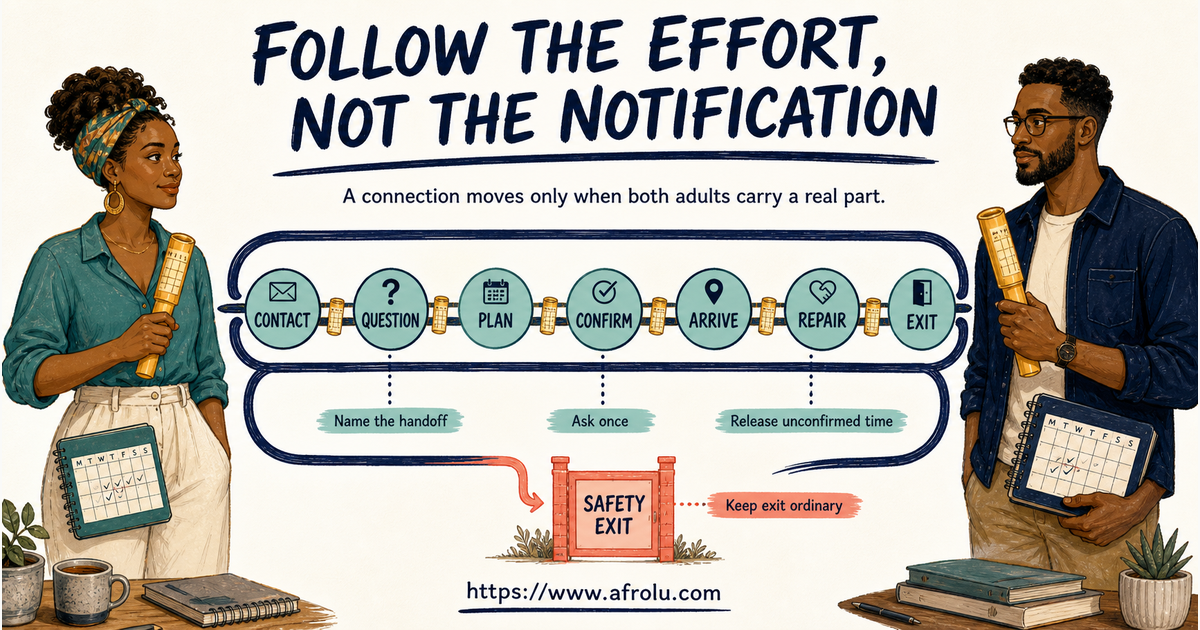
Low pressure changes the speed; it does not remove the next clear handoff.
Written and edited by Nia Kato · Profile Advice Editor
Use seven handoffs: CONTACT, QUESTION, PLAN, CONFIRM, ARRIVE, REPAIR and EXIT. Name the one step that is open and ask once. Mutual low pressure still produces clear modest plans, realistic counterproposals and respected endings. Release unconfirmed time, keep work, accounts, money and transport private, and keep consent specific. Continue, counter, pause, change route or close without proving motive. Seek qualified care for lasting daily-life distress and direct help for fraud or danger.
Mixed signals · New Relationship Starters
How can a new dater tell whether intermittent attention is becoming a mutual low-pressure connection or simply keeping career time and hope in an open loop?
Breadcrumbing is a non-clinical dating term for intermittent attention that keeps romantic possibility alive while clarity, reciprocity or a useful next step repeatedly remains out of reach. It does not diagnose a person or make every slow reply harmful. Mutual low-pressure dating, genuine career delay, new-dater uncertainty, mismatch, friendship, closure, distress and danger each leave different evidence and call for different choices.
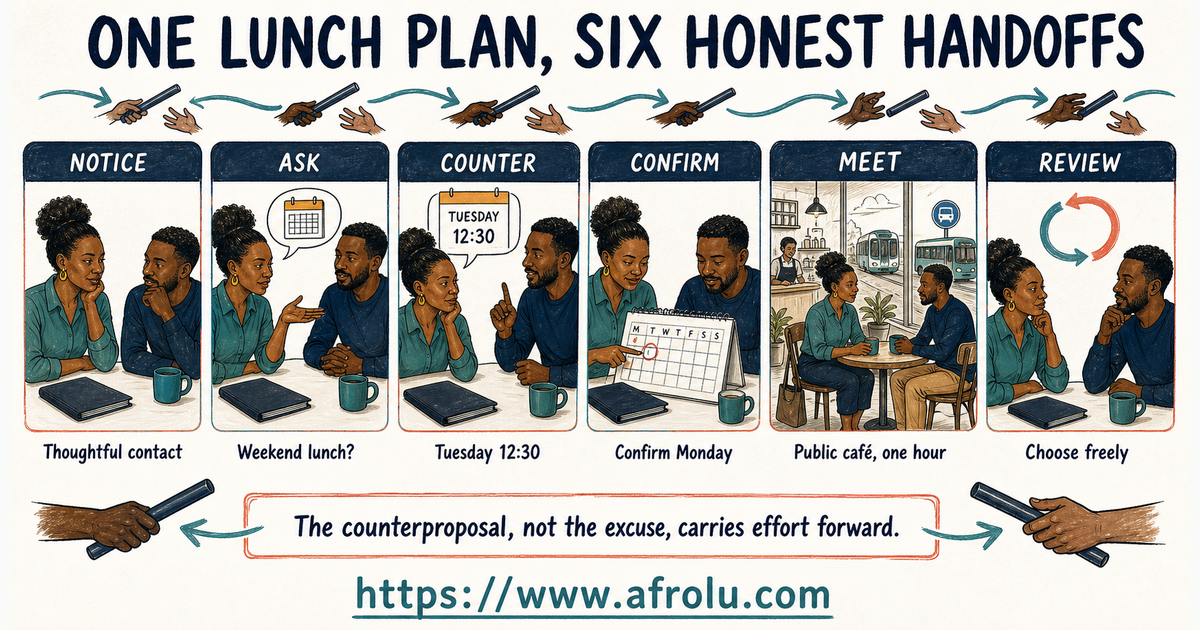
Nia, 30, is new to app dating and offers Elias, 33, a Saturday lunch. A client launch blocks him, so he proposes Tuesday at 12:30, confirms by their agreed point and meets in a public cafe. Both fictional adults keep work details, travel, ordinary costs and consent separate, then choose one date at a time without treating the six handoffs as a universal schedule.
The new-dater career effort relay
Let each adult carry a visible part without racing the relationship
Nia follows seven handoffs so a first app journey can stay warm, low pressure and answerable while career time remains protected.
Locate the current baton, ask once, read the delivered effort and choose an ordinary next door for fit, care or safety.
Turn warmth into a question
Mutual curiosity can be light and still answerable.
Put one plan on the track
A real window beats a week of someday language.
Read repair, not excuses
A career conflict carries a usable counterproposal.
Return time to your life
Pause and closure complete a route without failure.
New to dating does not mean available for guessing
Begin with one answerable handoff instead of proving you can be patient
Breadcrumbing is a popular, non-clinical term for intermittent attention that keeps romantic possibility open while useful progress stays out of reach. One delayed reply, awkward invitation or cancelled date does not establish a pattern. The term cannot reveal motive, diagnose attachment or prove manipulation. It can help you describe what contact repeatedly delivers and decide whether that route fits your life.
A first season of app dating can make every message feel like evidence you should understand. It is not. You are allowed to ask what an invitation means, how plans are confirmed and what pace is available. Dating experience is not a licence another person owns. Your work, sleep, friends, money, devices, transport, consent and exit remain yours from the first hello.
Low-pressure dating is an explicit adult choice to leave breathing room around contact and decisions. It may include fewer messages, shorter dates or a slower review. It is not a promise to accept endless uncertainty. When two people choose the pace, each can name the next step and change it. When warmth keeps returning but every useful question dissolves, the problem is not simply speed.
Start with one observable handoff. Perhaps a friendly exchange needs an invitation, an invitation needs a time or a cancellation needs a counterproposal. Ask once in plain language, then read the action that follows. You may continue, counter, pause or close. Fraud, threats, tracking, image abuse or blocked movement skip the relay and require direct protection through fitting local channels.
The seven-handoff effort relay
Keep contact, questions, plans, confirmation, arrival, repair and exit in separate lanes
CONTACT asks whether both adults initiate in a rhythm they actually want. It does not reward constant texting. QUESTION asks whether curiosity travels in both directions and leaves privacy intact. A person may be shy, busy or new to dating. One adult can carry more for a moment, but a whole connection cannot rest on one person's prompts, attention and emotional memory.
PLAN asks whether interest becomes an answerable activity, day and place. CONFIRM asks whether both adults know the plan still stands without one person waiting online all day. Low pressure may mean confirming by an agreed point rather than sending many updates. Unconfirmed time returns to work, rest or friends; holding it indefinitely is not a sign of openness.
ARRIVE means following through or giving timely notice. It includes emotional arrival too: listening, respecting the agreed length and staying present enough to learn. REPAIR follows a missed step. A realistic counterproposal, apology and changed action offer evidence. Another warm message that ignores the missed plan may feel good while leaving the baton exactly where it was.
EXIT tests whether either adult can decline, pause, end the chat or remove access without being punished. A respectful no is not a failed relay; it is a completed answer. Review only what you can observe. Do not check online status, recruit colleagues or create hidden tests. If contact crosses accounts, work, home or physical boundaries after a no, protect access before explaining further.
Nia and Elias carry one plan without racing
A fictional low-pressure lunch shows what a career conflict can hand forward
Nia is 30 and starting app dating after years focused on work and friends. Elias is 33 and also has a full career week. They are fictional Black African adults, not a model couple. Each controls personal information, money, travel, meeting place, consent and exit. Neither has to continue because the other spent time, replied warmly or appears professionally impressive.
After several thoughtful messages, Nia asks whether Elias would like lunch on Saturday. He says he is interested but must support a client launch. Instead of leaving the idea floating, he offers Tuesday at 12:30 near a public transport stop and says he has one hour. Nia checks her calendar and accepts. A weekday date is not better; it simply fits both adults.
They agree to confirm by Monday evening. Elias confirms without asking for Nia's office address, diary or live location. Nia chooses the venue through public information and plans her own journey. They each expect to pay ordinary costs and neither sends money. If confirmation had not arrived, Nia would have released the lunch hour without a chase or a lesson about manners.
They meet in the staffed cafe, enjoy the hour and agree that low pressure means one planned date at a time, not daily contact. Nia says she wants to think before another plan. Elias accepts. The useful evidence is modest: a clear counterproposal, confirmation, arrival and respect for review. It proves neither safety nor future compatibility, but it completes the current handoffs.
Fourteen signals at the handoff circles
Pair carried effort with the open loop it answers
The fourteen signals sit in seven pairs. Each pair shows a carried handoff and an open handoff. They are prompts for observation, not a diagnostic checklist. A connection can contain mixed evidence, and context may change. One clear safety problem matters more than several reassuring messages. No total proves that a person is trustworthy or that a relationship will succeed.
Carried CONTACT includes mutual initiation at an agreed pace; the open form returns mainly when attention is fading. Carried QUESTION shows specific curiosity and accepts a private answer; the open form collects reassurance while sharing little. These differences can be discussed without assuming intent. A shy or busy person may respond well once the missing handoff is named.
Carried PLAN gives a usable activity, window and place. Carried CONFIRMATION arrives by the point both adults chose. Carried ARRIVAL means the date happens or changes with notice. Their open forms repeat someday language, keep prime time on hold or disappear near each plan. You do not need to count likes, response minutes or profile activity to see that result.
Carried REPAIR addresses the missed action with accountability and a realistic alternative. Carried EXIT accepts no, pause, reduced contact and closure. Their open forms use affection to skip repair or reopen contact through another channel. Money demands, stolen identity, threats, tracking and blocked movement are not weak signals; they are concrete safety facts that need the correct response.

Observe the handoff you can see; do not invent the runner's motive.
Twelve lines that do not require dating expertise
Ask for effort, protect career time and leave every answer available
New daters sometimes write a whole case because they fear one question will seem difficult. Shorter is usually kinder. Name the fact, ask for one next step and allow yes, a useful alternative or no. You do not need to use the word breadcrumbing. A label may start an argument about motive while the ordinary question still needs an answer.
For contact, try: ‘I enjoy hearing from you, and I prefer messages that lead to a real plan.’ For an invitation: ‘Would you like coffee Saturday morning or a short call Tuesday evening?’ For time: ‘I can hold that window until Monday evening; after that I will make another plan.’ These lines protect a career week without pretending to be unavailable.
For a conflict, say: ‘I understand this week changed. What alternative can you realistically offer?’ For work privacy: ‘I share available windows, not my full diary, client details or office access.’ For money: ‘I do not send dating contacts funds, codes or investments.’ A person can dislike those limits and still must remain free to decline without seeking access another way.
For consent, say: ‘Enjoying this date does not decide any image, touch or later step.’ For a pause: ‘I do not have space for this rhythm, so I am stepping back.’ For closure: ‘The contact is not becoming the kind of connection I want, so I am ending it.’ If a clear boundary brings threats or pursuit, stop scripting and protect yourself.

A first clear question can be kind, direct and easy to leave.
Choose the smallest move supported now
Let current effort, career capacity, wellbeing and safety lead to different doors
CONTINUE fits when the pace is wanted and both adults carry useful handoffs. ASK ONCE fits one real ambiguity. COUNTER fits a plan that is clear but does not work. None of these requires unlimited patience. A new dater may accept a slow rhythm and still ask for confirmation, repair and an exit that works on every channel.
PAUSE fits when dating itself is taking capacity you want elsewhere. CLOSE fits mismatch, lost interest or a repeated open loop. CHANGE ROUTE fits when apps create more administration than discovery; meeting through friends, activities or another service may suit you better. You do not need to keep one intermittent contact as proof that your dating journey has begun.
SEEK CARE fits when distress remains severe, worsening or disrupts sleep, concentration, appetite, work or ordinary life. A qualified local professional assesses the affected adult, not the motives of a match. SEEK SAFETY HELP fits fraud, threats, stalking, hacked accounts, image abuse or blocked movement. Use relevant platform, bank, workplace, legal, health or emergency support.
Review again only when facts change. A completed counterproposal may justify another look; another wave of flattery may not. Keep work blocks, friends and rest visible while deciding. The relay ends whenever you choose. A respectful close is not failure, and a low-pressure connection that completes modest plans does not need to accelerate to prove it is real.

Your next move does not have to finish the whole dating story.
Nine routes that can resemble the same slow track
Separate breadcrumbing from honest pace, ordinary uncertainty, mismatch, care and danger
A BREADCRUMBING PATTERN brings intermittent warmth while the same next step repeatedly remains open. MUTUAL LOW-PRESSURE DATING has a pace both adults name and can review. GENUINE CAREER DELAY includes a concrete constraint and a usable new point. None reveals a person's whole character, and none guarantees that the connection fits you.
NEW-DATER UNCERTAINTY means someone needs plain information before choosing, then responds to that information. PACE MISMATCH means two honest preferences do not fit. FRIENDSHIP may hold real warmth without romantic movement. Asking directly prevents friendly attention or nervousness from being promoted into a relationship promise that nobody made.
RESPECTFUL CLOSURE ends a route without bargaining, punishment or a final private meeting. DAILY-LIFE DISTRESS concerns the affected adult's functioning and may need qualified care. These are different questions: a kind ending can still hurt, and distress does not prove that the other person has a disorder or that another date will provide treatment.
FRAUD OR DANGER includes deceptive identity used for access, money requests, threats, tracking, non-consensual images, workplace intrusion or interference with exit. Name the concrete fact instead of burying it under dating slang. Secure accounts, funds, work, movement and physical safety first. Relationship clarification can wait or end when direct discussion would increase risk.
Eight first-journey moments where attention needs a real handoff
Three warm chats compete with a deadline
New attention is real, but no contact deserves continuous access to a career day.
Choose one reply window.Dinner someday keeps returning
Affection restarts the idea while activity, time and place stay incomplete.
Offer one answerable option.A launch blocks the proposed date
A clear constraint arrives with a realistic weekday counterproposal.
Accept, counter or decline.A Saturday morning remains uncertain
The agreed confirmation point passes while one adult waits to organise the day.
Release the time without chasing.A family need changes the plan
One disruption is context; useful repair matters more than the apology's warmth.
Review the replacement offered.A match reacts after a month
A low-effort return can be friendly without reopening romantic priority.
Ask what is offered now.An online contact needs a work fee
Career language and affection do not verify an emergency, investment or identity.
Send nothing and check independently.Contact moves to a work account
Bypassing a clear ending changes ambiguity into unwanted access.
Protect the account and seek fitting help.Fourteen signals across contact, plans, career privacy, repair and exit
Contact is mutual at the low-pressure rhythm both adults actually want.
Warm returns address the previous gap instead of pretending it never happened.
Questions show specific curiosity and accept privacy without punishment.
An invitation names an activity and asks for an answer.
A plan includes a workable window and a public place.
Confirmation arrives by the point both adults chose.
A career conflict receives timely notice and a realistic alternative.
Follow-through is visible without checking online status or social feeds.
Repair changes the missed action rather than adding only affection.
Work calendars, clients, offices and devices stay private.
Money, codes, investments and identity documents never become trust tests.
Consent remains specific to each disclosure, image, touch and later date.
Pause and closure are accepted across every available channel.
Fraud, threats, tracking or blocked exit bypass the effort review.
Review the effort relay through ten independent questions
| Situation | What it may mean | What to do next |
|---|---|---|
| Is contact mutual enough for this pace? | Fits: Both adults initiate as agreed. Needs review: One rhythm needs wording. Stop: Returns mainly restart fading hope. | Name the wanted contact rhythm. |
| Did interest become an invitation? | Fits: An activity and answer are clear. Needs review: One detail remains open. Stop: Someday language repeats. | Offer one bounded choice. |
| Can the plan enter a real calendar? | Fits: Time and place are usable. Needs review: One adjustment may work. Stop: Prime time stays indefinitely held. | Set or release the window. |
| Was confirmation handled fairly? | Fits: It arrived by the agreed point. Needs review: A new confirmation point is needed. Stop: One adult must keep chasing. | Use one confirmation rule. |
| What followed a career conflict? | Fits: Notice and a realistic counter arrived. Needs review: Context needs one question. Stop: Busyness replaces every plan. | Judge the delivered alternative. |
| Did repair address the missed step? | Fits: Action changed after accountability. Needs review: One repair attempt is incomplete. Stop: Warmth skips the missed action. | Request repair or close. |
| Is work still private? | Fits: Only chosen availability is shared. Needs review: One disclosure needs limiting. Stop: Office or client access is demanded. | Restore professional boundaries. |
| Are money and consent independent? | Fits: Each choice remains freely controlled. Needs review: An assumption needs correction. Stop: Spending or effort is treated as access. | Separate every agreement. |
| Does exit work? | Fits: No, pause and closure are respected. Needs review: One channel needs securing. Stop: Contact bypasses a clear ending. | Close access proportionately. |
| What is the strongest current fact? | Fits: An ordinary dating choice remains. Needs review: Daily-life distress may need care. Stop: Fraud or danger needs protection. | Lead with that fact. |
Twelve lines for contact, plans, work, money, consent and closure
“I like hearing from you, and I prefer contact that leads to a real plan.”
“Are you interested in meeting, or would you rather keep this friendly?”
“Would coffee Saturday morning or a short Tuesday call work?”
“I can hold that window until Monday evening, then I will release it.”
“This week does not work; I can offer next Thursday at 18:30.”
“Let us confirm by tomorrow evening so neither of us waits around.”
“I share available windows, not my full diary, clients or office access.”
“I am not ready to share my address, live location or personal accounts.”
“I do not send dating contacts money, codes, fees or investments.”
“This date does not decide any image, touch or later step.”
“I do not have space for this rhythm, so I am stepping back.”
“This contact is not becoming the connection I want, so I am ending it.”
Know the difference
Breadcrumbing and mutual low-pressure dating leave different handoffs
Warm contact returns while the same useful next step repeatedly remains open.
Both adults choose a lighter rhythm and still complete modest plans, repairs and endings.
Slow the pace if you want; keep the handoff answerable.

Use the narrowest description supported by current actions.
Separate nine slow-contact routes without inventing motive
| Type or dimension | What it describes | Best next question |
|---|---|---|
| Breadcrumbing pattern | Intermittent attention keeps one useful step unfinished. | Ask once, then decide from action. |
| Mutual low pressure | Both adults explicitly choose fewer contacts or dates. | Continue while the rhythm fits. |
| Genuine career delay | A concrete work limit receives a useful alternative. | Accept, counter or decline. |
| New-dater uncertainty | Information is needed before one adult can choose. | Explain plainly and leave room for no. |
| Pace mismatch | Two honest preferences for contact or progress differ. | Redesign or close without blame. |
| Friendship | Warmth exists without an agreed romantic route. | Name the scope and accept it. |
| Respectful closure | One adult ends contact and access remains closed. | Let the answer complete the route. |
| Daily-life distress | Sleep, focus or ordinary functioning stays badly affected. | Seek qualified local care. |
| Fraud or danger | Money deception, threats, tracking or blocked exit appears. | Protect access and use fitting help. |
Use the seven-handoff effort relay at a pace you choose
Find the baton
Name the one step that contact has or has not reached.
Ask without auditioning
Use one direct question that permits yes, another option or no.
Release the calendar
Return unconfirmed time to work, rest, friends or another plan.
Read the counter
A genuine constraint becomes useful through a realistic alternative.
Protect first-season privacy
Keep work, money, identity, travel and devices outside romantic proof.
End at the right door
Separate mismatch, distress, fraud and danger before choosing a response.
Questions for handoffs, calendar protection, mutual effort and exit
Choose a few prompts that fit the moment. This is a reference library, not a list to complete.
Locate the handoff
Name what contact has actually reached.
- What arrived?
- What was asked?
- What plan exists?
- What remains open?
Protect the career week
Give confirmed plans a place without holding every gap.
- Which window is real?
- When is confirmation due?
- What work stays private?
- When is time released?
Read mutual effort
Separate low pressure from one-person continuity.
- Who initiates?
- Who counters?
- What repair changed?
- Is this pace wanted?
Choose the exit
Match the next move to fit, care or safety.
- Continue or ask?
- Counter or close?
- Does care fit?
- Does danger bypass review?
What breadcrumbing evidence and current safety guidance can support
Cleveland Clinic describes intermittent attention and weak progression
The psychologist-reviewed overview discusses sporadic contact, vague future talk, missing follow-through, direct communication and boundaries.
Evidence limit: It is not a diagnostic tool and cannot determine a match's motive or character.
A 2020 study reports associations with wellbeing measures
The cross-sectional adult study examined breadcrumbing or ghosting experiences alongside life satisfaction, loneliness and helplessness.
Evidence limit: Associations do not prove causation, establish local prevalence or predict one reader.
A 2023 study examines attachment associations in two countries
The online India-Spain study reports group-level associations between attachment insecurity dimensions and self-reported breadcrumbing engagement.
Evidence limit: It cannot diagnose attachment, explain an individual motive or represent every culture.
WHO guidance explains stress and when coping may need support
The official resource supports attention to sleep, concentration and daily functioning when dating uncertainty joins career load.
Evidence limit: General public-health information cannot diagnose a condition or prescribe a dating choice.
eSafety guidance covers privacy, public meetings and abuse response
The official guidance supports limiting personal information, keeping early meetings leaveable and using platform controls when needed.
Evidence limit: Australian services and legal context must be adapted to the reader's location.
FTC guidance describes trust-building routes into money requests
The official consumer resource supports refusing transfers, gifts and investments and checking claims independently.
Evidence limit: U.S. reporting routes do not verify a specific person and may differ locally.
Six ways a new dating journey can become an open loop
Counting notifications as effort
A ping fills the whole relay. Repair: locate the next usable handoff.
Performing experience
A new dater hides questions to seem relaxed. Repair: ask in plain words.
Holding career time open
Possibility occupies a confirmed work or rest block. Repair: set a release point.
Testing with silence
Distance is used to provoke pursuit. Repair: name the wanted action directly.
Diagnosing the other adult
A behaviour label becomes a personality verdict. Repair: stay with facts and fit.
Seeking a final private meeting
Closure creates more access than safety allows. Repair: use the safest channel.
Choose the resource that makes effort answerable
A busy career can explain delay without making indefinite ambiguity useful. Name the missing handoff—offer, alternative, delivery or repair—then choose one guide instead of adding more monitoring work.
Explore the guide library
Show more related guides
Continue with Afrolu
Show more Afrolu guides
Reviewed breadcrumbing research, stress, online safety and fraud guidance
Afrolu reviewed these health, research, safety, or public guidance resources while editing this page. They support the behaviour and safety guidance; they do not diagnose any individual described by a reader.
New-dater questions about low-pressure contact and busy careers
What does breadcrumbing mean for someone new to dating?
It is a non-clinical term for intermittent attention that keeps romantic possibility alive while clarity, mutual effort or a useful next step repeatedly stays unavailable. Being new does not make you responsible for decoding every message. Ask one answerable question, observe the response and choose whether the delivered route fits.
Is every slow reply a sign of breadcrumbing?
No. Work, care, health, travel and ordinary life affect response time. Look at context, the pace both adults named, whether a plan becomes usable and how a missed step is repaired. Do not track online status or count minutes. One delayed reply cannot reveal motive or relationship capacity.
How is low-pressure dating different from breadcrumbing?
Mutual low pressure is explicit. Both adults know the rhythm, complete modest plans and can review or leave it. Breadcrumbing is useful as a description when warmth repeatedly reopens hope while the same answerable step remains unfinished. A slow route can still be clear, reciprocal and respectful.
How many chances should I give a cancelled plan?
No universal number proves a pattern. Review the reason, notice, accountability, realistic replacement and later follow-through. You may accept one repair or decide the schedule does not fit. You do not need repeated cancellations or certainty about motive before releasing your time or closing contact.
Will asking directly make me look inexperienced?
A clear question is ordinary adult communication, not a sign of inexperience. Try: ‘Would you like to meet Saturday morning, or is occasional chat all you want now?’ The other person may accept, counter or decline. Their freedom to answer and your freedom to choose remain equally important.
Should I share my work calendar to make planning easier?
Share only the windows you choose. A new contact does not need client names, internal meetings, a complete diary, office access or live location. Professional privacy is compatible with interest. If a public plan cannot work without workplace access, choose a different venue or decline.
What if an online match asks for a fee or emergency payment?
Do not send money, codes, gift cards, cryptocurrency, investments or verification fees. Romantic warmth and a career story do not verify identity or need. Check any institution through an official route you find yourself, secure affected accounts and use relevant platform, bank and local reporting support.
Can I stop replying after I have clearly closed?
Yes. When safe, one clear closure is enough. Archive, mute or block according to the situation and release the reserved calendar space. You do not owe another explanation because contact returns. If someone bypasses the close through work, new accounts or physical access, treat that as a safety fact.
When is emotional support useful?
Trusted people can help when intermittent contact crowds perspective. Qualified local care may fit when distress is severe, worsening or persistently disrupts sleep, concentration, appetite, work or ordinary tasks. The dating label cannot diagnose a cause. Immediate danger or self-harm risk needs urgent local help.
Can I leave dating apps after one unclear experience?
Yes. Apps are one introduction route, not a test of openness or maturity. You may pause, try another service, meet through trusted activities or stop dating. If you return, choose a small routine, clear confirmation rules and fixed safety boundaries rather than keeping one intermittent match as proof of progress.
One thing to do now
Carry one honest handoff—or return the time to your life
Continue when a wanted low-pressure rhythm carries mutual questions, answerable plans, confirmation, repair and a usable exit. Ask once about one genuine gap, counter a plan that does not fit, and release unconfirmed time. Pause, change route or close without diagnosing motive. Use qualified local care for severe or persistent impairment and direct platform, bank, workplace, legal, health or emergency support for fraud or danger.