Five evidence tracks · three-weekend review
Turn a Weekend Talking Stage into Clear Evidence
A new-dater guide to talking-stage meaning, safe identity checks, reciprocal curiosity, public plans, other dating, boundaries and a three-weekend review.
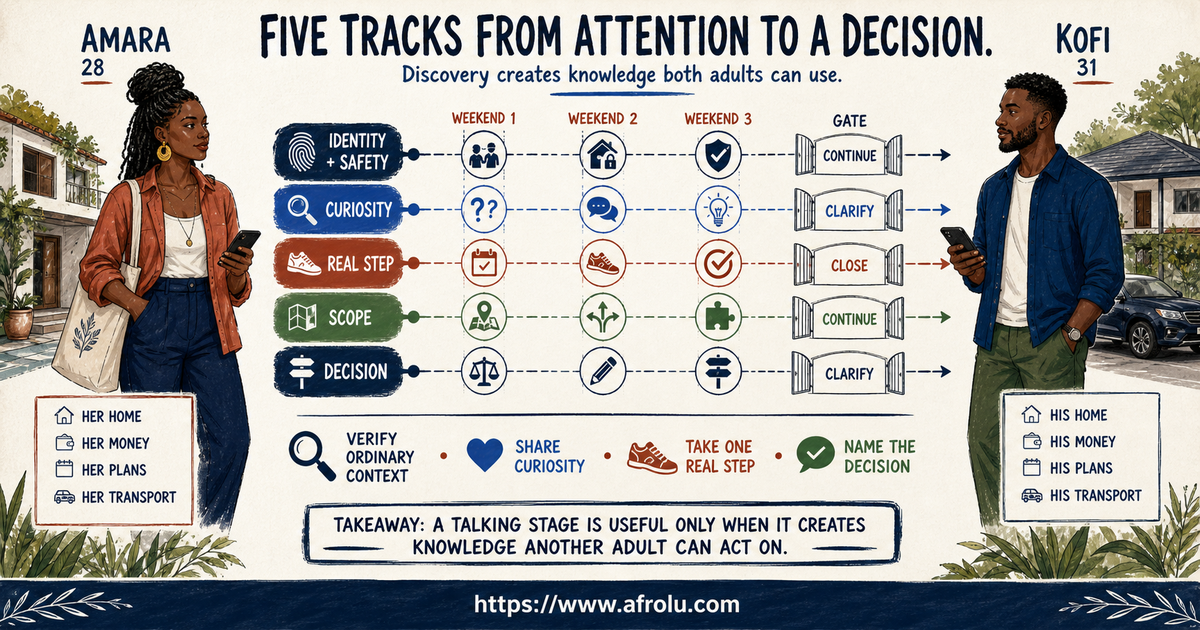
Attention keeps contact alive; evidence makes the next choice possible.
Written and edited by Jean-Claude Mukendi · Relationship Guides Editor
Treat the talking stage as low-agreement discovery, not a secret relationship or countdown. Track five kinds of evidence: IDENTITY + SAFETY, RECIPROCAL CURIOSITY, REAL-WORLD PROGRESSION, SCOPE + BOUNDARIES and DECISION MOVEMENT. Use a short call or staffed public weekend plan without paid verification, private access or controlled transport. Discuss romantic intent, other dating, health when relevant and what remains undecided. After a chosen interval, continue, clarify, pause, close or take safety action; do not use message volume as commitment.
Early relationship discovery · New Relationship Starters
Is this talking stage producing safer knowledge and a real weekend choice, or only increasing closeness while identity, plans, scope and decisions remain unavailable?
The talking stage is an informal low-agreement phase in which two adults explore possible romantic interest before they have mutually agreed that they are dating, exclusive or in a committed relationship. Attention can create real closeness, but it does not by itself verify identity, supply consent or establish scope.
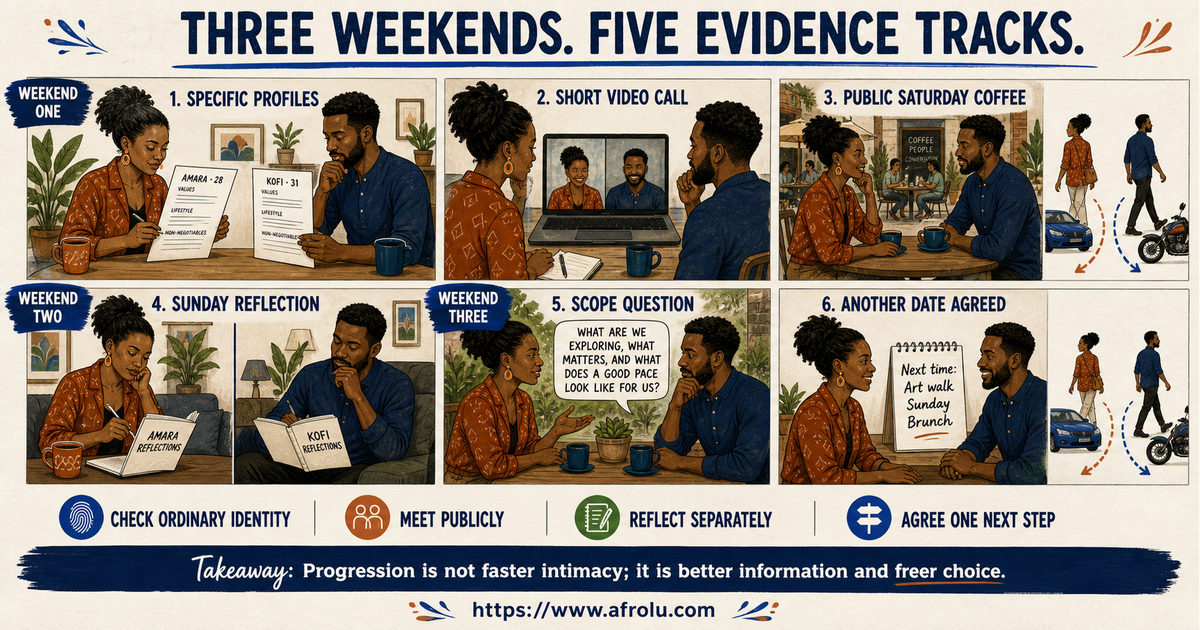
Amara and Kofi are fictional adults, 28 and 31. Across three weekends they move from specific profiles to a short call, public coffee, separate reflection, a discussion of other dating and two further dates. Their stage becomes useful because it creates five kinds of evidence and a mutual next step—not because contact earns automatic status.
The five-track weekend field guide
Move from warm contact to knowledge both adults can use
Jean-Claude keeps attention visible while separating identity, curiosity, progression, scope and decision evidence.
Choose one bounded weekend step, reflect separately, discuss the smallest current agreement and continue only while a new decision becomes possible.
Identity + safety
Add ordinary context without payment, documents, passwords or surveillance.
Reciprocal curiosity
Make sure both adults learn, contribute and accept limits.
Real step + scope
Use a bounded plan and name romantic interest, other dating and boundaries.
Decision movement
Continue, clarify, pause, close or act on safety without awarding a relationship prize.
Define only what exists
The talking stage is discovery, not a secret relationship or a universal countdown
A talking stage is this guide's name for low-agreement contact in which two adults explore possible romantic interest before they have agreed they are dating, exclusive or in a relationship. It may begin on an app, through friends, at work, in a community or after a friendship changes. The label itself supplies no consent or commitment.
Attention can feel relational before shared facts exist. Daily messages, voice notes, private jokes and imagined weekends may create closeness while identity context, other dating, sexual-health information, boundaries and a practical meeting remain unknown. Warmth may be genuine. It still cannot answer questions that require evidence or mutual agreement.
No rule says a talking stage should last three days, three weekends or three months. Amara uses three weekends because her route is weekend-first and the interval can contain several real steps; it is an editorial example, not research-backed timing. The useful measure is movement: what became safer, clearer, reciprocal and actionable?
Talking does not have to become dating. Either adult may learn that friendship, casual contact, a later meeting or closure fits better. A direct question is not pressure when yes, no, not yet and a different offer remain available. Threats, fraud, sexual coercion or repeated boundary violations are not ordinary stage uncertainty and require a safety response.
Track five kinds of evidence
Identity, curiosity, progression, scope and decision movement cannot replace one another
IDENTITY + SAFETY asks whether ordinary claims remain consistent and can be checked without payment, passwords, surveillance or secret investigation. A brief video call may add context but proves neither character nor every claim. Keep early contact on a platform when useful, refuse match-sent verification pages and retain independent meeting transport.
RECIPROCAL CURIOSITY asks whether both adults contribute specific questions, answers, context and repair. One person should not interview, entertain or emotionally regulate the entire stage. Different communication styles can still be reciprocal. The question is whether Amara can learn about Kofi while also being known, not whether their message counts are identical.
REAL-WORLD PROGRESSION means a step that improves knowledge or fit: a video call, public coffee, shared activity or workable long-distance plan. Moving off-platform is not progression by itself. Neither is sexual disclosure, private access or a costly trip. A safe next step is bounded, independently leaveable and freely accepted.
SCOPE + BOUNDARIES covers romantic interest, other dating, contact rhythm, privacy, sexual-health discussions when relevant and what remains undecided. DECISION MOVEMENT asks whether another date, clarification, pause or ending is becoming possible. A stage can stay low-agreement and still be useful when each weekend makes the next choice easier.
Follow three weekends without assigning a relationship
Amara and Kofi turn a warm chat into five kinds of evidence
Amara, 28, is beginning to date with clearer boundaries after years focused elsewhere. Kofi, 31, has a busy weekday schedule and prefers weekend plans. Their profiles give specific interests but neither assumes verification. Before the first weekend they exchange a short video call, keep private addresses undisclosed and agree that no third-party verification payment is needed.
On the first Saturday they meet for coffee at a staffed public venue, arrive independently and plan seventy minutes. Curiosity is reciprocal. Kofi accepts when Amara declines a second location. Neither interprets the public date as exclusivity. On Sunday each reflects separately instead of using nonstop messages to decide whether the meeting was successful.
During week two, contact becomes lighter. Amara asks whether the pace reflects work or fading interest. Kofi says weekdays are demanding and offers a Saturday museum visit. He confirms on Friday and follows through. They discuss that both remain free to date others and that neither wants physical escalation yet. The stage becomes clearer without becoming committed.
After the third weekend, they compare the five tracks. Identity context is ordinary but still incomplete, curiosity is mutual, two public steps occurred, scope is named and another decision is possible. They agree to two more dates and a later exclusivity conversation only if both want it. The talking stage did its job by producing a choice, not by earning a title.
Use three states on each evidence track
Clear, review and stop states keep uncertainty and danger separate
IDENTITY + SAFETY is clear when details stay consistent and ordinary checks require no sensitive disclosure. Review reluctance to video call or a changed story without assuming fraud. Stop payment requests, fake verification links, document demands, coercive secrecy or a private meeting that removes the exit. One badge or video does not certify safety.
CURIOSITY is clear when both adults ask, answer and remember. Review a style mismatch or one-sided week. Stop when one person extracts intimacy, sexual material or emotional labour while revealing little and punishes limits. A short reply is not automatically low interest; the repeated distribution of effort matters more than equal message volume.
REAL STEP is clear when a mutually chosen call or public plan occurs. Review one cancellation with accountable repair. Stop repeated private-location pressure, controlled transport or expensive travel before enough context exists. SCOPE is clear when romantic interest, other dating and boundaries can be discussed without assuming exclusivity or sexual access.
DECISION is clear when the evidence supports another date, a scope question, pause or closure. Review a real constraint with a named next point. Close when attention keeps repeating while every decision remains deferred. Use safety support rather than another clarity conversation when threats, stalking, extortion, image abuse or coercion appears.

Message volume cannot replace identity, reciprocity, plans, scope or movement.
Ask the question that changes the next choice
Ten scripts move from verification to a real decision without forcing a label
For VERIFY: 'A short video call would help before we meet.' 'I use official platform safety pages myself.' These lines add ordinary context without demanding a passport, password or paid verification. Amara can still decline after the call. Kofi can decline the call and accept that she may not meet.
For PLAN: 'Would Saturday coffee or Sunday video work?' 'Let's confirm the staffed venue by Friday.' 'I arrange my own return.' Two options turn vague interest into a usable response while a confirmation point protects the weekend. A private alternative or pickup is a material change, not a small favour she must accept.
For SCOPE: 'Are you exploring romantically or as friends?' 'Are you currently dating other people?' 'I am interested, and I am not exclusive.' 'Before relevant intimacy, I discuss health and boundaries.' These separate intention, other dating, agreement and sexual health instead of asking one label to do all four jobs.
For DECIDE: 'I would like another date.' 'I need more time before changing the scope.' 'This is not the route I want, so I am closing it.' Use the line that fits and let no remain complete. If the response includes threats, repeated accounts or pressure, end access and use appropriate support.

Ask the question that changes the next choice.
Review movement, not romantic performance
Five folders lead to five equal outcomes after the chosen interval
Open the IDENTITY + SAFETY folder first. Which ordinary details became more consistent? Were money, documents, home, accounts and transport still independently controlled? Then review CURIOSITY: did both adults learn, contribute and accept boundaries? Do not use chemistry to excuse an empty safety folder or caution to erase genuine respectful interest.
Open REAL STEP and SCOPE next. Did a call, meeting or plan actually occur? Was a cancellation repaired? Can both adults describe romantic interest, other dating, contact pace and what remains undecided in similar words? A talking stage does not fail because exclusivity is absent. It fails as a decision tool when shared meaning cannot be discussed at all.
DECISION MOVEMENT asks which door is available: continue discovery, clarify scope, pause, close or take safety action. Continue only when a new step will add useful information. Clarify one answerable issue. Pause for a genuine capacity limit. Close for mismatch or repeated non-movement. Safety action is separate and should not wait for the review date.
Name what would change the next decision and when it can realistically happen. If nothing new is likely to emerge, another month of messages may add closeness without knowledge. Release the channel without demanding that the other adult admit fault. A friendship or ending can be an honest outcome even after warm contact and two good dates.

The review asks what became knowable, safer and actionable.
Compare the agreement, not the amount of contact
Talking, friendship, dating, situationship and commitment answer different questions
A TALKING STAGE explores possible romantic interest before a dating or relationship agreement. FRIENDSHIP may include closeness and frequent contact without mutual romantic intent. Friends can become romantic partners, and research suggests friends-first pathways are common in studied samples, but closeness alone does not announce that transition.
DATING means both adults understand that romantic exploration is occurring, though exclusivity, seriousness and future direction may still be open. A SITUATIONSHIP is commonly used for relationship-like closeness without enough shared agreement about status, responsibilities or direction. The talking stage is earlier discovery; a situationship often includes more repeated intimacy and accumulated expectation.
A COMMITTED RELATIONSHIP includes an explicit mutual agreement whose scope still needs detail: exclusivity or openness, time, sexual health, visibility, support and direction. A relationship label does not supply consent, passwords, money or permanent access. The agreement can change only through another conversation and each adult remains free to leave.
Choose the next question. Is romantic interest mutual? Are we dating? Does either person date others? What contact and boundaries fit? Do we want a committed agreement? Ask only the decision now available. If the smallest accurate description disappoints, do not inflate it to preserve hope; choose whether the actual route works.
Eight weekend-first moments where attention becomes—or fails to become—evidence
Daily messages create quick closeness
Attention is real but identity, plan, scope and decision evidence remain incomplete.
Enjoy the contact while asking for one bounded next step.Amara wants ordinary context before meeting
A short call can add information without certifying character or requiring documents.
Offer the call and keep the right to decline afterward.A supposed safety page asks for payment
Match-sent verification can expose identity and financial information or trigger charges.
Do not use it; navigate independently to official help.A public Saturday meeting goes well
One date adds conduct and fit evidence but creates no automatic exclusivity or sexual access.
Reflect separately and name the next small question.Kofi messages less between weekends
The rhythm may fit his work context when a real Saturday plan and follow-through remain available.
Ask once about capacity and judge the stated next point.Amara learns Kofi is meeting others
The fact may fit a low-agreement stage but still change her willingness to continue.
Discuss scope and choose without assuming betrayal or consent.A second-location suggestion removes the public exit
Progression does not require faster private access or controlled transport.
Decline the change and leave independently.Both adults can name the current route
They choose two more dates without pretending commitment already exists.
Record what remains undecided and when it may be discussed.Ten signs across identity, curiosity, progression, scope and decisions
Ordinary identity details remain consistent without paid verification
Both adults contribute questions, answers, context and repair
A video call or public meeting adds real information safely
Other dating and present romantic interest can be discussed directly
A no, slower pace or changed physical answer remains effective
Each weekend makes another decision easier rather than only warmer
Daily messages grow while every real-world step remains vague
Private access, documents, money or verification links are rushed
One adult carries curiosity, planning and emotional regulation alone
Threats, stalking, extortion or repeated unwanted contact appears
Review the talking stage through ten separate questions
| Situation | What it may mean | What to do next |
|---|---|---|
| Can ordinary identity context be checked safely? | Fits: Details stay consistent without sensitive data. Needs review: One ordinary check remains open. Stop: Payment, documents or secrecy is demanded. | Verify independently and stop any financial or identity extraction. |
| Is curiosity reciprocal? | Fits: Both adults ask, answer and remember. Needs review: One style mismatch needs discussion. Stop: One person extracts intimacy while revealing little. | Reduce effort and ask whether the contact is genuinely mutual. |
| Is there a real next step? | Fits: A bounded call or public plan exists. Needs review: One detail needs confirmation. Stop: Only fantasy or private pressure is offered. | Offer one safe option and decide from the response. |
| What follows a cancellation? | Fits: It is owned and responsibly repaired. Needs review: One alternative needs confirmation. Stop: Warm messages replace the missed plan. | Count follow-through rather than affection as repair. |
| Can romantic intent be named? | Fits: Exploring, friendship or dating is discussable. Needs review: Uncertainty is admitted honestly. Stop: Every direct question is punished or evaded. | Choose whether the undefined route itself fits. |
| Is other dating understood? | Fits: Each adult can make informed choices. Needs review: A scope conversation is due. Stop: Exclusivity is implied while facts are hidden. | Clarify before increasing emotional or sexual access. |
| Do boundaries remain effective? | Fits: No and not yet are accepted. Needs review: One misunderstanding is repaired. Stop: Pressure, ridicule or retaliation follows. | Close access and use suitable support if the pattern continues. |
| Has the stage created decision movement? | Fits: Another date, clarification or ending is available. Needs review: A real constraint has a named review point. Stop: Attention repeats while all decisions stay deferred. | Stop gathering the same evidence and select the available route. |
| Does weekend-first dating protect ordinary life? | Fits: Work, rest and friends remain intact. Needs review: One weekend needs redesigning. Stop: Every weekend is reserved without a plan. | Use a confirmation point and release unconfirmed time. |
| Is another conversation safe and useful? | Fits: One answer could change the decision. Needs review: Support may help frame it. Stop: Threats, stalking or coercion make contact unsafe. | Skip clarity dialogue and prioritise appropriate safety action. |
Ten lines for verification, weekend plans, scope, health and closure
“A short video call would help before we meet.”
“I use official platform safety pages myself.”
“Would Saturday coffee or Sunday video work?”
“Let's confirm the staffed venue by Friday.”
“I arrange my own return.”
“Are you exploring romantically or as friends?”
“Are you currently dating other people?”
“I am interested, and I am not exclusive.”
“Before intimacy, I discuss health and boundaries.”
“This is not the route I want, so I am closing it.”
Know the difference
Five close bonds can look warm while carrying different agreements
A talking stage explores whether romantic dating should begin and gathers evidence without assuming status or exclusivity.
Friendship, dating, situationship or commitment each carries a different shared description and next decision.
Closeness can be felt privately; relationship scope must be understood mutually.

Closeness does not create an agreement that has never been discussed.
Separate five warm bonds by their actual agreement
| Type or dimension | What it describes | Best next question |
|---|---|---|
| Talking stage | Possible romantic interest is being explored before a dating or relationship agreement. | Ask whether a real date or another discovery step is wanted. |
| Friendship | Closeness exists without mutually understood romantic exploration. | Name any change in intent instead of implying it. |
| Dating | Both adults understand that romantic exploration is occurring. | Clarify pace, other dating and relevant boundaries. |
| Situationship | Relationship-like closeness has accumulated while status, duties or direction stay insufficiently shared. | Run a direct agreement conversation and choose from the answer. |
| Committed relationship | A mutual bond and scope have been explicitly agreed, though details can still change. | Maintain consent, repair and review rather than assuming permanent access. |
| Friends-first romance | A friendship transitions through newly mutual romantic intent rather than a stranger-based start. | Discuss the transition and protect the friendship choice. |
| Online-only contact | Digital closeness exists without enough verified or real-world progression. | Choose a safe call, meeting, distance plan or closure. |
| Unsafe contact | Money extraction, threats, coercion, tracking or fraud creates a separate risk pattern. | Protect access and use suitable official support. |
Use the five-track weekend map in six moves
Keep the definition small
A talking stage is low-agreement discovery, not a hidden commitment.
Use five evidence tracks
Identity, curiosity, progression, scope and decisions answer different questions.
Move through safe steps
A call or public date adds context without requiring private access.
Name scope early enough
Romantic intent, other dating and boundaries should not depend on assumptions.
Protect weekend time
Unconfirmed plans return to ordinary life at a stated point.
End when evidence repeats
More messages are unnecessary when no new decision can emerge.
Questions for identity, curiosity, weekends and decisions
Choose a few prompts that fit the moment. This is a reference library, not a list to complete.
Identity questions
Add context without extraction.
- Are details consistent?
- Would a short call help?
- Is any payment requested?
- Which data stays private?
- Can I still decline?
Curiosity questions
Check the shared conversation.
- Who asks questions?
- Who remembers answers?
- Can limits be named?
- Is repair mutual?
- Am I being known too?
Weekend questions
Turn warmth into one safe step.
- Saturday or Sunday?
- Which staffed venue?
- When is confirmation?
- Who controls transport?
- What is the end time?
Decision questions
Name the available route.
- What became clearer?
- What remains unknown?
- Is scope shared?
- Can another step add evidence?
- Continue, clarify, pause, close or safety?
What talking-stage, pathway, disclosure, survey and safety sources support
A 2024 qualitative study examines emerging-adult meanings
Nine focus groups with 52 emerging adults at two Midwestern U.S. universities explored how participants constructed 'just talking,' including technology, ambiguity and relationship development themes.
Evidence limit: The predominantly white, cisgender university sample cannot define a global stage, fixed sequence or African timeline.
Friends-to-lovers research challenges one courtship script
Multi-study work found friends-first initiation common and often preferred in studied samples, supporting the guide's view that talking stages can begin through different channels.
Evidence limit: Retrospective and sample limits prevent one prevalence estimate from becoming a rule for every reader.
Research links digital disclosure and intimacy in context
A study of self and partner online disclosure examined associations with intimacy and satisfaction, supporting the idea that messaging can create genuine closeness.
Evidence limit: More disclosure does not verify identity, create commitment or make sensitive early sharing safe.
Pew documents both positive and unwanted experiences
The 2023 U.S. survey analysis describes a wide range of online-dating experiences, including unwanted behaviour and scam exposure, supporting balanced rather than universally negative app language.
Evidence limit: U.S. survey estimates must not be presented as Kenyan, African or global prevalence.
CDC recommends conversation before sex
Current CDC guidance encourages partners to discuss sexual-health information and safer choices before sex, supporting explicit health questions rather than treating a stage label as informed consent.
Evidence limit: The source is general U.S. public-health guidance, not individual clinical advice or local law.
The FBI warns about fake dating verification services
The IC3 alert describes fraudsters moving users off-platform and directing them to supposed free verification sites that collect identity or payment information and may create recurring charges.
Evidence limit: The warning supports official independent navigation but cannot determine whether every reluctant or private dater is fraudulent.
Six ways a talking stage becomes a hidden agreement
Counting daily messages as commitment
Attention supplies a status it cannot create. Repair: ask for shared scope.
Using one universal timeline
Three weekends become law. Repair: review evidence movement and actual constraints.
Calling off-platform movement progress
The channel changes without knowledge or safety. Repair: require a real bounded step.
Treating video as verification
One call certifies character. Repair: keep gradual checks and independent safety.
Assuming exclusivity
Romantic focus becomes a secret agreement. Repair: discuss other dating directly.
Continuing after the same evidence
Messages replace decision movement. Repair: choose the available route.
Use a reviewed resource that matches the decision
This guide focuses on the relationship decision, so it does not rank dating apps. Check current prices, safety tools, and local availability before choosing a service.
Explore the guide library
Show more related guides
Continue with Afrolu
Show more Afrolu guides
Relationship-development research and official health and verification guidance
Afrolu reviewed these health, research, safety, or public guidance resources while editing this page. They support the behaviour and safety guidance; they do not diagnose any individual described by a reader.
Talking-stage questions for new weekend-first daters
What is the talking stage?
It is an informal low-agreement discovery phase in which two adults explore possible romantic interest before agreeing that they are dating, exclusive or in a relationship. The term varies across people and cultures. Messages, calls and closeness can be genuine, but they do not silently create status, consent, exclusivity or responsibility.
How long should a talking stage last?
There is no universal duration supported by research. Use the actual constraint and evidence movement: did identity context become clearer, curiosity stay reciprocal, a real step occur, scope become discussable and another decision become possible? Three weekends is Amara's example, not a rule. Continue only while the next interval can add useful evidence.
Does daily texting mean we are dating?
No. Daily contact may create closeness and habit, but dating status requires mutual understanding. Ask whether both adults are romantically exploring, whether a real date is wanted and what other dating or boundaries apply. The answer may be friendship, talking, dating, uncertainty or no. Choose from the smallest accurate description.
Should we video call before meeting?
A short call can add ordinary identity and communication context and may reduce some uncertainty, but it does not certify character or every claim. Do not share sensitive documents or pay for match-sent verification. Keep the right to decline afterward and use a staffed public venue, independent transport and personal phone control for any meeting.
When should we discuss other dating?
Discuss it before assumptions affect sexual health, exclusivity, emotional investment or consent. You can ask during the talking stage without demanding commitment. A person may be dating others, undecided or focused on one contact without an agreement. Each answer lets the other adult decide what pace and access they freely accept.
Is meeting in person required for progression?
Not in every context. Distance, disability, health, safety or location can make a video call or another verified step more realistic. Progression means better information and a more actionable decision, not faster physical access. An online-only connection still needs ordinary identity context, mutual effort, a realistic plan and explicit scope to avoid indefinite ambiguity.
How do I protect my weekend from vague plans?
Offer one or two bounded options and state a reasonable confirmation point. Until it is confirmed, keep the time available for ordinary life. If the point passes, make other plans without punishment or games. One accountable cancellation can be repaired; repeated affection without a plan is evidence that the present route may not fit.
What if a match sends a verification link?
Do not enter payment, identity or account information through a match-sent page. The FBI has warned about fake dating verification schemes and recurring charges. Navigate independently to the platform's official safety resources. A legitimate desire for safety never requires a stranger to control your financial details, passwords or sensitive documents.
When does a talking stage become a situationship?
There is no official threshold. A talking stage usually describes early discovery before dating or relationship agreement. Situationship often describes more accumulated intimacy or relationship-like routines while status, responsibilities or direction remain insufficiently shared. The useful move is not to win the label; ask what exists now and whether that agreement works.
How do I end a talking stage kindly?
Say that the route is not what you want and close the contact. You do not owe a diagnosis, long defence or friendship offer. If there is no safety concern, one clear message is enough. If threats, repeated accounts, stalking, coercion or fraud appears, prioritise access controls, evidence and appropriate platform, local or emergency support.
One thing to do now
Ask only the next question the evidence can answer
Continue discovery while each interval adds safer identity context, reciprocal knowledge, a real step, clearer scope or an actionable decision. Clarify one issue when an answer could change the route. Pause for genuine capacity. Close for mismatch or repeated non-movement. Refuse payment and sensitive-data requests and use suitable support for threats, stalking, fraud or coercion.