Five markers · twelve-day route
Learn Long-Distance Dating Without Living on Breadcrumbs
A first-route long-distance dating guide to breadcrumbing, calls, time zones, confirmation, repair, visits, money, identity, safety and clean closure.
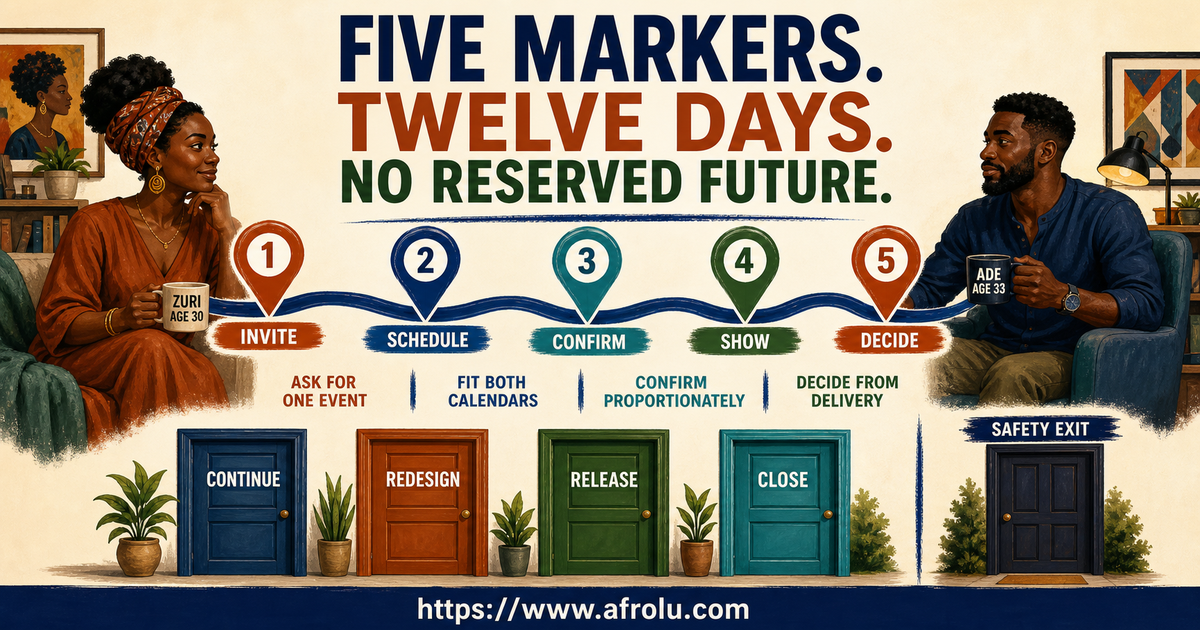
Distance explains logistics; it does not exempt a connection from one observable next step.
Written and edited by Nia Kato · Profile Advice Editor
Use five observable markers. INVITE requests one proportionate voice call, video call or later public meeting. SCHEDULE fits both local times, work and sleep. CONFIRM protects the reserved window. SHOW records delivery; a change counts as repair only when timely notice, ownership, a specific alternative and follow-through arrive together. DECIDE from contact, invitation, schedule, delivery and safety: continue, redesign, pause, release or close. Twelve days is fictional, not universal. Keep money, identity, documents, images, travel and exit independent. Fraud, coercion, threats, stalking or controlled travel bypasses the ordinary route and uses suitable support.
Mixed signals · New Relationship Starters
How can adults new to long-distance dating distinguish breadcrumbing from honest low capacity, request one answerable event and decide from delivery without diagnosing motive or funding the route?
Breadcrumbing is a repeated pattern of intermittent romantic signals that renew expectation without proportionate movement after clarity is requested. It is not a diagnosis or proof of motive. Honest low capacity, agreed asynchronous contact, repaired delay and route mismatch can also involve few messages but provide accurate scope and answerable decisions.
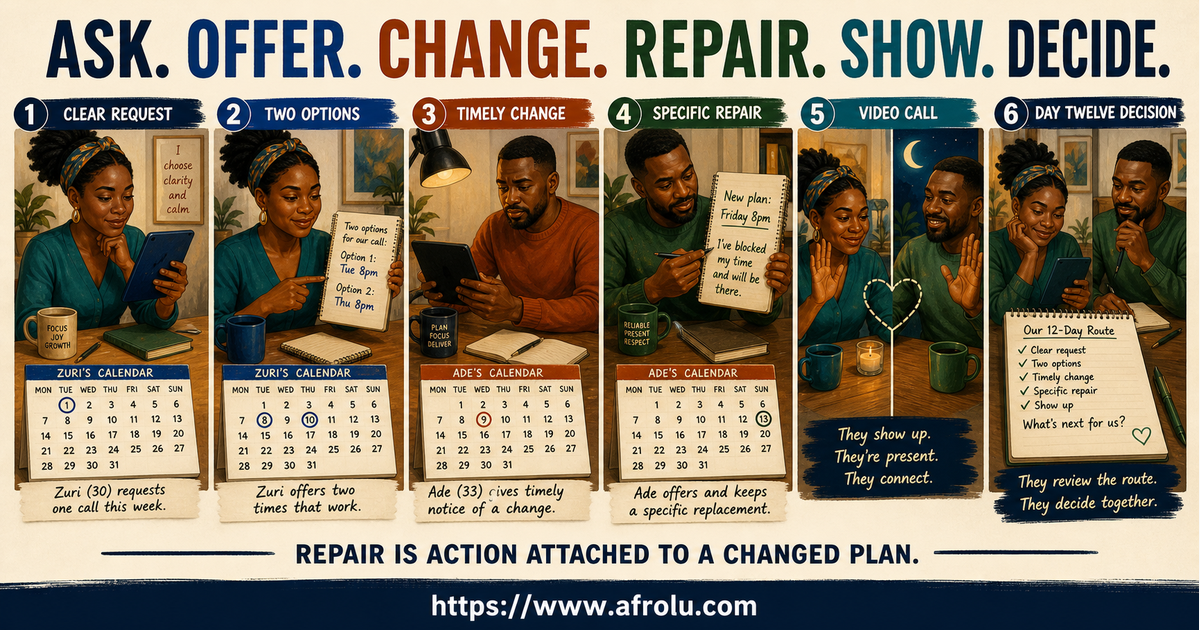
Zuri, a fictional 30-year-old adult new to long-distance dating, asks Ade, 33, for one twenty-minute video call. He changes the first time with notice, owns the disruption, offers a specific Saturday alternative and delivers it. On day twelve they choose another bounded interval without travel, payment or exclusivity promises.
The five-marker first distance route
Move warm contact through logistics into one delivered decision
Nia treats breadcrumbing as an emerging conduct pattern, respects honest asynchronous capacity and keeps travel, money and identity on a separate safety lane.
Invite one event, schedule it across real calendars, confirm, observe delivery or repair, then decide without reserving an indefinite future.
Invite
Ask once for a proportionate voice call, video call or later public plan.
Schedule and confirm
Fit both local times and release the window if it stays uncertain.
Show
Count delivery or a complete repair rather than affectionate context alone.
Decide
Continue, redesign, pause, release, close or use suitable support.
Start with observable movement
Breadcrumbing describes a contact pattern, not a diagnosis of the person sending messages
Adults new to intentional long-distance dating can mistake continuity for progression. A morning reaction, a late-night compliment and a weekly future joke may feel like an emerging relationship while identity, a real-time conversation, current dating scope and a workable meeting route remain unanswered. The affection may be genuine even when the route does not move.
Use breadcrumbing for a repeated pattern of intermittent romantic signals that renew expectation without proportionate effort toward a stated connection. Do not apply it to every delayed reply. Work, caregiving, disability, data costs, time zones and communication preference can create low frequency. The useful distinction is whether constraints are named and one realistic next step can be agreed.
Research links breadcrumbing experiences with some difficult wellbeing outcomes and examines attachment insecurity among people who engage in it, but cross-sectional associations cannot diagnose Ade or prove why he sent a message. Zuri therefore observes conduct: who invites, who schedules, what is confirmed, what happens and whether a missed event receives repair.
Money, identity and safety sit outside the patience question. A distant person who requests transfers, bank access, intimate proof, passwords, identity documents or secret travel creates a different problem. Do not wait twelve days to see whether fraud or coercion becomes more consistent; reduce access and use appropriate independent support channels.
Move through five markers
Invite, schedule, confirm, show and decide make a first long-distance route answerable
INVITE names one synchronous or real-world event appropriate to the stage: a voice call, video call or later public meeting. Zuri asks once because another warm week without an event would not help her choose. The invitation is not a demand for instant access; Ade remains free to decline or offer a proportionate alternative.
SCHEDULE fits both cities' real calendars and time zones. Instead of 'soon,' the adults compare two windows and the expected length. Asynchronous messages can remain meaningful, and research suggests communication formats carry different meaning for different long-distance couples. A schedule simply makes the chosen event observable without requiring continuous digital presence.
CONFIRM happens close enough to protect each person's time. SHOW records whether the agreed event occurs. A change does not automatically equal breadcrumbing: notice, ownership, a specific alternative and delivery can form repair. Repeated affectionate apologies without a new event keep hope alive but do not restore the plan.
DECIDE asks whether to continue, redesign, pause, release or close. A video call may support ordinary consistency, but it does not prove relationship status, financial claims or safety. Travel requires a later, independently planned layer: public location, separate funds and transport, trusted plan sharing, documents protected and no dependence on a new match.
Follow one repaired call
Zuri gives a warm long-distance connection one direct request and decides from delivery
For five days, Ade sends thoughtful voice notes but answers Zuri's meeting questions with 'we will make it happen.' Zuri is new to intentional long-distance dating and notices she is preserving future weekends around an undefined possibility. She says she enjoys the contact and asks for one twenty-minute video call within the next week.
Ade offers Wednesday evening or Saturday morning. They choose Wednesday and name their local times. On Tuesday he learns he must cover a work shift. He tells Zuri before the confirmation point, owns the change and offers Saturday at the original length. Zuri accepts without treating flexibility as endless availability.
Ade confirms Saturday morning and attends from a neutral, ordinary setting. They discuss broad location, current dating scope, communication preference and what a future public meeting would require. Neither shares identity documents, employer systems, account screenshots or money. The call adds proportionate consistency; it does not certify every biographical claim.
On day twelve, Zuri decides to continue for another bounded interval and alternate invitations. They do not buy travel or promise exclusivity. If Ade had missed the repaired call and returned with affection but no event, Zuri would have released the route. Both results protect clarity; continuation is not the prize.
Read four lanes independently
Contact, plans, delivery and safety should not be averaged into chemistry
CONTACT continues when both adults initiate, ask questions and accurately describe the low-agreement stage. Clarify affectionate messages that carry no answer about purpose. Stop contact used to obtain intimate images, account access or money. Message frequency by itself cannot separate honest low capacity from intermittent hope maintenance.
PLAN continues when an invitation receives a time, format, duration and confirmation point. Clarify genuine uncertainty with two options or a later decision date. Stop reserving weekends, leave or travel around 'maybe.' A first long-distance route should not require one adult to maintain an unlimited calendar for a person who will not choose an event.
DELIVERY continues when events happen or a change receives timely notice, ownership, a specific alternative and later follow-through. Clarify one missed call rather than prosecuting it. Stop recurring warm apology cycles that never attach to delivery. Repair changes future conduct; affectionate explanation alone supplies context but not movement.
SAFETY continues when identity checks are proportionate and money, documents, devices, images, travel and exit remain independent. Stop urgent transfers, paid verification, secret travel, controlled accommodation, threats, stalking or image abuse. Use independently found platform, financial, legal, health or emergency support suitable to location and circumstances.

Do not average money or identity danger against otherwise warm communication.
Ask without demanding constant access
Ten direct lines move a new long-distance route from contact to a decision
For purpose, Zuri can say, 'I enjoy talking and want to know whether we are exploring a real dating route.' Ade can answer yes, no or something more limited. The line does not create exclusivity. It prevents one adult from privately assigning a relationship future to messages that the other sees as casual contact.
For scheduling, she can offer two local-time windows and a call length. If neither fits, Ade can provide a concrete alternative. The goal is not daily proof; it is one mutually chosen event. Asynchronous messages remain available between events, but neither adult must sacrifice work, sleep or community life to demonstrate interest.
For change and repair, Zuri can say, 'I can release Wednesday; please offer one time you can confirm.' One repair opportunity may be proportionate. She is not required to repeat the request indefinitely. A pattern becomes clearer when each affectionate return is compared with the event that was promised and either delivered or not.
For travel, money and closure, she can state that visits use separate funds, public plans and independent accommodation, and that she does not send money or documents. 'The contact is warm, but the route is not moving, so I am releasing it' closes without diagnosing Ade or inviting another undefined promise.

Clarity requests one event and accepts the answer; it does not reserve a stranger's future.
Review the route on day twelve
Continue, redesign, pause, release or close without making patience a virtue test
CONTINUE when the adults share purpose, a workable rhythm and at least one delivered event. Keep the next interval bounded and alternate effort where practical. A successful call does not create a relationship, exclusivity or travel duty. It simply justifies another question if both adults want one.
REDESIGN when the contact is reciprocal but the format or schedule does not fit. They might replace spontaneous video with planned voice, use asynchronous notes or lengthen the interval. Low frequency can be honest when scope and constraints remain clear. Redesign should reduce confusion, not hide the absence of any event.
PAUSE when capacity is uncertain. RELEASE when Zuri stops reserving emotional or calendar space but does not need a conflict narrative. CLOSE when the offered route does not fit or repeated non-delivery supplies enough evidence. She may block when contact is unwanted; she does not owe one final explanation if engagement would create risk.
SEEK SUPPORT when fraud, coercion, threats, stalking, intimate-image abuse, identity misuse or unsafe travel appears. If funds moved, contact the relevant provider promptly. Secure accounts and preserve useful evidence. Immediate danger requires urgent local support, not another five-marker experiment or a demand that the person explain their motive.

The interval gathers evidence for a choice; it does not create a universal long-distance deadline.
Separate six nearby contact states
Breadcrumbing, low capacity, asynchronous rhythm, repair, mismatch and danger need different responses
A BREADCRUMBING PATTERN repeatedly renews romantic expectation while avoiding proportionate movement after clarity is requested. HONEST LOW CAPACITY names constraints and offers a smaller route that can actually be delivered. Both may involve few messages. The difference appears in scope, answerability and whether hope is continually reopened without action.
ASYNCHRONOUS CONTACT can be an agreed long-distance format, especially across time zones or demanding schedules. It becomes useful when adults know what it means and how decisions occur. REPAIRED DELAY includes timely notice, ownership, a specific alternative and delivery. Neither state needs a daily message quota to be legitimate.
ROUTE MISMATCH means one adult wants calls, visits or serious direction that the other cannot offer. A direct no or limited offer is not breadcrumbing when it is accurate and accepted. Zuri can still close because the route does not fit. Naming mismatch prevents a moral trial where an ordinary incompatibility becomes a personality claim.
UNSAFE CONDUCT includes financial fraud, coercion, stalking, identity misuse, intimate-image abuse, threats or controlled travel and exit. Protect access and use suitable support without delay. A distant relationship can feel emotionally real while a money story is fraudulent; closeness never replaces independent verification or financial boundaries.
Eight first-route distance moments where contact and movement diverge
Warm check-ins never produce a call
Affection recurs whenever Zuri steps back, but every event remains 'soon.'
Ask once for a bounded call and decide from the answer and delivery.Time zones genuinely limit overlap
Both adults have narrow waking windows and demanding work.
Choose one realistic synchronous slot and use agreed asynchronous contact elsewhere.A call changes with notice
Ade owns a work conflict before confirmation and offers one specific alternative.
Accept or decline the repair, then judge it by later delivery.A missed call receives only compliments
The apology is affectionate but supplies no replacement event.
Request one repair if wanted; release the reserved future if none arrives.A first visit needs travel money
The distant match asks Zuri to buy a ticket or send accommodation funds.
Do not transfer; keep travel independent and use official reporting routes if needed.Video is treated as complete verification
One real-time call is used to demand documents, exclusivity or private travel.
Treat the call as one consistency point and keep every other agreement separate.Low contact is accurately named
Ade says he can offer one weekly call and no visit this quarter.
Choose whether that honest route fits without calling it breadcrumbing.The route simply does not fit
Zuri wants a visit pathway while Ade wants indefinite online companionship.
Close the mismatch cleanly rather than waiting for one preference to change.Twelve signals across contact, plans, delivery and safety
{'name': 'Mutual initiation', 'detail': 'Both adults sometimes begin contact rather than one repeatedly reopening it.'}
{'name': 'Accurate scope', 'detail': 'Online companionship, romantic discovery and dating are not silently exchanged.'}
{'name': 'One clear invitation', 'detail': 'A voice call, video call or future public meeting is requested proportionately.'}
{'name': 'Two workable options', 'detail': "Scheduling reflects both cities' time, work, sleep and care."}
{'name': 'Confirmation protects time', 'detail': 'A named point releases the event if it remains uncertain.'}
{'name': 'Delivery is visible', 'detail': 'The agreed event occurs without one adult chasing it into existence.'}
{'name': 'Change receives notice', 'detail': "A constraint is communicated before the other person's time is consumed."}
{'name': 'Repair is specific', 'detail': 'Ownership, a realistic alternative and later follow-through arrive together.'}
{'name': 'Asynchronous contact is agreed', 'detail': 'Voice notes or texts have a known meaning rather than preserving hidden status.'}
{'name': 'Travel remains independent', 'detail': 'Funds, documents, accommodation, transport and exit are not controlled by a new match.'}
{'name': 'Identity checks stay proportionate', 'detail': 'A call adds context without demanding sensitive records or surveillance.'}
{'name': 'A direct answer can close', 'detail': 'No, limited capacity or mismatch is accepted without intermittent romantic re-entry.'}
Review the distance route through ten independent questions
| Situation | What it may mean | What to do next |
|---|---|---|
| What is this contact for? | Fits: Both describe the same discovery scope. Needs review: Warmth exists but status is assumed. Stop: Romance is used to obtain money or proof. | Name the present route and close unsafe access. |
| Has one event been invited? | Fits: A proportionate call or meeting is named. Needs review: Plans remain 'soon.' Stop: Only secret or financially dependent travel is offered. | Ask once for an answerable event or decline. |
| Can both schedules hold it? | Fits: Local times and duration are clear. Needs review: One calendar carries all sacrifice. Stop: Work, sleep or location proof is demanded. | Offer two balanced windows and protect private routines. |
| Is confirmation defined? | Fits: The event can be released at a named point. Needs review: The whole day remains reserved. Stop: Uncertainty is enforced through punishment. | Set a confirmation boundary or release the plan. |
| Did the event happen? | Fits: Both attend as agreed. Needs review: One change needs review. Stop: Repeated non-delivery is covered by pressure or deception. | Count delivery; allow only proportionate repair. |
| What did repair contain? | Fits: Notice, ownership, alternative and delivery. Needs review: Context arrives without a new event. Stop: Blame, guilt or threats follow the missed plan. | Accept real repair or close the recurring loop. |
| Is asynchronous contact mutually understood? | Fits: Its scope and rhythm are agreed. Needs review: One person reads more status into it. Stop: Continuous access is demanded across time zones. | Define meaning and protect work, sleep and ordinary life. |
| Are money and identity separate? | Fits: No transfer or sensitive proof is owed. Needs review: Oversharing is framed as closeness. Stop: Funds, documents, passwords or intimate images are requested. | Stop access and use independent support channels. |
| Does a visit have an independent route? | Fits: Public plan, funds, accommodation and exit are controlled separately. Needs review: Logistics remain premature. Stop: Travel depends on the match or becomes secret. | Delay, redesign or decline unsafe travel. |
| What does day twelve support? | Fits: One next choice follows delivery. Needs review: A pause or redesign is needed. Stop: Danger bypasses ordinary review. | Continue, redesign, release, close or seek suitable support. |
Ten lines for calls, schedules, repair, visits, money and closure
“I enjoy talking and want to know whether we are exploring a real dating route.”
“Would a twenty-minute voice or video call fit within the next week?”
“I can do Wednesday at seven or Saturday at ten in my local time.”
“If we have not confirmed by Wednesday noon, I will release the call.”
“I can release Wednesday; please offer one time you can confirm.”
“One call helps us learn; it does not make us exclusive or verified.”
“Any first visit will be public, independently funded and separately leaveable.”
“I do not send travel, emergency or verification money to a dating contact.”
“I will not share identity documents, passwords, intimate proof or live location.”
“The contact is warm, but the route is not moving, so I am releasing it.”
Know the difference
Long-distance breadcrumbing and nearby low-contact routes require different agreements
Contact repeatedly reopens hope while invitations, scheduling, events or decisions remain unavailable after clarity is requested.
Low frequency can be workable when constraints and present scope are accurate and at least one decision mechanism exists.
A slow route can be honest; an indefinite reservation is not a plan.

Frequency alone cannot identify breadcrumbing; delivered scope and response to clarity matter.
Separate eight nearby long-distance contact and safety routes
| Type or dimension | What it describes | Best next question |
|---|---|---|
| Breadcrumbing pattern | Intermittent romantic signals renew expectation while proportionate movement stays unavailable. | Ask once for an event, then release or close from the delivered answer. |
| Honest low capacity | Constraints and limited availability are named accurately without promising more. | Choose whether the small route fits and stop reserving anything beyond it. |
| Asynchronous contact | Messages or voice notes carry an agreed role across distance and time zones. | Define how calls, meetings and status decisions will occur. |
| Repaired delay | A missed event receives timely notice, ownership, a specific alternative and delivery. | Use the repair as current evidence without guaranteeing future reliability. |
| Online companionship | Connection is meaningful but neither adult is offering a dating or visit route. | Accept the actual scope or close if romantic discovery is required. |
| Route mismatch | One adult wants progression the other cannot or does not want to provide. | Believe the limited answer and close without diagnosing intention. |
| Romance fraud | A false or manipulated relationship opens money, account, identity or travel access. | Stop transfers and use appropriate platform, financial and official reporting channels. |
| Unsafe conduct | Threats, stalking, coercion, image abuse or controlled travel changes the problem. | Protect access and use suitable local specialist or emergency support. |
Use the five-marker distance evidence route in six moves
Separate contact from movement
Warm messages do not create a call, meeting, status or future.
Use five observable markers
Invite, schedule, confirm, show and decide each provide different evidence.
Respect honest low capacity
Few messages can be workable when scope and constraints are accurate.
Require action in repair
Context becomes repair only when a specific alternative is delivered.
Keep travel independent
Money, documents, accommodation, transport and exit stay separately controlled.
Release without a verdict
Non-delivery can close the route without diagnosing motive or attachment.
Questions for contact, logistics, delivery and decision
Choose a few prompts that fit the moment. This is a reference library, not a list to complete.
Contact
Name present scope.
- Who initiates?
- What does this mean?
- Is warmth reciprocal?
- What remains assumed?
- Can a no stand?
Logistics
Make one event answerable.
- Which format?
- What local times?
- How long?
- When is confirmation?
- What is the alternative?
Delivery
Count action and repair.
- Did it happen?
- Was notice timely?
- Who owned the change?
- Was repair specific?
- Was it delivered?
Decision
Release the reserved future.
- Continue?
- Redesign?
- Pause?
- Close?
- Which safety support fits?
What breadcrumbing and long-distance communication research can support
A preliminary study examines psychological correlates of ghosting and breadcrumbing experiences
The research supports treating breadcrumbing as an emerging digitally mediated pattern with possible wellbeing associations.
Evidence limit: Cross-sectional self-report data cannot diagnose motive, establish causation or represent every age and culture.
Research examines attachment insecurity and breadcrumbing engagement in India and Spain
The study supports caution about inferring engagement patterns from attachment measures and shows the construct is still developing.
Evidence limit: Country samples and correlations cannot label Ade or predict an individual relationship.
The BREAD-ASR study develops a breadcrumbing-perpetration questionnaire
The work clarifies repeated sporadic non-committal signals as a research construct and reports psychometric testing.
Evidence limit: Its adolescent sample and measure-development purpose do not create an adult diagnostic test.
A long-distance relationship study examines which communication formats feel meaningful
Survey findings support asking couples what paper, audio, visual and digital formats mean rather than ranking channels universally.
Evidence limit: The U.S. self-report sample cannot prescribe Zuri and Ade's frequency or prove relationship quality.
Research compares texting, voice and video in long-distance and geographically close relationships
The study supports examining responsiveness and medium together rather than assuming video or high frequency is always superior.
Evidence limit: Cross-sectional emerging-adult data cannot establish the best channel for every couple.
FTC guidance explains distance stories, urgent money requests and reporting
Official guidance supports refusing transfers or gifts to an online love interest not met in person and using independent checks.
Evidence limit: General fraud guidance cannot verify identity or determine motive in a specific contact.
Six ways warm contact becomes hidden waiting or unsafe access
Counting frequency as commitment
Regular signals are promoted into movement. Repair: identify invite, event and decision evidence.
Diagnosing every delayed reply
Distance constraints become a character verdict. Repair: ask about scope and one workable event.
Holding an undefined calendar
A future weekend stays reserved around 'maybe.' Repair: use a confirmation release point.
Accepting apology as repair
Warm context substitutes for a replacement event. Repair: look for ownership, alternative and delivery.
Using video as full verification
One call unlocks documents, money or travel. Repair: keep each evidence lane separate.
Funding the first visit
Romantic hope creates financial dependence. Repair: keep all travel independently affordable and leaveable.
Use a reviewed resource that matches the decision
This guide focuses on the relationship decision, so it does not rank dating apps. Check current prices, safety tools, and local availability before choosing a service.
Explore the guide library
Show more related guides
Continue with Afrolu
Show more Afrolu guides
Breadcrumbing studies, long-distance communication research and fraud guidance
Afrolu reviewed these health, research, safety, or public guidance resources while editing this page. They support the behaviour and safety guidance; they do not diagnose any individual described by a reader.
First long-distance dating and breadcrumbing questions
What is breadcrumbing in long-distance dating?
It is a repeated pattern in which intermittent romantic signals renew expectation while proportionate movement remains unavailable after clarity is requested. The term describes conduct, not a diagnosis or proven motive. Low frequency can be honest when constraints and present scope are accurate and one decision route exists.
How long should I wait for a video call?
There is no universal number. Twelve days belongs to Zuri's fictional route. Ask for one proportionate event within a period that fits both calendars, offer workable options and set a confirmation point. Decide from the answer, repair and delivery rather than from an internet deadline.
Does daily texting mean the relationship is progressing?
No. Daily contact may be meaningful, friendly, romantic or routine, but it does not verify identity, create exclusivity or produce a meeting. Ask what the contact currently means and which event or decision it supports. Message volume is evidence only about message volume.
Can slow replies be healthy across time zones?
Yes. Asynchronous contact can protect work and sleep when both adults understand its scope. A workable route might include voice notes and one planned weekly call. The issue is not speed alone; it is whether constraints are accurate, effort is reciprocal and decisions can become answerable.
What counts as repair after a missed call?
Useful repair includes timely notice when possible, ownership of the effect, a specific realistic alternative and later delivery. Context without a new event may explain the miss but does not restore movement. You may allow one repair, redesign the route or close without proving bad intent.
Is one video call enough to verify someone?
No. It can add ordinary consistency between voice, face, context and story. It cannot prove legal identity, employment, relationship status, financial claims or safety. Do not exchange documents, passwords, intimate images or money as verification. Navigate independently to official information where proportionate.
Who should pay for a first long-distance visit?
Each adult should choose only travel they can independently afford, control and leave. Do not send ticket, emergency, visa, accommodation or verification money to a new online contact. A later couple may agree expenses differently, but early travel should not make one person financially or logistically captive.
What if the person honestly cannot visit soon?
Believe the available route: perhaps one weekly call and no visit this quarter. Decide whether that fits. Accurate low capacity is not breadcrumbing merely because it is small. Avoid reserving more future than was offered or treating patience as a test that will eventually produce a different answer.
When should I stop asking for clarity?
One direct request and one proportionate repair opportunity are often enough to reveal the route, though circumstances vary. If warm contact repeatedly returns without an event or answer, release or close. You do not need to diagnose motive, win an argument or wait until the person admits a pattern.
When does this become a safety issue?
Money requests, identity misuse, account access, intimate-image pressure, stalking, coercion, threats or controlled travel and exit require access-focused action. Use appropriate platform, financial, legal, health, specialist or emergency support for your location. Immediate danger should not wait for a twelve-day review.
One thing to do now
Ask for one event, then release the future from evidence
Continue only while present scope, invitations, scheduling, delivery, repair and safety remain answerable. Believe an accurate low-capacity offer and decide whether it fits. Release or close repeated non-delivery without diagnosing motive. Protect access and use suitable independent support for fraud, coercion, threats, stalking, image abuse, identity misuse or unsafe travel.