Six bays · action-specific readiness
Start Dating After Heartbreak Without Turning It Into a Readiness Test
A clarity-first guide to dating after heartbreak in a career-heavy season: check six re-entry bays, protect work, disclose with purpose, and choose freely.
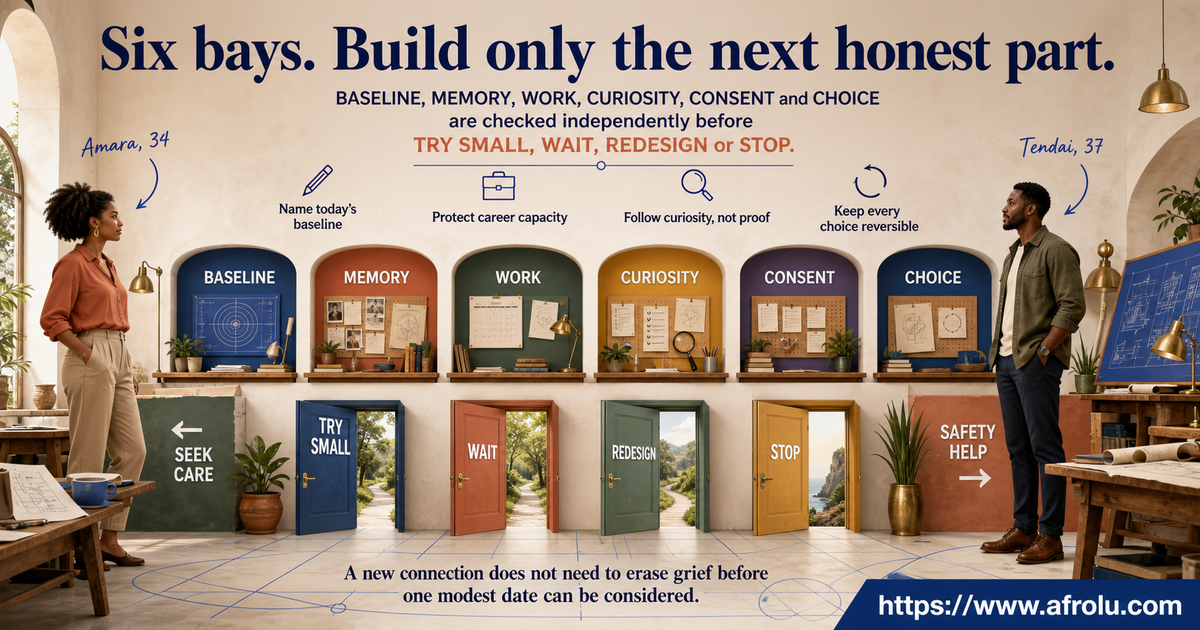
Readiness is specific to the next action; no single mood must certify the whole new journey.
Written and edited by Clarisse Uwimana · Dating Culture Editor
Replace ‘Am I fully ready?’ with six current bays: BASELINE, MEMORY, WORK, CURIOSITY, CONSENT and CHOICE. Decide one action at a time—a reply, call or bounded public date—and state what it does not include. Share history only for a present purpose, protect deadlines and recovery, notice comparison without making the new person compete, and keep affection, exclusivity, images, touch and sex separate. Choose TRY SMALL, WAIT, REDESIGN, STOP, SEEK CARE or SEEK SAFETY HELP. No universal readiness feeling or timeline exists.
Starting over · New Relationship Starters
How can an adult explore a new connection after heartbreak during a career-heavy season while keeping grief, work, curiosity, disclosure, consent and choice in their proper scope?
Dating after heartbreak is not a stage reached when grief disappears. It is a series of optional, specific decisions made after a meaningful ending. Ordinary grief, memory triggers, career strain, healthy curiosity, mismatch and persistent impairment can overlap. The six-bay workshop clarifies the next action; it cannot diagnose grief, certify healing, identify a rebound or predict relationship success.
Amara, a fictional 34-year-old adult in a career-heavy season, exchanges messages with Tendai, 37, and chooses two bounded public dates across three weeks. She names one comparison, protects a deadline and keeps affection separate from physical intimacy. He accepts each limit. She continues with one planned call, without treating the story's dates as a universal recovery schedule.
The six-bay re-entry workshop
Build one reversible action while grief, work and curiosity move at different speeds
Clarisse replaces the recovery finish line with six bays that can support different answers on the same day.
Check baseline and memory, protect work, test person-specific curiosity, unbundle consent and choose one door.
Name scope, not identity
A difficult reminder can be real without deciding the whole journey.
Protect capacity
Interest may stay alive while a career deadline closes this week.
Share by purpose
History, affection, images, touch and sex remain independently chosen.
Leave every door usable
Try, wait, redesign, stop, care and safety are not a ladder.
Replace the finish line
Ask whether one next action fits instead of whether heartbreak is over
After a significant ending, the question ‘Am I ready to date?’ can become too large to answer. It bundles a profile, a reply, a coffee, affection, exclusivity, sex and partnership into one verdict. Amara divides the question. She may be ready to read a message, interested in one public date and not ready for frequent contact or intimacy.
Clarity does not require emotional purity. A new person can be interesting while a memory still hurts. Grief can appear during a good week without cancelling every choice made before it. The practical task is to notice scope and agency: can Amara choose the action freely, remain present enough to participate and stop without using Tendai as a rescue?
A career-heavy season adds another source of load. A deadline may reduce patience, sleep or conversational energy without saying anything final about grief. Protecting work prevents urgency from borrowing tomorrow's capacity. A smaller date format may be more truthful than either disappearing or promising a full relationship rhythm.
The new person also deserves freedom from an impossible role. Tendai is not responsible for proving that Amara is healed, outperforming an ex or absorbing every detail of the previous relationship. Amara shares what affects the present interaction while keeping private history and third-party information proportionate.
Open the six-bay workshop
Inspect baseline, memory, work, curiosity, consent and choice separately
BASELINE asks what ordinary functioning looks like now: sleep, food, focus, connection and daily tasks. A difficult day may fit ordinary fluctuation; persistent severe changes across settings deserve qualified assessment. MEMORY asks whether the past is being remembered, replayed as a current threat or used to compare Tendai with someone he has never met.
WORK asks what the career season genuinely allows. Amara protects a deadline, does not answer from a meeting and leaves a free evening empty when she needs recovery. CURIOSITY asks whether she wants to learn about Tendai as himself rather than collect reassurance that she is still desirable or reproduce a familiar future.
CONSENT keeps emotional disclosure, messages, affection, images, touch and sex separate. A vulnerable story is not a request for rescue, and receiving it does not earn intimacy. CHOICE checks whether try, wait, redesign and stop remain ordinary options. If Amara must continue to prove recovery, the process has borrowed authority from her.
The bays can show different states at once. Baseline may be steady, memory tender, work crowded, curiosity alive, consent limited and choice open. That can support one short public date. Another week may support none. The framework resists universal delay and forced optimism by asking only what the current action requires.
A three-week re-entry note
Follow two modest dates without making the new connection carry the old ending
Amara sees Tendai's profile during a demanding project week and feels curiosity followed by guilt. She waits until the next evening, asks whether she wants this conversation rather than validation and sends a short reply. She shares that she is dating slowly after a significant ending but keeps the former partner's identity and private history out of the exchange.
They plan one daytime hour in a public place with separate transport. During the first date Tendai mentions a hobby that reminds Amara of her former relationship. She notices comparison, names that she needs a moment and returns to the present question. Tendai neither asks for the whole breakup story nor tries to prove he is different.
A deadline intensifies during the second week. Amara declines a spontaneous evening and offers no apology performance. Tendai accepts and proposes the following weekend. Before the second date, they discuss contact rhythm and Amara says affection is welcome but physical intimacy is not currently wanted. He receives that as a complete boundary rather than a challenge.
After the second date, Amara chooses one planned call and pauses new matching. She is still sometimes sad, yet curiosity about Tendai is specific and work remains intact. The decision is not a declaration of full readiness or a promise of partnership. Severe distress across functioning would belong with qualified care, not a longer dating experiment.
Read twelve bay signals
Separate available next actions, another-route needs and unsafe pressure
BASELINE and MEMORY signals ask whether life contains more than the breakup story. Ordinary grief can include waves of sadness, reminders and difficult dates. A next action may fit when Amara can notice the wave without making Tendai responsible for stopping it. A broader, persistent impairment deserves care rather than a more elaborate dating test.
WORK and CURIOSITY signals ask where attention comes from. A workable date fits around real obligations and includes questions about the new person. An overloaded route steals from sleep or deadlines, while rebound urgency asks the new connection to prove worth, erase silence or reproduce a future immediately.
CONSENT and CHOICE signals ask whether all branches remain reversible. Tendai can be disappointed by a boundary and still accept it cleanly. Pressure appears when the breakup is used against Amara—suggesting she owes intimacy to show trust, should disclose everything to prove honesty or must continue because stopping means she is damaged.
Safety overrides the workshop. Threats, stalking, impersonation, non-consensual image sharing, sexual coercion or blocked movement are not readiness challenges. Protect accounts and location, preserve useful evidence where safe and use appropriate platform, legal, health or emergency support for the present facts and the reader's current jurisdiction.

No readiness total can average away consent, persistent impairment or danger.
Disclose by purpose
Tell the present truth without turning a date into a case conference
A clear pace sentence avoids pretending the past never happened and making Tendai responsible for the whole story. Amara can say she is moving slowly after an ending and name the contact she can offer. She does not need to provide dates, screenshots, allegations or intimate details to make a boundary legitimate.
Comparison can be handled without asking the new person to compete. Amara might notice that a moment brought up an old association and ask to slow down. Repeated ranking, testing or reassurance-seeking can turn Tendai into an instrument; pausing and using other support protects both adults from that role.
Career boundaries should sound like current capacity, not a verdict on interest. A deadline can block a week while curiosity remains. Likewise, affection can be named without implying touch, sex or exclusivity. Before sex, partners, testing, prevention and contraception relevant to the adults need an unhurried conversation.
Stopping is a clarity line too. Amara may decide that dating is not wanted now, that this match does not fit or that a specific action should wait. She need not call herself unhealed or promise to return. If Tendai responds with pressure or unwanted pursuit, a protective route may replace further explanation.

Honesty about heartbreak does not require a full case file or a promise to be finished grieving.
Choose one build—or leave the bench empty
Try small, wait, redesign, stop, seek care or use safety help
TRY SMALL fits when baseline is workable, curiosity is person-specific and the action has clear limits. It might be one message, call or public hour. WAIT fits when grief, work or simple preference makes dating unwanted. Waiting need not have a deadline or be announced as a promise to a match.
REDESIGN fits when interest remains but the format borrows too much capacity. Shorten the date, change the channel, remove new matching or protect weekdays. STOP fits whenever the connection or dating route is unwanted. It does not prove that the adult started too early, and spent time need not be redeemed through continuation.
SEEK CARE fits severe, distressing or persistent effects across functioning and can coexist with any dating choice. SEEK SAFETY HELP fits threats, stalking, coercion, image abuse, fraud or blocked exit. Use the authority suited to the harm and jurisdiction rather than asking a date to manage the response.
After choosing, write a narrow note: what action occurred, what it cost, what remained intact and what boundary comes next. Avoid a daily readiness diary that turns every emotion into evidence for or against dating. A new journey needs attention for real decisions, not surveillance of whether the past has disappeared.

Waiting or stopping can protect a new journey; neither proves that recovery has failed.
Keep breakup evidence in proportion
Use longitudinal findings, workplace guidance, consent and safety sources without promising a course
Research has associated unmarried relationship dissolution with increased distress and lower life satisfaction, and longitudinal work has examined coping after breakups. These findings validate that endings can affect wellbeing while also showing variation. They do not establish a universal wait before dating, identify a correct coping strategy for Amara or prove that a new connection is a rebound.
A recent study described an average short-term symptom trajectory in one young-adult sample, but averages are not personal clocks. Some readers recover differently, experience ongoing harm or need qualified care. Afrolu therefore avoids translating a month count into readiness. Persistent severe impairment leaves the editorial lane.
WHO workplace guidance keeps career conditions visible. If concentration problems follow workload, poor support or harassment, dating redesign is not the full intervention. Current online-dating guidance also supports limiting details about an ex, home or workplace and keeping early meetings public, independently funded and independently leaveable.
Consent and sexual-health sources support checking before online or physical sexual activity and discussing relevant health information before sex. Heartbreak, disclosure, affection and a second date do not create consent. If a person weaponises history, ignores a no or causes harm, appropriate safety and health support takes priority.
Eight career-season re-entry moments where a workshop bay changes

The guilty match
The familiar hobby
The deadline week
The rescue offer
The good boundary
The ex update
The second-date ease
The history weapon
Twelve signals across baseline, memory, work, curiosity, consent and choice
{'signal': 'Baseline has ordinary range', 'meaning': 'Difficult feelings occur alongside sleep, work, food, friendship or moments of interest.', 'next_step': 'Choose only the action supported today.'}
{'signal': 'Memory is recognised', 'meaning': 'A reminder is noticed without being treated as a fact about Tendai.', 'next_step': 'Pause, orient to the present and ask a current question.'}
{'signal': 'Work remains intact', 'meaning': 'Dating does not repeatedly steal from deadlines or recovery.', 'next_step': 'Keep the bounded format or redesign.'}
{'signal': 'Curiosity is person-specific', 'meaning': 'Questions concern who the new adult is rather than how they compare.', 'next_step': 'Continue learning without future projection.'}
{'signal': 'Disclosure has a purpose', 'meaning': 'History shared helps explain a current boundary or need.', 'next_step': 'Stop before private detail becomes performance.'}
{'signal': 'Affection stays unbundled', 'meaning': 'Warmth does not imply exclusivity, home access or sex.', 'next_step': 'Ask separately for each next step.'}
{'signal': 'A no remains ordinary', 'meaning': 'The other person accepts a limit without diagnosing readiness.', 'next_step': 'Record respectful conduct without making it a guarantee.'}
{'signal': 'Stopping remains available', 'meaning': 'Neither sunk time nor recovery pride requires another date.', 'next_step': 'Wait, redesign or stop without a self-verdict.'}
{'signal': 'Comparison needs reassurance', 'meaning': 'The new person is repeatedly asked to defeat the old relationship.', 'next_step': 'Slow dating and use broader support rather than escalating access.'}
{'signal': 'Work strain crosses contexts', 'meaning': 'Exhaustion persists even when dating tasks disappear.', 'next_step': 'Examine workplace conditions and care routes.'}
{'signal': 'Impairment is severe or persistent', 'meaning': 'Basic functioning remains seriously affected across settings.', 'next_step': 'Seek qualified local assessment rather than another readiness test.'}
{'signal': 'Pressure uses the breakup', 'meaning': 'History is weaponised to obtain disclosure, intimacy or continued contact.', 'next_step': 'Close the branch and use appropriate safety help if needed.'}
Review the next dating action through ten independent questions
| Situation | What it may mean | What to do next |
|---|---|---|
| What is today's baseline? | Fits: Ordinary functioning has room for one action. Needs review: Capacity is difficult to read. Stop: Severe impairment or immediate risk is present. | Try small, wait or use qualified urgent support. |
| Is this memory or current evidence? | Fits: The distinction can be named. Needs review: Comparison colours the interaction. Stop: A current threat resembles prior harm. | Orient, slow or use a safety plan based on present facts. |
| Does work retain its boundary? | Fits: Dating fits around real obligations. Needs review: A date borrows from sleep or deadlines. Stop: A match intrudes on work or monitors availability. | Redesign capacity and protect professional access. |
| Is curiosity about this person? | Fits: Questions concern Tendai's actual life. Needs review: The date becomes reassurance about desirability. Stop: A rescue dynamic demands rapid dependence. | Slow the route and return support to appropriate places. |
| Does disclosure serve the present? | Fits: Enough context supports a current boundary. Needs review: Private history spills from pressure. Stop: Details are demanded or weaponised. | Limit disclosure and close coercive access. |
| Is affection still separate? | Fits: Warmth, touch and future contact have separate choices. Needs review: A good date creates assumptions. Stop: Sexual pressure or image abuse appears. | Unbundle every yes and use health or safety support. |
| Can the action stop cleanly? | Fits: Either adult can end without punishment. Needs review: Guilt or sunk cost encourages another step. Stop: Exit is blocked or retaliated against. | Stop, protect movement and seek appropriate help. |
| Is the next step smaller than the evidence? | Fits: One message, call or date fits. Needs review: Exclusivity or intimacy is being inferred. Stop: A relationship promise is demanded as proof. | Shrink the step and keep future decisions open. |
| Where does the difficulty persist? | Fits: It is bounded to one dating action. Needs review: Work or wider grief may be involved. Stop: Serious symptoms cross ordinary contexts. | Match redesign, workplace support or qualified care to scope. |
| Which workshop door is honest? | Fits: Try small or redesign is freely wanted. Needs review: Waiting or stopping protects agency. Stop: Danger needs a separate urgent route. | Choose without ranking the doors or promising return. |
Ten lines for pace, history, work, comparison, consent and stopping
“I am interested, and I am choosing one step at a time rather than promising a rhythm.”
“A significant relationship ended; I will share more only when it serves a current choice.”
“This deadline week is unavailable, and that is not a test of your interest.”
“That moment brought up an old association; I need to slow down and return to the present.”
“I like this connection, but affection does not create exclusivity or a future promise.”
“One planned call fits me; continuous messaging does not.”
“Kissing is welcome; going home together is not something I want tonight.”
“Before sex, I need time to discuss partners, testing and prevention relevant to us.”
“I do not want another date now, and I am not setting a return deadline.”
“This connection does not fit me, so I am ending it without making either of us a recovery test.”
Know the difference
Heartbreak and seven neighbouring re-entry states
Memories, grief or validation needs shape a specific dating choice after a significant ending.
Healthy curiosity, mismatch, career strain, persistent impairment or unsafe pressure requires a different route.
A feeling can be real without deciding every future action.

Describe the smallest supported state before choosing its next authority.
Separate eight nearby grief, curiosity, career, health and pressure states
| Type or dimension | What it describes | Best next question |
|---|---|---|
| Ordinary breakup grief | Sadness, longing or reminders occur after loss while ordinary life retains meaningful range. | Allow the feeling and choose dating actions separately. |
| Memory trigger | A current cue activates an old association without proving the new person is the same. | Orient to present facts, slow and ask what is needed now. |
| Rebound urgency | A new connection is asked to restore worth, erase pain or produce immediate certainty. | Shrink access and return support to friends, care or ordinary life. |
| Healthy curiosity | Interest concerns the new person's actual character and survives a modest pace. | Try one bounded action while keeping every later choice open. |
| New-person mismatch | Values, format, frequency or attraction does not fit, independent of the breakup. | Name mismatch and allow an ordinary ending. |
| Career strain | Deadlines, workload or work conditions drive depletion across dating and non-dating time. | Use workplace or qualified support suited to the context. |
| Persistent impairment | Severe changes in functioning persist across contexts and require individual assessment. | Seek qualified local care; no date can determine cause or treatment. |
| Unsafe pressure | Threats, stalking, coercion, image abuse or blocked exit restricts free choice. | Protect access and use appropriate platform, legal, health or emergency support. |
Use the six-bay re-entry workshop in six careful moves
Shrink readiness
Ask whether one action fits instead of grading the whole recovery.
Open six bays
Keep baseline, memory, work, curiosity, consent and choice independent.
Disclose by purpose
Share only history that serves a current boundary or agreement.
Protect the deadline
Career capacity can be low while relational curiosity remains real.
Unbundle affection
A good date creates no automatic exclusivity, intimacy or second date.
Route scope correctly
Wait, care and safety help answer different kinds of evidence.
Questions for baseline, memory, curiosity and choice
Choose a few prompts that fit the moment. This is a reference library, not a list to complete.
Baseline
Name the current day without grading recovery.
- How am I functioning?
- What support exists?
- What is severe or persistent?
- What belongs to work?
- What needs care?
Memory
Separate association from present evidence.
- What triggered this?
- What fact is current?
- Am I comparing?
- What disclosure serves now?
- Can I pause?
Curiosity + consent
Meet the new person one choice at a time.
- What do I want to learn?
- Which contact fits?
- What affection is welcome?
- What is not agreed?
- Can either stop?
Choice
Keep every workshop door ordinary.
- Try small?
- Wait?
- Redesign?
- Stop?
- Which care or safety route fits?
What breakup research and current work, consent and safety guidance can support
A within-subject study examined distress and life satisfaction after unmarried relationship dissolution
The study supports recognising that breakup can coincide with measurable changes in wellbeing rather than dismissing the event.
Evidence limit: Its 18-to-35 sample and observational design cannot set Amara's timeline or determine whether she should date.
Longitudinal research examined attachment, coping strategies and post-breakup symptoms
The work supports treating coping processes as relevant and avoiding shame-based assumptions about adjustment.
Evidence limit: Its emerging-adult sample cannot diagnose attachment, prescribe coping or predict an individual outcome.
A longitudinal young-adult study described an average course of depressive symptoms around breakup
The findings support the possibility of temporary distress and recovery while emphasising variation.
Evidence limit: An average group trajectory cannot become a three-month readiness rule or replace assessment.
WHO guidance addresses psychosocial risks and mental health at work
The resource supports separating career conditions from breakup and dating load when impairment crosses the week.
Evidence limit: General public-health guidance cannot assess Amara's workplace or establish personal accommodations.
eSafety guidance covers privacy controls, first meetings, consent violations and abuse
The resource supports limiting personal information, keeping dates public and using reporting tools when needed.
Evidence limit: Australian services must be adapted to the reader's jurisdiction and safety context.
eSafety guidance explains checking consent for online and offline sexual activity
The resource supports separate, current agreement for images, sexual messages, touch and sex.
Evidence limit: General consent information is not a substitute for local law, health care or trauma-informed support.
CDC conversation guidance recommends talking with partners before sex
The resource supports discussing partners, testing and prevention with enough time for informed decisions.
Evidence limit: It is U.S.-based general guidance and cannot provide individual clinical recommendations.
Six ways the new journey can become a recovery examination
Waiting for emotional perfection
One difficult feeling cancels all agency. Repair: decide the smallest current action.
Using a date as proof of healing
Continuation becomes a recovery exam. Repair: let each step stand on its own.
Making comparison a competition
The new person must defeat an ex. Repair: name the trigger and return to present facts.
Oversharing to prove honesty
Private history is disclosed under pressure. Repair: share by current purpose and consent.
Letting work decide worth
A deadline becomes evidence that connection is impossible. Repair: state capacity without a global verdict.
Calling pressure readiness coaching
A boundary is challenged as avoidance. Repair: keep the no and close unsafe access.
Use a reviewed resource that matches the decision
This guide focuses on the relationship decision, so it does not rank dating apps. Check current prices, safety tools, and local availability before choosing a service.
Explore the guide library
Show more related guides
Continue with Afrolu
Show more Afrolu guides
Longitudinal breakup evidence and current workplace, consent and safety guidance
Afrolu reviewed these health, research, safety, or public guidance resources while editing this page. They support the behaviour and safety guidance; they do not diagnose any individual described by a reader.
Dating after heartbreak in a career-heavy new journey
How do I know if I am ready to date after heartbreak?
Replace the global question with a specific one: are you freely interested in this reply, call or bounded date, with enough capacity to participate and stop? You may be ready for coffee and not for daily contact, sex or partnership. No universal feeling or timeline certifies readiness. Persistent severe impairment deserves qualified assessment.
Do I have to stop feeling sad before meeting someone new?
No universal rule requires emotional neutrality. Sadness, memories and curiosity can coexist. Ask whether the action is freely chosen, whether the new person is encountered as themselves and whether work, consent and support remain intact. A difficult wave may justify waiting without proving that all dating is wrong.
Is Amara's three-week, two-date story a recommended pace?
No. It is fictional narrative context chosen to make decisions visible. Your pace may be shorter, longer or no dating at all. Do not use the story as a healing clock. Build only the action supported by current capacity, privacy, consent, logistics and safety.
How much should I tell a new date about the breakup?
Share what serves the current interaction: perhaps that a significant relationship ended or that you want a slower pace. You do not owe names, screenshots, allegations or a complete chronology. Protect third-party privacy and your safety. More disclosure can happen later only if it remains wanted.
What if I compare everyone with my former partner?
Notice the comparison without treating it as truth about the new person. Ask what current fact triggered it and what you need now. If comparison repeatedly prevents curiosity or asks a date for constant reassurance, slow the route and use broader support instead of escalating access.
Can a career deadline mean I should pause dating?
Yes, if dating is unwanted or would borrow from essential work and recovery. You can also redesign with fewer messages or one later date. A deadline is a capacity fact, not proof that you are emotionally unavailable. State what is genuinely available and avoid promising later compensation.
Is a new connection a rebound?
Rebound is not used here as a diagnosis. Look at function: is the connection being asked to restore worth, erase pain or prove recovery, or is curiosity specific and each step independently chosen? You may slow or stop without settling the label, and timing alone cannot certify motive.
How should sexual-health conversations change after heartbreak?
They remain present-tense. Before sex, discuss partners, testing, prevention and contraception relevant to the adults with time for informed decisions and local advice. An ex's status or a claim of exclusivity does not answer current questions. Consent to affection, images, touch and sex remains separate.
What if a new date says my boundary proves I am not healed?
They may decide the pace does not fit, but they do not get to override your no or diagnose you. Repeat the boundary only if useful and safe, then reduce or close contact. If they weaponise history, harass you, threaten disclosure or restrict movement, use appropriate support.
When should grief move from reflection to qualified care?
Consider qualified local assessment when distress is severe, persistent, worsening or significantly affects sleep, concentration, appetite, enjoyment, work, relationships or basic tasks. Immediate self-harm risk or danger needs urgent local support. Dating choices and care can coexist; seeking help is not a failure.
One thing to do now
Build the next honest part without making a new person erase the old ending
Try only the next action supported by current functioning, person-specific curiosity, protected work, proportionate disclosure and freely reversible consent. Wait, redesign or stop whenever dating or the connection is unwanted. Use qualified local care for severe or persistent impairment and appropriate platform, legal, health or emergency support for threats, stalking, coercion, image abuse or blocked movement.