Later beginnings · Nairobi · dating safety
Dating Later in Life in Nairobi: Safety, Pace, and Clear Intent
Starting to date later than expected? Set your pace, protect privacy, choose a public Nairobi meeting, and discuss intent and consent clearly without pressure.

Choose a public, manageable first meeting without an age deadline.
Written and edited by Miriam Otieno · Senior Kenya Editor
There is no age deadline to catch up to. State what you want today, share only relevant personal history, and choose a public first meeting with a route home you control. Check current venue and transport details rather than relying on a static claim about Nairobi, and treat profile checks as partial information. Ask about consent, pause at money or access requests, and choose a second date only if you want one.
Dating basics · Late Entrants
How can adults who start dating later than expected meet in Nairobi with clear intent, privacy, and practical choices?
Self-directed dating later in adulthood means exploring a connection at a personally chosen pace, with honest present intent, proportionate privacy practices, a public first-meeting plan, and no assumption that age or past experience creates obligation.
Kariuki, 46, has not dated seriously for several years and is curious about meeting someone again. He does not present the gap as a warning or apology. He decides he wants a public first date and an honest conversation about relationship goals. A match can ask a thoughtful question, but Kariuki can keep private history private. They agree on a daytime coffee at a public venue he can reach independently. He checks current transport options and sets a one-hour window. When she says she is dating only one person at a time, they compare that with his own preference before making another plan. The conversation may lead to a second date or a mismatch; either way, he has not let an imagined age deadline choose for him.
later beginnings · Nairobi · present choice
Let your own experience set the pace
Beginning or returning to dating later than expected does not create a deadline or a deficit.
Clarify today's intent, protect personal details, plan a public meeting, and review behavior without age-based assumptions.
What do you want now?
Replace an imagined timeline with a present preference.
Can you reach and leave independently?
Check current local details and choose a public place.
What stays personal for now?
Use proportionate checks without sharing passwords or documents.
Are you genuinely interested?
Choose another date, a pause, or an ending from your experience.
life stage · self-respect · choice
Starting later is a timing fact, not a dating deficit
Kariuki, 46, has not dated seriously for several years and is curious about meeting someone again. He does not present the gap as a warning or apology. He decides he wants a public first date and an honest conversation about relationship goals. A match can ask a thoughtful question, but Kariuki can keep private history private.
A later start may mean a person has less practice with current apps or social norms, or simply different preferences. Ask for the information you need without treating yourself as inexperienced in every part of life. You can learn a platform's controls, choose an in-person meeting, or decline app dating altogether; none of those choices measures maturity.
Pressure to catch up can make a person accept exclusivity, marriage talk, financial help, or sexual intimacy before deciding whether a match is suitable. Slow the decision down. A promise made to stop feeling behind is not the same as a preference you freely chose. Take time to reflect or ask a trusted person for perspective.
You do not need to tell a date whether you have been married, how long you were single, or why you are returning unless it affects a current agreement or you decide the context matters. Be truthful about present commitments and intentions. Share personal history in stages that feel relevant, reciprocal, and safe for you.
intent · exclusivity · disclosure
A clear present answer is more useful than a future guarantee
Kariuki says he is open to a committed partnership but does not want to promise exclusivity before he knows the match. The other person says she is dating only one person at a time and would prefer the same. They can discuss whether their current preferences fit; neither has to treat a disagreement as a moral failing or persuade the other to wait.
A match may ask about a previous marriage, children, health, or a long gap. Answer the practical question honestly where it affects current decisions, but you can set a boundary around details that are not yet relevant. A person who demands proof, documents, passwords, or intimate disclosures before trust develops is asking for more than a conversation.
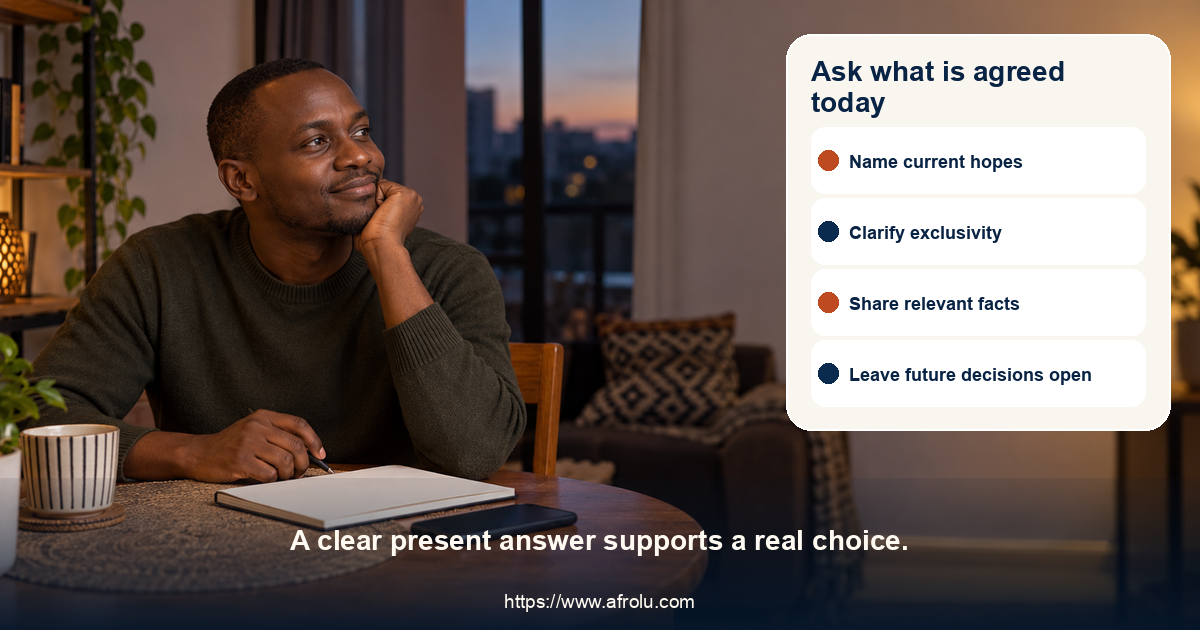
Be cautious about fast promises that assign you a role before you have met or discussed basic terms. Future plans can be sincere, but urgency alone does not confirm a person's identity or compatibility. Ask what is agreed today and make large choices—moving, lending money, leaving work, or sharing account access—independently and with time to think.
If you want to change the arrangement, bring it up before acting as if a new status already exists. If you want exclusivity, ask plainly and accept that the answer may be no. If the other adult wants a different direction, you can leave without proving that their preference or your own is objectively correct.
Nairobi · venue · transport
Choose a first meeting for comfort and access, not for a city-wide safety claim
Kariuki suggests a daytime coffee at a public place he already knows how to reach. They agree on the entrance and a one-hour window. He checks the day's transport options and keeps enough phone battery and fare for his return. The plan does not require a home pickup, private car, unfamiliar address, or explanation of where he lives.
Tell a trusted person the broad plan if that is useful to you, including the name of the venue and when you expect to check in. Save the profile details in a way that feels safe. These are optional planning practices, not guarantees, and responsibility for harmful conduct always belongs to the person who chooses it.
If the other person changes the plan to a private home, isolated venue, or location that is difficult for you to leave, pause. You can keep the original public plan, suggest another day, or end the meeting. A ticket, meal, ride offer, or distance travelled does not create an obligation to accept a new plan or physical intimacy.
Accessibility and comfort are individual: consider seating, noise, lighting, cost, mobility, prayer or dietary needs, and travel time. Ask rather than assume what a venue should be. Current conditions can change, so verify details from the relevant venue or transport service instead of relying on a static list in a guide.

Confirm the plan and keep an easy way to leave.
profile consistency · privacy · scams
Use ordinary checks while keeping both people's privacy intact
Kariuki asks for a brief in-app video call before meeting because it helps him feel more comfortable. His match agrees, and he still chooses a public venue and independent transport. If a person refuses a particular verification step, that alone may have several explanations; he can decide whether the uncertainty fits his own boundary without staging an investigation.
Look for contradictions across information the person volunteered, especially if the mismatch affects a real choice. Ask a direct question rather than searching for private records or contacting an employer. If you use a public profile search or image check, do not harass unrelated people who share a picture, and do not publish an accusation based on uncertain evidence.
Requests for money, investment, travel fees, gift cards, crypto, account access, or emergency transfers deserve a pause and independent advice. A genuine-sounding story can still be difficult to verify. Do not send funds you cannot afford to lose to someone you have not met. Consumer reporting instructions from the United States or Australia may not apply in Kenya.
If someone pressures you to leave the app immediately, reveals your phone number or contacts, demands secrecy, or uses personal details to threaten you, preserve relevant evidence when safe. Use the platform's report and block tools and check current Kenyan support resources. Avoid sharing a copied emergency number unless you have verified it from an official local source.

Use bounded verification and keep sensitive data private.
consent · pace · power
Experience, age, money, or a long wait never creates entitlement
Kariuki's date says she prefers not to kiss on the first meeting. He accepts the limit without asking her to explain whether it comes from past experience, faith, or a personal rule. If he wants a different pace, he can say so respectfully and decide whether to continue dating; pressure is not a compatibility strategy.
Do not let the label of a first date imply a right to touch, a kiss, an overnight stay, or continued contact. Ask clearly, listen to the answer, and stop when the other person is unsure or says no. A previous marriage, earlier intimacy, or a second meeting does not settle a new decision.
Financial help should remain separate from consent. If you choose to share costs, define what each person is contributing and avoid gifts that create pressure or dependence. Never share passwords or financial access as proof of trust. If an adult's work, caregiving, immigration, or financial circumstances make it hard to refuse, give the decision more time and seek independent support.
If harassment, threats, repeated unwanted contact, or image abuse occurs, the person targeted does not need to debate whether it is serious enough. Save messages if safe, stop engaging where possible, report through the platform, and seek current local specialist help. Legal options and support pathways vary, so use a qualified Kenyan source for a specific case.

Respect a no without demanding a reason.
reciprocity · consistency · judgment
Look for respect and follow-through rather than a polished life story
Kariuki notices that his match asks thoughtful questions but repeatedly changes the venue after he has confirmed the public plan. He names the effect and asks to keep the original location. If she respects the request, they can continue and see how it feels; if she mocks or ignores it, he has information to decline without diagnosing her.
Watch for asymmetry in expectations: one person asks for private details but offers none, demands a fast commitment while remaining vague about current status, or treats a refusal as an insult. These patterns are worth discussing. One awkward moment is not a diagnosis, and a concern can be enough to slow down even when you cannot label it.
If you are worried about missing a chance, remember that a good match can tolerate ordinary questions and reasonable time to decide. Do not excuse repeated deception because someone says your age means options are limited. Your boundaries do not need to become stricter or looser based on a social comparison; choose the standards that reflect your actual needs.
Ask a trusted person to review a profile or plan only if you want that perspective. They can help you notice inconsistency, but the choice remains yours. Avoid sharing another person's private messages widely or asking friends to confront them. If there is a credible threat, move from informal opinions to current platform and local support channels.
reflection · second date · pause
A second date is a choice, not evidence that you are behind
Kariuki enjoyed the conversation and asks whether his match would like to meet again at a daytime public event. She says she wants to keep dating other people, while he would prefer exclusivity before a second date. They discuss that difference directly. He can choose to continue under clear terms or decline without treating the opportunity as his last.
If you want another meeting, suggest a specific, manageable plan and ask for a clear answer. If you need more information, ask about the one issue that changes your decision. If you are not interested, close the connection briefly when safe. You do not owe a detailed explanation, continued access, or a response to repeated messages.
A dating pause can be useful after a stressful interaction or simply because other parts of life need attention. You do not have to replace the time with another app or date. If an experience raises a personal legal, health, or emotional concern, seek qualified support; a general guide cannot assess your individual circumstances.
Make the next decision in present tense: what am I comfortable agreeing to, what remains unknown, and what will I do if the boundary is not respected? This approach is practical at any adult age. It makes space for desire without letting fear of a timeline make the decision for you.
Eight moments where the pressure to catch up can change a dating choice
A friend says it is time to catch up
Kariuki is urged to accept a fast commitment because he started dating later.
Choose from current compatibility rather than an age deadline.A match demands an explanation for the dating gap
The person treats private history as proof that Kariuki is trustworthy.
Answer only what affects present decisions and set a boundary.A public plan becomes a private pickup
The match changes the location and offers transport after the date is set.
Keep the original venue or decline without needing to debate.A profile seems polished but details do not align
Some volunteered information conflicts, though the reason is unknown.
Ask directly and decide whether the uncertainty fits your boundary.An online match asks for an urgent transfer
The person cites travel, family, medical, or investment costs.
Do not send money; verify independently and seek trusted advice.Age or income is used to overrule a boundary
One adult says experience means the other should trust their judgment.
Restate the limit and leave if it is not respected.A good date is treated as a promise of intimacy
A person uses time or travel spent to imply a physical obligation.
Confirm current consent and remember that either adult can stop.A second date is accepted to avoid seeming too picky
Kariuki is not interested but fears he will not meet someone else.
Pause and choose from genuine curiosity, not scarcity.Fourteen signs of a considered pace and practical Nairobi plan
A later start is described without shame or an age-based deadline.
Present relationship intent is stated without guaranteeing a future outcome.
Personal history is shared only at the level relevant to a current decision.
A first meeting is public, manageable, and chosen by both adults.
Current transport and venue information is checked independently.
The reader keeps a return option that does not depend on the new match.
Profile checks are treated as partial information, not a character certificate.
Neither adult searches private records or contacts an employer to investigate a date.
A request for money, codes, or account access triggers a pause.
Physical boundaries are respected without age, experience, or money being used as leverage.
Both people can decline exclusivity or ask for more time without ridicule.
Plans and personal questions are reciprocal rather than one-sided.
A second date is chosen from interest and comfort, not fear of scarcity.
Local support routes are verified from current official or specialist sources.
A map for disclosure, verification, money, and a first meeting
| Situation | What it may mean | What to do next |
|---|---|---|
| I started dating later | That fact does not set your pace or explain your whole story. | Decide what you want from this interaction now. |
| They ask why I was single | They may be curious, but the detail is yours to share. | Answer briefly or keep the topic private for now. |
| They promise a future quickly | A hope may be sincere, but the present arrangement is still untested. | Ask what is agreed today and avoid rushed major decisions. |
| The plan moves to a private place | A venue change can alter your route and options. | Keep the public plan, reschedule, or leave. |
| They request verification | A reasonable question can still be handled without handing over sensitive data. | Choose a bounded call or platform feature; share no codes or documents. |
| Their profile details conflict | The discrepancy needs context; it does not prove one explanation. | Ask directly and decide whether you are comfortable continuing. |
| They ask for money | Urgency and a transfer request create financial risk. | Do not send funds; contact your bank if you already paid. |
| I feel pressured to catch up | A social comparison may be making the decision for you. | Pause and check what you would choose without the deadline. |
| They ignore a physical no | Consent is not being respected in that moment. | Stop the interaction and seek support if needed. |
| I do not want another date | A mismatch is sufficient; a person need not be at fault. | Close the connection briefly where it feels safe. |
Twelve direct scripts for privacy, intent, and consent
“I am open to a committed relationship, but I want to know someone before agreeing to exclusivity.”
“I am comfortable sharing more later; what matters for now is what I want in a connection.”
“I would prefer to keep our first meeting at the public cafe we agreed on.”
“Thanks for offering, but I will arrange my own route home.”
“I am happy to have a short in-app call, but I do not send identity documents or login codes.”
“That detail does not line up with what you told me. Can you clarify it?”
“I do not send money to someone I have not met, regardless of the emergency.”
“I do not want to make a commitment because I feel behind; I need time to decide.”
“I do not want to continue physically. Please stop now.”
“Are we agreeing to date only each other, or are we still seeing other people?”
“I enjoyed talking. Would you like to meet again in a public place next weekend?”
“I do not feel this is the right match for me, so I am ending contact.”
Know the difference
Self-directed dating pace versus pressure to make up for lost time
The adult chooses a public plan, asks about present intent, protects privacy, and allows compatibility to develop through observed behavior.
Fear of age or scarcity pushes someone to disclose too much, accept a private plan, send money, or promise exclusivity before they are ready.
A later start is not a reason to surrender time, privacy, or consent.

Notice whether urgency is replacing your own preference.
Self-directed choices versus a race against an imagined clock
| Type or dimension | What it describes | Best next question |
|---|---|---|
| In-app conversation | Keeps platform controls available but still involves uncertainty. | Share gradually and notice whether answers are consistent. |
| Brief video call | Can help compare basic presentation without proving identity or character. | Keep it short and do not share account codes. |
| Daytime cafe | Offers a public, familiar format with a natural time limit. | Choose a venue that works for both adults and check current details. |
| Public event | Gives the date a shared focus but can make conversation harder. | Agree on a meeting point and an independent return plan. |
| Long dinner | Can increase cost and make an early exit feel harder. | Choose it only if both adults want the length and expense. |
| Private pickup | May disclose a home location and reduce transport independence. | Meet at the venue and arrange your own route. |
| Fast commitment | Can sound reassuring but does not replace observed compatibility. | Discuss present status before promising exclusivity. |
| Second date | Adds another chance to learn but does not guarantee a relationship. | Say what you want and accept either answer. |
| Pause | Creates space after pressure, confusion, or a busy week. | Step back without treating the pause as a failure. |
A simple plan you can use today
No age deadline
A social timeline is not evidence that a match is right for you.
Present intent matters
Ask what both adults have chosen today, not what one hopes may happen.
Privacy can build gradually
A new date needs relevant context, not unrestricted access to your history.
Verification has limits
A video call or matching profile details cannot certify someone's character.
Nairobi needs current checks
Conditions vary by route, hour, access, and person; a static guide cannot rate locations.
A second date is optional
Continue only if interest and comfort are both present.
Questions organised by purpose and depth
Choose a few prompts that fit the moment. This is a reference library, not a list to complete.
Your timeline
Separate your own wishes from pressure to catch up.
- What do I want now?
- Which deadline did I invent or inherit?
- What pace leaves room for judgment?
Present terms
Make the current relationship arrangement speakable.
- Are we exclusive today?
- What would change if we were?
- What is still undecided?
First meeting
Keep logistics public, current, and reversible.
- Can I reach the venue independently?
- What is my return plan?
- Who can I check in with if I want?
Afterward
Choose from behavior and personal comfort.
- Did my boundary get respected?
- Am I genuinely curious?
- Would another date, pause, or ending fit?
What deserves a closer look
Replace the social clock with your own question
Ask whether this match's present behavior, goals, and pace suit the life you have now.
Evidence limit: The guide cannot decide what a reader should want from a relationship.
Plan around the actual day and route
Venue access, traffic, transport, and comfort can change; choose a public place and verify current details yourself.
Evidence limit: This page does not identify safe or unsafe neighborhoods.
Use proportionate checks
A bounded video call or direct question may help clarify a mismatch without searching private records or contacting an employer.
Evidence limit: No check proves identity or guarantees safety.
Pause before money or access
Urgent travel, medical, investment, gift-card, or account requests can be a warning to stop and seek independent advice.
Evidence limit: U.S. consumer reporting channels may not apply in Kenya.
Keep each decision current
Age, previous marriage, travel expense, gifts, and prior intimacy do not grant permission for a new activity.
Evidence limit: Seek qualified health support for personal medical questions.
Choose from observed experience
Interest can grow through respectful behavior, but a reader may also decline, pause, or end without having to justify a timeline.
Evidence limit: Local legal and support options vary.
Shortcuts that trade judgment for a false sense of urgency
Rushing to catch up
A social clock can push a reader into terms they would not otherwise choose.
Treating polish as proof
A confident story or professional image does not guarantee compatibility.
Over-sharing to establish trust
Sensitive information can be shared later when there is a clear reason.
Letting a match choose all logistics
A public plan and independent return option preserve choice.
Sending money to rescue a new match
Urgent romantic appeals can be difficult to verify and hard to reverse.
Ignoring a boundary to seem flexible
A respectful match can hear no without making it a character test.
Clarify exclusivity, read a date's actions, or decide about a second meeting
This guide does not rate Nairobi neighborhoods or replace current local safety, legal, medical, or emergency advice.
Explore the guide library
Show more related guides
Continue with Afrolu
Show more Afrolu guides
Sources used for this guide
Afrolu reviewed these health, research, safety, or public guidance resources while editing this page. They support the behaviour and safety guidance; they do not diagnose any individual described by a reader.
Questions about dating later in life and meeting in Nairobi
Is it too late to start dating?
No universal age deadline makes someone too late. Choose what you want now and move at a pace that fits your current life.
Do I have to explain a long dating gap?
No. Be truthful about current commitments and information that changes a match's choice, but your full personal history is yours to share when you choose.
How can I meet someone safely in Nairobi?
Choose a public venue that works for both adults, check current transport and venue information, and keep an independent way home. A guide cannot guarantee conditions or rank neighborhoods.
Should I video call before a first date?
You may choose a brief call if it helps you decide whether to meet. It is only one piece of information and does not verify character or guarantee an outcome.
What if the person's story does not match their profile?
Ask a direct, proportionate question and decide whether the answer fits your boundary. Avoid contacting employers or publishing an accusation based on uncertain information.
Should I send money for an emergency?
Do not transfer money, gift cards, cryptocurrency, or account access to a new online match. Seek independent advice and contact your bank promptly if you already paid.
Does dating later mean I should compromise more?
No. A social timeline does not require you to accept a relationship status, venue, disclosure, or physical choice that does not fit.
How do I discuss exclusivity?
Ask whether both adults are currently dating others and what exclusivity would change. Agree only when both freely want the same terms.
What if I feel unsure after a first date?
You can ask a question, take time, arrange another public meeting, or end the connection. Uncertainty does not create a duty to continue.
Where can I get help for online abuse in Kenya?
Use current official Kenyan or specialist resources and the platform's reporting tools. Support pathways can change; verify a service directly rather than relying on an old repost.
One thing to do now
Let the next decision fit the life you have now
Replace the pressure to catch up with a present-tense decision: what do you want, what is agreed, and what still needs a conversation? Share only relevant details, use proportionate checks without invading privacy, and choose a public Nairobi meeting with current route information and your own way home. Consent, money, and access remain separate choices. Continue, pause, or end from observed behavior rather than age stereotypes or fear of scarcity.