Six ledgers before dependence
Build Serious Long-Distance Love Without Risking an Established Life
A later-life serious distance plan that protects identity, home, assets, health, family roles and location choices before dependence.
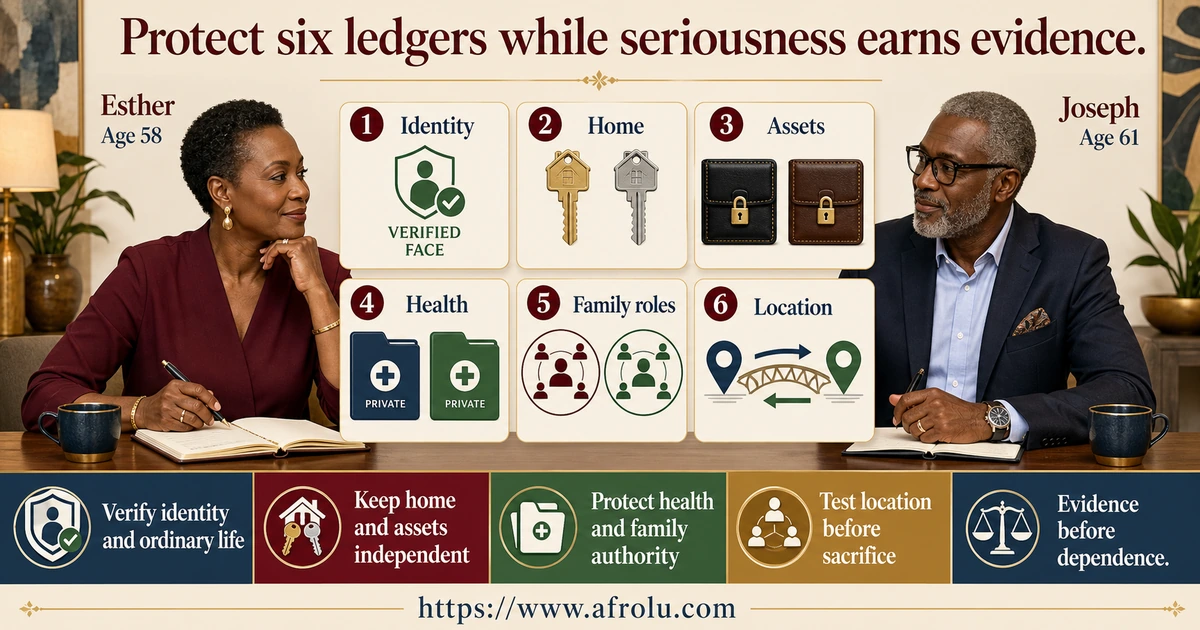
Build relationship evidence before changing home, money, health authority, family roles or location.
Written and edited by Jean-Claude Mukendi · Relationship Guides Editor
Protect six ledgers while the relationship develops. Verify identity and ordinary life in stages. Keep homes, keys, property, accounts, credit, investments and businesses independently controlled. Share health information by purpose while records and decision authority remain private. Preserve trusted family, friends, community and independent advisers without making them relationship judges. Make visits public and independently survivable, with controlled lodging, documents, money and return. Treat closing distance as a feasibility hypothesis involving law, income, housing, healthcare, family duties and an exit route. Never sign, lend, co-borrow, change beneficiaries, grant legal authority or relocate as proof of seriousness. Build ordinary evidence and obtain independent qualified advice before high-consequence change.
Relationship intent · Late Entrants
Does serious direction appear in verified ordinary conduct, and can identity, home, assets, health, family roles and location remain independently governed until each integration decision earns evidence?
Later-life serious long-distance dating is the evaluation of a possible lasting partnership between adults whose ordinary lives are geographically separate and may already contain established systems. Serious describes direction, distance describes geography and exclusivity describes a present agreement. Integration and dependence are additional choices, not automatic stages. The established-life firewall lets intimacy and evidence grow while identity, residence, assets, health authority, family roles and location remain controlled by the adults they belong to.
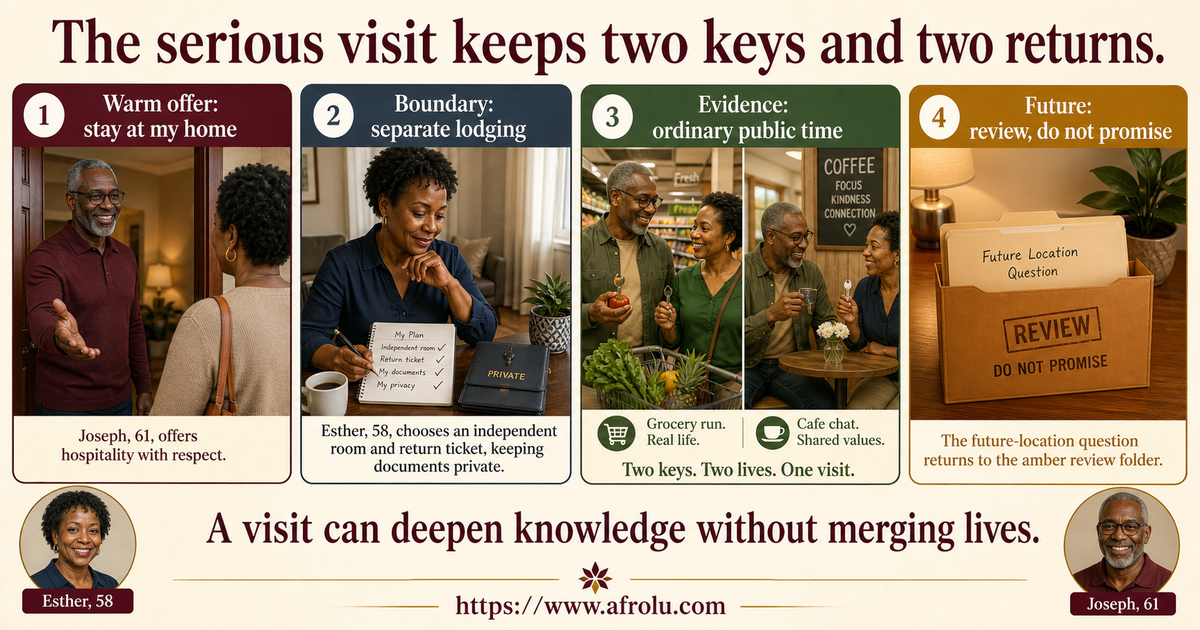
Esther and Joseph are fictional adults. Esther is 58 in Nairobi and Joseph is 61 in Gaborone. They verify in stages and agree on serious exclusive direction. For their first visit Joseph offers his home, but Esther retains independent lodging, documents and return. Their ordinary public time reveals warmth, respectful repair and a major location difference: Joseph imagines a shared base sooner than Esther does. They schedule a reciprocal visit and ninety-day audit without changing property, money, health authority, family roles or residence. Their serious relationship becomes more accurate because the visit creates a real question instead of hiding it under romantic hosting.
The established-life safeguard ledger
Let serious direction accumulate evidence before it receives authority
Later-life dating can carry more established systems, not less capacity for love. Jean-Claude protects the systems without infantilising the adults.
The ledger separates identity, home, assets, health, family roles and location, then permits only evidence-led, independently advised changes.
Identity and home
Verify ordinary life while residence, keys, documents and return remain controlled.
Assets and authority
Keep accounts, property, credit, beneficiaries and legal powers outside romantic proof.
Health and relationships
Share by purpose while care decisions and trusted support remain independent.
Location
Research both lives and use reversible trials before any permanent move or sacrifice.
An established-life firewall
Let serious direction grow outside six protected ledgers
Returning to dating later in life may mean bringing a home, savings, pension, business, healthcare plan, adult family relationships, community roles or memories of a long partnership. Those are not barriers to intimacy and they do not make an adult automatically vulnerable. They are existing systems with consequences. Serious dating should be evaluated through present evidence while each system remains governed by the person it belongs to.
The first ledger is identity and ordinary life. Verify enough to know that names, availability, work or retirement context and relationship status are broadly consistent. Use live conversation, independently found information and reciprocal public visits. Do not exchange identity documents, passwords or unrestricted background files. Verification reduces selected uncertainties; it cannot certify intention or future behaviour.
Ledgers two through five cover home, assets, health and family roles. A serious label does not create a key, deed interest, account authority, beneficiary position, healthcare role, emergency contact or family membership. Keep those systems separate during evaluation. If a later decision genuinely concerns legal, financial, housing or healthcare authority, obtain independent qualified advice in the relevant jurisdiction and preserve the adult's free decision outside romantic pressure.
The sixth ledger is location. Long-distance says where the relationship operates, not who must move. Closing distance can affect residence, income, health access, immigration status, tax, community, family duties and the ability to recover if the relationship ends. Treat it as a staged feasibility question. Serious direction may justify research and reversible trials; it does not justify resigning, selling, transferring assets or abandoning support before evidence supports the risk.
A visit with two keys
Esther and Joseph choose ordinary evidence over a romantic home stay
Esther is 58 and works in school administration in Nairobi. Joseph is 61, advises a logistics business in Gaborone and plans to reduce his workload over several years. They meet through an online interest group, verify through repeated live conversations and agree that they are evaluating a serious exclusive relationship. Four months later, Esther plans the first visit. Joseph warmly offers his home and says a hotel would make the relationship feel unnecessarily formal.
Esther keeps a refundable room, her own key, controlled documents and a return she can change without Joseph. She explains that serious direction is precisely why she wants the first visit to preserve choice. Joseph feels disappointed but accepts the boundary. He does not ask for the hotel booking, passport copy or live itinerary as proof. They agree on daytime meetings and a simple check-in after Esther returns to her room.
The visit includes a grocery shop, a cafe, a walk in a busy public place and quiet time discussing ordinary weeks. Joseph cancels one plan because of work and offers a specific replacement. Esther notices that they disagree about retirement: Joseph imagines a shared base soon, while Esther wants to remain near her work and community for several years. The visit creates a location question instead of solving it through romance.
They keep exclusivity and serious direction but make no move, property or caregiving promise. A reciprocal Nairobi visit will test another ordinary context. They set a ninety-day review for contact, repair, cost and future feasibility. Esther's separate room did not weaken the relationship; it allowed both adults to see whether warmth and respect survived a boundary. If the location visions remain incompatible, ending can be honest even when the relationship is genuine.
Ordinary evidence
Make visits independently survivable and relevant to real life
Plan the first visit around verified identity, public meetings, independent lodging, transport, communication, medication access and a reliable return. Tell trusted support the essential plan when useful. Each adult controls documents, devices and money. A host may offer generous help and a visitor may accept selected help, but neither person's spending creates authority over where the other sleeps, whom they contact, whether intimacy occurs or how long the visit continues.
Include ordinary contexts rather than only celebrations or expensive outings. See how each adult handles time, service workers, fatigue, a changed plan, different spending preferences and the need for quiet. Do not manufacture stress tests or enter private systems to gather evidence. One ordinary disagreement followed by a respectful repair can be more informative than a perfect itinerary in which every choice was outsourced.
Protect health without turning a date into a caregiver. Carry necessary medication, health information and insurance or payment arrangements as appropriate to the traveller. Decide who should be contacted in an emergency, and retain the ability to seek care independently. A new partner does not automatically need diagnosis details or legal authority. If health affects a shared activity, provide enough information for informed planning while personal records remain controlled.
After the visit, let the intensity settle. Review safety, compatibility, cost, repair, ordinary habits and the future questions that became clearer. Do not book the next trip, merge accounts or announce a move merely to preserve momentum. A visit may support another reciprocal visit, a smaller contact rhythm, independent advice on a specific issue or an ending. The return journey is part of the safety design, not evidence that the relationship failed to progress.
Promises versus conduct
Require ordinary evidence before any legal, financial or care dependence
Serious evidence is repeatable and proportionate: identity remains broadly consistent, contact works through ordinary weeks, visits occur in both directions where feasible, plans are kept or repaired and limits survive disappointment. Each adult maintains friendships, professional or retirement decisions and independent access to money and care. The pattern should make the current agreement easier to describe without requiring secrecy, monitoring or escalating proof.
Future promises belong in a separate column. Marriage, relocation, business, property, caregiving or lifelong support may be sincere aspirations and still remain untested. Write the conditions and open questions instead of treating emotional certainty as completion. Who bears cost? Which laws apply? What happens to housing, health access, tax, family duties and the ability to leave? A person who welcomes independent review makes the future more assessable.
Irreversible or hard-to-reverse sacrifice needs a locked gate. Do not add a new partner to property, beneficiary, account, credit, investment, business, insurance, power-of-attorney or healthcare authority as a relationship proof. Do not sign, guarantee, lend or transfer under urgency. Such decisions can have legal consequences that vary by place. Obtain advice from a qualified independent professional who is not selected or controlled by the partner.
Watch for coercive patterns: isolation from trusted people, humiliation about age, control of medication or transport, unexplained financial activity, pressure to sign, threats, stalking, sexual coercion or punishment after a no. WHO recognises psychological, physical, sexual and financial forms of abuse involving older people, but a population risk does not diagnose one relationship. Respond to observed harm and use appropriate local medical, financial, legal, safeguarding or emergency support.

Do not use property, pension, accounts, legal authority or caregiving as proof of romantic seriousness.
Warm, exact boundaries
Use scripts that preserve serious direction and independent authority
For identity and visits, ask for staged evidence and a complete plan. Say what you need for the next reversible choice rather than demanding an unlimited file. You might need a live conversation, consistent basic details, a public itinerary and independent lodging. You do not need passwords, account access or intimate records. If key facts conflict, pause expansion and verify through channels you find independently.
For home and money, use present ownership language. Each home, account, debt and essential expense stays under its current control during evaluation. You can discuss values and future options without sharing balances, credentials or legal rights. If a match asks for an urgent loan, investment, fare, customs payment or document signature, stop the transaction. Romance does not independently verify the request.
For health and family, define roles before emergencies create assumptions. A partner may receive selected information and still have no authority. Adult relatives may be important support without becoming decision-makers over the romance. No one needs family approval to be a competent adult; healthy relationships also do not demand isolation from people, advisers or clinicians who provide independent perspective.
For closing distance, use a feasibility script rather than a sacrifice test. Identify each location option, non-negotiable duty, legal or financial question and reversible trial. Agree that either adult can conclude the move does not work. If one person requires immediate sale, resignation, sponsorship or dependence to prove seriousness, the plan is not ready. Serious direction can remain genuine even when geography ultimately makes the relationship incompatible.

Ask for the next relationship answer without transferring financial, legal, medical or family authority.
A serious-direction audit
Review ninety days of ordinary evidence before increasing dependence
Choose a period containing ordinary work, retirement, family, health and rest rather than only celebration. Review whether the contact rhythm was sustainable and whether both adults could ask for change. Note kept plans, missed plans and specific repairs without counting messages as a love score. Serious direction should survive the reality that neither adult is continuously available.
Review visits and cost. Was effort reasonably reciprocal, accounting for actual capacity rather than an identical split? Did each adult retain lodging, money, documents and return? Were affordable plans respected? A relationship that repeatedly requires one person to travel, pay or host may be genuine and structurally unsustainable. Name the imbalance before another booking turns it into sunk cost.
Review independence. Are homes, assets, accounts, credit, healthcare choices, legal authority and community ties still controlled by their owners? Has either adult become isolated from trusted support or pressured to make secret changes? If a real integration decision is approaching, pause the romantic discussion long enough to obtain independent advice and create a downside plan. The ability to reverse course is part of readiness.
Choose one next step: continue the operating agreement, make a reciprocal ordinary visit, investigate a location through independent channels, test a temporary reversible arrangement or end because direction and feasibility diverge. Do not combine several high-consequence changes. A good ninety-day audit may produce a smaller promise. Accuracy is more protective of love than acceleration.

Review serious direction through repeatable conduct before discussing irreversible integration.
Do not confuse these dimensions
Separate serious direction, distance, exclusivity, integration and dependence
Serious dating describes direction toward evaluating a possible lasting partnership. Long-distance describes geography. Exclusive dating describes a present agreement about dating or seeking others. These terms can coexist, but none guarantees compatibility, marriage or shared residence. State each answer in current language and identify what would require a new conversation.
Integration describes practical overlap: shared routines, family contact, travel, home time or community participation. It can grow in selected domains while others remain separate. An adult may introduce a partner to friends and still provide no home key or financial access. Integration should follow purpose, consent and evidence rather than a timetable based on age or fear of losing time.
Dependence describes consequences such as relying on another person for housing, money, healthcare access, transport, legal authority or daily care. Interdependence can be freely chosen and loving, but its risks deserve independent planning. Dependence is not the proof that makes a relationship serious. It should never be engineered through urgency, isolation or removal of alternatives.
Closing distance is a possible location transition, not a relationship type or inevitable destination. Some couples sustain separate homes or commuter patterns. Others discover that work, climate, healthcare, law, family duties or community makes relocation unsuitable. The honest outcome may be a redesigned relationship or an end. A genuine bond does not make every practical structure solvable.
Eight later-life serious-distance decisions with real consequences
Ruth keeps convenience separate from residence access
Ruth is 56 and her visiting partner suggests keeping a key because their relationship is serious. Ruth says no and keeps the lodging plan independent. A key affects security, property and future access; it is not a souvenir or a test of emotional confidence.
Treat home access as its own consequential decision and observe whether the boundary remains intact.Samuel stops a business rescue request
Samuel is 63 and hears that a short-term loan will protect his partner's business and their future. He sends nothing, declines to co-sign and checks the claimed company through independent channels. A serious future cannot verify a transaction or make recovery likely.
Stop payment, protect credentials and obtain independent financial or legal help before any obligation.Nokuthula refuses to make insurance a love certificate
Nokuthula is 60 and a distant partner asks to be added as beneficiary after eight months. She declines and speaks privately with a qualified adviser about her existing plan. The partner's disappointment does not create urgency or entitlement.
Keep beneficiary and estate decisions outside romantic pressure and use independent advice.Peter shares the visit need, not his whole record
Peter is 57 and takes medication that affects meal timing. He tells his date the practical schedule for their outing and retains the prescription and health record. Necessary planning does not require handing over diagnosis files or medical authority.
Share enough for the activity while health records and decision rights remain controlled.Eunice does not recruit her daughter as relationship referee
Eunice is 66 and values her daughter's perspective. She shares the basic visit plan but decides the romance herself. Her partner is not required to earn family approval, and Eunice is not required to hide the relationship from trusted support.
Keep adult autonomy and independent social support at the same time.Joseph names an unsustainable pattern
Joseph is 61 and has paid for three visits while his partner has not researched one reciprocal trip. He asks for a complete proposal that fits her real capacity. If none is possible, they will address the structural mismatch rather than book a fourth trip from hope.
Request a specific reciprocal contribution and decide from feasibility, not promises.Amina rejects retirement as a relocation clock
Amina is 59 and plans to retire next year. Her partner says that creates the obvious time to move. Amina lists healthcare, housing, community, tax and family questions and chooses no commitment until independent advice and a reversible trial exist.
Turn the assumed deadline into a multi-system feasibility review.David keeps support from becoming authority
David is 64 and appreciates help after a minor procedure. His partner starts withholding transport unless he shares accounts and cancels time with friends. David seeks support elsewhere and speaks with appropriate professionals. Help conditioned on isolation or access is not ordinary relationship care.
Restore independent support and use suitable safeguarding, medical, legal or emergency help for observed control.Evidence that protects an established life while seriousness grows
Identity and ordinary life remain broadly consistent across live conversation and reciprocal visits.
Serious direction is defined through present behaviour rather than guaranteed marriage or relocation language.
Contact survives ordinary work, health, family and rest without demanding continuous availability.
Both adults can host, travel, repair and decline according to real capacity without one person carrying everything.
Homes, keys, property, accounts, credit and businesses remain under their owners' control during evaluation.
Health information is shared by purpose while records, medication and decision authority remain protected.
Trusted relationships and independent advisers remain available rather than being displaced by romantic secrecy.
A visit preserves lodging, documents, transport, money and return for each adult.
A future-location discussion includes law, income, housing, healthcare, family duties and an exit route.
Property, beneficiary, loan, sponsorship and power decisions can wait for independent qualified advice.
A no to money, access, intimacy or integration remains intact without age-based shame or retaliation.
The relationship may continue at a distance or end without treating dependence as the measure of seriousness.
Route each promise, visit or request to the right ledger
| Situation | What it may mean | What to do next |
|---|---|---|
| A match offers a permanent future very early. | Serious language is present but ordinary evidence remains limited. | Write the future as a hypothesis and test current identity, contact and repair first. |
| Home lodging is expected on the first visit. | Residence access and travel dependence have been bundled with romance. | Retain independent lodging, transport, documents and return. |
| A partner asks to see account balances. | Financial disclosure exceeds the present relationship purpose. | State affordability without exposing accounts and decline access. |
| An urgent loan promises to protect the shared future. | Romantic hope is being used to accelerate financial risk. | Stop the transaction and verify independently; do not sign or co-borrow. |
| A partner wants legal or healthcare authority. | A high-consequence role is being proposed. | Use independent jurisdiction-specific advice and keep the decision outside pressure. |
| Trusted friends are described as jealous obstacles. | Isolation pressure may be developing. | Keep independent contact and assess the observed control with appropriate support. |
| Visits happen only in one direction. | Distance effort or feasibility may be structurally unequal. | Request a realistic reciprocal plan and decide from what is possible. |
| Retirement is treated as an automatic move date. | One life transition is being asked to decide many systems. | Review location, health, money, housing, family and exit separately. |
| A boundary receives disappointment and then respect. | One relevant piece of emotional regulation and autonomy evidence is present. | Notice the changed conduct while continuing to assess the longer pattern. |
| The relationship is warm but location options do not fit. | Genuine connection and practical incompatibility may coexist. | Consider a freely chosen distance structure or end without inventing a sacrifice. |
| A partner controls transport, medicine or money. | Coercive control or abuse may be present. | Restore independent access where possible and use suitable local professional or emergency support. |
| Money was sent after deception. | Financial loss and possible fraud require swift action without shame. | Contact the financial provider, preserve useful evidence and use relevant reporting support. |
Scripts for identity, home, money, health, family and location
“I want enough consistent identity and ordinary-life evidence for the next visit, not access to private systems.”
“I will keep my own room, documents and return during our first visits.”
“My home and keys remain under my control while we are evaluating the relationship.”
“I will discuss affordability, but I do not share credentials, balances or account access.”
“I do not lend, co-sign or invest because a romantic deadline is urgent.”
“I will share what this visit needs. My health records and decision authority remain private.”
“My relationships with trusted friends, family and advisers continue independently.”
“Serious means we are evaluating a lasting partnership; it does not promise a shared home yet.”
“I have made the last two trips. What complete reciprocal plan can you realistically offer?”
“Before any move, we need independent advice, an ordinary trial and a plan if it does not work.”
“I will not change property, beneficiaries or legal authority as proof of love.”
“Our location needs do not fit, even though the relationship matters to me.”
Know the difference
Serious direction versus premature dependence
Adults define lasting-partnership direction and test it through identity, contact, reciprocal visits, repair and feasible future discussion.
Home, money, legal authority, care, isolation or relocation change before enough ordinary evidence and independent advice exist.
Seriousness can deepen while every established-life system remains independently controlled.

Name direction and structure without treating integration or dependence as proof of love.
Compare serious direction with integration and dependence
| Type or dimension | What it describes | Best next question |
|---|---|---|
| Serious direction | Evaluation toward a possible lasting partnership without a guaranteed outcome. | Which present behaviours express that direction? |
| Long-distance condition | Geography makes ordinary in-person time require travel and planning. | Can contact and reciprocal visits work without harmful dependence? |
| Exclusive structure | A present agreement about dating or seeking others and relevant disclosure. | What exactly is agreed, and how can it change? |
| Practical integration | Selected overlap in routines, homes, travel, family or community life. | Which overlap has a clear purpose and remains reversible? |
| Financial dependence | One adult relies on another for money, housing, debt, assets or essential cost. | Which independent resources and advice must remain available? |
| Legal authority | Formal power over property, finances, healthcare or another decision domain. | What independent jurisdiction-specific advice and safeguards are required? |
| Caregiving | Practical or health support that can range from occasional help to major responsibility. | What role is freely offered, sustainable and separate from romantic proof? |
| Closing distance | A possible location change affecting several established-life systems. | Which reversible trial and downside plan come before a permanent move? |
| Romance scam pattern | Trust-building followed by urgent money, account, document or transaction requests. | How can payment stop while claims are independently checked? |
| Coercive control | Conduct that narrows autonomy through isolation, threats, monitoring or control of resources. | Which access and suitable local support can restore safety and choice? |
Build an established-life firewall in six moves
List six ledgers
Write the identity, home, asset, health, family-role and location systems that remain independently controlled.
Define serious now
Translate future direction into current contact, exclusivity, visits, repair and honest feasibility questions.
Make visits ordinary
Use public time, independent lodging and reciprocal contexts rather than luxury intensity or constant hosting.
Lock sacrifice behind advice
Keep property, debt, beneficiaries, legal authority and healthcare roles unchanged under romantic urgency.
Test the location hypothesis
Research both options and use a reversible trial before any sale, resignation or permanent move.
Audit ninety days
Review ordinary contact, travel burden, repair, independence and one next reversible step.
Questions for serious direction without premature authority
Choose a few prompts that fit the moment. This is a reference library, not a list to complete.
Serious direction now
Translate future hope into current agreements and observable behaviour.
- What does serious mean in our choices today?
- Are we exclusive, and what does that include?
- Which contact rhythm survives ordinary life?
- How do we repair a missed plan?
- Which future statements remain hypotheses?
Visits and independence
Build evidence while lodging, documents, health and return remain controlled.
- Where will each visitor stay?
- How does each adult return independently?
- Which ordinary settings will we share?
- What health information does the plan truly need?
- What happens if either person wants to leave early?
Assets and authority
Keep high-consequence systems outside romantic proof and urgency.
- Which homes and accounts remain separate?
- Which requests would require independent advice?
- How do we refuse loans or signatures under urgency?
- Which trusted advisers stay involved?
- What authority is explicitly not on offer?
Location feasibility
Research both established lives before proposing permanent sacrifice.
- Which location options are legally and financially possible?
- How would housing and healthcare work?
- Which family and community duties remain?
- What reversible trial precedes a move?
- What is the exit plan if the trial fails?
What research and public guidance can actually support
Long-distance relationships do not follow one quality pattern
A U.S. study comparing long-distance and close-proximity relationships found similarities and differences rather than simple distance failure. Afrolu uses it narrowly to reject geography as a verdict. It cannot predict an individual couple or prescribe calls, visits or relocation.
Evidence limit: The sample, period and measures do not represent every country, age group or later-life relationship.
Older-adult abuse includes more than physical harm
WHO describes psychological, physical, sexual, financial and material abuse, neglect and serious loss of dignity within relationships of trust. This supports watching observed control of money, care, medicine, movement and choice. It does not mean an older adult or age-gap relationship is inherently unsafe.
Evidence limit: Population evidence cannot diagnose one relationship; local definitions and response systems vary.
Formal authority is a legal decision, not a romantic title
CFPB explains that a power of attorney is a legal document allowing someone to act on another person's behalf. Afrolu's narrow lesson is to treat any financial or healthcare authority as a separate high-consequence decision requiring independent jurisdiction-specific advice, not as proof of love.
Evidence limit: The CFPB source is U.S.-specific and this guide provides no legal or estate-planning advice.
Romance scams can ask for accounts, documents and joint obligations
CFPB and FTC consumer materials describe distant romantic interests requesting loans, account access, joint accounts or signatures. Do not send money or grant authority under urgency. Verify claims independently and contact financial providers promptly after suspected loss.
Evidence limit: Warning patterns do not prove criminal intent; use relevant local financial, legal and reporting support.
Consent remains voluntary and ongoing at every age
NHS public guidance explains that sexual activity requires active consent, that a relationship or an earlier yes does not supply consent, and that consent can be withdrawn at any time. Serious direction, travel, gifts and age do not decide the next activity. Coercion or inability to consent changes the safety and support task.
Evidence limit: Public education is not jurisdiction-specific legal advice or an assessment of an individual incident.
Sexual-health conversations belong before relevant choices
CDC guidance encourages partner conversations before sex about relevant STI information and testing. Dating later in life does not remove sexual-health decision-making. Use qualified local healthcare for testing, prevention, medication interactions, symptoms and treatment.
Evidence limit: General public-health information cannot provide an individual diagnosis or treatment plan.
Six shortcuts that convert serious hope into risk
Treating age as a deadline
Fear of lost time can accelerate commitments, but age does not remove the need for ordinary evidence and free choice.
Hosting as proof
A home stay bundles residence access, dependence and a narrower exit into what could be a separate visit choice.
Using assets as seriousness
Property, beneficiaries, loans and account access create consequences rather than relationship evidence.
Making care automatic
Health disclosure and support roles need purpose and consent; romance does not appoint a caregiver or decision-maker.
Isolating for privacy
A private relationship can still retain trusted people and independent advice; secrecy can reduce protective perspective.
Moving to solve uncertainty
Relocation increases dependence and cost while unresolved compatibility and feasibility travel with the couple.
Use a reviewed resource that matches the decision
This guide focuses on the relationship decision, so it does not rank dating apps. Check current prices, safety tools, and local availability before choosing a service.
Explore the guide library
Show more related guides
Continue with Afrolu
Show more Afrolu guides
Research and public guidance reviewed for this firewall
Afrolu reviewed these health, research, safety, or public guidance resources while editing this page. They support the behaviour and safety guidance; they do not diagnose any individual described by a reader.
Later-life serious long-distance dating questions
Is serious long-distance dating later in life realistic?
It can be, but seriousness and feasibility are separate. Define current direction, exclusivity, contact, reciprocal visits and repair. Then assess location, work or retirement, housing, healthcare, money, family duties and return options. A genuine connection can remain long-distance, close distance in stages or end when practical structures do not fit.
How do I verify a distant partner without insulting them?
Describe verification as mutual preparation for a consequential choice. Use consistent live interaction, independently found context and reciprocal public visits while both adults protect documents, passwords and accounts. A respectful person may feel disappointed by a boundary and still follow it. No verification step guarantees intention or conduct.
Should I stay at a serious partner's home on the first visit?
You are not required to. Independent lodging, transport, documents and return preserve options and can make the visit more informative. Declining home lodging does not accuse the host. Travel cost never creates consent to stay, share a room, have sex, extend the trip or continue the relationship.
When is it safe to combine finances?
This page cannot decide that for an individual. Combining accounts, debt, investments, property, insurance or business interests can have major legal and financial consequences. Do not use it as relationship proof. Build substantial ordinary evidence and obtain independent qualified advice in every relevant jurisdiction before any change.
Should I add a serious partner as beneficiary or power of attorney?
Not because the relationship is serious. Beneficiary and formal-authority decisions have consequences outside romance and vary by jurisdiction. Keep them separate from pressure, urgency and promised care. Consult an independent qualified professional who represents your interests and review existing family, estate and healthcare arrangements privately.
What if my partner asks for fare, medical or business money?
Do not send money, codes, account access or signatures because a romantic story is urgent. Verify any institution through contact details you find independently. If money was sent after suspected deception, contact the financial provider promptly, preserve useful evidence and use relevant local reporting support without shame.
How soon should adult family meet a long-distance partner?
There is no universal deadline, and adult family approval does not determine your competence. Choose an introduction for a clear purpose after enough identity and relationship evidence. Protect third-party information and avoid assigning care, financial or decision roles. Keep trusted relationships available without letting relatives run the romance.
Does sharing health information prove trust?
Health information should follow purpose and consent. Share what a visit, sexual-health choice or emergency plan needs while records and legal authority stay controlled. A partner can know a practical limit without seeing a complete file. Use qualified healthcare for medical decisions and independent legal advice for any formal authority.
How do we decide who relocates?
Do not begin with who loves more. Compare each location's law, residence rights, income, housing, healthcare, tax, climate, community, family duties and exit options. Use independent verification and reversible trials where possible. A move should not require hidden debt, surrendered property or loss of a safe return.
What if we love each other but neither can move?
A genuine relationship and a location incompatibility can coexist. You might freely choose a sustainable distance or commuter structure if it meets both adults' needs. If it does not, ending can be honest. Love does not make every practical system solvable, and sacrifice is not the only proof that the relationship mattered.
One thing to do now
Increase evidence before increasing dependence
Keep the six ledgers separate and translate serious language into current agreements. Use reciprocal ordinary visits and a ninety-day audit to test contact, repair, cost, independence and location feasibility. Put property, debt, beneficiaries, legal authority, healthcare roles and permanent moves behind independent professional advice and reversible planning. Increase dependence only when substantial evidence, free consent and a downside plan support that exact decision—not because age, distance or time invested creates urgency.