One relationship bridge between two complete foundations
Build Serious Distance Love Between Two Established Lives
A later-life Nairobi guide to serious long-distance dating with separate homes, money and care authority, safer visits, consent and relocation review.

Cross the relationship bridge one permission at a time.
Written and edited by Jean-Claude Mukendi · Relationship Guides Editor
Treat later-life dating as an adult context, not a deadline or vulnerability score. Define serious direction, present exclusivity, geography and desired household structure separately. Build one relationship bridge while home, money and care retain individual gates. Make visits complete with freely chosen lodging, public plans and independent return. Keep keys, accounts, identity and property records, health information and family contact behind separate permissions. Slow relocation and every formal authority change for independent evidence and qualified advice. Every ninety days, inspect agreement, reciprocity, autonomy and repair; continue, reinforce or close before adding new weight.
Distance and diaspora · Late Entrants
Can a serious long-distance relationship connect two established lives without silently merging homes, finances, documents, care authority or support networks?
Serious later-life long-distance dating is a lasting-partnership direction across meaningful geography between adults with established lives. The three-estate bridge separates the relationship from home, financial and care systems so commitment does not automatically create co-residence, joint money, document access, family contact or formal authority.
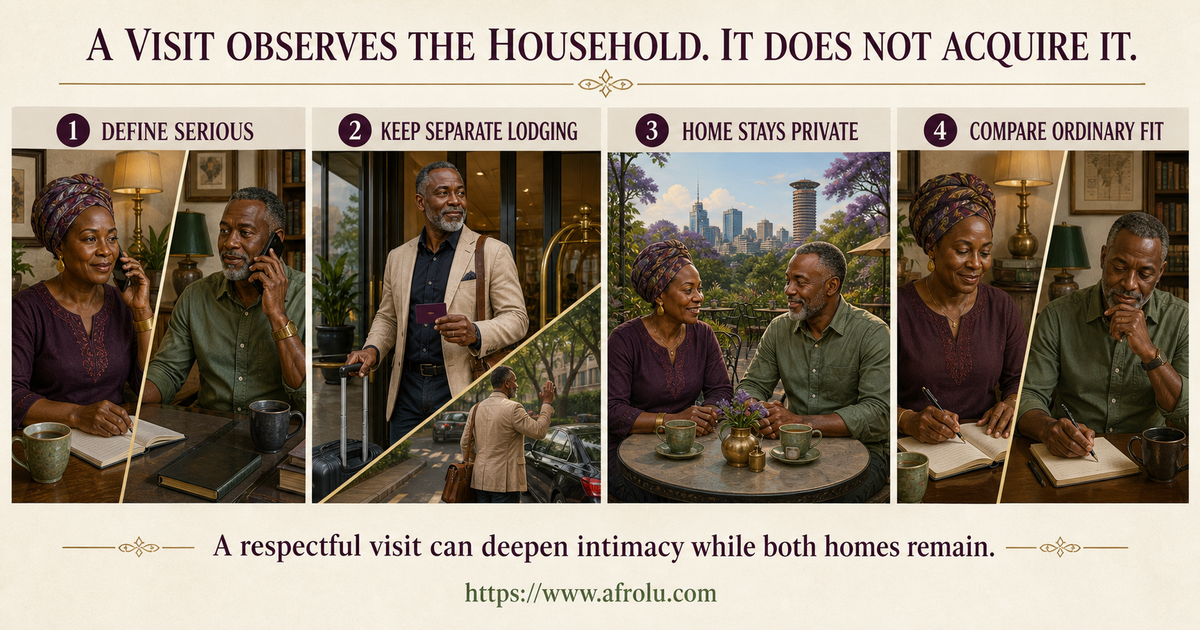
Achieng and Daniel are fictional adults, 52 and 56. For Daniel's first full Nairobi weekend, he keeps a hotel and return while Achieng keeps her home address private. They agree to exclusivity but not co-residence. When Daniel later asks to become her emergency contact, Achieng says not yet. His acceptance keeps care authority separate and gives better evidence than a promise to move.
The later-life three-estate bridge
Build commitment between two complete lives without turning age into urgency
Jean-Claude centres mature autonomy while making home, financial, care and family access visible enough to decide deliberately.
The bridge maps three established estates and inspects agreement, reciprocity, autonomy and repair before any new access is added.
Home
Addresses, keys, lodging and household structure change only through specific invitation.
Money
Accounts, transfers, investments, property and documents remain independently verifiable.
Care
Health sharing, emergency roles and formal authority follow the adult's informed choice.
Relationship
Serious direction, exclusivity, visits and repair grow through mutual words and conduct.
Begin without a deadline story
Returning to dating later in life is not a race to merge established lives
Later-comer is an Afrolu audience label for adults who return to dating after a long relationship, loss, separation, years of caregiving, career focus or simply a long pause. It does not imply one age, vulnerability or lack of experience. Some readers are in their forties; others are older. Many have homes, adult family relationships, savings, debts, health routines, community roles and hard-won ways of living that deserve deliberate choices rather than romantic assumptions.
Serious dating names a direction toward lasting partnership. It does not say whether two adults will remain in separate homes, live across cities, become exclusive, cohabit, marry, combine money or take on care authority. Define today's structure and the next review before discussing integration. A mature relationship can be committed while living apart, and a shared address can exist without healthy commitment.
Distance may protect established routines or reflect work, family and property realities. It can also hide incompatibility, increase cost or make a rare visit feel more conclusive than it is. Do not assume that distance is doomed or that closing it proves love. Compare the actual communication, visits, repair and practical options available to these two adults.
Avoid age-based trust shortcuts. A similar age, respected profession, familiar community or family introduction does not establish financial honesty, consent or relationship status. Equally, having assets or prior marriages does not make someone suspicious. Evaluate observable conduct and grant only the permission the current relationship needs. Dignity means neither infantilising a mature dater nor dismissing financial, psychological, sexual or material coercion.
The three-estate bridge
Connect the relationship while home, money and care retain their own gates
The home estate includes address privacy, keys, overnight stays, storage, household routines, neighbours and anyone else who lives there. An invitation applies to the stated occasion. A partner does not acquire a key, permanent presence or right to arrive because the relationship is serious. If co-residence becomes a real option, compare tenancy or ownership, costs, privacy, exit and local legal questions with qualified advice.
The money estate includes accounts, cards, mobile-money access, income, debts, investments, beneficiaries and property decisions. Share context at a depth relevant to a joint choice, but keep credentials private. A romantic partner should not become an informal bank, investment broker or emergency transfer destination. Slow any consequential decision and verify through independently located channels.
The care estate includes health information, appointments, medication, emergency contacts, caregiving and formal authority. Concern does not create consent to call clinicians, manage medication, view records or make decisions. Each adult chooses what to share and which formal documents or qualified advice are required. Do not ask a partner to sign or change authority during emotional urgency.
Family and community sit across all three estates. Adult children, former partners, dependants, friends and faith communities may be affected, but they do not own the new relationship. Decide when an introduction is useful, what private information may be shared and whether direct contact is welcome. A serious partner can respect existing bonds without using them to monitor, pressure or bypass the dater.
Achieng and Daniel visit before redesigning
One Nairobi weekend supplies evidence while two homes remain complete
Achieng and Daniel are fictional adults, 52 and 56. Achieng lives in Nairobi; Daniel lives in another Kenyan city and travels periodically for work. Both are dating toward a lasting partnership after long periods outside dating. After five months of calls and two public day visits midway between them, Daniel proposes a full weekend in Nairobi.
Achieng is not ready to share her home address or host overnight. She says so before travel. Daniel books a hotel he can afford and keeps his return. Their plan includes a garden café, an exhibition and unscheduled rest. Achieng shares the relevant itinerary with a trusted friend. Daniel does not turn hotel cost into emotional debt or ask for a key ‘for convenience.’
During dinner they discuss distance. Daniel hopes eventually to spend more time in Nairobi but cannot leave a family care commitment soon. Achieng enjoys her home and does not want to cohabit this year. These answers do not cancel serious intent. They agree to remain exclusive, alternate affordable visits and review after ninety days. Neither promises a move before examining what it would actually change.
Later, Daniel asks whether Achieng can add him as an emergency contact. She says not yet and explains that a sibling currently holds that role. Daniel accepts it. Had he contacted the sibling privately, requested medical records or framed the change as proof of trust, the request would have crossed into care authority. The clean no preserves the relationship's chance to grow from evidence.
Read the permission, not the romance
Sort ordinary intimacy from access to home, money, documents, care and family
Ordinary intimacy can include stories about past relationships, broad financial values, health preferences and family roles at a depth each adult chooses. Compatibility information may include travel capacity, caregiving duties, desired household structure and whether marriage matters. A difference can be painful without being unsafe. Ask for enough truth to decide, not total access to verify character.
Consequential requests include keys, mail delivery, address registration, account or mobile-money access, loans, investment, identity records, property paperwork, beneficiary changes, medical information or direct family contact. Pause. What purpose is being served? Is there a safer limited option? Does a qualified professional need to advise? Can the choice be reversed without losing housing, money, health access or family support?
Coercion may arrive through urgency, shame or isolation rather than obvious force. Someone says mature adults should not need separate accounts, that family doubts must be cut off, that a health crisis makes signatures urgent or that past loss proves fearfulness. Do not debate your adulthood. Keep documents and essential money secure, involve a trusted independent person and obtain appropriate professional support.
If money or access has already been transferred under suspicious pressure, act promptly. Contact the relevant financial provider, change exposed credentials and preserve messages or transaction details. Use legal, safeguarding, advocacy or police routes appropriate to the person, conduct and location. Do not meet privately to recover property or ask family members to confront someone on your behalf when risk is uncertain.

Relationship time never signs an access deed automatically.
Established-life language
Say yes to connection without signing away an unrelated part of life
For direction, say: ‘I am dating toward a lasting partnership and want to build it gradually around two established lives.’ For visits, say: ‘I am glad you are coming, and separate accommodation works for me this time.’ These statements are warm and exact. The other adult may prefer a different structure, but they do not get to convert preference into access.
For home, say: ‘My address and keys are private until I make a specific invitation.’ For money, say: ‘My accounts and investments stay separate; any future joint decision will receive independent review.’ A healthy partner can ask what values shape your choices. They should not demand balances, credentials, titles or transfers to prove that the relationship is real.
For care, say: ‘I will share the health information I choose. My current emergency and care arrangements remain in place.’ A partner may be important without holding formal authority. If later change is wanted, use current qualified legal and health guidance, give the decision time and make sure the adult is free from pressure.
For closing distance, say: ‘I want to explore more time in one city, but neither of us will leave housing, work or care duties before we have a practical plan.’ Compare trial visits, commute patterns or living-apart arrangements before irreversible change. A serious relationship can end because locations do not fit; that does not mean the connection was false.

Name the connection and the closed permission together.
Keep intimacy current
Past experience, mature age and exclusivity do not remove consent or sexual-health conversations
Adults returning to dating may have changed bodies, health conditions, medication, grief, confidence or sexual expectations. None should be assumed from age. Talk at the depth needed for a present choice, without demanding a complete medical history. A partner is not entitled to records, and a diagnosis does not decide worth or capacity by itself.
Consent remains active, specific and withdrawable. A serious label, exclusive agreement, hotel cost, previous sex, marriage history or fear of ‘wasting time’ does not provide it. Ask for the current activity and accept a changed answer. If intoxication, pressure or incapacity prevents a voluntary answer, do not proceed. Use qualified local support for an incident or health concern.
Discuss relevant sexual-health information, testing and prevention before sex. Exclusivity requires definition and conversation; it is not a laboratory result. Seek locally appropriate clinical care rather than treating a partner's reassurance as diagnosis. Stigma can block honest discussion, so keep the tone factual and avoid using health information as punishment or gossip.
Emotional intimacy also deserves pacing. Sharing a painful history can build closeness when voluntary and met with care. It should not become a demand for trauma detail, proof of widowhood or a comparison with a former partner. Notice whether disclosure leaves the speaker understood and free, or exposed and easier to control.
The ninety-day bridge inspection
Check agreement, reciprocity, autonomy and repair before adding load
Agreement asks whether both adults use the same words for serious direction, exclusivity, visit rhythm and closing-distance hopes. If one person believes exclusivity means cohabitation or family authority, correct the assumption. Record what remains undecided. Silence is not efficient when the hidden answer would change housing, money or care.
Reciprocity asks how calls, travel, costs and adaptation move across the bridge. Equality does not require identical spending or journeys, especially where health, care or income differs. It requires a plan both adults understand and freely accept, with neither person converting greater contribution into ownership.
Autonomy checks whether homes, essential money, documents, health choices, family relationships and return routes remain usable. Repair checks what happened after a boundary or disappointment. Did an unwanted post come down? Was a key returned? Did a money request stop? Did the next visit reflect the corrected plan? Practical change is stronger evidence than reassurance.
Continue when serious connection and established life support each other. Reinforce by reducing access, changing visits or obtaining professional advice before the next consequential choice. Close when directions do not fit or when coercion, isolation, financial exploitation, document control, threats or retaliation persists. A bridge succeeds by carrying voluntary connection, not by forcing two foundations to become one.

Continue, reinforce or close from observed load.
Eight later-life moments where serious connection can become access
Separate lodging is treated as distance
A visitor says a hotel makes serious dating look emotionally cold.
Keep the lodging choice and observe whether the boundary is accepted without debt or guilt.Convenience quietly becomes household access
A partner asks for a key because visits are becoming regular.
Ask what purpose is necessary and choose a limited alternative until both adults decide on access.A small emergency starts a transfer pattern
A remote partner requests help and promises repayment after the next visit.
Do not transfer through romantic urgency; verify independently and protect essential funds.Shared future language wraps a private opportunity
A match proposes an investment that must remain secret from family and advisers.
Send nothing, preserve the information and obtain independent qualified advice if the opportunity is legitimate.Family concern becomes surveillance
A partner and adult child each want direct access to the other's messages to judge safety.
Share useful context by choice while keeping accounts private and boundaries clear with both relationships.Care is confused with formal authority
A new partner asks to replace a long-standing contact after one health event.
Keep current arrangements until an unpressured, informed review with appropriate guidance.A move would erase one support network
The easier city financially would leave one adult far from care and community.
Compare full consequences and reversible trials; do not reduce the decision to rent or romance.Family contact bypasses the relationship boundary
A former date calls relatives to force another conversation.
Ask relatives not to relay messages, preserve evidence and use appropriate support rather than meeting privately.Evidence that intimacy and established-life autonomy can coexist
Both adults can define serious direction, current exclusivity and desired household structure separately.
Visits have independent lodging or another freely chosen arrangement plus usable return routes.
Home invitations apply to the stated occasion and do not imply keys, storage or permanent access.
Accounts, mobile money, identity records and property documents remain controlled by their owner.
Financial choices can be slowed, discussed with trusted independent people and declined without punishment.
Health information and care support are shared only at the depth the adult chooses.
Formal emergency, medical or legal authority changes only through informed unpressured processes.
Family involvement respects the new relationship without monitoring or bypassing either adult.
Travel and communication effort moves in both directions according to freely agreed capacity.
Consent and sexual-health conversations remain current despite age, seriousness or exclusivity.
A mistake is followed by practical restoration of privacy, access or plans.
Either adult can end the connection without losing housing, essential money, documents, care or family support.
Read the permission before adding weight to the bridge
| Situation | What it may mean | What to do next |
|---|---|---|
| A serious label is agreed | Shared future direction | Define present exclusivity, visits and household expectations separately. |
| A hotel is preferred | A privacy and exit choice | Respect it without treating cost as emotional debt. |
| A home key is requested | Ongoing household access | Pause and choose only the access required for a clear purpose. |
| A money emergency appears | A financial request inside relationship urgency | Transfer nothing until independently verified and safely considered. |
| An investment is secret | Isolation from independent review | Decline urgency and use qualified independent channels. |
| A document copy is requested | Identity, property or legal access | Keep it private and verify any legitimate process yourself. |
| A partner wants clinician contact | Care concern seeking health authority | Let the patient choose what is shared and through which formal route. |
| Adult children object | Family concern, conflict or control | Hear relevant facts without surrendering either adult's relationship authorship. |
| A move becomes possible | A major housing, work, care and support decision | Compare full consequences and seek qualified advice before irreversible change. |
| Sex occurred before | Past consent for a past activity | Ask for the present choice again. |
| A boundary is accepted | Evidence of respect | Let trust grow gradually without immediately granting new access. |
| Family is contacted after an ending | A boundary bypass and possible escalation | Close relay routes, preserve evidence and use appropriate support. |
Scripts for serious intent, visits, home, money, care and relocation
“I want a lasting partnership and I want to build it gradually around two established lives.”
“I am glad you are visiting; separate accommodation is the plan that works for me.”
“My address and keys remain private until I make a specific invitation.”
“My accounts and investments stay separate; I do not transfer through romantic urgency.”
“I will not share identity, property or financial documents for this request.”
“Please ask before contacting my family or sharing our photographs.”
“I will share the health information I choose; my current care arrangements remain in place.”
“Our age, exclusivity and past intimacy do not answer this present choice.”
“I will explore a trial rhythm before either of us leaves housing, work or care duties.”
“Calling this fear does not change my answer. The permission remains closed.”
“Before we add access, let us review agreement, reciprocity, autonomy and repair.”
“Do not contact my family or home again. I am ending contact and using support to protect those routes.”
Know the difference
Serious direction, geography and household structure are different dimensions
A lasting-partnership direction maintained across meaningful geography, with visits and communication agreed separately.
Living apart preserves separate homes by choice; cohabiting creates a shared household. Neither automatically measures commitment quality.
Name commitment and household structure separately before changing home, money or care access.

Commitment and household structure need separate names.
Compare direction, distance, separate homes, cohabitation and authority
| Type or dimension | What it describes | Best next question |
|---|---|---|
| Serious dating | A direction toward lasting partnership | What present choices express the direction? |
| Exclusive dating | A current mutual relationship agreement | What exactly has changed? |
| Long-distance dating | A relationship across material geography | What visit and contact rhythm works? |
| Living apart together | Commitment with deliberately separate homes | Which parts of life remain independent? |
| Cohabiting | A shared household arrangement | How are cost, privacy and exit handled? |
| Marriage | A formal legal and social status | Which jurisdiction-specific advice is needed? |
| Home access | A permission involving address, keys and household | What purpose and duration were agreed? |
| Financial partnership | A consequential shared-money arrangement | Can it withstand independent review? |
| Care support | Chosen practical or emotional help | What does the adult want shared? |
| Formal authority | Legal or clinical decision power | Use informed current qualified guidance. |
Build the three-estate bridge in six moves
Name four structures
Write serious direction, exclusivity, geography and household preference as separate answers.
Map three estates
List home, money and care permissions that remain individually controlled.
Make visits complete
Confirm lodging, public plans, cost, communication and independent return before movement.
Slow consequential access
Use independently found channels and qualified advice for money, property, documents or authority.
Keep family consent-based
Agree on introductions, contact and photographs rather than using relatives as a shortcut.
Inspect every ninety days
Review agreement, reciprocity, autonomy and repair before adding load.
Questions organised by agreement, estates, intimacy and inspection
Choose a few prompts that fit the moment. This is a reference library, not a list to complete.
Bridge agreement
Name relationship direction and structures separately.
- What does serious mean now?
- Are we exclusive?
- Do we want separate homes?
- What visit rhythm works?
- When will we review?
Three estates
Keep home, money and care permissions purpose-specific.
- Who has a key?
- Which costs are joint?
- Which documents stay private?
- Who holds current care roles?
- What requires qualified advice?
Family and intimacy
Let community and closeness remain voluntary.
- Who may be contacted?
- Can photos be shared?
- Which health information is relevant?
- What is the current consent?
- Can a no remain complete?
Bridge inspection
Add no load before the present structure holds.
- Do our words match?
- Is effort reciprocal?
- Are both lives usable?
- Did repair restore choice?
- Do we continue, reinforce or close?
What later-life research and public guidance can support
Older-adult dating research shows varied relationship participation and autonomy
A U.S. national portrait documents dating in older adulthood and notes that some adults value autonomy and do not seek co-residence. Afrolu uses this only to resist one inevitable relationship script.
Evidence limit: The data are older, U.S.-specific and cannot represent all later-life or African dating experiences.
Distance does not produce one relationship-quality outcome
Comparative research cautions against assuming long-distance relationships are necessarily worse, while other work highlights costs and transitions around closing distance. Individual evidence still matters.
Evidence limit: Population studies cannot prescribe contact, predict one couple or settle a move.
Psychological, sexual and financial harm deserve recognition without ageism
WHO describes abuse of older people as including psychological, sexual, financial and material harm, neglect and loss of dignity. Afrolu uses the categories for safety awareness, not to label ordinary disagreement.
Evidence limit: The WHO definition concerns older people and cannot determine whether a specific event is abuse; local assessment and support may be needed.
Purpose and minimisation support careful personal-data choices
Kenya's Data Protection Act sets principles for covered processing. The practical relationship lesson is to limit identity, family, financial and health sharing to a clear purpose.
Evidence limit: This page cannot determine legal coverage or duties in an individual private interaction.
Romance scams often use distance and urgent financial stories
The U.S. FTC describes remote interests who build trust and later ask for travel, emergency or investment money. Avoid transfers to an unverified interest and contact the provider promptly after suspected fraud.
Evidence limit: U.S. reporting routes and remedies are jurisdiction-specific; use appropriate local providers and authorities.
Relationship status and previous intimacy do not create present consent
NHS public-health guidance explains active, specific and withdrawable consent. Mature age, exclusivity, expense or previous sex does not answer a current activity.
Evidence limit: The source explains UK context; laws and support pathways vary by jurisdiction and individual situation.
Six shortcuts that rush a mature relationship into access
Rushing because life feels late
A deadline story can hide unanswered questions about structure, fit and access.
Treating home access as warmth
Addresses, keys and overnight stays carry privacy and exit consequences.
Combining money before evidence
Urgency and serious language do not replace verification and independent advice.
Making care equal authority
Concern does not create permission over records, medication or decisions.
Letting family decide privately
Community input can help, but neither relatives nor a partner owns the dater's answer.
Assuming cohabitation is graduation
Separate homes may be a deliberate committed structure, not a lesser stage.
Use a reviewed resource that matches the decision
This guide focuses on the relationship decision, so it does not rank dating apps. Check current prices, safety tools, and local availability before choosing a service.
Explore the guide library
Show more related guides
Continue with Afrolu
Show more Afrolu guides
Research, primary law and public guidance reviewed for this bridge
Afrolu reviewed these health, research, safety, or public guidance resources while editing this page. They support the behaviour and safety guidance; they do not diagnose any individual described by a reader.
Later-life serious long-distance dating questions
Is later-life dating supposed to move faster?
No universal rule applies. Experience may make priorities clearer, but it does not remove the need for evidence, consent and separate permissions. Define serious direction, present structure and the next bounded step. Age, loss or fear of wasted time should not rush home, money, document, care or relocation decisions.
Can a serious couple choose to keep separate homes?
Yes. Living apart together can be a deliberate household structure, and long-distance dating may continue for practical reasons. Serious describes direction, not address. Discuss visit rhythm, exclusivity, costs, privacy, care and the conditions under which either adult would reconsider the arrangement.
When should I share my home address?
Only when you freely choose and the purpose fits the relationship. Early meetings can remain public, with separate lodging and transport. Public information can still be sensitive when combined. An invitation for one occasion does not create a key, storage, mail or future-arrival permission.
Should later-life partners combine finances?
Not because of age or seriousness alone. Keep credentials and essential money controlled while discussing values and relevant joint costs. Any account, investment, property, beneficiary, debt or legal decision deserves time, independent verification and qualified advice where appropriate. A no must not threaten the relationship.
How should adult children be involved?
They may provide support or relevant observations, but they do not own the dater's relationship decision. Agree what information and photographs may be shared and whether direct contact is welcome. Neither a partner nor relatives should monitor accounts, relay unwanted messages or use concern to remove adult agency.
When should a partner become an emergency contact?
There is no duration rule. Ask what the role entails, whether current contacts work and what information may be shared. Concern does not create formal authority. For medical, legal or financial decision powers, use current qualified guidance and make changes slowly, explicitly and without pressure.
How do we know whether to close the distance?
Compare housing, work, cost, health access, care duties, family support, legal questions and the exit if the relationship ends. Try reversible arrangements where appropriate. A move should be a practical project supported by evidence, not repayment for travel or proof that the relationship is serious.
Are romance scams mainly a risk for older adults?
Scammers target adults of many ages, genders and orientations. Do not use age as a risk score. Focus on conduct: inconsistent identity, avoided meetings, isolation, urgent travel or health stories, investment pitches and hard-to-recover payment methods. Send no money to an unverified online interest and act promptly after suspected loss.
Do mature couples still need sexual-health conversations?
Yes. Age and previous relationship history do not answer current health information, testing, prevention or consent. Talk before sex at the depth needed for informed choice and seek locally appropriate clinical care. Exclusivity is an agreement, not a test result, and consent remains specific and withdrawable.
What if a former partner contacts my family or home?
Tell family not to relay unwanted messages, secure exposed home or account access and preserve relevant evidence. Use platform, legal, advocacy, safeguarding or emergency support appropriate to the conduct and local risk. You do not owe a private meeting to stop boundary bypassing.
One thing to do now
Cross toward connection without erasing either foundation
Write four relationship answers—serious, exclusive, distance and household preference—then map home, money and care permissions. Make visits independent and slow every consequential change. At ninety days, check shared words, reciprocal effort, intact autonomy and practical repair; add no load the present bridge cannot safely carry.