Dating later · choose your structure
Types of Dating for Later Starters: Choose Your Pace
Starting dating later? Compare casual, serious, exclusive and slower structures, protect work privacy, and choose terms that fit your present capacity.
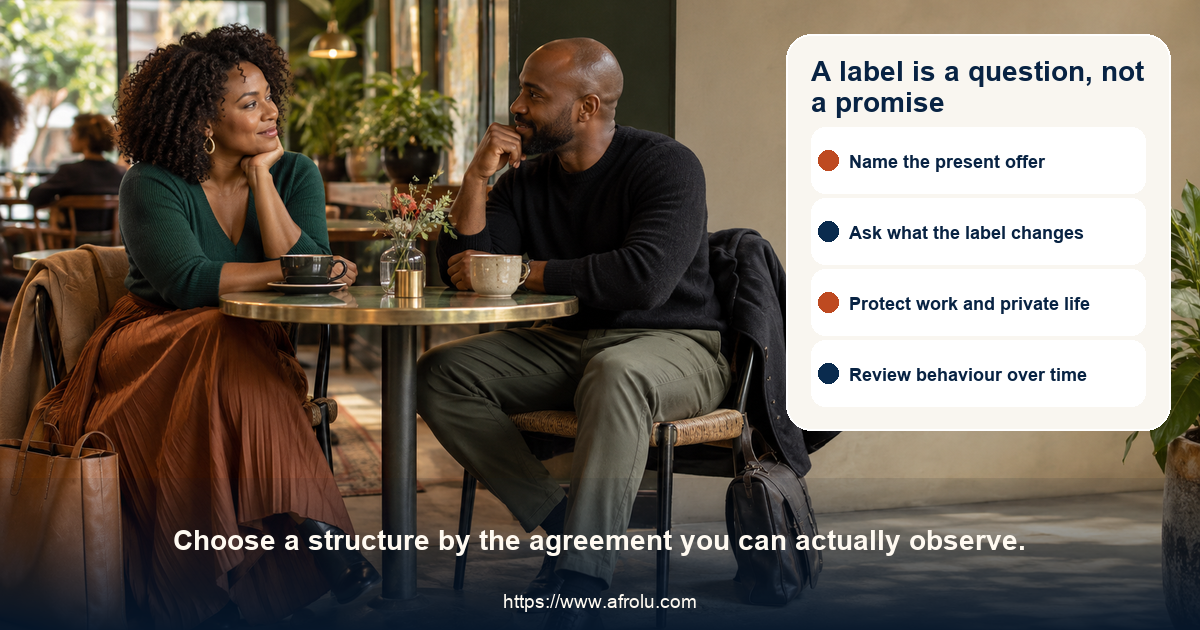
Translate labels into observable terms before changing your calendar.
Written and edited by Adwoa Boateng · Dating Safety Editor
Treat dating labels as starting points, not promises. Ask what casual, serious, exclusive, or slow changes in the present; compare words with repeated behaviour; state realistic availability without opening your work systems; and choose an affordable first plan you can change or leave independently.
Dating basics · Late Entrants
Which dating structure fits what I want now, and are its present terms clear enough for both adults to choose freely?
Types of dating are practical ways adults describe pace, intention, exclusivity, distance, and the amount of commitment they want now. The labels are not a standardized taxonomy: two people can use the same word differently, and one connection can combine several types. The useful definition is the explicit, revisable agreement both people understand.
After a long career-focused stretch, Ama accepts a short Saturday coffee with Kojo. He says he is looking for something serious, while she wants to date slowly before deciding whether exclusivity makes sense. Instead of treating those statements as a mismatch or a promise, she asks what each person means for the next month. Their answers give her a real choice without requiring either to pretend certainty.
later start · dating structures
A useful type of dating is an agreement two adults can describe and revise
This guide separates intention from exclusivity, pace from effort, career availability from workplace access, and an early label from evidence built over time.
Name what you want now, ask the term that changes your next step, make the first plan manageable, and review the answer against conduct rather than a borrowed timetable.
What do I want now?
A present answer can be honest while the future remains open.
What does the label change?
Ask about plans, other dates, disclosure, and expectations.
What can I sustain?
Offer a realistic rhythm without exposing work systems.
What have I observed?
Repeated choices are stronger evidence than intensity.
later start · self-authorship
A later start is context, not a promise to move faster
A person who has not dated much may feel pressure to present a polished explanation: where the years went, why they are starting now, and what outcome they expect. Those facts may matter to you, but they are not a qualification form. Begin with the choice that exists today: whether you would like to meet this particular adult under this particular plan.
Try separating curiosity from obligation before you reply. Curiosity sounds like wanting to hear how someone thinks or finding out whether conversation feels easy. Obligation sounds like accepting because friends say it is time, because a birthday is approaching, or because refusing might mean missing your only chance. Only the first is a reason you own.
Your answer can remain provisional without being misleading. You might be open to a relationship while not knowing whether this match could become one. You might want casual dates but still require honesty and care. A modest present-tense answer is more truthful than adopting a grand label to appear experienced or easygoing.
If you decide not to meet, no autobiography is owed. 'Thanks for asking; I am not looking to date right now' is enough when it is safe to say. If you do want to meet, choose a plan whose timing, cost, and length fit the rest of your week. A beginning should leave room for ordinary life rather than compete with it.
labels · observable terms
Dating types are useful only when both people mean the same thing by them
People often use the same label for different arrangements. One adult may mean casual dates without exclusivity; another may mean warmth and sex but no discussion of sexual health or future plans. Someone who says serious may be describing long-term hopes rather than a present promise. The word is a starting point, not the agreement itself.
Separate dimensions that can coexist. A connection may be slow and serious, casual and exclusive, long-distance and committed, or local and undefined. Ask about one term that changes your own choice. 'When you say casual, are you dating other people?' is clearer than trying to infer the answer from affectionate messages or how often someone calls.
Then compare the answer with conduct over time. A person can honestly want a serious relationship and still lack the capacity to build one with you now. A person can prefer casual dating and still keep plans, discuss health, and respect boundaries. Intention, agreement, and behaviour belong in separate columns; do not let one substitute for the others.
If a label stays vague after a direct question, you can decide from the information available. You do not need to force a definition, diagnose the other person, or wait indefinitely for the perfect explanation. 'I cannot choose this arrangement without knowing whether it is exclusive' states your decision condition, not a demand that the other adult adopt your preference.
pace · reciprocity
Low pressure can feel calm; low effort leaves one person carrying the connection
Low-pressure dating makes room for work, rest, friends, and a changing answer. It does not require instant disclosure, constant messages, or a weekend-long first meeting. But a slower rhythm still contains enough clarity for both people to know when they are likely to meet and how a change will be communicated.
Low effort often appears as a one-way system: you propose every plan, keep every conversation alive, absorb repeated last-minute changes, and accept contact only when the other person is bored. One busy week proves little. A recurring arrangement that depends on your flexibility is worth naming even when the person says they are interested.
You can test for reciprocity with one small, concrete invitation. Offer a day and a public activity that work for you, then notice whether the other person accepts, proposes a workable alternative, or leaves all the organising to you. This is not a trap. It gives both adults a chance to show what capacity looks like in ordinary conditions.
A difference in preferred frequency is not automatically a red flag. If one person wants weekly dates and the other can manage twice a month, the question is whether they can discuss it without guilt or punishment. You may decide the mismatch is too large. A calm incompatibility is still a valid reason to stop investing.

Judge a dating type by what both adults can choose and sustain.
career · capacity · privacy
A career can shape your availability without becoming your public dating profile
Busy periods affect capacity, but a job title cannot prove either seriousness or emotional availability. Tell a new date what they need to plan with you: perhaps you are free on alternate Saturdays, need notice before an evening plan, or cannot take personal calls during a shift. You do not have to share your employer, clients, calendar, or building to demonstrate honesty.
Protect the boundary between professional and personal access. Use a personal contact channel, avoid sharing confidential projects or identifiable colleagues, and do not let someone convert a slow reply into permission to contact your workplace. If you choose to describe your field, keep the detail proportionate to trust and avoid information that can expose another person's data.
A career-compatible arrangement is not one where the other adult always waits quietly or where you squeeze every date into exhaustion. It is a rhythm both people can understand and renegotiate. If a project ends, travel begins, or care duties change, say what has changed and what kind of contact you can still offer rather than relying on the other person to decode silence.
Notice whether the person treats your boundary as information or as a challenge. Respect may look like choosing another time, asking before calling, or accepting that work details are private. Pressure may look like arriving uninvited, messaging colleagues, demanding a screenshot of your schedule, or punishing you for a delay. Those behaviours concern access and control, not merely different texting styles.

Share an honest window; keep professional systems private.
first meeting · safety · money
Choose a first date whose logistics preserve your ability to leave
Pick a setting you can reach and exit without depending on a new match. Share the general plan with a trusted person if that helps you. Keep your home address, live location, employer access, passwords, and financial credentials private. A video call may help you decide whether to meet, but it cannot guarantee another person's identity or future behaviour.
Agree on the basic plan before travelling: where to meet, how long you have, and whether each person pays separately or shares a cost. A gift, ride, ticket, or meal creates no obligation to extend the date, accept touch, share intimate information, or go somewhere private. If the plan changes after you arrive, pause and choose again rather than treating sunk time as consent.
Keep sexual-health and intimacy conversations tied to the choices they affect. A first coffee does not require a full medical history. Before a sexual decision, adults may need to discuss relevant testing, protection, other partners, and boundaries plainly. Take time to ask; accepting a date, kissing once, or having a prior relationship does not decide what either person wants now.
Urgent requests for money, investment, account codes, travel deposits, or financial rescue deserve independent verification. Romance-scam approaches can sound personal and patient before a request appears. Do not send money to prove affection or protect a connection. If pressure continues, stop the transfer, preserve relevant messages where safe, use the platform's reporting options, and seek trusted financial or local support.
conversation · dignity
You can ask clear questions without pretending to know every dating rule
Start with the practical decision. If you need to know whether to keep other dates open, ask about exclusivity. If you are deciding whether another meeting fits, ask what kind of connection the person is seeking now. If the issue is calendar pressure, ask how often they realistically want to meet. One focused question is easier to answer than an interview about the whole future.
Listen for both content and room to choose. Someone may say they are uncertain, prefer casual dating, or want commitment eventually but not exclusivity yet. Those answers can disappoint without being dishonest. Your task is not to coach them into the answer you want; it is to decide whether the answer offered is enough for your own next decision.
You may choose to share that you are learning as you go, but keep disclosure in your control. Try: 'I have not dated much, so I prefer to make plans clearly rather than assume the rules.' That communicates a preference without giving a stranger access to private history, trauma, finances, or health details they have not earned by respect.
If the conversation becomes mocking, patronising, or coercive, stop trying to phrase the perfect question. A respectful disagreement leaves both adults free to decline. If you feel unsafe asking in person, choose a safer channel, tell someone you trust, or end contact without arranging a private explanation. Clarity is useful only when it does not require surrendering your safety.

Ask the term that would change your next decision.
review point · chosen structure
The right dating type is the one whose present terms still fit your life and values
Before another date, write down three things in plain language: what you want now, what you are not offering, and what behaviour would help you reassess. For example, you may want to meet occasionally, keep work private, and discuss other partners before intimacy. This is a private compass, not a script the other adult must adopt word for word.
Review after a real event rather than after every anxious thought. Did the person follow through? Could you decline an extension? Did both people get to suggest plans? Was the answer about casual or serious intent still consistent with what happened? A pattern is more informative than an emoji, one quiet evening, or a single awkward sentence.
When the arrangement changes, update the term that changed. New exclusivity, sexual intimacy, relocation, a career shift, or a wish to end can affect another adult's choices. Say what is now true and leave room for them to accept, negotiate, or decline. A past agreement does not remove either person's ability to revise it.
Starting later does not create a race, and choosing a low-pressure structure does not mean settling for neglect. Let mutual effort, usable honesty, privacy, consent, and workable time matter more than whether a label sounds impressive. You may continue because the current arrangement feels good, or stop because it does not. Either answer belongs to you.
Eight later-starter situations where a dating label meets a real calendar, boundary, or decision

Milestone pressure
Friends frame a date as overdue and you feel more obliged than curious.
Wait a day and decide whether this specific person and plan appeal.Casual means two things
One adult assumes no exclusivity; the other assumes they are building toward it.
Ask what the word changes now, especially around other dates.Slow but mutual
You meet less often than your peers but both people plan and follow through.
Judge the shared rhythm by consent and reciprocity, not frequency alone.Low effort pattern
You arrange every meeting and absorb repeated late cancellations.
Name one workable standard and watch the response.Personal channel
A match asks for your work calendar to prove your availability.
Give a realistic time window; keep employer systems private.Office contact
A delayed reply is followed by a message to your workplace.
State no work contact, restrict access, and preserve evidence if it continues.Plan changes privately
A public coffee is redirected to a home after you arrive.
Decline the change and leave using your independent transport.Urgent rescue request
A new connection asks you to transfer funds before a planned visit.
Pause the transfer and verify independently; affection is not proof.Fourteen observable signs that a dating structure leaves both adults free to choose
You can name the meeting you want without apologising for its size.
A dating label is explained through present agreements rather than implied promises.
The other adult can answer a clear question without ridiculing your experience.
A slower rhythm still includes plans and follow-through from both people.
Your work hours are respected without demanding calendar or employer access.
A cancellation can be discussed without punishment or a guilt invoice.
You can keep first meetings public and choose your own return journey.
A meal or ride never becomes a claim on touch, sex, or a second date.
Financial requests are not framed as proof that the connection is real.
A boundary can be heard without a lecture about your age or experience.
Sexual-health questions can be discussed before the decision they affect.
Private history is shared by choice, not extracted as an entry fee.
Both adults may revise the pace when work or capacity changes.
A no or ending is accepted without repeated contact or workplace access.
A decision map for timing, labels, career capacity, first meetings, and changed answers
| Situation | What it may mean | What to do next |
|---|---|---|
| I want to meet but feel behind | Comparison pressure is louder than present preference. | Choose a small date only if curiosity remains after the pressure settles. |
| They say casual | The word may leave exclusivity, contact, and disclosure unanswered. | Ask which of those terms matters to your next choice. |
| They say serious | Long-term hope does not establish present capacity or agreement. | Ask what serious changes in the current arrangement. |
| We date infrequently | A lower frequency may fit work or a chosen pace. | Compare mutual planning and satisfaction, not a universal weekly target. |
| I plan every date | Effort may be uneven even if affection is warm. | Make one clear invitation and see whether planning becomes mutual. |
| My calendar is private | Privacy is compatible with honest availability. | Offer a time window without exposing employer systems. |
| A public date becomes private | The plan changed and needs fresh consent. | Decline, remain in public, or leave with your own transport. |
| I feel inexperienced | A confidence gap is not authority for the other adult. | Name what would help; do not accept a teacher-student dynamic. |
| Money is requested | Romance does not verify an emergency or investment. | Stop, verify independently, and do not share codes or credentials. |
| My answer changed | Consent and relationship choices remain revisable. | State the changed term and let the other person choose freely. |
Twelve practical lines for asking about intent, work privacy, plans, consent, and endings
“What kind of connection are you interested in building at the moment?”
“When you say casual, are you dating other people, and what do you want us to tell each other?”
“You mentioned wanting something serious. What would that look like over the next month?”
“I prefer to meet once or twice a month while I see how this feels. Would that suit you?”
“I can meet Saturday afternoon; could you choose the place this time?”
“My work calendar is private, but I can tell you which evenings I am free.”
“I need a day's notice for an evening plan. Last-minute invitations usually do not work for me.”
“I am newer to dating, so I like clear plans and room to ask questions.”
“I would like to meet in public for about an hour and arrange my own way home.”
“Let's choose something we can each comfortably pay for ourselves.”
“I agreed to coffee, not a private location, so I am keeping to the original plan.”
“I have learned that this arrangement is not right for me, and I do not want to continue dating.”
Know the difference
Low-pressure dating versus low-effort ambiguity
A mutually chosen pace; enough notice; realistic contact; plans both adults can revise.
One person carries the planning; repeated uncertainty; limits treated as inconvenience.
Slow can be mutual. Unclear and one-sided deserves a direct conversation.

Distinguish pace from reciprocity instead of scoring message frequency.
Low-pressure pacing and low-effort ambiguity are not the same arrangement
| Type or dimension | What it describes | Best next question |
|---|---|---|
| Casual | Describes a lighter or non-exclusive arrangement only if both define it. | Ask what casual means around other dates and sexual health. |
| Serious | May describe a goal, not immediate exclusivity or capacity. | Ask what a serious intention changes this month. |
| Exclusive | Limits romantic or sexual dating by an agreed boundary; it does not settle every future plan. | Define what each person includes in exclusivity. |
| Slow | Describes pace, not the amount of care or the eventual outcome. | Agree one check-in point rather than indefinite waiting. |
| Low pressure | Keeps choices easy to accept, change, or decline. | Notice whether both people can state a preference. |
| Undefined | Means a needed term has not yet been agreed; it is not a promise. | Decide what information you need before continuing. |
| Long distance | Describes geography, not whether the connection is casual or serious. | Plan time, cost, privacy, and visits without rushing trust. |
| Multi-dating | May be open before exclusivity but must not rely on misleading omission. | Disclose what would change another person's informed choice. |
| New relationship | An early stage with limited evidence, whatever its label. | Let repeated conduct earn confidence gradually. |
A simple plan you can use today
A date is not a milestone
Decide from present interest rather than a borrowed deadline.
Labels need translation
Ask what a type changes in plans, disclosure, exclusivity, and care.
Slow can still be reciprocal
Look for mutual planning and honest updates, not constant contact.
Experience is not authority
Neither adult earns control of the other's pace by dating longer.
Work privacy is ordinary
Availability can be clear while professional details stay private.
Consent stays current
A prior yes, expense, kiss, or label does not decide the next choice.
Questions organised by purpose and depth
Choose a few prompts that fit the moment. This is a reference library, not a list to complete.
My present reason
Separate interest from comparison.
- What sounds enjoyable about this specific meeting?
- Would I still choose it if nobody asked about my dating life?
- What size of plan would feel manageable?
The type on offer
Translate a label into current terms.
- What does casual or serious change this week?
- Are other dates part of the agreement?
- Which unanswered term affects my next choice?
My career boundary
Share enough to plan and no more than you choose.
- What availability can I honestly offer?
- Which workplace details remain private?
- What response would show respect for that limit?
My review point
Use behaviour rather than a forecast.
- Did both people contribute to the plan?
- Could either person revise it freely?
- What will I do if the same mismatch repeats?
What deserves a closer look
Separate intention, agreement, and evidence
A person may want a serious future, agree to casual dating today, and still show whether their current conduct is reliable. Keep those facts distinct.
Evidence limit: No label proves honesty or future compatibility.
Measure the rhythm by mutual choice
A lower frequency can be workable if both people can plan, update changes, and say when they want something different.
Evidence limit: There is no universal correct number of dates or messages.
Treat confidence as individual, not hierarchical
More dating history may give someone stories, but it does not create authority to teach, correct, or hurry another adult.
Evidence limit: A guide cannot assess a power imbalance from age alone.
Share availability rather than infrastructure
A clear time window can support planning without handing over an employer calendar, client data, security badge, or private address.
Evidence limit: Workplace privacy and stalking support may depend on local policy.
Keep romance separate from financial rescue
A first date can involve ordinary shared costs; urgent loans, codes, investments, and travel transfers require independent checks.
Evidence limit: No source can guarantee a new match's identity or intentions.
Let evidence change the structure
A move, capacity shift, exclusivity conversation, or new intimacy decision can justify revisiting the agreement with both adults free to decline.
Evidence limit: Editorial guidance is not therapy, legal advice, or a safety assessment.
Common shortcuts that turn a label, job, or date cost into false certainty
Accepting to catch up
Comparison can hide whether you actually want this person or plan.
Using a label as a contract
A word cannot define exclusivity, disclosure, contact, or consent by itself.
Calling every slow rhythm low effort
People differ in capacity; assess planning and reciprocity across time.
Sharing work access to prove honesty
A schedule explanation never requires credentials, clients, or building access.
Treating a paid date as a debt
Money buys only the agreed item, not intimacy or future contact.
Explaining a no repeatedly
A clear boundary does not need to win a debate to be valid.
Ask a useful first-date question, understand a later-life start, or compare emotional availability
Choose the resource that fits what you need to decide now. An editorial guide can help you name a question; it cannot verify another adult's intentions or conduct.
Explore the guide library
Show more related guides
Continue with Afrolu
Show more Afrolu guides
Sources used for this guide
Afrolu reviewed these health, research, safety, or public guidance resources while editing this page. They support the behaviour and safety guidance; they do not diagnose any individual described by a reader.
Questions about starting later, dating labels, work boundaries, and consent
Am I too late to start dating?
There is no universal dating timetable. Decide whether you want to meet this person now, not whether the calendar says you should.
What types of dating can I choose?
You can explore casual, serious, exclusive, slow, or other arrangements, but the terms need to be clear enough for both adults to choose.
Does casual mean non-exclusive?
Not automatically. Ask whether other dates, sexual-health disclosure, and contact expectations are part of the agreement.
Can I want a serious relationship but date slowly?
Yes. Serious intention and present pace are different dimensions; explain what you want now and when you will revisit it.
How do I know if slow dating is low effort?
Look across repeated plans: mutual initiation, realistic follow-through, and honest updates matter more than a single reply gap.
Should I tell a date that I am inexperienced?
Only if you want to. You can state the preference that matters, such as wanting clear plans, without giving a full history.
Do I need to show my work calendar?
No. A truthful availability window is enough for planning; keep employer systems, client details, and credentials private.
Who should pay for a first date?
Choose an affordable arrangement both people understand. Payment never creates consent, intimacy, gratitude on demand, or another date.
Can I change my mind after agreeing to meet?
Yes. You may change or withdraw a yes at any point; communicate safely and do not treat earlier effort as a debt.
Is this guide professional or therapeutic advice?
No. It offers general editorial decision support; it cannot assess an individual, diagnose relationship dynamics, or replace qualified local help.
One thing to do now
Choose the smallest next step that still feels like your own choice
Name your current intention, translate the label into terms that affect your choices, set one boundary around time or privacy, and review the agreement against repeated conduct. Do not infer exclusivity, seriousness, honesty, or consent from a label, a payment, or someone else's confidence.