Faith-led · serious · long distance
Faith-Led Long-Distance Dating: Define Serious Intent Together
Explore faith-led long-distance dating: discuss serious intent, exclusivity, lived values, boundaries, travel and family input without assuming faith's rules.
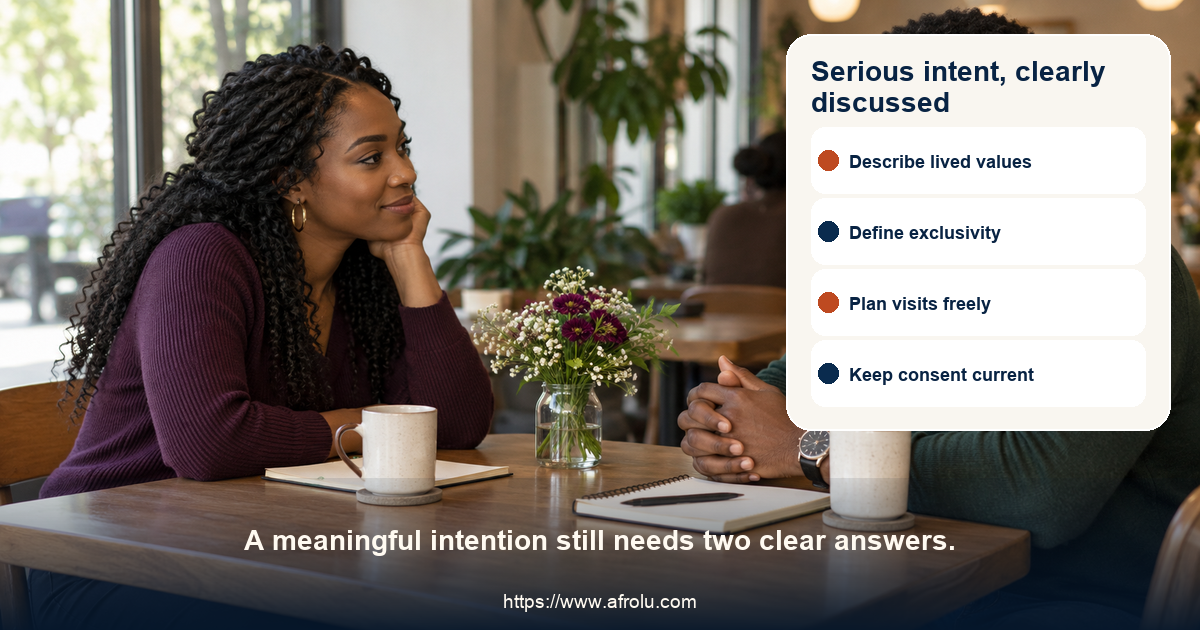
Ask what seriousness means in the present.
Written and edited by Grace Mutiso · Kenya Guides Editor
Ask what faith-led means in each person's daily life, separate serious intent from present exclusivity, and discuss the practical expectations that affect compatibility. Keep family involvement voluntary, travel affordable and independent, and intimacy based on current consent. Review stated values against repeated choices while leaving both adults free to slow down, renegotiate, or end the relationship.
Dating basics · Faith-Led Daters
How can two faith-led adults explore serious long-distance dating without treating a shared label, family expectation, or visit as a promise?
Faith-led long-distance dating is a relationship approach in which adults let personally held beliefs or practices inform a connection while location shapes contact and visits. Neither phrase defines a universal rulebook. The useful agreement is the specific, voluntary understanding two people make about intention, exclusivity, privacy, family, travel, and boundaries.
Samira and David both describe their dating as faith-led and hope for a serious relationship. They live in different cities, and David assumes they should stop seeing other people immediately; Samira wants to understand their day-to-day expectations first. Instead of asking a relative or leader to settle the difference, they discuss what each means by serious, which practices matter, and whether a slower checkpoint would feel honest to both.
faith-led dating · keep agency mutual
Serious intent is strongest when each adult remains free to choose
This guide separates personal practice from assumptions, future direction from current exclusivity, and family advice from the couple's consent.
Ask about lived values, make present terms explicit, plan distance independently, and review what both adults actually choose.
What does faith mean to you?
Let each adult describe their own daily commitments.
What is serious today?
Separate the future direction from present exclusivity.
Who participates?
Keep family and outside counsel voluntary.
Can we revise?
Keep travel, intimacy, and consent current.
faith · lived values · present intention
Faith-led dating begins with what each adult actually practices and values, not a borrowed script
Faith-led can mean different things to different adults, including people who share a tradition. One may mean that spiritual practice shapes their weekly rhythm; another may mean they want a partner who respects a personal ethical commitment; a third may be reconnecting with beliefs in a new way. Do not treat the phrase as a complete account of worship, gender roles, intimacy, family involvement, or future plans.
Start with the present offer. You might want a committed partnership eventually, yet still need time to learn whether this person shares your everyday values. You may already feel serious while remaining uncertain about exclusivity, location, or the pace of commitment. These are distinct questions. Saying that you want to date intentionally does not obligate you to promise a future before both adults have enough information.
Describe your own practice without presenting it as a test the other person must pass. You can explain which choices matter to you, where you are flexible, and which boundary is not negotiable. Then ask how the other adult understands those choices in daily life. A respectful answer may reveal alignment, difference, or uncertainty; each can be more useful than a polished claim that both people are 'on the same page.'
If the two of you use a shared faith label, stay curious about differences within it. If you come from different traditions or levels of observance, avoid assuming that the person is a representative or a conversion project. Compatibility is about the lives and agreements two adults can actually build, not about winning a theological argument during an early date. You may decide that shared practice is essential, or that mutual respect across difference is enough.
serious dating · pace · clear agreements
Serious intent describes a direction; exclusivity describes an agreement both people still need to make
A person may sincerely hope to marry or build a lifelong partnership and still want to date slowly before choosing exclusivity. Another may understand seriousness as a present commitment to focus on one person. Neither definition can be assumed from the word itself. Ask what changes now: other dates, regular contact, introductions, decision timing, or the level of planning each adult is willing to do.
A long-distance connection can intensify promises because there are fewer ordinary moments in which to test compatibility. Do not let declarations substitute for patterns. Notice whether the person follows through, makes space for your questions, and can discuss disagreement without invoking faith or seriousness as a reason you must comply. A meaningful intention should make room for both adults to choose; it should not close the conversation.
You can ask for a checkpoint instead of a guarantee. Perhaps after several calls or a mutually chosen visit, both of you can revisit exclusivity and practical capacity. The date should reflect what feels useful, not a universal relationship timeline. If one person wants an immediate promise and the other is not ready, say so directly. A difference in pace may be painful without making either person's answer dishonest.
Be precise about what exclusivity includes if you choose it. Adults may differ on romantic dates, sexual contact, app use, disclosure, or how a change is communicated. Discuss the parts that affect informed consent and health rather than relying on a broad status word. Exclusivity does not remove the need for respect, privacy, or the ability to end the relationship later; it describes one agreement, not ownership.
compatibility · everyday practice
Shared values become visible through ordinary decisions about time, care, money, family, and difference
Compatibility questions work best when they are concrete. You might ask how a weekly practice affects weekends, how each adult approaches giving or financial responsibility, or whether family participation is expected before a serious commitment. The answer should describe this person's life, not a claim that every member of a religion or community behaves in one way. Ask only what is relevant to the relationship you are considering.
Values are easier to compare through choices than slogans. Does each person keep a commitment when inconvenient? Can you talk about different interpretations without contempt? Do your expectations around care, honesty, children, work, or money leave room for two adults' needs? You do not have to share every habit. You do need to know which differences are workable and which would ask either person to live against a core conviction.
Do not promise that love will automatically resolve a serious values conflict. Nor do you have to dismiss a difference before understanding it. Name the practical point: perhaps one person wants a partner to attend certain observances, while the other prefers personal respect without participation. Discuss what is requested, how often it matters, and whether refusal would be accepted. The level of choice available is as important as the stated belief.
A date can be sincere and still lack the knowledge needed to answer every long-term question. Record what you know, what you need to ask, and what you cannot decide yet. If a topic has major consequences, slow the commitment conversation until both adults can speak without an audience, threat, or rush. A thoughtful 'I need time to understand this' can be more responsible than borrowing certainty from a phrase.
family · community · autonomy
Advice from relatives, elders, or faith communities can matter without becoming consent on behalf of either adult
Some adults welcome early family or community involvement; others prefer to build trust privately. Neither preference can be assigned from a faith label. Ask how the other person handles advice, introductions, and privacy, and explain your own comfort. A future meeting with relatives should not be presented as an automatic proof of seriousness if neither adult has agreed on what it means.
Outside support can be valuable when it is freely chosen and leaves both people able to disagree. Pressure begins when a leader, relative, or community member is used to corner one adult, disclose private information, demand a commitment, or restrict contact without consent. If you are being urged to meet someone alone, reveal personal details, or accept a decision to protect family reputation, you may pause and seek independent support.
Keep information about family members and community contacts private unless they agree to be involved. A new partner does not need a relative's phone number, home address, private messages, or access to a religious gathering as a shortcut to trust. Likewise, do not share the other person's disclosures with your circle as entertainment or as a vote on whether they are suitable. Consent applies to stories and introductions too.
If you choose an introduction, set its purpose and limits beforehand. It might be a simple meeting with people important to you, not an engagement signal or a promise to marry. Agree what can be discussed, what remains between the two of you, and how either person can step away afterward. An adult's decision should remain their own even when several respected people have strong opinions.

Agree on who participates and what the introduction means.
visits · logistics · financial boundaries
A serious long-distance hope still needs ordinary plans that protect money, time, and independent choice
Travel can make a relationship feel more certain because each meeting requires effort. Keep the effort distinct from the promise. You can want a serious partnership and still decide not to fly yet, meet only in a public setting, or keep your own lodging. Ask what each person expects the visit to include and what would happen if either of you changed your mind after arrival.
Make the money plan legible before spending. Decide whether each adult pays their own travel, how shared costs will be handled, and whether a proposed plan fits without borrowing. Do not send money, documents, passwords, or account codes to demonstrate faith or commitment. If an emergency or investment request appears, verify it through an independent source and speak with someone outside the new connection before acting.
A visit should not make either person dependent on the other for accommodation, transport, or permission to leave. When possible, choose an independent return option and a public first meeting. If separate lodging is not affordable, scale the plan down or wait. A person who is serious about building trust can accept that caution without turning it into a challenge to their character or faith.
Long distance also requires honest capacity. How often can each adult call, travel, or take time off without harming work, care, health, worship, or finances? A serious intention does not make those constraints disappear. If the answers reveal a gap, discuss whether a different rhythm is possible. Do not let a future plan become a hidden obligation one person is expected to fund or perform alone.

Discuss cost and expectations before booking.
consent · intimacy · personal conviction
A faith commitment can shape an adult's personal boundary, but it never replaces asking what the other person chooses
Adults may hold different beliefs about affection, sexual activity, marriage, or when a conversation should happen. Do not assume that a person with a faith identity wants the same boundary you do. Explain your own choice and ask what the other adult prefers. If you disagree, each person remains free to stop, slow down, or choose a relationship with a more compatible set of values.
Consent applies to each decision and can be withdrawn. A serious dating label, a previous intimate moment, a prayer, a family introduction, a paid visit, or a promise about marriage does not decide what either adult wants today. Ask clearly and leave room for an unpressured answer. If someone uses scripture, authority, shame, or a claim about what a 'good partner' must do to override a no, prioritize your safety and seek support.
Talk about sexual health and protection before intimacy, with enough privacy and time to make an informed choice. You do not owe a complete medical history to answer a specific question, and no adult should be denied relevant information that affects their consent. Be clear about what you want to know, what you will share, and what protection or testing decisions matter. If you are uncertain, waiting is a valid choice.
For digital intimacy, agree separately about images, messages, and storage. A private conversation is not permission to forward, publish, or retain intimate material against someone's wishes. Do not request passwords or proof of devotion. If an adult threatens to expose information or uses faith or family reputation to compel access, preserve evidence where safe and contact appropriate local specialist services rather than negotiating alone.
review point · clarity · next step
A serious relationship grows through compatible choices, not a title, a spiritual claim, or distance endured alone
After several conversations or a chosen visit, review what has become clearer. Do both adults understand the present level of commitment? Can each describe what exclusivity means? Are family expectations and personal practice discussable without an audience? Has the travel and contact load been shared in a way that feels sustainable? A large declaration cannot answer those questions; the ordinary pattern can.
Notice whether 'serious' is being used to support mutual responsibility or to accelerate access. A person can ask for reassurance, while still accepting that you need time. They can want a future and still say, 'I do not know yet.' If every question is interpreted as disloyalty, or every boundary is met with religious guilt or social threat, the language of commitment is not making the relationship more mutual.
If your understanding changes, say which term changed. You may want exclusivity now, decide to delay an introduction, need less travel, or conclude that your values do not align. The other adult can accept, negotiate, or decline. Neither person owes a continued relationship because of time, prayer, disclosure, gifts, or the expectations of relatives. An ending can be clear without condemning a whole faith or community.
Choose a next step that matches the evidence you have: one more conversation, a public visit with independent plans, a pause, or a respectful end. You do not have to settle marriage, relocation, and family questions during one call. You do need enough clarity to avoid making a decision you cannot freely revise. Seriousness is most useful when it supports honesty, patience, and the continued agency of both adults.

Look for choices both adults can revise.
Eight moments where faith, serious intent, family, and distance need separate answers
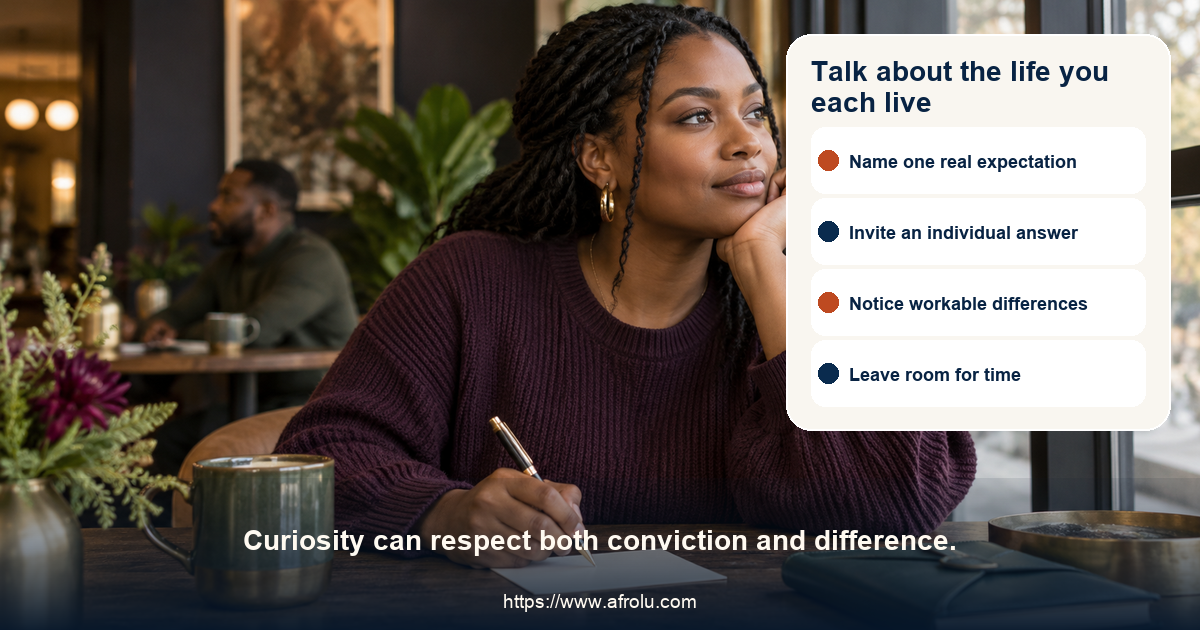
Faith-led means different things
Both people use the same label but imagine different daily practices and expectations.
Ask what the phrase means in their own life this month.Serious is treated as exclusive
One adult assumes the word means neither person will date anyone else.
Define exclusivity directly before relying on it.An introduction becomes a promise
Relatives interpret a first meeting as an agreement to marry or move quickly.
Clarify the purpose and keep the couple's choice central.A leader is asked to settle the disagreement
One person wants a third party to pressure the other into a decision.
Use outside guidance only when both choose it freely.One person funds every visit
Travel cost and leave accumulate on one side while future plans stay vague.
Discuss capacity and cost before booking another trip.A belief is used to demand intimacy
A date invokes spiritual or moral language after the other adult says no.
End the negotiation and seek support if your choice is not respected.Private information is shared with family
An adult's health or relationship disclosure is passed to a community group without consent.
Name the privacy breach and limit further access.One person is no longer ready
Serious hopes remain but the current timing, travel, or exclusivity offer changes.
State the new term and allow a real answer.Fourteen signs that commitment language still leaves both adults free
Each adult describes personal practice without claiming to represent a whole faith.
Serious intention and current exclusivity are discussed as separate terms.
A question about values is met with curiosity rather than shame.
Both people may be uncertain about the future without being called dishonest.
Family or community introductions happen only by mutual choice.
Third-party advice does not replace either adult's consent.
Travel costs and leave are shared or negotiated transparently.
Accommodation and transport preserve each person's ability to leave.
No one is asked to send money, documents, passwords, or verification codes.
Personal convictions are stated as one's own rather than assigned to a partner.
Intimacy decisions remain voluntary, specific, and current.
Sexual-health questions can be asked without spiritual ridicule.
Private family and community information stays confidential by agreement.
A changed answer or an ending is accepted without religious or social threats.
A decision map for practice, exclusivity, family input, travel, and changed intent
| Situation | What it may mean | What to do next |
|---|---|---|
| They say faith-led | The label alone does not describe their lived practice. | Ask what it means in the choices relevant to you. |
| They say serious | Intent may point toward a future without defining present exclusivity. | Ask what changes in the current arrangement. |
| We share a tradition | Shared identity does not guarantee identical values or practice. | Compare concrete expectations without assuming one script. |
| Our beliefs differ | Some differences may be workable; others may affect core choices. | Name the practical impact and decide at your own pace. |
| Family wants to meet | An introduction can carry different meanings. | Agree on purpose, timing, privacy, and freedom to decline. |
| A leader is asked to decide | Outside input may become pressure if one adult has no choice. | Use counsel only if participation is voluntary for both. |
| I am asked to travel | A visit is a separate logistical and financial decision. | Discuss cost, lodging, public plans, and expectations first. |
| A boundary is moralized | Belief may be used to override the answer you gave. | Stop debating and seek trusted support if necessary. |
| I want more time | Readiness can differ without erasing sincere intent. | State what you can offer now and set a review point. |
| I want to end it | Serious hopes or introductions do not create a duty to stay. | Communicate safely and protect private information. |
Twelve ways to discuss lived values without assigning a shared script
“What does faith-led dating look like in your day-to-day life?”
“These are the practices that matter to me; how do they fit with what matters to you?”
“When you say serious, what would change between us now?”
“Are we agreeing not to date others, or are we still discussing what we want?”
“I want to get to know you carefully before making a promise about the future.”
“Which difference matters to you in ordinary life, rather than in theory?”
“I am not ready to introduce family yet. Can we keep that choice between us for now?”
“Would we both want this person involved, and can either of us decline their advice?”
“What do you expect this trip to mean, and how will we handle separate plans and costs?”
“I want to talk about my boundary; what do you want, and can we both pause without pressure?”
“My timing has changed. I still respect you, but I cannot make the promise we discussed.”
“I have decided not to continue this relationship. Please keep what I shared private.”
Know the difference
Serious intention versus a promise assumed from faith or distance
Both adults define seriousness, exclusivity, practice, family involvement, travel, and consent in their own words.
A shared label, spiritual authority, long call, or expensive visit is treated as a decision the other adult never made.
A meaningful intention still needs two freely chosen answers.

Compare mutual agreement with borrowed certainty.
Chosen commitment is different from certainty borrowed from a label
| Type or dimension | What it describes | Best next question |
|---|---|---|
| Faith-led | Each adult defines how belief or practice shapes their relationship choices. | Ask about lived expectations rather than assuming doctrine. |
| Serious | Signals desired direction but not present exclusivity by itself. | Clarify what changes today and what remains undecided. |
| Exclusive | A specific agreement about dating others, independent of spiritual identity. | Define its scope and relevant disclosures. |
| Long-distance | Location affects contact and visits, not commitment level. | Discuss capacity and travel before making a promise. |
| Interfaith | Partners may share some values and differ on others. | Choose the concrete difference with real-life consequences. |
| Family-involved | Relatives may have a role only as both adults choose it. | Agree what an introduction does and does not mean. |
| Slow serious dating | A future goal can coexist with a deliberate present pace. | Set a review point instead of demanding certainty. |
| Private relationship | Privacy can be a boundary, not a claim of secrecy or shame. | Define what each person wants kept between them. |
| Undefined commitment | Hope exists, but the terms have not been agreed. | Ask what information you need before continuing. |
A simple plan you can use today
Faith labels are personal
Ask how this adult practices rather than supplying a script.
Serious is not synonymous with exclusive
Discuss the present agreement before changing other choices.
Values show in daily life
Compare expectations about time, care, family, and difference.
Family input is optional
An introduction or counsel should not replace two adults' consent.
Travel is not proof
A visit or expense cannot purchase a commitment or intimate access.
Boundaries remain current
Shared belief and past promises do not replace asking now.
Questions organised by purpose and depth
Choose a few prompts that fit the moment. This is a reference library, not a list to complete.
My faith in practice
Start with your own lived values.
- Which practice affects a real relationship choice?
- What am I flexible about?
- What should I ask rather than assume?
The serious offer
Define the present before forecasting the future.
- What does serious change today?
- Are we exclusive?
- When would a review help?
Family and counsel
Choose outside involvement instead of inheriting it.
- Whom do I want involved?
- Could either adult decline?
- What information stays private?
The visit
Keep travel separate from consent and commitment.
- Can I afford my own plan?
- Where can I stay independently?
- What would make me postpone?
What deserves a closer look
Ask about lived commitments
Discuss the routines, expectations, and decisions that actually shape each person's week rather than generalizing from a faith name.
Evidence limit: This guide does not interpret religious doctrine.
Separate hope from present agreement
A long-term goal may coexist with uncertainty about exclusivity, location, or timing; each term can be discussed on its own.
Evidence limit: No conversation guarantees future compatibility.
Make outside participation voluntary
Relatives and community figures may offer support when both adults want it and can reject the advice without punishment.
Evidence limit: The guide cannot assess a community's authority structure.
Plan visits without hidden debt
State who pays, where each adult stays, what the plan includes, and how either may change it.
Evidence limit: This is not travel or immigration advice.
Let present consent lead
Beliefs can inform personal boundaries, but neither person's assumptions replace a voluntary answer to a specific choice.
Evidence limit: No editorial guide can assess an individual safety situation.
Treat changed intent honestly
New limits, doubts, or plans should be shared early enough for the other adult to make their own informed choice.
Evidence limit: A respectful response is not guaranteed.
Shortcuts that make identity, family, or travel decide the relationship
Assuming one faith script
People within a tradition may practice and prioritize differently.
Treating serious as exclusive
A direction is not a mutually defined present agreement.
Using a leader to win
Outside authority can remove the other adult's freedom to choose.
Treating family approval as consent
Relatives cannot make a romantic decision for either adult.
Funding travel to prove intent
Cost and sacrifice do not guarantee a compatible future.
Using belief to negotiate a no
Consent remains voluntary regardless of shared values or commitment.
Explore religious dating, serious intent, or long-distance expectations
Choose the guide that addresses your current question. These editorial resources do not interpret doctrine or assess an individual relationship.
Explore the guide library
Show more related guides
Continue with Afrolu
Show more Afrolu guides
Sources used for this guide
Afrolu reviewed these health, research, safety, or public guidance resources while editing this page. They support the behaviour and safety guidance; they do not diagnose any individual described by a reader.
Questions about faith-led serious and long-distance dating
What does faith-led dating mean?
It depends on the adults involved. Ask how each person's beliefs and practices shape the relationship they want now.
Does serious dating mean we are exclusive?
Not unless both adults agree on that term. Discuss other dates and relevant disclosure directly.
Can we be serious and still take time?
Yes. Long-term intent and present pace are separate choices that can be reviewed together.
How do I discuss a difference in faith?
Choose one practical expectation, ask what it means in daily life, and decide whether it is workable for you.
Should family meet my date early?
Only if you want that and both understand what the introduction does and does not imply.
Should a religious leader decide whether we continue?
Outside guidance should be voluntary for both; it does not replace either adult's consent.
Does a visit prove commitment?
No. Travel is a separate decision about time, cost, accommodation, and current comfort.
Can my intimacy boundary differ from my partner's?
Yes. State it clearly, discuss relevant health questions, and allow either adult to decline without pressure.
Can I change my mind after a promise?
You can revise your choice. Explain what changed and leave the other adult free to decide too.
Is this religious counseling or legal advice?
No. It is general relationship editorial, not theological, legal, or individual safety advice.
One thing to do now
Choose the next step that respects both conviction and agency
Ask what faith and seriousness mean in the other adult's lived experience; separate future direction from present exclusivity; discuss one concrete values difference at a time; keep family input voluntary; and plan visits without debt or implied intimacy. Reassess after real interactions, and treat consent and the freedom to revise as essential even when intentions are sincere.