Seven-gate day pass · later-entry casual safety
Use a Day Pass, Not a Master Key, When You Return to Casual Dating
Safe talking-stage guide for adults returning to casual dating: verify identity, protect money, plan public meetings, define consent and keep exits clear.
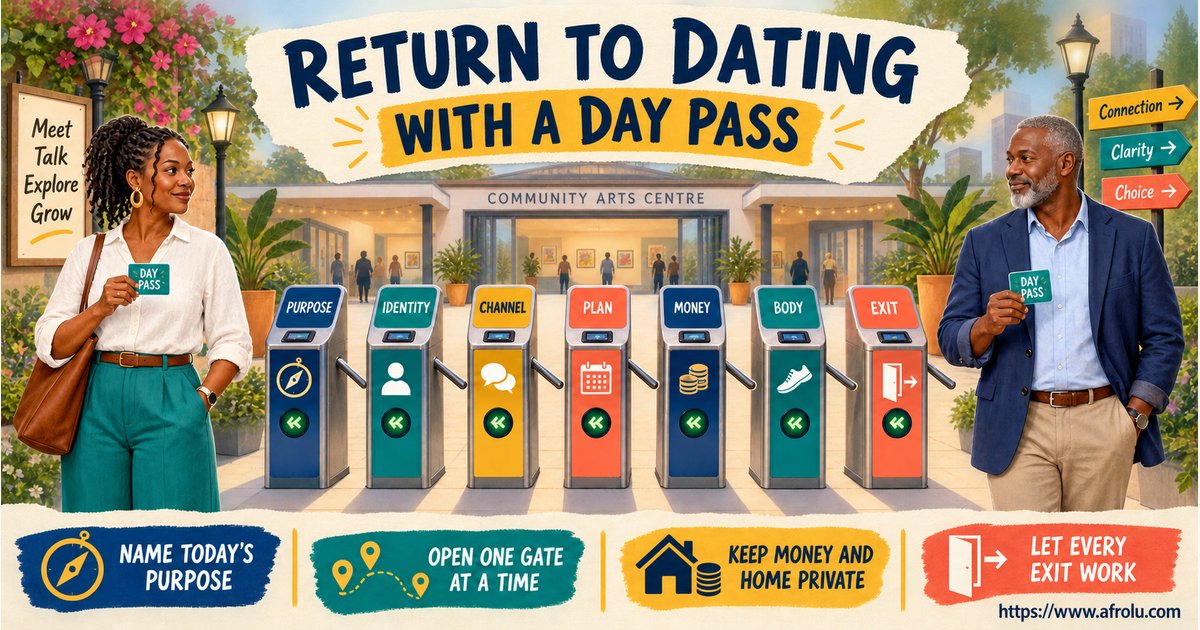
A talking stage is a day pass for exploration, not access to an adult's whole life.
Written and edited by Nadine El-Sayed · Verification Editor
Treat the talking stage as a day pass, not a master key. Name PURPOSE first. Then open IDENTITY, CHANNEL, PLAN, MONEY, BODY and EXIT one by one. Define casual before acting on the label: exclusivity, disclosure, rhythm, sexual health, home access and endings. Use small identity checks, public meetings, your own transport and no romantic money request. Time away never makes fast trust a duty. You can discuss or end a mismatch. Fraud, threats, tracking, force or blocked exits need direct protection.
Early relationship discovery · Late Entrants
How can an adult returning to dating explore casual dating while keeping control of privacy, consent, money, meetings and every exit?
A talking stage is time for two adults to explore before they agree on a relationship shape. Casual dating is a separate lower-commitment agreement. It does not always mean non-exclusive, sexual, private or free of care. Mutual slow dating, situationship, mismatch, re-entry learning, respectful closure, romance fraud and unsafe control are nearby but different ideas.
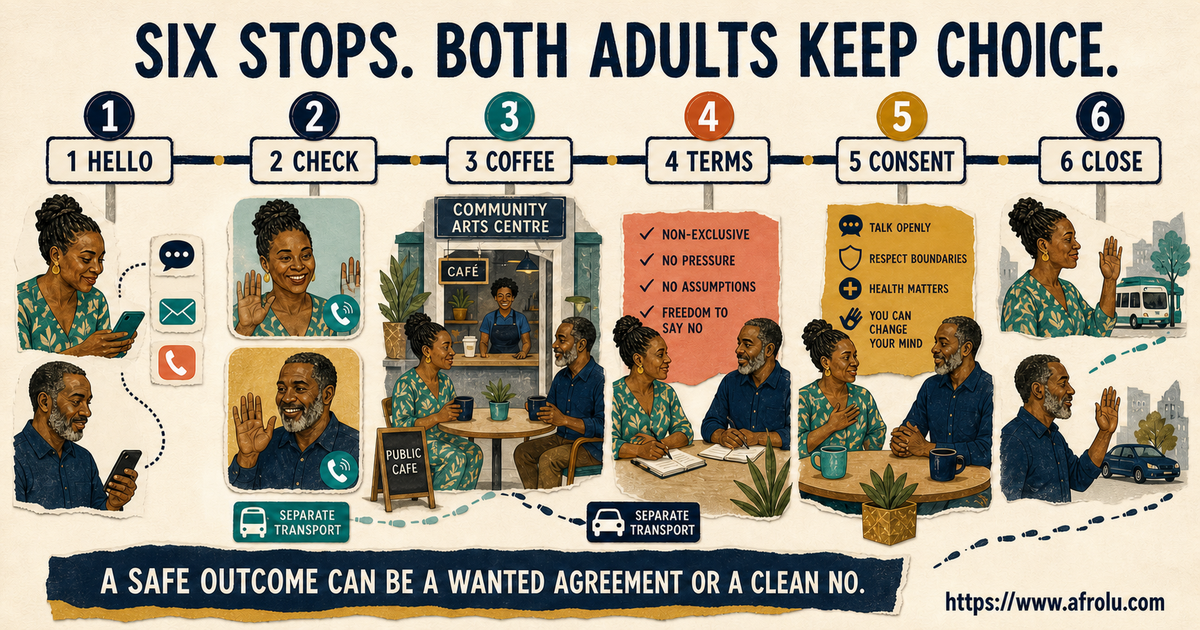
Across six fictional stops, Mariam, 46, and Ayo, 51, name a possible casual match, use one small identity check, meet in public and agree on non-exclusive terms with clear consent. When their pace and home wishes differ, they close with respect and do not seek another answer through work, family or new accounts.
The late-entry day-pass gatehouse
Open one gate without handing over the whole building
Nadine separates purpose, identity, channel, plan, money, body and exit so returning adults can learn without trading privacy for confidence.
Name today's offer, define casual terms, open only the access needed and choose help that fits the clearest fact.
Name purpose
Exploration and a casual agreement remain separate.
Issue one pass
Each kind of access needs its own adult choice.
Keep the master key
Money, home, documents and body stay controlled.
Make exit work
A no closes every channel without punishment.
The front desk before admission
Return to dating without handing over the life you built
A talking stage gives two adults time to learn about each other before choosing a relationship shape. It may show that casual dating could fit, but it is not yet an agreement, sexual consent, a home invite or proof of safety. Talk about what is on offer today. Message volume, charm and confidence cannot answer for you.
Coming back after years away can feel strange. New buttons, slang and quick moves between apps may take time to learn. That does not mean your judgment is poor. You can ask how a feature works, stay on one channel, skip a video call or take longer to decide. Your past needs no apology.
Casual dating needs clear words and kind limits. Ask whether either person may date others, what each wants to share, and how often you hope to meet. Talk about sexual health before physical contact. Agree on what an ending would look like. A casual label never turns doubt into permission or makes care less important.
Keep hold of your identity, accounts, money, address, work details, family contacts, travel plans and body. Casual interest does not make requests for cash, passwords, codes, records, intimate images or secret access normal. If you face threats, tracking, a fake identity, blackmail, force or blocked movement, protect yourself and seek the right help.
The seven-gate day-pass model
Open purpose, identity, channel, plan, money, body and exit separately
The gatehouse is a way to sort your choices. It is not a legal test, safety score or promise about another person. Each gate stays separate. A pleasant public date does not open your home. A simple identity check should not grow into a demand for private records. You choose what opens and when.
PURPOSE asks what each person wants now: time to explore, a clear casual agreement, a committed bond or more time to decide. IDENTITY uses small checks that suit the moment, such as details that stay consistent and a live call both people want. Keep identity cards, bank records, security codes, work systems and family contacts private.
CHANNEL covers your phone number, email, social accounts, device access and shared images. PLAN covers a public place, start time, length, normal cost, your own transport and a clear way home. Leaving an app, sharing live location and accepting a ride are three choices. Ease and speed do not prove trust.
MONEY stays out of romantic proof, so neither person pays an emergency, trip, fee or investment to show care. BODY covers touch, sex, contraception, barriers, testing talks and image consent one step at a time. EXIT means either person can stop without punishment. Fraud, threats, tracking or blocked movement need direct help, not another dating talk.
Mariam and Ayo at six ticket windows
See a later-entry talking stage become defined, tested and cleanly closed
Mariam and Ayo are fictional Black African adults, aged 46 and 51. Mariam has not used a dating app since her thirties. Ayo stepped away from dating while he changed work and cared for family. Their pasts, messages, meetings and ending are made up. Confidence is never used as proof of good character.
At the first stop, Mariam says she may want a light, non-exclusive bond if the terms are clear. Ayo is curious about the same idea. They do not call themselves casual partners yet. They stay on the first channel, share one live call they both want and keep documents, employer details and money records private.
Their first coffee is in a staffed public place. They plan ninety minutes, pay their own normal costs and travel on their own. Before date two, they agree that casual means non-exclusive for them. They will share facts needed for sexual-health choices. A date still does not promise touch, images, a ride or a home invite.
After three dates, Ayo suggests weekly contact and some dates at home. Mariam wants fewer dates, all in public. Ayo respects her home limit but knows the pace does not suit him. They end the match in one clear exchange. Neither contacts friends or work for another answer. A clean no is also a good outcome.
Sixteen readings from the gatehouse
Separate steady delivery, ordinary re-entry learning, pressure and direct danger
These signs cannot tell you someone's motive, history, health or state of mind. They do not prove identity, consent or safety. One serious act may call for help now. A clumsy message may need only one question, or no reply at all. Describe what happened in plain words and choose from those facts.
At PURPOSE, a steady sign is an honest answer about today. Pressure sounds like a bright future but avoids the present. At IDENTITY, use small checks that both people accept. Requests for documents, codes, work proof or money take too much. A smooth video call can feel warm, but it cannot promise that every detail is true.
At CHANNEL and PLAN, a good pattern respects the contact place you chose and builds a full public plan. Pressure keeps moving the chat, asks for live location, turns up without warning or makes you depend on a ride. Anyone can forget one detail. Fighting a clear way home again and again is different.
At MONEY and BODY, keep funds apart and ask for consent at each step. A gift, app fee, investment, sexual message, image and touch are separate choices. At EXIT, a good sign is a no that works everywhere. Fraud, blackmail, threats, tracking, hacked accounts or blocked movement need prompt support. You do not need more dating clues first.

Read observable conduct and the response to no, not confidence, age or charm.
Words to use at the ticket window
Ask for purpose, casual terms, privacy, logistics, consent and closure
Change these lines to sound like you. Skip them when silence, blocking, account care or urgent help is safer. Sample words cannot replace legal advice, app support, fraud help, health care, safety planning or emergency services. You do not owe anyone a final lesson before you protect your privacy, money, body or way home.
Purpose can be simple: 'I am seeing whether casual dating fits; I have not agreed to it yet.' Then add: 'For me, casual means non-exclusive dates, honest sexual-health talks and no assumed home access.' Those lines keep early interest apart from an agreement. The other person can offer different terms or give a clear no.
For privacy, try: 'I can use this channel and join one live call, but I do not share documents, codes, work records or live location.' For a meeting, try: 'I will meet in a staffed public place for one hour and use my own transport.' You state what you will do. You do not ask for a trust performance.
For health, say: 'Before intimacy, I want to talk about testing, barriers and what we each want today.' Interest in one step is not consent to the next. To close, say: 'This does not fit me, so I am ending romantic contact.' If the reply becomes threatening, false or relentless, stop explaining and protect yourself.

Safe words describe the offer and the action you control.
The smallest safe-access decision desk
Continue, verify, define, reduce, pause, close or use the help that fits
This desk cannot prove that a person is safe. It does not replace app rules, legal advice, health care, fraud help, safety planning or emergency services. Its job is simple: stop every worry from becoming a dating puzzle. Lost money, stolen account access, image abuse or blocked movement already points to a more direct kind of help.
CONTINUE keeps the early contact you still want. ASK ONCE seeks one missing answer about the present. VERIFY uses one small check without private proof. DEFINE CASUAL sets clear terms for exclusivity, contact, sexual health, home access and endings. Each choice is optional. An honest counteroffer can show whether your needs fit.
REDUCE means less contact, less shared detail or fewer meetings. PAUSE stops contact without saving either person for later. CLOSE ends romantic access. These are equal choices, not steps down a ladder. Someone returning to dating may change pace because a plan feels wrong. You do not need to prove bad intent first.
Use HEALTH CARE for testing, contraception and personal health questions. Contact the PROVIDER through its real site for a payment, account or device problem. Seek SAFETY HELP for threats, stalking, force, image abuse, blackmail or a blocked exit. Do not send money, share an image or take a private ride as a secret test of trust.

Choose the smallest access supported by today's evidence.
Nine lanes beside the gatehouse
Distinguish talking stage, casual dating, slow dating, situationship, mismatch, learning, closure, fraud and control
These nine ideas can overlap. They are not diagnoses, legal findings or ranks from good to bad. Clear names help in two ways. Normal learning does not get called danger, and a casual label cannot hide lost money, ignored consent or unwanted pursuit. Start with the plain facts you can see today.
A TALKING STAGE is time to explore before you agree on a shape. CASUAL DATING is a lower-commitment agreement whose terms still need words. MUTUAL SLOW DATING is a pace both people choose, not endless doubt. Any of the three needs current consent, useful facts and an exit that each person can use.
A SITUATIONSHIP means ongoing date-like or intimate contact with no shared clear status. PACE OR GOAL MISMATCH means two honest offers do not fit, while both people remain free to go. RE-ENTRY LEARNING means getting used to new terms or controls. It can grow through small practice without giving away private access.
RESPECTFUL CLOSURE lets an unwanted match end without blame or chase. ROMANCE FRAUD uses lies to seek money, identity details or account access. UNSAFE CONTROL uses threats, watching, force, payback or a blocked exit. More than one idea may fit. Protect money, accounts, images, location and movement before debating the perfect label.
Eight later-entry moments where casual interest needs a separate safety decision
The interface feels faster than remembered
Jo, 48, receives requests to move channels immediately and wonders whether delay looks rude.
Keep the chosen channel and learn one control at a time.Two adults use the same word differently
Mariam means non-exclusive public dates; Ayo also imagines occasional home meetings.
Define exclusivity, access, contact and ending separately.A live call becomes an identity-document request
A small identity check has already happened, but the contact asks for an ID image and workplace record.
Decline sensitive proof and protect those records.Convenience would remove a free exit
A friendly match offers collection from home before the first meeting and dismisses separate transport as distrust.
Meet publicly and arrange your own arrival and departure.A small payment is framed as harmless
A contact says an app renewal would prove genuine interest and sends an unfamiliar payment link.
Send nothing and verify any account issue through the provider.Casual interest reaches a physical decision
Both adults are interested, but testing, barrier use and what each wants today remain undiscussed.
Pause the physical step and have a specific voluntary conversation.One wants weekly contact and one wants monthly dates
Both offers are honest and neither adult has attempted to punish the other.
Try a mutually wanted rhythm or close without blame.A closed contact reaches a workplace account
The person ignores an ending and seeks another answer through professional contact details.
Protect the work account, save useful evidence and seek fitting help.Sixteen signals across purpose, identity, channel, plan, money, body and exit
Present purpose is stated without promising a relationship that has not been agreed.
A later entrant can ask how a feature or norm works without ridicule or pressure.
Identity checks stay small and avoid documents, codes, banking and workplace proof.
The chosen contact channel remains usable, controllable and easy to close.
A public meeting includes place, start, duration, normal cost and your own way home.
Home address, live location, transport and accommodation remain separately optional.
Money requests, investment offers and verification fees remain outside romantic proof.
Casual terms name exclusivity, other-partner disclosure, rhythm and endings explicitly.
Sexual-health questions happen before a physical decision and without remote diagnosis.
Consent is specific, freely given, checked again and reversible for every step.
An image request, image storage and image sharing each require separate permission.
A smaller pace can be accepted, countered or declined without punishment.
A no closes the offered channel without friend, family, work or profile bypass.
Check account or payment concerns through the provider's real site or number.
Ordinary unfamiliarity is answered with information rather than age-based judgment.
Threats, tracking, coercion, fraud or blocked movement bypass ordinary pattern review.
Review today's day pass through ten separate questions
| Situation | What it may mean | What to do next |
|---|---|---|
| Is purpose about today? | Fits: Both adults name what they are exploring now. Needs review: One term needs a plain meaning. Stop: Only a promised future keeps contact going. | Ask once, accept the answer or close. |
| Is casual structure actually agreed? | Fits: Exclusivity, disclosure and rhythm are explicit. Needs review: One term remains open. Stop: The label is used to assume access. | Define the agreement before acting on it. |
| Is the identity check small enough? | Fits: A shared step answers today's need. Needs review: The request can be reduced. Stop: Documents, codes or employer proof are demanded. | Protect sensitive records and check through real sources. |
| Can each person control the channel? | Fits: Each adult chooses and can close access. Needs review: One privacy setting needs review. Stop: New accounts bypass a stated no. | Tighten access and use fitting support. |
| Is the first plan leaveable? | Fits: Public place, duration and separate transport are clear. Needs review: One logistic needs completion. Stop: Home, secrecy or dependent travel is pressured. | Repair the public plan or decline. |
| Is money outside proof? | Fits: Each adult keeps normal costs separate. Needs review: One request needs a check. Stop: A transfer, investment or fee is urgent. | Send nothing and contact providers directly. |
| Are body decisions specific? | Fits: Consent and health choices are discussed separately. Needs review: One conversation must happen first. Stop: Casual is used as blanket permission. | Pause the step and restore free choice. |
| Can pace be countered? | Fits: Both adults may accept or decline. Needs review: A bounded trial may clarify fit. Stop: A smaller offer triggers punishment. | Reduce or close; protect access if needed. |
| Does exit work everywhere? | Fits: No is respected across channels and places. Needs review: One direct closure may help. Stop: Work, family or new accounts defeat no. | Protect each affected account or place. |
| What kind of help fits now? | Fits: Ordinary difference remains adult choice. Needs review: Health or account questions need specialists. Stop: Fraud, threats or control require protection. | Choose help that matches the clearest fact. |
Twelve lines for purpose, privacy, casual terms, health, pace and closure
“I am exploring whether casual dating fits; I have not agreed to it yet.”
“For me, casual means non-exclusive dates with honest disclosure and no assumed home access.”
“I am returning to dating and will learn this feature before changing channels.”
“I can do one live call, but I do not share documents, codes or workplace records.”
“I am keeping this conversation here until I choose otherwise.”
“I will meet in a staffed public place for one hour and use my own transport.”
“I do not send money, pay fees or invest through a dating contact.”
“Before physical intimacy, I want to discuss testing, barriers and current choices.”
“I am interested in this step, not any further step, and I may change my mind.”
“One date this month works for me; you are free to want a different rhythm.”
“I am pausing this contact and I am not setting a return date.”
“This match does not fit me, so I am ending romantic contact.”
Know the difference
A talking stage and casual dating are neighbouring, not identical
Adults explore fit and ask what structure, pace and access each would actually choose.
Adults have agreed a lower-commitment structure with explicit consent, disclosure, rhythm and ending terms.
Exploration does not create casual status, and casual status never creates blanket access.

Name the closest concept, then let the clearest safety fact guide the next step.
Separate talking stage, casual dating, slow dating, unclear contact, learning, fraud and control
| Type or dimension | What it describes | Best next question |
|---|---|---|
| Talking stage | Purpose and possible structure are still being explored. | Ask, observe and choose without assumed access. |
| Casual dating | A lower-commitment structure has explicit present terms. | Follow or renegotiate the actual agreement. |
| Mutual slow dating | Both adults choose a lower pace while keeping intent clear. | Review the shared rhythm when facts change. |
| Situationship | Relationship-like contact continues without a shared clear status. | Ask once, define it or leave the unclear contact. |
| Pace or goal mismatch | Honest adult offers differ while exit remains respected. | Counter, reduce or close without blame. |
| Re-entry learning | An adult is unfamiliar with current norms, controls or language. | Learn one bounded feature without exposing private access. |
| Respectful closure | One adult ends contact and the answer holds everywhere. | Accept the ending and close retained access. |
| Romance fraud | Deception seeks money, identity, accounts or business access. | Stop exposure and contact the relevant providers or official help. |
| Unsafe control | Threats, surveillance, coercion or pursuit defeats free exit. | Use location-appropriate safety support. |
Use the seven-gate day-pass model one decision at a time
Separate enquiry from agreement
A talking stage asks what might fit; casual dating states what is mutually chosen.
Learn without self-exposure
Unfamiliar controls can be practised while identity, money and location stay private.
Open one gate
Purpose, channel, plan, money, body and exit each need their own decision.
Make casual explicit
Exclusivity, disclosure, contact, sexual health and endings do not define themselves.
Read the response to no
Respectful acceptance provides more useful evidence than confidence or charm.
Match harm to help
Mismatch, health care, a stolen account, fraud and control need different responses.
Questions for structure, privacy, logistics, consent and exit
Choose a few prompts that fit the moment. This is a reference library, not a list to complete.
Purpose and structure
Separate exploration from the casual agreement.
- What are we exploring now?
- What would casual mean to each of us?
- Are other dates allowed?
- When do we review?
Identity and channel
Keep each check small and easy to stop.
- Which check answers today's need?
- What stays private?
- Which channel protects both adults?
- How can it be closed?
Plan, money and body
Do not bundle ease, money or consent.
- Is the public plan complete?
- Does each adult control transport?
- Is money kept apart?
- Which consent exists today?
Exit and help
Match the next step to the strongest fact.
- Can no work everywhere?
- Is this ordinary mismatch?
- Does a provider need contact?
- Does danger need direct help?
What current safety, fraud, privacy, consent, health and control guidance supports
eSafety covers app privacy and safer in-person meetings
The guidance supports chosen channels, privacy settings, small identity checks and public plans with a clear exit.
Evidence limit: Australian services and laws may differ elsewhere.
FTC guidance explains money requests in online romance
The material supports refusing transfers and finding a payment provider through its real site or number.
Evidence limit: U.S. reporting steps do not replace local remedies.
Kenya ODPC describes personal and sensitive information
The context supports protecting identity, contact, location, health, family and property details from unnecessary access.
Evidence limit: This is general privacy context, not personalised legal advice.
eSafety explains informed, freely given and reversible consent
The guidance supports specific permission for each online or in-person step and respect for withdrawal.
Evidence limit: Consent law varies by location and circumstance.
CDC guidance covers prevention, testing and safer-sex practices
The material supports discussing testing and prevention with qualified healthcare services before decisions that need that information.
Evidence limit: It cannot select tests or treatment for an individual.
eSafety describes technology-facilitated coercive control
The guidance supports taking surveillance, channel control, threats and defeated independence seriously.
Evidence limit: Australian definitions and response services may differ locally.
Six ways returning adults can be pushed to exchange access for confidence
Apologising for re-entry
A private history becomes the price of a normal pace. Repair: state today's offer without defending it.
Treating casual as self-explanatory
Two adults act on different assumptions. Repair: define structure, disclosure and ending.
Over-checking to catch up
Sensitive records replace a small check. Repair: protect documents, codes and work access.
Using a private date as a confidence test
Courage becomes dependent access. Repair: choose a complete public plan.
Paying a small request
Affection becomes tied to an unchecked payment. Repair: transfer nothing and contact the provider through its real site.
Sending a longer no
Explanation extends access after an answer. Repair: close once when safe, then protect affected channels.
Define the casual arrangement before opening another gate
A casual label cannot settle identity, exclusivity, health, privacy or meeting questions. Use the guide that matches the unsettled fact, then decide whether you want to continue, renegotiate or close the connection.
Explore the guide library
Show more related guides
Continue with Afrolu
Show more Afrolu guides
Current official safety, fraud, privacy, consent and sexual-health references
Afrolu reviewed these health, research, safety, or public guidance resources while editing this page. They support the behaviour and safety guidance; they do not diagnose any individual described by a reader.
Talking-stage questions for adults returning to casual dating
What does late-comer mean in this guide?
It means an adult returning after a long self-directed period away from dating or learning current dating formats later than peers. It is not a diagnosis, fixed age bracket or claim that the adult lacks judgment.
Is a talking stage already casual dating?
No. A talking stage explores whether a match fits. Casual dating begins only when both adults agree what casual means, including exclusivity, disclosure, contact rhythm, consent, sexual health and how either person can end it.
Does casual dating usually mean non-exclusive?
It can, but the label alone cannot answer. Ask whether either adult may date others, what disclosure is expected and which sexual-health information each needs for informed choices. An explicit agreement is safer than a popular definition.
Should I disclose that I have not dated for years?
Only if and when you want to. You may simply state your current pace or say you are learning a feature. A dating contact is not owed a private relationship history to make an ordinary boundary valid.
How can I verify someone without sharing my identity documents?
Use a small check that fits today's question and feels fair to both people. Keep sensitive records private. Confirm meeting details through the venue's real site or number. No video call, badge or document can promise identity, intent or safety.
When is it safe to move off a dating app?
There is no universal moment. Review what protections the current channel provides, what information the new channel exposes and whether you can close it easily. Moving channels never requires sharing codes, live location or employer access.
What should we discuss before physical intimacy?
Discuss what each adult wants today, consent, contraception where relevant, barrier use, testing and information needed for an informed choice. Qualified local healthcare can answer individual testing or prevention questions.
Can I insist on public dates even in a casual relationship?
Yes. Home access, transport and meeting place remain separate choices at every stage. The other adult may decline the offered plan, but should not treat a private meeting as proof of confidence or attraction.
What if a new match asks for a small amount of money?
Do not let the size or story replace a real check. Avoid transfers, fees, investments and account access through a dating contact. If you already paid, contact the provider quickly through its official site or number.
What should bypass a clarity conversation?
Threats, stalking, tracking, a fake identity, blackmail, image abuse, force, stolen accounts, financial harm or blocked movement need direct protection. Use the relevant app, provider, legal, health, safety or emergency help where you live.
One thing to do now
Carry a day pass into the talking stage and keep the master key
Continue while purpose is about today, casual terms are clear, identity checks stay small, meetings have an easy exit, money stays apart, body and health choices are specific, and every no works. Reduce, pause or close without judging age. Send provider problems, fraud and unsafe control to direct help.