Four doors for honest casual companionship
Choose Casual Dating Later in Life Without Surrendering Autonomy
A later-life casual dating map that separates companionship, exclusivity, intimacy, home, money, care and legal authority.
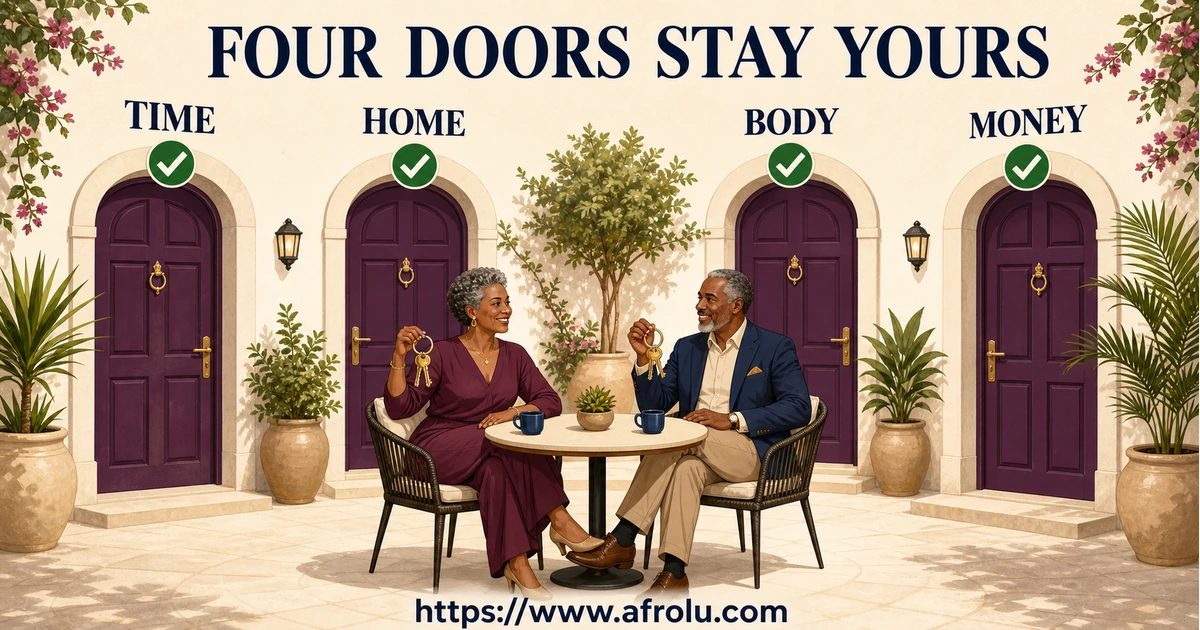
Casual describes present scope; it does not open a home, body, account or decision system.
Written and edited by Jean-Claude Mukendi · Relationship Guides Editor
Treat casual as a present relationship scope, not a verdict on value or care. State what companionship and contact are available, then define exclusivity separately. Keep first plans public and independently survivable. Open time, home, body and money only for the exact choice being made: a weekly date does not reserve every weekend; affection does not create a key; an earlier yes does not supply present consent; gifts do not buy access; and selected help does not appoint a caregiver or legal decision-maker. Protect accounts, property, records, medication, documents and formal authority. Review enjoyment, clarity, reciprocity and autonomy after thirty ordinary days, then continue, resize or end without making permanence the only successful outcome.
Dating basics · Late Entrants
Can we name the companionship available now while every choice about exclusivity, intimacy, home, money, care and authority keeps its own key?
Later-life casual dating is a lighter present relationship scope chosen by capable adults. It may include companionship, shared activities, romance or sexual connection, but it does not automatically determine exclusivity, intimacy, living arrangement, financial integration, care roles or formal authority. The autonomy courtyard keeps time, home, body and money behind separate doors so warmth can grow without unrelated systems opening by drift.
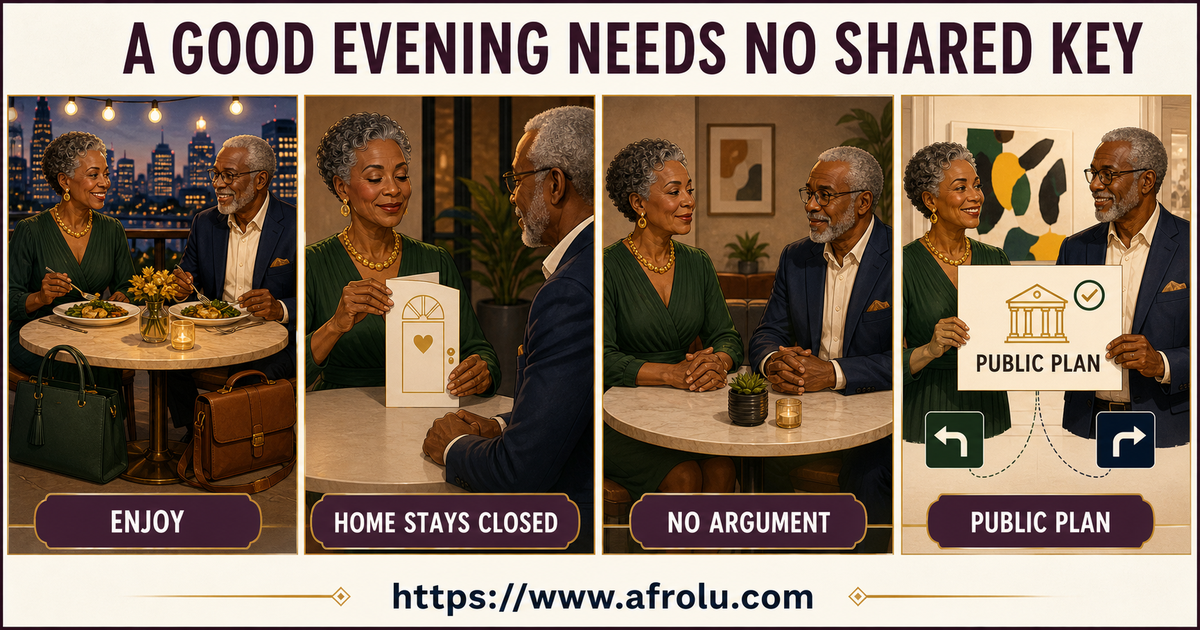
Asha and Peter are fictional adults, 58 and 61. They enjoy three public dates and agree they are not building a merged household. Asha declines Peter's home invitation while offering another public date. Peter accepts the boundary and creates a complete alternative. They later define their structure as non-exclusive and keep sex, health, home, money and care as separate decisions. After thirty days, Asha chooses another month at the same size because enjoyment, clarity, reciprocity and autonomy all remain present.
The later-life autonomy courtyard
Let companionship grow while four consequential doors keep separate keys
Later life may include established systems and strong preferences, not less capacity for choice. Jean-Claude treats those systems as adult decisions rather than barriers to affection.
The courtyard separates time, home, body and money, then tests whether each opened door matches a present purpose and free agreement.
Time and companionship
Agree the contact and dates actually offered without reserving the rest of either life.
Home and location
Keep addresses, keys, storage and household routines separate until their own decision.
Body, health and care
Ask for each activity and define support without transferring records or control.
Money and authority
Keep accounts, property, debt, beneficiaries and formal powers outside romantic proof.
Start with the word casual
Let casual describe the present relationship scope—not the value of either adult
Casual dating later in life is a present relationship scope in which adults are not currently promising a lasting merged partnership. It may centre companionship, shared activities, romance, sexual connection, or a mixture chosen by the people involved. The word does not reveal whether they are exclusive, sexually active, living alone, financially intertwined or open to future change. Those are separate questions. A useful casual agreement says what is available now, what is outside the offer and when the answer will be reviewed.
Later life is not one biography. An adult may be divorced, widowed, separated, never married, newly retired, working full time, caring for someone, living with disability, parenting adult children, building a business or enjoying a settled independent home. None of those facts chooses a dating type. Do not treat age as incapacity, loneliness as consent or relationship history as a debt owed to a new match. Ask what this adult wants and can freely sustain now.
Casual does not mean careless. Public first meetings, verified ordinary identity, independent transport, activity-specific consent, sexual-health conversation and firm money boundaries remain relevant. Casual also does not mean non-exclusive. Some adults choose a light but exclusive arrangement; others date non-exclusively and agree on relevant disclosure. The structure needs shared words before either person acts as though it exists.
The useful test is not whether the arrangement resembles a younger person's dating life or ends in marriage. Ask whether both adults can describe the current offer, keep their choices free, protect unrelated systems and leave without retaliation. A connection may continue at the same size, become more serious, become smaller or end. Each result can be an accurate adult decision rather than a referendum on age, desirability or readiness.
The four-door autonomy courtyard
Open time, home, body and money only for the choice being made
The time door covers contact rhythm, dates, overnights, holidays and the amount of companionship each adult offers. A weekly dinner does not reserve every weekend. A daily call does not create a duty to report movements. Write the actual rhythm and what happens when work, health, family or rest changes it. The pattern should allow news, a replacement offer and a free no without using past attention as leverage.
The home door covers address, keys, spare rooms, storage, transport, digital entry systems and household routines. A date can be warm without entering either home. Later, an invitation to visit does not create a key or right to return. Living apart may be temporary, permanent or simply the present arrangement. It can coexist with casual or serious dating; it is a household answer, not proof of emotional distance.
The body door covers touch, sex, images, health information, medication, care and emergency roles. Consent remains specific and present. Age, gifts, travel, exclusivity or an earlier yes cannot answer the next activity. Share health information for a real purpose at the depth freely chosen, and use qualified healthcare for testing or treatment. A romantic partner does not automatically become a caregiver, health proxy or keeper of records.
The money door covers date costs, gifts, loans, accounts, property, debt, insurance, beneficiaries, business interests and legal authority. Discuss the immediate plan without opening financial files. Never lend, co-sign, transfer, invest, change ownership or grant authority because casual intimacy is framed as trust—or because a serious future is promised. High-consequence decisions require substantial evidence and independent qualified advice in every relevant jurisdiction.
Asha and Peter keep the next choice small
A declined home invitation becomes useful evidence when the connection survives it
Asha is 58, works part time in procurement and values a settled home she rebuilt after divorce. Peter is 61, runs a small repair business and wants companionship without immediate cohabitation. They meet through a walking group, verify enough ordinary context to plan safely and agree that neither is promising a long-term merged household. Their first three dates are public, affordable and time-bounded. Both contribute plans and both sometimes say no.
After an enjoyable dinner, Peter invites Asha to continue at his home. Asha says she wants another date but is not entering homes yet. She does not produce a reason, recount past harm or promise when the boundary will change. Peter feels disappointed and says so once. Then he asks whether a daytime gallery visit the following week would work. He does not call her fearful, question whether she is truly casual or use the dinner bill as leverage.
At the gallery they discuss exclusivity. Peter is seeing nobody else but is not ready to make that an agreement. Asha has one other early conversation and wants non-exclusive dating with disclosure before relevant sexual-health choices. They keep the current structure non-exclusive and agree not to infer sex from the casual label. Their answer may not become permanent, but it is usable now.
Thirty days later, Asha notices enjoyment, complete plans, accepted limits and balanced effort. She offers a meal at a staffed community event rather than home access. Peter accepts. The relationship continues at the same size because both want that size. Its value is not measured by whether it reaches cohabitation. If either adult later wants a different scope, the honest task will be a new conversation, not pressure disguised as natural progression.
Evidence at the gate
Use ordinary conduct to distinguish companionship from a campaign for access
Look for complete plans, reciprocal effort and repair. A date names a public place, time, cost range and finish before either adult moves. A change comes with news and a workable alternative. Each person can initiate, decline and rest. These behaviours do not prove compatibility, but they reduce avoidable uncertainty and show whether a modest relationship can be carried by two adults rather than one organiser.
Watch what happens around privacy. A respectful match accepts that home, workplace, devices, documents, medication, family information and live location are not casual proof. They ask for information connected to the present plan and can hear a limited answer. Pressure may appear as teasing, age-based shame, repeated surprise visits, demands for passwords, contact with relatives or claims that privacy means the relationship is not real.
Money requests deserve their own gate. A plausible story about travel, illness, business, customs, investment or family still does not verify a transfer. Do not send money, gift cards, cryptocurrency, codes, credentials or signatures to prove interest. Contact any named institution through details you find independently. If money was sent after suspected deception, contact the financial provider promptly, preserve useful records and use appropriate reporting support without shame.
Shift from interpretation to safety when conduct includes stalking, threats, blocked exits, sexual coercion, control of medication or transport, financial exploitation, humiliation, isolation or retaliation after a no. Population guidance cannot diagnose one relationship, but observed harm deserves action. Create distance where possible and use suitable venue staff, trusted support, healthcare, safeguarding, financial, legal or emergency services for the actual facts and location.

Observe conduct at each gate; age, loneliness, gifts and a casual label do not prove access is owed.
Body and care remain present-tense
Discuss intimacy, health and support without appointing a partner by implication
Consent requires a present free answer to the specific activity. Being in a relationship, paying for a date, sharing a bed, travelling together or having consented before does not supply the next yes. A person can stop at any time. If alcohol, coercion, fear, sleep, cognitive impairment or another condition affects freedom or capacity, do not proceed. Use relevant local support when an incident or immediate concern requires it.
Sexual-health conversation belongs before relevant choices at every adult age. Discuss testing, known information, protection and what a result would change without assuming status from appearance, exclusivity or life experience. General public-health guidance cannot choose an individual testing schedule or treatment. Use qualified healthcare, especially when symptoms, medication interactions, chronic conditions or prevention choices need personal assessment.
Care is a role, not a romantic default. An adult may accept a ride, reminder or selected support without transferring records or decision authority. Define what help is requested, for how long and what remains private. A partner should not control medication, appointments, communication, mobility or access to other support. If formal healthcare or financial authority is being considered, separate that high-consequence decision from dating pressure and obtain independent advice.
Use calm scripts: ‘I enjoy our dates and I am not sharing home access.’ ‘Please ask before each kind of touch.’ ‘I can tell you what this activity needs, not open my medical file.’ ‘Our accounts, property and legal decisions remain separate.’ A respectful response may include disappointment or questions, but it leaves the no intact. Repeated bargaining, ridicule or punishment is new evidence about the relationship.

State the available choice and the closed door in the same calm sentence.
Thirty ordinary days
Review enjoyment, clarity, reciprocity and autonomy before changing the size
Start with enjoyment. Do you look forward to the actual contact, or mainly to what it might become? Does the current rhythm leave room for sleep, work, health, friends, family, community and quiet? Enjoyment can coexist with nerves or one imperfect date. The question is whether the real pattern adds something freely wanted rather than becoming an obligation maintained through age anxiety or fear of starting over.
Check clarity and reciprocity. Can both adults describe casual scope, exclusivity status, contact rhythm and relevant sexual-health expectations? Do both propose, confirm, adapt and repair? A relationship can remain small and still be mutual. If one person repeatedly supplies every plan, answer and emotional bridge, request one concrete change and assess the action rather than another broad promise.
Check autonomy at all four doors. Did either person gain unplanned access to home, devices, documents, medication, accounts, transport, family systems or professional advisers? Did generosity become a debt? Did a no remain complete? Close or reduce access that no longer feels freely chosen. Urgent risk calls for appropriate help; ordinary incompatibility can be handled with a direct smaller offer or ending.
Choose the next size. Continue the same rhythm, add one clearly defined choice, reduce contact, pause without demanding that someone wait, or end. Do not reward pressure with a larger door and do not treat permanence as the only successful result. The review works when it returns control to both adults and makes the present relationship more accurate, even if accuracy leads to goodbye.

Continue, resize or end from the pattern; do not reward pressure with a larger door.
Taxonomy without a ladder
Separate casual scope, exclusivity, intimacy, living arrangement and authority
Casual and serious describe present direction or scope. Casual usually means the adults are not currently building toward a merged lasting partnership; serious means they are evaluating one. Neither guarantees emotional intensity, kindness or duration. A casual relationship may be meaningful and long-running. A serious relationship may end quickly when evidence shows poor fit. State the available direction rather than ranking the adults by the label.
Exclusive and non-exclusive describe current structure. Either can coexist with casual or serious dating. Define whether either adult dates or seeks others, what relevant disclosure is expected and how change is requested before action. Friends with benefits adds an existing friendship plus an agreed sexual element; it is not a synonym for all casual dating. Every sexual activity still needs its own present consent and health conversation.
Living apart together describes a committed couple who maintain separate homes; it is not automatically casual. Cohabitation describes a household arrangement and can create practical or legal consequences that vary by place. Neither should happen by drift through spare keys, stored belongings or financial dependence. Adults can choose separate homes permanently, temporarily or until a later review without that choice proving less affection.
Caregiving, beneficiary status, power of attorney, property ownership and account authority are high-consequence roles outside the dating taxonomy. They require purpose, free choice and often independent professional advice. A partner may be loving without holding any of them. Keep the relationship word, household choice, care role and formal authority in separate columns so intimacy never becomes a shortcut to control.
Eight later-life choices that keep companionship and authority separate
Ruth wants concerts, not a merged calendar
Ruth is 63 and enjoys monthly concerts with a new date. She says the connection is casual and does not reserve every weekend. Her date agrees rather than treating lighter frequency as a challenge to overcome.
Write the real companionship rhythm and leave unoffered time unclaimed.Musa asks instead of reading frequency
Musa is 56 and has met the same person weekly for two months. He does not treat repetition as exclusivity. They discuss whether either dates others and choose an exclusive but still casual arrangement for the next month.
Let structure come from shared words, not elapsed time.Asha keeps dinner out of her address
Asha is 58 and declines a home meal after an enjoyable public date. She offers another staffed venue. Her interest and home boundary remain true at the same time.
Offer a public alternative only if you genuinely want another meeting.Peter returns an expensive surprise
Peter is 61 and receives an expensive device after three dates. The giver says it will make daily contact easier. Peter returns it because he does not want cost or ownership to define access.
Decline gifts whose consequence or expectation exceeds the relationship.Lydia shares the relevant limit
Lydia is 67 and needs a shorter walking route. She states the practical limit but declines to send her records. The date adjusts the plan without demanding a diagnosis.
Share enough for the activity while records remain controlled.Kofi keeps adult children out of verification
Kofi is 59 and is asked to arrange a video call with his adult daughter as proof he is genuine. He declines and suggests another direct verification step between the daters.
Verify the adult without conscripting relatives or exposing third-party data.Nandi declines an automatic emergency role
Nandi is 62 and her date lists her as an emergency contact without asking. She requests removal and explains that support roles require a separate conversation and consent.
Name and accept care roles before using anyone's details.Daniel stops at the money door
Daniel is 55 and receives an urgent medical-money request from an online match he has not met. He sends nothing and checks the named institution through independently found details.
Separate compassion from payment and use appropriate verification or support.Evidence that casual scope is honest, reciprocal and autonomy-preserving
Both adults can describe the casual offer without belittling it or promising a hidden future.
Exclusivity is stated directly rather than inferred from age, frequency, sex or profile changes.
Public plans have place, time, affordable scope and independent return before movement begins.
A home boundary remains complete without demands for history, diagnosis or proof of trust.
Each adult proposes, confirms, adapts and repairs some of the shared plans.
Consent is requested for the present activity and can be withdrawn without retaliation.
Sexual-health information follows relevance and qualified care rather than appearance or assumptions.
Gifts and date costs do not purchase time, touch, access, transport, disclosure or follow-up.
Accounts, property, documents, passwords, medication and legal authority remain controlled.
Friends, family, community and professional advisers remain available without running the romance.
A modest relationship adds enjoyment without steadily reducing either adult's ordinary life.
Either adult can continue, resize or end without age or loneliness being used as leverage.
Route each invitation or request to the door it actually affects
| Situation | What it may mean | What to do next |
|---|---|---|
| A date says casual means no questions. | A lighter scope is being used to avoid a usable agreement. | Ask about structure, sexual health and contact; leave if the necessary answers stay unavailable. |
| Weekly dates are called exclusive. | A behavioural pattern is being mistaken for a mutual structure. | Define whether either dates or seeks others and how changes are disclosed. |
| A home visit is framed as easier. | Convenience is adding private access and a narrower exit. | Choose a public alternative or decline without proving danger. |
| A costly gift arrives early. | Generosity may carry an unwanted expectation or practical consequence. | Return or decline it and state that spending creates no access. |
| A date asks for medical records. | Curiosity exceeds the purpose of the current activity. | Share only the practical information you freely choose and keep records private. |
| A partner assumes a care role. | Support, authority and romance have been merged without agreement. | Define or decline the role and use qualified support where needed. |
| A relative is requested as identity proof. | Third-party privacy is being traded for dating reassurance. | Use direct staged verification that does not expose family data. |
| A money story becomes urgent. | Romantic trust is being recruited for a financial decision. | Send nothing, verify independently and contact the provider promptly after suspected loss. |
| A no receives a calm alternative. | One piece of respect and problem-solving evidence is present. | Notice it without converting one response into permanent trust. |
| The relationship is enjoyable but exhausting. | The current rhythm may exceed available capacity without misconduct. | Offer a smaller pattern or end if the available sizes do not fit. |
| One adult wants serious integration. | A genuine direction mismatch may now be visible. | Name it directly; do not use casual ambiguity to hold someone in a future they do not choose. |
| Tracking, threats or blocked exits appear. | The task has shifted from taxonomy to immediate safety. | Create distance where possible and use appropriate local support for the observed facts. |
Scripts for time, home, body, health, money and care
“I want companionship without building a merged household or permanent future right now.”
“Are either of us dating or actively seeking other people at the moment?”
“One planned evening most weeks is the amount of time I can freely offer.”
“I enjoy seeing you and I am not sharing either home or a key.”
“I can share the present lesson, not private details about a former partner.”
“Please ask before each kind of touch; an earlier yes does not answer now.”
“I will share what this activity needs, not my complete medical record.”
“Our accounts, property, debt and legal decisions remain independent.”
“This gift is more than I want in this relationship, so I am returning it.”
“I have not agreed to be an emergency contact or decision-maker.”
“I want less contact and the same honest casual scope.”
“The relationship available now does not fit me, so I am ending the romantic contact.”
Know the difference
Casual scope versus living arrangement
A lighter present relationship scope without an agreed lasting merged direction. It can still be exclusive, caring and long-running.
A committed couple maintains separate homes. It describes household arrangement, not whether the relationship is casual.
Scope and household are independent: neither word supplies consent, home access, money sharing, care duty or legal authority.

Use one label per decision; no relationship word supplies consent, home access or legal authority.
Compare nearby later-life relationship and household choices
| Type or dimension | What it describes | Best next question |
|---|---|---|
| Casual dating | A lighter present scope without a promised merged future. | What companionship and contact are actually available now? |
| Serious dating | Direction toward evaluating a possible lasting partnership. | Which present behaviours express that direction without guaranteeing it? |
| Exclusive structure | A current agreement about dating or seeking others and relevant disclosure. | What exactly is agreed, and how can it change? |
| Non-exclusive structure | Dating or seeking others remains within the spoken agreement. | Which disclosure and sexual-health choices are required before action? |
| Friends with benefits | An existing friendship includes a mutually agreed sexual element. | How are friendship, sexual consent and changes protected separately? |
| Living apart together | A committed couple maintains separate homes by choice or circumstance. | Which household expectations and boundaries make separate homes workable? |
| Cohabitation | Adults share a household, with practical or legal effects that vary by place. | Which independent advice and exit plan are needed before moving? |
| Care role | Selected practical or health support with a defined purpose and consent. | What help is wanted, for how long and without which authority? |
| Financial integration | Shared accounts, debt, property, insurance or business consequences. | Which independent qualified advice protects each adult? |
| Consent | A free present agreement to a specific activity that can be withdrawn. | What does each adult choose now, independent of every label? |
Build an autonomy courtyard in six moves
Write the casual offer
Name companionship, frequency, structure and what is outside the present relationship.
Keep four key rings
Time, home, body and money change only through their own freely chosen decisions.
Use public evidence
Let complete plans, reciprocity, limits and repair reveal the actual pattern.
Define care by purpose
Accept selected help without transferring records, control or formal authority.
Review thirty days
Check enjoyment, clarity, reciprocity and autonomy before changing size.
Choose the accurate exit
Continue, resize or end without making permanence the only success.
Questions organised by scope, structure, access and review
Choose a few prompts that fit the moment. This is a reference library, not a list to complete.
Casual scope
Describe the relationship that is actually available now.
- What companionship are we offering?
- What future is not promised?
- How often do we want contact?
- What would make either adult resize?
- When will we review the scope?
Structure and intimacy
Keep exclusivity and activity-specific consent in separate conversations.
- Are either of us dating others?
- What change needs disclosure?
- Which sexual-health conversation is relevant?
- How will we ask before each activity?
- What is outside the offer now?
Home and care
Protect address, keys, records and support roles from drift.
- Are homes outside the current relationship?
- What practical help is genuinely wanted?
- Which health information does the plan need?
- Who is the actual emergency contact?
- What access remains closed?
Money and review
Keep financial systems independent and choose the next size from evidence.
- What date cost protects essentials?
- Which gifts would be too consequential?
- What transaction is never romantic proof?
- Did reciprocity and autonomy remain intact?
- Do we continue, resize or close?
What later-life research and public guidance can support
Later-life dating exists across varied adult lives
A U.S. national portrait studied dating among unmarried adults ages 57 to 85 and described social, health and economic differences between daters and non-daters. Afrolu uses it only to reject the idea that dating is outside later life and to stress heterogeneity.
Evidence limit: The 2005–2006 U.S. data do not estimate current African dating patterns or prescribe any individual's choices.
Autonomy can matter in later-life relationship choices
A review of later-life family research notes that some women preferred casual relationships to marriage in order to preserve autonomy and avoid assumed care roles. This supports asking about autonomy rather than treating marriage as the universal goal.
Evidence limit: A review of particular studies cannot represent every gender, culture, age or relationship history.
Abuse of older people includes financial and psychological harm
WHO describes psychological, physical, sexual, financial and material abuse, neglect and loss of dignity within relationships of trust. Watch observed control of money, care, medication, movement and choice without treating age itself as evidence of abuse.
Evidence limit: Population guidance cannot diagnose one relationship; definitions and response systems vary by location.
Formal authority is a separate legal decision
CFPB explains that a power of attorney is a legal document allowing someone to act on another person's behalf. Afrolu uses that narrow point to keep financial authority outside romantic proof and pressure.
Evidence limit: The source is U.S.-specific; obtain independent qualified advice in every relevant jurisdiction.
Consent remains active and withdrawable
NHS guidance explains that sexual activity requires active consent, that a relationship or past yes does not supply consent, and that consent can be withdrawn. Apply that principle to every adult age and specific activity.
Evidence limit: Public health information is not jurisdiction-specific legal advice or an individual incident assessment.
Sexual-health conversations still belong before relevant choices
CDC guidance encourages partner conversation before sex about relevant STI information and testing. Age, exclusivity, appearance and familiarity do not establish status; use qualified healthcare for individual decisions.
Evidence limit: General guidance cannot provide a personal diagnosis, testing schedule, prevention plan or treatment.
Six shortcuts that turn warmth into unchosen dependence
Treating casual as careless
A lighter scope still needs complete plans, honesty, consent, health choices and money boundaries.
Assuming older means serious
Age does not choose marriage, cohabitation, exclusivity or any other relationship direction.
Letting home access drift
Repeated visits, stored items and spare keys can create dependence without a deliberate household decision.
Turning care into romance proof
Support can be kind while records, medication and decision authority remain controlled.
Buying trust
Large gifts, loans and account access create consequences rather than reliable relationship evidence.
Making permanence the score
A truthful bounded relationship or respectful ending can be more successful than pressured integration.
Use a reviewed resource that matches the decision
This guide focuses on the relationship decision, so it does not rank dating apps. Check current prices, safety tools, and local availability before choosing a service.
Explore the guide library
Show more related guides
Continue with Afrolu
Show more Afrolu guides
Research and public guidance reviewed for this autonomy map
Afrolu reviewed these health, research, safety, or public guidance resources while editing this page. They support the behaviour and safety guidance; they do not diagnose any individual described by a reader.
Later-life casual dating questions
Is casual dating appropriate later in life?
It can be if it is the freely chosen present scope of capable adults. Age does not require marriage, cohabitation or seriousness. Define companionship, frequency, exclusivity, sexual-health expectations, privacy and how either adult can change or end the arrangement. A lighter relationship can be caring and honest without being a waiting room for a larger one.
Does casual dating mean we can both see other people?
Not automatically. Casual describes scope; exclusive or non-exclusive describes structure. Ask directly whether either adult dates or seeks others, what relevant disclosure is expected and how a structure change is requested. Discuss sexual health before relevant activities regardless of the label.
Can a casual relationship be exclusive?
Yes. Adults may agree not to date others while keeping the relationship's future and household scope light. Define what exclusivity covers and review it. Exclusivity does not create consent, home access, financial integration, care duties or a guaranteed permanent partnership.
Should I disclose my finances or estate before dating seriously?
This guide cannot set an individual disclosure timetable. Early dating rarely needs balances, account access, property papers, beneficiaries or estate documents. Share only what a present decision requires. Any property, debt, insurance, beneficiary, business or authority change deserves independent qualified advice in all relevant jurisdictions and freedom from romantic pressure.
When should a later-life date visit my home?
There is no universal date number. Choose only when you genuinely want that specific access and the practical risks fit. A public staffed setting with independent return can remain appropriate for as long as needed. A home visit does not create a key, repeat access, storage right, overnight stay or consent to another activity.
Does accepting help make a partner my caregiver?
No. A ride, meal or reminder can be one selected act. Define what help is wanted, for how long and what remains private. Romance does not appoint an emergency contact, health proxy, account manager or medication controller. Formal roles require separate consent and may need independent professional advice.
How do we handle sexual health later in life?
Discuss relevant STI information, testing, protection and consent before sex. Do not infer status from age, appearance, exclusivity or relationship history. A general page cannot choose an individual testing schedule or treatment; use qualified local healthcare for personal risks, symptoms, prevention, medication interactions and care.
What if an online match asks for medical or travel money?
Do not send money, codes, credentials or signatures because a romantic story is urgent. Verify any institution through contact details you locate independently. If money was sent after suspected deception, contact the financial provider promptly, preserve useful evidence and use appropriate local reporting support without shame.
Is living apart together the same as casual dating?
No. Living apart together generally describes a committed couple maintaining separate homes. Casual describes a lighter present relationship scope. Either arrangement needs explicit agreements, and neither supplies home access, caregiving, financial integration or legal authority. Household and relationship direction are separate decisions.
How do I end a casual relationship respectfully?
Use a direct present statement: the relationship no longer fits and romantic contact is ending. Do not keep someone waiting through an indefinite pause or debate their worth. Set practical boundaries for belongings, contact and shared plans. If you fear retaliation, prioritise distance and appropriate local safety support rather than an in-person explanation.
One thing to do now
Keep the companionship that fits and every unrelated key
Write the casual offer and the current exclusivity answer. Keep every first or changed plan complete before movement begins. Share only what the present activity needs. Never use home, money, care or formal authority as relationship proof. Review the observed pattern after thirty ordinary days and choose the next size from enjoyment, clarity, reciprocity and autonomy—not age anxiety or a promised future.