Six stops · four calls + two dates
Define a Serious Nairobi Talking Stage Without Age Urgency
A Nairobi guide for later-entry adults on serious talking stages, identity, public dates, data privacy, sexual health, status and safer closure.
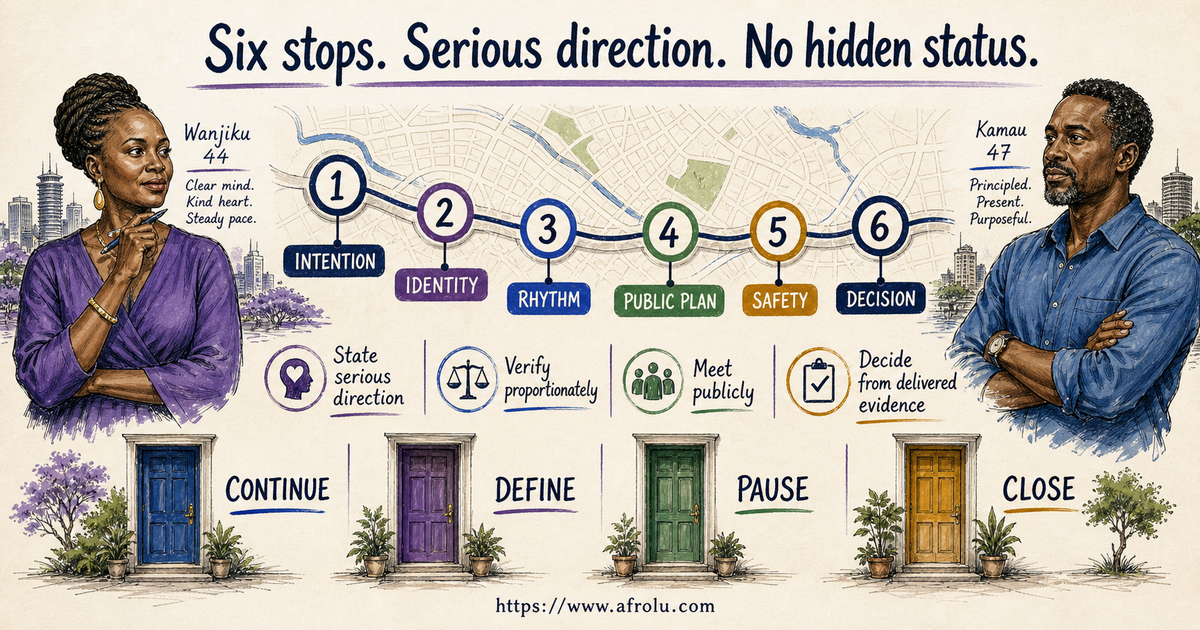
Serious intention gives the route a direction; only mutual agreement changes its status.
Written and edited by Jean-Claude Mukendi · Relationship Guides Editor
Treat the talking stage as low-agreement discovery. Move through six independent stops: INTENTION states the serious direction; IDENTITY checks ordinary consistency without invasive proof; RHYTHM protects work and sleep; PUBLIC PLAN creates bounded in-person evidence; SAFETY protects sensitive data, money, consent and exit; DECISION asks whether to keep talking, define serious dating, slow, pause or close. Four calls and two public dates are one fictional interval, not a rule. Serious intention never creates exclusivity, family access or payment duty. Use current Kenya DCI and ODPC guidance to keep meetings, personal information and financial access proportionate.
Early relationship discovery · Late Entrants
How can later-entry adults in Nairobi move a serious-intent talking stage toward an explicit decision without assuming status, oversharing data or trading safety for speed?
A talking stage is low-agreement romantic discovery before adults have explicitly chosen a relationship status. Serious intention is a broad direction toward committed partnership; it does not itself create serious dating, exclusivity, family involvement or consent to greater access. No universal talking-stage duration exists.
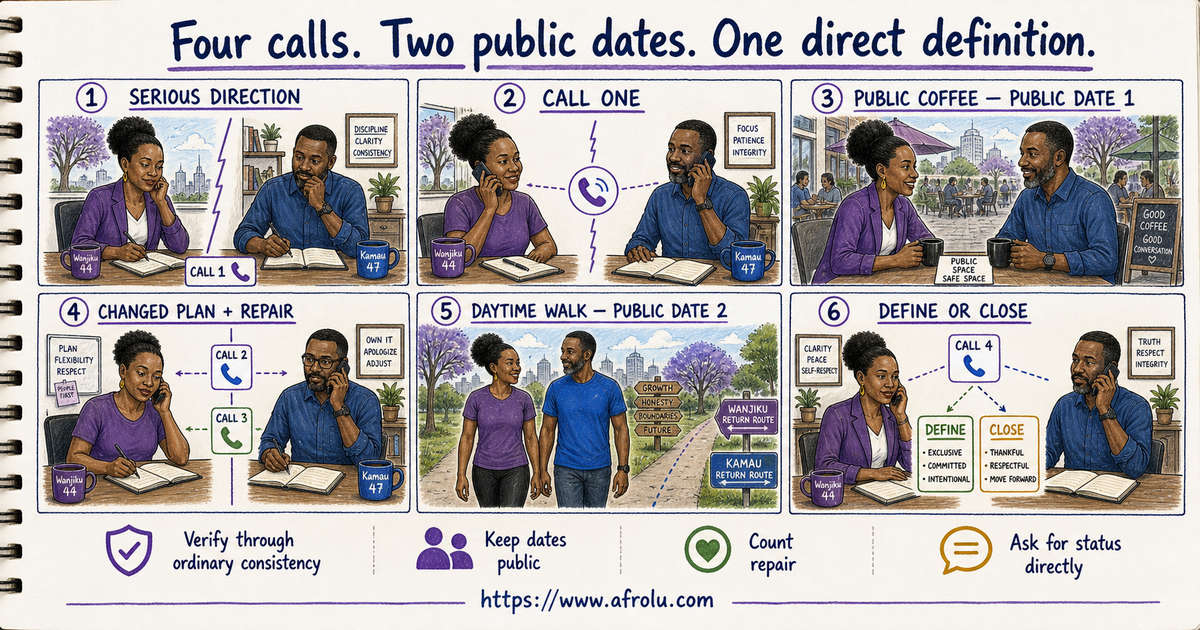
Wanjiku, a fictional 44-year-old Nairobi adult, and Kamau, 47, share four bounded calls and two public dates. They keep homes, employers, money and family data private, observe one repaired plan, then explicitly choose serious dating while leaving exclusivity for a separate conversation.
The six-stop Nairobi clarity route
Move serious intention through evidence into one explicit adult decision
Jean-Claude keeps later entry free of urgency and uses current Kenya safety and privacy context without claiming one Nairobi dating culture.
Pass intention, identity, rhythm, public plan and safety stops, then ask directly when another status answer matters.
Direction and identity
State the goal and verify proportionately without sensitive proof.
Rhythm
Choose planned contact that protects work, sleep and family care.
Public plan and safety
Meet through independent logistics while data and money stay protected.
Decision
Keep talking, define, slow, pause, close or seek suitable support.
Move through six answerable stops
Intention, identity, rhythm, public plan, safety and decision keep seriousness usable
INTENTION asks what each adult may want if fit grows: committed partnership, marriage, companionship or something else. A matching answer opens discovery but does not create commitment. IDENTITY uses ordinary consistency across name, voice, story and public presence while avoiding surveillance, paid background schemes or demands for sensitive documents.
RHYTHM asks what contact each adult can actually offer. Wanjiku prefers two planned calls rather than continuous messaging. Kamau can accept or counter. A serious goal does not require workplace interruption, password sharing or late-night proof. The delivered rhythm should remain specific enough to learn rather than becoming an emotional holding queue.
PUBLIC PLAN turns online familiarity into one independent meeting. Kenya's DCI has advised public places, telling a trusted person, keeping a phone charged and protecting personal and financial information in online-dating contexts. Those steps reduce risk without guaranteeing safety or implying that every new person is dangerous.
SAFETY protects location, identity, family details, money, images, consent and exit. DECISION asks whether to keep talking, define dating, slow, pause, close or seek support. Four calls and two dates fit this fictional pair, but no number creates status. Wanjiku asks directly when she has enough information for her choice.
Follow serious discovery without an age clock
Wanjiku and Kamau use four calls, two public dates and one direct definition
During their first call, both say they are open to a committed partnership if mutual fit develops. Wanjiku explains that she does not assume exclusivity during discovery. Kamau agrees and says he prefers two planned calls a week. They share general work areas but keep employer, residence and live-location detail private.
After a second call, they meet for daytime coffee in a staffed public venue and arrange separate transport. Wanjiku tells a trusted friend the plan and keeps her phone charged. Kamau does not ask for her national identity number, adult children's details or mobile-money activity. Their conversation is warm without becoming a privacy exchange.
Kamau later postpones a planned walk because of family care. He gives notice, names the affected plan and offers the following Saturday. Wanjiku accepts. The changed plan supplies context and repair rather than proof that he is reliable forever. Their third and fourth calls include family expectations, faith, finances in principle and sexual-health values without demanding records.
After the second public date, Wanjiku asks whether they want to define serious dating and discuss exclusivity. Kamau says yes to serious dating but wants another conversation before exclusivity. Wanjiku accepts that distinction. They agree on the next definition point. Had their directions differed, closing would have been equally complete.
Read four lanes across three states
Direction, knowledge, plans and safety should not be averaged into chemistry
DIRECTION continues when partnership intention and current non-exclusive scope are both explicit. Clarify future language that sounds committed while status stays unanswered. Stop relying when age, family or spirituality is used to demand exclusivity, sex or access before agreement. Serious words never override a present no.
KNOWLEDGE continues when stories remain proportionate and consistent without sensitive proof demands. Clarify one ordinary discrepancy through conversation or independently found official information. Stop identity documents, account screenshots, intimate-image verification, surveillance, impersonation or pressure to reveal children, residence, workplace or live location. Familiarity never makes those demands proportionate.
PLAN + REPAIR continues when public dates receive confirmation, notice and independent exits. Clarify a real busy period with a specific next point. Stop repeated private-venue pressure, controlled transport, missed plans covered by affection or family involvement before the adults have defined their own status.
SAFETY continues when money, identity, images, sexual consent and data remain independent. Stop mobile-money requests, investments, paid verification, threats, stalking, image abuse or blocked exit. DCI and ODPC sources support caution around financial and sensitive data; immediate danger uses appropriate local emergency or investigative channels.

No shared goal or later-entry urgency can average away money, identity or consent pressure.
Use direct questions before access grows
Ten lines take serious intention from direction to an agreed next status
For DIRECTION: 'I am dating toward a committed partnership if fit grows.' 'I do not assume exclusivity during the talking stage.' 'What are you genuinely open to?' These lines make seriousness visible while allowing a different answer. They do not turn later entry into a demand for speed.
For RHYTHM + PLAN: 'I can offer two planned calls a week.' 'I meet in a staffed public place and arrange my own return.' 'If a plan changes, please name it and offer an alternative.' Wanjiku shares usable availability without disclosing employer systems, residence or a minute-by-minute routine.
For DATA + MONEY: 'I do not share identity documents, family details or live location.' 'I do not send money or use match-supplied verification.' 'If sex becomes relevant, we will discuss consent, current partners, testing and protection first.' Serious direction cannot transform sensitive data or payment into proof.
For DECISION: 'Do we want to define serious dating now?' 'Serious dating and exclusivity are separate answers for me.' 'Our available directions do not match, so I am closing.' A direct no may disappoint without becoming deception. Repeated access after closure moves to safety action rather than another clarity talk.

Clarity is a question both adults may answer; it is never a reward for access.
Ask after relevant evidence rather than a fixed clock
Four calls and two public dates are a fictional interval, not a universal duration
Review DIRECTION and IDENTITY. Did both adults state what they may want and keep present status explicit? Did ordinary details remain consistent without demanding documents or surveillance? A matching long-term goal is encouraging but does not compensate for identity pressure or create an agreement on exclusivity.
Review RHYTHM, PLAN and REPAIR. Did two calls a week fit? Did public dates become real? When Kamau changed a plan, did notice and an alternative protect Wanjiku's time? One repaired plan is useful evidence without guaranteeing future reliability or requiring Wanjiku to define a relationship.
Review SAFETY. Did money, data, family privacy, images, sexual consent, venue and transport stay independent? The ODPC identifies location, online identifiers, family and sexual information as personal or sensitive data in its Kenya guidance. Share proportionately and use official complaint or reporting routes when rights or safety are affected.
Choose keep talking, define serious dating, slow down, pause, close or seek support. Wanjiku and Kamau define serious dating while leaving exclusivity for another explicit discussion. Another pair may close. The interval exists to support an answer, not to award status for patience or message intensity.

The interval gathers enough evidence to ask; it does not create a universal talking-stage clock.
Compare nearby routes without a commitment ladder
Talking, serious dating, slow dating and undefined closeness carry different agreements
TALKING STAGE is low-agreement romantic discovery. SERIOUS DATING is an explicit shared direction toward a committed partnership; exclusivity may be included only when discussed. Message intensity, a second date or family awareness does not automatically move one state into the other. Only a mutual answer can do that.
SLOW DATING describes pace: adults deliberately use smaller steps and more reflection. It can occur during a talking stage or serious dating. FRIENDSHIP includes care and contact without an agreed romantic trajectory. Wanjiku should not assign romantic duties to a friend because their values or age seem compatible.
SITUATIONSHIP is commonly used for an ongoing undefined romantic or sexual connection whose ambiguity matters to at least one person. A talking stage can be brief discovery without becoming a situationship. The useful distinction is whether the adults can answer present scope and whether the route is moving, stable by agreement or repeatedly avoided.
UNSAFE CONDUCT includes fraud, coercion, stalking, image abuse, threats or blocked exit and requires access-focused action rather than a better status label. Continue discovery, define serious dating, choose a slower pace, remain friends, close an undefined route or use appropriate support. None is a moral ranking.
Eight Nairobi moments where serious direction and present status diverge
Serious on call one
Employer detail
Mutual acquaintance
Public coffee
Family-care change
Mobile-money request
Definition question
Exclusivity distinction
Ten signs across intention, knowledge, plans and safety
Serious future language appearing before present scope is named
Later entry being used as a reason to accelerate access
Message intensity being treated as exclusivity
Identity documents or family details being requested as proof
A mutual acquaintance being recruited to investigate or persuade
Public meeting plans repeatedly shifting toward private controlled spaces
Changed plans receiving affection but no direct repair
Mobile-money, investment or paid-verification requests entering trust
Sexual consent or health conversation being replaced by assumption
Threats, stalking or persistent impairment requiring qualified support
Review the talking stage through ten independent questions
| Situation | What it may mean | What to do next |
|---|---|---|
| Is serious direction explicit? | Fits: Both adults state what they may want. Needs review: One future phrase needs clarification. Stop: Age or destiny is used to demand status. | Return to a present-tense intention question. |
| Is current status named? | Fits: Talking, dating and exclusivity are separate answers. Needs review: One assumption needs words. Stop: Message intensity is treated as a secret contract. | Define the current agreement before relying further. |
| Is identity evidence proportionate? | Fits: Ordinary details remain consistent. Needs review: One discrepancy needs a safe check. Stop: Documents, surveillance or intimate proof is demanded. | Stop disclosure and reduce access. |
| Does rhythm protect ordinary life? | Fits: Planned calls fit work and sleep. Needs review: One frequency mismatch needs redesign. Stop: Constant access is demanded as seriousness. | Offer a bounded rhythm or close. |
| Are meetings public and leaveable? | Fits: Venue, plan share and return remain independent. Needs review: One public detail needs confirming. Stop: Private pickup or a hidden venue is required. | Decline or leave without trading safety for momentum. |
| Do changed plans receive repair? | Fits: Notice, ownership and an alternative appear. Needs review: One element is incomplete. Stop: Future talk repeatedly covers the miss. | Count direct repair rather than affection. |
| Are money and data separate? | Fits: No transaction or sensitive proof is requested. Needs review: An odd request is refused. Stop: Funds, documents or account access are pressed. | End access and use official reporting support. |
| Can sexual health be discussed? | Fits: Consent, partners, testing and protection are answerable. Needs review: The conversation needs more time. Stop: Pressure or secrecy replaces informed choice. | Do not proceed and reassess the contact. |
| Would a status answer change the choice? | Fits: The reader is ready to ask and accept an answer. Needs review: More person-specific evidence would help. Stop: Waiting is used to avoid a known mismatch. | Ask directly or close from the available answer. |
| Can closure remain safe? | Fits: No is accepted. Needs review: One logistical message remains. Stop: Repeated accounts, threats or pursuit appears. | Use access controls and appropriate local channels. |
Ten lines from serious direction to an agreed status
“I am dating toward a committed partnership if fit grows.”
“I do not assume exclusivity during the talking stage.”
“What are you genuinely open to?”
“I can offer two planned calls a week.”
“I meet in a staffed public place and arrange my own return.”
“I do not share identity documents, family details or live location.”
“I do not send money or use match-supplied verification.”
“Before sex, we will discuss consent, partners, testing and protection.”
“Do we want to define serious dating now?”
“Our available directions do not match, so I am closing.”
Know the difference
Talking stage, serious dating and nearby Nairobi relationship routes need different agreements
Adults communicate with romantic possibility while gathering enough knowledge to choose an explicit next route.
Serious direction, slow pace, friendship, undefined closeness or unsafe conduct changes what should be agreed next.
Closeness can grow before status; status begins only when both adults agree.

Closeness can grow before status; status begins only when both adults agree.
Separate eight nearby relationship routes
| Type or dimension | What it describes | Best next question |
|---|---|---|
| Talking stage | Romantic discovery is active while status and exclusivity remain low-agreement. | Gather proportionate evidence and ask when an answer matters. |
| Serious dating | Adults explicitly share a direction toward committed partnership. | Define whether exclusivity is included or still separate. |
| Slow dating | Pace is deliberately small and reflective across any agreed status. | Keep each step mutual rather than using slowness to hide scope. |
| Friendship | Care and contact exist without an agreed romantic trajectory. | Do not assign romantic duties to familiar warmth. |
| Situationship | Ongoing romantic or sexual closeness remains undefined in a way that matters to someone. | Request a present agreement and choose from the answer. |
| One repaired plan | A change receives notice, ownership and a realistic alternative. | Use it as evidence without guaranteeing the future. |
| Direction mismatch | Adults want different relationship routes and accept each other's no. | Close respectfully without age or family pressure. |
| Unsafe conduct | Fraud, coercion, stalking, image abuse, threats or blocked exit creates danger. | Protect access and use appropriate official help. |
Use the six-stop Nairobi clarity route in six moves
Separate direction from status
Serious partnership intent does not silently create exclusivity.
Use six Nairobi stops
Intention, identity, rhythm, plan, safety and decision each supply separate evidence.
Remove the age clock
Later entry never converts privacy or pace into a lost chance.
Meet through independent logistics
Public place, trusted plan share, phone and own return protect choice.
Ask when the answer matters
A direct definition question ends assumed status.
Escalate precisely
Health support addresses impairment; official channels address dangerous conduct.
Questions for direction, knowledge, plans and decision
Choose a few prompts that fit the moment. This is a reference library, not a list to complete.
Direction
Keep goal and status separate.
- What may I want eventually?
- What exists now?
- Is exclusivity separate?
- What pace fits?
- Which answer would close?
Knowledge
Verify proportionately.
- Is the name consistent?
- Does voice match context?
- What claim needs official checking?
- What data stays private?
- Am I avoiding surveillance?
Plan
Move discovery into public evidence.
- Which staffed venue?
- Who knows the plan?
- Is the phone charged?
- Who controls transport?
- How is change repaired?
Decision
Ask when another answer matters.
- Keep talking or define?
- Slow or pause?
- Does direction match?
- What access closes?
- Which support fits?
What talking-stage research and current Kenya guidance support
A qualitative paper examines how adults construct the talking stage
The research identifies technology, ambiguity and relationship-development themes while showing that meanings vary among participants.
Evidence limit: Its sample and context do not create one universal definition or duration.
Friends-to-lovers studies show relationship pathways vary
Multi-study research supports avoiding one compulsory sequence from first contact to romantic status.
Evidence limit: Retrospective and population limits mean the findings do not predict Wanjiku's route.
An online-disclosure study examines intimacy and satisfaction
The research supports distinguishing communication effects from verification, consent and commitment.
Evidence limit: Digital disclosure cannot establish identity, safety or an agreed relationship status.
DCI guidance describes online-dating setup and romance-scam risks
The official 2025 magazine advises public meetings, trusted plan sharing, charged phones and protection of personal and financial information.
Evidence limit: A general alert cannot assess every match or guarantee a venue is safe.
ODPC explains personal and sensitive data categories
Current official FAQs identify names, location, online identifiers, family, health and sexual information as personal or sensitive data requiring protection.
Evidence limit: The page offers general privacy context and is not individual legal advice.
CDC recommends partner conversations before sex
Current official guidance supports discussing partners, STI testing and informed choices before sexual activity.
Evidence limit: U.S. guidance should be paired with relevant local clinical care and individual circumstances.
Six ways serious intent becomes hidden status or access
Promoting intention into status
A shared goal becomes hidden exclusivity. Repair: ask what exists now.
Using age as a speed limit
Later entry becomes forced access. Repair: let evidence and capacity set pace.
Treating a mutual friend as verification
Community context replaces person-specific evidence. Repair: keep safeguards.
Exchanging sensitive proof
Clarity becomes data exposure. Repair: verify proportionately without documents.
Counting messages instead of plans
Intensity appears to equal movement. Repair: observe public action and repair.
Waiting for status to happen
Definition becomes a reward for time. Repair: ask directly when the answer matters.
Use a reviewed resource that matches the decision
This guide focuses on the relationship decision, so it does not rank dating apps. Check current prices, safety tools, and local availability before choosing a service.
Explore the guide library
Show more related guides
Continue with Afrolu
Show more Afrolu guides
Relationship research, Kenya safety and current privacy guidance
Afrolu reviewed these health, research, safety, or public guidance resources while editing this page. They support the behaviour and safety guidance; they do not diagnose any individual described by a reader.
Later-entry serious talking-stage questions for Nairobi
What is the talking stage for serious later-entry daters?
It is low-agreement romantic discovery: adults are communicating with possibility while gathering enough knowledge to choose an explicit next arrangement. Serious direction can be stated from the start, but exclusivity, family involvement and relationship status begin only through mutual agreement, not age, message intensity or elapsed time.
How long should a talking stage last in Nairobi?
There is no universal duration. Wanjiku and Kamau use four calls and two public dates because those are relevant to their fictional choice, not because the number is correct. Ask when another status answer would change what you do. Mismatch or safety concerns can justify ending much sooner.
Does saying I want marriage make the connection serious dating?
No. It states a broad relationship direction. Serious dating is a present mutual agreement, and exclusivity may still require a separate answer. Believe someone who says their available route differs. Do not use marriage intention to demand documents, home access, sex, money, family approval or faster commitment.
How can I verify someone without invading privacy?
Use proportionate ordinary consistency across name, voice, story and public meetings. Navigate independently to official information when a claim genuinely needs checking. Do not demand national identity documents, account screenshots, intimate images or surveillance. A mutual acquaintance can add context but should not be recruited to investigate or pressure.
What Nairobi first-meeting steps are sensible?
Choose a staffed public place, tell a suitable trusted person the plan, keep your phone charged, protect personal and financial information and arrange an independent return. Kenya's DCI has published similar precautions for online-dating contexts. These steps reduce risk but do not guarantee safety or make every match suspicious.
Should I share my home, workplace or family details?
Only share what is proportionate to the current connection. The Kenya ODPC describes location, online identifiers, family, health and sexual information as personal or sensitive data. General availability is usually enough early on. Repeated demands for documents, live location or adult children's details are reasons to reduce access.
What if a serious match asks for mobile money?
Do not send funds, join an investment or treat serious language as verification. Protect accounts and use independently found official platform, financial and reporting channels. An emergency story may be genuine or false; you can refuse the transaction without proving motive. Financial pressure bypasses an ordinary status conversation.
When should sexual health be discussed?
Before sex, discuss consent, current partners, STI testing, protection and any information needed for an informed decision. Serious intention, exclusivity assumptions or mature age do not replace the conversation. Each person can change their mind, and coffee, touch, sex and an overnight stay remain separate choices.
How do I ask to define the relationship?
Use present tense: 'Do we want to define serious dating now?' Then separate exclusivity if necessary. Accept yes, no or a specific not-yet answer and decide whether the delivered route fits. Avoid asking friends or family to negotiate status. A direct mismatch can close without a character verdict.
When should I seek additional support?
Seek qualified health care when uncertainty or distress persistently affects ordinary functioning. Fraud, coercion, stalking, image abuse, threats, identity misuse or blocked exit require appropriate platform, financial, investigative, legal or emergency help. In immediate danger, use relevant local emergency channels rather than another talking-stage conversation.
One thing to do now
Let mutual agreement—not age or intensity—change the status
Continue discovery while direction, identity, rhythm, public plans, repair and safety remain proportionate. Ask for status when another answer would change your choice. Accept a genuine not-yet only if its delivered route fits. Close a mismatch without age or family pressure. Use qualified care for persistent impairment and appropriate local support for fraud, coercion, stalking, threats, image abuse, identity misuse or blocked exit.