Six-gate Nairobi clarity veranda · consenting adults
Six Clarity Gates for a Faith-Led Talking Stage in Nairobi
A faith-led Nairobi talking-stage guide with six clarity gates, adult scripts, a public meeting plan, consent, privacy, safety and honest next choices.

Open one clarity gate at a time; shared faith never certifies identity, consent or safety.
Written and edited by Samira Benali · Faith and North Africa Editor
Use six separate gates: CURRENT STATUS names what exists; CONTACT RHYTHM protects two adult lives; SHARED VALUES translates identity language into ordinary conduct; PUBLIC MEETING keeps time, place, spending and transport independently leaveable; CONSENT gives each choice its own free yes; EXIT confirms that no works. Ask one gate-sized question, then use the answer. Verify factual claims outside the match. Shared faith can guide questions but cannot certify identity, money requests, health information or safety. Fraud, threats, tracking, coercion and blocked movement need direct protection, not a longer romantic review.
Early relationship discovery · Faith-Led Daters
How can two adults build clarity in a faith-led Nairobi talking stage without turning belief, attention or community approval into proof of compatibility, consent or safety?
A faith-led talking stage is an early period when consenting adults explore whether dating could fit while one or both voluntarily include belief, practice or community values in decisions. Talking stage names present relationship status; faith-led names a chosen lens. Neither creates exclusivity, consent, compatibility or safety.
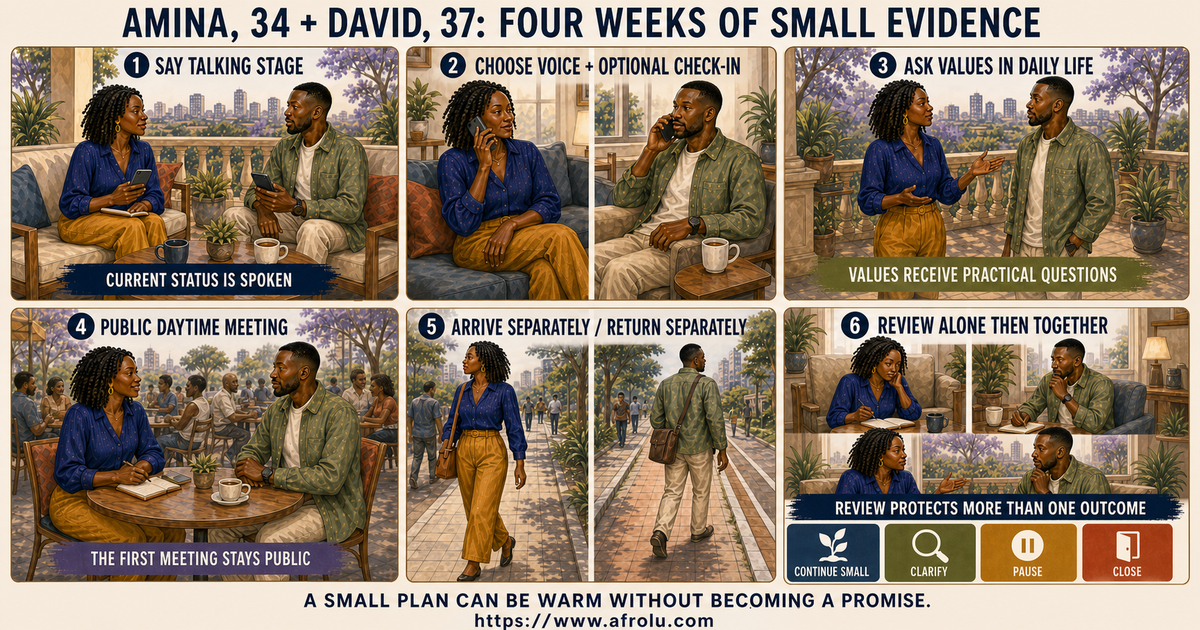
Amina, 34, and David, 37, are fictional adults in Nairobi. Across four weeks they name the talking stage, choose a small contact rhythm, turn shared-value language into practical questions, use a public daytime meeting with separate arrival and return, and review alone before deciding together. They continue small; that ending is an example, not a promised result.
The Nairobi six-gate clarity veranda
Keep faith, present facts and adult choice in their own frames
Samira Benali uses six separate gates so warmth and shared values never have to carry missing practical answers.
Open one gate, ask the narrowest honest question and let the answer support continuation, resizing, pause or closure.
CURRENT STATUS
Name what exists before describing what might grow.
CONTACT RHYTHM
Fit connection around two complete adult lives.
SHARED VALUES
Ask how chosen values appear in ordinary conduct.
PUBLIC MEETING
Keep place, time, spending, transport and return separate.
CONSENT
Give every online and offline choice its own free yes.
EXIT
Make sure no and closure work without punishment.
The honest opening
Let a talking stage be early without letting it become obscure
A talking stage is an early period when two adults are learning whether dating could fit. It can hold genuine warmth, frequent contact and serious hope without yet being a relationship agreement. In Nairobi, a full week may already contain work, family, faith community, friends and long journeys. Clarity should fit that life instead of demanding constant access.
Faith-led means an adult freely chooses to include belief, practice or community values in dating decisions. It does not tell us that two people interpret those values alike. It cannot verify identity, honesty, consent, sexual-health information, money requests or physical safety. Those questions still need plain words, observable conduct and independent checks that fit the fact.
Low detail is not always deception. Adults may protect a home, congregation, workplace or family during early contact. The useful distinction is whether privacy leaves enough truth for a safe next step. A person can decline a private fact and still offer a public plan. They can also choose not to continue when the remaining uncertainty is too large.
The six-gate veranda keeps CURRENT STATUS, CONTACT RHYTHM, SHARED VALUES, PUBLIC MEETING, CONSENT and EXIT separate. Open only the gate needed for today's decision. If the answer is ordinary uncertainty, ask or resize. If it reveals fraud, threats, tracking, coercion or blocked movement, leave the veranda and use direct protection that fits the location and harm.
The veranda method
Ask one gate-sized question instead of demanding a whole future
CURRENT STATUS asks what exists now. Are both adults single, dating others, exploring casually or hoping for something serious? Is exclusivity absent, discussed or agreed? Future language does not answer these questions. A respectful answer may still reveal a mismatch. That is useful clarity, not a debate invitation or evidence that either adult lacks faith.
CONTACT RHYTHM asks what two ordinary lives can carry. Amina might prefer one planned call and lighter messages. David might enjoy more contact. Neither preference is automatically warmer or more faithful. They can offer, counter and test a rhythm without opening exact schedules, workplace systems, live locations or every evening to inspection. Rest and private time remain legitimate.
SHARED VALUES converts attractive words into practical questions. What does honesty look like after a missed plan? How does each adult handle disagreement, money, sexual boundaries, community involvement and privacy? The aim is not a theology exam. It is to learn whether freely chosen values produce conduct that both adults can understand, question and decline.
PUBLIC MEETING, CONSENT and EXIT keep the practical edge visible. A first meeting needs a bounded public plan, independent transport and a return each adult controls. Consent stays specific across calls, images, touch and sex, and it can change. EXIT asks whether no works without punishment. A talking stage is only genuinely voluntary when leaving remains possible.
A Nairobi field note
Amina and David collect four weeks of small, ordinary evidence
Amina, 34, and David, 37, meet through a dating platform. They both describe faith as important and discover that they value family care and honest disagreement. Amina says she is still talking to other people. David says he is not, but does not ask her to stop. They agree that the current stage is exploration, not exclusivity.
During the first two weeks, they choose one midweek voice call and one optional weekend check-in. When Amina needs a quiet evening, David accepts the no without asking for proof. When David misses a call, he names it the next morning and offers a different time. Neither act guarantees compatibility, but each supplies a current fact about how a boundary or miss is handled.
For their first meeting, they choose a public daytime setting and a one-hour window. Each arrives separately, pays personal costs and controls the return journey. Amina declines a second location. David accepts the ending and travels home. The declined extension is not a hidden test; his response simply provides one more observable piece of conduct.
Before their four-week conversation, Amina and David review alone. Amina wants another month of the same rhythm. David wants to discuss dating more intentionally but does not present it as a spiritual obligation. They clarify the difference and continue small for two weeks. Their result is not promotion. It is a bounded choice that both can revisit or end.
The observation board
Read sixteen signs as conduct, never as a virtue score
WORDS MATCH TODAY has four signs: current status is specific; exclusivity is not assumed; future hope remains a hope; and a difficult answer can be spoken without pressure. These do not promise a relationship. They show that present questions receive present words. Repeatedly changing the label only when access is requested deserves clarification or a smaller route.
RHYTHM FITS TWO LIVES adds four observations: either adult can propose contact; a counteroffer is welcome; a quiet block needs no proof; and a miss receives a workable repair. Frequent messages can feel intimate while hiding one-way effort. A modest rhythm may be stronger when both adults can shape it and neither must abandon sleep, work or community life.
VALUES BECOME CONDUCT looks at four more facts: disagreement stays respectful; money remains independent; privacy is not treated as disloyalty; and community language does not override either adult's voice. Shared faith may make a conversation easier, but it is conduct after friction that makes an answer usable. A title, introduction or endorsement cannot transfer consent.
NO KEEPS ITS MEANING completes the board: camera refusal stands; a meeting ends on time; physical and sexual choices stay specific; and closure stops romantic pursuit. Repeated accounts, surveillance, threats, image pressure, forced access or movement blocked by another person are not amber dating signals. They need direct protection rather than more romantic explanation.

Read repeated conduct and the response to a limit; never average danger into a trust total.
Words that leave room
Use twelve scripts without trying to control the reply
For status, try: 'I like getting to know you, and we are still in a talking stage.' Add: 'I am not agreeing to exclusivity through message frequency.' These lines name the present rather than diminishing the warmth. If the other adult needs a different structure, the next task is deciding whether the offers fit, not persuading either person to want less.
For rhythm, say: 'I can do one call this week and will not share my full schedule.' To explore values, ask: 'What would honesty look like after one of us misses a plan?' Another useful line is: 'I make my own decisions; community advice will not replace my consent.' Practical questions show how a value might live in an ordinary week.
For a meeting, offer: 'I can meet in public from one to two and will travel myself.' For consent, say: 'I am comfortable with conversation, not with sharing private images.' If money appears, use: 'I do not send fees, fares, airtime or codes to a match.' Each sentence closes only the route it names unless you decide to close more.
For review, try: 'Let us each think alone, then compare what we want now.' To resize, say: 'This contact rhythm is too much; I can offer something smaller.' For closure, state that the connection no longer fits and that you will not continue romantic contact. If harm follows, stop scripting. Preserve useful evidence and seek real local or provider help.

Say what you offer and control; leave the other adult free to answer, counter or decline.
The choice courtyard
Match the next door to the strongest fact you actually have
ASK fits one answerable gap, such as whether the talking stage is exclusive. KEEP fits a rhythm that already protects both lives. RESIZE changes contact, duration, disclosure or meeting scope. These are ordinary relationship choices. State one question or offer, then use the answer rather than stacking several hidden tests into the same conversation.
VERIFY fits a factual claim that can be checked outside the match. Use an official provider, a known institution reached independently or a public source appropriate to the claim. Do not use a link, phone number or person supplied only by the contact as its own verification. Verification reduces a specific uncertainty; it does not certify character or future safety.
MEET begins a separate plan: public setting, bounded time, personal spending, independent arrival and return, trusted-contact arrangement if wanted, and consent that remains current. A public meeting is not a relationship milestone and never creates sexual access. If essential pieces cannot stand independently, keep contact online, choose another plan or decline.
PAUSE and CLOSE require no proof that the other person is bad. A capacity or direction mismatch is enough. GET HELP belongs to fraud, account loss, image abuse, threats, stalking, coercion or immediate danger. Contact genuine services suited to the harm and location. In urgent danger, prioritize a safer place and local emergency assistance over finishing a conversation.

Choose ASK, KEEP, RESIZE, VERIFY, MEET, PAUSE, CLOSE or GET HELP from today's strongest fact.
The nearby route map
Separate stage, pace, values, mismatch and harm before choosing advice
A TALKING STAGE explores fit before a dating agreement is shared. MUTUAL EARLY DATING means both adults have agreed they are dating while much remains open. CASUAL DATING and SERIOUS DATING describe different present intentions or structures, each of which still needs consent and practical terms. Contact volume alone cannot choose among them.
A FAITH-LED LENS means belief or practice voluntarily informs decisions. It can sit beside several relationship types. It does not make one route morally superior, require community disclosure or prove honesty. A SITUATIONSHIP describes ongoing date-like contact without shared clear status. That label suggests a status conversation, not a judgment about either adult's worth.
A CAPACITY MISMATCH can occur when both offers are honest but do not fit. One adult may want more contact, a different community role or a faster commitment. The useful response is an agreed resize or closure. Breadcrumbing is different when intermittent attention repeatedly keeps access open without enough clarity or follow-through to meet the stated offer.
ROMANCE FRAUD uses deception to seek money, identity data or account access. UNSAFE CONTROL uses surveillance, threats, coercion or blocked choice. Neither is a more intense talking stage or a spiritual problem to solve together. Reduce exposure and use direct provider, privacy, safety, legal or emergency help appropriate to the concrete fact.
Eight Nairobi moments where one clarity gate changes the next move
Njeri, 33, hears marriage language in week one
Njeri and her 38-year-old contact are adults. He speaks warmly about a future but avoids saying whether he is dating anyone else now.
Ask for current status once; future language cannot answer it.Kamau, 41, is offered an elder's endorsement
Kamau is an adult. His 36-year-old match says a respected community introduction should remove every need for privacy and safety checks.
Value the introduction without transferring identity, consent or safety.Asha, 35, declines a second call
Asha and Peter, 39, are adults in Nairobi. Peter accepts her quiet evening and offers another time without asking for a location or explanation.
Count the respected no as one useful fact, not a guarantee.Musa, 34, receives rapid belief tests
Musa's adult contact asks increasingly private questions and treats any hesitation as proof that he is not serious or spiritually aligned.
Decline the test and ask for conduct-based, mutual questions instead.Wanjiku, 37, wants her own return journey
Wanjiku and her 40-year-old match agree on a public daytime meeting, but he repeatedly insists on collecting her from home.
Keep the address private and retain separate arrival and return.David, 37, says no to an intimate image
The adult contact links a private photo to trust and claims that shared faith should make David comfortable with the request.
Keep the no; shared belief does not transfer image consent.Leila, 32, is asked for an urgent fee
Leila's adult match says a temporary payment will protect a community obligation and sends an unfamiliar link for immediate transfer.
Do not pay or use the link; verify the claim independently.Amina, 34, wants intentional dating
After four weeks, Amina wants an agreed dating relationship while David wants to continue open exploration without a review date.
Accept the mismatch, choose a genuine resize, or close cleanly.Sixteen observations across present words, shared rhythm, lived values and a working no
Both adults can state the relationship stage that exists today.
Future hope is not used to avoid a present-status answer.
Exclusivity is discussed directly rather than inferred from attention.
A difference in intention can be heard without spiritual pressure.
Either adult can propose, counter or decline a contact window.
Quiet time does not require a location, schedule or loyalty proof.
A missed plan receives ownership and one realistic new action.
Contact leaves room for work, family, friendship, rest and community.
Shared values are explored through mutual practical questions.
Community advice never replaces either adult's independent choice.
Money, passwords, codes and private records remain independently controlled.
A public meeting has a bounded time and separate arrival and return.
Consent stays specific across calls, images, meetings, touch and sex.
A no does not trigger guilt, surveillance, threats or a new channel.
Closure is accepted without recruiting family or community pressure.
Concrete danger is routed to direct help instead of a relationship score.
Ten decisions for asking, verifying, meeting, resizing, closing or getting help
| Situation | What it may mean | What to do next |
|---|---|---|
| Is the present stage named? | Fits: Both describe what exists today. Needs review: One term needs a plain definition. Stop: Future promises replace every current answer. | Ask once for current status, then decide from the answer. |
| Is the contact rhythm mutual? | Fits: Both can offer and counter. Needs review: One window needs resizing. Stop: Access is demanded as proof of care. | Offer the smallest rhythm you can freely sustain. |
| Do shared values become conduct? | Fits: Everyday examples are specific and mutual. Needs review: One value needs a practical question. Stop: Faith language excuses secrecy or pressure. | Ask what the value looks like during an ordinary disagreement. |
| Can privacy and truth coexist? | Fits: Enough is known for the chosen step. Needs review: One claim can be checked independently. Stop: Proof demands expand into accounts or live access. | Limit disclosure and verify only the fact that matters. |
| Is the meeting independently leaveable? | Fits: Public place, time and return are clear. Needs review: One practical detail is unfinished. Stop: Home access or controlled transport is required. | Complete a public plan or decline the meeting. |
| Does consent stay specific? | Fits: Each choice receives its own yes. Needs review: One assumption needs correction. Stop: Faith, gifts or travel are treated as access. | Name the affected boundary and keep every other choice separate. |
| Does no work? | Fits: The named route closes without punishment. Needs review: A channel setting may support the boundary. Stop: Pressure returns through new accounts or people. | Stop explaining, protect the channel and seek fitting help. |
| Did repair change the next action? | Fits: Ownership and a realistic offer arrive. Needs review: The offer needs one clearer edge. Stop: Apologies grow while conduct repeats. | Use the changed action, not apology size, as evidence. |
| Can review hold several outcomes? | Fits: Continue, resize, pause and close remain possible. Needs review: The date needs one mutual reset. Stop: Review moves while access keeps growing. | Hold the review, reset once together, or close. |
| Where does the strongest fact belong? | Fits: Ordinary uncertainty fits one question. Needs review: A genuine provider or public source can help. Stop: Fraud, threats, tracking or coercion needs protection. | Use direct local, provider, legal, safety or emergency help. |
Twelve scripts that keep faith, clarity and adult choice on separate lines
“I like this, and we are still getting to know each other.”
“I am not agreeing to exclusivity through message frequency.”
“I can do one call this week and will keep my full schedule private.”
“What would honesty look like after one of us misses a plan?”
“I listen to advice, and I still make my own dating decisions.”
“Voice is comfortable today; I am not turning on my camera.”
“I can meet in public from one to two and will travel myself.”
“I do not share private images as proof of trust.”
“I do not send fees, fares, airtime or codes to a match.”
“The plan was missed; what different action can you offer now?”
“Let us think separately, then compare what each of us wants now.”
“This no longer fits me, so I am ending romantic contact.”
Know the difference
A talking stage and a faith-led lens answer different questions
Two adults explore whether dating could fit before a shared relationship agreement is established.
An adult voluntarily includes belief, practice or community values in decisions across more than one possible relationship type.
Stage describes what exists; faith-led describes a chosen lens. Neither proves compatibility, consent, identity or safety.

Talking stage names exploration; faith-led names a chosen lens; neither certifies compatibility or safety.
Separate relationship stage, a faith lens, ordinary mismatch, fraud and unsafe control
| Type or dimension | What it describes | Best next question |
|---|---|---|
| Talking stage | Adults explore fit before a dating agreement is shared. | Name current status, rhythm and a review point. |
| Mutual early dating | Both adults have agreed they are dating while many terms remain open. | Define the agreement and the next practical boundary. |
| Casual dating | The present structure does not seek the same commitment as serious dating. | State expectations, disclosure, consent and exit. |
| Serious dating | Both adults share a longer-term direction plus present commitments. | Name what is promised now without claiming permanence. |
| Faith-led lens | Belief or practice voluntarily informs choices across several possible routes. | Translate values into mutual everyday conduct. |
| Situationship | Repeated romantic contact continues while the adults have no common account of what it is. | Ask what is being offered now, then decide whether that answer is enough. |
| Capacity mismatch | Two truthful offers cannot share a workable pace, community role or direction. | Choose a mutually smaller route or end it respectfully. |
| Romance fraud | Deception seeks money, identity data or account access. | Stop exposure and use genuine provider or local help. |
| Unsafe control | Surveillance, threats, coercion or blocked choice changes the task. | Prioritise a safer route and direct protection. |
Open the six-gate veranda for one proportionate next step
Name today first
Present status keeps hopeful language from becoming an accidental agreement.
Shape a humane rhythm
Contact should leave both adult lives recognisable outside the connection.
Make values practical
Ordinary conduct teaches more than a polished identity label.
Plan the meeting separately
Public place, time, transport, money and return each keep their own decision.
Let no keep its meaning
A respected limit is evidence; pressure after no changes the route.
Keep review open
Continuation is one possible answer beside resizing, pausing and closure.
Questions for status, rhythm, values, a public meeting, consent and exit
Choose a few prompts that fit the moment. This is a reference library, not a list to complete.
Status and rhythm
Keep the current offer separate from hoped-for meaning.
- What exists today?
- Is exclusivity agreed?
- What rhythm fits both lives?
- When will we review?
Values and community
Move identity language into mutual practical questions.
- What does honesty look like after a miss?
- Who makes the final choice?
- What stays private?
- How do we handle disagreement?
Meeting and consent
Build a first plan that each adult can freely leave.
- Which public setting?
- What start and end?
- How will each person travel?
- Which choices remain separate?
Exit and direct help
Distinguish ordinary closure from concrete harm.
- Does no work?
- Which channels need protection?
- What evidence matters?
- Which genuine service fits the fact?
What current research and official communication, safety, privacy and health guidance supports
A multi-faith study supports asking rather than assuming importance
A peer-reviewed multi-country study examined how people in several religious and nonreligious groups perceived religion's importance within couple relationships, reinforcing why two adults should describe their own expectations.
Evidence limit: It does not study Nairobi dating safety, prove compatibility or supply a successful-relationship rule.
CDC emotional-well-being guidance supports respectful, specific conversation
The public-health page includes practical communication ideas such as expressing feelings clearly and listening, which can support a values-and-scope discussion without turning it into a test.
Evidence limit: This is general U.S. wellness guidance, not faith-specific evidence or mental-health treatment.
WHO keeps consent, privacy, safety and respectful relationships visible
The global health overview frames sexual health around respectful, safe experiences free from coercion and discrimination, so shared faith cannot silently answer consent or health questions.
Evidence limit: It is broad public-health context and does not replace an individual clinical consultation.
eSafety keeps personal detail and meeting readiness under the user's control
The official guide supports limiting profile information, using platform privacy and blocking controls, recording a profile before meeting, telling a trusted person about plans and declining a meeting when uneasy.
Evidence limit: Its reporting routes and legal context are Australian, so readers elsewhere need local services.
Kenya's ODPC describes rights around personal information
The official page explains rights involving informed use, access, objection, correction and deletion, plus a separate safeguard for personal data transferred outside Kenya.
Evidence limit: These are broad privacy rights and principles, not a ruling about an individual dating dispute.
Kenya's NSDCC publishes confidential testing information
The official Kenyan page supports open discussion and confidential HIV testing when sexual contact is being considered, instead of treating affection or shared faith as health evidence.
Evidence limit: The page is not an emergency service and readers may need a suitable current local clinic.
Six ways faith language or warmth can hide a missing practical answer
Using faith as verification
Shared language cannot prove identity or safety. Repair: check the relevant fact independently.
Opening every evening
Warmth becomes constant access. Repair: choose a bounded rhythm both adults shape.
Turning values into an exam
Private belief answers become obedience tests. Repair: ask mutual conduct questions.
Borrowing community consent
An introduction replaces individual choice. Repair: keep each adult's yes current.
Combining the first meeting
Venue, ride, money and access become one package. Repair: separate every practical choice.
Moving the review
Access grows while status stays untouched. Repair: hold it, reset once together or close.
Ask what exists now before shared values carry tomorrow's meaning
Faith can inform a voluntary value without proving identity, compatibility or safety. Name the current status, contact rhythm and public Nairobi meeting plan, then use one resource for the gate that is still unanswered.
Explore the guide library
Show more related guides
Continue with Afrolu
Show more Afrolu guides
Current peer-reviewed and official faith, communication, safety, privacy and health sources
Afrolu reviewed these health, research, safety, or public guidance resources while editing this page. They support the behaviour and safety guidance; they do not diagnose any individual described by a reader.
Faith-led Nairobi talking-stage questions
What is a faith-led talking stage?
It is an early period when two adults explore whether dating could fit while one or both voluntarily include faith, practice or community values in decisions. The talking stage names relationship status; faith-led names a lens. Neither creates exclusivity or proves compatibility, consent, identity or safety.
How long should a talking stage last in Nairobi?
There is no universal duration. Choose a review point that fits the actual contact rhythm, then discuss what exists now. A date is useful when it prevents indefinite drift, not when it acts as an ultimatum. Continue, resize, pause and closure should all remain genuine options.
Does shared faith make an online match safer?
No. Shared language or community connections may support useful conversation, but they cannot verify identity, money requests, consent, sexual-health information or safety. Check the specific fact through an independent source and keep practical boundaries such as public meetings and separate return routes.
Should a faith leader decide whether we date?
An adult may freely seek trusted advice, but another person's approval does not replace either dater's consent or decision. Be cautious if a match recruits community authority to force disclosure, access, exclusivity, money or continued contact after no. Each adult remains responsible for their own choice.
How much contact is enough during the talking stage?
Enough is a rhythm both adults can freely sustain while work, family, sleep, friendship and community remain intact. One pair may prefer a planned call; another may message lightly. Frequency is not proof of intent. Look for mutual planning, respected limits, repair and a real review.
What should we discuss before meeting in Nairobi?
Agree on a public setting, bounded time, spending, independent arrival and return, contact with a trusted person if wanted, and how either adult will leave. Keep the home address private if preferred. A meeting never creates consent for touch, sex, another location or a relationship.
Can I keep my congregation or community private?
Yes. Early privacy can be reasonable. Share only what the chosen next step needs. A respectful contact can ask a clear question without demanding names, schedules, leaders or attendance proof. If limited disclosure leaves too much uncertainty for you, you may choose a smaller step or stop.
How do we discuss sexual boundaries in a faith-led context?
Use direct, non-assumptive language about calls, images, touch, sex, protection, testing and the right to change a decision. Faith language does not create or remove consent. When health questions matter, use a suitable clinician or service rather than relying on a match's assurances.
What if we want different relationship directions?
Name the difference plainly. You may find a smaller shared offer, set a short review or close without blaming either adult. An honest mismatch is not a spiritual defect. Do not accept pressure, secrecy or unwanted access merely to prove seriousness or preserve community approval.
What should bypass the normal clarity conversation?
Fraud, account loss, image abuse, threats, stalking, coercion, forced access or blocked movement call for direct protection. Stop sharing access, preserve useful evidence and contact genuine provider, privacy, safety, legal or emergency help that fits the location and harm. Urgent danger takes priority.
One thing to do now
Keep only the clarity that leaves both adult voices intact
Open the smallest gate needed for today's strongest fact. Ask one present-status or conduct question, resize a rhythm that strains ordinary life, verify one factual claim independently, or make a public meeting independently leaveable. Pause or close an honest mismatch without blame. Fraud, account loss, image abuse, threats, tracking, coercion or blocked movement belong with genuine provider, privacy, safety, legal or emergency help suited to the place and harm.