Three words, no borrowed meaning
Slow, Faith-Led, and Casual Are Three Different Choices
Separate pace, relationship direction and faith boundaries in slow casual dating, with clear scripts for community privacy, consent and a kind exit.
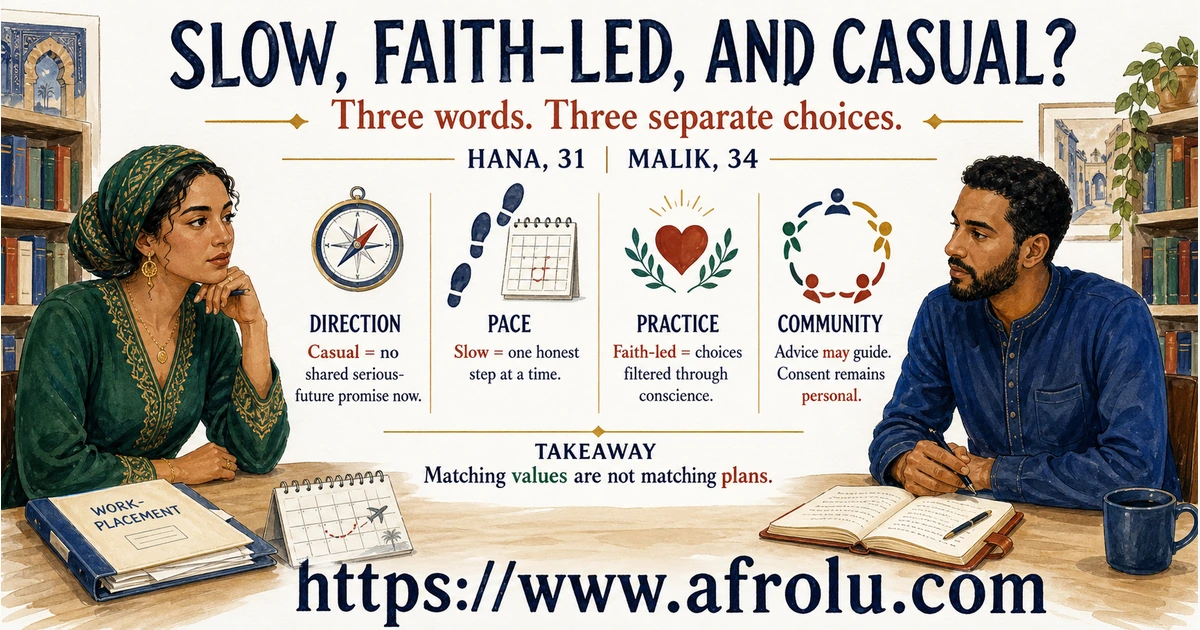
Casual names present direction, slow names pace, and faith-led names the values used for choices. Matching values are not matching plans.
Written and edited by Samira Benali · Faith and North Africa Editor
For some adults, yes. The answer depends on their own beliefs and on whether both people choose the same present agreement. Slow names pace: one manageable step at a time. Casual names direction: there is no shared promise of a serious future now. Faith-led names the values used to make choices about time, touch, sex, alcohol, money, worship, family, and privacy. None of those words decides the other two. Write all three answers separately. Add a fourth answer about community: who may advise, who may know, and which decisions remain private. A respected adviser can help an adult think; an adviser, relative, or partner cannot replace either adult's consent. If one person means a slow path toward commitment while the other means careful companionship with no such direction, the kind choice may be a clear ending rather than a longer trial.
Intentional dating · Faith-Led Daters
Can two adults date slowly and honor their faith when neither has promised a serious relationship?
Slow faith-led casual dating is a possible combination of three separate choices. The adults reduce speed, filter conduct through their beliefs, and do not share a serious-commitment promise at present. It is not automatically a contradiction, and it is not automatically suitable for every person or faith tradition. A useful agreement names what the adults are doing now without borrowing a doctrine, family expectation, or future promise they have not chosen.
Hana is 31 and expects to relocate after a six-month work placement. Malik is 34 and wants his next relationship to move deliberately toward marriage. Both say faith shapes their choices. Both prefer public daytime dates, no alcohol, and no physical intimacy while they are deciding. After two calm dates, Hana calls the connection casual because she wants companionship without planning a shared future before the move. Malik calls it slow because he sees each date as discernment toward commitment. Their conduct looks similar; their direction is not. They write three lines: pace, practice, and possible future. The first two match. The third does not. Malik does not argue that shared values create a promise. Hana does not offer maybe-later language to keep his attention. They end the romantic part, keep private details private, and leave with more respect than an undefined extra month would have produced.
The discernment ledger
Keep direction, pace, practice, and community on separate lines
The words faith-led, slow, and casual answer different questions. The ledger makes each answer visible before similar conduct is mistaken for the same plan.
Read every line in present tense. Review the ledger after a meaningful change, not after every warm message. An answer can be revised, but it cannot be revised for the other adult.
What future is possible now?
Casual means no shared serious-future promise now. If partnership or marriage is the intended direction, say that instead.
What is the next honest step?
Slow can mean fewer dates, gradual disclosure, or later integration. It still needs a next step and a review point.
Which choices protect conscience?
Name boundaries around touch, sex, substances, spending, worship, overnight stays, images, and private spaces without vague moral tests.
Who advises, and who decides?
Choose what relatives, friends, or faith leaders may know. Advice can inform a decision; consent and the right to leave remain personal.
Separate the questions
Do not ask one label to carry three decisions
Write one sentence for direction, one for pace, and one for practice. Hana writes, 'I am open to companionship, not commitment before my move.' Malik writes, 'I am dating slowly toward a committed partnership.' Their public dates and physical boundaries match, but the first sentence shows why the connection cannot be treated as one plan.
A slow pace does not prove serious intention. A serious intention does not require fast access. Faith-aware conduct does not reveal whether a person is exclusive, dating toward marriage, or simply meeting another adult with care. Ask the missing question instead of reading it from the surface.
Use language a third person could understand without knowing either adult's private theology. 'One public date every other week' is clearer than 'proper courtship'. 'No shared commitment goal now' is clearer than 'let us see'. Specific words reduce argument without reducing conviction.

Write present answers for direction, pace, practice, and community, then review after real evidence or a meaningful change.
Let the calendar tell the truth
A slower rhythm should protect worship, work, rest, and real plans
Place work, care, study, worship, sleep, friendships, and existing community commitments on the calendar before adding dates. Then choose a rhythm both adults can keep without turning every quiet day into a test of interest.
Slow dating still moves. A date has a time and place. A change includes a brief reason and a usable alternative. A review point asks whether the current direction still fits. Patience is not an instruction for one person to carry every invitation, journey, and repair.
Do not use a service, holy day, retreat, family event, or community meeting as surprise relationship disclosure. Ask before arriving together or using a shared space as proof that the bond is serious. Familiar surroundings can feel safe while still creating social pressure.

Public dates, no alcohol, no physical intimacy, and privacy can all match while the adults choose different futures.
Make boundaries usable
Translate conviction into choices without policing another adult
Each adult names their own boundary and the action they will take. 'I do not want overnight dates' is a boundary. 'A good believer would never want that' turns a personal choice into a verdict on someone else's character. The first sentence can guide a plan; the second invites shame and argument.
Consent remains specific and changeable. Agreement to date, pray together, meet a relative, accept a meal, or enter a home does not create agreement to touch or sex. A shared faith identity does not make health information or contraception questions unnecessary where physical intimacy is relevant.
Keep money separate from moral worth. A modest public plan can be generous. No adult should risk rent, food, transport, charitable commitments, or essential family support to demonstrate sincerity. Payment never purchases privacy, touch, access, or another date.

Clear scripts can name companionship, pace, a personal boundary, community privacy, and a kind stop without moral judgment.
Invite counsel with limits
Community can support discernment without becoming surveillance
An adult may value advice from a relative, elder, mentor, counsellor, or faith leader. Decide what question is being taken to that person and what private information may be shared. Advice is more useful when the adviser knows the actual agreement rather than a family-friendly version of it.
Neither adult should contact the other's community to force a decision, reveal private health or physical information, or punish an ending. Group pressure does not turn a no into consent. A public reputation is not a relationship contract.
Keep messages, intimate details, confessions, prayer requests, images, and family circumstances within the permission given. Privacy can coexist with support: a person may tell a trusted helper enough to stay safe without making the relationship a public case.
Let different directions be different
A clean ending may honor both adults more than extended discernment
When one adult wants slow serious discernment and the other wants slow casual companionship, neither answer has to be declared morally inferior. State the difference in one sentence. Do not stay in the smaller agreement to audition for the larger one.
Close practical matters: return belongings, settle only agreed expenses, remove shared access, and confirm what remains private. If community members already know, use a neutral statement such as 'we chose not to continue' instead of publishing a private explanation.
If a stop brings threats, repeated contact, spiritual condemnation, outing, image abuse, or pressure through relatives or leaders, move from etiquette to safety. Preserve useful records, restrict access, and seek appropriate local or specialist support.

A true no can show more care than a false maybe. Name the difference, close practical access, and preserve privacy.
Four moments when pace, belief, and direction split apart
The same physical boundary hides two futures
Two adults both prefer no physical intimacy while dating. One is exploring toward marriage; the other wants companionship during a temporary placement.
Ask what future is possible now instead of treating similar conduct as a promise.A relative calls the second date a courtship
The word adds a serious public meaning neither adult discussed. Warm family interest cannot update a private agreement.
Correct the description calmly and decide together what relatives may be told.Slow becomes three months of vague invitations
One adult keeps asking for patience but never proposes a date, repairs a change, or names what is being considered.
Request one concrete next step and a review point; leave if delay is the only pattern.A personal boundary becomes a character test
A person declines an overnight plan, then describes the invitation itself as proof that the other adult has weak values.
Keep the no, remove the verdict, and check whether respectful difference is possible.Six signs slow faith-led dating is clear rather than controlling
Both adults can explain the present direction without hiding a serious hope inside casual language.
Slow has observable movement: specific dates, shared repair, gradual learning, and a review point.
Faith boundaries are stated as personal choices, not used to rank, shame, or control another adult.
Consent remains specific even around prayer, family meetings, private homes, gifts, and physical affection.
Community advice is invited with clear privacy limits and cannot be used to force continuation.
Either adult can change direction or end the connection without threats to reputation, belonging, or safety.
Respond to the line that changed
| Situation | What it may mean | What to do next |
|---|---|---|
| Both adults say faith-led and slow, but only one is dating toward commitment. | Practice and pace match while relationship direction does not. | Name the different futures before adding dates, family visibility, or exclusivity. |
| A date moves because of a named community duty and a new time is offered. | The calendar changed while interest and repair remain visible. | Judge the usable alternative, not one schedule change as a moral signal. |
| A partner asks a faith leader to persuade the other adult to stay. | Counsel is being turned into pressure against a personal decision. | Restate the boundary directly and limit third-party access to private information. |
| A gift or expensive meal is followed by a demand for affection or secrecy. | Generosity is being treated as a purchase of access. | Decline the condition, keep independent transport, and leave if pressure continues. |
| One adult asks to revise a physical boundary without mocking the original belief. | A personal answer changed and is being disclosed before action. | Each adult chooses freely; a mismatch may require a smaller plan or an ending. |
| A clear stop leads to rumours, condemnation, or repeated contact through relatives. | The issue has moved beyond ordinary disappointment into coercive pressure. | Preserve records, restrict access, and use appropriate community or specialist support. |
Five sentences that keep conviction and choice in the same room
“I want slow companionship. I am not promising a serious future before my move. What are you choosing?”
“One public date every other week works for me. Let us review after four dates.”
“My boundary is no overnight dates. I can explain my choice without judging yours.”
“You may say we are getting to know each other. Please do not share private details.”
“You want a path toward commitment and I do not. I think we should stop dating kindly.”
Know the difference
Slow casual exploration or slow serious discernment?
The pace is deliberate, but there is no shared serious-future goal now. Dates may offer companionship and learning without a promise of progression.
The pace is deliberate and both adults are exploring compatibility for a committed partnership or marriage. The outcome is uncertain; the direction is named.
The visible conduct may be identical. The present direction is the difference that must be spoken.

Speed does not reveal the destination. Slow casual exploration has no shared commitment goal now; slow serious discernment names a committed direction.
Six nearby relationship types that can look similar from outside
| Type or dimension | What it describes | Best next question |
|---|---|---|
| Slow casual exploration | Careful pace with no shared commitment goal now. | What are we enjoying, and what future are we not promising? |
| Slow serious discernment | Careful pace while assessing a committed future. | Which evidence would support or end that direction? |
| Faith-led dating | Values guide conduct; direction and exclusivity still need separate answers. | Which choices come from conviction, and which are assumptions? |
| Courtship | Often implies intentional progression and community visibility, but meanings vary. | What does this word require in this family or tradition? |
| Exclusive dating | Both adults agree not to date others; seriousness may still be under review. | What does exclusive cover, and when will it be reviewed? |
| Situationship | Recurring closeness continues without a clear shared definition or direction. | Which answer is missing, and is either adult willing to provide it? |
Build a four-line discernment ledger
Write three separate lines
Record current direction, workable pace, and faith boundaries without using one as proof of another.
Add a community permission
Name who may know, what may be shared, and whether advice is wanted before involving another person.
Choose a visible next step
Set one affordable date and one review point that fit worship, work, care, friends, and rest.
Keep consent personal
Gifts, prayer, introductions, shared beliefs, and private venues do not replace a present yes.
Close a mismatch cleanly
State the different directions, return practical items, protect privacy, and do not recruit a community campaign.
Questions for direction, practice, community, and closure
Choose a few prompts that fit the moment. This is a reference library, not a list to complete.
Name the three choices
Answer alone first so agreement is not confused with politeness.
- What future am I genuinely open to during this season?
- Which part should move slowly, and what next step remains real?
- Which conduct follows from my own conviction rather than fear of judgment?
- Which answer would make this connection incompatible?
Set community limits
Invite useful support without creating a public contract.
- Who may know that we are dating, and which word should they use?
- What private information may never be shared without fresh permission?
- Whose advice do I want, and what question am I asking them?
- How will we respond if an outsider adds pressure or a label?
Review or close
Use evidence and present answers, not moral bargaining.
- Did plans, repair, respect, and privacy remain mutual?
- Do pace, direction, and practice still match?
- What simple sentence names a changed answer?
- What practical access or information must be closed if we stop?
Four habits that turn clarity into pressure
Assuming shared faith means shared intention
Two adults can agree on conduct while choosing different futures. Ask about direction directly.
Calling indefinite delay slow dating
A slow connection still includes specific plans, repair, learning, and a point where both adults choose again.
Using belief language to shame a boundary
State personal conviction and the plan it creates without making another adult's different answer a character verdict.
Recruiting community pressure after a no
Advice cannot replace consent. Private details and reputation should not become tools for reversing an ending.
Use a reviewed resource that matches the decision
This guide focuses on the relationship decision, so it does not rank dating apps. Check current prices, safety tools, and local availability before choosing a service.
Explore the guide library
Show more related guides
Continue with Afrolu
Show more Afrolu guides
Sources behind the pace, disclosure, choice, and health notes
Afrolu reviewed these health, research, safety, or public guidance resources while editing this page. They support the behaviour and safety guidance; they do not diagnose any individual described by a reader.
Slow Faith-Led Casual Dating: Clear Questions
Can dating be both faith-led and casual?
For some adults, yes; for others, their beliefs make that combination unsuitable. Define casual as the absence of a shared serious-future promise now, then choose conduct that fits each adult's own convictions.
Does slow dating mean the relationship is serious?
No. Slow describes pace. A casual connection and a serious connection can both move slowly. Ask what future is possible now rather than reading direction from speed.
Is slow casual dating the same as courtship?
Usually not. Courtship often implies intentional progression and community visibility, though meanings vary. Slow casual dating has no shared serious-commitment goal now.
Should a faith leader or relative approve the relationship?
An adult may freely seek advice, and some traditions value community involvement. Advice should not replace either adult's consent, privacy, or right to leave.
How can I discuss physical boundaries without judging the other person?
Use first-person language: name what you choose, what plan follows, and what you will do if the answers differ. Avoid turning your boundary into a verdict on their worth.
Can two adults have different faith practices and still date slowly?
Possibly, if both understand the differences and can make compatible agreements about time, worship, food, substances, sex, family, celebrations, and future expectations.
When should we review a slow casual agreement?
Choose a meaningful point such as four dates, a move, a new physical decision, exclusivity, or wider community involvement. Review after evidence rather than after every message.
What if I now want a serious relationship?
State the new direction directly. The other adult may accept, ask for time, or decline. Time already spent does not require them to change the original agreement.
How do we end without creating community gossip?
Use one neutral public sentence, keep private details private, return practical items, and ask trusted people not to campaign. A full explanation is not owed to every observer.
When does faith language become a safety concern?
Seek appropriate support when belief or community access is used for threats, isolation, financial control, sexual pressure, outing, stalking, reputation attacks, or contact that continues after a clear stop.
One thing to do now
Write the direction before asking patience to carry it
Continue when pace, present direction, faith boundaries, and community privacy are all compatible. Pause when one answer is assumed or outsourced. End when a belief is used to shame a boundary, casual language hides a serious expectation, or slow language keeps one adult waiting for a future the other has not chosen.