The New Start Record
Start Serious Long-Distance Dating Slowly After Time Away
A plain guide for adults returning to serious long-distance dating, with slow pacing, safe visits, money limits and clear next steps.
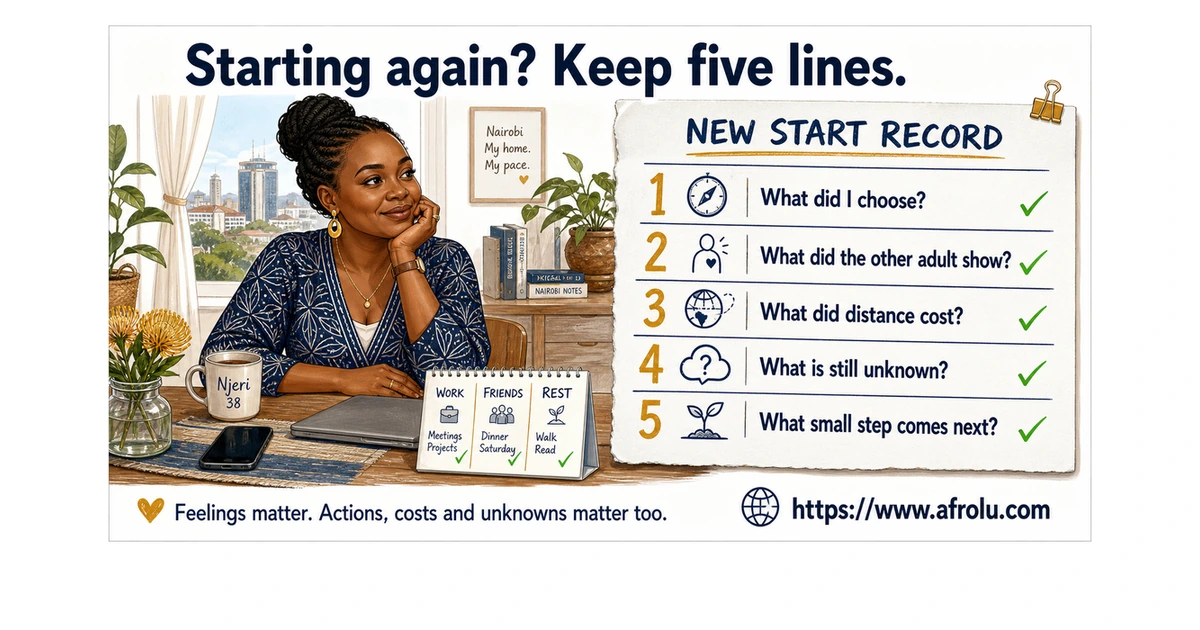
https://www.afrolu.com | Write your choice, the other adult's action, the distance cost, what remains unknown and one small next step.
Written and edited by Tariro Ncube · Diaspora Dating Editor
Start with your present life, not the relationship you had before or the future you hope to recover. Tell the new person that you want a serious direction and a slow pace. Those are separate choices. Serious means you are open to a lasting partnership if the match works. Slow means trust, access and life changes grow in small steps. Long distance means calls and messages can show care, but they cannot show every part of daily life. Use a five-line New Start Record after each important week. Write what you chose, what the other adult showed, what the distance cost, what remains unknown and the next step that is easy to undo. Agree on a call rhythm, current dating status, privacy, money limits, sexual boundaries and a safe first visit. Each adult keeps control of accounts, documents, lodging, transport and return travel. Discuss a possible shared city early enough to find a major mismatch. Do not move, resign, sponsor travel or a visa, borrow, merge money or give up housing too early. Wait until several ordinary visits and checked facts support that choice. Slow dating should make the relationship clearer. If time only brings bigger words, more requests and the same missing answers, the pace is not protecting a new start. It is keeping the future out of reach.
Intentional dating · New Relationship Starters
How can an adult return to serious long-distance dating at a slow pace? How can they keep strong calls, patience, and future hope separate from real progress?
Slow serious long-distance dating is an adult relationship with three clear parts. Slow describes pace. Serious describes a possible long-term direction. Long distance describes limited in-person access. None of these words creates exclusivity, trust, sexual consent, financial duty or a promise to move. Adults who are returning to dating may need more time to learn new habits and hear their own answers. That need is not a flaw. A useful slow pace still contains action. Calls happen, changes are repaired, identity details remain consistent, visits become possible and the future question gains facts. Every dating person and pictured dating subject in this guide is an adult aged 25 or older.
Njeri is 38 and lives in Nairobi. She returns to dating two years after a twelve-year marriage ended. Samuel is 41 and lives in Kampala. He has been away from dating apps for seven years. They are fictional composite adults. Their choices are examples, not reported events. Njeri likes Samuel's calm voice and clear wish for a lasting partner. In the first ten days, they speak every evening. The contact feels warm, but Njeri notices an old habit. She is moving sleep, friends and weekend plans before Samuel has asked her to do so. She also starts filling unknown parts of his life with kind guesses. Samuel notices his own habit. He speaks about a shared home because future talk feels easier than asking what Njeri can offer now. They do not end the connection. They make it smaller and more honest. Njeri writes five lines after Sunday calls. She records her choice, Samuel's action, the distance cost, the unknown and one next step that traps neither adult. Samuel keeps the same record for himself. They change daily calls to two planned calls and optional voice notes. They say they are dating seriously but are not exclusive yet. They share only what the next choice needs. They do not exchange home addresses, account details or private family stories. Over twelve weeks, their calls include ordinary mornings, a work deadline, separate social plans, a missed call and a repair. Live calls and details that stay consistent add useful information. Neither adult treats them as proof of every claim. They plan a first weekend in Kampala without making Samuel the owner of Njeri's safety. Njeri books her lodging and travel. Samuel plans a public first meeting. Both keep their own money, phone, documents and route home. The visit is good but not perfect. Samuel likes late dinners. Njeri needs early rest. He feels hurt when she returns to her hotel after dinner. She feels watched when he asks for every journey update. They talk the next morning. They agree on one arrival message, not a live map. Njeri shares the fuller plan with her own trusted person. Her hotel and sleep remain her choice. The repair tells them more than another easy call would. At 120 days, they choose exclusivity and plan a second visit to Nairobi. They do not promise a move. Instead, they list the facts a move would require: work, housing, family care, legal status, health, money and each person's real wish. Their choice is serious because both can explain it. Neither has promised more than they know.
Five lines after every important week
Keep a New Start Record that separates feeling from proof
A returning dater can feel both hopeful and careful. The record makes room for both. It does not score the other person. It helps you notice your choices, their actions and the effect of distance before a strong story becomes a large commitment.
Write one or two plain sentences for each line. Use events from the week. Do not guess a hidden motive. Review the record alone before discussing the next step together.
What did I choose?
Record the time, access, money, information or promise you gave. Notice whether you freely chose it or repeated an old habit.
What did this adult show?
Use actions you could see. A call happened, a change was explained, a boundary was accepted or a plan stayed vague.
What did distance cost?
Count sleep, time zones, data, travel research, money, missed local life and the work of keeping plans. Do not count only tickets.
What is still unknown?
Name the blank without filling it with fear or hope. Unknown identity, daily life, conflict, sex, family, money or location facts need different answers.
What small step comes next?
Choose one call, question, public visit, check or review. Keep jobs, homes, savings, documents and the route out unchanged while you still know little.
Begin before the next match
Return to dating as the adult you are now
A new dating start does not erase your earlier life. You may know more about conflict, care, money, sex, loneliness or family than you knew before. You may also feel unsure about apps, video calls or the labels people use now. Both things can be true. Write why you are returning now. Name what you want, what you cannot offer and what still feels unclear.
Do not make a new match carry the job of proving that you are lovable, healed or ready. You do not need to share a full history on the first call. You do need an honest present answer. You might say that you want a lasting partner, can manage two calls a week and need time before exclusivity or travel. That answer gives another adult something real.
Make a local-life list before distance expands. Protect sleep, work, friends, family care, health, worship, exercise and quiet time. These are not rivals to a relationship. They are the life a partner would join. If calls take every free hour, the match sees your attention but not your real week. Keep enough ordinary life to judge how the connection fits.
Choose a personal money limit. Include app costs, data, calls, dates, travel research and possible tickets. Keep rent, food, debt payments, medicine, care duties and emergency funds outside romantic spending. A returning dater may want to show generosity or independence. Neither requires hiding a limit or paying for the other adult's unverified crisis.
Choose two trusted people who remain yours. They do not need every message or private detail. They can know that you are dating, the broad location of a first visit and when you expect to check in. A serious connection should add support over time. It should not make your existing support disappear before trust has grown.
Follow one return without turning it into a rule
Njeri and Samuel make warm contact small enough to study
Njeri's first surprise is not Samuel. It is the speed of her own adjustment. Daily evening calls feel normal because her former marriage had daily shared time. She moves dinner and declines two local plans. Samuel never asks for this. He simply enjoys the access. The New Start Record helps Njeri see that a voluntary choice can still be too costly.
Samuel's first surprise is how quickly he speaks in years. He likes Njeri and wants a serious partner. He starts sentences with 'when you move' before they have met. Njeri does not accuse him of lying. She changes the tense. She asks what they agree today, what they are only open to later and which facts neither person has yet.
Their new call plan has two fixed calls. One covers ordinary life. The other can hold a deeper question. Voice notes are welcome but never required. A missed message does not need a report. A changed call needs a short update and a new offer. This rhythm gives both adults room to see whether care remains steady without constant contact.
In week six, Samuel misses a planned call and explains the next morning. Njeri feels the old fear that silence means withdrawal. She writes the event before sending a long message. One missed call is a change, not a pattern. Samuel offers a new time and keeps it. The repair does not prove the future, but it gives the week a clear ending.
The first visit brings facts that a screen could not show. Samuel is kind to service staff and makes public plans well. He also wants more travel updates than Njeri wishes to give. Njeri is warm in person but needs an early night. They do not call either difference a red flag. They make two new agreements and watch whether those agreements hold.
At the 120-day review, Njeri does not ask whether Samuel is better than her former partner. Samuel does not ask whether Njeri is fully over her old life. They ask whether this relationship works now. They choose exclusivity, another visit and no move. The answer is serious because it is clear, shared and no larger than the proof.
Keep pace, purpose and access in separate sentences
Slow serious dating is not fast commitment or endless waiting
Slow dating answers how quickly access and commitment grow. Serious dating answers which future the adults are willing to explore. Long distance answers how often they can share physical space. A relationship may be slow and serious from the first month. It may also be slow and casual. Ask about purpose instead of reading it from speed.
Fast commitment uses little evidence for a large promise. It may include instant exclusivity, constant calls, private lodging, shared money or relocation talk. Strong feelings can be real. The problem is not emotion. The problem is giving a new person control or making a life change before ordinary behaviour has appeared.
Stalled distance has time but little movement. Calls may be loving, yet identity, dating status, visits, money and the future remain impossible to discuss. A genuine barrier can delay one step. It should lead to an honest reason and another useful step. The same vague answer for months is not made healthy by calling it patience.
Slow progress has small completed actions. Two adults choose a call rhythm, answer the status question, make a safe meeting possible and review what happened. A step can reveal a mismatch. That is still progress. The aim is not to reach commitment at any cost. The aim is to replace a guess with enough truth for the next free choice.
A returning dater may fear wasting time and rush. The same adult may fear another ending and keep the relationship forever untested. Use the New Start Record for both fears. The next step should be real enough to teach you something and small enough that no one becomes trapped.
Let communication show a whole adult
Build a call rhythm that leaves room for ordinary life
More contact is not always more knowledge. Daily messages can show care, but both adults may only call when they feel rested and ready. Let some ordinary moments appear too. A short morning call, a tired day, a quiet shared task or a respectful goodbye can show how the relationship handles real energy.
Choose a minimum rhythm for busy weeks. Njeri and Samuel use two calls and brief updates when a plan changes. Another pair may need less or more. The useful rhythm can survive work, family, sleep and local friendships. It does not make immediate replies a test of care.
Name time-zone and data costs. One adult should not always lose sleep or buy the larger bundle. Alternate inconvenient times where possible. Use voice, video and text for different jobs. A message can confirm a plan. A call lets you hear tone. Video adds clues about identity and daily life. None gives a right to record, inspect a room or demand constant access.
Agree what counts as urgent. A health emergency, travel change or safety issue may need another route. Anxiety about a slow reply is real, but it does not make a partner an emergency service. Keep local contacts and qualified help for needs that a distant date cannot safely carry.
Watch response, not only frequency. Does the other adult remember what mattered? Can they answer a question without turning it back on you? Can they say they need rest? Do they return after a small disagreement? Two honest calls may teach you more than a full day of checking in.
Protect private media. Ask before saving or sharing messages, voice notes, photographs or intimate images. Do not send content because distance makes physical closeness impossible. Once an image leaves your device, your control may be limited. A serious label does not remove that risk.

https://www.afrolu.com | Slow progress protects local life, states the relationship clearly, repairs changes, accepts money limits and keeps two travel exits.
Let trust grow without handing over control
Check what matters and keep private life private
Reasonable checking is not a demand for a full file. Look for a name, face, location story and daily details that stay consistent. Use live contact at ordinary times. If a job, school, charity, travel or legal claim affects your choice, find the organisation through your own search. A video call adds information. It cannot prove every identity, relationship or money claim.
Do not trade access for trust. Keep passwords, one-time codes, bank or mobile-wallet credentials, passport images, identity numbers, employer systems and health files private. A date may need a name for a booking later. That does not require control of the document or account.
Keep money requests separate from relationship repair. A real emergency can happen to a real person. A new long-distance romance still makes checking hard. Do not send money because a refusal is called cold, disloyal or proof that an old relationship damaged you. Contact any hospital, airline, employer, charity or authority through details you found yourself.
Talk about normal money before travel. Compare data, calls, tickets, lodging, local transport, food, insurance, visa needs where relevant and cancellation risk. Fair may not mean equal. It means the plan is honest, affordable and does not buy private access, sex or a commitment answer.
A returning dater may be protecting a home, children, family property, a business or retirement savings. Do not apologise for keeping those assets separate. Serious dating can include a truthful discussion of duties and debt without signing, lending, sponsoring or merging. Get independent qualified advice before a decision with legal, tax, immigration or property effects.
If facts change, ask once for a clear account. A small mistake can be corrected. A pattern of names, jobs, locations, relationship status or emergencies changing after questions needs distance. You do not need to prove whether the cause is shame, chaos or fraud before protecting yourself.
Meet without making one adult the safety plan
Plan the first visit so both adults can leave freely
Choose who travels based on safety, cost, time, legal access and personal choice. The returning dater does not owe the first journey. The person with more money does not own the plan. Before any payment, agree on dates, city, public first venue, lodging, local transport, check-ins, end times and cancellation.
Each adult controls identity documents, phone, medication, money and a route away. Independent lodging is useful for a first visit even when one person has a comfortable home. A visitor is not owed a home stay. A host is not owed sex, a longer date or constant location access because they helped with the city.
Share a limited plan with a trusted adult aged 25 or older. Give the venue, broad schedule, lodging contact and check-in times. Do not post live travel details publicly. Use a word or missed check-in plan that tells the trusted person when to call or seek help.
Talk about touch and sex before privacy makes the conversation harder. Say what is comfortable now, what is not and what safer-sex or testing discussion is needed. Consent can change during the visit. A ticket, serious direction, months of calls or a test result does not give ongoing consent.
Keep part of the visit ordinary. Have one meal, one quiet hour, one changed plan and some separate time. Do not create secret tests. Simply allow rest, budget, manners, public behaviour and small repair to remain visible. A holiday plan full of special events can hide the daily fit both adults need to know.
After each adult is safely home, wait long enough to rest. Then compare the event with the plan. Did identity, money, consent, lodging and transport stay under individual control? Did either person punish alone time or a changed answer? Choose the next step from what happened, not from the sadness of goodbye.

https://www.afrolu.com | Meet first in public. Keep separate lodging, documents, money and return travel. Consent can change.
Choose from a full block of ordinary evidence
Use 120 days to continue, revise, pause or end
A 120-day review is an example, not a rule. It gives Njeri and Samuel enough time for ordinary weeks, a missed plan, several deeper questions and one safe visit. Another pair may need a different period. Set the date so silence does not decide the relationship for you.
Read both New Start Records before the talk. Look for facts, not a final score. What choices became easier to make? Which actions repeated? What did distance cost each adult? Which unknowns now have answers? Which next step still protects work, home, money, body and the right to leave?
Choose continue when the current rhythm is healthy and more evidence is needed. Choose revise when one part needs a named change. Choose pause when stress, grief, work, health or family leaves too little space for honest dating. A pause needs a contact rule and review date. It is not a quiet demand that the other adult wait forever.
Choose end when the match does not fit or the relationship is unsafe. A kind adult can still be the wrong partner. A caring relationship can still need a city future that neither person wants. Deception, threats, ignored consent, surveillance and money or document pressure need a firmer exit and suitable support.
Close practical access after an ending. Return items, cancel shared bookings, change any exposed credentials and remove location or account links. Use one clear sentence. Do not keep a long-distance friendship immediately because the silence feels harsh. Each adult may need a clean end to return to local life.
If you continue, write only the next 120-day decision. Njeri and Samuel choose exclusivity, one Nairobi visit and research into both work markets. They do not choose marriage or a move. Their promise stays the same size as the life both adults have actually seen.
Njeri does not finish 120 days as a person who has defeated the past. She finishes as a 38-year-old adult who can see her current choices. Daily calls cost too much sleep. Samuel can repair a missed plan. A good visit can still contain a difference. One arrival message feels caring, while live location feels like too much access.
Samuel does not finish with a promise that Njeri will move. He knows she wants a lasting partner and can say no without leaving the relationship. He must research his own options instead of making her flexible job the answer. Those facts are more useful than the shared-home story he told in week two.
Write your five lines after the next important week. Use actions, costs and unknowns. Then choose one step that can change without harming work, housing, savings, body, documents or support. A call may be enough. A public visit may be next. A pause or ending may be right. Starting again is a chance to make each commitment fit the adult life you have now.

https://www.afrolu.com | Review repeated actions and distance costs, then choose to continue, revise, pause or end.
Seven moments when a new start begins carrying old weight

Daily calls copy a former marriage
Njeri, 38, moves dinner, sleep and local plans for Samuel, 41. Samuel did not ask. The call rhythm feels normal only because Njeri once shared every evening with a spouse.
Return two evenings to local life. Agree on fewer planned calls and see whether care remains steady without daily access.A shared home appears before a first visit
Musa, 35, tells Wanjiku, 32, where they will live. Wanjiku likes his serious direction but has never seen his daily life or agreed that she would move.
Change will to might. List what a first visit can show and which work, family and legal facts must come much later.Slow is mistaken for exclusive
Peter, 44, stops seeing other people after six weeks. Amina, 39, still accepts dates because both adults said serious but never agreed to exclusivity.
Ask the status question today. Do not accuse either adult of breaking a rule that was never spoken.A ticket request becomes a readiness test
David, 37, asks Rose, 34, to buy his flight. He says her former breakup has made her afraid to invest in love. Rose can afford the fare but cannot check his story.
Send no money. Keep the relationship question separate from the payment request and verify any real travel issue yourself.Free lodging removes the visitor's easy exit
Kelvin, 40, offers his home to Fatima, 36, for their first meeting. Her budget becomes tight, so every return route would depend on him if she accepted.
Delay the trip or choose independent lodging and return funds. A cheaper visit is not safer when one adult controls every exit.Months of calls are treated as physical permission
Lilian, 29, changes her mind about sex during a visit with James, 33. James says the relationship has been serious for months and the trip was expensive.
Stop the activity and protect Lilian's departure. Cost, time and serious intent do not replace consent in the moment.The adult with fewer belongings is expected to move
Brian, 46, owns a home. Esther, 43, rents and works remotely. Both families assume Esther should move, though she provides nearby care for her mother.
List work, housing, care, support and exit costs for both places. Flexibility on paper does not make one adult's life disposable.Eight signs slow distance is adding truth without taking over life
The returning dater keeps sleep, work, friends, family and private time while contact grows.
Serious direction and exclusivity have separate answers that both adults can repeat.
Calls have a sustainable rhythm and changed plans receive a short, honest repair.
Identity and daily-life details remain consistent without passwords, surveillance or a private file.
Money limits are accepted, and neither adult uses an emergency or ticket as a love test.
A first visit keeps lodging, documents, phone, funds, transport and return under individual control.
Future-city talks gain checked facts while jobs, homes, care and savings remain protected.
Either adult can slow down, revise, pause or end without threats, guilt or contact through other people.
Choose the response from what changed, not from a guessed motive
| Situation | What it may mean | What to do next |
|---|---|---|
| At 36, Zuri sees one planned call move, and her date keeps the new time. | Ordinary change was handled with notice, repair and a usable new plan. | Record the repair, then keep watching the pattern rather than demanding a promise. |
| At 42, Martin enjoys warm calls, but every question about dating status is delayed. | Feeling is growing while the present relationship still has two possible meanings. | Ask for a current answer and step back if serious remains the only word available. |
| At 31, Chipo wants more messages from her 34-year-old date during a hard week. | A temporary need may be reasonable, but constant access is not the only answer. | Agree when the extra contact will end, use local support too and review the lighter rhythm later. |
| At 39, Joseph has a live call with his 37-year-old match, but key identity details keep changing. | Video has added a face without solving the inconsistent story. | Pause travel, money and private disclosure until the important facts have a clear account. |
| Asha, 30, and Tom, 33, can afford a visit, but only Asha researches and books. | Money is available while the work of progress has become one-sided. | Assign the next tasks fairly and do not book until both complete their part. |
| At 45, Irene has a warm first visit, but her 47-year-old date sulks after a private boundary. | Irene may feel she must give in just to keep the peace. | Irene should return to her own lodging. Later, she can judge whether her date accepts the boundary. |
| At 29, Kofi may be able to move, but his career and care duties are still unknown. | The future is not blocked; it simply lacks facts that matter. | Set dates for learning the missing facts. Keep the current plan smaller than those unknowns. |
| At 40, Ruth ends the relationship, then receives threats from new numbers and through friends. | The issue has moved beyond a painful breakup into unsafe contact. | Save useful records, close access and seek suitable local legal or specialist support. |
Ten plain lines for return, rhythm, status, travel and ending
“I am dating again after a long break. I want a lasting partner, and I need closeness and trust to grow in small steps.”
“Two planned calls work for me. Voice notes are welcome, but neither of us needs to answer at once.”
“I hear that we both want something serious. Have we also chosen exclusivity, or are we still deciding?”
“I can share the part of my past that affects us now. I am not ready to give every detail on this call.”
“This work and travel claim affects our visit. I will find and use the organisation's official contact details myself.”
“I do not send emergency money or share account access in a new relationship. That boundary stays even if the need is real.”
“I will keep my lodging, documents, phone, money and return route. Let us choose a public first meeting.”
“I have changed my mind. I am stopping now and returning to my lodging.”
“I am open to one city later. I am not promising a move before we check work, housing, care and legal facts.”
“This relationship no longer works for me. My answer is final. Please do not contact me through other people.”
Know the difference
Slow serious progress or a long-distance stall?
The purpose is clear. Small actions finish. Calls fit real life, identity remains consistent, visits become safe and the future gains facts.
Warm contact continues, but status, identity, visits, money or location questions stay unusable. One adult carries most of the work.
Slow describes the size of each step; stalled describes the absence of a usable next step.

https://www.afrolu.com | Slow progress completes small shared actions. A stall keeps status, visits and the future vague.
Seven nearby relationship patterns that can look slow from a screen
| Type or dimension | What it describes | Best next question |
|---|---|---|
| Slow serious long-distance dating | Small mutual steps test a possible lasting partnership across limited access. | Which one unknown can the next call or visit answer? |
| Fast long-distance commitment | Large promises, access or sacrifice arrive before ordinary in-person evidence. | Which promise should return to a question until more life is visible? |
| Stalled online connection | Time and emotion grow while identity, status, meetings or direction stays vague. | What clear action has been delayed more than once? |
| Casual long-distance dating | The adults may enjoy contact without exploring a shared long-term partnership. | Does the current purpose fit both adults, including the returning dater? |
| Exclusive dating | Both agree on limits involving other romantic or sexual connections. | What does exclusive cover, and how can either adult change the agreement? |
| Living apart together | Committed adults choose separate homes as a relationship structure. | Is separate living a chosen future or a distance neither adult wants? |
| Rebound dating | A new connection may be used mainly to escape pain or replace a former role. | Can this adult be seen as themselves instead of as relief from the past? |
Keep the five-line New Start Record
Write your present offer
State the serious future you can explore, the weekly time you can give and the access that still needs to wait.
Keep five lines
Record your choice, their action, the distance cost, the unknown and one small next step.
Make contact sustainable
Choose calls and messages that leave sleep, work, local support and quiet thinking in place.
Check without surrendering access
Use live contact and independent sources. Keep passwords, codes, documents, accounts and private media controlled.
Meet as two independent adults
Control lodging, money, phone, documents, transport and return. A visit never buys consent.
Review 120 real days
Choose continue, revise, pause or end from repeated actions and ordinary life, not goodbye emotion.
Questions for your return, the current agreement, the visit and the future
Choose a few prompts that fit the moment. This is a reference library, not a list to complete.
Write your return entry
Answer alone before a new person becomes the author of your readiness.
- Why am I dating now, and what do I want to explore?
- Which weekly parts of my life must remain protected?
- What can I offer now in time, attention, privacy and travel?
- Which old habit might appear when I feel hope or fear?
- Who remains part of my local support?
Write the current relationship entry
Keep present facts separate from a possible future.
- Are we both exploring a lasting partnership?
- Are we exclusive, still dating others or not yet decided?
- Which call rhythm leaves both adult lives in place?
- What important identity or daily-life fact remains unknown?
- What one small step would answer it without adding unsafe access?
Write the visit entry
Complete this before either adult pays.
- Who controls each booking, document, phone, payment and return?
- Where is the staffed public first meeting and when does it end?
- Which trusted adult aged 25 or older has the limited plan?
- What are today's touch, sex, privacy and location boundaries?
- What happens if identity, health, travel, money or consent changes?
Write the 120-day entry
Choose the next block from repeated actions and checked facts.
- Which choices protected my present life and which made it smaller?
- Which useful actions did each adult repeat?
- What did the distance cost each person in time, money and local life?
- Which unknowns now have answers and which still need a date?
- Should we continue, revise, pause or end?
What six sources can teach and what each one cannot decide
Trust and useful relationship habits can move together
A 2026 study of emerging adults in long-distance relationships examined trust, relationship care habits and relationship quality. In its results, openness and positive behaviour were linked with trust, and trust was linked with reported relationship quality. This supports looking at what adults do during contact, not only how often they call.
Evidence limit: Participants were emerging adults who had been long distance for at least six months. The study does not set a call rule, prove cause or represent every adult aged 25 and older returning to dating.
Distance can support closeness and also leave room for an ideal picture
A diary study compared long-distance and nearby dating relationships across communication methods. It examined self-disclosure, idealised views and intimacy. The result supports using calls for real sharing while still testing the picture through ordinary life.
Evidence limit: The 2013 study describes group patterns from its sample. It cannot tell whether one match is honest, safe or compatible, and it does not prove that distance makes a relationship better.
A loving story does not verify a money request
The U.S. Federal Trade Commission describes fake profiles, trust building and requests tied to travel, medical needs, fees or investment. Its practical warning is clear: do not send money or gifts to an online love interest you have not met.
Evidence limit: The FTC is a U.S. authority. Kenyan and other reporting routes differ. A request alone cannot diagnose fraud, but a reader can still refuse payment and check the claim independently.
Recorded personal data has legal rules as well as relationship risks
Kenya's Data Protection Act sets duties for personal data handled by controllers and processors. These are people or organisations that decide how data is used or handle it for someone else. The Act covers fair handling, stated purposes and limits on what is needed. A simple dating safety habit is to share only the data needed for the next decision.
Evidence limit: The Act applies through legal definitions and facts. It does not decide every private message between two adults. A real complaint or cross-border question needs current qualified guidance.
Choice, freedom and ability are required for consent under the Act
Section 42 of Kenya's Sexual Offences Act defines consent for that Act through agreement by choice, with freedom and capacity to choose. Distance, months of calls, tickets and serious intent do not remove the need for a free answer during a visit.
Evidence limit: This is a narrow use of Kenyan law, not a finding about a particular event. Laws differ by place. Personal legal or safety questions need qualified local help and current official text.
Testing choices depend on the adult, the sex and the place
The U.S. Centers for Disease Control and Prevention says many infections may have no symptoms. Its March 2026 page advises an open talk with a healthcare provider about sexual history and which tests fit. Long distance and exclusivity do not answer those health questions.
Evidence limit: CDC guidance is written for the United States. Testing options and advice vary by location, age, sexual history, practices and symptoms. Use a qualified local provider for personal care.
Six habits that make a careful return harder to read
Using daily access to prove readiness
A returning dater can be sincere and still need sleep, local support and time to hear their own answer.
Comparing every act with a former partner
The comparison can hide who the new adult is and turn ordinary differences into an old argument.
Calling future talk a location plan
A shared-city story needs work, housing, care, legal, health, money and personal-choice facts.
Making the traveller dependent
One adult should not control lodging, documents, phone, funds, transport and return on an early visit.
Treating an emergency payment as relationship care
Money urgency makes checking harder and can turn fear of another failed relationship into pressure.
Waiting without a review date
A slow plan needs a point where both adults choose again instead of living inside two silent agreements.
Use a reviewed resource that matches the decision
This guide focuses on the relationship decision, so it does not rank dating apps. Check current prices, safety tools, and local availability before choosing a service.
Explore the guide library
Show more related guides
Continue with Afrolu
Show more Afrolu guides
Sources for distance, trust, fraud, privacy, consent and sexual health
Afrolu reviewed these health, research, safety, or public guidance resources while editing this page. They support the behaviour and safety guidance; they do not diagnose any individual described by a reader.
Slow Serious Long-Distance Dating After a Break: Ten Questions
How do I know whether I am ready to date again?
Readiness is not a perfect feeling. You should be able to state why you are dating, keep ordinary life, set limits and see a new adult as themselves. A pause is sensible when contact takes over sleep, work, money or the support you need.
Should I tell a long-distance match about my divorce or the death of a partner?
Share the present facts that affect the relationship and the part you freely choose. You do not owe every private detail early. Do not hide a current marriage, active partner or duty that changes what you can offer.
Can slow dating still have serious intent?
Yes. Serious describes the lasting future you are exploring. Slow describes how quickly trust, access and commitment grow. Keep the purpose clear and complete small mutual steps.
How often should a new long-distance couple call?
No number fits every pair. Choose a minimum rhythm that survives work, sleep, care and local life. Judge responsiveness, honesty and repair instead of using instant replies as proof.
When should we become exclusive?
Choose exclusivity when both adults want it and can define it. Daily calls or serious plans do not create the agreement. Discuss other dates, apps, sexual contact and how either person can change the answer.
How can I check identity without becoming controlling?
Use ordinary live contact, consistent details and independent official sources for claims that affect your choice. These checks add information but cannot prove every claim. Do not demand passwords, room tours, live location or private files.
Who should pay for the first long-distance visit?
Use an affordable split that both adults freely accept. Count tickets, lodging, local transport, food, insurance and cancellation risk. Spending never buys a home stay, sex or commitment.
Should I stay at my match's home on the first visit?
Not because it is expected or cheaper. Independent lodging can protect rest, thought and a free exit. Each adult should control documents, phone, funds, transport and return.
When should we discuss moving to the same city?
Discuss whether it is possible early enough to find a major mismatch. Make no move until repeated visits and checked work, housing, care, legal, health, money and support facts make it reasonable.
When is a slow long-distance relationship actually stalled?
It is stalled when status, identity, visits, money or future questions remain unusable after repeated talks. Slow progress completes small steps. A barrier explains a delay and offers another action instead of the same vague promise.
One thing to do now
Let the next choice fit the life both adults have actually seen
Choose the next step that answers one real question and stays easy to undo. Continue when both adults keep plans, accept limits, repair changes and share the cost of progress. Clarify when serious direction, exclusivity, contact, privacy, sex, money or visits has two meanings. Step back when the pace takes sleep, work, friends, savings or clear thinking from the returning dater. Stop when identity facts keep changing or when money, documents, sex, location, housing, surveillance, threats or a rushed move are used as proof of love.