Situationships · adult students · long distance
Adult students can ask for clarity in a long-distance situationship
Adult students dating across distance can ask about labels, exclusivity and realistic contact while protecting study time, budgets and personal boundaries.
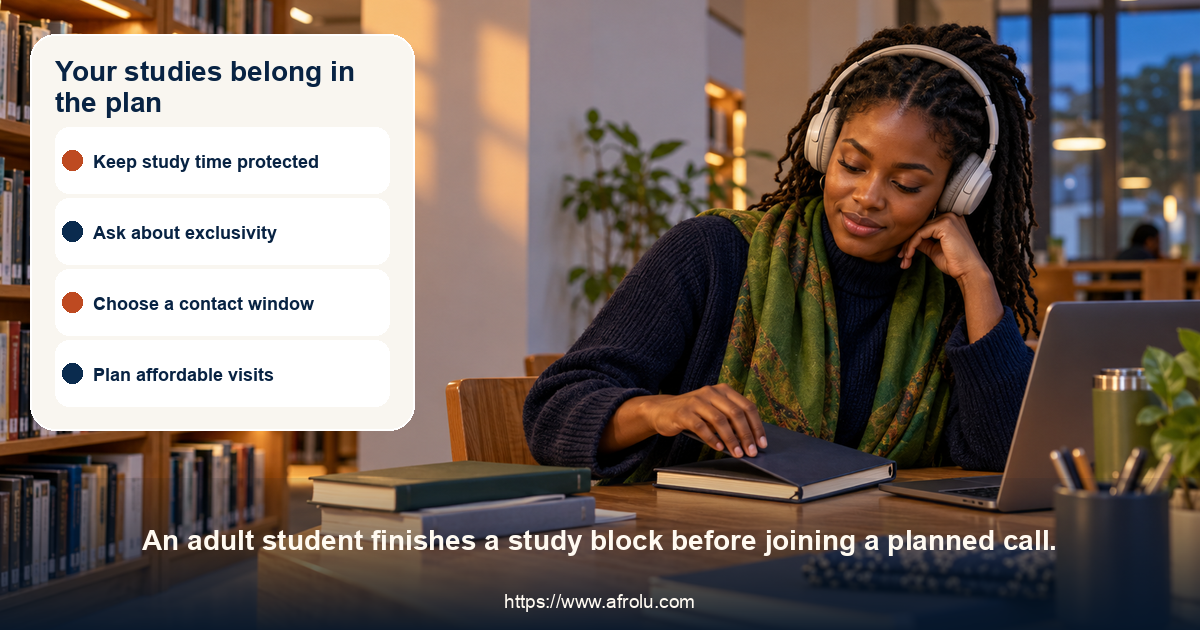
An adult student finishes a study block before joining a planned call.
Written and edited by Grace Mutiso · Kenya Guides Editor
Ask whether you are exclusive, what kind of contact feels realistic during term and how you will confirm a visit. Keep study blocks, money and personal information private unless you choose to share them. You can continue casually, request a different agreement or step away based on the answer.
Relationship clarity · Students
How can adult students ask what a long-distance situationship means while balancing study and travel?
Situationship is informal language for a romantic connection with unclear labels or expectations. Adult students may face term dates, exams, placements and different campuses, but those constraints do not answer whether they are exclusive or committed. Ask about the agreement in plain language and remember that consent can change.
Two adult students in different cities call each other after evening classes and exchange weekend plans, but neither has asked whether they are exclusive. When travel becomes expensive during term, 24-year-old Akinyi proposes a realistic call rhythm and asks what each person wants from the connection.
Keep your adult life in view
Student status does not reduce your right to set the pace
Adult students may combine classes with work, caregiving, placements, travel and rest. A message arriving during a study block can wait until you are free. You do not have to be constantly reachable because a partner knows your timetable or because campus life appears more flexible from outside.
A situationship label can describe a connection that feels close while its expectations remain unclear, but student status does not make that uncertainty easier or more harmless. Ask what the two of you have chosen about exclusivity, contact and future plans. Your course schedule is context, not evidence of whether you care.
You can block time for revision, sleep and friends without asking permission. If you want to coordinate calls, share a broad window rather than a full class schedule. You may adjust when deadlines change. A relationship arrangement should make space for two lives; your education does not need to shrink to demonstrate interest.
Ask about the label
A situationship can mean different things to each person
One person may use situationship to mean casual dating, while another means a romantic connection that may become committed later. Research into the term is still limited and focused on particular young-adult samples. Ask what the label means to the person you are dating instead of assuming it matches a definition you saw online.
If exclusivity matters, ask directly whether either person is dating others. If you want to keep the connection casual, say so clearly too. Neither choice is implied by frequent calls, travel plans, physical intimacy or a social-media post. Each agreement can be specific and can be revisited if one adult's preference changes.
Try, 'I enjoy this, and I want to understand what we are choosing now. Are we exclusive, casual, or still discussing it?' You can hear the answer without making an immediate promise. If you need time, say when you want to revisit the conversation, or decide that an undefined period does not suit you.
Plan contact around term
A realistic call can be more useful than constant checking
Long-distance research has examined communication and satisfaction in particular emerging-adult samples. It does not provide a required number of messages for students or prove that one channel works for every couple. Discuss what helps you feel connected without interrupting lectures, labs, placements or sleep. Your own shared routine matters more than copying a frequency from a study or another couple.
You might plan one longer call on a quieter evening and send short updates when schedules shift. A week of exams may need a lighter rhythm; a break may allow more time together. Both adults can suggest changes. If only one person keeps adapting, ask whether the arrangement feels fair before resentment builds.
When a call is missed, agree how to reschedule instead of monitoring online status. A quick note can explain that someone is busy without requiring a full account of the day. You can ask for an update when plans change, but no one owes live access during classes or every waking hour.

Conversation prompts for adult students clarifying labels and contact while protecting academic time and budget, with a direct opening and usable next steps.
Make visits affordable
A visit should fit both budgets and academic calendars
Travel between campuses or cities can involve fares, accommodation, meals, missed work and study time. Discuss who is travelling and how expenses will be handled. If one person cannot afford a visit during term, that limit is real information. It does not prove a lack of affection, and it does not obligate the other person to pay.
Confirm an exact date, public meeting location and return plan before purchasing anything. Keep your own account credentials, documents and funds private. A request for tuition help, emergency cash or an investment from someone you have not met deserves a pause and independent verification. Urgency or romantic language is not evidence that a transfer is safe.
If the visit depends on an exam calendar, agree what happens if a deadline changes. You can postpone without promising a replacement date before you know your schedule. A ticket, shared room or invitation to stay does not create consent to intimacy or a commitment to continue the relationship afterward.

Observable signals in adult students clarifying labels and contact while protecting academic time and budget help separate agreements from assumptions.
Keep consent and study separate
A relationship label is not permission for intimacy or access
Agreeing to a call, date or visit does not decide what physical intimacy you want. Consent is specific and can change, even when two people are exclusive or have been intimate before. State what you are comfortable with and listen when the other adult states a limit. A disagreement is a reason to pause, not to pressure.
Your private notes, devices, assignments, accounts and location remain yours. Do not share a password or verification code because someone calls it proof of trust. If you want to share a project or study time, choose what access makes sense. You can say no without showing a grade report, timetable or financial account.
If a partner repeatedly interrupts exams, demands immediate replies or threatens to end the connection whenever you study, name the effect and decide what boundary you need. You may mute notifications during a block or take distance. You do not have to choose between caring about someone and protecting your education.
Use one direct question
Clarity can be a conversation rather than a deadline
Pick a time when neither person is rushing to class or work. You can ask whether you are exclusive, what serious dating means or how often you want to meet. Choose one topic at a time so the conversation does not become an interview about every possible future. You can share your own answer honestly.
If the person needs time, ask what they are deciding and when they would like to talk again. You can agree to revisit it, continue casually or stop dating. A request for a deadline is not automatically controlling; it can be a way to decide how long you are willing to remain uncertain.
Research about relationship talk and uncertainty finds associations in particular studies, but it cannot tell you what the other person will say. You do not need a study to justify asking a practical question. Listen to the words, watch whether the plan is kept and choose what works for your present circumstances.
Review the arrangement
Your plans can change as term and priorities change
An arrangement that felt easy at the start may become difficult during exams, placement or a move. Check whether the contact rhythm, travel costs and expectations still feel voluntary. You can ask for a change without treating the earlier version as a mistake. Both adults can decide whether the new plan suits them.
If you want commitment and the other person still wants no label, take the difference seriously. You can continue only if the current arrangement works without relying on a promise that has not been made. You may also choose to leave. The person does not need to be a villain for the fit to be wrong.
Talk with a trusted friend or student support service if you want help thinking through a difficult interaction. Share only what you are comfortable sharing. Support can help you consider options, but the decision remains yours. You can close the conversation, block contact or change a boundary whenever your comfort or circumstances change.

Action map for adult students clarifying labels and contact while protecting academic time and budget, ending with a choice the reader can make today.
Three ways this can show up
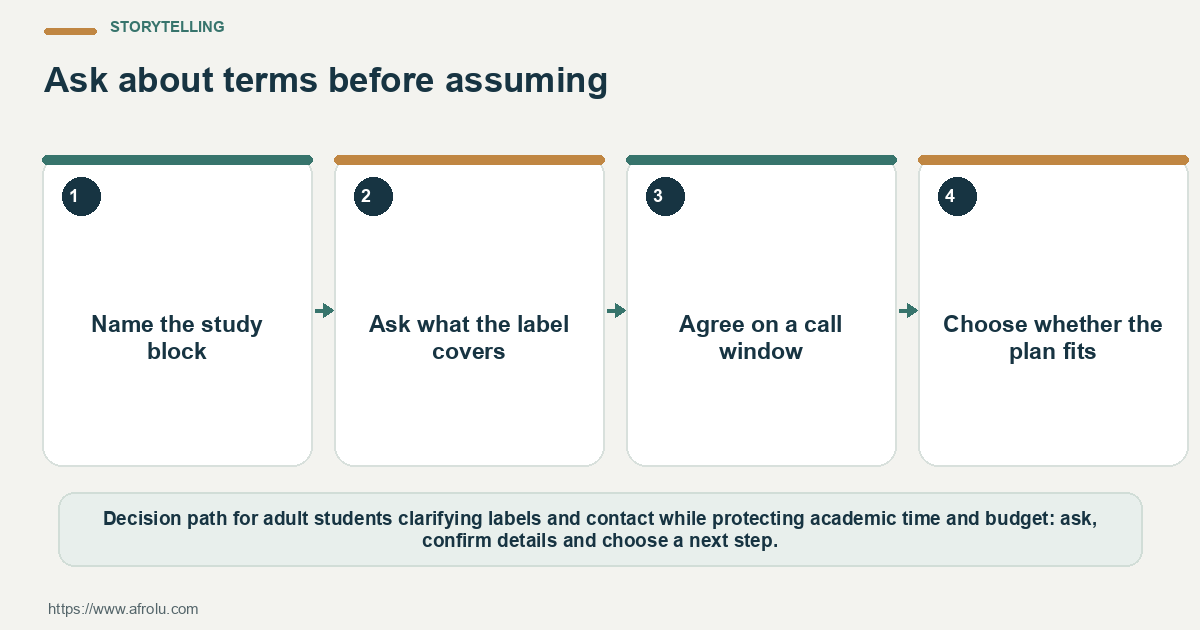
A label is assumed
One student thinks the connection is exclusive after several calls
Ask whether either adult is dating other people.Exams interrupt contact
A partner treats a revision week as evidence of disinterest
Explain the study window and agree when to reconnect.A visit strains the budget
Someone proposes an expensive trip during term
Check travel, lodging and return costs before making a commitment.A message arrives in class
A date expects immediate replies during labs or lectures
Share a broad contact window rather than your full timetable.A call is missed
A student misses a planned call during a deadline
Send a brief update and suggest one replacement time.Intimacy is presumed
A shared label or overnight stay is treated as permission
State that each activity needs its own present consent.A code is requested
Someone asks for a university login or verification code
Keep credentials private; no relationship term requires account access.Needs change
One adult now wants exclusivity or more frequent contact
Name the changed preference and hear what the other person wants.What to notice before you react
A label is assumed: One student thinks the connection is exclusive after several calls
Exams interrupt contact: A partner treats a revision week as evidence of disinterest
A visit strains the budget: Someone proposes an expensive trip during term
A message arrives in class: A date expects immediate replies during labs or lectures
A call is missed: A student misses a planned call during a deadline
Intimacy is presumed: A shared label or overnight stay is treated as permission
A code is requested: Someone asks for a university login or verification code
Needs change: One adult now wants exclusivity or more frequent contact
A plan has a time and place both adults can describe before travelling.
A work or study limit is stated with a realistic time to reconnect.
Each person can explain what the relationship label means to them.
A changed preference starts a new conversation rather than an assumption.
A no is accepted without repeated pressure or punishment.
Privacy, money and account boundaries remain the reader's choice.
Read the moment without overbuilding the story
| Situation | What it may mean | What to do next |
|---|---|---|
| A label is assumed | One student thinks the connection is exclusive after several calls | Ask whether either adult is dating other people. |
| Exams interrupt contact | A partner treats a revision week as evidence of disinterest | Explain the study window and agree when to reconnect. |
| A visit strains the budget | Someone proposes an expensive trip during term | Check travel, lodging and return costs before making a commitment. |
| A message arrives in class | A date expects immediate replies during labs or lectures | Share a broad contact window rather than your full timetable. |
| A call is missed | A student misses a planned call during a deadline | Send a brief update and suggest one replacement time. |
| Intimacy is presumed | A shared label or overnight stay is treated as permission | State that each activity needs its own present consent. |
| A code is requested | Someone asks for a university login or verification code | Keep credentials private; no relationship term requires account access. |
| Needs change | One adult now wants exclusivity or more frequent contact | Name the changed preference and hear what the other person wants. |
| One plan is cancelled | A real constraint may interrupt a date | Ask whether a replacement works for both adults. |
| A preference changes | The current arrangement no longer fits one person's needs | Name the change and decide from the answer you receive. |
Three calm ways to start the conversation
“Are we both free to date other people, or are we choosing exclusivity now?”
“I have exams this week and will be offline during my revision blocks. Can we talk Sunday?”
“One planned call each week works for me during term. What feels realistic for you?”
“What does serious dating mean to you this semester?”
“I want to see you, but this trip is outside my budget. Could we plan a lower-cost option?”
“I want us to talk about each activity rather than assume from the label or a visit.”
“I do not share passwords or verification codes, even with someone I trust.”
“My feelings have changed and I want more structure. Is that something you want too?”
“I want to understand what we are choosing now. Can we talk about it directly?”
“I can make that plan if we confirm the details today. Otherwise I will use the time differently.”
“Thanks for being clear. I will decide what works for me from here.”
“If either of our needs changes, I would rather discuss it than assume the old terms still apply.”
Know the difference
A study week versus Constant access
An adult explains a temporary schedule and offers a time to reconnect.
A partner expects immediate replies and treats class or revision as rejection.
A contact rhythm should leave room for study, sleep and both adults' choices.

Comparison of A study week and Constant access for adult students clarifying labels and contact while protecting academic time and budget.
Compare the closest dating types before choosing a label
| Type or dimension | What it describes | Best next question |
|---|---|---|
| A study week | An adult explains a temporary schedule and offers a time to reconnect. | Ask what the current agreement actually says. |
| Constant access | A partner expects immediate replies and treats class or revision as rejection. | Decide whether the arrangement works for you today. |
| One delayed reply | A single gap has several possible explanations. | Use the contact window you discussed or ask once. |
| Repeated uncertainty | The same question or plan stays unresolved over time. | Name the pattern and decide what boundary you need. |
| A stated preference | An adult explains what they want in the present. | Check whether you want the same arrangement. |
| A future possibility | A hope describes something that has not yet happened. | Do not treat it as a current agreement. |
| A changed need | One adult wants a different pace, label or boundary. | Revisit the terms and hear the answer. |
| A respectful no | Someone declines a date, boundary or new term. | Accept their choice and make your own decision. |
| A practical limit | Time, distance, cost or privacy affects a possible next step. | Find a mutual option or decide the fit is not right. |
A simple plan you can use today
Springer Nature: Situationships: A New Relationship Category?
An exploratory study using interviews and an online survey with U.S. university convenience samples. Its proposed features are not a universal definition or evidence about every Kenyan or diaspora adult.
Springer Nature: Situationships, communication modality, and trust
The study reports associations in an emerging-adult sample and retrospective relationship reports. It cannot show that a communication channel causes trust or predict an individual connection.
PubMed Central: Long-distance texting: Text messaging is linked with higher relationship satisfaction in long-distance relationships
A survey of 647 emerging adults examined communication and satisfaction. It does not set a message frequency for students, professionals or diaspora couples.
Personal Relationships: The relationship talk: Understanding the transition from casual to committed romantic relationships
This study examines relationship discussions and uncertainty in a particular emerging-adult sample. It does not prescribe a universal timeline for defining a relationship.
PubMed Central: Evaluations and future plans after casual sexual experiences: Differences across partner type
Event-based reports from 192 emerging adults compared experiences by partner category. The sample and study design do not define casual dating for every adult.
U.S. Federal Trade Commission: Romance Scams
The FTC explains U.S. consumer guidance about romance scams. It is not a prevalence estimate for Kenya or diaspora communities.
Questions organised by purpose and depth
Choose a few prompts that fit the moment. This is a reference library, not a list to complete.
Study block
Protect focused time and agree on reconnection.
- When am I studying?
- When will I be free?
- What update is useful?
Relationship label
Ask about exclusivity and direction directly.
- Are we exclusive?
- What does serious mean?
- What remains uncertain?
Travel budget
Consider the whole cost, not only a ticket.
- Can I afford the trip?
- Where will I stay?
- Can I return independently?
Changed need
Make space for a new preference.
- What changed?
- What do I want to ask?
- What will I decide if we differ?
What deserves a closer look
Situationships: A New Relationship Category?
An exploratory study using interviews and an online survey with U.S. university convenience samples. Its proposed features are not a universal definition or evidence about every Kenyan or diaspora adult.
Evidence limit: Read the finding within this source's sample and scope; do not use it to predict an individual.
Situationships, communication modality, and trust
The study reports associations in an emerging-adult sample and retrospective relationship reports. It cannot show that a communication channel causes trust or predict an individual connection.
Evidence limit: Read the finding within this source's sample and scope; do not use it to predict an individual.
Long-distance texting: Text messaging is linked with higher relationship satisfaction in long-distance relationships
A survey of 647 emerging adults examined communication and satisfaction. It does not set a message frequency for students, professionals or diaspora couples.
Evidence limit: Read the finding within this source's sample and scope; do not use it to predict an individual.
The relationship talk: Understanding the transition from casual to committed romantic relationships
This study examines relationship discussions and uncertainty in a particular emerging-adult sample. It does not prescribe a universal timeline for defining a relationship.
Evidence limit: Read the finding within this source's sample and scope; do not use it to predict an individual.
Evaluations and future plans after casual sexual experiences: Differences across partner type
Event-based reports from 192 emerging adults compared experiences by partner category. The sample and study design do not define casual dating for every adult.
Evidence limit: Read the finding within this source's sample and scope; do not use it to predict an individual.
Romance Scams
The FTC explains U.S. consumer guidance about romance scams. It is not a prevalence estimate for Kenya or diaspora communities.
Evidence limit: Read the finding within this source's sample and scope; do not use it to predict an individual.
Four mistakes that make this harder
Treating a label as a full agreement
The same word can describe different choices about exclusivity and direction.
Reading motives from reply time
A timestamp cannot tell you why a person is unavailable.
Using one study as a rule
Small or narrow samples cannot define every adult or faith community.
Trading privacy for trust
A password, code, address or work detail is not proof of closeness.
Treating a future hope as a present plan
Intentions need a current conversation and mutual choices.
Ignoring your own limits
You can respect another person's circumstances and still decide the fit is wrong.
Choose a contact rhythm that protects study and rest
These information links are labelled, non-commercial and do not promise a match or relationship outcome.
Explore the guide library
Show more related guides
Continue with Afrolu
Show more Afrolu guides
Sources used for this guide
Afrolu reviewed these health, research, safety, or public guidance resources while editing this page. They support the behaviour and safety guidance; they do not diagnose any individual described by a reader.
Adult students can ask for clarity in a long-distance situationship Questions
Can adult students date across distance?
Yes, if the arrangement fits both lives. Study, work, travel and rest can all be part of the conversation.
Does frequent contact mean exclusivity?
No. Ask whether either person is dating others and agree on what exclusivity means.
How can we stay in touch during exams?
Set a temporary contact window or call time, then revisit after deadlines. You do not owe replies during class or sleep.
Who should pay for a visit?
Discuss costs openly and choose only a plan each person can afford. Do not spend essential funds to secure a label.
Does a visit imply consent?
No. Consent is specific to each activity and can change regardless of the relationship label or travel cost.
What if our desired commitment differs?
Hear the answer and decide whether the current arrangement works for you. You do not need to persuade someone into a different choice.
Can research tell me what the other person intends?
No. Studies describe patterns in particular samples; ask the person and decide from the agreement you have.
When should I seek support?
You may talk with someone you trust or a qualified professional if that would help. There is no required timetable for deciding.
Can I stop seeing someone without proving wrongdoing?
Yes. A mismatch in timing, values or availability can be enough reason to end a connection.
Can our agreement change later?
Yes. Either adult may raise a changed need, and both can decide whether the new terms work.
One thing to do now
Turn the lesson into a better match pool
Protect study and budget boundaries, ask one concrete question about the relationship and confirm travel plans before either person commits money or time.