Situationships · distance · demanding work
A low-pressure communication rhythm for a long-distance situationship
In a long-distance situationship, agree on a realistic contact rhythm, keep work boundaries and decide whether travel and expectations fit both adults.
A professional checks a realistic visit window before planning around work and time zones.
Written and edited by Jean-Claude Mukendi · Relationship Guides Editor
Agree on a contact rhythm that fits both workdays, define whether you are exclusive and decide what would make a visit worthwhile before spending money. A busy schedule can be genuine context; it does not obligate either adult to remain on standby or to disclose private workplace details.
Relationship clarity · Professionals
How can I keep a long-distance situationship low pressure and still know what we are choosing?
A situationship is an informal term for a romantic connection whose label, commitment or expectations remain unclear. Long-distance adds travel and time-zone logistics but does not answer those questions. Research on communication in emerging adults is limited and cannot prescribe a message frequency for a particular couple.
Two professionals in different time zones have warm evening calls when their schedules align, but one is unsure whether they are exclusive. After a missed call during a project deadline, 38-year-old Daniel suggests a realistic weekly window and asks what each person wants from the connection now.
Separate distance from definition
A time-zone gap explains timing, not relationship terms
A long-distance situationship can include affection, frequent calls and future talk while leaving exclusivity or commitment unclear. The label does not tell either person whether they are dating others or planning visits. Ask about those subjects directly rather than assuming the time spent online settled them. Schedule that conversation in a shared waking window instead of reading relationship terms from timestamps.
Research on situationships and communication has examined young adults in United States samples. One recent study looked at reports of several past relationships and found associations between relationship type and trust across some communication contexts. It cannot show that message volume causes trust or predict how two professionals in different countries will feel.
Distance makes logistics visible: time zones, shifts, travel costs and recovery time. Those details are useful context, but they do not determine whether the connection fits you. You can respect a person's workload and still ask for a clear window to talk, a plan for visits or a conversation about present intentions.
Protect work time
Being interested does not require being reachable all day
A professional may have meetings, shifts, client work, travel or a device policy that limits personal messages. A delayed reply during those hours is not enough to establish a motive. You can describe your availability in broad terms, such as 'I can usually call after seven on two evenings,' without naming projects or coworkers.
Ask the other person to offer a window too. If only one adult is adjusting sleep or moving work to make calls possible, discuss whether the rhythm is sustainable. A connection can feel warm and still demand more time than either person can reasonably give. The practical issue is fit, not who is more devoted.
If a call needs to move, a brief update and a replacement time may be more useful than an apology that creates no plan. You can agree how much notice is realistic and what to do when work changes unexpectedly. Make the arrangement flexible enough for real life, but concrete enough that neither person waits indefinitely.
Agree on contact
More messages are not a substitute for shared expectations
Long-distance communication studies have examined established couples and emerging adults, not every new situationship. Their findings can prompt a conversation about feeling connected, but they do not supply a daily text quota. Ask what format helps: a short voice note, a weekly call or an occasional message when something meaningful happens.
Try an agreement that leaves room for busy days: 'Can we plan a call on Sunday and send a quick update if either schedule changes?' Then notice whether it works for both people. If it does not, revise it. Frequent contact can be enjoyable, but access to someone's phone is not the same as clarity about intentions.
Avoid tracking online indicators as a substitute for asking. A person can be active for work or friends and still not have capacity for a long conversation. If the difference in preferred contact leaves you unsettled, say what you need and ask whether the other person wants to find a workable middle ground.

Conversation prompts for building a realistic long-distance rhythm around professional work and time zones, with a direct opening and usable next steps.
Discuss direction separately
A call schedule cannot settle exclusivity
You can enjoy talking each week while still not knowing whether the connection is exclusive. Ask plainly whether either person is dating others, wants exclusivity now or is still learning about fit. A label such as situationship may not answer; people use it differently, so make the actual choice the topic.
If one adult wants a committed partnership and the other prefers casual dating, neither answer is automatically wrong. It may still be a mismatch. You can decide how long you are comfortable with uncertainty and whether you want to revisit the question. Do not treat a warm future conversation as a promise unless both people say so.
A useful question is, 'What would you like us to choose for the next month?' It keeps the discussion in the present and gives each person room to be honest. You can then decide whether to continue, date others, pause or end the connection without waiting for a prediction about the far future.

Observable signals in building a realistic long-distance rhythm around professional work and time zones help separate agreements from assumptions.
Plan visits carefully
Travel effort should not be used as a commitment test
Before booking, discuss who travels, how the cost is shared, where each person will stay and what activities you expect. A first visit can include a public meeting and separate accommodation. Choose an amount of money and time you can afford without needing the other person to make a relationship promise in return.
If a visit depends on a visa, long leave or a costly fare, confirm the practical details before paying. Keep your own documents and financial accounts under your control. An urgent request for money, a fee or a verification code from someone you have not met deserves independent checking and a pause.
Decide how either person can postpone or cancel without pressure. If one adult's work changes, identify another date or agree to revisit later. You may also decide not to travel. The other person can feel disappointed, but your choice remains yours; travel plans do not create consent to stay together or continue dating.
Keep boundaries around work
You can be clear without sharing sensitive work information
You may prefer not to name your employer, schedule, clients, colleagues or travel route. That privacy can coexist with making plans. Say when you are available and what kind of update you can give if work changes. A partner's curiosity does not create permission to see private calendars, internal messages or accounts.
If your job requires discretion, keep personal conversations off employer systems and do not send confidential material to a match. If you work late or travel, share only the general details needed for a call or visit. Being professional is not the same as being emotionally unavailable; it is a boundary around information and time.
A person who repeatedly demands real-time access or treats a delayed reply as proof of cheating may need a direct conversation about expectations. You can ask what reassurance they want and decide whether you can offer it without harming your work or sleep. If the arrangement remains uncomfortable, you may step away rather than surrender more privacy.
Review whether it fits
A workable connection makes room for two real lives
People can miss calls for real reasons. What matters is whether both adults communicate about changes, make replacement plans and discuss what they are choosing. A single missed call does not establish intent; a repeated arrangement where one person waits and the other never confirms is still useful information about fit.
Research about relationship uncertainty and talk avoidance describes associations in specific samples. It should not be used to diagnose your partner or make a forecast. Use it as a reminder that avoiding the question can keep assumptions alive; then ask the question you need answered and decide what to do with the response.
If the rhythm works, keep it and revisit it when work or travel changes. If you are losing sleep, abandoning other plans or carrying every visit, name that effect and choose a boundary. You can want the person and still decide that the current arrangement is not sustainable for you.

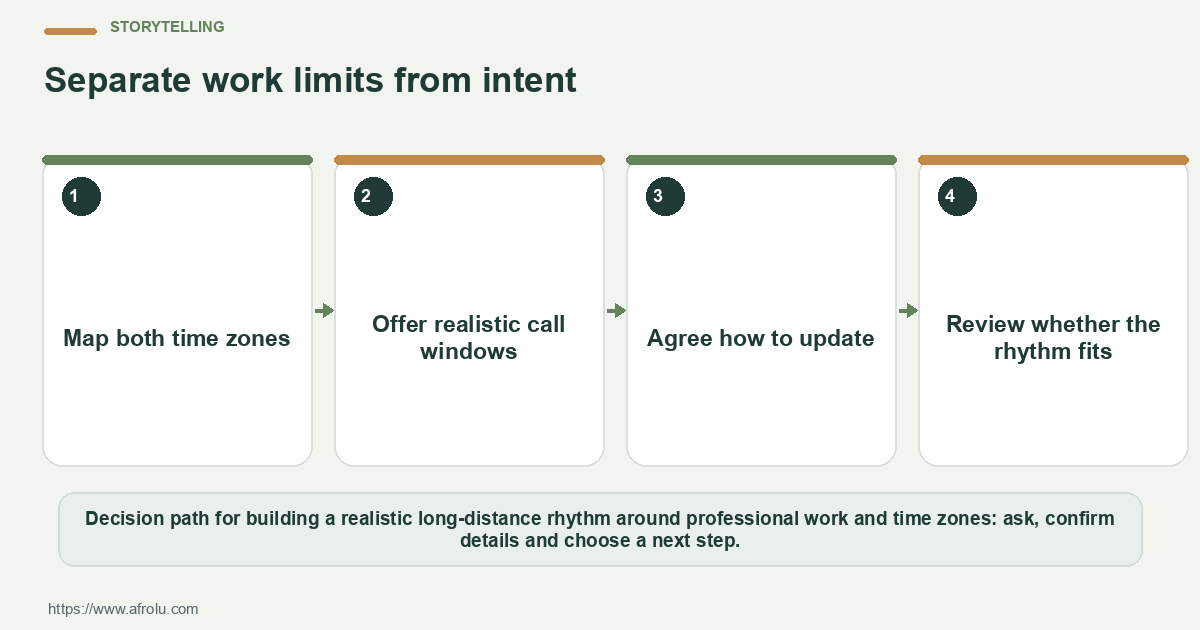
Action map for building a realistic long-distance rhythm around professional work and time zones, ending with a choice the reader can make today.
Three ways this can show up
A call crosses time zones
One person's workday ends after the other has gone to sleep
Offer two shared waking windows and decide what is realistic.A deadline cancels a call
A project overruns and no new time is suggested
Ask once whether the other adult wants to choose another window.Only one person adjusts
The same adult repeatedly loses sleep to make calls happen
Discuss whether the rhythm and effort are sustainable.Work details are requested
A date asks for a roster, client name or office location
Share broad availability without exposing confidential information.Future talk replaces a plan
A person describes a shared life but will not agree to the next call
Ask about one present action, not a future guarantee.A visit is costly
A trip would affect rent, savings or needed leave
Do not travel until budget, dates and independent arrangements work.Online status is monitored
A partner expects immediate replies throughout the workday
State when you can respond and set a work boundary.The arrangement changes
A role or time zone shift makes the old rhythm unworkable
Revisit the agreement and decide whether the new version fits.What to notice before you react
A call crosses time zones: One person's workday ends after the other has gone to sleep
A deadline cancels a call: A project overruns and no new time is suggested
Only one person adjusts: The same adult repeatedly loses sleep to make calls happen
Work details are requested: A date asks for a roster, client name or office location
Future talk replaces a plan: A person describes a shared life but will not agree to the next call
A visit is costly: A trip would affect rent, savings or needed leave
Online status is monitored: A partner expects immediate replies throughout the workday
The arrangement changes: A role or time zone shift makes the old rhythm unworkable
A plan has a time and place both adults can describe before travelling.
A work or study limit is stated with a realistic time to reconnect.
Each person can explain what the relationship label means to them.
A changed preference starts a new conversation rather than an assumption.
A no is accepted without repeated pressure or punishment.
Privacy, money and account boundaries remain the reader's choice.
Read the moment without overbuilding the story
| Situation | What it may mean | What to do next |
|---|---|---|
| A call crosses time zones | One person's workday ends after the other has gone to sleep | Offer two shared waking windows and decide what is realistic. |
| A deadline cancels a call | A project overruns and no new time is suggested | Ask once whether the other adult wants to choose another window. |
| Only one person adjusts | The same adult repeatedly loses sleep to make calls happen | Discuss whether the rhythm and effort are sustainable. |
| Work details are requested | A date asks for a roster, client name or office location | Share broad availability without exposing confidential information. |
| Future talk replaces a plan | A person describes a shared life but will not agree to the next call | Ask about one present action, not a future guarantee. |
| A visit is costly | A trip would affect rent, savings or needed leave | Do not travel until budget, dates and independent arrangements work. |
| Online status is monitored | A partner expects immediate replies throughout the workday | State when you can respond and set a work boundary. |
| The arrangement changes | A role or time zone shift makes the old rhythm unworkable | Revisit the agreement and decide whether the new version fits. |
| One plan is cancelled | A real constraint may interrupt a date | Ask whether a replacement works for both adults. |
| A preference changes | The current arrangement no longer fits one person's needs | Name the change and decide from the answer you receive. |
Three calm ways to start the conversation
“I can usually talk Sunday afternoon my time. Would that overlap with a workable time for you?”
“I cannot be online throughout my workday, but I can send an update after my shift.”
“We missed our call yesterday. Would you like to choose another time this week?”
“Are we exclusive now, dating casually, or still discussing what we want?”
“I am not ready to book a trip yet. I would like to plan the details first.”
“I prefer not to share my client list or work calendar, but I can tell you when I am free.”
“I have adjusted my sleep a few times. Can we find a window that works for both of us?”
“This arrangement is not meeting my needs, so I am going to leave it here.”
“I want to understand what we are choosing now. Can we talk about it directly?”
“I can make that plan if we confirm the details today. Otherwise I will use the time differently.”
“Thanks for being clear. I will decide what works for me from here.”
“If either of our needs changes, I would rather discuss it than assume the old terms still apply.”
Know the difference
A work constraint versus Unclear availability
A person describes a realistic window and helps plan around a change.
Future intentions recur while no present call, visit or shared action becomes possible.
Respect work demands and decide whether the available arrangement fits you.

Comparison of A work constraint and Unclear availability for building a realistic long-distance rhythm around professional work and time zones.
Compare the closest dating types before choosing a label
| Type or dimension | What it describes | Best next question |
|---|---|---|
| A work constraint | A person describes a realistic window and helps plan around a change. | Ask what the current agreement actually says. |
| Unclear availability | Future intentions recur while no present call, visit or shared action becomes possible. | Decide whether the arrangement works for you today. |
| One delayed reply | A single gap has several possible explanations. | Use the contact window you discussed or ask once. |
| Repeated uncertainty | The same question or plan stays unresolved over time. | Name the pattern and decide what boundary you need. |
| A stated preference | An adult explains what they want in the present. | Check whether you want the same arrangement. |
| A future possibility | A hope describes something that has not yet happened. | Do not treat it as a current agreement. |
| A changed need | One adult wants a different pace, label or boundary. | Revisit the terms and hear the answer. |
| A respectful no | Someone declines a date, boundary or new term. | Accept their choice and make your own decision. |
| A practical limit | Time, distance, cost or privacy affects a possible next step. | Find a mutual option or decide the fit is not right. |
A simple plan you can use today
Springer Nature: Situationships, communication modality, and trust
The study reports associations in an emerging-adult sample and retrospective relationship reports. It cannot show that a communication channel causes trust or predict an individual connection.
Springer Nature: Situationships: A New Relationship Category?
An exploratory study using interviews and an online survey with U.S. university convenience samples. Its proposed features are not a universal definition or evidence about every Kenyan or diaspora adult.
PubMed Central: Long-distance texting: Text messaging is linked with higher relationship satisfaction in long-distance relationships
A survey of 647 emerging adults examined communication and satisfaction. It does not set a message frequency for students, professionals or diaspora couples.
PubMed Central: Time for Each Other: Work and Family Constraints Among Couples
A U.S. time-use analysis of established couples offers context on competing demands, not a dating cadence or explanation for one person's availability.
Office of the Data Protection Commissioner of Kenya: Rights of a Data Subject
Kenya's regulator outlines data-protection rights. Legal rights do not verify a dating profile or eliminate every risk after information is shared.
U.S. Federal Trade Commission: Romance Scams
The FTC explains U.S. consumer guidance about romance scams. It is not a prevalence estimate for Kenya or diaspora communities.
Questions organised by purpose and depth
Choose a few prompts that fit the moment. This is a reference library, not a list to complete.
Time zones
Look for shared waking hours, not constant availability.
- When am I free?
- When are they free?
- What is the overlap?
Work boundary
Offer a broad window without disclosing private details.
- What time can I sustain?
- What changes during deadlines?
- What should stay confidential?
A visit
Keep travel practical and voluntary.
- Can I afford it?
- Are the dates confirmed?
- Do I have an independent plan?
Review the rhythm
Revisit after a schedule or need changes.
- Who adjusts most?
- What feels sustainable?
- What would I choose next?
What deserves a closer look
Situationships, communication modality, and trust
The study reports associations in an emerging-adult sample and retrospective relationship reports. It cannot show that a communication channel causes trust or predict an individual connection.
Evidence limit: Read the finding within this source's sample and scope; do not use it to predict an individual.
Situationships: A New Relationship Category?
An exploratory study using interviews and an online survey with U.S. university convenience samples. Its proposed features are not a universal definition or evidence about every Kenyan or diaspora adult.
Evidence limit: Read the finding within this source's sample and scope; do not use it to predict an individual.
Long-distance texting: Text messaging is linked with higher relationship satisfaction in long-distance relationships
A survey of 647 emerging adults examined communication and satisfaction. It does not set a message frequency for students, professionals or diaspora couples.
Evidence limit: Read the finding within this source's sample and scope; do not use it to predict an individual.
Time for Each Other: Work and Family Constraints Among Couples
A U.S. time-use analysis of established couples offers context on competing demands, not a dating cadence or explanation for one person's availability.
Evidence limit: Read the finding within this source's sample and scope; do not use it to predict an individual.
Rights of a Data Subject
Kenya's regulator outlines data-protection rights. Legal rights do not verify a dating profile or eliminate every risk after information is shared.
Evidence limit: Read the finding within this source's sample and scope; do not use it to predict an individual.
Romance Scams
The FTC explains U.S. consumer guidance about romance scams. It is not a prevalence estimate for Kenya or diaspora communities.
Evidence limit: Read the finding within this source's sample and scope; do not use it to predict an individual.
Four mistakes that make this harder
Treating a label as a full agreement
The same word can describe different choices about exclusivity and direction.
Reading motives from reply time
A timestamp cannot tell you why a person is unavailable.
Using one study as a rule
Small or narrow samples cannot define every adult or faith community.
Trading privacy for trust
A password, code, address or work detail is not proof of closeness.
Treating a future hope as a present plan
Intentions need a current conversation and mutual choices.
Ignoring your own limits
You can respect another person's circumstances and still decide the fit is wrong.
Agree on one realistic way to stay in touch
These information links are labelled, non-commercial and do not promise a match or relationship outcome.
Explore the guide library
Show more related guides
Continue with Afrolu
Show more Afrolu guides
Sources used for this guide
Afrolu reviewed these health, research, safety, or public guidance resources while editing this page. They support the behaviour and safety guidance; they do not diagnose any individual described by a reader.
A low-pressure communication rhythm for a long-distance situationship Questions
How often should we message long-distance?
There is no universal number. Agree on a rhythm that works for both schedules; research does not provide a required frequency.
Does a late reply mean low interest?
Not by itself. Consider the time zone and work context, then look at whether plans and updates are mutual.
Should I share my full work calendar?
No. Share a broad availability window if useful, while keeping confidential or sensitive work information private.
Should one person always travel?
Discuss time, cost and capacity. Travel effort is not a reliable measure of commitment.
What if the call rhythm stops working?
Explain what changed and ask whether another window is possible. You can also decide the arrangement no longer fits.
Can research predict whether we will work out?
No. Group findings describe specific samples; your agreement and circumstances are individual.
Can research tell me what the other person intends?
No. Studies describe patterns in particular samples; ask the person and decide from the agreement you have.
When should I seek support?
You may talk with someone you trust or a qualified professional if that would help. There is no required timetable for deciding.
Can I stop seeing someone without proving wrongdoing?
Yes. A mismatch in timing, values or availability can be enough reason to end a connection.
Can our agreement change later?
Yes. Either adult may raise a changed need, and both can decide whether the new terms work.
One thing to do now
Turn the lesson into a better match pool
Set a mutual communication window, keep work and sleep boundaries, and assess whether both adults make the next practical plan possible.