Situationships · safety · weekend plans
A safer weekend plan when a situationship is undefined
Planning a weekend date in a situationship? Set a public meeting plan, protect your transport and privacy, and choose a pace that stays yours before you travel.
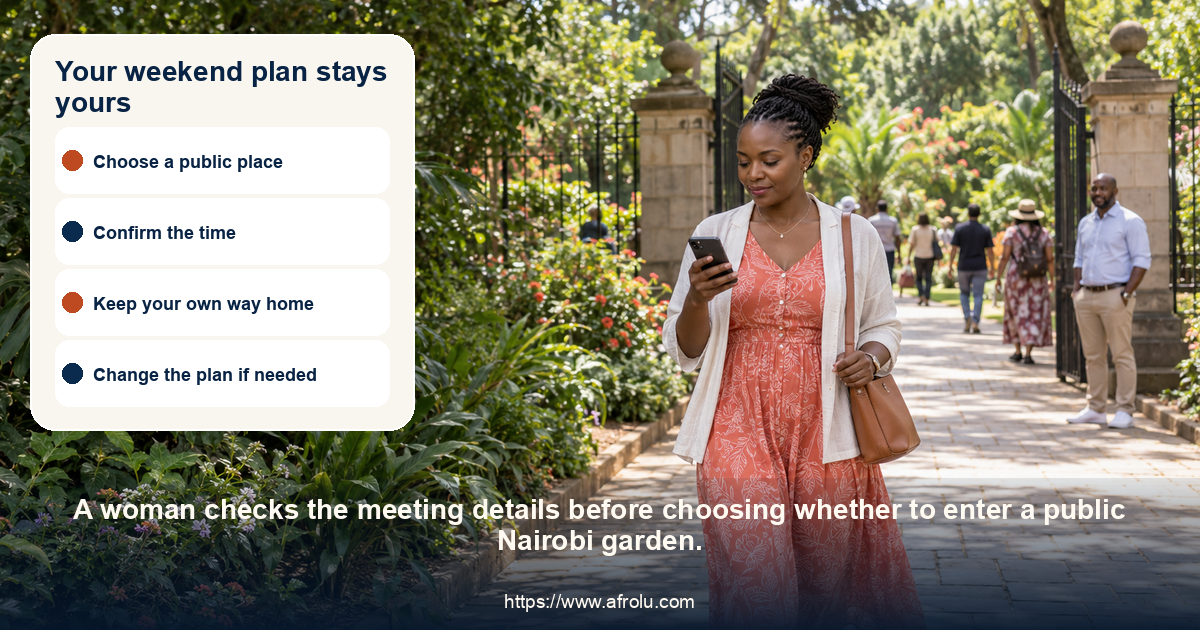
A woman checks the meeting details before choosing whether to enter a public Nairobi garden.
Written and edited by Nadine El-Sayed · Verification Editor
Keep the meeting choice separate from the relationship label. Agree on a public place, a clear time and an easy way home; tell someone you trust if that helps you; and share only the details you want to share. You can change or cancel the plan at any time.
Relationship clarity · New Relationship Starters
How can I plan a weekend date safely when we have not agreed what this connection is?
Situationship is an informal term, not a standardized relationship category. Research describes some connections with unclear labels and low commitment alongside affection and time together, but two people can use the word differently. Ask what each person means instead of assuming the label settles exclusivity, consent or safety.
Maya, an adult who has been seeing someone for several weeks, is invited to a Saturday evening event across town. She likes the person but they have not discussed labels. She suggests meeting in a busy public place and keeps her own transport and return time.
Define the word
A situationship label does not decide what you have agreed
People use situationship to describe different connections. A small body of exploratory research describes relationships with romantic behavior but unclear labels or lower commitment; the study sampled young adults in the United States and does not define how every adult in Kenya or the diaspora uses the word. Your own agreement matters more than a label.
You may spend time together, feel affection and still be unsure whether you are exclusive, dating others or building toward a committed partnership. Those questions do not become answered merely because the connection has lasted a certain number of weeks. Name the subject you want to discuss rather than asking the word to carry several meanings.
Before a weekend plan, you can keep the conversation practical: where to meet, when to arrive, how long you have and what happens if either person wants to leave. Relationship direction can be discussed separately. Asking for useful details is ordinary planning; it does not require an ultimatum or a promise about the future.
Keep safety independent
An undefined label neither proves risk nor guarantees trust
Your comfort is enough reason to choose a public meeting, share a check-in plan or postpone. You do not need to prove that someone is unsafe before setting a limit. At the same time, an affectionate message, several dates or an agreed label cannot guarantee what another person will do once you meet.
RAINN's safer-dating information is written for a United States audience, so its crisis contacts and local assumptions may not fit Kenya. Its practical principles still support options: choose a public place, tell a trusted person if useful, control your transport and leave when you want. These steps reduce uncertainty for you, not responsibility for anyone who causes harm.
Notice whether the other adult accepts ordinary planning without pressure. A disagreement about location can be talked through, but repeated insistence on privacy, secrecy or a ride you did not request is enough reason to pause. You can decide based on what feels workable without diagnosing the person's character or explaining your boundary at length.
Confirm the plan
A warm invitation still needs place, time and a way home
Suggest a reachable public venue and a time that fits both calendars. If one place is inconvenient, offer another public option rather than moving straight to a private home. Agree on how you will recognize each other and what to do if either person is delayed; small details lower friction without making the meeting a test of commitment.
Arrange your own transport or decide in advance how you will leave. Keep enough money and phone battery for the return journey where practical. If you want a friend to know your plan, share the broad location and expected end time. You can choose a shorter first meeting and extend it only if that feels right.
A simple confirmation message can say, 'Saturday at four at the public entrance works for me. I will make my own way there, and I have plans after six.' If no reply confirms the details by your chosen cutoff, make another plan. You are not obliged to keep the slot open while the other adult decides.

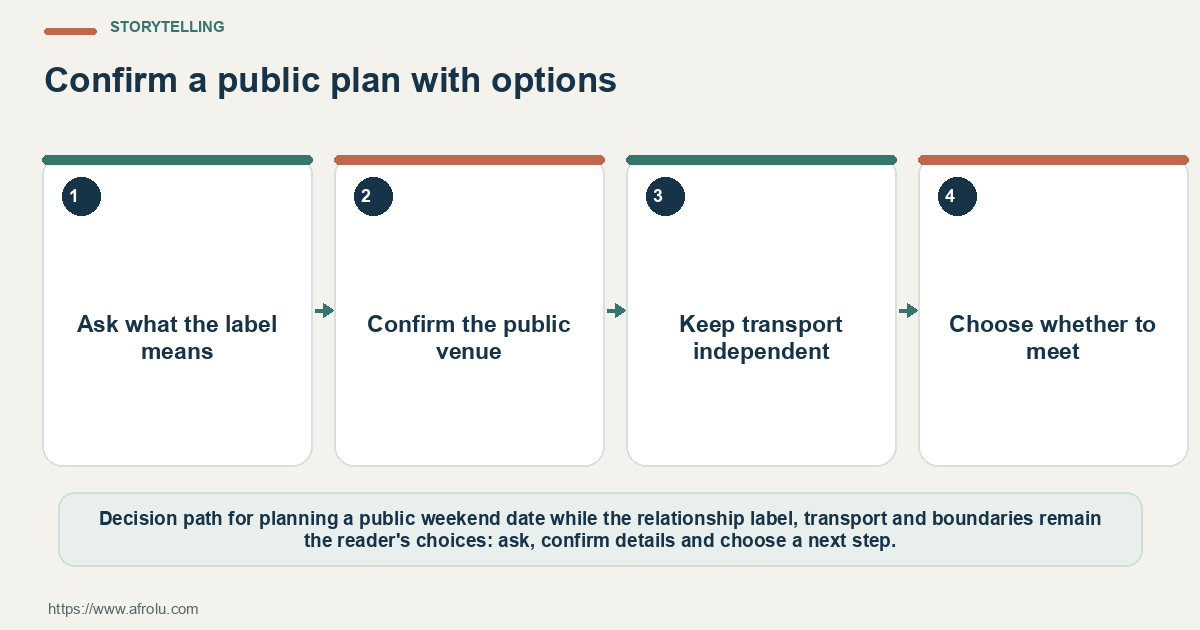
Conversation prompts for planning a public weekend date while the relationship label, transport and boundaries remain the reader's choices, with a direct opening and usable next steps.
Protect your privacy
Closeness does not require access to your home or accounts
A first or early meeting does not require your home address, employer, daily route, financial information or account passwords. Share a public meeting point instead of a precise home location if that feels safer. Kenya's data regulator explains rights around personal information, but a legal right cannot stop every person from misusing details once you have shared them.
Be cautious if someone asks for money, a verification code, intimate images or an urgent transfer as proof of trust. Romance-scam guidance from the United States Federal Trade Commission describes common financial pressure patterns; it does not measure their prevalence in Kenya. You can refuse a request and independently verify a story before making any financial decision.
If you use a dating app, keep the conversation on its platform until you are comfortable changing channels and understand what privacy or reporting tools it offers. Do not post a location in real time if you prefer not to. A person who respects you can hear 'I do not share that yet' without demanding a detailed explanation.

Observable signals in planning a public weekend date while the relationship label, transport and boundaries remain the reader's choices help separate agreements from assumptions.
Keep consent specific
A date, a label and earlier intimacy do not grant future permission
Deciding to meet does not mean agreeing to physical intimacy, staying late or going somewhere private. Each person can choose what they want in the moment and change their mind. If you want to set a boundary before the date, state it plainly; the other adult can respond, and you can decide whether their response feels respectful.
If physical intimacy is part of what you may choose, talk about comfort, protection and any health questions before they become urgent. Research on situationships does not provide medical guidance or replace a clinician. You can pause and seek reliable health information independently; affection or earlier consent does not settle a later decision.
A useful sentence might be, 'I am happy to meet, but I am not agreeing to go home together.' You can say it before leaving or during the date. If someone argues, threatens to withdraw affection or treats a boundary as a debt, you may end the meeting and get support from someone you trust.
Review what happened
After the meeting, notice whether your choices were respected
Write down concrete details while they are fresh: Did the person confirm the time? Did they accept the venue? Could you keep your own exit plan? Did the conversation about expectations feel answerable? These notes help you assess your experience without turning a single pause, joke or missed signal into a complete explanation of the person's motives.
You might want another date even if the connection is still undefined. You might enjoy the meeting and still ask for a clearer conversation before continuing. You might decide that the pace or the label does not fit you. None of those choices requires you to prove that the other person acted badly.
If a boundary was crossed or you felt unsafe, prioritize immediate support and a safe place. Consider contacting someone you trust or a local support service. You are not responsible for preventing another person's harmful actions. Advice about practical precautions can expand your options, but responsibility for harm remains with the person who causes it.
Choose your next step
You can pause, continue or close the conversation
If the plan felt good, you can suggest another date and name what you would like to understand next. If you want to stop, a short message is enough. You do not have to keep seeing someone because they paid, travelled or used a caring tone; the choice to meet does not create a future obligation.
If you want clarity about exclusivity or direction, ask a direct question at a time when both people can answer. The 2026 study of communication and trust in situationships involved emerging adults and found group-level associations; it cannot predict whether your conversation will resolve uncertainty. Listen to the actual answer and decide whether the arrangement works for you.
If the other adult says they want something different, you can take that information seriously without trying to persuade them into a commitment. You may choose a casual connection if it genuinely suits you, or step away if it does not. Your boundaries can change when your priorities, comfort or circumstances change.

Action map for planning a public weekend date while the relationship label, transport and boundaries remain the reader's choices, ending with a choice the reader can make today.
Three ways this can show up
The venue moves
A confirmed public place changes to a private home on the day
Keep the original plan or cancel if the new venue does not work for you.The time stays vague
A weekend invitation has no arrival time or end point
Ask for the details you need before you reserve the afternoon.A ride is offered
The other adult wants to control both your trip there and home
Arrange your own transport or choose another plan.The label is used
One person says situationship means exclusivity and the other assumes it does not
Ask what each person means and agree on the present terms.A private detail is requested
A new date asks for your exact address or work roster
Share a public meeting point and broad availability instead.A money request appears
Someone asks for travel funds or a one-time account code
Pause and verify independently; do not send money or access codes under pressure.A boundary is challenged
Your date argues that meeting means you owe more time or intimacy
Restate your choice and end the meeting if you want.You feel unsure
Interest is present, but the weekend plan no longer feels right
Change or cancel the plan; you do not need to prove a danger.What to notice before you react
The venue moves: A confirmed public place changes to a private home on the day
The time stays vague: A weekend invitation has no arrival time or end point
A ride is offered: The other adult wants to control both your trip there and home
The label is used: One person says situationship means exclusivity and the other assumes it does not
A private detail is requested: A new date asks for your exact address or work roster
A money request appears: Someone asks for travel funds or a one-time account code
A boundary is challenged: Your date argues that meeting means you owe more time or intimacy
You feel unsure: Interest is present, but the weekend plan no longer feels right
A plan has a time and place both adults can describe before travelling.
A work or study limit is stated with a realistic time to reconnect.
Each person can explain what the relationship label means to them.
A changed preference starts a new conversation rather than an assumption.
A no is accepted without repeated pressure or punishment.
Privacy, money and account boundaries remain the reader's choice.
Read the moment without overbuilding the story
| Situation | What it may mean | What to do next |
|---|---|---|
| The venue moves | A confirmed public place changes to a private home on the day | Keep the original plan or cancel if the new venue does not work for you. |
| The time stays vague | A weekend invitation has no arrival time or end point | Ask for the details you need before you reserve the afternoon. |
| A ride is offered | The other adult wants to control both your trip there and home | Arrange your own transport or choose another plan. |
| The label is used | One person says situationship means exclusivity and the other assumes it does not | Ask what each person means and agree on the present terms. |
| A private detail is requested | A new date asks for your exact address or work roster | Share a public meeting point and broad availability instead. |
| A money request appears | Someone asks for travel funds or a one-time account code | Pause and verify independently; do not send money or access codes under pressure. |
| A boundary is challenged | Your date argues that meeting means you owe more time or intimacy | Restate your choice and end the meeting if you want. |
| You feel unsure | Interest is present, but the weekend plan no longer feels right | Change or cancel the plan; you do not need to prove a danger. |
| One plan is cancelled | A real constraint may interrupt a date | Ask whether a replacement works for both adults. |
| A preference changes | The current arrangement no longer fits one person's needs | Name the change and decide from the answer you receive. |
Three calm ways to start the conversation
“I would like to meet in a public place this weekend. Which of these two areas works for you?”
“Thanks for offering a ride. I will make my own way there and home this time.”
“When you say situationship, are we exclusive or still deciding?”
“I am happy to meet, but I am not agreeing to go somewhere private afterward.”
“I do not send money, codes or account access to someone I am dating.”
“I am not comfortable continuing tonight, so I am heading home.”
“Can we settle the venue and time by Friday evening? Otherwise I will make another plan.”
“I enjoy seeing you. What are you hoping this connection becomes, if anything?”
“I want to understand what we are choosing now. Can we talk about it directly?”
“I can make that plan if we confirm the details today. Otherwise I will use the time differently.”
“Thanks for being clear. I will decide what works for me from here.”
“If either of our needs changes, I would rather discuss it than assume the old terms still apply.”
Know the difference
An open invitation versus A confirmed public plan
A warm suggestion still needs a place, time and mutual confirmation.
Both adults choose practical details, retain a way home and can still change their minds.
A relationship label cannot replace a plan or create consent.

Comparison of An open invitation and A confirmed public plan for planning a public weekend date while the relationship label, transport and boundaries remain the reader's choices.
Compare the closest dating types before choosing a label
| Type or dimension | What it describes | Best next question |
|---|---|---|
| An open invitation | A warm suggestion still needs a place, time and mutual confirmation. | Ask what the current agreement actually says. |
| A confirmed public plan | Both adults choose practical details, retain a way home and can still change their minds. | Decide whether the arrangement works for you today. |
| One delayed reply | A single gap has several possible explanations. | Use the contact window you discussed or ask once. |
| Repeated uncertainty | The same question or plan stays unresolved over time. | Name the pattern and decide what boundary you need. |
| A stated preference | An adult explains what they want in the present. | Check whether you want the same arrangement. |
| A future possibility | A hope describes something that has not yet happened. | Do not treat it as a current agreement. |
| A changed need | One adult wants a different pace, label or boundary. | Revisit the terms and hear the answer. |
| A respectful no | Someone declines a date, boundary or new term. | Accept their choice and make your own decision. |
| A practical limit | Time, distance, cost or privacy affects a possible next step. | Find a mutual option or decide the fit is not right. |
A simple plan you can use today
Springer Nature: Situationships: A New Relationship Category?
An exploratory study using interviews and an online survey with U.S. university convenience samples. Its proposed features are not a universal definition or evidence about every Kenyan or diaspora adult.
Springer Nature: Situationships, communication modality, and trust
The study reports associations in an emerging-adult sample and retrospective relationship reports. It cannot show that a communication channel causes trust or predict an individual connection.
RAINN: Tips for Safer Dating: Online and In-Person
RAINN's practical guidance is U.S.-focused. Its options can support autonomy but do not guarantee another person's behavior; its emergency contacts are not Kenya-specific.
Office of the Data Protection Commissioner of Kenya: Rights of a Data Subject
Kenya's regulator outlines data-protection rights. Legal rights do not verify a dating profile or eliminate every risk after information is shared.
U.S. Federal Trade Commission: Romance Scams
The FTC explains U.S. consumer guidance about romance scams. It is not a prevalence estimate for Kenya or diaspora communities.
Personal Relationships: The relationship talk: Understanding the transition from casual to committed romantic relationships
This study examines relationship discussions and uncertainty in a particular emerging-adult sample. It does not prescribe a universal timeline for defining a relationship.
Questions organised by purpose and depth
Choose a few prompts that fit the moment. This is a reference library, not a list to complete.
Weekend choice
Plan around comfort and options.
- What place feels right?
- How will I get home?
- What stays private?
Relationship terms
Keep the label separate from consent.
- Are we exclusive?
- What does this label mean?
- Which question can wait?
A changed plan
Decide what detail would make you pause.
- What changed?
- Can we keep it public?
- Would I rather cancel?
After the date
Review what happened without predicting the future.
- Were details mutual?
- Did I feel free to choose?
- What do I want next?
What deserves a closer look
Situationships: A New Relationship Category?
An exploratory study using interviews and an online survey with U.S. university convenience samples. Its proposed features are not a universal definition or evidence about every Kenyan or diaspora adult.
Evidence limit: Read the finding within this source's sample and scope; do not use it to predict an individual.
Situationships, communication modality, and trust
The study reports associations in an emerging-adult sample and retrospective relationship reports. It cannot show that a communication channel causes trust or predict an individual connection.
Evidence limit: Read the finding within this source's sample and scope; do not use it to predict an individual.
Tips for Safer Dating: Online and In-Person
RAINN's practical guidance is U.S.-focused. Its options can support autonomy but do not guarantee another person's behavior; its emergency contacts are not Kenya-specific.
Evidence limit: Read the finding within this source's sample and scope; do not use it to predict an individual.
Rights of a Data Subject
Kenya's regulator outlines data-protection rights. Legal rights do not verify a dating profile or eliminate every risk after information is shared.
Evidence limit: Read the finding within this source's sample and scope; do not use it to predict an individual.
Romance Scams
The FTC explains U.S. consumer guidance about romance scams. It is not a prevalence estimate for Kenya or diaspora communities.
Evidence limit: Read the finding within this source's sample and scope; do not use it to predict an individual.
The relationship talk: Understanding the transition from casual to committed romantic relationships
This study examines relationship discussions and uncertainty in a particular emerging-adult sample. It does not prescribe a universal timeline for defining a relationship.
Evidence limit: Read the finding within this source's sample and scope; do not use it to predict an individual.
Four mistakes that make this harder
Treating a label as a full agreement
The same word can describe different choices about exclusivity and direction.
Reading motives from reply time
A timestamp cannot tell you why a person is unavailable.
Using one study as a rule
Small or narrow samples cannot define every adult or faith community.
Trading privacy for trust
A password, code, address or work detail is not proof of closeness.
Treating a future hope as a present plan
Intentions need a current conversation and mutual choices.
Ignoring your own limits
You can respect another person's circumstances and still decide the fit is wrong.
Plan the meeting around the choices you want to keep
These information links are labelled, non-commercial and do not promise a match or relationship outcome.
Explore the guide library
Show more related guides
Continue with Afrolu
Show more Afrolu guides
Sources used for this guide
Afrolu reviewed these health, research, safety, or public guidance resources while editing this page. They support the behaviour and safety guidance; they do not diagnose any individual described by a reader.
A safer weekend plan when a situationship is undefined Questions
Does a situationship label make a date safe?
No. The label cannot guarantee conduct. Choose practical options that help you feel comfortable, and remember that responsibility for harmful behavior belongs to the person who causes it.
Should I meet at a private home?
That is your choice. If you prefer a public place, say so and keep that plan or cancel if it changes.
Do we have to be exclusive?
Only if both adults discuss and choose exclusivity. Ask what each person wants rather than inferring it from affection or frequency.
Can I change my mind after agreeing?
Yes. You can change a date, leave a meeting or decline any activity at any time.
Should I send travel money?
Pause and verify independently. A new relationship does not require you to transfer money or share a verification code.
What if a boundary upsets my date?
You can restate it and decide whether to continue. You are not responsible for persuading someone to respect your choice.
Can research tell me what the other person intends?
No. Studies describe patterns in particular samples; ask the person and decide from the agreement you have.
When should I seek support?
You may talk with someone you trust or a qualified professional if that would help. There is no required timetable for deciding.
Can I stop seeing someone without proving wrongdoing?
Yes. A mismatch in timing, values or availability can be enough reason to end a connection.
Can our agreement change later?
Yes. Either adult may raise a changed need, and both can decide whether the new terms work.
One thing to do now
Turn the lesson into a better match pool
Plan the meeting around your own comfort and options; discuss the relationship label in a separate conversation when you want clarity.