Situationships · later-life dating · Nairobi
A low-pressure situationship conversation for adults dating later
Dating again later in life in Nairobi? Keep the pace low pressure while asking what a situationship means, making clear plans and protecting your time.

Two adults compare a public Nairobi walking route at an unhurried pace.
Written and edited by Tariro Ncube · Diaspora Dating Editor
Choose a pace you can enjoy, ask one present-tense question about what each person wants and turn invitations into plans with a time and reachable public place. You do not have to share your dating history, family details or home location to explain why a boundary matters.
Relationship clarity · Late Entrants
How can I date at my own pace in Nairobi while making an undefined connection clearer?
Situationship is informal language for a romantic connection whose label or level of commitment may be unclear. Adults use it in different ways, and research definitions are exploratory rather than universal. Talk about the specific arrangements you want instead of treating age, time spent dating or one word as a deadline.
After years focused on work and family, 44-year-old Wanjiku meets someone through friends. They enjoy one another but keep calling the connection a situationship. She suggests a short Saturday walk in a busy Nairobi area and asks what kind of dating pace feels comfortable to both.
Start from your own timeline
Returning to dating does not make you late
Adults return to dating after many different experiences: a separation, a move, caregiving, study, work changes or simply a period when romance was not a priority. The phrase late-comer can describe the page audience, but it does not mean you have missed a required stage or need to catch up with friends.
You can be curious and cautious at the same time. Decide how often you would like to meet, what information you want to share and whether you want to date one person or several. Those are separate choices. A situation that feels low pressure to one adult may still feel vague or uncomfortable to another.
The best pace is one you can explain to yourself without relying on fear of being judged. If you want a short date rather than a full evening, suggest that. If you want time before discussing family or finances, say so. You can change your mind after learning more about the person and the arrangement.
Ask what the label means
A familiar word can hide different expectations
One person may use situationship to mean casual dating without exclusivity; another may mean a connection that is emotionally close but not yet named. Research on the term is still exploratory and largely based on young adults in the United States. It can help frame questions, but it does not settle what two Nairobi adults have agreed.
Try asking, 'When you say situationship, are you dating other people, and what kind of time do you want us to spend together?' You can also ask whether either person hopes the connection may become committed. A direct answer does not force a decision today; it lets you decide whether to keep learning.
If the person answers that they do not know, you can accept the uncertainty without promising to wait. Decide whether an undefined arrangement is enjoyable for you now and when you would want to revisit the topic. You may set a limit, continue casually or step away; none requires you to persuade the other adult.
Keep low pressure intentional
Low pressure does not have to mean no plan
A low-pressure date might be a short coffee, a walk in a busy public area or a call after work. It can still have a day and time. Plans become easier to enjoy when both adults know whether they are meeting, how long they have and what to do if traffic or a work obligation changes the schedule.
Notice whether planning is shared. If you have suggested the last three dates, invite the other adult to choose a time or place. This is not a secret test of interest; it is a practical way to see whether both people want to contribute. You can discuss the imbalance rather than silently keeping score.
When a plan remains tentative, make other arrangements after a cutoff that works for you. A person may be busy for a real reason and the connection may still not fit your schedule. Compatibility includes available time, not only warmth. You can be considerate without reserving your whole weekend for an unconfirmed possibility.

Conversation prompts for returning to dating later in life in Nairobi without treating age as a deadline, with a direct opening and usable next steps.
Plan around Nairobi
Make the location workable for both people
Nairobi travel time can change with the time of day, road conditions and where each person is starting. You do not need to disclose a home address to compare meeting areas. Offer two public options near routes you can manage, then let both people say which one is practical before either leaves.
A message such as, 'Would the CBD or Kilimani be easier for you on Saturday afternoon?' makes the question answerable without assuming both adults have the same transport, budget or schedule. If the suggested area does not work, propose another public place. A mutual plan includes enough detail for each person to decide.
Set a confirmation time if the date requires a journey or childcare arrangement. If the other adult has not confirmed by then, use your time elsewhere. That boundary is about your calendar, not a verdict on their character. You can try again another day if you both want to make a clearer plan.

Observable signals in returning to dating later in life in Nairobi without treating age as a deadline help separate agreements from assumptions.
Choose what to share
Your history is yours to disclose
You can say you are returning to dating without describing a divorce, grief, health issue, family conflict or previous relationship in detail. Share personal history when you want to and when the conversation feels mutual. A person who asks for more than you are ready to share can hear that you would rather take time.
The same applies to work, income, children, address and daily routine. Kenya's Office of the Data Protection Commissioner outlines rights over personal information, but a privacy policy does not make every personal disclosure risk-free. Do not share a document, password, verification code or financial detail because someone says it proves trust.
If you have dependants, decide in advance what identifying information about them stays private while you are getting to know someone. You can keep early dates separate from family routines. That choice is not secrecy about your worth; it is a boundary about who has access to people who did not choose the conversation.
Use direct, ordinary language
A calm question can create more clarity than hints
Indirect hints can leave both adults interpreting the same conversation differently. A direct question can be short: 'I enjoy our dates. Are you hoping for casual dating, an exclusive relationship or are you still deciding?' You can listen without agreeing immediately. Asking is a way to gather information, not a demand for a specific answer.
If the answer is 'let us see,' ask what that means for the present. Are you both dating other people? How often do you want to meet? Is either person expecting a future commitment? Specifics reduce the chance that one adult treats an assumption as a promise. You may still choose to keep things undefined if that truly suits you.
You can also share a limit: 'I am happy to keep meeting, but I do not want to be exclusive unless we both discuss it.' This avoids implying that sex, frequent messages or a number of dates automatically create an agreement. Each adult can choose their own boundary and decide what response works for them.
Review fit without comparison
The useful question is whether this works for you now
It can be tempting to compare your connection with a friend's engagement, an adult child's opinion or a social-media post. Those snapshots do not tell you what arrangements either person actually chose. Bring the question back to your time, values, comfort and the kind of partnership you want to make room for.
Research on situationships and trust measures group patterns in particular samples; it does not tell you whether your individual connection will become committed or remain casual. Use studies to understand possible questions, not to predict an outcome. The most relevant evidence is the answer you receive and whether both adults follow the agreements they make.
If the present arrangement feels good, you can keep it and revisit it when your needs change. If it feels costly or one-sided, you can ask for something different or end it. There is no requirement to stay to prove that you are open-minded, and no requirement to leave just because a label sounds unfamiliar.

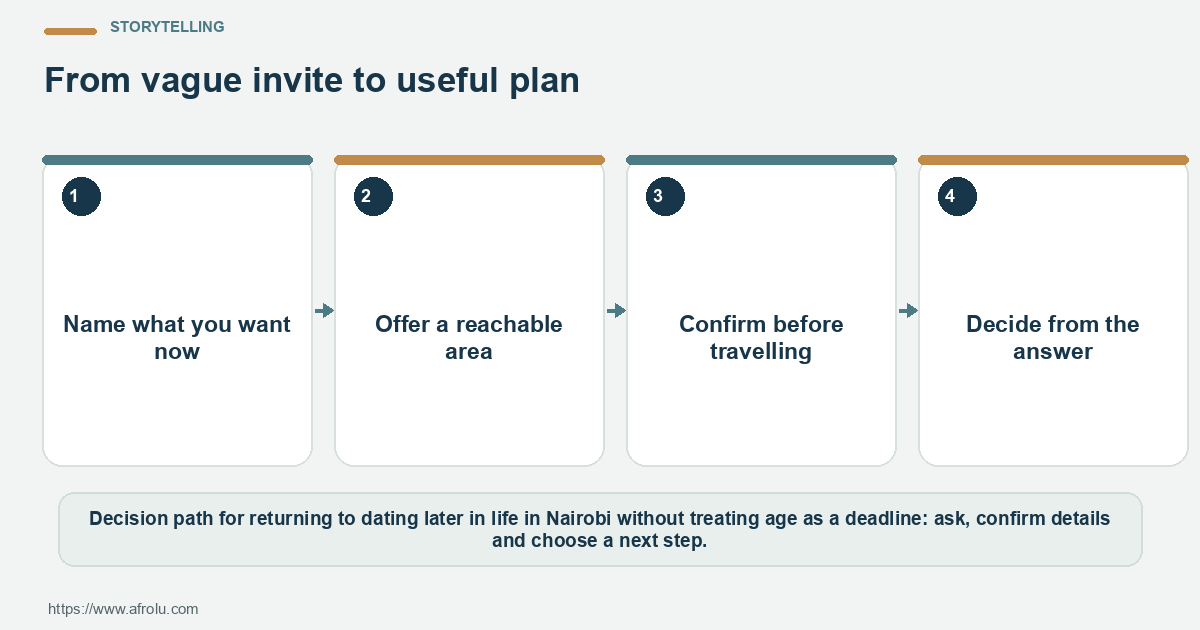
Action map for returning to dating later in life in Nairobi without treating age as a deadline, ending with a choice the reader can make today.
Three ways this can show up
An invitation stays open
A warm exchange never settles the day or location
Suggest one public, reachable option and set a confirmation point.A route is inconvenient
The proposed place makes one adult cross the city at rush hour
Compare two areas that work for both routes and budgets.A plan changes
Traffic or a family responsibility affects the agreed time
Check whether a revised time still works rather than assuming motive.The label differs
One person means casual; the other expects a path to commitment
Ask about exclusivity and direction separately.A pause feels embarrassing
You worry that returning to dating later means you should accept less
Choose based on your current needs, not someone else's timeline.Family details come early
A match presses for information about children or relatives
Share only what you want and keep dependants' details private.You plan every date
The other adult answers but never chooses a time or place
Invite them to make the next plan and decide whether the effort is mutual.A former connection returns
Someone reappears after a long silence and expects immediate access
Reply only if you want and ask what they are seeking now.What to notice before you react
An invitation stays open: A warm exchange never settles the day or location
A route is inconvenient: The proposed place makes one adult cross the city at rush hour
A plan changes: Traffic or a family responsibility affects the agreed time
The label differs: One person means casual; the other expects a path to commitment
A pause feels embarrassing: You worry that returning to dating later means you should accept less
Family details come early: A match presses for information about children or relatives
You plan every date: The other adult answers but never chooses a time or place
A former connection returns: Someone reappears after a long silence and expects immediate access
A plan has a time and place both adults can describe before travelling.
A work or study limit is stated with a realistic time to reconnect.
Each person can explain what the relationship label means to them.
A changed preference starts a new conversation rather than an assumption.
A no is accepted without repeated pressure or punishment.
Privacy, money and account boundaries remain the reader's choice.
Read the moment without overbuilding the story
| Situation | What it may mean | What to do next |
|---|---|---|
| An invitation stays open | A warm exchange never settles the day or location | Suggest one public, reachable option and set a confirmation point. |
| A route is inconvenient | The proposed place makes one adult cross the city at rush hour | Compare two areas that work for both routes and budgets. |
| A plan changes | Traffic or a family responsibility affects the agreed time | Check whether a revised time still works rather than assuming motive. |
| The label differs | One person means casual; the other expects a path to commitment | Ask about exclusivity and direction separately. |
| A pause feels embarrassing | You worry that returning to dating later means you should accept less | Choose based on your current needs, not someone else's timeline. |
| Family details come early | A match presses for information about children or relatives | Share only what you want and keep dependants' details private. |
| You plan every date | The other adult answers but never chooses a time or place | Invite them to make the next plan and decide whether the effort is mutual. |
| A former connection returns | Someone reappears after a long silence and expects immediate access | Reply only if you want and ask what they are seeking now. |
| One plan is cancelled | A real constraint may interrupt a date | Ask whether a replacement works for both adults. |
| A preference changes | The current arrangement no longer fits one person's needs | Name the change and decide from the answer you receive. |
Three calm ways to start the conversation
“Would the CBD or Kilimani be easier for you to reach on Saturday?”
“I am enjoying dating again and would like to keep the next few dates low pressure.”
“When you say situationship, what does that mean to you about exclusivity and time together?”
“I will share more about my family when I feel ready; for now, let's plan our date.”
“I have suggested our last few outings. Would you choose the next place?”
“If we have not chosen a place by Friday, I will use Saturday for other plans.”
“I am open to a committed relationship if we are a good fit. What are you looking for now?”
“I was unsure when contact stopped. What are you hoping for by reaching out now?”
“I want to understand what we are choosing now. Can we talk about it directly?”
“I can make that plan if we confirm the details today. Otherwise I will use the time differently.”
“Thanks for being clear. I will decide what works for me from here.”
“If either of our needs changes, I would rather discuss it than assume the old terms still apply.”
Know the difference
Low pressure versus No agreement
A relaxed pace with clear, manageable plans and room to say no.
Every detail stays undefined, leaving one adult to carry the guessing and coordination.
Low pressure can include a clear next step and a boundary around your time.

Comparison of Low pressure and No agreement for returning to dating later in life in Nairobi without treating age as a deadline.
Compare the closest dating types before choosing a label
| Type or dimension | What it describes | Best next question |
|---|---|---|
| Low pressure | A relaxed pace with clear, manageable plans and room to say no. | Ask what the current agreement actually says. |
| No agreement | Every detail stays undefined, leaving one adult to carry the guessing and coordination. | Decide whether the arrangement works for you today. |
| One delayed reply | A single gap has several possible explanations. | Use the contact window you discussed or ask once. |
| Repeated uncertainty | The same question or plan stays unresolved over time. | Name the pattern and decide what boundary you need. |
| A stated preference | An adult explains what they want in the present. | Check whether you want the same arrangement. |
| A future possibility | A hope describes something that has not yet happened. | Do not treat it as a current agreement. |
| A changed need | One adult wants a different pace, label or boundary. | Revisit the terms and hear the answer. |
| A respectful no | Someone declines a date, boundary or new term. | Accept their choice and make your own decision. |
| A practical limit | Time, distance, cost or privacy affects a possible next step. | Find a mutual option or decide the fit is not right. |
A simple plan you can use today
Springer Nature: Situationships: A New Relationship Category?
An exploratory study using interviews and an online survey with U.S. university convenience samples. Its proposed features are not a universal definition or evidence about every Kenyan or diaspora adult.
Personal Relationships: The relationship talk: Understanding the transition from casual to committed romantic relationships
This study examines relationship discussions and uncertainty in a particular emerging-adult sample. It does not prescribe a universal timeline for defining a relationship.
PubMed Central: Time for Each Other: Work and Family Constraints Among Couples
A U.S. time-use analysis of established couples offers context on competing demands, not a dating cadence or explanation for one person's availability.
Office of the Data Protection Commissioner of Kenya: Rights of a Data Subject
Kenya's regulator outlines data-protection rights. Legal rights do not verify a dating profile or eliminate every risk after information is shared.
U.S. Federal Trade Commission: Romance Scams
The FTC explains U.S. consumer guidance about romance scams. It is not a prevalence estimate for Kenya or diaspora communities.
RAINN: Tips for Safer Dating: Online and In-Person
RAINN's practical guidance is U.S.-focused. Its options can support autonomy but do not guarantee another person's behavior; its emergency contacts are not Kenya-specific.
Questions organised by purpose and depth
Choose a few prompts that fit the moment. This is a reference library, not a list to complete.
Your own pace
Choose without comparing life timelines.
- What do I want now?
- What pace feels enjoyable?
- What would feel pressured?
A clear plan
Make an invitation answerable and reachable.
- Which area works?
- When should we confirm?
- How long do I want to meet?
Label and direction
Ask about the current arrangement.
- Are we exclusive?
- What does casual mean?
- When might I revisit this?
Family privacy
Share personal history when it feels mutual.
- What can stay private?
- What is useful to coordinate?
- What would I like to share later?
What deserves a closer look
Situationships: A New Relationship Category?
An exploratory study using interviews and an online survey with U.S. university convenience samples. Its proposed features are not a universal definition or evidence about every Kenyan or diaspora adult.
Evidence limit: Read the finding within this source's sample and scope; do not use it to predict an individual.
The relationship talk: Understanding the transition from casual to committed romantic relationships
This study examines relationship discussions and uncertainty in a particular emerging-adult sample. It does not prescribe a universal timeline for defining a relationship.
Evidence limit: Read the finding within this source's sample and scope; do not use it to predict an individual.
Time for Each Other: Work and Family Constraints Among Couples
A U.S. time-use analysis of established couples offers context on competing demands, not a dating cadence or explanation for one person's availability.
Evidence limit: Read the finding within this source's sample and scope; do not use it to predict an individual.
Rights of a Data Subject
Kenya's regulator outlines data-protection rights. Legal rights do not verify a dating profile or eliminate every risk after information is shared.
Evidence limit: Read the finding within this source's sample and scope; do not use it to predict an individual.
Romance Scams
The FTC explains U.S. consumer guidance about romance scams. It is not a prevalence estimate for Kenya or diaspora communities.
Evidence limit: Read the finding within this source's sample and scope; do not use it to predict an individual.
Tips for Safer Dating: Online and In-Person
RAINN's practical guidance is U.S.-focused. Its options can support autonomy but do not guarantee another person's behavior; its emergency contacts are not Kenya-specific.
Evidence limit: Read the finding within this source's sample and scope; do not use it to predict an individual.
Four mistakes that make this harder
Treating a label as a full agreement
The same word can describe different choices about exclusivity and direction.
Reading motives from reply time
A timestamp cannot tell you why a person is unavailable.
Using one study as a rule
Small or narrow samples cannot define every adult or faith community.
Trading privacy for trust
A password, code, address or work detail is not proof of closeness.
Treating a future hope as a present plan
Intentions need a current conversation and mutual choices.
Ignoring your own limits
You can respect another person's circumstances and still decide the fit is wrong.
Choose one low-pressure plan that fits your life now
These information links are labelled, non-commercial and do not promise a match or relationship outcome.
Explore the guide library
Show more related guides
Continue with Afrolu
Show more Afrolu guides
Sources used for this guide
Afrolu reviewed these health, research, safety, or public guidance resources while editing this page. They support the behaviour and safety guidance; they do not diagnose any individual described by a reader.
A low-pressure situationship conversation for adults dating later Questions
Am I behind if I return to dating later?
No. Adults begin or resume dating at different points. Choose from your own needs rather than a social timeline.
How do I keep dating low pressure?
Use a manageable plan, a clear time and one direct question. Low pressure can still be specific.
Does a vague invitation mean disinterest?
It means the date is not confirmed yet. Ask for the missing detail and decide how long to hold the time.
Should I explain my dating history?
Only as much as you want to share. You can keep family, health, divorce and home details private until you are ready.
What is a reasonable Nairobi meeting area?
Choose a public place both people can reach within their schedule and budget; there is no single best area for every route.
Does situationship mean non-exclusive?
Not automatically. Ask whether either person is dating others and what the term means to each of you.
Can research tell me what the other person intends?
No. Studies describe patterns in particular samples; ask the person and decide from the agreement you have.
When should I seek support?
You may talk with someone you trust or a qualified professional if that would help. There is no required timetable for deciding.
Can I stop seeing someone without proving wrongdoing?
Yes. A mismatch in timing, values or availability can be enough reason to end a connection.
Can our agreement change later?
Yes. Either adult may raise a changed need, and both can decide whether the new terms work.
One thing to do now
Turn the lesson into a better match pool
Set your own pace, ask for the detail you need next and decide from the other person's present answer rather than a social timeline.