Values-led casual dating · safety and clarity
Situationships for Faith-Led Daters: Safer Casual Clarity
A practical situationship guide for faith-led adults: keep casual dating honest, protect consent and privacy, state values clearly, and handle pressure safely.

Values can make choice clearer.
Written and edited by Samira Benali · Faith and North Africa Editor
Use your values to name what you will freely choose, not to control another adult. Translate casual into clear present-tense terms about contact, other dates, intimacy, privacy, and endings. Keep consent current, access gradual, money and systems separate, and plans easy to leave. A mismatch can be released without blame. If contact becomes coercive, persistent, financially manipulative, threatening, or frightening, reduce access and use support.
Relationship clarity · Faith-Led Daters
Is this a values-led mutual casual arrangement, a normal mismatch, a conversation about pace or intimacy, a return worth a smaller plan, access or money pressure, unwanted pursuit, or conduct that makes me feel unsafe?
A faith-led situationship is an undefined or partly defined connection in which an adult's personal values may shape the pace, intimacy, honesty, privacy, or commitment they can freely choose. The useful distinction is between values that clarify one's own boundary and pressure that narrows someone else's freedom.
Zuri enjoys a casual connection but notices that she has been avoiding a conversation about other dates and late private plans because she does not want to sound judgmental. She says what she is comfortable with, asks what the other person means by casual, and learns that their expectations differ. Rather than argue, she chooses a public lower-pressure plan only if both adults can keep the terms honest and voluntary.
values-led casual dating · safety and clarity
Zuri keeps casual dating honest by naming her own limits and leaving another adult free to choose
This guide separates personal values, mutual casual terms, a normal mismatch, a pace conversation, current consent, gradual access, a returning message, financial pressure, unwanted pursuit, and fear—without using faith as a moral scorecard.
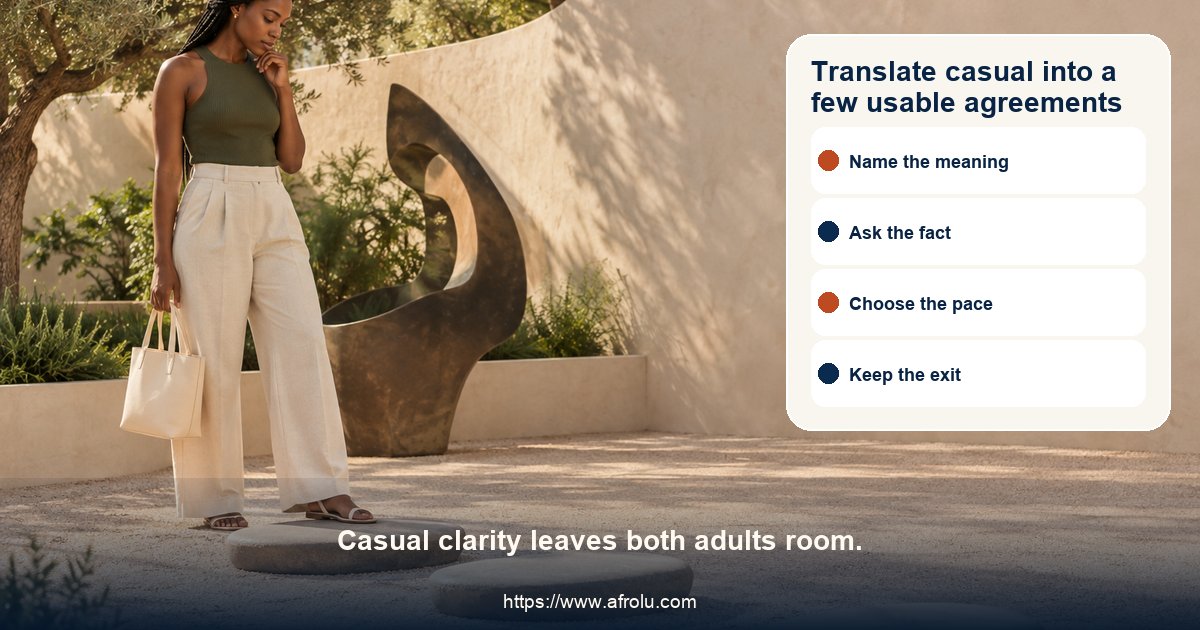
Turn values into a personal boundary, define casual in practice, speak before self-silencing, keep consent and access current, distinguish fit from risk, redesign only mutual terms, and carry one clear standard forward.
Guide yourself
A personal boundary can be clear without becoming a verdict.
Name the terms
Contact, intimacy, privacy, and exits need shared meaning.
Keep it current
Warmth and history never settle a new choice.
Protect freedom
Money pressure, coercion, monitoring, and fear change the task.
faith-led dating · casual honesty
Values can make a casual situationship more honest without making anyone's choices a moral scorecard
A faith-led adult may enter a situationship with a strong sense of what matters to them while still feeling unsure how to speak about it. You might value sexual boundaries, emotional steadiness, exclusivity, privacy, directness, rest, or a particular pace. The important task is not to make another adult share your framework. It is to decide what you can freely choose and communicate it without disguise.
Casual dating can fit a values-led life when both people are candid about its scope. It may mean companionship without partnership, intimacy with explicit limits, or contact that remains non-exclusive and low-pressure. The arrangement becomes difficult when one person uses a softer word for something they cannot actually accept, hoping the other person will eventually infer the unstated rule.
Avoid treating your values as a screening performance. A sentence such as 'I am open to casual dating, but I need honesty about other connections and I do not want late changes to my boundaries' tells someone how to date with you. It does not demand a confession, a promise, or agreement to a belief they do not hold.
The same generosity applies to a person whose values or casual preferences differ from yours. An honest mismatch can be disappointing and still respectful. You are not required to argue them into your shape, and they are not entitled to persuade you out of yours. Shared freedom begins when both people can say what they offer and decline what does not fit.
mutual expectations · present tense
Casual can be caring when the terms are clear enough for both adults to act on
The word casual carries many possible meanings. One person may hear occasional dates and no exclusivity; another may hear regular intimacy, daily conversation, and emotional closeness without a relationship label. Neither definition is automatically wrong. Confusion begins when the difference remains hidden because both people assume the word should settle it.
Ask about the present arrangement instead of asking for a permanent forecast. How often do we want to see each other? Are either of us dating others? What do we need to know for sexual health and consent? How much messaging feels welcome? What kind of privacy do we want? A few ordinary questions can prevent one person from carrying all the invisible risk.
Make room for an answer that is not your preferred one. Someone may say they want lower contact, no exclusivity, or no physical intimacy. You can say that does not work for you without calling them careless, less sincere, or less compatible with your values. Mutuality does not require matching desires; it requires honest conditions for choosing.
Review terms when the facts change. New feelings, a new person, a shift in contact, a desire to pause, or a boundary around intimacy can all require a fresh conversation. Revisiting an agreement is not evidence that casual dating failed. It is evidence that neither person is treating an earlier conversation as a permanent claim over the other.
conversation · self-respect
A clear sentence protects values better than trying to be easygoing at your own expense
Many people avoid a clarity conversation because they fear seeming intense, judgmental, or attached. That fear can produce the exact uncertainty they hoped to avoid: silent resentment, over-reading messages, or agreeing to plans that do not sit well. Your question can be calm and still matter. The goal is usable information, not a perfectly unbothered tone.
Choose a question that changes a decision. 'I am comfortable keeping this casual, but I need to know whether you are also seeing other people' is clearer than asking someone to promise how they will feel. 'I do not want late-night private plans; would a daytime public plan work?' turns a value into an option the other person can accept or decline.
Listen to the way someone handles your limit. They may respond with curiosity, name their own needs, or say the setup is not for them. Those can all be respectful outcomes. Deflection, mockery, repeated testing, or a demand that you soften the boundary before they answer gives information too. You do not need to win a debate in order to believe what the response shows.
If speaking feels unsafe or disproportionately difficult, make the message smaller. You can say you are stepping back, end a plan, or stop sharing access without producing a full explanation. A values-led boundary is not measured by how beautifully you articulate it. It is measured by whether it leaves you able to act in line with your own comfort and safety.

A simple true sentence can protect choice.
current consent · gradual access
A familiar situationship still needs fresh consent and privacy boundaries every time the context changes
Intimacy can be meaningful, playful, or casual for adults who choose it. What keeps it respectful is not a particular script about what casual dating should look like. It is present consent, attention to each person's comfort, and an ability to change direction. You can want less, more time, a public setting, no image sharing, or no contact at all after having wanted something different before.
Privacy deserves the same attention. A person may ask for your address, routine, personal account, live location, private photos, or a faster move to a channel you cannot easily control. You can decline because you prefer gradual access, not because you have established that the person is unsafe. Trust is more useful when it grows from repeated respect than when it is forced by premature disclosure.
Build plans that keep your exit practical. Meet in a setting you choose, retain your own way home, tell a trusted person what you want to share if that supports you, and avoid arrangements that make leaving feel like a betrayal. Independent logistics are compatible with closeness. They allow both adults to experience a genuine yes rather than a constrained one.
If someone treats a boundary as proof that you are inconsistent, selfish, or insufficiently trusting, pause. Consent and privacy are not favours granted in exchange for affection. Repeated pressure can be a signal to reduce access, end the connection, or seek support. A respectful casual arrangement should make your choices easier to state, not harder to keep.
safety · proportionate response
A mismatch can be handled with clarity; coercion, money pressure, monitoring, and fear need protection
A person may want a different pace, prefer another form of casual connection, or decide they do not want to continue. Those outcomes may be painful while still belonging to ordinary dating uncertainty. You can hear the answer, decide whether to redesign the arrangement, or step away. You do not have to make a moral case against a mismatch in order to choose yourself.
The situation changes when someone asks you for money, a transfer, account access, verification codes, documents, or help moving funds. A story about hardship, urgency, love, or shared values does not turn a casual dating connection into a safe financial relationship. Keep every system separate and verify any claim through an independent, recognised channel.
It also changes when a boundary triggers new accounts, repeated contact, tracking, threats, blackmail, pressure for sexual material, or fear about your safety. Those behaviours are not signs that you need more compassion or a better values conversation. Reduce access, use platform tools, preserve material only if it is safe, and involve trusted, specialist, or urgent support appropriate to the situation.
You may feel reluctant to name risk because the connection began warmly or because you do not want to judge too quickly. Safety does not require a final diagnosis. If your body, money, privacy, movement, or attention no longer feels freely chosen, you can act. Protection is not a failure of generosity; it is a condition for genuine connection.

Mismatch can be clear; pressure needs protection.
repair · release · mutuality
The clearest ending is often shorter and kinder than a prolonged attempt to make a mismatch disappear
If the conversation reveals a mutual middle ground, make it visible. Perhaps you agree on lower contact, a more public plan, a pause from intimacy, a clear non-exclusive arrangement with updated health boundaries, or a review after a period of time. The test is not whether the new design sounds elegant. It is whether both people can follow it without self-erasure or constant negotiation.
If you decide to leave, use a sentence that matches the scale of the connection. 'I do not think this setup works for me, so I am stepping back' can be enough. You are allowed to offer goodwill without leaving a door open. A lengthy explanation can be useful when both people are safe and receptive, but it is not an obligation.
A returning message deserves the same present-tense attention as a new one. An apology or renewed warmth may be sincere, yet you can still decide that the old rhythm does not fit. If you want to explore it, choose a smaller plan and watch whether the person respects the boundaries you now name. Repair is conduct over time, not a persuasive story.
Where direct closure would expose you to pressure or fear, choose safety over ideal etiquette. You can block, report, ask for help, or avoid re-engagement. The goal is not to demonstrate that you ended perfectly. It is to preserve your right to a connection, casual or serious, that does not turn your values or boundaries into a liability.
next connection · grounded openness
A values-led casual standard can make future dating lighter, not narrower
Think about what you learned from this situationship. Maybe you need to discuss other dates earlier, want daytime plans, prefer a slower pace before intimacy, need a clearer review point, or want to keep one communication channel until trust develops. These are not universal rules. They are concrete ways to help future connection meet the person you are.
Name preferences before resentment has to do the speaking. An early statement about contact, intimacy, privacy, or availability can feel vulnerable, but it saves you from trying to read someone into an agreement they never made. A compatible person may not want the same thing, yet they can still respond clearly enough for you to choose.
Keep room for joy as well as caution. Casual dating does not need to be a test, a moral lesson, or a route to a predetermined outcome. It can be an adult connection with honest limits, pleasure, respect, and a clear ability to stop. The quality of the arrangement is shown by freedom and care, not by its label or duration.
When you encounter money requests, coercion, unwanted pursuit, threats, monitoring, image abuse, or fear, bring the standard back to safety. Close routes of access where possible, seek support, and use reporting or urgent help as needed. You never owe a continued conversation because someone frames pressure as affection, sincerity, or shared values.

Choose the move that keeps you freely aligned.
Eight values-led casual situationships where honesty, consent, privacy, and safety change the next move
Casual means different things
Two adults use the same word but have not discussed contact, other dates, or intimacy.
Turn the broad label into a few present-tense agreements.A limit feels hard to say
One person likes the connection but wants to slow intimacy or change the usual plan.
State the change without apologising for having a current preference.Warmth arrives with pressure
Plans repeatedly appear late at night after public or daytime invitations are ignored.
Offer the plan you want once; release the connection if it cannot meet it.Honesty reveals a different fit
The other person names a casual arrangement that does not sit well with your own boundaries.
Treat the answer as useful information and choose accordingly.Past intimacy is treated as permission
A familiar person assumes that prior closeness settles images, touch, access, or an overnight plan.
Restate that consent and privacy are current decisions.Affection becomes a financial ask
A message asks for money, a transfer, account help, or a secret payment narrative.
Keep money and systems separate and verify outside the connection.An old pattern returns with promises
After a quiet gap, a person says they have changed but seeks immediate intimacy or access.
Choose a smaller plan, or decline without debating.A boundary creates pursuit
A clear close produces repeated messages, new accounts, threats, or monitoring.
Reduce access and use appropriate safety support.Fourteen observable signs that a casual situationship is mutual, vague, pressuring, controlling, or unsafe
Both people can say what casual means in their current connection.
A values boundary can be stated without mockery or persuasion.
Other dating, intimacy, and health expectations are discussable before assumptions harden.
A plan respects the place, time, and pace each adult chooses.
A change of mind is received as information, not a personal insult.
Privacy grows through conduct rather than requests for proof.
Communication can remain on a channel you control.
You can make a public or independent plan without defending it.
A mismatch is named rather than softened into indefinite uncertainty.
A return after silence is evaluated through present conduct.
Money, accounts, codes, documents, and transfers stay separate.
A no does not invite repeated contact, pressure, monitoring, or threats.
The connection leaves room for your rest, friendships, and values.
Fear or coercion prompts a safety response rather than a longer dating conversation.
A proportionate decision map for values, casual terms, consent, access, returns, money, and safety
| Situation | What it may mean | What to do next |
|---|---|---|
| You use the word casual differently | The label is too broad to guide behaviour. | Ask about plans, other dates, intimacy, privacy, and endings. |
| You want to slow down | Your current preference has changed. | State the new boundary and see whether it is respected. |
| They want a plan you do not | There may be a normal mismatch in pace or setting. | Offer an alternative once or decline. |
| They avoid an expectations question | Warmth may be covering an arrangement they cannot name. | Choose whether a non-answer works for you. |
| You feel judgmental about a difference | Your values may be colliding with another adult's free choice. | Separate your boundary from a verdict about them. |
| They return after a gap | A new invitation may be possible, but the old pattern remains relevant. | Choose only the amount of access you want now. |
| They ask for money | The issue has shifted beyond casual fit. | Keep systems separate and decline financial involvement. |
| They push a sexual or digital limit | Consent and privacy may be eroding. | Repeat the limit once, then reduce access. |
| You want to end it | A mismatch can be enough reason to leave. | Use a brief clear close when safe. |
| You are afraid | The issue is safety, not a values disagreement. | Seek trusted, specialist, platform, or urgent support. |
Twelve complete lines for casual terms, pace, values, privacy, consent, a return, and an ending
“I am open to casual dating, and I want us to be honest about what that means for each of us.”
“Before we continue, I need to know whether either of us is seeing other people.”
“I like this, but I want to keep the pace slower than we have been moving.”
“I am available for a public daytime plan, not a late private plan.”
“This is a limit that helps me stay aligned with myself; I am not asking you to become someone else.”
“I keep personal routines and private accounts gradual while I get to know someone.”
“I do not want to continue with that tonight.”
“The arrangement has changed for me, so I want to check whether it still works for both of us.”
“I am not returning to the old pattern, but I can consider a smaller, clearer plan.”
“I do not mix dating with money, transfers, codes, or account help.”
“This no longer fits my values or capacity, so I am stepping back.”
“Do not contact me again.”
Know the difference
Values-led casual dating and values-based pressure are opposite patterns
Each adult names their own limits, receives a free answer, keeps consent current, and treats a mismatch as legitimate information.
One person uses beliefs, affection, or ideals to extract access, override a no, delay honesty, or make another adult responsible for their comfort.
Values support connection when they make choice clearer, not when they become leverage.

Values should widen choice, not become leverage.
Keep values-led casual clarity distinct from pressure that uses ideals, affection, or uncertainty as leverage
| Type or dimension | What it describes | Best next question |
|---|---|---|
| A personal boundary | It describes what you will choose. | State it without asking another adult to abandon themselves. |
| A rule for someone else | It tries to control their choice to ease your discomfort. | Return to your own limit or leave the fit. |
| Casual honesty | Terms about contact and intimacy are mutual and current. | Review them when the facts change. |
| Casual ambiguity | One person must infer whether affection has any terms. | Ask one usable question or step back. |
| A respectful no | It is accepted without a campaign to change it. | Let the plan end or choose another fit. |
| A pressured yes | Guilt, urgency, or spiritualised language shrinks freedom. | Pause, reduce access, and seek support if needed. |
| A return with repair | New conduct includes a realistic plan and respect for limits. | Start small if you want to explore it. |
| A financial request | Connection is used to seek money, systems, or secrecy. | Keep all financial routes separate. |
| Fear or monitoring | Repeated contact, tracking, threats, or blackmail replace mutuality. | Use safety and reporting support. |
A simple plan you can use today
Values are a guide to your own choices
They can make a casual arrangement more legible without becoming a ranking of someone else's life.
Casual can still be intentional
Honesty about scope, intimacy, and endings is a form of care, not a contradiction.
Directness can be gentle
A clear question allows another adult to answer freely instead of decoding your hopes.
A mismatch is not a failure of character
It can simply show that the connection cannot support what you need.
Consent includes the context
A change in setting, timing, privacy, touch, images, or contact requires a present choice.
Safety has its own category
Money pressure, coercion, monitoring, threats, and fear deserve protection rather than more discussion.
Questions organised by purpose and depth
Choose a few prompts that fit the moment. This is a reference library, not a list to complete.
Name your values
Turn vague alignment into personal information.
- What lets me feel freely chosen in casual dating?
- What boundary matters before I get attached?
- What do I not need another adult to share?
Define the arrangement
Ask about the facts that affect consent and choice.
- What does casual mean to me in practice?
- What do I need to know about other dates or intimacy?
- What rhythm can I enjoy without guessing?
Check access
Keep warmth and privacy separate.
- What access have I actually chosen?
- What would I rather keep gradual?
- Can I leave or change my mind easily?
Choose proportion
Match the next move to the facts.
- Is this a mismatch, a redesign, or a safety concern?
- What short sentence would be true?
- Who can I contact if pressure appears?
What deserves a closer look
Turn a principle into a personal boundary
Name the action you will take around pace, intimacy, privacy, or honesty so another adult can respond freely.
Evidence limit: Do not use values as leverage over someone else's choice.
Make the word actionable
Discuss contact, other dates, health, intimacy, privacy, and exits in ordinary language.
Evidence limit: Do not assume casual has one universal definition.
Ask for present facts
Use a short question that changes a practical decision rather than seeking a lifetime promise.
Evidence limit: Do not pad the question until it no longer asks anything.
Keep every context current
Choose touch, images, plans, settings, and access anew when the situation changes.
Evidence limit: Do not borrow consent from earlier closeness.
Release a mismatch without a trial
Use a proportionate ending or a smaller redesign only if both people can uphold it.
Evidence limit: Do not keep a door open to manage someone else's reaction.
Protect freedom before explaining
Reduce access and seek help when money pressure, coercion, threats, monitoring, or fear arise.
Evidence limit: Do not continue engagement to prove you are fair.
Shortcuts that turn personal values into silence, pressure, unwanted access, or risk
Using values as a test for another adult
It obscures your own boundary and can turn connection into control.
Calling a need a demand for commitment
You can ask for current expectations without asking for a future guarantee.
Accepting vague terms to seem relaxed
Silenced needs tend to return as resentment or unsafe assumptions.
Treating prior closeness as permanent permission
Consent and privacy remain specific to the present moment.
Explaining a no until it becomes negotiable
A clear limit does not need a defence to be valid.
Calling pressure a values conversation
Coercion, money requests, monitoring, and fear require protection.
Set a values-aware boundary, ask a safer question, or send one proportional message
Choose the resource that fits the decision in front of you. A guide can help you name a limit, but it cannot promise another adult's honesty, interest, or conduct.
Explore the guide library
Show more related guides
Continue with Afrolu
Show more Afrolu guides
Sources used for this guide
Afrolu reviewed these health, research, safety, or public guidance resources while editing this page. They support the behaviour and safety guidance; they do not diagnose any individual described by a reader.
Questions about situationships for faith-led adults choosing casual dating
Can a faith-led person have a casual situationship?
Yes. Faith-led adults define their own values. Casual dating can be caring and intentional when both people speak honestly about what they choose, maintain consent, and keep boundaries voluntary.
Do I have to explain my beliefs to set a boundary?
No. You can state the limit and what you will choose. Sharing more context is optional and should not become a requirement for another person to respect your no.
How do I ask what casual means without sounding intense?
Ask about a present fact that affects you, such as other dates, contact, intimacy, or plans. A clear question is more respectful than prolonged guessing.
What if their casual preferences differ from mine?
Treat the answer as information. You can redesign the arrangement if both people freely agree, or leave without making either person wrong.
Can I change my mind about intimacy?
Yes. Consent is current. Past dates, kissing, sex, flirtation, or a shared value do not decide what you want in a new moment.
How do I keep casual dating safe?
Use settings and channels you control, keep private information gradual, arrange independent movement, discuss relevant health boundaries, and take pressure seriously.
Should I give a detailed reason when ending it?
Not necessarily. A brief clear ending is enough when it is safe. You do not owe a closing argument or continued access.
What if they say my boundary is judgmental?
You can distinguish your own limit from a verdict about them. A respectful person can disagree or leave the fit without pressuring you to erase the boundary.
What if a situationship asks for money?
Keep financial systems separate. Do not send, receive, lend, or move money, codes, documents, or account access in a dating connection; verify claims independently.
What should I do if I feel afraid?
Reduce access, use blocking or reporting tools, preserve evidence only when safe, and seek trusted, specialist, platform, or urgent support appropriate to the situation.
One thing to do now
Choose the casual arrangement that keeps values and freedom in the same frame
Choose the smallest next action that protects your values, body, time, privacy, independent movement, financial security, support network, and ability to accept or end the connection without negotiating your freedom.