Shared values beside two independently controlled journeys
Meet Faith-Led First-Date Nerves With Three Clear Circles
A three-circle guide to faith-led long-distance first dates, separating values, travel safety, community privacy, present consent, pressure and danger.

Warm hope may approach the gate; only current facts open it.
Written and edited by Samira Benali · Faith and North Africa Editor
Use three independently closable circles. Translate what faith-led means in daily conduct without treating a shared label as identity or safety proof. Build two complete journeys with a public venue, independent transport, essential money, documents, communication and return. Ask separately about prayer, photographs, community contact and physical choices; travel and serious hope consent to none of them. Sort ordinary nerves from an open values question, coercive pressure and observable danger, then ground, ask, pause or leave accordingly. Review only after both adults return to ordinary context, unless safety needs immediate action. Meet again, clarify or close with a next step no larger than the evidence earned.
First dates · Faith-Led Daters
Can shared values and a meaningful meeting remain separate from independent travel, community access, money and the present right to say no?
A faith-led long-distance first date is an initial in-person meeting between adults in different places whose beliefs materially inform dating. The three-circle arrival gate keeps values fit, a complete independent journey and present specific consent separate, so meaning cannot become authority, debt or a blocked exit.
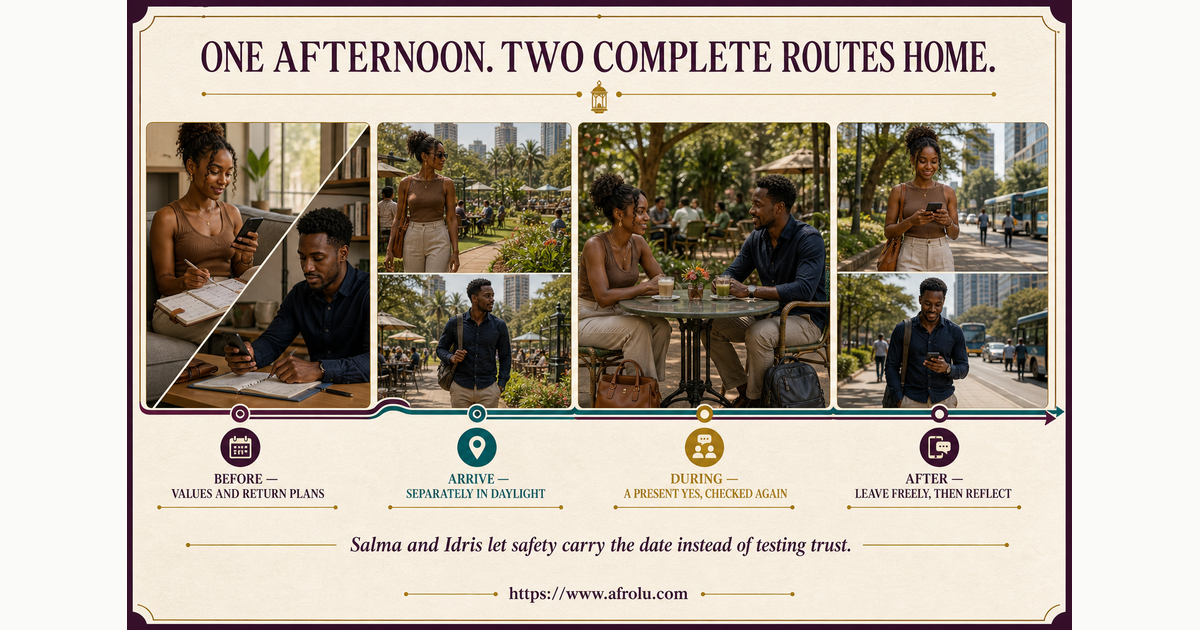
Salma and Idris are fictional adults, 32 and 35. They discuss what faith-led means, choose a midpoint public venue and buy separate returns. When Salma asks to shorten the morning plan, Idris agrees without spiritualising her doubt or invoking his cost. They explore one community-expectation difference, decline a photograph and review separately at home before choosing another call rather than a larger trip.
The faith-distance three-circle arrival gate
Let shared values guide the meeting without deciding for either adult
Samira separates meaningful faith from the distinct permissions involved in a long-distance first date.
The gate translates belief into conduct, completes two independent journeys and preserves a present yes before a return-home review.
Values
Describe faith, practice, community and future questions without claiming private authority.
Journey
Keep venue, travel, money, documents, communication and return independently complete.
Present yes
Ask separately for prayer, images, introductions, touch and every changed activity.
Discernment
Review ease, agreement, autonomy and repair after both adults regain ordinary choice.
Begin without interpreting the feeling
First-date anxiety can be noticed without being treated as prophecy, pathology or weak faith
A long-distance first meeting can bring anticipation, uncertainty and practical load at once. The connection may already feel emotionally important because calls have carried faith, family or future conversations. Travel raises the stakes again. A fast heartbeat, restless night or desire to rehearse does not by itself say that the date is unsafe, destined or wrong. Start with observable facts: what has been agreed, what remains unknown and whether each adult still has usable choices.
Faith-led means that belief, practice, ethics or spiritual community materially informs how an adult wants to date. It does not describe one religion, one role for women or men, one sexual timeline or one family structure. Ask what the person means. Two adults can use the same faith word and differ about worship, modesty, physical affection, marriage, children, interfaith family, community visibility and who may advise them.
Grounding can make choice easier: eat, sleep where possible, reduce the itinerary, write the plan, breathe slowly, speak with a trusted person and keep an exit. These are practical options, not treatment. If fear or distress is persistent, severe or affecting daily life, a qualified mental-health professional can help. If the concern is threats, stalking, coercion or immediate danger, prioritise safety and appropriate local support rather than trying to calm yourself into attending.
Long-distance familiarity is still partial. Repeated calls, shared prayer, a community introduction or aligned values may be meaningful, but none proves identity, relationship status, safety or consent. Verify proportionately, keep money and documents independent, meet publicly and let the first date remain a first date. Trust can grow from how a person responds to ordinary limits.
The three-circle arrival gate
Open values, journey and present-consent circles separately
The values circle asks what faith-led dating means in present conduct. Discuss relationship intention, practice, physical boundaries, family or community involvement, privacy and major future questions only to the depth relevant now. The goal is not a theological examination. It is to find whether both adults can describe their own commitments, tolerate an honest difference and refuse to use spiritual status as authority over the other.
The journey circle makes the meeting complete. Confirm the person's identity through reasonable independent checks, choose a public venue, arrange transport and accommodation without dependency, keep essential funds and documents, tell a trusted person the relevant plan and know how to leave. If either adult crosses a border, use current official travel advice and entry requirements. A host's confidence never replaces the traveller's own checks.
The present-consent circle covers every choice during the date. Agreeing to travel does not agree to a private venue, photograph, community introduction, prayer, physical contact, sex, an overnight stay or another date. Ask specifically and accept no without debate. Consent can change even when a faith value, past conversation or relationship intention seemed to point elsewhere.
Anxiety gets smaller questions at the gate. Is the plan complete? Can I change it? Can I leave without asking? Does this person accept a modest boundary? Is an unanswered values question important before travel or safe to explore in public? Do not force certainty. Postpone when information, money, rest or practical independence is missing. Close when coercion or danger makes further testing unreasonable.
Salma and Idris meet at a midpoint
A public afternoon lets shared values meet ordinary behaviour
Salma and Idris are fictional adults, 32 and 35, living in different cities. They have spoken for ten weeks after meeting through a dating platform. Both describe faith as central and say they date toward a lasting partnership. Before booking, they compare what that means now. Salma does not want physical affection on a first date. Idris wants a relationship visible to community eventually but agrees that no introduction belongs to this visit.
They choose a midpoint city and a daylight garden cafe near a busy transport interchange. Each buys a return ticket and keeps enough money to change it. Neither stays overnight. They share the venue and expected return with separate trusted contacts, but do not exchange live tracking or private home addresses. Salma confirms the venue through its public listing rather than a link sent only by Idris.
On the morning, Salma feels unsettled and asks to shorten the plan from five hours to two. Idris says yes and keeps the original public venue. He does not call her doubt a spiritual attack, accuse her of mistrust or invoke the money he spent. During the date, they discuss prayer routines, family privacy and future interfaith questions without deciding all of them. He asks before taking a photograph; she declines, and the subject ends.
Both return home before reviewing. Salma notices that her body settled once the plan became smaller and that Idris respected every closed permission. Idris notices one unresolved issue about community expectations. They choose another video conversation, not a larger trip. The first date succeeds by producing accurate information and intact choices, not by guaranteeing a relationship.
Sort the signal before acting
Ordinary nerves, values questions, coercive pressure and danger need different responses
Ordinary nerves can include anticipation, self-consciousness or uncertainty while the adult still thinks clearly enough to choose, asks for changes and uses the exit. Ground, simplify and proceed only if wanted. A values question is an open uncertainty—perhaps family visibility or physical boundaries—that can be discussed without pressure. Ask directly and accept that compatibility may remain unknown after one date.
Pressure narrows choice. Examples include saying the trip proves commitment, treating travel cost as debt, demanding a private venue, insisting a trusted contact is disrespectful, using a faith leader's name to end discussion or calling a boundary sinful without room for the adult's own judgment. Pause. Restore independent transport, money and communication before deciding whether any meeting remains appropriate.
Danger is observable conduct such as threats, stalking, impersonation, confinement, violence, tampering with transport, taking documents, extortion or repeated pursuit after a clear end. Leave if it is safe, move toward staffed or populated help, contact trusted or emergency support appropriate to the location and preserve useful evidence without investigating at personal risk. Do not return to settle a theological argument.
Patterns matter, but so does repair. One awkward question followed by an immediate, durable correction differs from repeated spiritual pressure. A person who accepts a shorter date, separate lodging, no photograph or no touch supplies useful evidence. A person who agrees privately and then uses community shame, money or travel disruption to reverse the answer supplies different evidence. Believe the conduct you can observe.

Do not call every flutter danger or explain every danger as nerves.
Language for the three circles
Speak faith values and closed permissions in the same calm voice
For values, say: ‘Faith matters in how I date. I want to understand what it means in your daily choices without assuming we practise identically.’ For intention, say: ‘I am open to a lasting partnership; this meeting is one first date, not an engagement or exclusivity agreement.’ These sentences make hope visible without promising an outcome.
For travel, say: ‘I will book and control my route home, and I am meeting only at the public venue we agreed.’ For money, say: ‘We can each cover what we agreed; I do not send emergency transfers or share account access in dating.’ If the original plan becomes financially impossible, postpone instead of turning dependence into a test.
For community and privacy, say: ‘Please do not contact my family, faith community or post our photograph without asking me.’ For consent, say: ‘My values matter to me, and I will still answer each physical choice in the moment.’ A present no remains complete whether it matches or differs from an earlier general discussion.
For leaving, say: ‘I am ending the date now and I do not need to debate the reason.’ If a direct statement would increase risk, prioritise a safe exit and support. For spiritual pressure, say when safe: ‘You may hold that interpretation; it does not give you authority over my travel, body, money or relationships.’ The point is not to win the argument. It is to keep the permission with its owner.

A respectful value can be spoken without becoming authority over another adult.
Keep community and conscience distinct
Faith can inform discernment without creating private authority over another adult
Community can provide belonging, wisdom and practical support. It can also hold sensitive information or unequal influence. Decide who knows about the date, what may be shared and whether introductions are wanted. A mutual contact is not a background-check guarantee, and a respected role does not establish private conduct. Verify relevant facts and observe how the adult handles limits.
Spiritual abuse can include using belief, shame, claimed divine authority, exclusion or community consequences to control another person. Not every disagreement about doctrine is abuse. Focus on conduct: Can each adult speak, leave, seek outside advice and retain body, money, documents and relationships? Repeated coercion deserves safety support; it is not solved by becoming more persuasive or compliant.
Physical boundaries may arise from faith, health, preference, readiness or no stated reason. None needs cross-examination. Adults may share the same boundary for different reasons or change their own answer over time. Consent is still active, specific and withdrawable. If sexual activity is a possibility, discuss relevant testing and prevention with appropriate healthcare guidance rather than assuming serious intent or faith identity removes the need.
Compatibility is allowed to be disappointing. One adult may require a shared practice or future that the other cannot honestly offer. Name the difference and close respectfully. Do not label the person impure, deceptive or unsafe merely for incompatibility. Safety language should remain available for actual pressure and harm, while ordinary differences retain dignity.
The twenty-four-hour return-home review
Let both adults regain ordinary choices before interpreting the date
Ease asks whether the nervousness shifted when information or boundaries improved. Could you eat, think, speak and change the plan? Agreement asks whether the date matched the stated venue, duration, payment, values and privacy terms. A pleasant feeling and a complete plan can both matter; neither needs to erase the other.
Autonomy asks whether transport, money, documents, communication, consent and community contact stayed under each adult's control. Notice small moments: a declined photograph, a changed departure, a separate bill or a request not to pray together. Respect appears in an uncomplicated response, not only in grand kindness.
Repair asks what happened after discomfort or a mistake. Did the person stop, acknowledge impact and change conduct? An apology without restored choice is incomplete. If the problem involved coercion, threats or pursuit, prioritise safety and support rather than scheduling a repair conversation. You never owe another date to test whether harm repeats.
Meet again when values exploration feels worthwhile and choices stayed intact. Clarify before another journey when a specific question remains answerable. Close when faith or relationship direction does not fit, or when pressure makes the connection unsafe or unusable. The three-circle gate is not a method for eliminating uncertainty. It is a way to keep uncertainty from taking away adult agency.

Discern from conduct after both adults regain ordinary choices.
Eight moments where nerves, values and safety require different moves
A smaller plan restores usable choice
An adult feels overwhelmed on departure morning but sees no threatening conduct.
Shorten or postpone freely, keep the independent route and proceed only if the revised plan feels workable.A meaningful practice still needs a present yes
One dater expects prayer together because faith is central to both profiles.
Ask rather than assume; choose a public, time-bounded form or decline without defending belief.Visibility is separate from affection
A date wants a photograph to send immediately to family or a faith group.
Keep the image and disclosure closed unless both adults consent to the exact audience and purpose.A public plan is called mistrust
After arrival, one adult asks to move from the agreed cafe to a private home.
Keep the original public plan or leave; travel effort creates no obligation to expand access.An emergency transfer appears before travel
A remote match says a lost wallet will cancel the meaningful meeting unless money arrives now.
Send nothing under urgency; verify independently and postpone without creating financial dependency.A claimed sign is used to settle the relationship
One adult says they received certainty that the pair must marry and resistance shows weak faith.
Keep personal authorship, decline the claim as authority and seek independent support if pressure continues.An earlier value is treated as standing consent
Both discussed affection positively online, but one adult does not want touch at the meeting.
Use the present answer; stop immediately and do not bargain through faith, cost or disappointment.Transport is blocked after a clear end
A date takes a ticket or follows the other adult toward the station after being told the meeting is over.
Move toward staffed or populated help, contact trusted or emergency support and avoid a private confrontation.Evidence that a faith-led long-distance first date preserves adult choice
Each adult explains what faith-led dating means without claiming authority over the other.
Relationship intention, exclusivity and a first meeting are named as separate facts.
Identity and travel details are checked through independently located information.
The venue, duration, cost and return plan are complete before either adult moves.
Both adults retain essential money, documents, communication and transport.
Family, faith-community contact, prayer and photographs each require a specific invitation.
Physical consent is asked in the moment and a no ends the request without argument.
A smaller plan or postponement is accepted without shame, debt or spiritual interpretation.
Values differences can be discussed without labelling the other adult unsafe or deficient.
A mistake leads to restored choice and visibly changed conduct.
Nerves can be grounded while threats, stalking and coercion trigger safety action.
Either adult can close the connection with housing, money, community and travel still intact.
Sort the signal before opening another gate
| Situation | What it may mean | What to do next |
|---|---|---|
| Anticipation disrupts sleep | Ordinary first-date activation or wider distress | Ground, simplify and seek qualified help if distress persists or impairs daily life. |
| Faith language matches | A promising value area, not full compatibility | Ask what the words mean in daily conduct, roles and boundaries. |
| A mutual contact introduces you | One contextual reference | Retain independent identity, status and plan checks. |
| The date requires travel | Added logistical and emotional load | Build a public, funded, time-bounded journey each adult can end. |
| A host offers a private room | Convenience that creates access and dependency | Use independent lodging or postpone when it is not affordable. |
| A fare emergency appears | A money request under urgency | Transfer nothing; verify independently and let the date move rather than the money. |
| Prayer is proposed | A spiritual practice needing consent | Agree, adapt or decline the exact activity without treating the answer as a test. |
| A community introduction is requested | Expanded visibility and third-party access | Choose audience, timing and information separately or keep it closed. |
| A claimed revelation directs you | A belief statement crossing toward authority | Preserve your decision and pause when disagreement brings shame or threats. |
| A physical boundary changes | A current consent decision | Stop the activity and accept the new answer completely. |
| A public-plan boundary is respected | Useful evidence of ordinary regard | Notice it without immediately expanding another permission. |
| Transport or contact is blocked | Observable danger or coercive control | Prioritise exit, staffed help and appropriate trusted or emergency support. |
Scripts for values, public plans, money, community, consent and leaving
“Faith shapes my choices; I want to hear what that means in your daily life without assuming we practise alike.”
“This is one first date. It does not decide exclusivity, engagement, family access or another visit.”
“I am meeting at the public venue we agreed and I will not change to a private location today.”
“I am booking and controlling my own travel, essential money and return.”
“I do not send money for dating travel. We can postpone if the plan is no longer complete.”
“Please ask before prayer or another spiritual practice; I may join, adapt it or decline.”
“Do not contact my family or faith community or share our photograph without my permission.”
“We understand this value differently. Let us decide compatibility without judging either person's faith.”
“Our earlier conversation does not answer physical contact now. Please ask for the present choice.”
“Your spiritual interpretation does not decide my body, money, travel or relationship answer.”
“I want to shorten the date to two hours and keep the same public venue and return.”
“I am ending the date now. I do not need to debate the reason.”
Know the difference
Compatibility, activation, disagreement, pressure and danger are not synonyms
Anticipation may coexist with usable choice, while a genuine values difference may need discussion or a respectful close.
Pressure narrows choice through shame, debt or authority; danger includes threats, stalking, confinement, violence or blocked exit.
Ground a feeling, clarify a question, pause pressure and leave danger—the response follows the evidence.

Name the pattern before giving it spiritual meaning.
Compare faith fit, nerves, tension, pressure and danger
| Type or dimension | What it describes | Best next question |
|---|---|---|
| Faith fit | Enough compatible belief and practice for the relationship sought | Which daily choices and future questions matter now? |
| First-date nerves | Anticipation or uncertainty while choices remain usable | Would grounding or a smaller plan help? |
| Values tension | A real difference that may be negotiable or incompatible | Can both discuss it without authority or contempt? |
| Spiritual practice | Prayer, worship or counsel requiring individual consent | What exact participation was invited? |
| Community visibility | Disclosure to family, leaders or a group | Who may know what, and when? |
| Travel dependence | Reliance on the match for route, money, lodging or documents | Can the journey become independently complete? |
| Coercive pressure | Shame, urgency, debt or claimed authority narrowing a no | Pause and restore choices before contact continues. |
| Spiritual abuse | Belief or community power used as part of control | Focus on conduct and use independent safety support. |
| Present consent | A specific, active and withdrawable answer now | Ask again when the activity changes. |
| Observable danger | Threat, stalking, confinement, violence or blocked exit | Leave when safe and seek appropriate support. |
Build the three-circle arrival gate in six moves
Translate the faith word
Ask what belief changes in daily dating conduct rather than assuming a shared label is complete.
Build two complete routes
Keep transport, money, documents, communication and return under each adult's control.
Keep the first date small
Use a public venue, bounded duration and no automatic community or private-home access.
Ask for the present yes
Travel, prayer, photographs and physical contact each have separate consent.
Sort the lantern
Ground nerves, clarify questions, pause pressure and leave observable danger.
Review after returning
Compare ease, agreement, autonomy and repair before choosing the next step.
Questions organised by values, journey, present yes and return
Choose a few prompts that fit the moment. This is a reference library, not a list to complete.
Values circle
Translate faith language into present dating conduct.
- What does faith-led mean daily?
- Which practices matter now?
- What is private?
- Who may advise us?
- Which difference could close fit?
Journey circle
Make two complete routes before emotion adds pressure.
- Is identity proportionately checked?
- Is the venue public?
- Who controls each booking?
- Are funds and documents independent?
- How can either adult leave?
Present-yes circle
Ask once for each changed activity.
- Did we ask about prayer?
- May a photograph be taken?
- May anyone else be contacted?
- What physical choice is wanted now?
- Was a no accepted?
Return-home review
Choose a proportionate next step from observable conduct.
- Did the feeling change with clarity?
- Did words match the date?
- Were choices intact?
- Did repair restore agency?
- Meet, clarify or close?
What safety, travel, consent and public-health guidance can support
Belief can be used within coercive control
The U.S. National Domestic Violence Hotline describes spiritual abuse as using religious or spiritual beliefs to exert power and control. Afrolu uses this to recognise conduct such as shame or claimed authority, not to judge a doctrine or diagnose a relationship.
Evidence limit: The source is U.S.-based support guidance; terminology, services and legal routes differ by location.
Dating-safety guidance supports public plans and trusted contact
Police Scotland advises first meetings in public, telling someone the plans and keeping personal information protected. Afrolu applies these as adaptable planning options for adult dates.
Evidence limit: The advice is jurisdiction-specific and cannot make a date risk-free or replace local emergency guidance.
Cross-border journeys require current official checks
The UK Foreign, Commonwealth & Development Office checklist points travellers to destination advice, entry rules, insurance, documents and contingency planning. Use the official guidance relevant to the traveller and destination.
Evidence limit: Rules change, the UK checklist serves UK travellers, and no general article can determine an individual's entry or safety position.
Urgent money requests deserve independent distance
The U.S. Federal Trade Commission warns that romance scammers often build trust and then ask for money, including for travel or emergencies. Afrolu therefore keeps a planned date separate from transfers and account access.
Evidence limit: A money request does not prove fraud, and FTC reporting and remedies are U.S.-specific; use current local channels.
Travel, faith and relationship intent do not supply consent
NHS guidance describes consent as active, specific and withdrawable. A ticket, prayer, gift, serious intention or earlier conversation cannot answer a present intimate choice.
Evidence limit: The source explains UK context; laws and support pathways vary, and individual incidents need locally appropriate help.
Values do not remove the need for relevant health conversation
Current CDC guidance encourages partners to speak before sex about testing and prevention so adults can make informed choices. A faith identity or serious intention does not answer personal health questions.
Evidence limit: CDC guidance is U.S. public-health information; use locally appropriate clinical advice for testing, vaccination, prevention or treatment.
Six shortcuts that turn meaning into pressure
Treating shared faith as verification
A profile, call, role or introduction cannot establish every relevant fact or future conduct.
Calling all nerves intuition
A feeling can carry information without delivering a complete verdict; inspect the plan and behaviour.
Spiritualising a boundary
A claimed sign or doctrine cannot replace another adult's consent over body, money or travel.
Making travel a commitment test
Cost and distance can create dependency and pressure that a first meeting should not carry.
Inviting community by implication
Family contact, counsel, photographs and group disclosure each affect privacy and require consent.
Reviewing inside the farewell peak
Intensity can encourage oversized promises before both adults regain ordinary context.
Use a reviewed resource that matches the decision
This guide focuses on the relationship decision, so it does not rank dating apps. Check current prices, safety tools, and local availability before choosing a service.
Explore the guide library
Show more related guides
Continue with Afrolu
Show more Afrolu guides
Official guidance and survivor-support material reviewed for this gate
Afrolu reviewed these health, research, safety, or public guidance resources while editing this page. They support the behaviour and safety guidance; they do not diagnose any individual described by a reader.
Faith-led long-distance first-date anxiety questions
Is first-date anxiety a sign that I should cancel?
Not necessarily. Notice the feeling, check whether the person and plan have supplied a concrete concern, and confirm that you can think, change the plan and leave. Grounding or a shorter date may help. Postpone freely if the plan is incomplete. Seek qualified help for persistent disabling distress and safety support for threats or coercion.
Can I trust someone more because we share a faith?
Shared faith may be meaningful compatibility information, but it does not verify identity, relationship status, private conduct or safety. Ask what the shared language means, make proportionate independent checks and let trust grow from consistent respect for boundaries and ordinary plans.
How should we plan a long-distance first meeting?
Choose a public, independently confirmed venue and bounded duration. Each adult should control transport, essential money, documents, communication, lodging if needed and return. Share useful plans with a trusted person. Check current official travel and entry guidance when a border is involved.
Is separate travel disrespectful in faith-led dating?
No. Independent routes are a practical safety and autonomy choice, not a verdict on character or belief. A respectful match can prefer togetherness while accepting separate tickets, accommodation and money. If independence is unaffordable, postponing is safer than creating obligation.
Should we pray together on a first date?
Only if both adults want that specific practice. Prayer may feel intimate, public or doctrinally significant in different ways. Ask, choose a form and duration, or decline. Refusal does not authorise conclusions about sincerity, morality or relationship consent.
When should family or a faith leader know?
There is no universal timetable. Decide whose support is useful, what may be disclosed and whether direct contact is welcome. A trusted adviser can help the adult think; they should not secretly negotiate, monitor or override the adult's answer. Safety concerns may require different support.
What if my date says a spiritual sign proves we belong together?
They may describe their belief, but it does not create authority over your relationship decision, body, travel, money or community. State the boundary if safe. Pause or close if disagreement becomes shame, threats, isolation or persistent pressure, and use independent support where needed.
Does travelling to meet someone imply physical consent?
No. Travel agrees only to the journey and the meeting described. Prayer, photographs, private venues, touch and sex each require a present, specific and withdrawable yes. Past discussion, expense, exclusivity or religious expectation cannot supply that answer.
What if they need money to reach the date?
Do not let urgency turn the first meeting into financial dependency. Postpone while facts are independently checked. Never share account access or send money you cannot safely lose. A request does not prove fraud, but romance-scam guidance makes distance and verification especially important.
How do I decide whether to meet again?
Review after both adults return to ordinary context. Ask whether the plan and values discussion matched, whether your choices stayed intact, and whether any mistake led to changed conduct. Meet again, clarify one issue first or close. The next step should be no larger than the evidence earned.
One thing to do now
Let shared values enter through three independently chosen circles
Translate the values question, complete two independent journeys and ask for each present permission separately. If choices remain usable, ground ordinary nerves or clarify an open question. When spiritual language, money or travel narrows a no, pause and restore independence. When threats, stalking, confinement, violence or blocked exit appears, prioritise safety and appropriate support.