Four lanterns for serious hope at one low-stakes first meeting
Bring Serious Faith Values to a Casual First Date Calmly
Manage faith-led first-date anxiety while keeping serious hopes and casual scope separate, with public-date planning, consent scripts and clear signals.
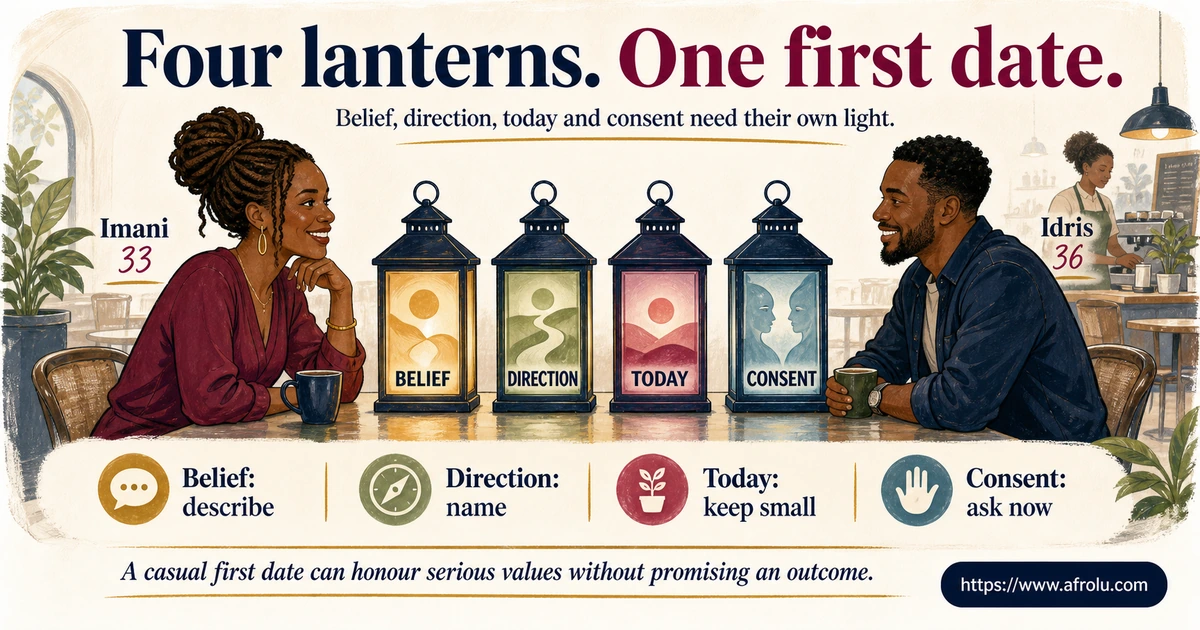
Belief, future direction, today's scope and consent each need their own light.
Written and edited by Samira Benali · Faith and North Africa Editor
Use four lanterns. Describe lived belief in first-person language; state that you date toward partnership; keep today's scope to one casual public meeting; and ask for current consent at every physical or digital step. Shared faith does not prove compatibility, and a casual format does not mean casual intention. Sort discomfort before responding: make ordinary nerves smaller, ask the missing question, decline a real mismatch and leave pressure. Confirm a staffed public place, time box, payment, phone, transport and return. Keep community disclosure, private data and money outside the first date. Review after rest and invite only one next conversation.
First dates · Faith-Led Daters
How can an adult bring serious faith values to a low-stakes first date without turning nerves, belief or hope into pressure?
Faith-led first-date calm is an adult process that lets belief and serious direction matter while the meeting remains small, public and reversible. The four-lantern table separates conviction, future hope, today's casual scope and present consent so no label silently grants another permission.
Imani and Idris are fictional adults, 33 and 36, who both value faith. They choose one public tea, describe different lived practices and name serious direction without assuming exclusivity. Idris respects Imani's decision not to extend the meeting. After separate reviews, they choose one second date because difference remained discussable and every exit stayed open.
The four-lantern calm table
Let faith and serious hope illuminate the date without issuing its verdict
Samira separates conviction, direction, present scope and consent before sorting nerves from missing facts, mismatch and pressure.
The table uses four lanterns, four signal windows and six practical place settings without ranking traditions or promising anxiety-free dating.
Lived belief
Describe the practice and future implication that actually matters.
Serious direction
Name lasting hope without promising this relationship as the outcome.
Casual scope
Keep today to one public, time-bounded adult meeting.
Current consent
Ask separately for every physical, digital and community step.
Let hope and scope coexist
Serious faith values can enter a casual first date without taking it over
A faith-led adult may date toward lasting partnership and still choose a short, casual first meeting. Serious describes future direction; casual can describe the present scope. The date is one conversation, not a courtship announcement, family introduction, exclusivity agreement or marriage decision. Keeping the scope small does not dilute conviction. It gives both adults room to discover whether their actual practices and relationship choices can coexist.
Faith is also not one dating type. It may shape weekly time, food, physical boundaries, celebrations, family expectations, community participation, future household choices or none of those in the same way for two adults. Ask about lived practice rather than treating a profile label as a completed compatibility report. Adults who share a tradition may disagree; adults from different traditions may share important values. Identity alone cannot certify kindness, honesty or safety.
First-date anxiety can mix several experiences: excitement, fear of judgment, uncertainty about the plan, concern about a values mismatch or a signal that the other person's conduct is pressuring. Do not force every feeling into one explanation. A smaller public plan can help ordinary nerves. One clear question can reduce missing information. A real mismatch may require a no. Threats, coercion or an unusable exit require safety action rather than a breathing exercise.
This guide is for adults and does not diagnose or treat an anxiety disorder, interpret scripture, rank beliefs or promise safety. If social fear is persistent, overwhelming or seriously affecting life, a qualified health professional can assess it; NHS and NIMH guidance describe established care routes. The dating method here is narrower: separate four decisions, prepare one public meeting, use plain language and choose the next step from observable conduct.
Light the four-lantern table
Belief, direction, today's scope and consent should glow independently
The belief lantern belongs to each adult. Describe practice in first-person language: ‘I protect this weekly time’, ‘I do not drink’, ‘I welcome an interfaith household’ or ‘I need shared observance in a future partnership.’ A conviction can govern your participation without controlling another adult's clothes, friends, work, body or conscience. A mismatch can be decisive without either belief becoming morally inferior.
The direction lantern answers what future is being explored. ‘I date toward a lasting partnership’ is clear serious intention. It does not promise marriage to this person or require them to mirror the answer. The scope lantern says what exists today: perhaps a ninety-minute tea and no exclusivity, family contact or private venue. The two statements can sit together without contradiction.
The consent lantern supplies present permission for every physical and digital step. Shared faith, a meal, prayer, serious intention, a gift, prior flirting or an earlier yes does not authorise touch, sex, photographs, recording or a second date. Ask, listen and stop when the answer changes. A person's religious or cultural boundary may be stricter or looser than expected; only that adult can provide the current answer.
Community remains outside the four lanterns until invited. A friend, relative or faith leader may offer private counsel, but should not receive messages, intimate history or a vote by default. Ask before disclosing that the date occurred. Do not arrange a surprise meeting or public announcement. If community approval is necessary for one person's future, say so as compatibility information and define what participation would mean later.
Imani and Idris share one cup of tea
The first date becomes useful when it does not have to decide the whole future
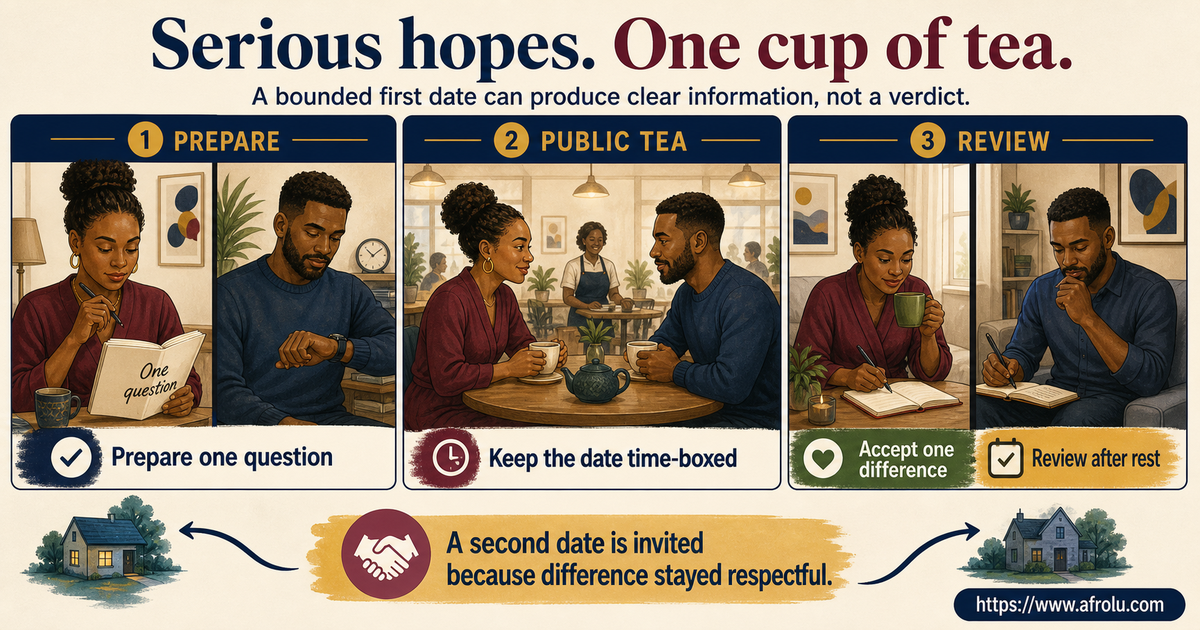
Imani, 33, and Idris, 36, are fictional adults who meet online and both say faith matters. Imani feels nervous that serious hopes will make the date feel like an interview. Idris worries that a casual café plan will be mistaken for casual intention. They agree on a ninety-minute tea in a staffed public place, confirm the plan that morning and arrange separate transport. Each prepares one question rather than a full compatibility list.
Imani describes a weekly practice that shapes her availability and says she dates toward partnership. Idris also wants a lasting relationship but practices differently and is unsure how future family celebrations would work. He does not promise conversion or instant accommodation. She does not ask him to represent an entire tradition. They note the difference and decide it deserves another conversation if the rest of the date feels respectful.
They clarify today's scope. Neither assumes exclusivity or a family introduction. When Idris asks whether Imani would like to extend the meeting with a walk, she notices fatigue and says no. He accepts the answer, helps settle the table and leaves by his own route. Her nervousness decreases not because he supplied certainty, but because her limit remained usable after he heard it.
The next morning, each reviews separately. Imani asks whether she was able to be herself, not whether every pause looked impressive. Idris asks whether the belief difference felt discussable, not whether attraction should erase it. They choose one public second date focused on everyday practice and future household questions. No family, leader or online audience receives the news. The first date has done enough.
Match the response to the signal
Ordinary nerves, missing clarity, incompatibility and pressure are not the same discomfort
Ordinary first-date nerves may include a quick heartbeat, self-consciousness, rehearsing or worrying about a silence. Make the task smaller: arrive early enough to orient, keep the date finite, prepare one question and focus on the answer rather than monitoring your performance. The goal is not zero anxiety. It is enough capacity to hear, choose and leave. If symptoms are persistent, overwhelming or impairing daily life, seek qualified care rather than forcing more dates as self-treatment.
Missing clarity has an answerable question underneath it. You may not know whether the person seeks partnership, how faith affects daily life, whether the meeting is alcohol-free, who else knows or how long the date will last. Ask directly. A useful answer may reduce uncertainty; an evasive or shaming response adds evidence. Do not gather information through invasive searches, tracking or contacting community members behind the person's back.
Incompatibility is a real difference, not a symptom to breathe away. One adult may require shared worship, abstinence, interfaith openness, a particular family role or a different relationship direction. Hear the actual choice and decide whether it fits. You may feel anxious and still have a valid no. A respectful ending does not require proving that one belief is correct or that the other adult is unsafe.
Pressure makes choice harder through shame, status, urgency, money, threats, physical persistence or claims that faith requires compliance. Leave the interaction if you can do so safely. Tell a trusted person, protect accounts and retain useful records. Use qualified local support for coercion, violence or immediate danger. A date is not a theological forum in which you must defend the right to control your body, money or private life.

Name the observable cause before treating every uncomfortable feeling as one problem.
Ask one question at a time
Short first-person sentences keep faith conversations specific and reversible
For lived practice, say: ‘Faith matters to me, and this weekly practice shapes when I date.’ Then ask, ‘What does faith change in your ordinary week?’ Avoid knowledge tests or requests for private confessions. You need enough practical information for compatibility, not authority over the person's conscience. If a boundary is firm, name what you will do rather than prescribing the other adult's life.
For direction and scope, try: ‘I am dating toward a lasting partnership, and tonight is a casual first meeting with no promised outcome.’ Add structure: ‘I do not assume exclusivity from a good conversation.’ This prevents serious hope from raising the stakes of every pause. The other adult can want the same future, a different one or more time. Clarity is the answer, not forced agreement.
For community and privacy, say: ‘I may seek private counsel for myself, but I will not share your messages or announce the date without permission.’ If later joint counsel is proposed, both adults choose the person, purpose and disclosure scope. Community status does not create access to phones, sexual history, medical information, finances or family conflict.
For consent, use plain present language: ‘May I hold your hand?’, ‘I do not want a photograph’, or ‘I am ready to leave now.’ A quiet, indirect or nonverbal withdrawal should be respected. The person asking should make no easy to use. When alcohol or another substance affects capacity, do not proceed with sexual activity. Serious intention and religious language can never turn uncertainty into a yes.

Ask one decision-sized question and leave every no usable.
Make the first meeting ordinary and complete
Confirmation, public place, time, transport, support and consent reduce avoidable strain
Confirm the venue, time and expected duration through the channel you already use. Identify the public, staffed place directly rather than following an unfamiliar link. Decide how payment will work if uncertainty would add stress. Keep your phone, funds and return under your control. Share a broad plan with one trusted person if helpful, without broadcasting the other adult's sensitive information.
Verify only what the meeting reasonably needs. Compare profile details with ordinary conversation, use in-platform calls where helpful and check material claims through independent sources. Do not send identity documents, private images, passwords or one-time codes. Romance scams may use shared faith, travel, charity, medical needs or investments to create urgency. Send no money through a new or unverified match.
Build a graceful end into the invitation: ‘I can stay until seven.’ Leave when the time arrives or when the conversation no longer fits. You can enjoy the date and decline another. You can accept tea and decline touch. You can agree to a walk and change your mind. Consent is active and specific, not a single gate passed at the start of the evening.
After the date, review facts before replaying performance. What did you learn about practice, direction and responses to difference? Did the plan remain mutual and leaveable? Did your body settle when information improved, or did pressure continue? Send a second-date invitation, a respectful no or a request for one clarification. You do not need to decode silence endlessly; choose a communication boundary and return attention to ordinary life.

Meaningful conversation still needs an ordinary exit plan.
Keep the labels in their lanes
Belief, serious direction, a casual format, exclusivity and consent answer different questions
Belief answers what conviction guides an individual. Faith compatibility asks whether two actual practices can coexist. Serious intention answers which future direction an adult explores. A casual first-date format answers what the adults are doing today. Exclusive structure answers whether either may date others now. Consent answers whether a specific physical or digital step is wanted at this moment. None of these concepts grants another permission.
The distinction reduces anxiety because it shrinks the question. You do not need to know whether this person will become a spouse. You may need to know whether they respect your weekly practice, want a lasting partnership and can hear a no. If future household, sexual-health or community questions matter, choose a later conversation. Do not compress them into an exam designed to eliminate every uncertainty before the tea cools.
Continue when the date stayed public and mutual, serious direction broadly fits, belief differences remain discussable and boundaries were respected. Revise when the setting or question load was too heavy but conduct was good. Decline when an important future choice does not fit. Leave and protect systems when pressure, money requests, private-image demands, threats, monitoring or community exposure makes refusal costly.
A useful first date produces honest information, not certainty. Faith can supply meaning and serious direction can supply purpose, while the casual format protects proportionality. Let the second date be invited rather than presumed. Let exclusivity wait for two answers. Let every physical step receive a present yes. The calmest table is not one without nerves; it is one where no feeling or label confiscates adult choice.
Eight first-date moments where faith, hope and nerves need separate answers
A short tea is mistaken for casual intention
One adult worries that the modest plan hides a lack of serious purpose.
State direction and today's scope in separate sentences.Shared faith language means different weekly habits
The adults discover a real scheduling and household question.
Ask about lived practice rather than debating labels.A racing heart appears before a complete public plan
The feeling eases when venue, duration and return become clear.
Finish logistics and keep the task small.Future interfaith choices do not fit
Both adults remain respectful but cannot freely accept the other's need.
End without a verdict on belief.A relative expects immediate news
The date would become public before both adults choose disclosure.
Keep counsel private and announcements consensual.A faith-framed charity request arrives
Giving is presented as proof of character and future seriousness.
Send nothing through the match and verify independently.One adult declines the post-date walk
The other person accepts the answer and keeps the return plan intact.
Read respected no as strong conduct evidence.The date contained difference and mutual respect
Neither adult has certainty, but one next question is clear.
Invite a second public meeting after rest.Evidence for calming, asking, declining or leaving
{'label': 'Body', 'title': 'Nerves remain manageable enough to choose', 'detail': 'The adult can hear, answer and leave.', 'reading': 'Ordinary activation'}
{'label': 'Plan', 'title': 'Logistics reduce uncertainty', 'detail': 'Venue, time and return are clear.', 'reading': 'Practical calm'}
{'label': 'Practice', 'title': 'Faith is described specifically', 'detail': 'A label opens questions rather than ending them.', 'reading': 'Useful context'}
{'label': 'Direction', 'title': 'Serious hope is stated honestly', 'detail': 'No outcome is promised on date one.', 'reading': 'Clear intent'}
{'label': 'Scope', 'title': 'The first meeting stays small', 'detail': 'No family, exclusivity or private access is inferred.', 'reading': 'Proportionate'}
{'label': 'Difference', 'title': 'A mismatch can be heard', 'detail': 'Disappointment produces no shame or conversion demand.', 'reading': 'Respectful process'}
{'label': 'Community', 'title': 'Counsel and disclosure are invited', 'detail': 'No outside audience appears by surprise.', 'reading': 'Bounded support'}
{'label': 'Money', 'title': 'Giving stays outside affection', 'detail': 'No charity, emergency or investment tests faith.', 'reading': 'Independent'}
{'label': 'Consent', 'title': 'Every answer remains current', 'detail': 'A previous yes or serious aim grants nothing more.', 'reading': 'Voluntary'}
{'label': 'After', 'title': 'The review returns to facts', 'detail': 'The adult judges fit rather than grading performance.', 'reading': 'Grounded'}
Choose the next move from the four-lantern table
| Situation | What it may mean | What to do next |
|---|---|---|
| Can nerves remain choice-sized? | Fits: The adult can hear, answer and leave. Needs review: The plan needs simplifying. Stop: Symptoms are overwhelming or persistent. | Shrink the date or seek qualified help. |
| Is the public plan complete? | Fits: Venue, time, payment and return work. Needs review: One item needs confirmation. Stop: Private access is the only option. | Complete it or cancel. |
| Is practice specific? | Fits: Daily implications can be described. Needs review: One important question remains. Stop: A label is used to stop inquiry. | Ask one lived-practice question. |
| Is serious direction named? | Fits: Both answers are understood. Needs review: Uncertainty is honest. Stop: Faith is called a promise. | State future direction directly. |
| Does today's scope stay small? | Fits: Only the meeting is agreed. Needs review: One assumption needs correction. Stop: Family or exclusivity is announced. | Restate present scope. |
| Can difference remain free? | Fits: A mismatch can be considered. Needs review: Disappointment needs repair. Stop: Shame or conversion pressure follows. | Pause or close. |
| Is community invited? | Fits: Both choose person and scope. Needs review: One seeks private counsel. Stop: A surprise audience receives details. | Restrict disclosure. |
| Can money stay separate? | Fits: Each adult controls payment and funds. Needs review: A bill expectation needs clarity. Stop: Giving or investment proves affection. | Send nothing and protect providers. |
| Is consent current? | Fits: Every changed answer is respected. Needs review: One misunderstanding receives repair. Stop: Status, faith or cost creates entitlement. | Stop and leave safely. |
| What does the date support? | Fits: One public second meeting. Needs review: One clarification or smaller plan. Stop: Less conscience, privacy or choice. | Continue, revise or end. |
Scripts for practice, direction, scope, community, money and consent
“Faith matters to me, and this weekly practice shapes when I date.”
“What does your belief change in an ordinary week?”
“I date toward partnership and am not promising an outcome tonight.”
“This is a casual first meeting with no assumed exclusivity or family involvement.”
“I hear that our practices differ; I need time to decide whether that fits.”
“I may seek private counsel, but I will not share your details without permission.”
“I do not send donations, emergency funds or investments through a new match.”
“Would you like to hold hands, and is no comfortable to say?”
“I am ready to end the date now and will use my own route home.”
“I would like another public date to discuss everyday practice and future direction.”
Know the difference
The five-lantern first-date register

A serious hope can sit inside a casual first date without opening any other permission.
Compare belief, serious direction, casual format, exclusivity and consent
| Type or dimension | What it describes | Best next question |
|---|---|---|
| Personal belief | ||
| Faith compatibility | ||
| Serious direction | ||
| Casual first-date format | ||
| Exclusive structure | ||
| Community counsel | ||
| Physical consent | ||
| Second date |
Build a calm faith-led first date in six moves
Shrink the date
Describe lived faith
Separate hope and scope
Sort the discomfort
Keep every no usable
Review after rest
Questions for calm, faith, scope and the after-date review
Choose a few prompts that fit the moment. This is a reference library, not a list to complete.
Calm questions
Shrink the task before grading the feeling.
- Is the plan complete?
- Can I hear and choose?
- Which one question matters?
- What would help me leave?
- Do I need qualified support?
Faith questions
Translate labels into lived choices.
- What shapes your week?
- Which boundary is personal?
- What future issue matters?
- Can difference remain free?
- Who may be invited later?
Scope questions
Keep serious hope and today's meeting separate.
- What am I dating toward?
- What exists tonight?
- Are we exclusive?
- What stays private?
- What would a second date answer?
After-date questions
Review facts rather than performance.
- Was my no usable?
- What did I learn?
- Which mismatch is real?
- Did pressure appear?
- Is one next meeting proportionate?
What anxiety research and official guidance can support
Dates can feel more negative without losing all positive experience
A 2024 daily-diary study compared young adults with and without social anxiety disorder and found group differences in negative, shame and embarrassment experiences, while positive date experience did not significantly differ. Afrolu uses this only to resist all-or-nothing assumptions.
Evidence limit: The sample was ages 18 to 33 in one research context and cannot diagnose a reader or predict a date.
Momentary anxiety and desire for future interaction can be studied separately
Asher and Aderka examined initial interactions involving adults with social anxiety disorder and their partners. The practical lesson is that anxious feeling and actual relational choice need not be treated as one signal.
Evidence limit: A controlled study cannot determine whether an individual date is compatible or safe.
Persistent social anxiety deserves qualified assessment
The NHS distinguishes social anxiety from ordinary shyness and describes self-help and established treatment routes. Seek professional care when fear is long-lasting, overwhelming or substantially affecting daily life.
Evidence limit: NHS services are UK-specific; use qualified care available in your own location.
Freedom of thought, conscience and religion is a human-rights principle
Article 18 of the Universal Declaration of Human Rights addresses freedom of thought, conscience and religion, including the freedom to change religion or belief. Dating choices should preserve each adult's conscience.
Evidence limit: This page does not interpret international or local law or resolve a rights dispute.
A date and a shared value never replace a current yes
Healthdirect explains consent as knowingly and freely agreeing and says it can be withdrawn at any time. Apply that principle to touch, sex, private images and recording regardless of belief, serious intention or who paid.
Evidence limit: Healthdirect services are Australia-specific; legal definitions and support routes differ by jurisdiction.
Shared faith language can still accompany a scam story
The U.S. FTC describes romance scammers who move conversations, avoid meeting and later request travel, medical or investment money. Verify charity or emergencies independently and keep transfers outside new matches.
Evidence limit: FTC reporting and remedies are U.S.-specific; use channels appropriate to your jurisdiction.
Six shortcuts that turn faith or nerves into pressure
Use a reviewed resource that matches the decision
This guide focuses on the relationship decision, so it does not rank dating apps. Check current prices, safety tools, and local availability before choosing a service.
Explore the guide library
Show more related guides
Continue with Afrolu
Show more Afrolu guides
Primary research and official health, rights, consent and scam sources
Afrolu reviewed these health, research, safety, or public guidance resources while editing this page. They support the behaviour and safety guidance; they do not diagnose any individual described by a reader.
Faith-led first-date anxiety questions
Can I want a serious faith-led relationship and still have a casual first date?
Yes. Serious describes the future direction you are exploring; casual can describe today's short, low-stakes format. State both: you date toward partnership, and this meeting promises only conversation. Exclusivity, family involvement, intimacy and another date remain separate choices.
How do I discuss faith without making the date an interview?
Describe one lived practice and ask one practical question: how belief affects the week, celebrations, physical boundaries or a future household. Avoid knowledge tests and requests for private confessions. You need enough information for the next relationship decision, not a complete account of another adult's conscience.
Is first-date anxiety a sign that the person is wrong for me?
Not automatically. Ordinary nerves, an incomplete plan, a values mismatch and pressure can all feel uncomfortable. Make the date smaller, complete logistics and ask the missing question. A real incompatibility may still require no. Persistent or overwhelming social fear deserves qualified assessment rather than a dating label.
What should I prepare before a faith-led first date?
Prepare one useful question, a short description of your lived practice and one boundary sentence. Confirm a staffed public venue, duration, payment expectation, phone, transport and return. Share a broad plan with a trusted person if helpful. Keep family, community, documents and money outside the first meeting.
Does shared faith mean we are compatible?
No. Adults using the same label may differ in practice, intention, exclusivity, physical boundaries, community roles and future household choices. Adults from different traditions may share important values. Compatibility emerges through specific answers and respectful conduct, not identity shorthand.
When should family or a faith leader know about the date?
Private counsel for yourself is your choice. Sharing the other adult's details or arranging joint counsel requires agreement on the person, purpose, timing and information scope. A first date does not need an audience. If outside approval is necessary for a future, disclose that as compatibility information.
How can I tell a faith mismatch from pressure?
A mismatch means two freely stated choices do not fit. Pressure tries to make refusal costly through shame, status, threats, financial leverage, monitoring or claims that belief requires compliance. You can end a mismatch respectfully; pressure calls for protected access, trusted support and possibly specialist help.
Should I donate or send money to someone I met through faith dating?
Do not use giving as proof of belief, generosity or serious intention. Verify charities and emergencies through channels you choose, not accounts or links supplied under urgency by a new match. Send no travel, medical or investment money, and contact providers promptly after suspicious loss.
Does a serious first date imply consent to physical affection?
No. Faith, serious direction, a meal, a gift, flirting or an earlier yes does not authorise present touch, sex, images or recording. Ask clearly and stop when the answer changes. A person can enjoy the date, decline touch and still be serious about partnership.
How do I decline a second date without judging someone's faith?
Use a short present-tense statement: the practices, direction or interaction did not fit, so you are not continuing romantically. Do not issue a verdict on the person's belief. You may end without a debate or private meeting. Protect accounts and seek support if contact becomes persistent or threatening.
One thing to do now
Let one respectful date illuminate only the next choice
Light belief, direction, today's scope and consent separately. Continue when the public plan is complete, lived practice can be discussed, serious direction broadly fits and every no remains usable. Revise one question or setting when ordinary nerves are carrying too much. Decline a genuine mismatch. Leave and protect systems when shame, money, community exposure, physical pressure, threats or retaliation reduces choice.