Safety-first · Faster Pace
Safer First-Date Questions for Faith-Led Daters in Casual Dating
Faith-Led Daters: safer first-date questions in casual dating. Four examples, scripts, safety steps, and ten picture lessons show the next move.

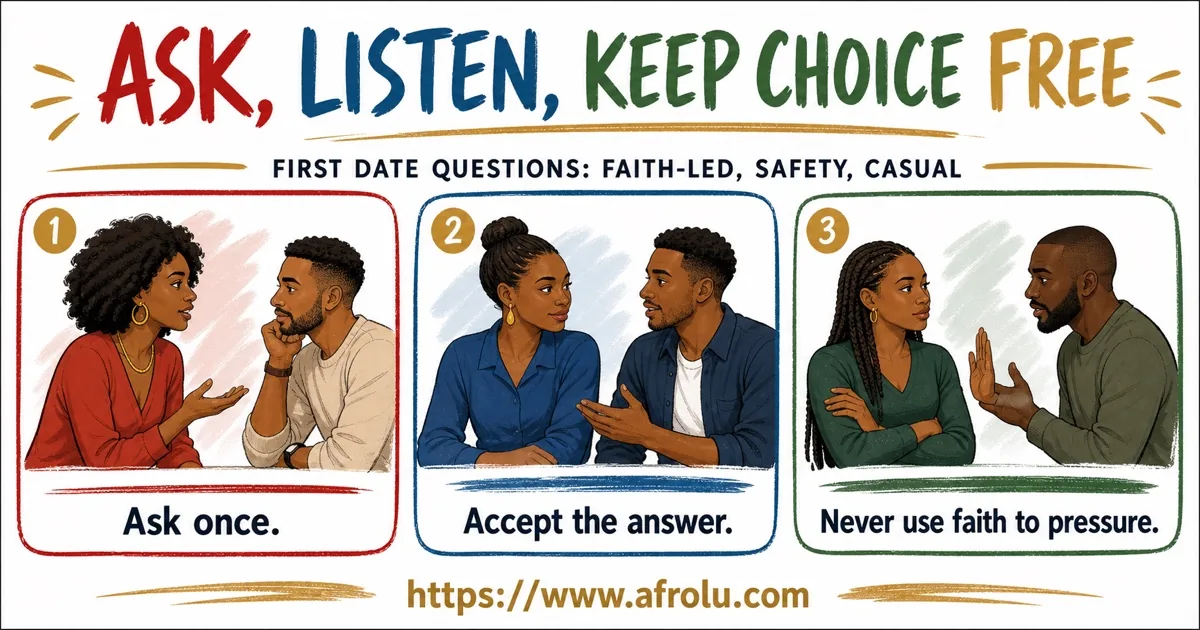
Created for Afrolu: https://www.afrolu.com. Use this overview illustration with the nearby advice before choosing your next step.
Written and edited by Grace Mutiso · Kenya Guides Editor
Ask how faith and casual dating fit each adult's own choices. Clarify what casual means, whether either person sees other partners, and which safer-sex talk is needed before physical contact. An earlier yes applies only to that exact choice at that time. Belief never permits shame, coercion, or an ignored refusal. Keep worship, family, community, money, and health details private until freely shared. Leave when spiritual language or sexual pressure is used to defeat a boundary.
First dates · Faith-Led Daters
How can faith-led adults ask safer first-date questions during a casual dating connection?
A safer first-date question asks for each adult's own view of faith, casual dating, sex, privacy, and endings. It never treats belief as consent. Every physical choice needs a current free yes and space for no. Family, community, health, and money details remain private. Spiritual shame, sexual pressure, fraud, threats, or stalking require leaving and support.
Amara and Joel are faith-led adults considering a casual connection. They meet in a public garden café and begin with their own meanings. Amara wants warmth without a promise of partnership. Joel agrees and says he is also speaking with another adult. They discuss safer sex without using belief to judge desire. Amara says kissing might feel welcome today, but nothing else is agreed. Joel understands that a yes can change before or during any contact. Neither person asks for a place of worship, family name, leader, address, donation record, or health document. They choose one more public date and a brief check-in afterward. Either adult may change or end the arrangement without a moral defence.
Safety and clarity
Keep warmth without losing your standards for faith-led daters
Amara and Joel define a casual connection without asking faith to decide for either person. Their questions make consent, safer sex, privacy, and an ending visible.
Use personal language, separate every physical choice, and keep community access closed. Replace ordinary conversation with protective action when shame, coercion, or threats appear.
Invite a personal view
Faith-led adults can hold different choices without judging or speaking for an entire community.
Define casual in full
Partners, contact, safer sex, privacy, and endings need words beyond the single relationship label.
Ask in the present
Earlier interest cannot decide a later action. A changed answer must be accepted immediately.
Leave shame and pressure
Leave when belief or sex is used for control. Report the person, protect community access, and get urgent support.
Ask about the person's view
Faith and casual dating need a personal answer
People within the same faith can make different adult choices. A question should invite Amara's view rather than announce what her belief must require for dating.
Joel can share his own practice and limits too. Neither person needs to debate doctrine on a first date. Curiosity stays safe when one answer or pass is accepted.

Created for Afrolu: https://www.afrolu.com. Use this real-life scene with the nearby advice before choosing your next step.
Remove the hidden guess
Say what casual includes and what it does not
Casual may describe fewer meetings, no exclusive promise, or a connection without a shared future plan. The word alone cannot settle those important details completely.
Discuss other partners, communication, safer sex, privacy, and how either adult will end things. A clear agreement can remain light. It does not need false certainty or constant access.

Created for Afrolu: https://www.afrolu.com. Use this signal checklist with the nearby advice before choosing your next step.
Keep every choice current
An earlier yes belongs only to that moment
Agreeing to flirt, meet, kiss, or visit does not answer a later question. Touch, sex, safer-sex methods, photos, home access, and future contact need separate current choices.
A person may stop without giving a reason. The other adult should stop immediately and make space. Prayer, guilt, attraction, money, gifts, or past consent cannot turn no into yes.
Protect belonging
Family and worship details can remain private
A place of worship, community leader, family role, or home address may reveal more than an early connection needs. Sharing belief does not open every social tie.
Use broad language if preferred. Do not request member lists, donation records, family contacts, private photos, or live location. Meeting publicly lets both adults leave without exposing others.

Created for Afrolu: https://www.afrolu.com. Use this conversation example with the nearby advice before choosing your next step.
Know when talk is over
Spiritual shame and sexual pressure require an exit
Warnings include calling refusal sinful, claiming divine authority, threatening community exposure, or continuing touch after stop. These acts are not merely difficult first-date questions between adults.
Leave the place, end contact, block and report the account, and tell trusted support. Protect any exposed records. Seek urgent help for threats, fraud, stalking, forced contact, or immediate danger.

Created for Afrolu: https://www.afrolu.com. Use this practical takeaway with the nearby advice before choosing your next step.
Choose the right next tool
Dating Boundaries helps when a stated limit is tested
First-Date Questions helps Amara and Joel define belief, casual dating, safer sex, privacy, and an ending. Dating Boundaries supports limits that must be stated or defended.
Stay with questions while two adults are freely learning. Move to boundary guidance when the answer is known but challenged. Leave immediately when pressure creates danger.
Three clear ways to use this advice
Use these page-specific summaries for a safety check, a decision, and one reminder worth saving.


Four faith and safety moments in casual dating
Two adults share a faith but not one dating rule
Amara says her faith matters deeply, yet she does not seek a serious relationship now. Joel attends a similar tradition but makes another choice. Neither claims to speak for all believers. They explain what casual dating means personally and accept that their answers may not fit.
Ask for the adult's own view and offer yours. Do not use scripture, leaders, family, or shame as leverage. Decline kindly if the values do not work together.A kiss is discussed before the meeting ends
Joel asks whether a kiss would feel welcome. Amara says maybe, then changes to no when the moment arrives. The earlier answer does not bind her. Joel stops, moves back, and continues the public goodbye without complaint. Her faith is not offered as evidence either way.
Treat the current answer as complete. Stop the proposed contact and leave room. Discuss any later physical choice only if both adults freely want another conversation.A place of worship is requested as proof
Amara mentions a weekly faith practice. Joel asks for the worship site, leader's name, and a family contact. She says those details are private. He accepts the limit and returns to a broad question about how rest and community shape her week.
Keep names, addresses, schedules, lists, and family contacts closed. Share a general value if desired. End the subject after one clear privacy answer.Refusal is met with shame and exposure
A different date says Amara owes physical contact because she agreed to casual dating. He threatens to message her community after she refuses. The threat turns the moment into a safety matter. Amara moves toward staff and calls a trusted adult.
Leave, stop responding, block and report the person, and preserve threat evidence safely. Protect community accounts and seek urgent help if pursuit, stalking, or danger continues.What free belief and consent leave possible
Each adult explains personal belief without claiming one rule for everyone.
Casual expectations include other partners, contact rhythm, and an easy ending.
Safer-sex questions arrive before touch, with room for no or changed consent.
Family, worship, community, health, and money information stay personally owned.
Choose the safer response from visible conduct
| Situation | What it may mean | What to do next |
|---|---|---|
| Faith matters to both adults, but their casual choices differ. | Shared belief does not guarantee the same relationship agreement. | Describe each personal choice without judgment. Continue only if the difference can be respected without conversion pressure. |
| A yes to kissing changes before contact occurs. | Consent is no longer present for that action. | Stop the contact immediately and create space. Do not argue from earlier warmth, faith, gifts, or the casual label. |
| Community names, addresses, or family contacts are requested. | Ordinary curiosity may be reaching into private belonging and movement. | Give a broad answer or pass. Keep identifying details closed and watch whether the subject ends without punishment. |
| A refusal brings sexual pressure, spiritual shame, or a threat. | The date no longer offers free consent or emotional safety. | Leave, end contact, block and report the account, tell trusted support, protect records, and seek emergency help when danger is immediate. |
Four lines for belief, safer sex, privacy, and endings
“How do faith and casual dating fit your own choices?”
“I can answer first. Which safer-sex talk is needed before physical contact?”
“Which community or family details should stay private? A broad answer is enough.”
“I need clarity. How can either adult change or end the agreement clearly?”
Know the difference
Faith, casual consent, and the role of Dating Boundaries
Use these questions to learn each adult's beliefs, casual expectations, consent needs, and private areas.
Use that guidance when a limit is already known and needs clear statement, distance, or protection.
Questions reveal a free choice. Boundaries protect it once the answer has been given.

Created for Afrolu: https://www.afrolu.com. Use this nearby concept comparison with the nearby advice before choosing your next step.
Learning a choice and protecting a limit are different jobs
| Type or dimension | What it describes | Best next question |
|---|---|---|
| Personal faith | Describes one adult's values without judging others. | Ask broadly and accept a pass or different view. |
| Casual terms | Clarify partners, contact, sex, privacy, and ending. | Continue only when both adults understand the agreement. |
| Current consent | Applies to one action at one time. | Ask directly and stop whenever the answer changes. |
| Community privacy | Protects people and places beyond the date. | Keep names, addresses, lists, and schedules closed. |
| Spiritual coercion | Uses belief or exposure to defeat a refusal. | Leave, end contact, report, protect records, and get help. |
Five checks before a casual connection becomes physical
Ask the person, not the label
Faith communities contain many adult dating choices. Personal language lets Amara explain her own practice without carrying everyone else's.
Define the casual agreement
Discuss exclusivity, other partners, communication, safer sex, privacy, and endings. A shared word becomes useful only after these details are clear.
Renew consent each time
A free yes can change. Ask about the specific action in the present moment. Stop promptly when comfort or willingness disappears.
Keep community doors closed
Belief can be shared without exposing worship sites, leaders, family contacts, member lists, giving records, or home addresses.
Treat shame as a warning
A person who uses faith to defeat refusal is not seeking mutual understanding. Leave and connect with support rather than debating.
Four ways belief or casual language can hide pressure
Treating faith as one dating rule
Adults within a tradition may choose differently. Ask for personal meaning instead of testing the answer against a stereotype.
Letting casual remain undefined
The word may hide different views about partners, sex, contact, privacy, and endings. Name the terms before relying on it.
Carrying consent forward
A past yes applies only to its moment and action. Ask again, notice comfort, and stop whenever willingness changes.
Debating after spiritual shame
A threat or moral attack does not need a better response. Leave, end contact, preserve safety, and use trusted support.
Use a reviewed resource that matches the decision
This guide focuses on the relationship decision, so it does not rank dating apps. Check current prices, safety tools, and local availability before choosing a service.
Explore the guide library
Show more related guides
Continue with Afrolu
Show more Afrolu guides
Sources used for this guide
Afrolu reviewed these health, research, safety, or public guidance resources while editing this page. They support the behaviour and safety guidance; they do not diagnose any individual described by a reader.
Common questions from faith-led adults considering casual dating
Can a faith-led adult choose casual dating?
Adults make personal choices within their beliefs. Explain your own meaning, hear the other person's view, and decline without shame when the choices do not fit.
What should casual mean on a first date?
Discuss exclusivity, other partners, communication, physical contact, privacy, and endings. Do not assume the shared label already settled those points.
Should we discuss safer sex before kissing?
Discuss what is relevant before the physical action it affects. Direct questions may include protection, health, other partners, and consent.
Does saying yes once cover later contact?
No. Each action needs current consent. Either adult may change the answer before or during contact without owing a reason.
May I keep my place of worship private?
Yes. Share beliefs broadly while keeping names, addresses, schedules, leaders, member lists, and community contacts under your control. Those details can stay closed during an early romantic meeting.
Do I need to introduce family during casual dating?
No. Relatives and other community members are not proof of honesty. Introduce anyone only through a separate, freely chosen decision.
Can a gift create a duty to be physical?
No. Food, transport, donations, or gifts purchase no consent. Keep money independent and leave when payment is used as leverage.
What if faith is used to shame my refusal?
Stop the conversation and leave. End contact, block and report the account, tell trusted support, and seek urgent help for threats.
How can either adult end a casual agreement?
Use plain words that the arrangement is ending. Do not bargain over the decision. Stop further contact when the message is ignored.
When are Dating Boundaries more useful?
Use them when a known limit needs clear words or protection. Questions fit the earlier stage of freely learning each adult's choices.
One thing to do now
Let belief support choice without taking it away
Continue only when both adults can describe the casual agreement and ask direct consent questions. Private community ties stay protected, and either person can change or end the connection freely.