Faith-led dating · casual clarity
Faith-Led Casual Situationship Clarity
For faith-led adults, make a casual situationship clear with personal values, direct terms, current consent, chosen privacy, separate systems, and safe exits.
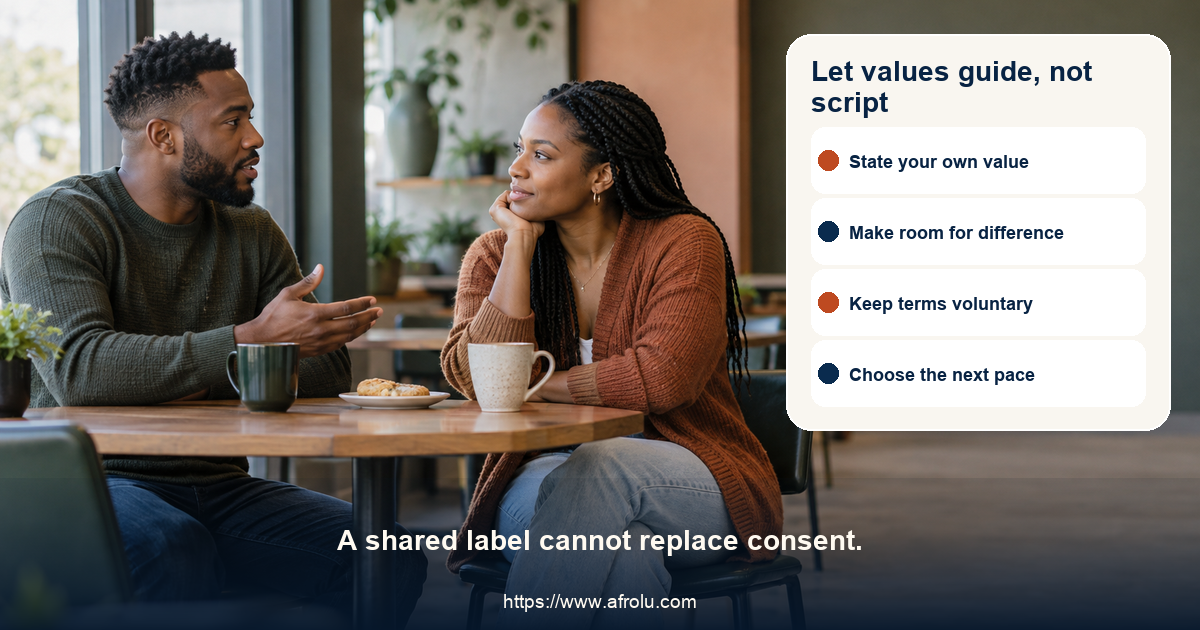
Values can guide without prescribing.
Written and edited by Samira Benali · Faith and North Africa Editor
Let your own values guide your choices without prescribing another adult's role. Make casual terms current, invite difference without recruitment, decide again when a plan changes, keep visibility and support chosen, protect money and systems, and step back if shame, secrecy, access demands, or ignored boundaries reduce freedom.
Relationship clarity · Faith-Led Daters
Is this a personal value I can state, a casual offer I can describe, a difference that needs respect, a date that needs fresh consent, a visibility choice, a request for access, or a pressure pattern that needs an exit?
A faith-led casual situationship is recurring romantic or affectionate contact without a fully shared long-term relationship definition, where one or both adults bring personal values or faith to their choices. It can be ethical and clear when both adults state their present terms, respect difference, keep consent current, protect privacy and systems, and remain free to revise or end.
Amal likes someone whose values matter to them both, but neither wants to assume that similarity answers every question. She says what intimacy boundary suits her, asks what casual means in practice, keeps a date public and time-bounded, declines a request for private account access, and learns that a respectful difference is more useful than an invented agreement.
faith-led dating · casual clarity
Amal holds personal values without assigning another adult a script, and makes a casual connection practical rather than vague
This guide separates values from prescribed roles, casual clarity from moralized ambiguity, respectful difference from recruitment, current consent from assumed access, discretion from isolation, and care from control of money or private systems.
State your own boundary, clarify the current offer, ask what matters for the next plan, make consent specific, keep visibility chosen, protect independent systems, and choose the action that leaves your answer yours.
Guide, do not script
Personal conviction can shape a boundary without controlling another adult.
Make casual current
Lightness still needs truthful practical answers.
Decide again
Every changed plan requires a present voluntary choice.
Protect access
Shame, secrecy, money, and monitoring reduce freedom.
values · individual choice
Faith-led dating can involve commitments, questions, privacy, community, or personal reflection, yet no label tells another adult what you believe, how you practise, which boundaries matter, or whether casual dating fits your life
A faith-led identity can be important without becoming a relationship shortcut. It does not tell you whether someone wants romance, sex, exclusivity, marriage, privacy, public visibility, frequent contact, or a casual arrangement. It also does not tell you how they understand a text, a date, a promise, or a boundary. Treat each of those questions as something two adults can discuss rather than something a label silently settles.
Begin with your own practical values. You might care about a slow pace, physical limits, a certain kind of communication, honesty about other dates, discretion, or not making a future promise you cannot support. Those are usable preferences when you can state them without requiring another person to justify their different view. A boundary describes what you will choose; it is not a demand that another adult arrange their life around your certainty.
Be especially careful when a shared-sounding value is used to close conversation. Phrases such as 'you should understand' or 'this is what people like us do' can make disagreement feel disloyal rather than ordinary. You are allowed to ask what the value means in this connection, and you are allowed to discover that the answer does not work for you. Difference is information, not evidence that anyone is broken.
You can also keep faith private. A new situationship is not automatically entitled to your history, place of worship, family context, community ties, private rituals, or the reasons a particular boundary matters to you. A simple answer can be enough: 'That does not work for me.' The person who respects your limit does not need a complete spiritual biography before accepting it.
casual dating · clear scope
Casual can describe a lighter present arrangement, but it is not a blank cheque for silence about contact, other dates, intimacy, health, privacy, plans, money, or what either adult will do if the arrangement begins to feel different
People often use casual to mean different things. One adult may mean occasional dates without exclusivity, another may mean affection without intimacy, another may mean no daily contact, and another may be open to a future but unwilling to promise one. A mismatch does not require a debate about whose definition is better. It requires a present answer about whether the two offers can coexist without anyone quietly giving up something important.
Ask a question sized to the moment. Before a weekend date, you may only need to know whether you are both comfortable seeing other people. Before intimacy, you may need to discuss consent, health, protection, images, privacy, and a changed mind. Before more emotional investment, you may want to ask whether the rhythm is intended to stay light or whether either person hopes to revisit it. Clear does not mean exhaustive.
Do not use faith language to make a casual answer sound like a moral failure. A person can choose a casual arrangement with care, and another can decide it is not right for them without needing to persuade anyone to change. The useful standard is voluntary truthfulness: can both people say what they want now, hear a different answer, and act in a way that does not punish the boundary?
If the connection becomes hard to describe, return to conduct. Are plans honored? Are questions answered directly? Does affection turn into pressure when you set a limit? Are you expected to provide emotional labour, secrecy, money, or access while being told that asking for clarity is too much? A casual label cannot make an uneven arrangement easier to choose. It can only name an arrangement that is already mutual.
belief · difference · respect
A values conversation should make room for difference: shared faith, different faith, changing faith, or no faith can all exist beside attraction, and none of them gives either adult authority to recruit, correct, test, expose, or manage the other
A thoughtful question can be simple: 'Are there any boundaries or plans you want me to know about before we meet again?' It makes room for the person to name timing, food, alcohol, intimacy, privacy, public settings, or nothing at all. It does not assume that values must be visible or that another adult owes a detailed explanation because faith has appeared in a profile, a conversation, or a first date.
Avoid treating difference as a problem to solve before a connection can be real. You may learn that another person's view of casual dating, intimacy, visibility, or future direction differs from yours. That can be enough to choose a smaller connection or no connection. It is not an invitation to argue them into your pace, invoke shared community, or hold out affection as a reward for becoming more acceptable.
Privacy matters here too. You do not need to introduce a new date to anyone, attend a gathering, share a private network, disclose names, or make a connection visible before you are ready. Someone who asks for secrecy that isolates you is different from someone who respects a chosen private pace. The distinction is whether you can say what you need and retain the option to speak, leave, or seek support.
When a topic feels too charged, return to the next practical action. You can say, 'We do not need to agree about everything, but I need this boundary respected if we continue.' That sentence leaves room for dignity. It keeps the focus on your decision rather than on proving a belief, winning an argument, or turning a casual situationship into a referendum on either person's identity.

Ask what affects the plan, not belief.
dates · consent · changing terms
A value, a prior conversation, a flirtatious message, a shared label, a meal, a ride, or a previous intimate moment does not create consent for a later plan, touch, image, overnight visit, disclosure, or relationship definition
A casual date can be tender without becoming presumptive. You can meet in public, set a time to leave, arrange your own transport, and decide later whether you want another step. If one person believes their values call for a particular pace, they can name it. If the other person chooses a different pace, that answer is not a challenge to overcome. It is the information needed to choose whether the plan still fits.
Check in before the moment where a boundary matters. Ask whether a touch is welcome, whether an invitation home is wanted, whether an image is okay to send, whether the two of you are seeing other people, or whether a longer evening still suits the plan. A vague response, stillness, intoxication, fatigue, pressure, or a changed mind is not something to negotiate around. It is a reason to pause or stop.
Do not make an adult responsible for soothing your disappointment after a no. Someone can be caring and still decide not to kiss, not to drink, not to stay late, not to disclose a private detail, not to have sex, or not to continue the arrangement. Respect is visible in what happens after the boundary: a direct acceptance, not teasing, silence as punishment, moral language, bargaining, guilt, or an attempt to obtain a different answer.
A plan can change in either direction. You may decide a casual connection feels right, that a value matters more than you expected, that the other person's pace is incompatible, or that you no longer want contact. You do not have to predict every future choice at the beginning. You do need to make the current choice freely and leave room to revise it without making a shared value or past intimacy into a debt.

Consent belongs to the moment.
visibility · support · privacy
A casual situationship should not make either adult surrender control over who knows, where they go, which community connections they disclose, what becomes visible online, or whether a personal boundary is explained to people outside the connection
Some people prefer a new casual connection to stay private because it is early, because their life is complicated, because they value discretion, or because no public definition exists yet. Privacy can be entirely healthy when it belongs to both people and neither is required to lie, hide from support, or become more isolated. You can choose a quieter pace without agreeing to an arrangement that makes you harder to reach.
Secrecy changes the balance when one person demands access to your time or body but forbids you from telling anyone where you are, asks you to delete evidence, threatens to expose you, or uses community ties to pressure compliance. Those behaviors are not made respectful by a concern for reputation, values, or privacy. They reduce your choices and can make it harder to leave a situation safely.
Keep a support path outside the connection. A trusted person does not need every detail, but you can retain someone you can call, a way to get home, and access to your own accounts and devices. If you are meeting someone new, choose a plan that does not require you to hand over your phone, location, address, or ability to leave. Support is compatible with discretion.
If visibility becomes a disagreement, focus on what you will do. You might say that you are not ready to share the connection, that you will not pretend someone is a stranger in a way that feels unsafe, or that you will not keep a relationship secret from every support person. A clear boundary is not an accusation. It tells you whether the current arrangement leaves enough room for your privacy and your safety.
systems · scam resistance · autonomy
A values-based or casual connection never needs emergency transfers, financial favors, documents, account access, passwords, verification codes, private-device control, live location, intimate images, or a secret request that would be hard to explain later
Requests can arrive in gentle language: help with a bill, a temporary account issue, a gift, a charitable cause, a ticket, a purchase, an emergency, or a transfer that will be repaid soon. You can care about another adult's difficulty and still decline to move money, receive money, share a code, open an account, or provide a document. An undefined or casual dating connection is not a secure channel for financial systems.
Do not confuse a shared value with a shared financial obligation. Someone may describe a request using duty, compassion, trust, forgiveness, generosity, or a future promise. Those words do not make the request safer. A person who respects your values can hear a limit without interpreting it as a test of your character. Urgency and secrecy are reasons to slow down, not reasons to prove that you are kind.
Digital access deserves the same boundary. You do not need to share a password, location, device, private account, or disappearing image to reassure someone about faithfulness or interest. If a platform, organisation, or family story is mentioned, find independent contact information yourself. A legitimate need can survive a pause; a pressure pattern often depends on making a pause feel morally impossible.
If another adult reacts to a system boundary with anger, spiritualized guilt, threats, or a campaign to make you feel selfish, reduce the access they have to you. You do not need proof that the story is false before declining. The request, the pressure, and the loss of freedom can be enough information to step back, block, report, or ask for help.

Keep access outside the arrangement.
decision rule · autonomy
A good values-based standard should help you choose a next step while you are hopeful, attracted, unsure, or disappointed; it should not require you to predict another adult's future, suppress a question, or defend every boundary as a moral argument
Try writing a one-sentence rule: 'I do not continue a casual arrangement that makes my no into a moral problem,' or 'I can hold my values without asking another adult to perform mine.' A concrete rule is useful because it tells you what to do when a date becomes uncertain: ask a direct question, choose a smaller plan, hold a private detail, decline an invitation, or step back without turning the decision into a verdict.
Test the rule at the next point of change. Can you ask about other dates? Can you say that intimacy is not part of tonight? Can you keep faith or community details private? Can you use your own money and transport? Can you leave if the mood changes? If the answer is no, the arrangement may be asking for more than casual interest. Pause until the next step is one you can freely choose.
Look for evidence that values and casual clarity coexist: a person names their offer, asks rather than assumes, accepts difference, does not use belief to shame you, keeps money and access separate, respects a changed mind, and leaves you able to seek support. Those behaviors do not predict a lifetime outcome. They show whether this present connection is respectful enough to remain optional.
You do not need to choose between conviction and compassion, between a light relationship and honesty, or between privacy and support. You can make a clear casual decision that fits your values today and revise it tomorrow. The essential condition is that the choice remains yours, and that another adult's disappointment never becomes a reason to abandon your boundary, systems, body, or ability to leave.
Eight casual situationships where a value, a term, difference, consent, visibility, access, shame, or a return changes the next move

The assumed shared rule
A date hears faith mentioned and assumes intimacy, exclusivity, or marriage expectations without asking.
Name your own boundary and invite their present answer.The casual label conflict
One person calls the arrangement casual while expecting emotional access, secrecy, or priority.
Ask which practical terms the word is meant to cover.The difference debate
A disagreement about belief becomes pressure to explain, defend, or convert.
Return to the boundary that affects the connection.The changing date
A public plan turns into an invitation home and an expectation of intimacy.
Make a fresh decision before the plan changes.The visibility demand
Someone insists you hide the connection from every support person.
Keep chosen privacy without accepting isolation.The duty request
A financial favor is framed as proof of kindness, trust, or shared values.
Keep money, codes, and accounts separate.The shame response
A clear no is met with moral language, guilt, or a lecture about what you should want.
Treat the reaction as information and reduce access if needed.The pressured return
A person returns after a break and wants immediate intimacy or secrecy.
Ask what they offer now and keep your prior boundary available.Fourteen signs that values and casual clarity remain voluntary, private, current, independently planned, or no longer safe
Values are named as personal choices rather than rules for the other adult.
A casual arrangement can be described in current practical terms.
Difference is heard without recruitment, correction, or shame.
Private faith, community, and family context remain voluntarily shared.
Questions about other dates, health, and intimacy can be asked directly.
A public plan, time limit, transport, and departure remain independently chosen.
A changed mind is accepted without moral pressure or bargaining.
Visibility is chosen rather than demanded or used to isolate.
You retain a support person and an easy way to leave a date.
Money, documents, accounts, codes, devices, and location remain separate.
A request for reassurance does not become surveillance or image pressure.
A casual label does not excuse dishonesty or unequal access.
A return after absence includes a clear present offer.
An ending is respected without threats, guilt, monitoring, or new accounts.
A practical decision map for values, casual terms, difference, dates, visibility, verification, money, a return, and an ending
| Situation | What it may mean | What to do next |
|---|---|---|
| Faith appears in conversation | A personal value or a topic that needs privacy. | Ask only what affects the next plan. |
| Casual is proposed | A lighter offer with terms still to clarify. | Name the question that affects your choice. |
| Beliefs differ | A compatibility question, not a conversion task. | State your boundary and accept a different answer. |
| A date changes shape | An invitation that needs fresh consent. | Decide again before extending time or intimacy. |
| Visibility is requested | A mutual choice or a route to isolation. | Keep social disclosure under your control. |
| Someone asks for proof | Curiosity or a bid for private access. | Decline passwords, location, devices, or records. |
| Money is requested | A financial boundary question. | Keep transfers and accounts outside dating. |
| A no brings shame | A pressure pattern, not spiritual care. | Reduce access and use support. |
| Contact fades | A mismatch or changed capacity. | Ask once or choose your own ending. |
| They return | A new offer or a repeat of old ambiguity. | Assess conduct and terms in the present. |
Twelve complete lines for personal values, casual clarity, difference, privacy, a date, consent, access, a return, and an exit
“There are a few boundaries that matter to me. Are there any you want me to know about before we plan again?”
“When you say casual, what does that mean for contact, other dates, and expectations right now?”
“We may not see this the same way, and I need this boundary respected if we continue.”
“I share that part of my life gradually.”
“I am comfortable meeting there and heading home afterward.”
“I agreed to this date, not to changing the plan after we arrive.”
“I am not choosing intimacy tonight.”
“Before this affects my decisions, are you currently seeing other people?”
“I want this connection to stay private for now, but not in a way that cuts me off from support.”
“I do not transfer money, share codes, or manage accounts in dating.”
“I do not share passwords, live location, or private images as reassurance.”
“This arrangement no longer fits me, so I am stepping back.”
Know the difference
Values-led casual clarity versus values used as pressure
Each adult can state a personal boundary, hear difference, make current choices, keep privacy and systems protected, and leave without shame.
Belief, reputation, duty, affection, or a casual label is used to silence questions, obtain access, force secrecy, or make a no feel wrong.
Values support a connection only when they leave both adults more free to choose.

Mutual terms keep conviction from becoming a demand.
Keep values-led casual clarity distinct from a pattern that uses duty, shame, secrecy, or access to reduce choice
| Type or dimension | What it describes | Best next question |
|---|---|---|
| A personal boundary | It describes what one adult will choose. | Respect it without requiring a defense. |
| A prescribed role | It turns a value into control of another adult. | Return to voluntary present terms. |
| Casual clarity | Scope is named when it affects a decision. | Ask the next practical question. |
| Casual vagueness | A label blocks every useful answer. | Use the lack of clarity as information. |
| A values conversation | Difference can be heard without recruitment. | Keep the focus on the plan or boundary. |
| Moral pressure | Shame or duty is used to obtain compliance. | Step back and restore control. |
| Chosen privacy | Disclosure and support remain in your control. | Keep a safe support path. |
| Isolation | Secrecy limits your ability to speak or leave. | Reduce access and seek support. |
| Independent systems | Money, accounts, devices, and codes remain separate. | Decline unsafe requests. |
| A respectful ending | A no is accepted without retaliation. | Block and report if it is not. |
A simple plan you can use today
Values are personal
Faith can guide a boundary without writing someone else's script.
Casual can be clear
A light arrangement still needs truthful present terms.
Difference is not a defect
Compatibility can be assessed without recruitment or correction.
Consent stays current
Past messages, values, and dates never settle the next choice.
Privacy can include support
Discretion should not isolate you from people or options.
Systems protect freedom
Money, accounts, codes, devices, and private media remain yours.
Questions organised by purpose and depth
Choose a few prompts that fit the moment. This is a reference library, not a list to complete.
Values and terms
Use before you assume a shared label answers a practical question.
- What boundary matters to me?
- What does this arrangement mean now?
Difference and privacy
Use before a conversation becomes a demand for agreement or disclosure.
- What actually affects the next plan?
- What can remain private?
Plan and consent
Use before a date, intimacy, images, alcohol, or visibility changes.
- Can I leave independently?
- What needs a present yes?
Access and exit
Use when duty, money, secrecy, monitoring, or shame enters the connection.
- What restores my control?
- Who can support me if pressure continues?
What deserves a closer look
Begin with your own terms
State the boundary that guides your conduct.
Evidence limit: Do not turn it into another adult's script.
Name the present agreement
Clarify scope when it affects a decision.
Evidence limit: Do not demand a lifetime promise.
Keep conversation voluntary
Ask what matters for the connection and accept privacy.
Evidence limit: Do not recruit, correct, or shame.
Decide again at each change
Make dates, intimacy, images, and endings current choices.
Evidence limit: Do not infer agreement from history.
Choose privacy with support
Keep community and digital disclosure under your control.
Evidence limit: Do not accept isolating secrecy.
Protect ordinary independence
Keep funds, records, accounts, devices, and codes separate.
Evidence limit: Do not act under urgency or moral guilt.
Shortcuts that turn faith, casual dating, privacy, care, or duty into a reason to silence a boundary
Assuming shared beliefs
A label cannot tell you another person's actual boundaries or hopes.
Treating casual as exempt
Truthfulness, consent, safety, and privacy still matter.
Recruiting instead of listening
It makes difference into pressure rather than information.
Letting a date settle consent
Every changed plan needs a present answer.
Confusing secrecy with discretion
Isolation reduces choice and support.
Using duty to bypass a limit
Money and access requests remain unsafe under moral pressure.
Explore faith led dating, navigate interfaith differences, or keep consent current
Choose the guide that fits the immediate decision. An editorial resource can help name a preference or safety pattern, but it cannot guarantee another adult's honesty, availability, or conduct.
Explore the guide library
Show more related guides
Continue with Afrolu
Show more Afrolu guides
Sources used for this guide
Afrolu reviewed these health, research, safety, or public guidance resources while editing this page. They support the behaviour and safety guidance; they do not diagnose any individual described by a reader.
Questions about faith-led dating and casual situationship clarity
Can faith-led adults choose casual dating?
Yes. Adults can choose different present arrangements; the useful questions are honesty, consent, boundaries, privacy, and compatibility.
Does faith tell me what another person wants?
No. Ask about the individual terms that affect the connection rather than assuming a shared script.
How do I describe a faith-based boundary?
State the practical choice you are making and let the other adult decide whether it fits them.
Is asking for casual clarity too much pressure?
No. A direct question about the present arrangement supports informed choice when it can receive any honest answer.
What if our beliefs differ?
Difference can be a compatibility question. You do not need to recruit, correct, or debate someone into your pace.
Do I need to disclose community or family details?
No. Share private context gradually and only when you choose to.
How do I keep a date consensual?
Use a plan you can leave, ask before a change, accept a no immediately, and keep every new choice current.
Can I keep a casual connection private?
Yes, provided privacy remains mutually chosen and does not isolate you from support or make you unsafe.
What if someone asks for money or digital access?
Decline transfers, codes, documents, passwords, devices, location, or private images and verify claims independently.
What if a boundary brings shame or threats?
Reduce access, use block and report tools, keep trusted support available, and seek local or specialist help if fear or pressure continues.
One thing to do now
Choose the next casual step that protects conviction, dignity, and a freely usable no
Choose the smallest next action that preserves your stated values, body, privacy, money, accounts, support, independent movement, and ability to hear or give a no without shame. If a present term cannot be named or a boundary cannot be respected, pause or step back.