Off-duty switchboard · professional casual safety
Take Dating-App Burnout Off the Professional Clock
A practical professional guide to dating-app burnout: reduce app workload, define casual scope, protect work privacy, plan safer dates and close clearly.
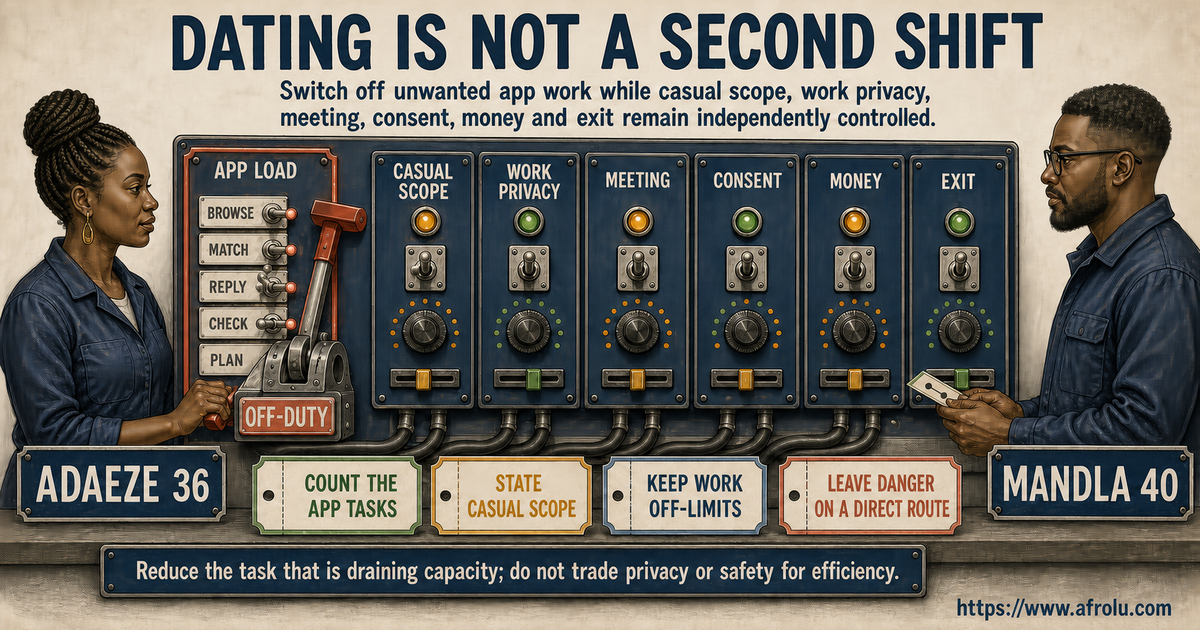
Dating can leave the clock without leaving casual scope or safety vague.
Written and edited by Nia Kato · Profile Advice Editor
Use seven independent circuits: APP LOAD, CASUAL SCOPE, WORK PRIVACY, MEETING, CONSENT, MONEY and EXIT. Turn down browse, match, reply, check or plan without opening another circuit. State non-exclusive scope, keep employer systems private and choose one public meeting with separate return. Then CONTINUE ONE, SHRINK TASKS, CHANGE CHANNEL, PAUSE APPS, CLOSE, SEEK CARE, REPORT FRAUD or SEEK SAFETY HELP.
Dating wellbeing · Professionals
How can a professional reduce unwanted dating-app work while keeping casual scope honest and work, meetings, consent and exit safer?
Dating-app burnout here means unwanted browsing, matching, replying, checking and planning work. It is non-diagnostic shorthand, not WHO's occupational burn-out category. Work strain, casual mismatch, low interest, ordinary uncertainty, persistent impairment, romance fraud and unsafe control need different explanations and different responses.
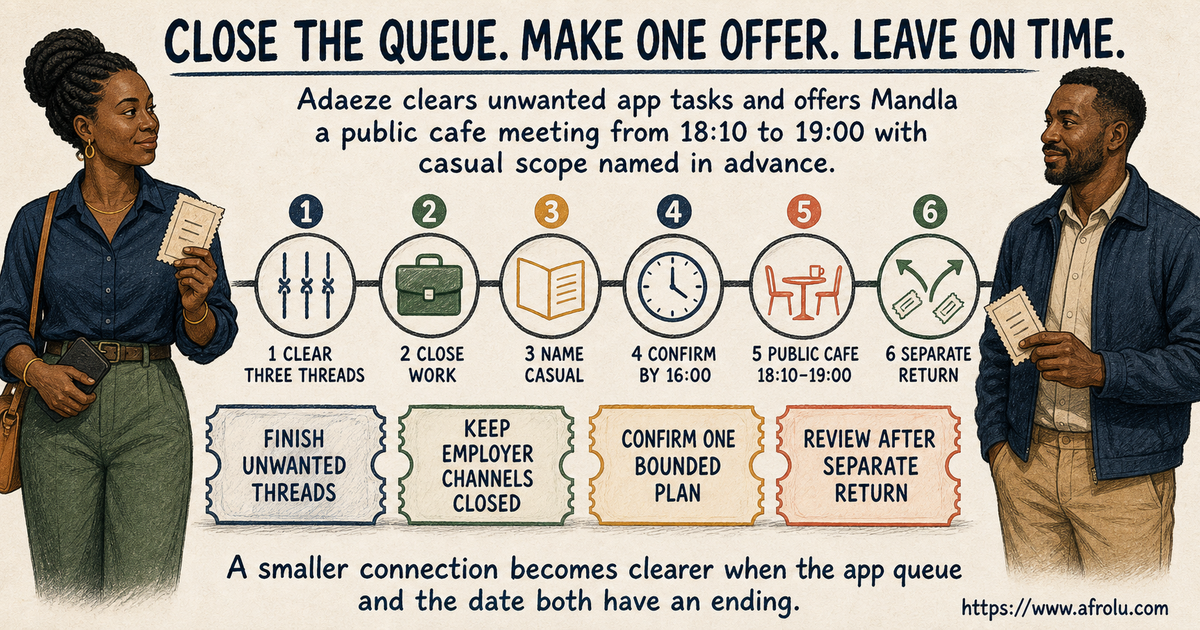
Adaeze, 36, closes five unwanted app threads before offering Mandla, 40, a public cafe meeting from 18:10 to 19:00. They name non-exclusive casual scope, confirm by 16:00, use separate transport and keep work private. Both adults, jobs, places and events are fictional.
The professional casual-safety off-duty switchboard
Switch off dating work without switching off adult clarity
Nia treats professional status as context, casual dating as an agreement and safety as a separate route—not as evidence of worth or a single score.
Count app verbs, state the small offer, firewall work, complete one leaveable plan and follow the highest-risk fact first.
Reduce app load
Close the exact tasks that no longer feel chosen.
State casual scope
Name non-exclusivity, contact and what is not promised.
Firewall work
Employer systems and credentials stay outside romance.
Choose one route
Continue, shrink, pause, close, use care, report or protect.
The unread badge is not overtime
Separate unwanted dating tasks from professional identity and casual interest
This page uses dating-app burnout as everyday, non-diagnostic shorthand. WHO reserves its formal burn-out description for the occupational context, so tired browsing, matching or replying should not be turned into a medical conclusion. The useful question is narrower: which dating tasks have become unwanted, and what part of adult life are they displacing today?
Professional competence can hide the cost of an open queue. Someone who answers clients, manages a rota or travels for work may begin treating every match like another item requiring a polished response. Courtesy then expands into monitoring, drafting and apologising. That pattern says nothing about their worth, ambition or ability to form a relationship; it describes work they did not choose.
Casual interest also needs a precise meaning. It may describe non-exclusive dates without a current commitment, but it does not automatically mean sex, weak care, secrecy or low standards. One adult can want a light present connection and limited app time. The other can want more contact or commitment. Honest mismatch is a fit issue, not proof that either person is careless.
Begin with verbs rather than feelings: browse, match, reply, verify, schedule, meet or close. Circle the verbs you still choose and cross out the ones that borrow focus or rest. If sleep, concentration or ordinary functioning remains badly changed across settings, use qualified local care. If fraud, threats, tracking or defeated closure appears, move directly to protection.
Build the seven-circuit off-duty switchboard
Give app load, casual scope and safety their own controls
The switchboard has seven circuits: APP LOAD, CASUAL SCOPE, WORK PRIVACY, MEETING, CONSENT, MONEY and EXIT. It is a reflection aid, not a productivity system. APP LOAD can be turned down while interest remains. CASUAL SCOPE can stay open while work accounts remain shut. Every circuit answers a different adult decision and can change independently.
Break APP LOAD into five toggles: BROWSE, MATCH, REPLY, CHECK and PLAN. Adaeze may stop browsing, keep one conversation and plan one date. Mandla may answer less often or decide the proposed pace does not suit him. Neither adult owes the app or the other person a full queue merely because a profile remains visible.
WORK PRIVACY covers employer names, internal calendars, client details, badges, devices, travel routes and colleague access. A broad statement such as ‘I am free after six’ is usually enough to plan. Verification should fit the next romantic choice, not recruit workplace systems as identity proof. Use official organisational channels for real work matters, never credentials sent through a date.
EXIT is the master cut-off only for your own access. It does not control the other adult's phone or feelings. You can mute, pause, unmatch or close contact as platform controls allow. If someone returns through work, new accounts, threats or location tracking after closure, stop refining the casual agreement. Preserve useful evidence where safe and seek fitting local help.
Adaeze hands over the app before Friday tea
A fictional casual date becomes smaller, clearer and complete
Adaeze is a fictional 36-year-old working adult, and Mandla is a fictional 40-year-old working adult. Their professions, income and employers are deliberately unnamed. Each controls a home, money, transport, devices, sexual-health choices and exit. The story represents no company, country or professional group, and casual interest gives neither adult a claim on the other.
On Friday afternoon, Adaeze notices that six open conversations have become evening admin. She closes three, archives two and keeps Mandla's thread because she wants one answerable plan. She tells him she is offering non-exclusive casual dates, checks messages only twice a week and cannot move dating into her workplace channels. He can accept, counter or leave.
Mandla accepts the scope and suggests a public cafe away from both workplaces. They agree to confirm by 16:00 and meet from 18:10 to 19:00. Each travels independently and pays ordinary personal costs. Neither shares a badge, calendar, live route, home address, password or identity document. Tea creates no consent for touch, sex or another meeting.
After leaving separately, Adaeze notes that one completed date felt lighter than maintaining six possible ones. She keeps one Friday message window but makes no promise about exclusivity or next month. Mandla remains free to want a fuller connection elsewhere. Their useful result is not continuation; it is a complete handover from vague app labour to a clearly bounded choice.
Read fifteen fuses without adding a score
Observe load, scope, work, consent and safety as separate facts
Five LOAD signals ask whether app hours close, unwanted threads can end and one plan replaces constant checking. These are capacity facts, not tests of enthusiasm. A professional may reply slowly because work is demanding, interest is modest or the chosen rhythm is small. Ask about usable availability instead of treating speed as proof of attraction or respect.
Three SCOPE signals ask whether casual is defined, non-exclusivity is discussed and changed feelings can be voiced. ‘Casual’ cannot do all the explaining. Adults still need separate conversations about other partners, sexual health, public visibility and emotional care. A person can decline casual scope without arguing that serious dating is morally superior, and either adult may revisit fit.
WORK, MEETING and CONSENT signals watch whether personal channels stay personal, public plans retain an ending and each later step receives its own yes. A professional title, polished message or live video does not verify safety. A respectful first boundary is useful evidence only for the next choice; it is not a pass that unlocks documents, body or home.
The SAFETY cut-off sits outside the grid. Requests for money or codes, threats, tracking, image abuse, impersonation, workplace intrusion and renewed contact after closure are not amber points to balance against charm. Act on the concrete risk. Secure accounts and funds, tell a trusted person and use current platform, employer, bank, legal, health or emergency help suited to location.

A pleasant casual connection cannot cancel one concrete danger signal.
Use twelve lines that return the evening
Speak as an adult dater, not as a manager writing a performance note
The scripts work best as short handovers: one present fact, one boundary and one available next step. Avoid explaining every work demand or diagnosing the other person's messaging style. A clear line does not guarantee agreement. It creates a choice that can be accepted, answered with one fair counteroffer or declined without making ambiguity the price of politeness.
For app time, say, ‘I check dating messages on Tuesday and Friday evenings.’ For interest, try, ‘I like this, and I have room for one plan at a time.’ For scope, say, ‘I am offering non-exclusive casual dates, not a committed partnership.’ These lines distinguish access, attraction and relationship structure without turning slowness into a hidden pursuit test.
For work and verification, say, ‘My employer, colleagues and work accounts stay outside dating,’ followed by, ‘I can do one live call; I do not share documents, codes or screens.’ For a meeting: ‘I can meet in public from 18:10 to 19:00.’ Separate travel and money so a date remains possible without creating practical dependence.
Sexual health deserves direct, adult language before sexual contact, not an assumption based on casual scope. Pause may be, ‘I am taking dating apps out of my week and will not promise a return date.’ Closure may be, ‘I am ending romantic contact; do not use my work channels.’ When contact is unsafe, skip the script and protect access.

Clear words return time; they do not turn dating into a performance review.
Put a safety firewall around casual scope
Keep work, identity, sexual health, money and movement independently protected
A casual connection may include affection, sex, companionship or none of these, depending on what adults freely agree. Discuss non-exclusivity rather than inferring it, and talk about protection, testing and relevant partner agreements before sexual contact. Public-health guidance can inform those choices, but it cannot replace local clinical advice or consent to a particular act.
Use personal contact channels and follow workplace policy. A date does not need internal files, client names, access cards, payroll details or a precise daily route. Someone with a public-facing role may need stricter profile and location controls. The boundary protects both worker and organisation; it is not evidence that the dater is hiding another relationship.
Plan a first meeting with a known public place, fixed time and independent return. Tell a trusted person when useful, while sharing only the details needed for support. Alcohol or a paid bill does not create sexual access. A public meeting lowers some risks but cannot verify identity, motive, health status or future conduct, so each later decision stays separate.
Fraud and coercion require different tools from dating fatigue. An urgent fare, investment, equipment purchase or verification fee should not be paid because the sender seems professionally credible. Phishing can imitate ordinary work processes, so confirm any genuine business matter through an independent official channel. Threats or monitoring need safety help, not another casual-scope discussion.
End the app shift with one proportionate route
Choose continuation, reduction, closure, care or protection from present evidence
CONTINUE ONE when the connection is wanted, casual scope is understood and each circuit remains independently controlled. SHRINK TASKS when browsing or checking is the main load. CHANGE CHANNEL only when a personal channel improves a wanted conversation without weakening privacy. These choices solve different problems, so do not stack them merely to appear decisive.
PAUSE APPS when dating work needs to leave the week. A pause requires no return date and makes no relationship promise. CLOSE when interest, scope, pace or practical fit has ended. You do not need to prove burnout, blame work or secure the other adult's agreement. Closure can be courteous and still be final across every personal and professional channel.
SEEK CARE when distress or impairment remains severe, persistent or widespread after app tasks shrink. REPORT FRAUD when money, credentials or fabricated opportunities are involved, using banks, platforms and reporting routes that fit the location. SEEK SAFETY HELP for threats, stalking, image abuse, forced contact or defeated exit. Urgent danger calls for urgent local services.
Review only a safe action and ask what changed: time returned, casual fit became clearer, work stayed private or an exit worked. Do not turn the review into a personal efficiency score. Online dating may remain useful, become occasional or leave your life entirely. The objective is chosen adult connection with capacity intact, not maximum app output.

Choose the route that fits today's facts, not the one that looks most productive.
Eight moments when an app queue crosses casual scope, work privacy or safety
The Monday backlog
Twelve conversations feel like unfinished assignments after a demanding day, although only one still interests you.
Close unwanted threads and keep one answerable plan.The casual shorthand
A match assumes casual means daily contact and sex, while you meant occasional non-exclusive public dates.
Define contact, exclusivity and consent separately.The calendar request
A new date asks for a screenshot of your work calendar to prove that you are genuinely busy.
Share broad availability and keep the calendar private.The office message
A slow personal reply is followed by contact through your public professional profile.
State that work channels are closed and end access if it repeats.The efficient ride
A match offers to collect you from work so the first meeting takes less time.
Choose a public venue and independent travel instead.The conference fare
Professional travel language is used to explain an urgent ticket, fee or equipment request.
Send nothing and verify any claim independently.The casual assumption
Sex is proposed without discussing protection, testing, other partners or the acts each adult wants.
Have the adult sexual-health and consent conversation first.The new work account
Contact resumes through an employer channel after you clearly ended the romantic connection.
Preserve useful evidence, protect work access and seek fitting support.Fifteen fuses for load, scope, professional privacy, consent and direct risk
App hours end — browsing and replying stay inside chosen windows; close the switch when the window ends.
Threads can close — politeness does not keep unwanted conversations alive; finish them without a long defence.
One plan replaces checking — a specific invitation reduces monitoring; release it if confirmation never comes.
Casual scope is stated — non-exclusivity and present intention are spoken; do not let one label carry hidden terms.
Changed feelings are allowed — either adult may ask to revisit scope; accept a different answer or close.
Replies need no work proof — slower contact brings no calendar demand; offer only broad availability.
Employer channels stay closed — personal delays are not bypassed through work; block inappropriate routes.
Verification stays personal — one proportionate live step uses no badge, document, code or shared screen.
Meetings have edges — place, start, ending and confirmation are clear; release vague plans.
Travel stays independent — neither adult controls arrival or return; keep a usable exit.
Money stays separate — fares, fees, investments, gifts and account access are absent; send nothing under pressure.
Sexual health is discussed — protection, testing and relevant agreements receive adult words before sexual contact.
Consent renews — a yes to tea, touch or sex never pre-approves another act, image or date.
Daily functioning stays badly affected — wider impairment continues after app load shrinks; use qualified local care.
Exit is defeated — threats, tracking, image abuse or work-channel contact bypass closure; seek direct safety help.
Ten switchboard questions for one proportionate next route
| Situation | What it may mean | What to do next |
|---|---|---|
| Can the app window end? | Fits: The chosen session closes on time. Needs review: One task still spills over. Stop: Checking occupies every break. | Remove or bound the exact task. |
| Can unwanted threads finish? | Fits: Closure is brief and complete. Needs review: One conversation needs an answer. Stop: Guilt keeps every match open. | Close what you do not choose. |
| Is casual scope explicit? | Fits: Present structure and non-exclusivity are understood. Needs review: One term needs defining. Stop: Casual hides incompatible assumptions. | Name the current offer directly. |
| Does pace fit both adults? | Fits: Contact has mutual, usable edges. Needs review: One fair counteroffer appears. Stop: One person must remain on call. | Shrink the rhythm or close. |
| Can work stay outside dating? | Fits: Employer systems remain private. Needs review: One channel needs redirecting. Stop: Work access is demanded or bypassed. | Close and protect the professional route. |
| Is verification proportionate? | Fits: One personal live check fits the next choice. Needs review: Ordinary uncertainty remains. Stop: Documents, codes or screens are requested. | Share no protected proof. |
| Is the meeting leaveable? | Fits: Public time and separate return are clear. Needs review: One practical detail is missing. Stop: Movement depends on the match. | Do not meet until the exit works. |
| Are sexual health and consent spoken? | Fits: Each decision receives adult words. Needs review: A health or scope question remains. Stop: Casual is used as automatic consent. | Pause the sexual step and discuss it. |
| Did reduced app work restore capacity? | Fits: Time and voluntary interest return. Needs review: Impact needs another safe observation. Stop: Severe impairment remains across settings. | Consider qualified local care. |
| Which fact has the highest risk? | Fits: Ordinary fit remains freely chosen. Needs review: Fraud needs independent reporting. Stop: Threats, tracking or defeated exit appears. | Handle protection before dating fit. |
Twelve off-duty lines for app time, casual scope, work, meetings and closure
“I check dating messages on Tuesday and Friday evenings.”
“I like this, and I have room for one plan at a time.”
“I am offering non-exclusive casual dates, not a committed partnership.”
“A slow answer is not an invitation to use another channel.”
“My employer, colleagues and work accounts stay outside dating.”
“I can do one live call; I do not share documents, codes or screens.”
“I can meet in public from 18:10 to 19:00.”
“I will make my own trip there and home.”
“I do not send fares, fees, gifts or account access.”
“Before sex, I discuss protection, testing and current agreements directly.”
“I am taking dating apps out of my week and will not promise a return date.”
“I am ending romantic contact; do not use my work channels.”
Know the difference
Dating-app load is not the same problem as work strain or casual mismatch
Browsing, matching, replying, checking and planning continue after the adult no longer chooses those tasks.
A wanted, non-exclusive present connection has stated contact, consent, privacy, meeting and exit terms.
Work strain, low interest, ordinary uncertainty, persistent impairment, romance fraud and unsafe control each need a different route.

Name the narrowest supported problem before changing access.
Do not confuse app load with work strain, low interest, mismatch, fraud or control
| Type or dimension | What it describes | Best next question |
|---|---|---|
| Dating-app load | Specific online-dating tasks consume time the adult no longer chooses to give. | Remove, batch or close those tasks. |
| Work strain | Pressure remains inside the occupational context even when every dating tool is closed. | Use workplace and health support suited to the issue. |
| Casual fit | The present non-exclusive offer either fits both adults or it does not. | Define scope and accept a mismatch. |
| Low interest | This connection feels heavy while wider curiosity and daily life remain available. | Close kindly without diagnosing anyone. |
| Pace mismatch | Both adults want contact but need different frequency or planning rhythms. | Make one fair counteroffer, then decide. |
| Ordinary uncertainty | There is not yet enough information for a larger promise or a firm conclusion. | Choose one small, leaveable next step. |
| Persistent impairment | Sleep, focus, enjoyment or ordinary tasks remain seriously affected across settings. | Seek qualified local care rather than self-diagnosis. |
| Romance fraud | Affection carries urgent money, credential, account or fabricated opportunity requests. | Send nothing and use fitting reporting routes. |
| Unsafe control | Threats, tracking, forced contact, image abuse or defeated exit changes the risk. | Protect access and seek current local safety help. |
Use the seven-circuit switchboard in one after-hours review
Count verbs, not matches
Identify browse, match, reply, check, plan and close as separate pieces of dating work.
Define the small offer
Casual scope needs words for contact, non-exclusivity and what is not promised.
Keep work dark
Employer accounts, calendars, colleagues, files and credentials never prove romantic sincerity.
Make one complete date
A public plan with a confirmation point and independent return can replace an open queue.
Renew every consent
Conversation, touch, sex, images and later meetings remain different adult decisions.
Use the direct cut-off
Money tricks, threats, tracking and defeated closure bypass ordinary compatibility review.
Questions for the queue, the casual agreement, the firewall and the exit
Choose a few prompts that fit the moment. This is a reference library, not a list to complete.
Queue
Identify unwanted app work.
- Which verbs consume time?
- Which thread is still wanted?
- When does the app close?
- What returns when it closes?
Scope
Make casual terms usable.
- Is this non-exclusive?
- What contact fits?
- What is not promised?
- When can either adult revisit fit?
Firewall
Protect work and meeting access.
- Which channel stays personal?
- What identity check is proportionate?
- Can the meeting end?
- Is return travel independent?
Route
Follow present evidence.
- Continue one or shrink tasks?
- Pause or close?
- Does care fit wider impairment?
- Does fraud or danger bypass review?
What current classification, dating research, safety and sexual-health guidance supports
WHO limits burn-out to an occupational phenomenon
The official classification supports keeping dating-app burnout as everyday shorthand for unwanted app tasks, not a clinical label.
Evidence limit: It does not diagnose the reader, explain dating distress or prescribe treatment.
SAGE reports dating-app burnout patterns across four survey waves
The peer-reviewed study examined emotional exhaustion, inefficacy and depersonalisation among active single app users over twelve weeks.
Evidence limit: All 493 first-wave participants were U.S.-based adults recruited through Prolific, and 190 completed all four waves; the findings cannot establish African prevalence, diagnose a reader or prove cause.
Springer examines coping with mobile-online-dating fatigue
The open-access study uses interviews to explore fatigue, app practices, meaning-making and coping as social experiences rather than simple personal failure.
Evidence limit: The 27 interviewees were German-speaking heterosexual adults aged 22 to 42 in northern Germany; qualitative context cannot supply African prevalence, a universal pathway or treatment advice.
Pew maps positive, negative and overwhelming online-dating experiences
The national report separates casual dates from casual sex and documents varied app motives, message experiences, harassment and perceived safety.
Evidence limit: The survey covered 6,034 U.S. adults from July 5 to 17, 2022; its percentages cannot be projected onto African professionals or a single reader.
RAINN gives online and in-person risk-reduction tips
The guidance supports protecting work and location details, accounts, photos, money, public meetings, independent transport, boundaries and exit plans.
Evidence limit: Risk-reduction steps cannot guarantee safety, and RAINN's hotline and emergency references are U.S.-specific.
CDC explains STI prevention and testing choices
The public-health page supports direct adult conversations about barriers, testing and mutually understood agreements before sexual contact.
Evidence limit: It is U.S. general information and cannot choose tests, treatment or protection for an individual.
Six ways efficiency can become obligation, ambiguity or unsafe access
Managing every match
A professional tone turns unwanted threads into obligations. Close what you do not choose.
Letting casual mean everything
One label silently covers exclusivity, sex and contact. Define each agreement instead.
Using work as identity proof
Calendars, badges or client details enter dating. Use a proportionate personal check.
Optimising away the exit
Shared transport saves time but removes independence. Keep the first return under your control.
Balancing danger against charm
Many pleasant facts are scored against one direct risk. Follow the highest-risk fact first.
Scheduling the end of a pause
Rest becomes another deadline. Pause without forecasting when interest or capacity will return.
Put one clean boundary between work, app chores and a casual date
Start with the task that is consuming off-duty capacity: browsing, replying, planning or checking. Reduce that task without loosening workplace privacy, casual scope, meeting safety or either adult's right to leave.
Explore the guide library
Show more related guides
Continue with Afrolu
Show more Afrolu guides
Live authoritative sources and the jurisdictional limits this guide keeps visible
Afrolu reviewed these health, research, safety, or public guidance resources while editing this page. They support the behaviour and safety guidance; they do not diagnose any individual described by a reader.
Professional questions about dating-app load, casual scope and safer choices
Is dating-app burnout a medical diagnosis?
No. This guide uses the phrase for unwanted browsing, matching, replying, checking and planning. WHO's formal burn-out description is occupational and should not be stretched into a dating diagnosis. Severe or persistent changes in daily functioning deserve qualified local care, while immediate danger needs immediate local help.
Can a professional want casual dating and fewer messages?
Yes. Interest, relationship structure and message frequency are different decisions. State that the connection is non-exclusive if that is the agreement, offer app hours you can keep and let the other adult accept, counter or leave. Casual scope does not create permanent access or remove ordinary care.
Does casual dating automatically mean sex?
No. Casual describes the relationship agreement, not consent to a sexual act. Adults should discuss what casual means, other partners where relevant, protection, testing and each person's boundaries. Every sexual or digital step requires its own freely given consent, and anyone may change their mind.
Should I prove a busy schedule with my work calendar?
No. Broad availability is enough to arrange a date. Keep employer systems, client details, travel routes, access cards, codes and internal calendars private. A new match can decide whether the offered times fit without inspecting your work. Repeated attempts to bypass that limit are useful conduct information.
How many dating conversations should I keep open?
There is no correct number. Keep only conversations you freely want and can answer without sacrificing important work, rest or safety. One clear plan may teach you more than many suspended chats. Close unwanted threads kindly and do not treat matching as a target that measures romantic worth.
Can I move a match to my professional profile?
Usually it is safer to keep dating on personal channels and follow workplace policy. A public professional profile can expose colleagues, schedule clues or reputation. If a personal channel is changed, share only what the next dating choice needs. Never provide work credentials, files, codes or screens.
What makes a casual first date safer?
Use a known public place, a start and ending, a confirmation point and independent transport. Keep home and workplace private, control ordinary costs and tell a trusted person when useful. These steps reduce some practical risks but do not certify identity, health, intent or future conduct.
What should we discuss before sex in a casual connection?
Discuss consent to the specific acts, protection, testing, relevant partner agreements and what either adult needs afterward. Use current local clinical guidance for personal health decisions. A profile label, payment, prior date or earlier yes cannot replace the conversation or make later consent automatic.
What if affection turns into a work opportunity or fee request?
Keep the opportunity outside romance and verify it through independently found official contact details. Do not send fares, equipment money, application fees, gifts, codes or account access. Professional language and a polished profile cannot validate a transaction. If money moved, contact the provider promptly and use fitting reporting routes.
When should I skip a boundary script?
Skip direct discussion when it may increase danger or when threats, stalking, tracking, image abuse, impersonation, forced contact or workplace intrusion is already present. Preserve useful evidence where safe, secure devices and money, tell trusted support and use platform, employer, legal, health, safety or emergency services appropriate to your location.
One thing to do now
Leave the app shift with time, work, consent and exit intact
Continue only while app hours end, casual scope is plain, pace fits both adults, work and credentials stay private, the meeting is leaveable, sexual health is discussed and every consent remains separate. Shrink, pause or close without proving burnout. Route persistent impairment to qualified care, fraud to reporting and direct danger to safety help.