Professional dating · safety-first long distance
Ghosting for Professionals: A Safety-First Long-Distance Guide
A guide to long-distance ghosting for professionals: set clear contact rhythms, protect work privacy, resist access pressure, and choose a safer next step.
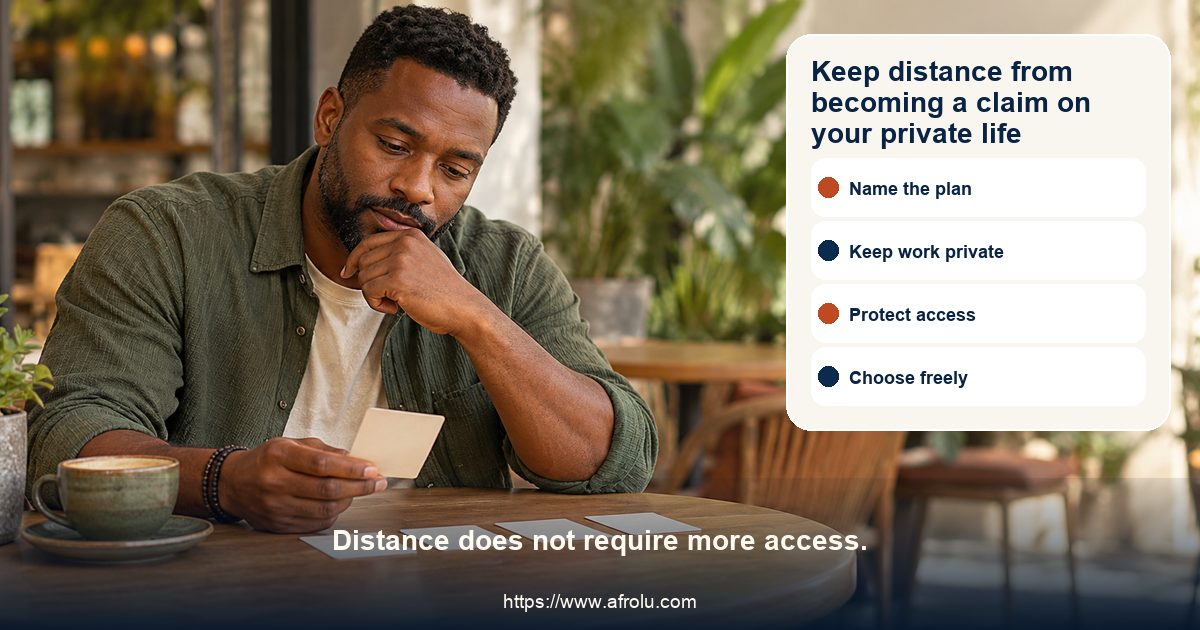
Distance does not require more access.
Written and edited by Tariro Ncube · Diaspora Dating Editor
Do not let a quiet long-distance thread make your life more accessible. Choose a clear contact window and release point, keep work and private systems separate, and let a returning match earn only a small next step through changed conduct. Long-distance dating does not require a live routine, private channel, location, money, account access, documents, images, or body. If someone pressures, threatens, monitors, bypasses a no, asks for financial or professional access, or makes you afraid, reduce contact and seek appropriate support.
Dating behaviour · Professionals
Is this one missed call, a clear distance-aware rhythm, a compatible pace, an honest mismatch, a returning message worth a bounded test, pressure for a private channel or professional access, a financial request, unwanted pursuit, or conduct that makes me feel afraid?
Safety-first long-distance ghosting is a reduced or ended early-dating communication rhythm that leaves an adult wondering whether a planned call or connection will continue. It is not proof that you must become constantly available. The useful distinction is between one quiet gap, a clear rhythm, compatible pace, honest mismatch, observable repair, professional leverage, access or financial pressure, unwanted pursuit, and conduct that creates fear.
Daniela has been speaking to a new match who lives far away and works irregular hours. They agree on a short evening call, but he vanishes until midnight and then asks for her private number and a video tour of her home. Daniela does not debate the request. She keeps the platform channel, says she prefers scheduled calls, and decides that any return needs to respect her workday, privacy, and right to decline.
professional dating · safety-first long distance
Daniela keeps a quiet distance-aware thread from becoming a claim on her private life
This guide separates a missed call from a clear rhythm, compatible pace, honest mismatch, returning message, professional leverage, private-access request, financial pressure, unwanted contact, and fear—without office, status, map, or travel stereotypes.
Name the contact change, set a release point, keep work separate, choose channels deliberately, test repair with a small step, protect systems, and choose the action that restores freedom.
Confirm or release
A missed call does not own your evening.
Keep it private
A new match does not need your employer, systems, or network.
Choose the channel
Distance does not require location, video, or private account access.
Protect choice
Pressure and fear need more than another call.
long-distance dating · safety-first clarity
distance can make a connection feel intense without creating a claim on your private life
Distance can make early dating feel unusually concentrated. Messages may carry more weight because there is less ordinary context, a scheduled call can feel like a major event, and a quiet period can leave room for elaborate explanations. When someone goes silent, it is tempting to fill that space with theories about workload, technology, commitment, or whether you should demonstrate patience by becoming more available. Begin with the observable change: the communication rhythm has shifted and you still get to choose what access you offer next.
A safer long-distance connection does not depend on constant availability. Two adults can name when they are free, what kind of contact they enjoy, and how they will handle changes without giving each other a live view of their routines. A missed call may be disappointing, but it does not automatically require a private number, a detailed schedule, a location share, a late-night video conversation, or a promise that you will keep waiting until the other person returns.
Keep the next step proportionate to what has actually happened. You might ask whether a planned call is still useful, suggest another short time, or allow the thread to rest. If a person returns after ghosting, you can decide whether a smaller conversation suits you. Their explanation may be sincere, incomplete, or neither; you do not have to settle that question before deciding whether the current arrangement protects your attention and comfort.
Distance is not a reason to shortcut trust. It can be tempting to make a connection feel real by sharing private routines, financial details, employer information, documents, intimate material, or a level of emotional access you do not yet want. Let trust grow through repeated conduct that you can observe: clear communication, respect for a no, patience with a slower pace, and no pressure to turn absence into a reason for greater access.
professional life · no leverage
your working life is not evidence of interest and not a resource for a new match
People who work in demanding roles often feel pressure to explain why they are unavailable or why a call moved. You can name capacity without providing a diary of meetings, clients, projects, income, travel, colleagues, or work locations. A clear sentence such as “This week is full; I can talk on Thursday evening” gives enough information for a dating decision. It does not make your professional life an open file for someone you have not yet met or do not yet know well.
After ghosting, a returning match may use work language to create urgency: an investment idea, a referral request, a business opportunity, a need for a work account, a request to receive a payment, or a question about your employer or professional network. These requests need a separate answer from the dating conversation. Attraction, empathy, and apparent shared ambition do not replace independent verification or make you responsible for another adult's professional or financial problem.
Avoid using work status as a measure of relational safety too. A polished profile, confident job title, expensive setting, or impressive story cannot tell you whether someone will respect a boundary. Look instead at the ordinary behaviours that matter: do they confirm a time, accept a shorter call, communicate changes early, hear a no without retaliation, and keep money, credentials, and access outside the connection? Reliability is usually visible in small arrangements before it is visible in grand claims.
You are allowed to keep the dating lane simple. Do not give a new match your work email, office address, company systems, colleagues' names, referral power, client information, device access, or calendar to prove trust after a quiet stretch. If someone treats that boundary as a lack of support or intimacy, the response itself gives you information. A compatible person can understand that professional life remains private while a connection is still new.

Name the pattern before sharing more.
communication rhythm · reversible choices
a long-distance connection needs agreements that remain easy to revise
A useful long-distance rhythm can be modest. Perhaps you exchange messages when both have room, plan one short call, or agree that a busy week should include a clear release rather than an open-ended maybe. The point is not to create a contract that measures devotion. It is to make ordinary coordination less draining and give both people a way to decline, reschedule, or slow down without turning a missed conversation into an emotional trial.
A confirmation point helps. If a call is planned for an evening, both people can decide when it needs to be confirmed and what happens if it is not. You might make another plan, log off, or simply let the evening belong to you. This is different from demanding constant updates. It is a boundary around your own time, not a tool for tracking someone else's movement or testing whether they can prove their interest.
Keep calls and messages in channels that feel safe and proportionate. You can stay on a dating platform, use a public-facing account, or delay moving to a private number until you want to. You do not have to turn on video, show your surroundings, reveal who is nearby, or answer at a time that leaves you exhausted. A person who wants a real connection can tolerate a pace that keeps both adults comfortable and able to choose their level of access.
If someone says that distance requires total availability, constant visual proof, a location share, an immediate private channel, or a long explanation for every missed reply, step back. Those demands do not create closeness; they can reduce autonomy. You can prefer more contact if it is freely chosen, but you do not need to make your life inspectable in order to make a new connection legitimate.
return after ghosting · observable repair
a renewed message is a chance to choose, not an instruction to resume the old level of access
A person may return after a quiet period with a technical problem, workload explanation, family difficulty, apology, or sudden tenderness. Some explanations may be true, some may be incomplete, and some may simply be a way to reopen contact. You do not need to decide their character before you decide whether you want a response. Notice whether they acknowledge the missed arrangement, offer a specific next step, and make it easy for you to say no or ask for a different pace.
If you want to test a return, choose a bounded step. A short scheduled call, a message about availability, or a public meeting only when you are both comfortable can reveal whether the person follows through. Keep the test small enough that you do not sacrifice sleep, work, privacy, or peace to find out. A return that cannot respect a modest boundary is not made more trustworthy by becoming more intense.
Avoid handing over additional information to make up for a gap. You do not need to share a private number, personal address, employer, salary, account, image, or future promise because someone has apologised. Trust does not grow from accelerated disclosure. It grows when both adults can make and keep small agreements, communicate a change early, and accept that an answer may be no.
You may also decide that the rhythm is not for you. A clean ending can be brief and non-punitive: “I am looking for steadier communication, so I am stepping back.” You do not need a verdict on the other person's motives. You only need enough information to decide whether the connection leaves you more able to choose your life or more often waiting for someone else to decide when you matter.

Clear access is safer access.
privacy · money · verification
being far apart does not make financial, digital, or intimate access more reasonable
Long-distance dating can create requests that sound practical: help with an account, a transfer that cannot be made locally, a document check, a code, a work introduction, an investment, a delivery, or a promise that money will be returned when circumstances change. None of these requests belongs inside an early romantic connection. Do not lend, receive, transfer, invest, route funds, share codes, send documents, or use your professional position to solve a match's problem.
Privacy requests can also arrive dressed as intimacy. Someone may want live video from your home, a view of your surroundings, a location share, a private social account, intimate images, a list of people around you, or a detailed schedule to prove that the relationship is real. You can decline each request without proving that the other person intends harm. The fact that a request makes you less free to choose is enough reason to keep the answer simple.
If you meet in person later, keep the first arrangement reversible. Choose a public setting that feels right to you, use transport and timing you control, share only the detail needed for the plan, and remember that a meal, gift, apology, or long conversation does not purchase a private location, touch, photos, continued time, or access to your work life. Consent is not made permanent by distance or anticipation.
When someone accepts these limits, they make it easier to continue safely. When they argue, invent urgency, ask you to keep secrets, press for a change of channel, or turn a no into a debate, reduce the access that is safest to reduce. If the conduct becomes persistent, threatening, coercive, or frightening, treat it as a safety concern rather than an invitation to become a better communicator.
safety · proportionate response
not every quiet period is danger, and danger is not cured by a more convincing message
One unanswered message, an honest change of interest, or a person who cannot sustain the contact level you prefer can be disappointing without being unsafe. You may wait, ask once, or stop pursuing the thread. That proportionate response protects your energy and prevents every gap from becoming a crisis. It also makes it easier to recognise when contact begins moving beyond disappointment into control, pressure, or intimidation.
Financial pressure deserves a hard boundary. A person may tell an emotional story about work, travel, illness, a delayed payment, an investment, a locked account, or a temporary emergency. Even if the story is true, a new romantic connection is not the right verification or payment channel. Keep your money, documents, codes, and professional systems separate, and use independent official information if you decide the claim needs checking.
Repeated unwanted contact, monitoring, threats, blackmail, coercion, humiliation, pressure for intimate material, or attempts to reach you through work or new accounts are not normal long-distance complications. If you feel afraid, controlled, or unable to stop the contact safely, prioritise the action that restores safety. That may include blocking, reporting, preserving relevant material if safe, contacting a trusted person, or seeking urgent local support where appropriate.
You do not need to diagnose a stranger or prove their intent before protecting yourself. A boundary can be based on the impact a pattern has on your freedom, not on whether you can prove the person is dangerous. The goal is not to win an argument about the relationship. It is to keep your attention, systems, choices, and support network from becoming the cost of an uncertain connection.
next step · sustainable attention
choose the action that gives your workday and private life back to you
If the thread has faded, no further message can be a complete decision. Archive it, make the plan you had, and let your attention return to work, rest, friendships, health, or the ordinary parts of life that do not need another person's reply to be worthwhile. If a closing sentence helps, make it about your decision: “I need clearer communication, so I am stepping back.” That line does not require a debate or a response.
If you want to continue, make one clear offer and let the answer guide you. A scheduled short call, a direct question about availability, or a defined public plan if and when you both want it gives another adult room to participate. You do not become demanding by stating what makes a connection workable. You become exhausted when you repeatedly organise an arrangement that the other person will not help create.
Use the experience to refine preferences rather than punish yourself for hoping. You may want earlier confirmation, fewer late-night calls, a slower move to private channels, stronger separation between work and dating, or a smaller restart after silence. Those are not signs that you are closed off. They are useful conditions for a connection that leaves both adults more free, not less.
If the pattern includes fear, persistent unwanted contact, coercion, threats, monitoring, financial manipulation, intimate-image pressure, or blackmail, put safety before politeness. Do not offer a private call, address, or meeting for closure because someone insists that distance makes it necessary. Reduce access, involve support if safe, and seek urgent local help if you think you are in immediate danger. Your right to end contact does not depend on consensus.

Choose the action that protects your private life.
Eight professional long-distance dating moments after quiet contact

A planned call goes quiet without a change message
A professional keeps an evening open and rereads the chat while the other person does not confirm or explain.
Release the slot, continue with your evening, and ask once only if an answer would change a later plan.A match names a busy week and offers a precise alternative
Someone says they are overloaded, suggests a short time, and makes it easy to decline.
Assess the new rhythm by whether it fits your actual capacity, not by the status of their work story.Impressive career language replaces ordinary follow-through
A person sounds established but never confirms a call and becomes irritated when asked for clarity.
Treat small reliability as more useful evidence than presentation or status.Distance is used to demand a number, video, or location
After a quiet stretch, a match says a real long-distance connection requires continuous access and visual proof.
Choose the channel and pace you want; distance does not erase consent or privacy.An apology comes with a short scheduled call
A person acknowledges the missed contact and proposes a brief time without demanding an instant reset.
Choose a bounded test if you want one, then observe whether the arrangement is respected.A new match requests a referral, work help, or employer information
A dating conversation shifts into a request for access to your role, network, system, or clients.
Keep professional resources separate and decline without turning the connection into a transaction.A story becomes a transfer, document, or code request
Someone says distance has created an urgent payment or verification problem that only you can solve.
Do not transact or share access; verify independently if relevant.A clear ending is followed through work or alternate accounts
After you ask for space, the person uses new channels or professional contact details to reopen the relationship.
Reduce access, preserve relevant material only if safe, and seek support if the conduct continues or feels frightening.Signals about contact rhythm, work privacy, private channels, financial pressure, consent, unwanted contact, and safety
They can name a contact window or change without expecting you to stay on standby.
They accept that distance does not require a live routine, private channel, video, or location share.
They respect a shorter call, slower pace, public plan, or decision not to continue.
They do not use work status, confidence, luxury, or polished presentation as a substitute for clear conduct.
They do not request your employer, calendar, colleague details, clients, systems, credentials, or referral power.
They keep money, transfers, codes, documents, investment talk, and account problems outside the connection.
They can return after silence with a concrete next step and room for your answer.
They communicate changes early enough for you to protect sleep, work, and personal time.
They do not pressure you for intimate material, private surroundings, a personal number, or a change of channel.
They understand that a gift, apology, long call, or future promise does not purchase access or consent.
They do not use work channels, alternate accounts, or people around you to bypass a clear request for space.
They can hear that the rhythm does not work for you without retaliation or guilt.
They make repair visible in the next small arrangement rather than in a grand explanation alone.
They never use threats, monitoring, blackmail, financial manipulation, humiliation, or fear to keep you engaged.
Choose a proportionate next move
| Situation | What it may mean | What to do next |
|---|---|---|
| A planned call is not confirmed | There is not enough information to reserve your evening or expand access. | Release the slot and ask once only if a reply would change your plan. |
| A capacity message includes a specific alternative | Limited availability may still fit your preferred rhythm. | Accept, decline, or offer another time based on your own capacity. |
| A work story stays vague across several plans | The connection may not have a workable communication pattern for you. | Stop doing all the coordination and release unconfirmed time. |
| A return includes an apology and a defined call | Repair may be possible without resetting trust or access. | Choose a short test, ask for clarity, or decline. |
| Distance is used to demand constant proof | A request may be reducing your autonomy rather than building closeness. | Keep the channel, timing, and disclosure level you choose. |
| Someone requests professional access | The dating connection is being mixed with work resources. | Keep employers, systems, colleagues, referrals, and credentials separate. |
| A person asks for money, codes, documents, or a transaction | The contact is moving toward financial or digital risk. | Do not transact and verify independently if relevant. |
| A limit is met with alternate-channel or work contact | The issue may be moving from disappointment into unwanted pursuit. | Reduce access and use platform or trusted support. |
| You feel watched, threatened, blackmailed, or afraid | This needs a safety response rather than more long-distance analysis. | Prioritise immediate safety and seek relevant local help. |
| You want one more explanation before leaving | You may be asking someone else to settle a decision you can make yourself. | Use one clear line or choose no contact; neither needs agreement. |
Twelve lines for calls, work privacy, chosen channels, money, consent, exits, endings, and escalation
“Are you still available for our call, or should I make other plans for the evening?”
“I have not heard back, so I am releasing the time. Take care.”
“This week is full for me. I could talk briefly on Thursday, or we can reconnect when there is more room.”
“I am comfortable keeping our conversation here for now.”
“I hear your apology. If we restart, I would prefer a short scheduled call first.”
“I keep my employer, colleagues, systems, and professional network separate from dating.”
“I do not lend, transfer, receive, or handle money in a new connection.”
“I am not sharing my address, live routine, or private account at this stage.”
“I am not comfortable with that. Earlier conversations are not permission now.”
“I am logging off now. Thank you for the conversation.”
“The communication rhythm does not work for me, so I am stepping back.”
“I have asked for no further contact. Please do not use other accounts or work channels to reach me.”
Know the difference
A quiet call, clear distance rhythm, compatible pace, mismatch, repair, professional leverage, financial pressure, and fear need different responses
A person can confirm or release a call, accept a chosen channel, respect work privacy, make a return smaller, keep money separate, and leave you free to say no.
Standby access, constant proof, private-channel pressure, professional leverage, financial urgency, repeated contact, monitoring, coercion, threats, blackmail, and fear make a connection less freely chosen.
Distance works better when neither adult has to make their private life, work, or safety available as proof of interest.

Different distance patterns deserve different boundaries.
Separate a quiet call, clear rhythm, compatible pace, mismatch, repair, leverage, pressure, and fear
| Type or dimension | What it describes | Best next question |
|---|---|---|
| One quiet gap | A message or planned call has not happened, with no wider pattern yet. | Wait, clarify once if useful, or continue with your own evening. |
| Clear distance rhythm | Both adults can confirm, reschedule, and release calls without punishment. | Decide whether the arrangement suits your capacity. |
| Compatible pace | Contact feels voluntary and does not require constant proof or private access. | Continue while autonomy and interest remain mutual. |
| Honest mismatch | Another adult wants a different contact level or relationship direction. | Accept the information and choose whether to leave. |
| Observable repair | A return names the gap and changes the next practical arrangement. | Use a bounded test or decline. |
| Professional leverage | Work resources, status, credentials, or referrals are requested through dating. | Keep professional life separate and decline. |
| Financial pressure | A story becomes a request for money, codes, documents, or a transaction. | Do not transact; verify independently if relevant. |
| Unwanted pursuit | Contact continues after a clear no or expands through work and new channels. | Reduce access and use support. |
| Fear | Threats, coercion, monitoring, blackmail, or fear enter the connection. | Prioritise safety over relationship etiquette. |
Keep long-distance dating, call plans, work privacy, access, consent, and safety clear after ghosting
Distance does not require inspection
A connection can be real without location sharing, constant video, private routines, or total availability.
Work is not dating evidence
Career presentation cannot replace small acts of clarity, respect, and follow-through.
A rhythm can be revised
A contact window and release point reduce standby time without becoming surveillance.
Repair should shrink the risk
A returning person can earn a small next step without receiving more access than before.
Systems remain separate
Money, codes, accounts, documents, devices, employers, and referrals do not belong in early dating.
Fear changes the task
Pressure, unwanted pursuit, threats, and coercion call for protective action rather than better explanations.
Questions organised by purpose and depth
Choose a few prompts that fit the moment. This is a reference library, not a list to complete.
Protect the evening
Keep an unconfirmed call from becoming the centre of your private time.
- When will I release this call?
- What will I do if no answer arrives?
- What part of my evening do I want to protect?
Choose a rhythm
Make contact clear without making either adult inspectable.
- What frequency feels sustainable?
- What channel feels proportionate?
- What would make a call or request too demanding?
Separate systems
Keep professional, financial, and digital access outside dating.
- What work details stay private?
- What will I never transact or share?
- Can I decline without explaining the whole boundary?
Choose protection
Separate ordinary disappointment from conduct that removes choice.
- Has someone asked for money, access, proof, or secrecy?
- Has a clear limit been respected?
- Who can help if contact becomes persistent or frightening?
Look more closely at contact rhythms, work privacy, distance access, repair, financial separation, and escalation
Why a release point beats standby time
A defined call window lets both adults use their evenings without making absence a test of devotion.
Evidence limit: It cannot make another adult communicate.
Keeping work private in early dating
Clear capacity can be shared without offering employer, system, client, calendar, or referral access.
Evidence limit: It does not require hiding your whole career.
Why privacy can remain gradual
Location, video, accounts, routines, and intimate material are optional choices, not proof that a connection is real.
Evidence limit: It cannot guarantee trust.
Testing repair with one bounded step
A short scheduled call can reveal whether a person changes conduct without demanding a full reset.
Evidence limit: It cannot prove future reliability.
Keeping money and digital systems outside romance
Independent verification is safer than transfers, documents, codes, account help, or professional favours.
Evidence limit: It does not judge a claim before evidence exists.
When distance contact needs a safety response
Unwanted pursuit, work-channel contact, threats, monitoring, pressure, and fear justify reducing access and seeking support.
Evidence limit: It is not a diagnosis of the other person.
Shortcuts that let distance, professional leverage, or access pressure take more from you than they have earned
Treating distance as proof of intimacy
A long message history does not make private access, financial help, or constant availability necessary.
Overexplaining work capacity
Detailed professional disclosure can create access without improving dating clarity.
Using status as a safety shortcut
Presentation, title, or luxury cannot substitute for respectful conduct.
Making a return a full reset
An apology does not require a private channel, longer call, or immediate trust.
Handling money requests as romance
Transfers, codes, documents, and accounts must stay outside early dating.
Treating coercion as a distance problem
Threats, monitoring, pressure, and fear need protection, not better coordination.
Use one focused guide for safety, red flags, or a sustainable long-distance rhythm
Choose one resource that helps you make a new dating rhythm more practical. A guide can support a clear choice but cannot guarantee another adult's interest, conduct, or respect for a boundary.
Explore the guide library
Show more related guides
Continue with Afrolu
Show more Afrolu guides
Sources used for this guide
Afrolu reviewed these health, research, safety, or public guidance resources while editing this page. They support the behaviour and safety guidance; they do not diagnose any individual described by a reader.
Questions about ghosting and safety-first long-distance dating
Should I wait for a long-distance match to explain a missed call?
You can ask once if an answer would change your plan, but you do not need an explanation before you release the evening and protect your attention.
Does long-distance dating require a private number or constant video?
No. You can choose the channel, pace, timing, and disclosure level that feel comfortable. Distance does not override privacy or consent.
Can I keep work details private without seeming distant?
Yes. You can name capacity without providing employer, client, calendar, colleague, system, salary, credential, or location details.
What if someone returns after ghosting with a convincing work explanation?
You can hear the explanation and choose a small scheduled restart if you want one. Look for changed conduct in the next arrangement.
Should a professional profile make me feel safer?
No profile, title, status signal, or polished story substitutes for clear plans, respect for boundaries, and independent verification.
What if a match asks for money, a code, or help with an account?
Keep transfers, funds, documents, codes, investments, devices, and account problems outside the connection. Verify claims independently if relevant.
Can I insist on a public first meeting if we eventually meet?
You can choose a public setting, a short plan, your own transport, or no meeting at all. Those decisions remain voluntary.
Does a previous video call count as consent for a new request?
No. Consent is current and specific. You can change your mind about video, privacy, touch, images, disclosure, or continuing contact at any time.
When does ghosting become a safety issue?
Treat repeated unwanted contact, work-channel pressure, monitoring, coercion, threats, financial pressure, blackmail, image pressure, or fear as safety concerns.
How do I close a long-distance thread without being harsh?
Use a short statement about the rhythm you need, then let the decision stand. You do not have to solve another person's motive before choosing clarity.
One thing to do now
Choose the grounded next move that gives your workday and private life back
Choose the smallest next action that protects your time, professional life, private systems, independent movement, current consent, money, support network, and ability to end contact without negotiating your comfort or safety.