Professionals · distance, work and free choice
Long-Distance Dating Red Flags for Busy Professionals
Long-distance dating red flags for professionals: protect work, travel, privacy and money, spot monitoring, and choose a safe next step with clarity today.

Distance needs agreements, not constant proof.
Written and edited by Nia Kato · Profile Advice Editor
A low-pressure long-distance relationship still needs clear agreements about calls, changed plans, work privacy, travel, money, devices, and exits. Name one sustainable limit, then read the response and follow-through. Demands for proof, location, professional access, private travel, funds, account details, repeated calls, threats, or fear deserve reduced access and a safety response rather than more reassurance.
Dating safety · Professionals
Is this long-distance connection using a sustainable rhythm to build trust, or is it using career, travel, technology, money, and future talk to demand more access than you freely want to give?
Long-distance dating involves adults building a connection across separate locations. A red flag is an observed behaviour that changes what access is safe to give, including repeated monitoring, workplace intrusion, financial leverage, coercion, threats, unwanted contact, or fear. These terms describe conduct rather than diagnosing a person's intent or character.
Nadia likes the calm possibility of a distant connection until every delayed reply starts requiring proof, and every future visit starts requiring more money, access, or sacrifice. She makes the relationship smaller enough to observe: a real call window, work privacy, independently controlled travel, no funds or passwords, and one clear boundary. The response tells her whether low pressure is real or only a label for unequal access.
professionals · distance, work and free choice
Nadia turns a vague low-pressure distance dynamic into a rhythm she can actually keep
This guide separates normal work and travel friction from monitoring, workplace intrusion, financial leverage, and other behaviour that makes a long-distance connection less free.
Audit the rhythm, read a changed plan, build a work firewall, keep travel and technology independent, choose a risk-matched ending, and review the access the relationship leaves you.
Make contact sustainable
A clear call window and repair route protect work, rest, and free choice.
Keep the firewall intact
Career systems, colleagues, confidential data, and professional access stay outside dating.
Keep every exit yours
Separate money, lodging, transport, documents, and return from a new distance date.
Read the freedom left
Trust grows where one person's reassurance does not require another person's permanent visibility.
Low pressure is not low accountability
Separate a sustainable long-distance rhythm from a pattern that makes one professional carry all of the uncertainty
Long distance introduces genuine coordination work: time zones, bandwidth, travel cost, care commitments, deadlines, changed calls, and the uncertainty of a relationship that has not yet been tested in ordinary life. Those facts do not automatically make a connection unhealthy. They do make plain agreements more useful. A workable rhythm says how people handle missed plans, what level of contact is realistic, what remains private, who pays their own costs, and when a visit would become sensible rather than speculative.
A red flag is an observed behaviour that changes what access is safe to give. A changed call with a clear apology and a specific alternative may be ordinary friction. Repeated pressure for passwords, work itineraries, office access, money, documents, late-night video proof, private travel, or a decision you are not ready to make is different. The aim is not to diagnose a date from a screen. It is to keep your own practical choices intact while you assess the connection.
Begin with a small boundary that fits the real situation. Nadia can offer two call windows, keep work systems private, say that travel will be independently funded, and decline continuous check-ins. A compatible person can express a preference, propose an alternative, or decide the rhythm does not suit them. If the response is guilt, punishment, repeated monitoring, financial urgency, threats, or fear, the connection needs less access and a safety response rather than a more detailed relationship explanation.
A professional does not have to choose between caring about a connection and caring about a real life outside it. If a relationship only works when every deadline, evening, or trip becomes relationship property, it is not a low-pressure offer. Continue only where the contact rhythm leaves enough room for focused work, sleep, private friendships, and the quiet recovery that makes your choices genuinely yours.
Read the response to a changed plan before reading the excuse
A demanding workweek can be repaired with communication; it should not make one person responsible for soothing every uncertainty.
Use a simple record when you feel confused: what was agreed, what changed, how it was communicated, what happened after you set a limit, and what action you control. 'The call moved twice; no alternative was offered; I said I cannot take calls after midnight; they kept ringing and asked for proof of where I was; I will mute contact and keep my location private.' This is not a case file about someone's identity. It is enough information to decide whether the current offer is workable.
Pay attention to escalation after access is declined. A date may say they understand your job, then expect your employer systems, calendar, travel details, colleagues, or availability to become relationship evidence. They may call an independent hotel or return ticket unromantic, say that paying for a visit proves devotion, or blame you for not rearranging a deadline. A serious connection can need planning. It cannot make professional confidentiality, bodily rest, or financial independence into a loyalty test.
Avoid turning this review into surveillance in return. Do not search workplace contacts, use professional platforms to bypass silence, ask colleagues to investigate, or demand a detailed account of every hour. If the relationship requires that level of monitoring to feel secure, the structure is already not serving one or both adults. Ask one clear question, choose a boundary or a pause, and let the response plus follow-through decide the access you offer next.
This approach keeps both fairness and safety intact. A person may have a credible reason for a difficult week and still be unable to offer the kind of relationship you want. You do not need to punish them or prove a hidden motive. You can choose a different rhythm, ask for a repair, or step away because the present arrangement does not leave enough clarity, peace, or practical room to keep dating well.
Build a career firewall before intimacy turns into workplace access
A relationship does not create permission to enter work systems, read confidential material, contact colleagues, use a professional channel, or influence career decisions.
Keep dating out of workplace channels unless both adults have deliberately chosen a safe personal route, and never use professional contact to press someone who is quiet or has ended the relationship. An email, LinkedIn profile, work phone, company car, conference pass, or colleague's name is not a back door around a boundary. If a date appears at work, contacts a colleague, pressures for access, or threatens career harm after a no, treat it as a safety concern rather than a romance problem.
Power differences deserve extra care. If a connection involves a supervisor, client, supplier, direct report, recruiter, or someone who can influence pay, references, assignments, visas, accommodation, or reputation, apparent interest may not make consent fully free. Pause private dating contact where appropriate, follow applicable policy, and seek confidential independent guidance. A low-pressure label cannot remove a material power imbalance or protect a person from retaliation.
Professional life also includes recovery. A long-distance date does not need access to every evening, weekend, airport transfer, or quiet hour after travel. Protect sleep, family, health, friendships, and unstructured time. If someone calls your recovery selfish or treats your availability as an invoice they can audit, the conflict is no longer simply about different communication preferences. It is about whether a connection respects a whole adult life.
If pressure overlaps with work, do not make a private dating conversation your only response. Use the appropriate professional or confidential support route for the facts you face, especially where there is a power imbalance, unwanted workplace contact, or a threat to career access. You are allowed to protect your reputation and obligations without carrying another person's reaction alone or exposing confidential information to defend a boundary.

A changed plan and an access demand need different responses.
Keep distance planning separate from access pressure
A visit, relocation idea, or future plan can be discussed honestly without becoming a reason to share money, documents, lodging, or a private exit.
Do not treat distance as a reason to absorb another adult's financial risk. A request for a flight, visa fee, medical payment, device, investment, emergency transfer, or account use may be a scam, a boundary test, or a genuine difficulty; you do not have to solve it in a new relationship. Keep your accounts and verification codes private, do not use workplace or family resources, and independently check facts before making any decision. A compelling story should not remove your time to think.
A relocation conversation is also not a commitment plan by itself. It can be healthy to ask about hopes, careers, care obligations, visas, housing, finances, children, and the freedom of each person to remain where they are. It becomes concerning when a date demands that you move, quit, host them, merge finances, disclose documents, or make travel sacrifices before the relationship has enough shared evidence. Future possibility must not erase present autonomy.
If a date insists that a public meeting, separate room, independent return ticket, or limited visit means you do not trust them, name the fact: safety and free choice matter because the connection is new and distance adds practical uncertainty. A respectful person can be disappointed and still accept the plan. A person who blocks an exit, withholds money, traps you in a venue, threatens, or makes you afraid has changed the situation from travel logistics to a safety issue.
A small first visit can also answer a larger question without forcing a future decision. Meet in daylight, retain your own room and route home, and notice how both adults handle ordinary changes. If the plan feels respectful and uncomplicated, there can be another. If it requires secrecy, dependency, financial rescue, or a sacrifice you did not freely choose, you have useful evidence before the cost becomes greater.

A workable distance offer can fit in one clear sentence.
Do not mistake continuous visibility for connection
Video calls, read receipts, location sharing, shared calendars, and social platforms can support a relationship only when both adults freely choose their limits.
Review settings that can quietly expose more than a relationship needs: location sharing, photo albums, cloud storage, device backups, calendar permissions, social media audience lists, saved passwords, and account recovery options. Do not assume an app setting is harmless because it is common. If removing access could provoke someone who is already pressuring or monitoring you, make a safer plan with trusted or specialist support rather than announcing the change in a risky moment.
Repeated calls, messages, fake accounts, unwanted social-media contact, password requests, tracking claims, threats to expose work or private information, and attempts to contact colleagues can be more than awkward digital dating. Preserve relevant evidence if safe, use platform reporting and account safeguards, and seek appropriate local support if you feel afraid. You do not need to answer every message or provide a final explanation in order to make a boundary real.
Digital privacy also protects the connection from becoming a performance. A person who can trust a stated limit, accept a return time, and live without constant proof is easier to date across distance than someone who demands access to calm themselves. If the only way to avoid conflict is to become permanently visible, the relationship is asking for a level of access that does not work for you.
You can choose a more limited digital rhythm without announcing every reason. Turn off a setting, use a personal rather than professional channel, reply when you are ready, or take a break from an account if that supports your wellbeing. If you believe a change could increase risk, do not make it alone or impulsively; think through support, safe devices, account recovery, and the other person's access before acting.
Match the ending to the actual level of risk
A low-pressure connection can end with a concise message; pressure, threats, stalking, or fear may require a quieter and more protected exit.
For repeated pressure, reduce opportunities for bargaining. State one boundary if it feels safe, stop providing work, travel, or location details, remove unnecessary account access, and avoid a private visit to explain your decision. Tell one trusted person the broad situation if that would help you keep the plan. You can block a person who keeps contacting you; keeping a channel open is not a requirement of kindness when it is being used to wear down your boundary.
For threats, coercion, stalking, retaliation, unwanted workplace contact, image-based abuse, financial exploitation, or fear, shift from relationship management to safety planning. Preserve relevant records only when doing so is safe, use platform and account protections, and seek appropriate urgent, local, legal, health, security, specialist, or trusted support. A general article cannot assess immediate danger or tell you which local route is best; if danger is immediate, seek emergency help.
Afterward, restore the parts of your life that distance dating may have crowded out: sleep, work focus, family, friendships, movement, and time without a screen. The lesson is not that a long-distance relationship cannot be low pressure. It is that healthy low pressure leaves both adults more able to live their ordinary lives. When a connection makes one person constantly explain, prove, fund, hide, or recover, its cost is already information.
Do not measure the quality of an ending by how calmly the other person receives it. You can be fair in your own communication and still decide that no further explanation is safe or useful. If a late apology or new promise arrives, look for a specific acknowledgment, a practical change, and time to observe it. You remain free to decline another attempt even when someone finally offers the clarity you once wanted.

Choose the smallest honest move that keeps work and safety yours.
Review the offer by the freedom it leaves in ordinary life
Before adding more time, travel, intimacy, or disclosure, ask whether this connection makes your work, rest, safety, and relationships more manageable or more constrained.
A green pattern might include a date who accepts a deadline, offers a specific alternative after a missed call, respects an independent travel plan, keeps professional boundaries intact, and never makes private access a condition of care. An amber pattern might be a genuine difference in contact needs or geography that deserves a direct conversation. A red pattern is repeated monitoring, pressure, financial leverage, coercion, threats, workplace intrusion, or fear. Do not compress all three into one vague idea of compatibility.
The next move can remain small: retain a public call rhythm, schedule one independent visit, ask a direct question about intent, pause new matches, narrow device permissions, say no to a money request, step away, or seek support. You do not need to book a trip, share a location, merge routines, or make a future promise to prove interest. A relationship worth exploring can tolerate a pace that preserves both adults' real lives.
End with the decision you control: what access do I freely want to offer next? The answer may be more time, less messaging, a clearer agreement, a public meeting, a separate travel plan, no financial sharing, an ending, or a safety response. The central standard is simple: continue only where distance does not turn your job, privacy, body, money, or exit into another person's proof of loyalty.
Use the context you know better than any article can. Immediate threats, unwanted sexual contact, stalking, coercion, or workplace retaliation deserve urgent local help, not another test of communication. In ordinary uncertainty, choose the next move that preserves your professional obligations and your private life at once. A connection that is truly sustainable can make room for both without asking you to disappear into it.
Eight professional long-distance dating moments
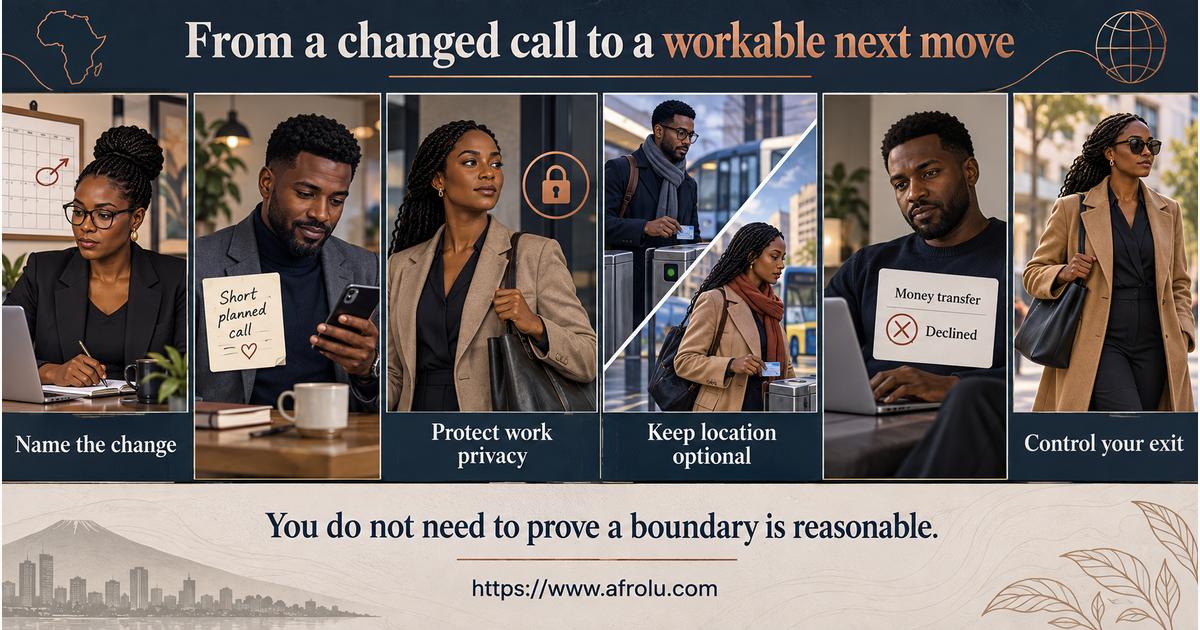
A deadline changes one planned conversation
Nadia's meeting runs late and she sends a short return time. Her date calls repeatedly and demands an office screenshot.
Nadia keeps work systems private, restates the call window, and treats continued demands as a boundary issue.A check-in becomes surveillance
A date asks to keep video on through an evening so they can feel reassured about a work trip.
Kemi declines continuous proof and offers only the level of contact she freely wants.Professional contact is used to bypass a no
After silence, a date messages a colleague through a professional platform for information.
Tariq preserves the contact if safe, protects workplace channels, and reduces access rather than debating privately.Cheap travel becomes an urgent financial ask
A match says a discounted ticket will disappear unless Bola sends money immediately.
Bola sends no transfer or code, keeps financial decisions independent, and declines the urgency.Independent lodging is treated as rejection
A first visit is proposed, and the date says a separate room means the connection cannot be serious.
Sade keeps independently controlled accommodation and assesses the response to the boundary.Arrival information becomes continuous tracking
A date asks for a live location for the whole weekend after a broad arrival message.
Omar keeps location private and shares only what he voluntarily chooses.Two adults want different contact rhythms
One person wants daily calls and the other can sustainably offer two planned calls per week.
They name the mismatch and either find a mutually workable rhythm or end kindly.A disruption receives practical accountability
A flight delay cancels a call, and the date acknowledges it, offers two alternatives, and accepts the professional's later availability.
The response can be read as a repair while future follow-through remains observable.Signals about rhythm, work, travel, technology, money, and safe exits
They accept a broad availability boundary without requesting proof from your calendar, employer, or device.
They repair a changed call with acknowledgement and a realistic alternative.
They repeatedly use late replies, travel, or time zones to justify monitoring or accusations.
They respect professional confidentiality, colleagues, systems, clients, and personal work channels.
They ask for your itinerary, live location, video proof, passwords, or office access as a trust test.
They make independent lodging, transport, or return travel sound like a rejection.
They use a flight deal, emergency, visa, investment, or travel story to pressure you for money.
They can discuss future distance plans without demanding relocation, documents, or merged finances now.
They accept sleep, recovery, family, and work time as part of a sustainable relationship rhythm.
They use gifts, paid travel, or career connections to claim more relationship access.
They contact colleagues, professional platforms, or workplaces after you ask for privacy or space.
They apologise by changing their conduct rather than restarting the same access demand.
They create fake accounts, repeated calls, threats, or unwanted digital contact after a boundary.
They make you afraid to change a plan, withhold information, leave a visit, or end the connection.
Choose a proportionate next move
| Situation | What it may mean | What to do next |
|---|---|---|
| A call changes once with a clear return time | Ordinary work or travel disruption can be repaired without constant proof. | Decide whether the alternative works and keep your existing limits. |
| They demand calendar or office screenshots | A wish for reassurance has turned into a request for professional access or surveillance. | Keep systems private and offer no evidence you do not freely want to share. |
| They dislike your contact rhythm | This may be a genuine compatibility difference rather than a safety concern. | Name the sustainable rhythm and let either adult choose whether it works. |
| They repeatedly call after you set a return time | Repeated contact can become pressure or harassment when a no is ignored. | Mute or block, preserve relevant information if safe, and seek support if you are afraid. |
| They ask for money for travel or an emergency | Urgency and a romantic story do not make financial access a safe relationship step. | Do not transfer money, codes, documents, or account access under pressure. |
| They propose a first visit | Distance planning can be thoughtful when both adults retain independent money, lodging, transport, and a route home. | Use a public, bounded plan and keep each practical exit independently controlled. |
| They object to separate accommodation | Disappointment may be ordinary; making a private stay a condition of the visit is pressure. | Keep the accommodation boundary and cancel the plan if it is not accepted. |
| They contact your workplace after a boundary | Professional channels are being used to bypass personal consent or create career pressure. | Secure work channels, document what is relevant, and seek appropriate confidential support. |
| They apologise and sustain a change | A repair can be meaningful when it is followed by different access behaviour over time. | Choose a modest next step and continue observing rather than overcorrecting. |
| You feel fear around a call, visit, or ending | Fear changes the task from compatibility review to safety planning. | Prioritise a protected exit and appropriate urgent or local support. |
Twelve lines for work, travel, privacy, money, and ending contact
“I can reliably talk on these two windows. I will not be available for constant check-ins.”
“I keep my work calendar, systems, colleagues, and travel details private.”
“I am not sharing a live location. I will send the update I choose when I arrive.”
“If we meet, I will arrange my own travel, lodging, money, and return.”
“I do not send money, codes, documents, or account access to someone I am dating.”
“Daily contact does not work for me. If this rhythm does not suit you, we can end kindly.”
“Do not contact me through work or contact my colleagues. That route is not available to you.”
“Our call changed. Can you offer a specific new time that works for both of us?”
“I am not booking travel while this pressure is unresolved.”
“I do not share passwords, screens, or proof of where I am to establish trust.”
“This dynamic does not work for me. I am ending the dating connection and need no further contact.”
“I will not meet privately to discuss this. I am getting support and need you to stop contacting me.”
Know the difference
A busy week, a genuine mismatch, and access pressure are different facts
A changed call, different rhythm, work boundary, or independently planned visit can be handled by honest communication, repair, and room for either adult to choose.
Proof demands, workplace intrusion, money requests, private travel pressure, repeated unwanted contact, threats, and fear reduce independence and call for a stronger response.
Name the current fact before increasing access or deciding what distance means.

Name the situation before granting more access.
Separate coordination, mismatch, planning, and pressure
| Type or dimension | What it describes | Best next question |
|---|---|---|
| Busy week | A real constraint is named broadly, acknowledged, and followed by a workable repair. | Choose whether the alternative fits your capacity. |
| Monitoring | Proof, location, screens, or continuous contact are demanded to manage another person's insecurity. | Keep access private and reduce contact if a no is not accepted. |
| Low-pressure rhythm | Both adults choose a modest, reliable pattern that respects work, rest, and other commitments. | Review it after ordinary weeks rather than one intense call. |
| Low-accountability dating | One person leaves all planning and uncertainty with the other while retaining access when convenient. | Ask for a usable offer or step back. |
| Independent visit | Transport, lodging, money, documents, and a route home remain under each person's control. | Use a public, bounded plan and keep exits practical. |
| Travel leverage | A flight, room, or gift is used to demand private access, more intimacy, or a promise. | Do not trade safety or consent for a trip. |
| Professional privacy | Work systems and colleagues remain outside a relationship while broad availability can still be shared voluntarily. | State the firewall and use personal channels only. |
| Workplace intrusion | A date uses professional contact, data, networks, or threats to bypass a boundary. | Secure channels and seek confidential support. |
| Safety concern | Threats, stalking, coercion, financial exploitation, or fear require a protected exit, not a better schedule. | Use relevant local, urgent, specialist, or trusted support. |
A sustainable operating system before another distance promise
Distance needs an operating system
A small contact rhythm, repair route, and travel boundary reveal more than constant messaging.
Work privacy is legitimate
A relationship does not need confidential calendar, client, device, colleague, or workplace access.
Reassurance differs from surveillance
A chosen update is not the same as live location, video proof, or account access.
Travel needs independence
Separate funding, transport, lodging, documents, and return make a changed plan possible.
Future talk needs present facts
Relocation or commitment ideas do not settle current questions about money, consent, or practical capacity.
Fear changes the task
When you are afraid, move from relationship management to safety planning and appropriate support.
Questions organised by purpose and depth
Choose a few prompts that fit the moment. This is a reference library, not a list to complete.
Rhythm audit
Use before promising more contact.
- What can I sustain in an ordinary week?
- How will we repair a changed plan?
- What access is not part of the agreement?
Work audit
Use when a date asks for professional information.
- What is confidential?
- What broad truth is enough?
- Which channel stays personal only?
Travel audit
Use before a first visit.
- Who controls transport, lodging, money, documents, and return?
- Can either person change their mind?
- What plan remains public and bounded?
Safety audit
Use when pressure or fear appears.
- What access should I reduce now?
- Who can support me confidentially?
- Do I need urgent local help rather than another call?
Look more closely at work, travel, technology, money, power, and endings
Keep professional and romantic access separate
Use broad availability rather than client details, system access, colleague contact, or workplace channels.
Evidence limit: Workplace policy and power dynamics vary; seek confidential guidance where needed.
Plan before booking
Discuss public meetings, independent transport, lodging, money, documents, and return before a first visit.
Evidence limit: A checklist cannot verify a person or remove all travel risk.
Choose digital access deliberately
Review location, calendar, cloud, device, and account settings before a date treats them as trust evidence.
Evidence limit: Changes may need a safety plan if someone is already monitoring you.
Separate need from obligation
Do not let a moving emergency, flight, investment, or future promise decide a transfer or account share.
Evidence limit: A request is not automatic proof of fraud, but pressure warrants a pause.
Notice material career influence
Pause and seek independent support if a date can affect pay, assignments, references, clients, access, or reputation.
Evidence limit: A guide cannot assess every workplace or legal obligation.
Use a risk-matched exit
Choose a short message for ordinary mismatch and a protected support-based exit for threats, intrusion, coercion, or fear.
Evidence limit: Seek urgent local help when danger is immediate.
Shortcuts that make a distant connection more costly
Calling every delay a red flag
A work disruption can be ordinary; the response, repair, and repeated pattern are more informative.
Treating privacy as proof of disinterest
Professional confidentiality and personal boundaries can coexist with a clear relationship offer.
Making a first visit financially dependent
Shared funding, documents, lodging, or a ride can make a change of mind costly or unsafe.
Using workplace channels to find clarity
Professional contacts and systems are not a back door around silence or a boundary.
Trying to cure anxiety with constant access
Surveillance creates more pressure rather than durable trust.
Waiting for a perfect motive
You can reduce access because the present behaviour is unworkable, even without a final theory about why.
Choose the resource that matches the open fact
Use one guide for a smaller dating rhythm, one for distance planning, or a private tool when observed conduct raises a safety concern.
Explore the guide library
Show more related guides
Continue with Afrolu
Show more Afrolu guides
Sources used for this guide
Afrolu reviewed these health, research, safety, or public guidance resources while editing this page. They support the behaviour and safety guidance; they do not diagnose any individual described by a reader.
Questions about long-distance dating red flags for professionals
Are delayed replies a long-distance red flag?
Not by themselves. Compare the delay with your actual rhythm, whether a changed plan is communicated, whether a repair follows, and whether boundaries are respected.
Should I share my work calendar with a long-distance date?
Only if you freely want to, and usually a broad availability statement is enough. You do not owe client details, screenshots, internal systems, or proof of where you are.
Is live location sharing a sign of trust?
It can be a voluntary logistics choice, but it is not required. It is concerning when a no is not accepted or visibility is used to monitor, accuse, or punish.
Who should pay for a first long-distance visit?
Each adult should retain financial independence and a safe way home. Do not use shared funding, documents, account access, or a private stay to create trust.
What if they say separate accommodation means I do not trust them?
Independent lodging is a reasonable early-visit boundary. A compatible person can be disappointed and still accept it; pressure to remove the boundary is useful information.
Can I contact a date through LinkedIn or work after they go quiet?
No. Keep dating out of professional channels unless both adults deliberately chose them. Work contact is not a route around silence or a boundary.
What should I do if a long-distance date asks for money?
Do not send transfers, codes, documents, account access, or workplace resources under pressure. Pause, independently verify where appropriate, and keep finances separate.
How can low-pressure dating stay serious?
By making a modest, reliable agreement about contact, repair, plans, privacy, and future questions. Low pressure should leave both adults more informed, not more uncertain.
Can I end a long-distance connection by message?
For an ordinary mismatch, a short direct message is often enough. If pressure, fear, threats, or workplace intrusion exist, choose a more protected exit and seek appropriate support.
When does a concern become a safety issue?
Treat threats, stalking, repeated unwanted contact, financial exploitation, coercion, workplace intrusion, or fear as reasons to prioritise safety planning and appropriate local support.
One thing to do now
Let a serious possibility fit the work and life you already have
Choose the smallest dating action that protects work, rest, professional confidentiality, independent travel and money, digital privacy, current consent, an easy exit, and the freedom to decline.