Parents · low-pressure Nairobi privacy check
Low-Pressure Dating Red Flags for Parents in Nairobi
Low-pressure dating red flags for parents in Nairobi: protect home routines, family privacy, money and consent while keeping adult dating calm and independent.
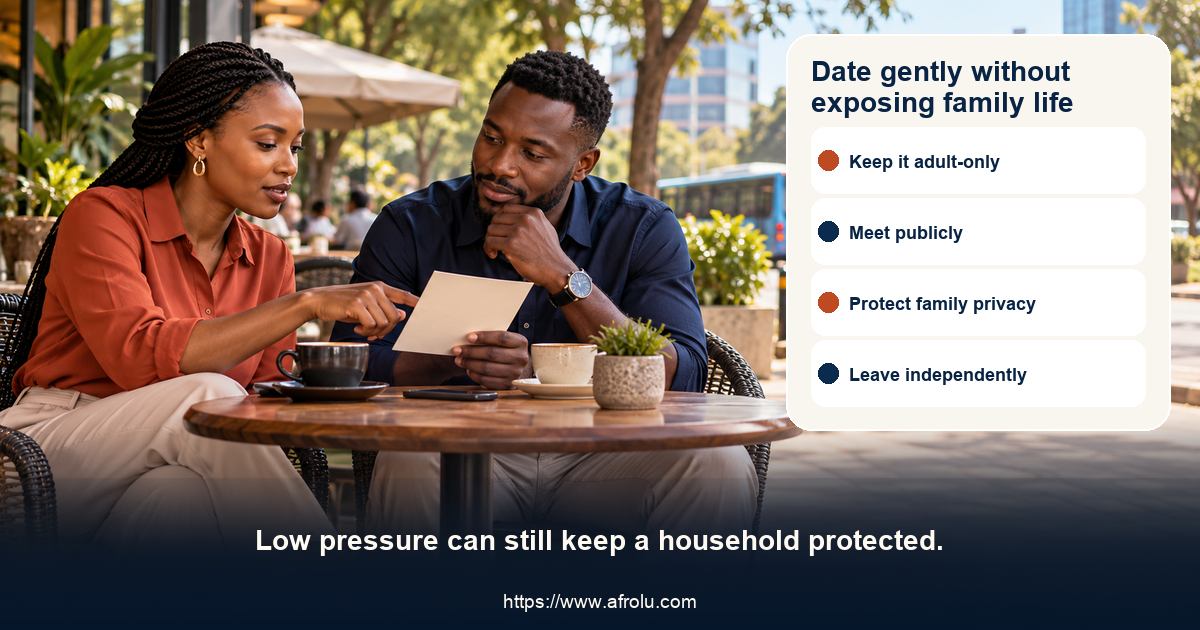
Care for a household does not make your boundaries negotiable.
Written and edited by Grace Mutiso · Kenya Guides Editor
Low-pressure parent dating can remain warm and clear. Keep early plans adult-only and public, layer family information, control transport and home access, keep money and accounts separate, and watch what happens after one boundary. Repeated family guilt, routine intrusion, private-plan pressure, financial requests, monitoring, unwanted contact, coercion, threats, or fear deserve less access and a safety-led response.
Dating safety · Parents Returning To Dating
Is this connection fitting an adult parent’s real life, or are schedule guilt, family detail requests, home access, money, digital visibility, pressure, unwanted contact, or fear making dating less voluntary?
Low-pressure dating red flags for parents in Nairobi are observable behaviours that make time, household privacy, family routines, money, digital access, consent, or an exit less freely chosen. They can include schedule guilt, pressure for home or family access, repeated information gathering, financial leverage, monitoring, unwanted contact, coercion, threats, or fear. The phrase describes conduct and its effect on freedom, not a verdict on parenthood or dating in Nairobi.
Wanjiku enjoys a thoughtful conversation with someone new but notices that a modest public plan quickly becomes questions about her family routines, an offer to collect her at home, and a complaint when she reschedules. Rather than defending every parenting choice, she keeps the date adult-only, chooses independent transport, gives a brief no, and lets the next response show whether the connection fits her life.
parents · low-pressure Nairobi privacy check
Wanjiku keeps adult dating calm without inviting a new connection into her household
This guide separates ordinary scheduling differences from patterns that make a parent’s time, home, family information, money, consent, or ending less freely chosen.
Set a realistic pace, layer family information, make adult-only public plans, keep resources separate, read the first boundary, end proportionately, and review whether the connection protects your whole life.
Keep time parent-led
A real availability window is an offer, not a debt.
Share in layers
A broad truth can be enough while trust is still being earned.
Date as adults first
Public meetings and independent travel do not require household access.
Protect the whole life
Clarify a mismatch and reduce access or seek support when intrusion or fear appears.
low pressure still needs adult boundaries
A gentle Nairobi dating rhythm can protect family life without making care an apology
Parents often enter dating with a practical calendar already in motion: paid work, care, rest, relatives, errands, school-related commitments, and the ordinary unpredictability of a household. A date who understands this does not need every detail. They can work with a broad availability window, a public meeting, and a changed plan without turning the fact that you have responsibilities into proof that they are being treated as less important.
Low pressure is not the same as low information. Before a first or early date, it is reasonable to choose a venue that feels comfortable, arrange your own way there and back, decide how long you can stay, and keep your home address and routine out of the plan. You can say that you are a parent without sharing names, schools, custody arrangements, photographs, neighbourhood details, or a timetable that makes your family easy to map.
A simple scheduling disappointment can be ordinary. An adult may prefer more spontaneous weekends, decide that a different rhythm is not for them, or ask once whether another time works. The concern begins when cancelled plans bring demands for proof, guilt about family commitments, surprise offers to solve childcare, questions that become an interrogation, or pressure to compensate with private access, money, a home visit, or a rapid introduction.
Dating gently can be a strong choice rather than a defensive one. Choose a small adult-only plan, see whether it can be kept, and allow your answer to change if the facts change. You do not owe a date a shortcut into your household because they are charming, generous, nearby, or impatient. A relationship worth exploring can respect the boundaries that let you remain a present parent and a free adult.
keep family information layered
A broad truth is enough until sharing a detail feels freely chosen and practically safe
Begin with categories instead of identifiers. You may say that weekday evenings are limited, that you prefer a daytime plan, or that you share care responsibilities without naming where children spend time, who provides help, where you work, or which routes you use. This is not a test you have to announce. It is an ordinary way to preserve the ability to leave a date without your private life becoming a path back to you.
Digital habits can reveal more than a conversation. A photo background, calendar screenshot, location tag, school reference, local group post, shared contact, or ride request may expose a routine you did not mean to hand over. Review what a new match can see through social accounts, event invites, public profiles, photo albums, and mobile settings. If changing a setting might make someone react or become suspicious, make a safety plan and seek support rather than changing everything in front of them.
Take seriously a pattern of collecting details that have no clear role in the current plan. A person may ask exactly where you live before a public coffee, request family photographs after a declined home visit, question why you cannot meet at a particular time, or contact people around you for background. One curious question is not a verdict. Repetition after a boundary, or an attempt to get the information indirectly, is a different kind of data.
Privacy becomes especially important when ending contact. You do not need to meet at home, explain the details of your family arrangements, or accept a final visit to make a no sound kind. Keep the ending focused on the adult connection. Ask friends and relatives not to share information, remove a person from location-enabled groups if appropriate, and choose a more protected response if contact becomes persistent, intrusive, threatening, or frightening.

Family privacy is a boundary, not a debt.
make the first plans adult-only and easy to leave
A modest public date can show more than a grand weekend that depends on your household
Choose a public place that suits you, not a venue chosen because it is convenient for the person who wants the most access. A daytime coffee, a walk in a familiar public area, or a meal with an independently arranged journey home can be enough for an early meeting. You do not have to disclose your starting point, accept a pickup at home, or rely on a date for a ride because declining feels impolite.
Keep a plan separate from your children and wider household. An adult connection can grow through conversation, reliability, and respectful pacing without an introduction, a doorstep visit, childcare offer, family celebration, or household errand. A person who is genuinely interested in you can understand that access to family life is not an early dating milestone and may never be part of the relationship if you decide it is not right.
Watch how a date handles a change. If a care need, work demand, or personal energy makes a plan impossible, a respectful response might be a broad acknowledgment and a new option. A concerning response may be anger, mockery, insistence on a late private alternative, requests for proof, a sudden offer to come over, or a claim that their inconvenience entitles them to more of your time later. The pattern matters more than a single reschedule.
You are allowed to choose a short plan even when someone says they have travelled far or paid for something. Expense, effort, and romance do not create a claim on your evening, body, home, family details, or a second date. If the plan can only work when you override your own ending time or independent route, it may be asking for access that you have not freely chosen. Postponing is a practical option, not a relationship failure.
keep family resources out of the relationship test
Money, documents, transport, household access, and practical help can remain separate while trust is still being earned
A person may offer a meal, a ride, a gift, or an apparently helpful solution. You can accept, split, or decline according to your comfort. The boundary is whether the offer stays freely given. If a ride becomes a request for your address, a gift becomes an expectation of intimacy, an offer of childcare becomes a way to meet family members, or a paid plan becomes leverage after you change your mind, the generosity has become a claim on access.
Set a simple money rule for dating: do not lend, transfer, receive, invest, hold, or move funds for a match; do not share account details, verification codes, documents, or household financial information; and do not let a travel, health, visa, business, or family emergency create a secret deadline. Use independent official channels if a practical story needs checking. You are not required to carry a new partner’s crisis in order to appear caring.
Household help also needs a clear boundary. It can feel flattering when someone offers to collect you, fix something, bring supplies, supervise a task, or visit during a busy moment. Early on, those offers can make it harder to keep the adult relationship distinct from home access. A good answer can be brief: you have the household covered, and you will meet in a public place when you are free. You do not need to explain why the limit exists.
If a person has learned too much about your routine or resources, choose practical containment. Avoid a private confrontation if that could increase risk, change plans through independent channels, tell a trusted person what you need them not to share, and contact relevant providers or local support if money, identity, location, images, or safety are involved. You can protect a household without proving that every concern has a dramatic label.
notice what happens after a plain no
The quality of a new adult connection is visible in how it handles your limits, not in how persuasive its promises sound
Name one limit that fits the situation: no pickup at home, no family introduction, not this weekend, no private itinerary, no intimate images, no money, no shared account, no late-night change, no contact through relatives, or no further dating. A short statement gives a person an opportunity to show whether they can accept a decision that does not centre them. You do not need a speech about parenting to make it legitimate.
A mistake can sometimes be repaired. A date may hear that a comment about your family was intrusive, apologise without demanding reassurance, and choose a different plan. That is different from someone who calls you guarded, says a caring parent would make time, promises to be better only if you give access now, asks the same question through a new phrasing, or turns a meal or a ride into evidence that you owe them emotional or physical closeness.
Be cautious about people who frame speed as maturity. They may say that adults should not need public dates, that family details are necessary for honesty, that a household visit will make things easier, or that someone who wants a serious relationship should not keep separate plans. Preferences can be incompatible. They cannot make your boundaries irrational. A serious adult relationship can include careful privacy, independent travel, and a pace that protects existing responsibilities.
If saying no begins to make you anxious about retaliation, reduce the amount of access the person has. Do not meet privately to soothe their reaction. Stop giving schedule updates, remove shared digital visibility, ask people around you not to relay information, and choose an exit that does not require their agreement. When there are threats, stalking, coercion, unwanted sexual contact, image abuse, financial exploitation, or fear, seek urgent local help rather than trying to solve it as a dating misunderstanding.

A short boundary can keep family life out of a dating debate.
end the adult relationship without putting family life on trial
A clear no can be private, short, and proportionate to the risk
For a straightforward mismatch, one concise line will do: “I do not want to continue this connection. I wish you well.” You can send it by message, decline a final date, and leave questions unanswered. This is not a judgment on whether the person is good or bad. It is an adult decision about what fits your life. A person may dislike the answer without gaining a claim on your household or your time.
When the issue is repeated pressure, state only the boundary you need to hold. “I am not continuing a connection that asks for access to my home and family life” is enough. You do not need to list every incident, prove intent, or keep responding to every apology. Long explanations can become a new route for a person to bargain with your reasons instead of respecting your decision.
If someone knows your neighbourhood, workplace, family network, or regular routines, make the next moves practical. Tell trusted people not to share information, avoid posting live whereabouts, use public settings for any unavoidable exchange, and keep records of concerning contact if it is safe to do so. A date does not need to be labelled a villain before you decide that protecting visibility around your family is sensible.
If the ending brings repeated messages, contact through relatives, surprise appearances, threats, monitoring, coercion, blackmail, or fear, move from a dating script to a safety plan. Block and report accounts when useful, preserve evidence if safe, consult appropriate local services, and choose urgent support if you are in immediate danger. The right question is not whether you can make them understand. It is whether your household can return to feeling free and secure.

Choose the action that protects your whole life.
review whether the connection protects your whole life
A healthy dating rhythm leaves room for care, work, rest, privacy, support, and a genuine choice to continue or leave
After a few interactions, ask whether the relationship makes your daily life wider or smaller. Can you keep routines private without being punished? Can you cancel a plan without giving proof? Can you say no to a pickup, a home visit, an introduction, money, images, or intimacy without managing a reaction? Do you still have time to rest and speak to trusted people? Those answers matter more than whether the connection looks effortless from outside.
Separate an ordinary mismatch from a pattern of intrusion. Two adults may simply have different weekend capacity or different ideas about how soon a relationship should become serious. That can be disappointing but manageable if each person can leave freely. Repeated pressure for home access, family details, private schedules, financial help, secrecy, monitoring, unwanted contact, coercion, or fear changes what the situation requires. It calls for less access and, when needed, support.
Choose one action sized to the fact. Confirm a public plan, offer another day, keep an address private, decline a ride, ask one question, set a money rule, slow the relationship, end it by message, block a route of contact, or tell someone trusted. You do not need to decide the whole future while standing at the edge of one uncomfortable moment. A practical next action can create enough space to see what happens next.
Parents can date with warmth, hope, desire, seriousness, curiosity, or a wish for companionship while still protecting family life. The strongest measure of a connection is not how quickly it enters your home or calendar. It is whether it respects the structures that let you care for yourself and others without fear, debt, secrecy, or a shrinking ability to choose. Adult dating can stay adult until you decide otherwise.
Eight low-pressure parent-dating moments
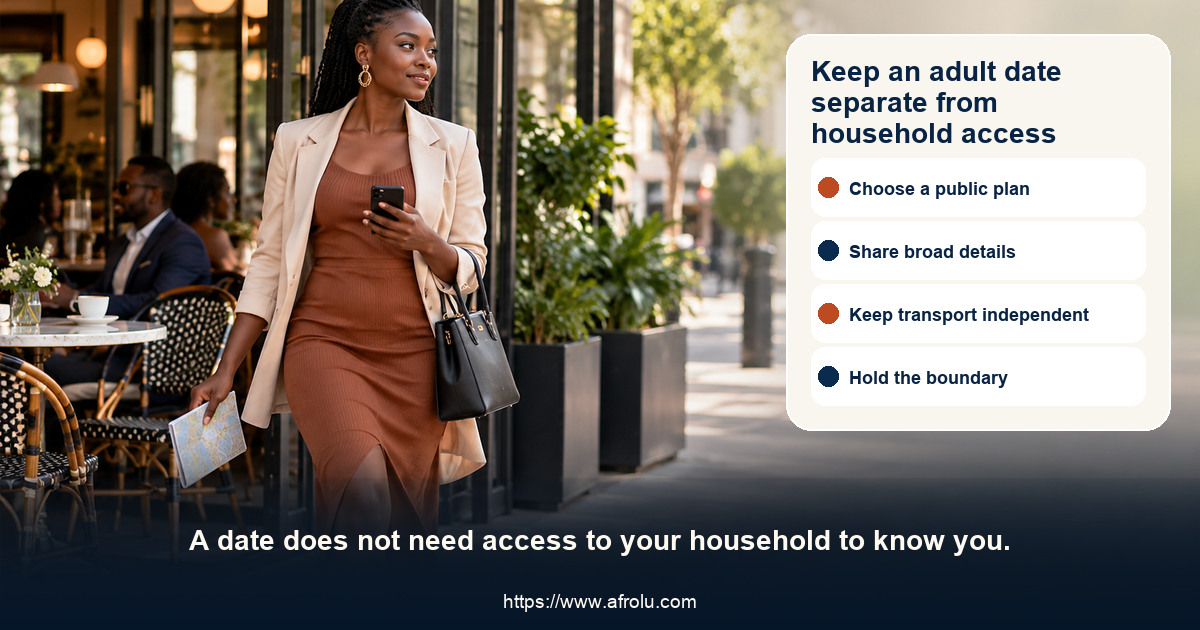
A care need changes an evening plan
A parent gives a broad notice that the date cannot happen and the other person asks for a new time without demanding family proof.
Treat the response as ordinary compatibility information and choose another plan only if it fits your week.A ride offer becomes an address request
A match says collecting you would be easier and becomes insistent when you prefer to meet at a public location.
Keep travel independent and decline a home pickup without explaining the household.Childcare is offered before adult trust exists
A person frames an early offer to solve a busy weekend as proof that they are serious and should be welcomed into family life.
Keep the relationship adult-only and choose a public plan when you are genuinely available.Broad parenting talk becomes a map of routines
A date repeatedly asks for names, schools, exact schedules, addresses, co-parenting details, and family photographs after being given a broad answer.
Restate that the detail is private, then reduce access if the questioning continues.Expense becomes leverage after a short date
A person complains that an early ending wasted their money and asks for a private extension to make the night worthwhile.
Leave on your own schedule; spending never purchases time, intimacy, or a household invitation.Two adults have different weekend capacity
One person wants spontaneous overnight plans and the parent prefers planned daytime dates, with neither person pressuring the other to change.
Name the mismatch honestly and decide whether the rhythm is compatible.A boundary changes the next invitation
After making an intrusive remark about meeting family, a date apologises and plans the next meeting in a public adult-only setting.
Treat the changed conduct as useful evidence while keeping the pace yours.An ending is bypassed through a mutual contact
After a clear no, the person asks someone in your circle where you will be during the weekend.
Ask contacts not to share information, preserve concerning messages if safe, and seek support if the behaviour continues.Signals about time, household privacy, public plans, money, consent, and exits
They can accept a broad availability window without demanding family proof or detailed routines.
They are comfortable meeting in a public place and with you arranging your own transport.
They do not turn a ride, meal, gift, or travel effort into a claim on your time, home, body, or second date.
They understand that early dating can remain adult-only and does not require access to children or household life.
They respect a no to a home visit, pickup, family event, childcare offer, image, money request, or late private change.
They do not collect exact names, addresses, schedules, schools, family photographs, or co-parenting details without a clear current reason.
They can handle a rescheduled plan without sulking, punishment, mockery, or a demand to compensate them.
They do not use helpfulness, generosity, or seriousness as a shortcut into your household.
They keep money, account information, codes, documents, and family resources separate from dating.
They do not ask you to hide a date, change a safe public plan, or withdraw from trusted support.
They make a repair visible in the next plan instead of using an apology to reopen the same boundary.
They do not approach or contact family, friends, workplaces, or routine places to bypass a decision.
They do not make you feel responsible for managing their reaction to a boundary.
They leave you able to rest, care, work, talk to support people, and end contact without fear.
Choose a proportionate next move
| Situation | What it may mean | What to do next |
|---|---|---|
| You must cancel a plan | A family or work conflict can be ordinary; the response shows whether your time is respected. | Give only the broad update you want and see whether a different time can be discussed calmly. |
| They ask to pick you up | A ride can be generous, yet home access and dependent transport change the risk. | Meet independently at a public location or decline the date. |
| They offer childcare or household help early | An offer may feel kind, but it can also accelerate family access before trust exists. | Keep early plans adult-only and separate from household needs. |
| They want exact family details | Curiosity can be normal; repetition after a broad answer can become information gathering. | Keep the detail private and reduce contact if the boundary is negotiated. |
| They pay for a date | Expense can be freely offered; leverage after a boundary is the concern. | Leave or end the plan on your schedule without repayment through access. |
| They request money or account help | Urgency can be a scam or a financial risk you do not want. | Do not transfer, lend, receive, invest, or share codes or documents. |
| They apologise for an intrusive question | A repair matters only if the next conversation and plan change. | Name the needed boundary once and observe conduct. |
| They say adult dating should be spontaneous | Different preferences may be incompatible; pressure is not a preference. | Choose the rhythm that fits your life or end the mismatch. |
| They contact people around you after an ending | Indirect contact can turn curiosity into a boundary bypass. | Ask others not to share details, block accounts, and preserve evidence if safe. |
| You feel fear or your household feels exposed | The concern has changed from dating pace to safety. | Use a protected exit and relevant urgent local support instead of further negotiation. |
Twelve lines for time, privacy, transport, money, consent, and ending
“I date around real responsibilities, so I plan ahead and keep early meetings short.”
“I am getting to know you as an adult. Meeting my family is not part of this stage.”
“That family detail is private. I have shared the amount of context I want to share.”
“I will make my own way there and back. Let us meet at the venue.”
“I do not host early dates at home. A public plan works for me.”
“I do not lend, transfer, receive, or move money in a dating connection.”
“I appreciate the thought, and I have the household covered.”
“I can stay until this time, then I am leaving as planned.”
“I am enjoying the date, and I am not agreeing to that.”
“I heard the apology. I need the next plan to respect the boundary I named.”
“I do not want to continue this relationship. Please do not contact my family or people around me.”
“I am not discussing this further. I am taking steps to protect my privacy and need no more contact.”
Know the difference
A schedule change, a practical mismatch, mounting intrusion, and fear need different parent-dating responses
A person can accept a broad family commitment, meet publicly, respect adult-only dating, keep resources separate, accept a current no, and alter the next plan after impact is named.
Schedule guilt, household access pressure, repeated family-detail requests, financial leverage, monitoring, unwanted contact, coercion, threats, or fear turn dating into a claim on a parent’s private life.
The appearance of helpfulness does not decide the risk. The pattern and your freedom to choose do.

The pattern and your freedom decide the next move.
Separate a schedule change, a mismatch, intrusion, and fear
| Type or dimension | What it describes | Best next question |
|---|---|---|
| A schedule change | A parent gives a broad update and the date can reschedule without demanding family proof. | See whether the practical response fits both lives. |
| Family guilt | A cancelled plan is used to extract more time, private details, or a compensating favour. | Keep the boundary and choose less access. |
| Adult-only dating | Two adults build trust before anyone has a role in family life. | Let any introduction remain parent-led and gradual. |
| Household access pressure | Gifts, charm, childcare offers, or future talk are used to make early access sound owed. | Keep children, home, and routines outside the connection. |
| A repair | A careless comment is heard, acknowledged, and followed by different conduct. | Observe whether the changed plan holds over time. |
| Routine intrusion | Home, family, workplace, schedules, or contacts become routes around a boundary. | Reduce visibility and seek support if it continues. |
| Generosity | A date can offer a meal or plan without expecting access to private family life. | Accept, split, or decline freely. |
| Financial leverage | Urgent money, transport, documents, or account access are framed as a test of care. | Keep resources separate and verify independently. |
| A safety concern | Threats, stalking, coercion, unwanted contact near routines, or fear appear. | Use a protected exit and appropriate local support. |
Start with an adult dating plan that fits your real life
Treat availability as a choice
Family time can be offered freely; it is not a debt created by someone else’s dating interest.
Keep plans modest
A short public date with independent travel can reveal more than a dramatic weekend promise.
Layer family information
Names, routines, addresses, images, and former-family details can stay private early on.
Separate adults from household life
An adult connection can develop without early access to children, home, or care arrangements.
Read the response to care
A compatible person can handle a family need without turning it into jealousy or leverage.
Match an ending to risk
Use a short close for mismatch and a more protected route when intrusion or fear appears.
Questions organised by purpose and depth
Choose a few prompts that fit the moment. This is a reference library, not a list to complete.
Before an early plan
Make a date fit the life you already have.
- What public venue and independent route suit me?
- What time can I offer without displacing care or rest?
- What family details stay private today?
Before sharing a detail
Use a privacy pause.
- Does this person need this information for the current plan?
- Could this detail reveal a household routine or another person’s privacy?
- Would a broader answer be enough for now?
When help is offered
Keep generosity separate from access.
- Do I actually need this help?
- Would accepting it reveal my home or family routine?
- Can I decline without making a debt?
Before continuing
Check whether the adult connection still leaves you choices.
- Can I say no without managing their mood?
- Does the pace protect work, care, rest, and support?
- Would a smaller next step restore freedom?
Look more closely at pace, privacy, plans, resources, boundaries, and endings
Low pressure can be clear
Describe a realistic dating window, a public first plan, independent travel, and the amount of contact that fits your life without giving an account of family logistics.
Evidence limit: No guide can decide a parent’s capacity or family choices.
Layer details rather than defend them
Keep addresses, routines, photographs, names, former-family details, calendar access, and location data under your control while a connection is new.
Evidence limit: Changing digital settings may need a safety plan if another person could notice and escalate.
Keep early dating adult-only
Use public venues, independent travel, a visible finish time, and household-free plans so an adult connection can be evaluated on its own terms.
Evidence limit: A public plan cannot eliminate every risk.
Help should not purchase access
Pause money, transport, documents, codes, household assistance, and invitations that make a new date part of family life before trust exists.
Evidence limit: A helpful offer is not proof that every person has harmful intent.
The first no supplies useful evidence
Notice whether a date accepts a reschedule, public plan, no home visit, no family detail, or no money without turning it into a loyalty test.
Evidence limit: One awkward interaction can be repaired; recurring pressure changes the pattern.
Risk sets the amount of contact
Use a clear adult-only close for a mismatch and a support-led exit when unwanted contact, threats, stalking, coercion, or fear enter the picture.
Evidence limit: Blocking alone may not resolve every safety concern.
Shortcuts that make parent dating less freely chosen
Apologising for family commitments
A parent can be considerate without treating care as an inconvenience that requires repayment.
Using a household introduction as proof
Family members should not be recruited to validate a new adult connection.
Sharing a detailed schedule too early
Routine information can make a household easier to monitor or approach.
Calling every time mismatch a red flag
Different capacity can be an ordinary incompatibility when both adults are respectful.
Accepting a rescue story as care
Help becomes leverage when it purchases access, money, gratitude, or a quicker pace.
Meeting privately to calm an ending
A date’s wish for closure does not override family privacy or a safer exit.
Choose one resource that fits the fact in front of you
Use a slower dating guide to protect pace, a parent boundary route to make a limit practical, or a serious-dating guide when you want to explore intent without speeding up household access.
Explore the guide library
Show more related guides
Continue with Afrolu
Show more Afrolu guides
Sources used for this guide
Afrolu reviewed these health, research, safety, or public guidance resources while editing this page. They support the behaviour and safety guidance; they do not diagnose any individual described by a reader.
Questions about low-pressure dating red flags for parents in Nairobi
Can I date without sharing much about my family?
Yes. A new date needs enough information to make the current adult plan work, not names, addresses, schedules, photographs, or private family history.
Is it rude to refuse a home pickup?
No. Meeting at a public venue and arranging your own transport are ordinary ways to protect location and a free exit.
Should a person I date meet my children early?
No. An adult relationship can develop without an early introduction. Any family access should be parent-led, gradual, and never used as proof of love.
What if a date is upset when I cancel for a family reason?
Disappointment is possible. The concern is guilt, demands for proof, punishment, or pressure to compensate with more access.
Can I accept a meal or a ride?
You can accept, split, or decline freely. The issue is whether generosity remains freely given or becomes leverage for time, intimacy, home access, or another date.
What if someone offers childcare or household help very early?
You can decline without explanation. Early help can blur adult dating and household access before you have enough trust.
How do I keep a dating profile from exposing routines?
Review location tags, photo backgrounds, public posts, calendars, linked contacts, and details that reveal where you live, work, or care for family.
What if someone asks detailed questions about my former relationship?
Share only what you freely want to share. A date does not need a full family history to respect your present boundary.
Can I end a connection by message?
Yes. A short adult-only message can be enough for an ordinary mismatch. Choose less direct contact if a discussion could create pressure or fear.
When should I seek outside support?
Seek urgent or specialist local support when there are threats, stalking, coercion, unwanted sexual contact, financial exploitation, image abuse, repeated unwanted contact, or fear.
One thing to do now
Let adult dating stay adult until you freely choose otherwise
Choose the smallest next action that preserves adult-only dating, family privacy, independent transport, current consent, money and data boundaries, trusted support, and a genuine ability to change or end the plan.