Casual now, clear choices
A Clear Casual Dating Agreement for Nairobi Parents
Nairobi parent guidance on casual structure, future intent, consent, childcare and family privacy.

Clarity protects a stable home.
Written and edited by Grace Mutiso · Kenya Guides Editor
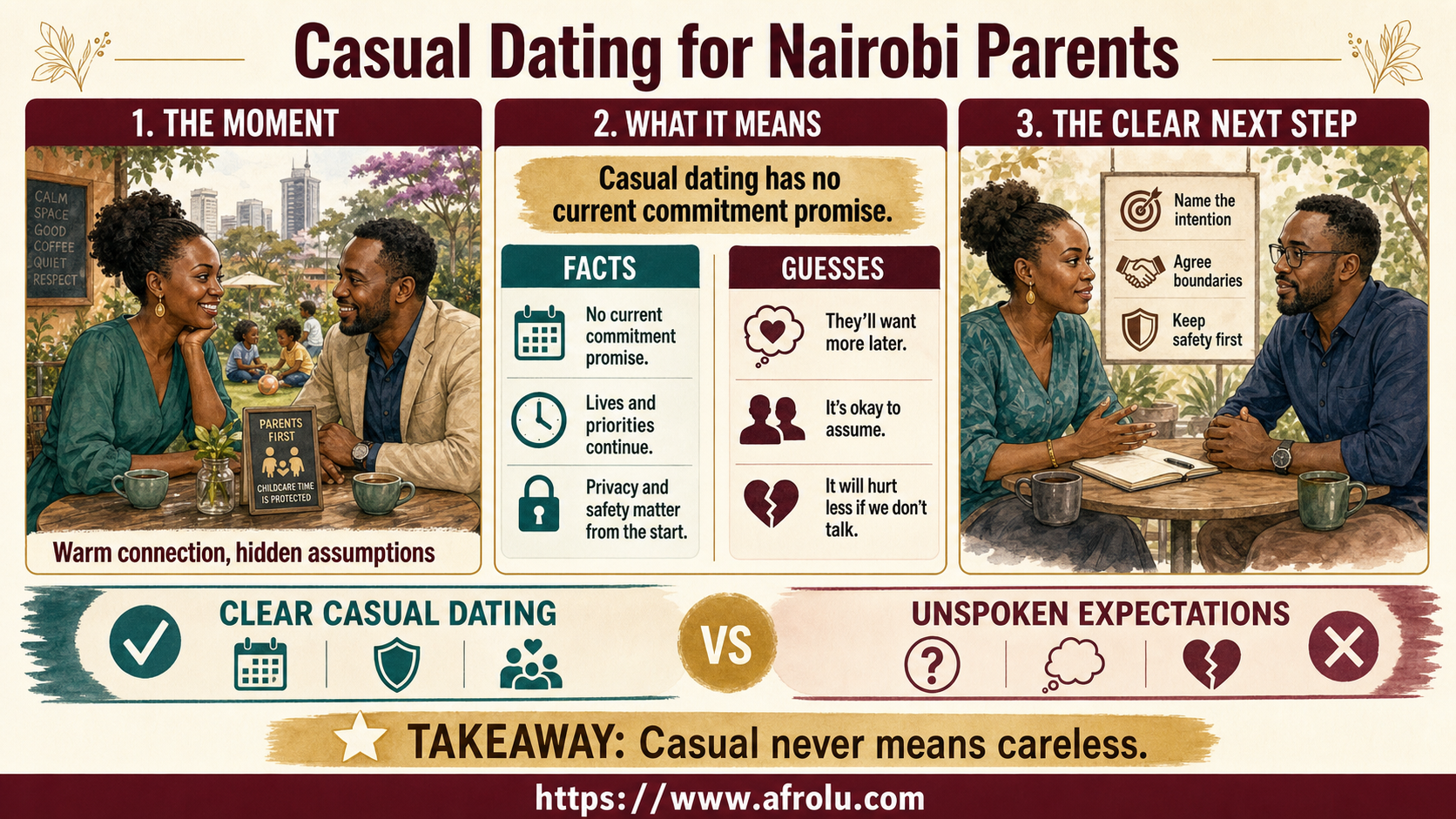
A casual connection can fit a Nairobi parent's life when the adults name the arrangement, confirm plans before childcare is paid for, and keep children outside early uncertainty. Casual does not automatically mean non-exclusive, available at short notice, or ready for family access. Decide what is true now, then let any larger role be earned slowly.
Dating styles · Parents Returning To Dating
What casual agreement fits without involving children in adult uncertainty?
For a parent, casual dating is an adult agreement about the present relationship. It may allow affection, regular dates, and honest interest without a promise of partnership or a role in family life. The agreement must still cover other partners, sexual-health choices, contact, cancellations, privacy, and how either person can end it. A child's routine is not part of that agreement until trust and commitment justify a separate family decision.
Mumbi enjoys seeing Daniel twice a month. Their evenings feel easy, but every date requires a sitter, transport, and a clear return time. Daniel often confirms on Saturday afternoon. Mumbi used to pay the sitter on Friday and hope the plan would happen. After two late cancellations, she changes the rule: no confirmed time and public venue by Thursday evening means she keeps the weekend for herself and her daughter. She is not asking Daniel to become a partner. She is making casual dating fit the real cost of her life.
The household test
Judge the arrangement by its cost to ordinary family life
Chemistry is only one part of a parent's decision. A workable connection also respects planning time, privacy, money, sleep, and the emotional boundary around children.
Read each choice through three questions: what have the adults actually agreed, what does this plan cost the household, and has the other person earned the access they are requesting?
A late plan has a real price
Childcare cannot be treated like an invisible detail. A confirmation deadline makes the cost visible.
Curiosity is not family access
A new date does not need a home address, school name, photographs, or a child's routine.
Warmth is not step-parenting
A pleasant connection can remain adult-only. A family role requires a separate, slower decision.
Reliability shows after disruption
Everyone cancels sometimes. Notice whether the person acknowledges the cost and proposes a usable alternative.
Planning reality
Count the hidden work before calling a date low pressure
A two-hour date may require a sitter, a meal prepared in advance, transport, and a firm return time. A casual label does not erase that work.
Use a confirmation deadline that matches the household. Someone who respects the arrangement will either make a plan or release it cleanly.
Repeated late invitations are not made harmless by charm. They may simply be incompatible with parenting life.

Pause, name the rhythm and agree.
Access ladder
Let each kind of access arrive at its own pace
Phone contact, adult dates, home access, child information, and a family role are five different levels. One does not automatically unlock the next.
Early dating can stay public and adult-only. Later commitment may justify broader conversations, but only after identity, conduct, and consistency have been observed.
This ladder protects children from unstable introductions and gives the adults room to decide without performance pressure.

A clear adult plan protects family stability.
Clear language
Say the logistical truth before resentment builds
A parent does not need to pretend to be endlessly flexible. Name sitter deadlines, preferred contact windows, and cancellation expectations before a pattern forms.
Keep the sentence about your decision: what you need, what you will do, and what alternative remains available.
A respectful date may not share every preference, but they will not punish you for protecting your household.

Clear plans reduce stress for everyone.
Review point
Change the agreement before changing the role
If casual dating begins to feel serious, pause before adding family access. Discuss exclusivity, time, public commitment, and conflict repair as adult subjects first.
A child meeting should follow established trust, not create it. It is not a romantic milestone to use for reassurance.
If the adults want different futures, a kind ending protects the family better than an indefinite half-role.

A small agreement protects a full life.
Three ways this can show up
The Thursday deadline
Amina's date keeps saying Saturday should work but will not choose a time. She explains that her sitter must be booked by Thursday. When no confirmation arrives, she releases the plan without argument.
Treat an unconfirmed plan as unavailable; do not pay to preserve someone else's option.The convenient pickup
Kamau offers to collect Wanjiku from home on their second date. She likes the gesture but is not ready to reveal where her children live. She suggests a busy cafe near a transport stop instead.
Choose a public meeting point until home access has a clear, earned reason.The quick introduction
After four enjoyable dates, a match asks to join a family outing. The parent says the children are not part of early dating and offers another adult-only plan.
Do not make a child introduction a reward, test, or shortcut to seriousness.Casual no longer fits
Two adults begin casually, but one now wants exclusivity and regular family time. They discuss the change before increasing access. The other person is free to decline.
Replace the old agreement openly; do not let extra closeness silently rewrite it.What to notice before you react
Plans are confirmed early enough for childcare and transport decisions.
A date accepts that home, school, and co-parenting details stay private.
Neither adult treats frequent dates as an unspoken family commitment.
Cancellations include an apology and a practical repair, not only a new promise.
Questions about exclusivity are answered directly instead of through jealousy.
A possible child introduction is discussed only after adult trust has become steady.
Read the moment without overbuilding the story
| Situation | What it may mean | What to do next |
|---|---|---|
| The date is still vague when the sitter deadline arrives | The person may be disorganised or keeping options open; either way, the plan is not usable. | Release the evening and require earlier confirmation next time. |
| A match asks for school, home, or co-parent details | Interest has moved beyond the access earned so far. | Keep the information private and offer only what the date needs. |
| Frequent dates create jealousy about other people | The casual structure is no longer understood in the same way. | Ask directly about exclusivity, disclosure, and whether the arrangement should change. |
| Both adults want a committed partnership | The connection may be ready for a new agreement, not an assumed promotion. | Discuss commitment first; plan any family introduction separately and slowly. |
Three calm ways to start the conversation
“I book childcare by Thursday. If we do not have a time and place by then, I will keep Saturday free.”
“I keep my home and my child's routine private while I am getting to know someone. Let us meet at the cafe.”
“I enjoy seeing you. Are we still dating casually, and are either of us dating other people?”
“I am not introducing anyone to my child at this stage. We can keep learning about each other as adults.”
Know the difference
Casual dating vs family integration
The adults share agreed dates and affection without a family role.
A trusted partner begins entering routines, relationships, and responsibilities around children.
Move between these stages through deliberate adult agreement and child-aware planning, not through convenience.

Name it, protect home and review.
Compare the closest dating types before choosing a label
| Type or dimension | What it describes | Best next question |
|---|---|---|
| Casual dating | Defines the adults' present romantic commitment. | What have we agreed about exclusivity, contact, and endings? |
| Exclusive dating | Stops romantic dating with others but does not create a parenting role. | What changes for us, and what still stays separate? |
| Committed partnership | Adds a wider mutual promise and future planning. | How do we handle time, conflict, family privacy, and public commitment? |
| Family integration | Introduces a partner into a child's real routines and relationships. | Why is this right for the child now, and how will we pace it? |
A simple plan you can use today
Write the adult agreement
Name exclusivity, contact, sexual-health disclosure, cancellations, and endings in ordinary words.
Set the sitter deadline
Choose the latest time a plan can be confirmed without costing the household money or calm.
Keep early dates public
Use neutral meeting points and independent transport while home and family information remain private.
Separate affection from role
Enjoy closeness without treating it as permission to enter a child's daily life.
Review after behaviour changes
Talk again when jealousy, frequency, commitment wishes, or family-access requests alter the original fit.
Four mistakes that make this harder
Paying for uncertainty
Booking childcare for an unconfirmed plan transfers the other person's indecision into the household budget.
Using home as convenience
An early home date reveals family information and makes a clean exit harder.
Introducing children to test chemistry
The child becomes part of an adult experiment before trust and direction are known.
Assuming frequency means commitment
Regular dates can feel serious while the actual agreement remains casual and unclear.
Use a reviewed resource that matches the decision
This guide focuses on the relationship decision, so it does not rank dating apps. Check current prices, safety tools, and local availability before choosing a service.
Explore the guide library
Show more related guides
Continue with Afrolu
Show more Afrolu guides
Sources used for this guide
Afrolu reviewed these health, research, safety, or public guidance resources while editing this page. They support the behaviour and safety guidance; they do not diagnose any individual described by a reader.
A Clear Casual Dating Agreement for Nairobi Parents Questions
Does casual dating mean non-exclusive dating?
No. Casual describes a level of commitment, but exclusivity is a separate agreement. Ask whether either adult is dating other people and what disclosure is needed for informed choices.
When should a casual date meet my child?
There is no universal date count. Wait until identity, reliability, adult commitment, and the reason for the introduction are clear. Consider the child's age and any co-parenting agreement.
Is a confirmation deadline too strict?
Not when childcare or transport must be arranged. Explain the practical reason and choose a deadline that lets both adults plan fairly.
Should my casual date know where I live?
Not early by default. Meet publicly and share home information only when trust and the purpose for access justify it.
Can casual dating become a committed relationship?
Yes, but extra time together does not make the change automatically. Discuss exclusivity, expectations, family boundaries, and the future before acting as though the new agreement exists.
What if my date cancels after I paid a sitter?
Name the impact and change the planning rule. Look for acknowledgment and practical repair. Repeated disregard may make the connection incompatible with parenting life.
Do I need to explain everything about my co-parent?
No. Share only what affects scheduling, safety, or the agreement. Private conflict and identifying details do not belong in early dating.
How do I end the arrangement kindly?
Be direct and brief: the arrangement no longer fits your life, so you are ending it. Do not use a child as the excuse or invite negotiation you do not want.
One thing to do now
Turn the lesson into a better match pool
Protect the household before protecting the date. Confirm the plan before spending on childcare, meet away from home, and do not use a child's introduction to test romantic potential. If the connection grows, make a new adult agreement first; family access comes later and for a different reason.