New daters · serious long-distance reality check
Serious Long-Distance Dating Red Flags for New Daters
Serious long-distance dating red flags: verify identity, plan independent visits, protect money and privacy, and spot pressure before trust outruns evidence.

A future plan earns trust through present choices.
Written and edited by Tariro Ncube · Diaspora Dating Editor
A serious long-distance relationship can grow gradually. Keep verification reciprocal, arrange travel and lodging independently, separate money and private data from romance, use a sustainable call rhythm, and watch the response to one clear boundary. Repeated avoidance, a rushed visit, financial urgency, secret plans, image pressure, monitoring, unwanted contact, coercion, or fear deserve less access and a safety-led response.
Dating safety · New Relationship Starters
Is this serious long-distance connection building enough shared reality for the next step, or are future promises, travel, money, secrecy, digital access, pressure, or fear asking you to outrun the evidence?
Serious long-distance dating red flags are observable behaviours that make identity, travel, money, privacy, consent, time, or an exit less freely chosen. They can include recurring verification avoidance, rushed commitment, travel leverage, financial requests, secret itineraries, boundary bargaining, monitoring, unwanted contact, coercion, threats, or fear. The phrase describes conduct and its effect on choice, not a diagnosis or a verdict on distance itself.
Asha is new to dating and excited by a relationship that seems serious across distance. Before booking a visit, she notices that every ordinary video call is replaced by a future promise and that an urgent ticket request arrives after a warm conversation. She keeps the visit independent, declines money, and decides from the next practical response whether the connection can grow in reality.
new daters · serious long-distance reality check
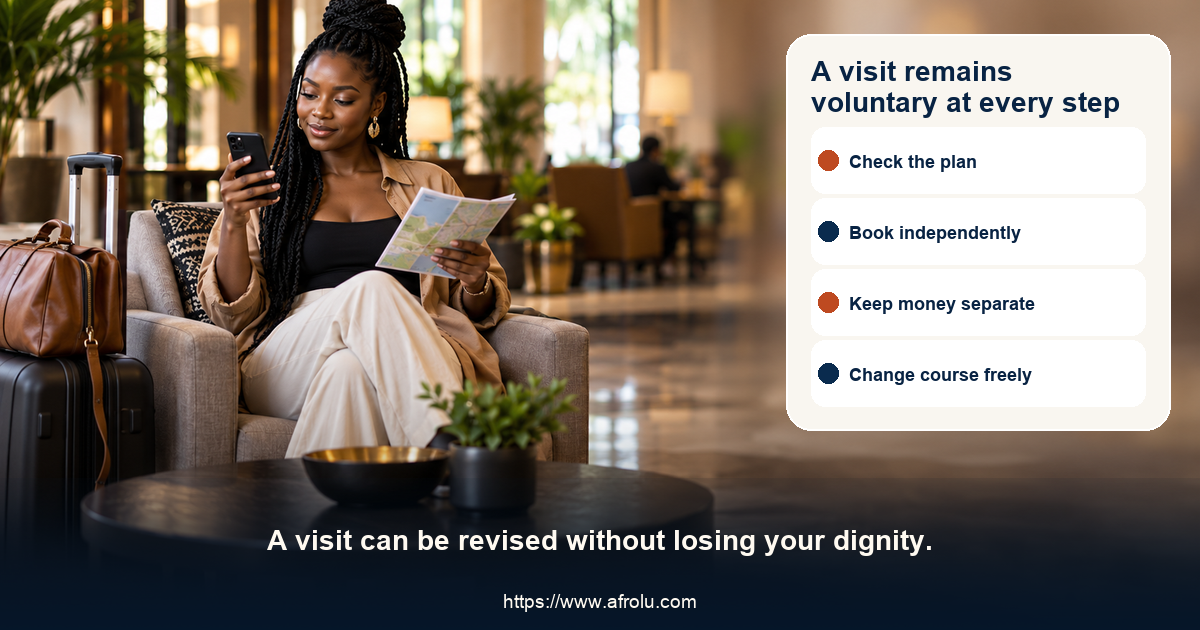
Asha keeps serious intent connected to evidence, independent movement, and a free exit
This guide separates ordinary long-distance logistics from patterns that make a new dater’s money, travel, privacy, body, time, or ending less freely chosen.
Name the present offer, verify proportionately, design independent visits, keep money and data separate, read the first boundary, end at the level of risk, and make the next move evidence-sized.
Future talk needs present facts
A serious wish can be genuine without becoming an urgent test of trust.
Keep movement independent
Separate travel, lodging, money, and a route home leave consent possible.
Read the response
A compatible person can tolerate a slower plan and a plain no.
Match action to risk
Clarify a mismatch; reduce access or seek support when pressure or fear appears.
distance is a circumstance, not evidence
Serious language cannot replace the ordinary work of getting to know someone
When a connection begins across cities or countries, it is easy to mistake intensity for knowledge. Long calls, affectionate messages, shared playlists, daily check-ins, and talk of a future visit can be real parts of a growing relationship. They are not, by themselves, proof that a person is who they say they are, that their practical story is stable, or that their promised commitment has room for your choices.
Serious intent is most useful when it is described in present-tense terms. Ask what each person is open to now, how they want to communicate, whether they are seeing others, what a first visit would require, and what would make either person slow down. A person may not have every answer early. The concern is not uncertainty; it is using a distant future to avoid every ordinary question in the present.
Distance also magnifies the temptation to fill gaps with optimism or fear. One missed video call can have a routine explanation. A repeated pattern of avoiding basic verification, changing core facts, refusing workable alternatives, or insisting that doubt is betrayal deserves a pause. You do not need to diagnose the person or disprove every story. You only need to decide what evidence you require before increasing access.
A serious relationship can unfold gradually. You can keep your existing routines, tell a trusted person about a travel plan, meet through a format that lets you leave independently, and revise the pace when new information appears. The goal is not to turn dating into an investigation. It is to keep affection, curiosity, money, privacy, consent, and movement under your own control while trust is being earned.
verify in proportion to the plan
Use small, reciprocal reality checks before a larger promise changes your risk
Start with ordinary consistency. Does the person keep a planned call, explain a genuine change without turning it into drama, and speak about their daily life in ways that remain coherent over time? Do they use a live conversation when that is reasonable, rather than endlessly relying on polished photographs or messages? A person can value privacy and still offer enough reciprocal reality for you to choose a next step.
Keep verification narrow and reciprocal. A video chat, a public first meeting, a separate booking, or a conversation about a visit can be useful. Passwords, identity documents, banking screens, live location, employment records, or invasive searches are not a substitute for trust. If someone requests those things from you, or frames refusal as evidence of disloyalty, the issue has shifted from reasonable reassurance to control or extraction.
Take note when a person has a solution only if you surrender more. Perhaps they cannot video call but demand a flight payment; cannot meet publicly but want your hotel details; cannot answer a basic question but want a promise of exclusivity; or cannot keep a call but wants you to prove confidence in them. Each fact may have an explanation. The pattern matters because it repeatedly makes your choice depend on taking the larger risk.
Independent checking is most useful when it does not alert a person who may react badly. Compare the practical details they volunteer, talk to a trusted person who can hear the story without romantic momentum, and use official channels for travel or money questions rather than a link sent by a match. If you feel pressured, confused, or afraid, you do not need one more verification task. You can simply make the plan smaller or end it.

Let the pattern decide the next level of access.
treat a first visit as two adults making logistics
A visit should preserve a separate place to sleep, leave, pay, and change your mind
Before a first in-person meeting, choose a plan that does not require either adult to become dependent on the other person’s address, transport, ticket, or mood. A public daytime meeting, independently arranged travel, separate lodging when practical, a return route you control, and enough money to alter the plan are ordinary safeguards. They create room for chemistry to be discovered without making politeness your only exit.
Do not treat a costly booking as a reason to ignore new information. If a person becomes angry when you choose a hotel, asks you to keep the visit secret, changes a public plan to a private one after you arrive, or says that travel proves you owe time or intimacy, the plan is no longer simply inconvenient. You can leave, change accommodation, contact a trusted person, or cancel the meeting without converting your discomfort into a debate.
Talk about consent before logistics obscure it. A visit does not promise a sleepover, sex, shared transport, alcohol, photographs, or access to a room. Both people can welcome a trip and still make separate choices at every point. A considerate person may feel disappointed by a limit but will not use fatigue, money spent, immigration paperwork, a visa story, or their own travel effort to turn a no into something you must soften.
If a visit cannot be planned without a rushed transfer, a secret itinerary, a private pickup, a shared room, or dependence on a person you do not yet know well, that is useful information. You can postpone. Serious interest that is compatible with you can survive a slower, safer meeting. A plan that collapses when you retain an independent route home may be asking for access rather than offering partnership.
keep money and private data outside the relationship test
A distance story never makes a transfer, code, document, or account request your responsibility
A request for help with a ticket, visa, hospital bill, parcel, investment, account recovery, mobile transfer, cryptocurrency, or exchange rate is not a normal proof of commitment. There may be real difficulties in the world, but a new long-distance connection is not the place to solve them with your money or identity. Do not send, receive, lend, invest, forward, or hold funds for someone you have met online or barely know in person.
Keep your digital life layered too. A person may know your broad field of work without knowing your employer address, schedule, salary, security questions, travel booking reference, banking app, home location, or family members’ details. Avoid links sent to verify a flight or account, and do not share a code that arrived on your phone. A relationship cannot make a risky request safer by attaching it to a tender message.
Be especially careful with stories that turn a practical obstacle into a moral emergency. Someone may say that a payment is the only barrier to a future together, or that keeping the request private proves loyalty. Your answer can be simple: you do not handle money, documents, or account access for a dating connection. A respectful person can hear that limit without shaming you, escalating the story, or bringing in another supposed crisis.
If you have already sent money or data and suspect fraud, acting quickly can matter. Contact the relevant bank, payment provider, platform, or official reporting route and tell a trusted person rather than trying to recover the relationship privately. If the concern includes threats, monitoring, blackmail, unwanted sexual material, repeated contact, or fear, focus on safety and support instead of negotiating with the person who is causing the pressure.
read the response to a reasonable boundary
A relationship can be serious without becoming urgent, exclusive, private, or physically close on demand
Try a small boundary that matches the moment: a shorter call, a later visit, a public meeting, no shared booking, no intimate images, no money, no location sharing, or a week to think. Notice what happens. A compatible person may ask a question or share disappointment, but they leave the decision with you. They do not turn a pause into proof that you are incapable of serious love.
Pressure can wear a romantic costume. It may sound like instant soul-mate language, constant calls that make ordinary work or sleep difficult, claims that only secrecy protects the relationship, or a demand to define a future before a basic fact is stable. It can also sound more polished: a lecture about how mature adults take risks, a comparison with an ex, or a promise that your concerns will vanish once you commit. The outcome is the same if your no keeps shrinking.
Distinguish disappointment from punishment. A person can say that a slower pace is not for them and end the connection respectfully. That is compatibility information. A person who withdraws affection, insults you, threatens to cancel plans you paid for, contacts people around you, uses new accounts after a block, or keeps bargaining for access is responding to your choice as a problem to overcome rather than a decision to respect.
Keep a record only if it is safe and useful, especially when there are repeated messages, threatening statements, changed accounts, image pressure, or unexpected approaches near a planned trip. Tell someone who can support you without trying to take over. You do not need to produce a perfect file before you reduce contact, change a plan, block an account, or seek local help. Fear is enough reason to choose a protected exit.

A clear boundary does not need a long defence.
end a distant connection at the level of risk
A concise message can close an ordinary mismatch; pressure may require no further conversation
For an ordinary mismatch, a direct sentence is enough: “I do not want to continue this relationship, and I wish you well.” You can send it by message and decline a final video call. You do not have to diagnose the other person, justify every concern, or leave the door open for them to prove that you misunderstood. A short ending is not cruel when it is the clearest way to stop a connection.
When the concern is a recurring pattern, name only what helps you hold the boundary. “I am not continuing a relationship that asks me to rush visits and money decisions” is sufficient. Do not argue about intentions, compare screenshots, or accept a new promise as payment for staying. Repeated explanations often give a pressuring person more phrases to negotiate rather than more information to understand.
If a visit is pending, make your own travel and accommodation changes before you announce details to the other person when that feels safer. Do not share your updated hotel, flight, or route. Let a trusted person know where you are, and use venue or travel staff if you need immediate assistance. A person who was genuine can cope with a changed plan; safety does not require their approval.
Where threats, stalking, coercion, sexual pressure, financial exploitation, blackmail, or fear appear, stop treating the situation as a relationship discussion. Preserve what is safe to preserve, use platform reporting tools, avoid meeting alone, tell trusted people not to share your information, and seek urgent local support when needed. The goal is not to win the narrative. It is to restore your ability to move, communicate, and rest without being watched or pressured.

Choose the move that gives tomorrow back to you.
make the next step evidence-sized
A serious long-distance connection should make both adults more able to choose, not less
After a few weeks or a first visit, ask concrete questions. Can I ask a reasonable question without being punished? Does the person’s story stay coherent enough for the next practical plan? Can I keep money and private information separate? Do I control my transport and accommodation? Can I say no to sex, images, or an extra day without managing a crisis? These are relationship-quality questions, not signs that you are incapable of trust.
Notice the difference between a logistical complication and a pattern that reduces your options. A delayed call, a changed work shift, or a postponed visit can be manageable when it is communicated and repaired. Repeated inability to verify, sudden emergencies that require your money, pressure to hide, anger at independent travel, surveillance, or fear require a more protective response. The right move depends on the fact, not on the romance of the story.
Choose one action you can carry out today. That might be asking for a video conversation, booking your own lodging, declining a financial request, moving a visit later, telling a friend, taking a break from the app, ending contact, or contacting a relevant support service. Smaller actions are not failures of courage. They let you see whether a connection can meet you in reality without demanding that you gamble your safety for certainty.
Long distance can make a relationship more deliberate, not more precarious, when both people welcome gradual knowledge and independent choice. You are allowed to be hopeful and careful at the same time. A serious intention worth pursuing will not require you to become less private, less solvent, less rested, less connected to support, or less free to leave in order to prove you mean it.
Eight serious long-distance dating moments
Calls never become live conversation
A match sends polished photographs and affectionate voice notes but repeatedly cancels a short video call, then says a serious person should stop asking.
Keep the pace small and decline travel or exclusivity until ordinary reciprocal verification is possible.A visit depends on a transfer today
After weeks of future talk, a person says a ticket, visa fee, or emergency clinic bill is the final obstacle to meeting and asks for private help.
Do not send money or codes; use an independent official channel for any concern and step away from financial pressure.Travel is framed as proof of intimacy
A date says a separate hotel is wasteful and that a long trip means they should stay in the same room.
Book independently or postpone; travel never settles lodging, touch, sex, or an overnight plan.Your sleep becomes a loyalty measure
A person expects daily calls at hours that disrupt work and rest, then sulks when you choose a sustainable time.
Name a realistic rhythm once and notice whether they can respect a life that is not organised around the relationship.A work shift changes a call
A match gives a timely, specific update, offers a new time, and follows through without asking for extra access.
Treat this as a normal logistical fact and decide whether the revised rhythm works for you.A meetup must remain secret
Someone asks you not to tell anyone about a visit and requests your hotel, flight, and arrival details before you are ready.
Keep plans visible to trusted support and do not share travel details that make you easier to locate.A boundary changes the plan
After assuming a sleepover, the person hears your no, apologises without bargaining, and revises the day around separate transport and lodging.
Observe the changed conduct before increasing access; a repair is useful evidence, not a guarantee.An ending is bypassed
After you end contact, the person uses a different profile to ask why you will not give them one final chance before a planned trip.
Do not reopen the discussion; block, preserve concerning contact if safe, and seek support if it continues.Signals about verification, visits, money, privacy, consent, pacing, and exits
They can name a present intention without demanding a future promise before basic facts are clear.
They can use a reasonable live conversation or public meeting without treating it as an accusation.
They respect separately arranged travel, lodging, money, and a route home.
They accept that a trip does not imply sex, a shared room, alcohol, photographs, or constant access.
They communicate a changed plan in time and offer a workable alternative.
They do not make a ticket, visa, medical story, investment, or family emergency your financial responsibility.
They do not request codes, documents, passwords, account recovery details, banking screens, or live location.
They accept a sustainable call rhythm without measuring affection by lost sleep or missed work.
They do not make secrecy the price of a relationship or a visit.
They can hear a pause, a later visit, or a public plan without insults, guilt, or cold withdrawal.
They do not convert disappointment into bargaining, tracking, threats, or contact through new accounts.
They distinguish an ordinary logistical delay from a demand that you take a larger risk.
They make a repair visible in the next plan instead of using an apology to accelerate trust.
They leave you able to ask questions, change plans, speak to trusted people, and end contact without fear.
Choose a proportionate next move
| Situation | What it may mean | What to do next |
|---|---|---|
| A call is postponed once | A work or family conflict can be ordinary when it is communicated and a new plan is kept. | Accept the update or decide whether the timing suits you; do not invent a motive. |
| Video verification is avoided repeatedly | Privacy may matter, yet an ongoing refusal can leave a planned visit without enough shared reality. | Keep access small and do not travel, pay, or promise exclusivity before a workable alternative exists. |
| They request ticket or visa money | Urgency may be a scam or simply a financial risk that is not yours to carry. | Do not transfer, lend, receive, invest, or share account information. |
| They want shared lodging | Preference is not consent and a long trip can make leaving harder. | Arrange separate accommodation or postpone the visit. |
| They insist on daily late-night calls | Different schedules can be incompatible; guilt around rest can be pressure. | Offer a sustainable rhythm once and step back if it is punished. |
| A plan becomes secret | Privacy can be different from isolation; secrecy can reduce your support and options. | Tell trusted people the broad plan and do not share personal travel details with the date. |
| They apologise for a boundary cross | An apology has value only when the next plan changes. | State the practical limit and observe action before increasing trust. |
| They ask for intimate images | A request can be declined; repeat pressure changes the issue. | Keep images private and make the channel smaller if the no is negotiated. |
| They contact you after a clear ending | One message may be disappointment; repeated or indirect contact can be a boundary bypass. | Do not debate; block, document if safe, and tell support people not to share details. |
| You feel afraid or cannot leave freely | The question has moved beyond relationship pace to immediate safety. | Use an independent exit and urgent local support rather than another relationship conversation. |
Twelve lines for calls, travel, money, privacy, consent, and ending
“I am open to serious dating, and I want our next step to be clear before we make a bigger promise.”
“A short live conversation would help me decide whether to plan a visit. If that does not work, I am slowing down.”
“If we meet, I will arrange my own travel and place to stay.”
“A trip does not mean I am agreeing to share a room or stay overnight.”
“I do not send money, use payment links, share codes, or handle transfers in a dating connection.”
“I can share a broad plan, but I am not sharing my hotel, full schedule, or private documents.”
“I enjoy talking to you, and I need a schedule that leaves room for sleep and work.”
“I do not build a relationship that requires me to hide a visit from people I trust.”
“I am happy to meet, and I am not agreeing to that part of the plan.”
“I heard the apology. I need the next plan to respect the boundary I named.”
“This pace and level of access do not work for me, so I am not continuing.”
“I asked for no further contact. Do not use another account or other people to reach me.”
Know the difference
A delay, a practical mismatch, mounting pressure, and fear need different long-distance responses
A person can communicate a changed call, offer reciprocal verification, respect independent travel and lodging, keep money and data separate, accept a current no, and alter the next plan after impact is named.
Repeated avoidance, rushed future talk, secret visits, travel leverage, financial urgency, demanded images, monitoring, unwanted contact, coercion, threats, or fear turn distance into a claim on access.
The romance of distance does not decide the risk. The observed pattern and your freedom to choose do.

The future promise does not decide the risk; the pattern and freedom do.
Separate a logistical change, a mismatch, pressure, and fear
| Type or dimension | What it describes | Best next question |
|---|---|---|
| A delayed call | A change is explained, a new time is offered, and the person keeps it. | Decide whether the rhythm works without assuming dishonesty. |
| Verification avoidance | Basic reality checks are continually replaced with demands for more trust or more access. | Do not increase travel, money, intimacy, or promises. |
| A planned visit | Both adults retain independent travel, lodging, payment, consent, and an exit. | Confirm the practical details before going. |
| Travel leverage | The cost or distance of a trip is used to claim a room, sex, secrecy, or more time. | Change or cancel the plan and restore independence. |
| A future conversation | Two adults describe a possibility while allowing uncertainty and slower evidence. | Keep the next step modest and reciprocal. |
| Urgent commitment | A far-off promise is used to bypass basic questions, verification, or present boundaries. | Return to what is observable today. |
| Generosity | A gift or plan is offered without creating a debt or a private obligation. | Accept, split, or decline freely. |
| Financial extraction | A transfer, code, document, investment, or payment link is framed as love or rescue. | Keep money and accounts entirely separate. |
| A safety concern | Threats, stalking, coercion, image pressure, repeated unwanted contact, or fear appears. | Use a protected exit and relevant local support. |
Start with a serious intention that still leaves room for reality
Let intent stay present-tense
A serious wish can be named without forcing a future guarantee before there is enough shared reality.
Verify without surveillance
Use reciprocal calls and practical plans, not documents, passwords, tracking, or invasive proof.
Design an independent visit
Control your own booking, lodging, return route, money, and ability to change your mind.
Keep money outside romance
A ticket, emergency, investment, transfer, or account request never becomes safer through affection.
Read the first boundary
Disappointment can be ordinary; bargaining, guilt, tracking, and fear are different information.
Make exits practical
A short ending, separate travel details, support people, and a smaller communication channel can restore choice.
Questions organised by purpose and depth
Choose a few prompts that fit the moment. This is a reference library, not a list to complete.
Before a deeper promise
Keep future talk connected to present facts.
- What do we each mean by serious right now?
- What evidence would make the next step feel proportionate?
- What would I keep independent for now?
Before a first visit
Design the logistics before the romance of the trip decides them.
- Who controls transport and lodging?
- Can either person leave without a social penalty?
- Who knows the broad plan and check-in time?
When money enters
Use a firm financial pause.
- Is this my responsibility to solve?
- Would I make this transfer without a dating story attached?
- Which independent official channel could verify the claim?
When the pace feels wrong
Use one clear boundary before adding access.
- What exact plan do I want to slow or decline?
- What response would show respect?
- Would a smaller next step restore my freedom?
Look more closely at reality, verification, travel, money, pressure, and endings
Future talk needs a present plan
Discuss the next call, current scope, first meeting, travel conditions, privacy, money, and what each person can genuinely offer now.
Evidence limit: No guide can establish another person’s intent with certainty.
Use evidence that fits the risk
A live conversation, public meeting, coherent details, and independent arrangements can support a decision without demanding invasive proof.
Evidence limit: A reasonable check should never become tracking, document collection, or a substitute for judgment.
Independence changes the quality of consent
Separate bookings, money, accommodation, and a route home mean either adult can revise a visit without negotiating their safety.
Evidence limit: Local conditions and personal circumstances may require additional planning.
Romance does not make financial risk mutual
Decline payment, investment, ticket, visa, transfer, account, document, and code requests, then use independent official sources if help is needed.
Evidence limit: A concerning request is not proof that every distant dater is a scammer.
The first no is useful data
Notice whether a person accepts a later visit, public plan, separate room, slower call rhythm, or no to images without turning it into a loyalty test.
Evidence limit: One uncomfortable interaction can sometimes be repaired; repeated pressure changes the pattern.
Risk determines how much contact is useful
Use a clear short close for mismatch and a support-led route when unwanted contact, threats, stalking, coercion, or fear appear.
Evidence limit: Blocking alone may not resolve every safety concern.
Shortcuts that make a distant relationship less freely chosen
Treating distance as evidence of devotion
Distance changes logistics; it does not prove identity, compatibility, or a right to faster trust.
Making a costly trip the test
A booking can make it harder to leave but never makes intimacy, secrecy, or a shared room owed.
Offering money to solve uncertainty
Transfers and payment details create financial risk without resolving whether a person is trustworthy.
Sharing an itinerary to appear open
Travel details can be layered while a relationship is still unproven.
Explaining every boundary
A concise no leaves fewer openings for someone to negotiate the limit.
Seeking a final call when fear is present
More contact can increase access and pressure when a protected exit is the safer choice.
Choose one resource that fits the practical fact in front of you
Use a slower dating guide to gather evidence, a long-distance resource to plan logistics, or a boundary guide when more access would make your next step less freely chosen.
Explore the guide library
Show more related guides
Continue with Afrolu
Show more Afrolu guides
Sources used for this guide
Afrolu reviewed these health, research, safety, or public guidance resources while editing this page. They support the behaviour and safety guidance; they do not diagnose any individual described by a reader.
Questions about serious long-distance dating red flags
Can I want a serious long-distance relationship and still move slowly?
Yes. Serious intent can be expressed through a present plan, clear communication, and reciprocal evidence rather than an urgent promise or risky visit.
Is refusing a video call always a red flag?
Not automatically. Privacy, disability, work, or confidence may shape a person’s preference. Repeated avoidance combined with pressure for travel, money, or trust is more concerning.
Should I pay for a date’s ticket or visa fee?
No. Do not send, lend, receive, or invest money for an online or new dating connection. Use independent official channels if a story needs checking.
Do I need to share my hotel or flight details?
No. You can give a broad plan to a trusted person while keeping precise travel, lodging, and return details private from a new date.
Does a visit imply a shared room or sex?
No. Travel, expense, affection, and a prior conversation do not replace a current freely chosen yes to any specific plan.
What if someone says separate lodging means I do not trust them?
Their preference may be incompatible, but separate lodging is a reasonable way to preserve choice. You do not need to trade independence for reassurance.
How much contact is reasonable across time zones?
There is no universal amount. Choose a rhythm that leaves room for sleep, work, relationships, and rest, then see whether it can be respected.
What if a person repeatedly changes their story?
You do not need to prove deception. Pause a larger plan, ask one practical question if useful, and decide whether the available information supports continuing.
Can I end a long-distance relationship by message?
Yes. A concise message can close an ordinary mismatch. Choose less direct contact if a call, visit, or detailed explanation could create pressure or fear.
When should I seek outside support?
Seek urgent or specialist local support when there are threats, stalking, coercion, unwanted sexual contact, financial exploitation, image abuse, repeated unwanted contact, or fear.
One thing to do now
Let serious intent grow through evidence rather than urgency
Choose the smallest next action that preserves reciprocal evidence, independent travel, current consent, money and data boundaries, sustainable time, trusted support, and a genuine ability to change or end the plan.